rile*books

Search books

Search books by title, author, publisher, keywords...

Cover of Cancelled Confessions (or Disavowals)

Siglio Press

Cancelled Confessions (or Disavowals)

Claude Cahun

€36.00

First published in 1930 by anti-fascist, avant-garde publisher Éditions du Carrefour in Paris as Aveux non Avenus, Cancelled Confessions (or Disavowals) is Claude Cahun’s wildly radical answer to an invitation to write a memoir. Shattering the very premise of the “memoir”—the singularity of identity—into sharp and prismatic fragments, Cahun assembles an ever-mutating inquiry into the instability of “self” and its many masks.

Masculine? Feminine? It depends on the situation. Neuter is the only gender that always suits me.

Using a multitude of forms (fables, jokes, aphorisms, letters, dialogues, dreams, hymns, pronouncements, etc.), to plumb the subjects of desire, love, gender, sex, fear, faith, religion, and vanity (among others), Cancelled Confessions (or Disavowals) is a tour-de-force work of resistance: it provokes the reader to enter the capacious, provocative, playful, and deeply imaginative space constructed by Cahun in defiance of all categorization, to repudiate a delimited, censured world and embrace, instead, the outcasts and cast-offs, the unknowable and the unknown.

I believe, but in the conditional: I would like to believe.

Thoughtfully redesigned to emulate the original artist’s book, this revised edition of the out-of-print English translation by Susan de Muth—originally published in the UK by the Tate in 2007 and in the U.S. by MIT Press in 2008—includes novelist and critic Pierre Mac Orlan’s original 1930 preface along with contemporary essays by scholar Amelia Groom and translator de Muth. Almost 100-years-old, it is not only prescient, but urgent, in.

It’s not enough to be vanquished, you also have to know how to turn defeat to your advantage.

Translated by Susan de Muth, preface by Pierre Mac Orlan, essay by Amelia Groom.

Published in 2025 ┊ 272 pages ┊ Language: English

recommendations

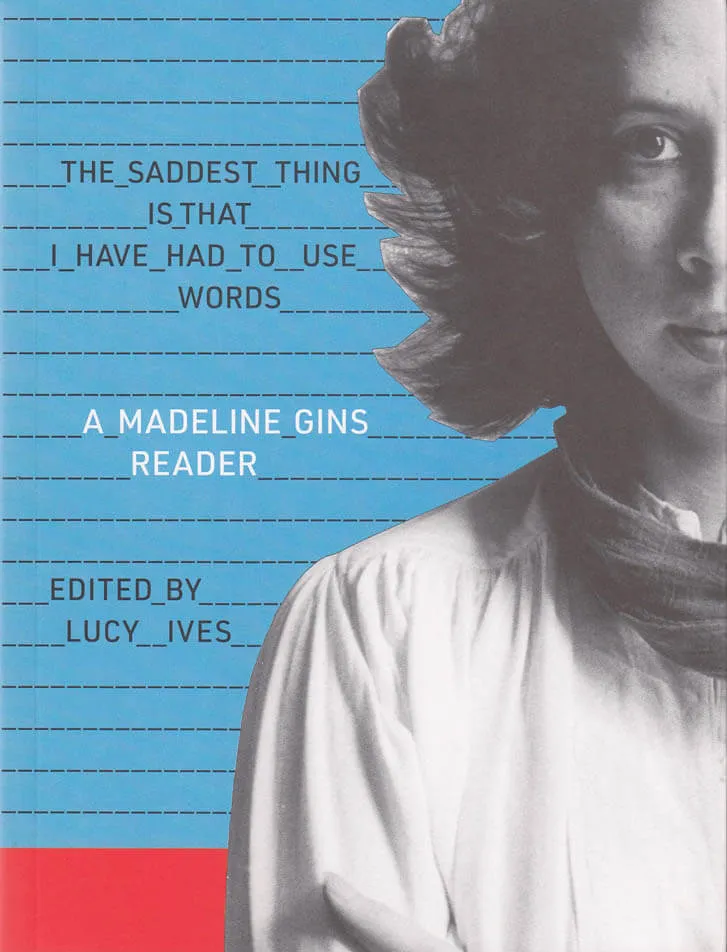
Cover of The Saddest Thing Is That I Have Had to Use Words: A Madeline Gins Reader

Siglio Press

The Saddest Thing Is That I Have Had to Use Words: A Madeline Gins Reader

Madeline Gins

Poetry €28.00

Poet, philosopher, speculative architect and transdisciplinary artist, Madeline Gins is well known for her collaborations with her husband, the artist Arakawa, on the experimental architectural project Reversible Destiny, in which they sought to arrest mortality by transforming the built environment. Yet, her own writings — in the form of poetry, essays, experimental prose and philosophical inquiries — represent her most visionary and transformative work. Like Gertrude Stein before her, Gins transfigures grammar and liberates words. Like her contemporaries in conceptual art, her writing is attuned to the energized, collaborative space between reader and page.

The Saddest Thing Is That I Have Had to Use Words: A Madeline Gins Reader is a revelatory anthology, edited and with an introduction by the writer and critic Lucy Ives. It brings never-before-published poems and essays together with a complete facsimile reproduction of Gins' 1969 masterpiece, WORD RAIN (or A Discursive Introduction to the Intimate Philosophical Investigations of G, R, E, T, A, G, A, R, B, O, It Says), along with substantial excerpts from her two later books What the President Will Say and Do!! (1984) and Helen Keller or Arakawa (1994). Long out of print or unpublished, Gins' poems and prose form a powerful corpus of experimental literature, one which is sure to upend existing narratives of American poetics at the close of the 20th century.

Edited by Lucy Ives. 

Cover of Burn & Gloom! Glow & Moon!

Sternberg Press

Burn & Gloom! Glow & Moon!

Katrina Daschner

Monograph €19.00

Retrospective monograph: a journey through over two decades of intersectional and queering practices in film, performance, sculpture, community work, and textiles.

In Daschner's textile-based works, threads are minimal yet highly visible, akin to the pinch needed to wake up from a dream. These works—as well as her collages—merge with her confronting yet inviting image politics: she cuts and pastes stories of love and pleasure, violence and resilience, death and rebirth.
The written contributions reflect on Katrina Daschner as part of a hardworking generation of queer artists and makers who have been responding to the major conceptual shifts and gender upheavals happening in contemporary art since the 1990s, especially in New York and London. They highlight Katrina Daschner's longstanding line of intersectional queer interest that continues to undermine (neo-)liberal, heteropatriarchal conceptions of sexuality, gender, subjectivity, and relationships

Edited by Övül Ö. Durmuşoğlu.
Texts by Amelia Groom, Tim Stüttgen; foreword by Övül Ö. Durmuşoğlu; interviews by Rike Frank.

Cover of  Terrassen – Privilege: An Yvonne Rainer Filmography

At Last Books

Terrassen – Privilege: An Yvonne Rainer Filmography

Terrassen

Published as appendix to the Yvonne Rainer Retrospective (November 6-28 2024), organised by Terrassen at Palads Cinema, Copenhagen.

Yvonne Rainer (b. 1934), one of the great American artists of her generation, revolutionised dance and choreography in the 1960s. Yet over the course of two decades - from the early 1970s to the mid-1990s - Rainer also directed seven feature films, each intensely discursive and consistently inviting critical reflection. Radically diverse and impossible to categorise, her films carve out their own space between documentary, fiction, performance, and the avant-garde. For decades, these films have been difficult to access, and when shown, they were often confined to small monitors in large museum settings. Now, newly restored in 4K, they were presented in a retrospective by Terrassen in 2024 - the first of its kind in Denmark. 

The retrospective culminated in the publication of a new Yvonne Rainer filmography, with contributions from Babette Mangolte, Ursula Andkjær Olsen, Mira Adoumier, Emily Wardill, Emily LaBarge, Amelia Groom, Valérie Massadian, Iman Mohammed, Frida Sandström and Yvonne Rainer herself.

Cover of A4 review N°4

Littérature Supersport

A4 review N°4

Gorge Bataille, Marc Buchy and 2 more

Founded in 2023, A4 is a poetry review which showcases and explores contemporary writings practices. Run by Littérature Supersport collective, the object is seen as the extension of their events. The review takes the form of 4 postcards which, when placed side-by-side, form an A4-sheet. A light (even precarious) format for literature that slips into the back pocket of pants and hangs on fridge doors. Each issue features unpublished texts by 4 authors. Wrapped in colors, A4 is distributed by post and available in good bookshops, in Brussels, Liège, Paris and Marseille. 

This fourth issue presents texts by: Gorge Bataille, Marc Buchy, Samy Manga, Elke de Rijcke.

Cover of Elizabeth in the Woolds

Self-Published

Elizabeth in the Woolds

Jennifer Brewer

Elizabeth in the Woolds is the product of two superimposed compositional strategies; a thematic aggregate based on notes dating back to 2008 and an epic prose narrative. Elizabeth is the device through which this simultaneous register moves. Screen writing provides a model for multiple voices. In a film script, the narrator can be the camera; there’s a machine at the centre of the story structure which figures a demand for resolution of plot; a contrario, the thematic approach (S, U, N, as electric light) obliterates chronology, and enumerates an atemporal topological figure, or the way the world is built.

(730pp., self-published first edition of 50, Kortrijk, 2021) 

Cover of How to Sleep Faster 5

Arcadia Missa

How to Sleep Faster 5

Various

Periodicals €12.00

What are our politics of refusal? Sleep? Catatonia? Hedonism? Transgression even? #hustle? 

[Can refusal can be performed as resistance and not operate as preemptively fucked. . .]

Arcadia Missa Publications; Rózsa Farkas, Holly Childs, Leila Kozma, Tom Clark (eds)

Cover of Gravity Road: A Rollercoaster Reader

Arcadia Missa

Gravity Road: A Rollercoaster Reader

Jesse Darling, Heinrich Dietz and 2 more

Constructed in Pennsylvania in 1827, Gravity Road was a precursor to the modern roller coaster; a sloping stretch of railroad used to cart coal out of mines. With passenger rides on offer soon afterwards, the rapid descent became an attraction and the technology was appropriated for thrill rides in amusement parks.

Jesse Darling’s sculptures, drawings and installations address the fallibility, fungibility and mortality of living beings, systems of government, ideologies and technologies – nothing is too big to fail. For his exhibition at Kunstverein Freiburg in 2020, Darling created a sculpture of a dysfunctional roller coaster, broken down to a child-like scale, becoming an anti-monument to a modernity that celebrates progress, acceleration and mastery and produces violence.

Exploring the entangled history of labour, leisure, extraction and entertainment, Gravity Road: A Rollercoaster Reader was commissioned in response to Darling’s 2020 exhibition, bringing together new texts by artist and Darling-collaborator Joe Highton and writer Sabrina Tarasoff along with a correspondence between Darling and the Kunstverein’s director Heinrich Dietz.

FEATURING TEXTS BY:
Jesse Darling
Heinrich Dietz
Joe Highton
Sabrina Tarasoff

Cover of Language is a map of failures: Messy thoughts on reading, writing and dressing up

Afternoon Editions

Language is a map of failures: Messy thoughts on reading, writing and dressing up

Runa Borch Skolseg

Afternoon Editions no. 3: Language is a map of failures. Messy thoughts on reading, writing and dressing up by Runa Borch Skolseg.

In May 2019, Time has fallen asleep in the afternoon sunshine relocated its base to the Oslo Biennale headquarters in Myntgata, with a room of its own and ongoing activities. Runa Borch Skolseg visited the space at several occasions before its final closure, in 2021. Her invitation to write for the Afternoon Editions bridges the move from one room to another, and is a reflection on how fashion can be a world of fantasy, and drama, a language we all communicate through. With a personal narrative she makes readings of clothes, literature and writing, and how they merge and enrich each other.