Literary Studies
Literary Studies

CUNY Center for the Humanities
Lost & Found: Series X
Lois Elaine Griffith, Joseph Cáceres
Lost & Found Series X focuses on the literary, visual, and cultural work of Lois Elaine Griffith, one of the last surviving founders of the Nuyorican Poets Cafe. Since its inception in 1973, this Puerto Rican cultural center has been a site where artists from the Nuyorican and Black arts movements have come to share their work, voices, histories, talents, and language on its stage. While the scant existing scholarship on the Cafe has been told from the perspectives of its predominately male and/or Latinx founders, this series seeks to reinstate Griffith’s essential role as a founder, and honor Griffith’s stewardship of the Cafe’s archive.
The four publications presented in Series X highlight how Griffith brings Afro-Caribbean cultural traditions to her archival work, disrupting the legacies of colonization and transatlantic slavery through cultural creation and preservation. Series X, edited by Lost & Found scholar and archival collaborator Joseph Cáceres, includes the following archival publications of Lois Elaine Griffith:
Dedications includes selections from unpublished poetry manuscripts of Griffith’s poetics of memorialization devoted to loved ones and others who died due to sudden illness, during the HIV/AIDS crisis, or the result of American racism.
“All My Scattered Pieces” Surrealist Gatherings (1972 – 1979) includes a collection of Griffith’s surrealist visual artwork which led to collaborative projects with artists of the feminist, Black and Nuyorican arts movements.
Keeper of the Archive further documents people important to the Cafe’s legacy not found in academic narratives, whose legacies are kept alive through Griffith’s meticulous archival work. Through Griffith, we are invited to witness relationships between poet and costume designer Marcel Christian, photographers Arlene Gottfried and Tony Gleaton, and the Cafe.
Finally, You See What You See (a collaboration and co-publication with Granary Books) is a collection of Griffith’s picture-poems discovered in a notebook stored among her papers, and represents an aesthetic offering meant to inspire curiosity and collaboration, mirroring the kaleidoscopic vision of both Griffith’s and the Cafe’s aesthetic.

Fiction Non Fiction – Volume 2
Fiction Non Fiction is a series of readers that pairs voices in literary criticism with the material histories of labor, gender, and race. Each volume proposes a close-reading of fictitious and theoretical works to explore how identity politics have been narrativized by liberal institutions across space and time.
Volume II, published on the occasion of Belas Artes, Bruno Zhu’s exhibition at CAM – Centro de Arte Moderna Gulbenkian, Lisbon, is anchored by the centrality of how one looks. Ranging from domestic scenes in the female-owned prazos of Zambezi Valley, the trade of Indian calico, the 19th century British Nonconformist campaign in Southern Tswana, and accounts of Chinese workers by writer Eça de Queiroz, this reader surveys the role of dress in colonial and postcolonial contexts.
Featuring contributions by Jean Comaroff, Simon Gikandi, Stuart Hall, Kate Haulman, Eugénia Rodrigues, Regina A. Root, Victoria L. Rovine, and José Carvalho Vanzelli, Volume II addresses how fashion facilitated idealized images of the Other to serve the unity of the colonial topos.

Close Writing: Kathy Acker, Cookie Mueller & Love-in-Pieces
In Close Writing, Alice Butler reflects on the diaries, letters, publications, performances, lives, and afterlives of her most beloved queer feminist writers: Kathy Acker and Cookie Mueller. While the transgressive avant-garde writer Kathy Acker has developed a cult following in the decades since her death in the late-90s, the actress and writer Cookie Mueller has remained relatively obscure. In this creative-critical study, Butler participates and responds to the lives and writings of her shared “beloved," reimagining the scene of the archive as a scene of triangulated and bittersweet love that traverses the boundaries of life and death. She draws on the autofictional strategies that Acker and Mueller pioneered in their own experimental writings and performances, encountering the women in intimate theoretical spaces of sensuality, sexuality, and sickness that slip between life and text. By encountering Acker and Mueller as transgressors and innovators, but also as beloved figures in her writing life whom she addresses in love letters, Butler brings readers to new, reparative textures of understanding, embodiment, and affection through close writing.
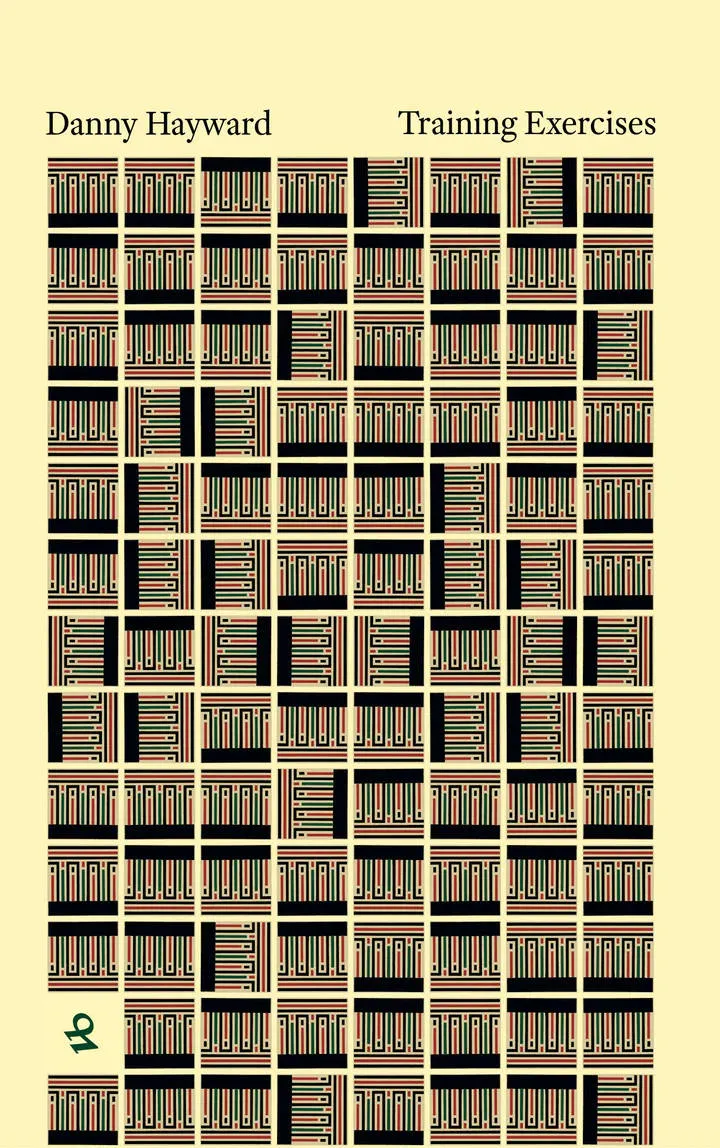
Training Exercises
Organized violence committed on ordinary speech’ is therapy for those who don’t believe in literature as value. Training Exercises is an unpacking of that dictum: seven short essays, letters, reports and anti-biographies written to overcome the feeling of resistance to the defacement of what strikes us as true. An anti-purge written out by lipstick or hammer, scrawled over the top of itself and run through a translation program that turns everything upside inside down, its pieces include: a polemic against catharsis; a letter to the poet Dom Hale on his book Seizures; and a series of on-the-spot reports on the UK Illegal Migration Bill, East London poetry readings, the politics of the war in Ukraine, and a conversation about the meaning of damage in contemporary literature.
‘First you learn to write down your ideas, then you learn again how to write all of your lurid political and intellectual and intimate disappointments and all of your childhood hopes over the top of them’. Jack Spicer scrawled the name of his book in pink lipstick on the cover of the academic journal he had published in: Training Exercises scrawls itself on top of that.

University of California Press
Novel Palestine
Palestinian writing imagines the nation, not as a nation-in-waiting but as a living, changing structure that joins people, place, and time into a distinct set of formations. Novel Palestine examines these imaginative structures so that we might move beyond the idea of an incomplete or fragmented reality and speak frankly about the nation that exists and the freedom it seeks. Engaging the writings of Ibrahim Nasrallah, Nora E. H. Parr traces a vocabulary through which Palestine can be discussed as a changing and flexible national network linking people across and within space, time, and community. Through an exploration of the Palestinian literary scene subsequent to its canonical writers, Parr makes the life and work of Nasrallah available to an English-language audience for the first time, offering an intervention in geography while bringing literary theory into conversation with politics and history.
NORA E. H. PARR is a Research Fellow at the University of Birmingham and at the Center for Lebanese Studies. She coedits Middle Eastern Literatures.

Freud and the Non-European
In this influential lecture, Edward Said explores Freud’s foundational work Moses and Monotheism to rethink the relationship between identity, politics and psychoanalysis. The result is a study illuminating both Freud’s thinking and that of Said, on whom the great psychoanalyst was a formative influence.
Was Moses Jewish or an Egyptian? The question undermines any simple ascription of identity, highlighting the limits of these categories. Said suggests that such an unresolved, nuanced sense of identity might, if embodied in political reality, form the basis for a new understanding between Jews and Palestinians. In contrast, Israel's relentless march towards an exclusively Jewish state denies any sense of a more complex, inclusive past.
With an introduction by Christopher Bollas and a response by Jacqueline Rose.

Tendencies
Tendencies brings together the essays that have made Eve Kosofsky Sedgwick "the soft-spoken queen of gay studies" ( Rolling Stone). Combining poetry, wit, polemic, and dazzling scholarship with memorial and autobiography, these essays have set new standards of passion and truthfulness for current theoretical writing.
The essays range from Diderot, Oscar Wilde, and Henry James to queer kids and twelve-step programs; from "Jane Austen and the Masturbating Girl" to a performance piece on Divine written with Michael Moon; from political correctness and the poetics of spanking to the experience of breast cancer in a world ravaged and reshaped by AIDS. What unites Tendencies is a vision of a new queer politics and thought that, however demanding and dangerous, can also be intent, inclusive, writerly, physical, and sometimes giddily fun.

Theory for Moving Houses
You are asking me where I live and it’s making me think all these things about space, where I start and end in space and where space starts and ends in me and when, in space, I am a body and when I’m a book, in space.
So begins Renee Gladman's Theory for Moving Houses, and with these lines we are invited into a liminal space of imagination and investigation, as Gladman guides us through the architectures of her poetics. Foundational here is a sense of fluidity, a slippage of time, a devotion to “non-linear and hyper gestural movement,” a communal spirit. Gladman’s inquiry into her intersecting practices of writing and drawing reveals a deep commitment to uncertainty and “fictional knowing.” Yet again, Gladman upends traditional expectations of prose, as she leads us through landscape of her Ravicka series novels, ultimately surprising us with a novel within nonfiction. The latest volume in Wave’s Bagley Wright Lecture Series, Theory for Moving Houses is not only visionary in its contemplations but also is a virtuosic example of the ways in which language can shape utopian sites of possibility.

CUNY Center for the Humanities
“This Great River”—Translating the Beats into Arabic
Sargon Boulus, Khaled al-Hilli
The Great River—Translating the Beats into Arabic traces the literary encounters of Sargon Boulus (1944-2007), an Iraqi poet who was part of the vibrant literary scene of late 60’s San Francisco. His life was marked by a period of restless traveling, that he would later describe as an attempt to pursue a poetic imaginary. This project continues to map his proximity to the Beat poets, his short-lived Bay Area poetry journal, Tigris, and his other English language publications.
This publication includes a facsimile reproduction of Tigris, featuring a long poem “Jebu” by Boulus’ good friend Etel Adnan.

Tripwire 23 - Work/Anti-work
Work/Anti-work issue with writing by Nat Raha /. lisa minerva luxx /Ghayath Almadhoun, trans. Catherine Cobham / Jacqui Germain / Jazra Khaleed, trans. Peter Constantine / Finn Finneran / Cait O’Kane / Rebecca Kosick / Lara Durback Skye /Lotta Thießen / William Rowe / Danny Hayward / Rona Lorimer / Zoe Beloff / Jike Ayou, trans. Yě Yě / Miguel de Vallester, trans. Erasmo Pantoja / Lucas Martínez / ko ko thett / Hung Q. Tu / Raymond de Borja / etaïnn zwer, trans. Ilan A.L.S. Erikson Weisbrod / Annie Raab on Taylor Portela / Rachael Guynn Wilson on Lyn Hejinian / Will Rowe on Danny Hayward / Chloe Watlington on Joshua Clover.
CUNY Center for the Humanities
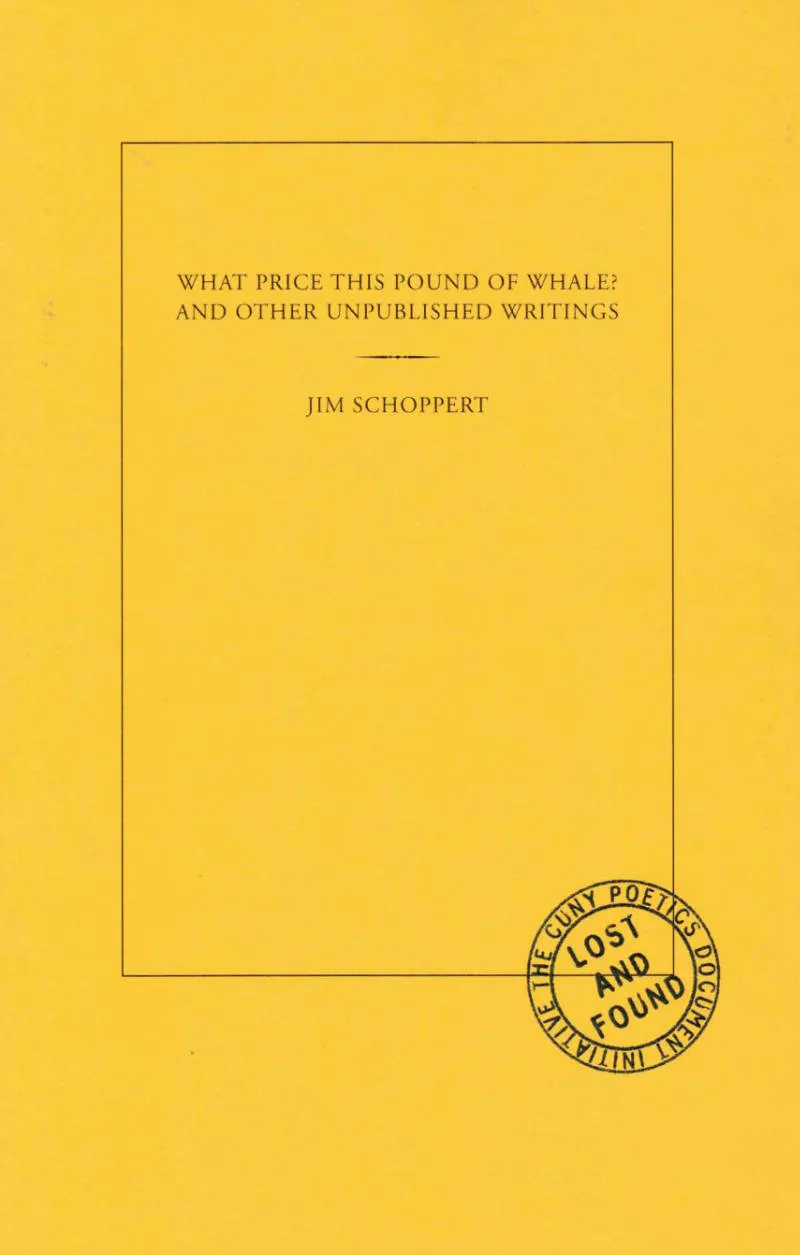
What Price This Pound of Whale? and Other Unpublished Writings
The Tlingit artist Jim Schoppert (1947-1992) was among the most accomplished, innovative, and prolific Alaska Native artists of the twentieth century. His whimsical sculptures and large scale painted wooden carvings reconfigure Tlingit visual motifs, and he challenged the binary categories against which Indigenous artists are so often defined, such as traditional and contemporary, historic and innovative, and artist or craftsperson. While known primarily for his modernist interventions in Tlingit visual traditions, Schoppert was also a prolific writer, an eloquent speaker, and an ardent advocate for Alaska Native artists. This publication brings together a selection of his unpublished poetry and writings from the artist’s personal papers. Presented alongside never before seen sketches and studies, this selection bridges Schoppert’s written and artistic practices in a deeply personal portrait of the artist and Alaska Native life that upsets preconceptions about Native art and unsettles the established narrative of Euro-American and Indigenous aesthetic relations.
Jim Schoppert (1947-1992) was a Tlingit multidisciplinary artist and writer. He was a Taku Tlingit Raven of the Ishkahittaan (Inland Frog) clan from his Tlingit mother and half-German from his father and carried the Łingit name Dom-Yetz. Born in Juneau, Alaska, he earned a BFA in Sculpture and Printmaking from the University of Alaska—Anchorage and an MFA from the University of Washington. In addition to his artistic career, Schoppert was instrumental in promoting Alaska Native arts and organizations. He was Director of Arts and Crafts at the Cook Inlet Native Association, Director of the Alaska Arts in Prisons Program for the University of Alaska Juneau, and organized exhibitions and workshops across Alaska and the Pacific Northwest. He was visiting professor in visual art at the University of Alaska, Fairbanks and directed its Native Art Center. He sat on the Washington State Arts Commission and on the boards of the Alaska State Council on the Arts and the Institute of Alaska Native Arts. His work is held in public and private collections across the United States, including the Smithsonian National Museum of the American Indian, the Anchorage Museum, the Heard Museum, and the Newark Museum, among others. His writing and poetry has appeared in The Greenfield Review and Journal of Alaska Native Arts, among other publications.

This Reasonable Habit
Rainer Diana Hamilton, Violet Spurlock
Violet and Rainer, over the course of a long phone call, become hosts of an imaginary literary summit where attendees spar over casualwear, animal metaphors, fascist art, bodily autonomy, and other problems of the everyday. A collaborative work of friendship as much as the occasion for philosophical scholarship, where one can find the answers to burning questions like: What makes sex good? What constitutes a good reason to dislike someone? What does my nipple piercing mean for your nipples? And how have you been, lately?

Memory
A spiritual homage to Bernadette Mayer's monumental artwork of the same title, Dorothea Lasky's Memory is a cycle of "poet's essays" stirred by two profound questions. What constitutes personhood and consciousness? What memories get lost, and why?
Expansive in her quest for answers, Lasky launches an inspired investigation of the forces that form our lives and deepest senses of ourselves. She identifies three dimensions of memory—ancestral, personal, and poetic—and in her singularly clear voice, undertakes to enter into their mysteries. From those recesses, she returns with a wide-ranging collection of essays that like lyric poems find the universal inside the particular. Memory reflects on the banal; private emotions and historical trauma; dear departed poets (Diane di Prima, Lucie Brock-Broido); her father's battle with Alzheimer's; and cultural events that have become charged sites of collective reminiscence (the moon landing, the music of Neutral Milk Hotel). Other pieces face the flip side of memory, asking what's left where memory is absent, and what's "real" beyond the horizon of death. The book closes with "Time, the Rose, and the Moon," an ars poetica published here in English for the first time, which offers the ancient symbol of the Ouroboros as a figure for the nonlinear processes of time, memory, and art.
Like Mayer before her, Lasky reveals memory to be huge and haunting, as she accumulates impressions that challenge the very possibility of fixed meaning. "Every rose has the scent of death," she writes. "And poetry is a perfume. That will stay on your body forever.... Whatever happens this time around, remember that."
Dorothea Lasky is the author of six full-length collections of poetry, including, most recently, The Shining (2023). She is also the author of the prose book Animal (2019) and a forthcoming book about Sappho, as well as the editor of Essays (2023) and a coeditor of Open the Door: How to Excite Young People About Poetry (2013). Her writing has appeared in POETRY, The New Yorker, The Paris Review, The Atlantic, and Boston Review, among other places.

The Site of Memory
All water has a perfect memory and is forever trying to get back to where it was. Writers are like that: remembering where we were, what valley we ran through, what the banks were like, the light that was there and the route back to our original place.
The Site of Memory describes Toni Morrison’s work of literary archaeology. She offers insights into how she arrives at a text through the act of imagination bound up with memory and shows how she explores two worlds – the actual and the possible – via the nimbus of emotion surrounding the journey of an image: from picture to meaning to text.
Exploring the radical possibilities of literature and the limits of history, Morrison finds a truth deeper than documentation in the silences and omissions in African American narratives of the past. Fiction, for Morrison, is a practice of ethical restoration: a means to recover what history has neglected through the ‘flooding’ of a rush of imagination. In The Site of Memory, ancestral presence, emotion and imagination converge.
If writing is thinking and discovery and selection and order and meaning, it is also awe and reverence and mystery and magic.

A Larger Reality
Ursula K. Le Guin, Conner Bouchard-Roberts
A beautiful compilation of poems, stories, essays, talks, and illustrations by Ursula K. Le Guin. Edited and designed by Conner Bouchard-Roberts.
With additional essays on Le Guin's thinking and craft by: adrienne maree brown, Isabelle Stengers, Moe Bowstern, Lola Milholland, Nisi Shawl, David Naimon, Mary Anne Mohanraj, Margaret Killjoy, Julie Phillips, and Harold Bloom.
This book serves as the companion publication to a gallery exhibition, of the same name, about Ursula’s life and work, showing at Oregon Contemporary Museum (from Nov 1st 2025 - Feb 8th 2026 in Portland, OR) curated by the Author’s son, Theo Downes-Le Guin.

Tripwire 16 - Performance/Writing
A special issue focused on performance writing, with work by Tanya Lukin Linklater (with Michael Nardone), Jibade-Khalil Huffman & Simone White, Jean-Thomas Tremblay, Claudina Domingo (trans. Ryan Greene), Kim Rosenfield, Nathan Walker, Liz Knox, Rona Lorimer, Léo Richard, & Hector Uniacke, Mohamed A. Gawad & Dalia Neis, Mei-mei Berssenbrugge & Teddy Yoshikami, interviewed by Michelle N. Huang, Kyoo Lee and Jocelyn Saidenberg, Adriana Garriga-López, Gabrielle Civil, plus a Kevin Killian Tribute, with Eileen Myles * Scott Hewicker * Cliff Hengst * Karla Milosevich * Craig Goodman * Michelle Rollman * Anne McGuire * Wayne Smith * Tanya Hollis * Steve Orth * Lindsey Boldt * Maxe Crandall * Arnold J. Kemp * Carla Harryman, Lee Ann Brown & Tony Torn * Susan Gevirtz * Laynie Browne * Patrick Durgin * Norma Cole * Jo Giardini. & reviews: Jessica Lopez Lyman & Jocelyn E. Marshall on Gabrielle Civil, alex cruse on Merce Cunningham, Rob Stanton on Anne Boyer, Jack Chelgren on Miyó Vestrini, David Grundy on Stephen Jonas, Virginia Konchan on Sarah Vap.

Tripwire 19 - Sean Bonney Tribute Issue
Sean Bonney Tribute Issue
Don’t say “Rest in Peace,” say Fuck the Police: A Sean Bonney Tribute Portfolio, featuring: Katharina Ludwig, Lama El Khatib & Haytham El Wardany, Anahid Nersessian, Vicky Sparrow, Koshka Duff, Max Henninger, Joshua Clover, Jasper Bernes, D.S. Marriott, Fran Lock, Joey Frances, Mathilda Cullen, Nicholas Komodore, David Lau, Eve Richens, Sacha Kahir, Uwe Möllhusen & Marie Schubenz, Kashif Sharma-Patel, Linda Kemp, Daniel Eltringham & Fred Carter, Hugo García Manríquez, Jèssica Pujol Duran & Macarena Urzúa Opazo. With additional work by Belén Roca, translated by Noah Mazer, Adelaide Ivánova, translated by Chris Daniels, stevie redwood, Cait O’Kane, Mau Baiocco, Peter Bouscheljong, translated by Jonathan Styles. Zheng Xiaoqiong, translated by Zhou Xiaojing, Mayamor, translated by Eric Abalajon, Afrizal Malna, translated by Daniel Owen, Jorge Carlos Fonseca, translated by Shook, James Goodwin, Amalia Tenuta. Plus Engagements: Anne Boyer interviewed by Eduardo Rabassa, Gail Scott interviewed by Michael Nardone, Noah Ross on David Melnick, Guillermo Rebollo Gil on Pedro Pietri, Coco Fitterman on Ennio Moltedo, Sam Moore on Aaron Shurin, David Grundy on Lorenzo Thomas

Acker
A lyric essay written through Kathy Acker's evocative prose, public statements, and private archives.
A cover of Kathy Acker’s career and a study of the development of narrative in her books deftly tracing Acker’s interactions with a diverse palette of avant-gardisms, world letters, cultures, and theory. Martin follows Acker through New York’s downtown St. Mark’s Poetry Project scene, Black Mountain College, and the Beats, as Acker embarks on her own deconstructions of subjects autobiographical and historical, art procedurals, proto-conceptual writing, legacies, and spirits.

Slips of the Mind: Poetry as Forgetting
An audacious account of what happens when forgetting becomes a way of writing and writing becomes a way of forgetting.
In Slips of the Mind, poet and critic Jennifer Soong turns away from forgetting’s long-standing associations with suppression, privation, and error to argue that the absence or failure of memory has often functioned as a generative creative principle. Exploring forgetting not as the mere rejection of a literary past or a form of negative poetics, Soong puts to the test its very aesthetic meaning. What new structures, forms of desires, styles, and long and short feelings do lapses in time allow? What is oblivion’s relationship to composition? And how does the twentieth-century poet come to figure as the quintessential embodiment of such questions?
Soong uncovers forgetting’s influence on Gertrude Stein, Lyn Hejinian, Tan Lin, Harryette Mullen, Lissa Wolsak, and New York School poets John Ashbery, James Schuyler, Bernadette Mayer, and Ted Berrigan, among others. She reveals that forgetting’s shapeshifting produces differences in poetic genre, interest, and degrees of intentionality—and that such malleability is part of forgetting’s nature. Most provocatively, Soong shows how losing track of things, leaving them behind, or finding them already gone resists overdetermination and causality in the name of surprise, as poets leverage forgetting in order to replace identity with style. Slips of the Mind is the kind of literary criticism that will reward all readers of modern and contemporary poetry.

Worms #10: The Love Issue
Clem Macleod, Caitlin McLoughlin and 2 more
This latest issue of Worms invites readers into a bold and tender exploration of love in all its messy, political, and transformative guises.
Set against the backdrop of state-sanctioned transphobia in the UK and US, ongoing genocide in Gaza, and a litany of global injustices that see us staggering under the weight of collective and personal upheaval, this issue reckons with thinking and writing about love in a time of crisis. How do we take seriously the seemingly frivolous demands of love, devotion, beauty—in all their myriad and sometimes painful forms—when basic needs and rights are stripped away.
Featuring voices from at home and overseas including Shon Faye, Torrey Peters, Melissa Febos, Constance DeJong, Sarah Aziza, Precious Okoyomon, Carmen Maria Machado and Constance Debré, as well as contributions from rising stars in experimental literature, we ask: How can we continue to love someone who refuses to change? Is writing about sex still strange – or have we done and seen it all? What do you do if you fall in love with your sperm donor?
From the resilience and fierce creativity of trans writers, the challenges and ethics of telling love stories that are not our own, to the guts and gristle of motherhood, pet love, age-gap relationships and getting off on poetry, Worms 10 is a testament to the power of writing, and of love, as acts of resistance, reclamation and truth.
FEATURING: Shon Faye, Jackie Ess, Precious Okoyomon, Constance Debré, Melissa Febos, Torrey Peters, Carmen Maria Machado, Sarah Aziza, Constance DeJong, Sophie K Rosa
CONTRIBUTORS: Caitlin Hall, Zara Joan Miller, Devki Panchmatia, Lu Rose Cunningham, Gabrielle Sicam, Aimée Ballinger, Mimi Howard, Enya Ettershank, Sufjan Bile, MK McGrath, Amie Corry, Dizzy Zaba, 2ly (Molly Cranston, Safiye Gray, Hanako Emden, Sophie Florian, Johanna Maierski), Jemima Skala, Fariha Róisín, Summer Moraes
PHOTOGRAPHERS: Minu, Dozie Kanu, Jen Dessinger, Karla Monroe, Sophie Williams, Ellen Stewar
ILLUSTRATORS: Rifke Sadleir, Chloe Sheppard, Charlotte Pelissier, Leomi Sadler
EDITORS: Caitlin McLoughlin, P. Eldridge, Clem MacLeod, Arcadia Molinas
DESIGN: Caitlin McLoughlin

The Winter Sun
Fanny Howe's richly contemplative The Winter Sun is a collection of essays on childhood, language, and meaning by one of America's most original contemporary poets.
Through a collage of reflections on people, places, and times that have been part of her life, Howe shows the origins and requirements of "a vocation that has no name." She finds proof of this in the lives of others—Jacques Lusseyran, who, though blind, wrote about his inner vision, surviving inside a concentration camp during World War II; the Scottish nun Sara Grant and Abbé Dubois, both of whom lived extensively in India where their vocation led them; the English novelists Antonia White and Emily Brontë; and the fifth-century philosopher and poet Bharthari. With interludes referring to her own place and situation, Howe makes this book into a Progress rather than a memoir.
The Winter Sun displays the same power as found in her highly praised collection of essays, The Wedding Dress, a book described by James Carroll as an "unflinching but exhilarating look at real religion, the American desolation, a woman's life, and, always, the redemption of literature."
Fanny Howe is the author of more than twenty books of poetry and prose. She has won a fellowship from the Guggenheim Foundation and an award from the Academy of Arts and Letters.

Mousse #92
Regions surface often in this issue—across arts, tales, and gatherings of individuals and meanings—as a possibility to bypass the borders of nation-states and the meta-geographies of colonial modernity.
Slavs and Tatars; Hera Chan on Stephanie Comilang; Stephanie Bailey on Ho Tzu Nyen; Drifting into the Atmospheric by Sohrab Mohebbi; Lauren Cook contributes nine newly commissioned note-like fiction pieces; Asad Raza on Édouard Glissant; Mira Dayal in conversation with Shanzhai Lyric, TJ Shin, and jina valentine; Temporary Communities, Four Points on Radically Public Institutions by Elvira Dyangani Ose; A Signature Truer Than the Name by Dani Blanga Gubbay; tidbits: Ruoru Mou by Amy Jones; Virginia Ariu by Brit Barton; Bagus Pandega by Harry Burke; Ceidra Moon Murphy by Alex Bennett; Oshay Green by Ikechúkwú Onyewuenyi; Shafei Xia in conversation with Danielle Shang; books by Christian Rattemeyer; Guest Design: Lamm & Kirch.
This issue comes with different covers, randomly distributed.
Mousse is a bimonthly contemporary art magazine. Established in 2006, Mousse contains interviews, conversations, and essays by some of the most important figures in international criticism, visual arts, and curating today, alternated with a series of distinctive articles in a unique tabloid format.

On The Rag
Casual Encountersz presents On The Rag, America’s Greatest Tabloid. Blending art and literature with sex, slime and sleaze, On The Rag emerges from LA's underground reading series Casual Encountersz to create a new media platform where the Ivory Tower and the gutter collide. On The Rag is a literary journal, gossip mag and conceptual art project all in one. Get off the apps…And get On The Rag!

Heavy Traffic 6
Featuring new fiction from Ralph Bakshi, Ottessa Moshfegh, Rachel Kushner, Dean Kissick, Jordan Castro, Zans Brady Krohn, Cara Schacter, Patrick McGraw, Charles Clateman, and Johanna Stone.