rile*books

Search books

Search books by title, author, publisher, keywords...

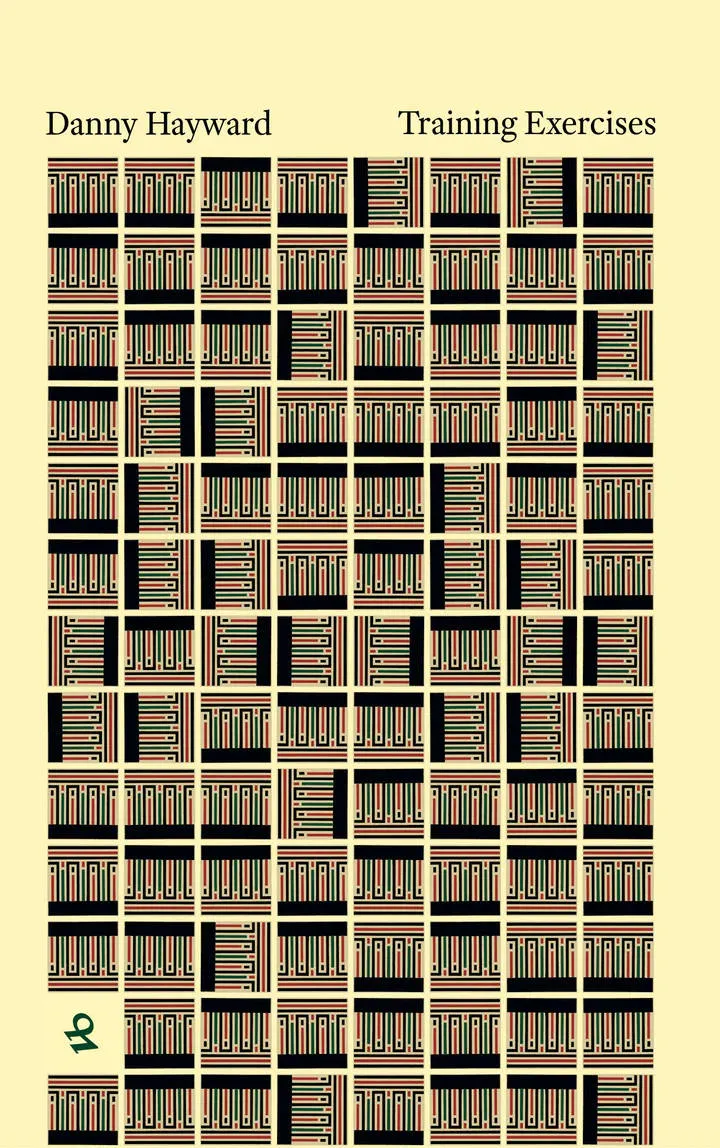
Cover of Training Exercises

both are worse

Training Exercises

Danny Hayward

€16.00

Organized violence committed on ordinary speech’ is therapy for those who don’t believe in literature as value. Training Exercises is an unpacking of that dictum: seven short essays, letters, reports and anti-biographies written to overcome the feeling of resistance to the defacement of what strikes us as true. An anti-purge written out by lipstick or hammer, scrawled over the top of itself and run through a translation program that turns everything upside inside down, its pieces include: a polemic against catharsis; a letter to the poet Dom Hale on his book Seizures; and a series of on-the-spot reports on the UK Illegal Migration Bill, East London poetry readings, the politics of the war in Ukraine, and a conversation about the meaning of damage in contemporary literature. 

‘First you learn to write down your ideas, then you learn again how to write all of your lurid political and intellectual and intimate disappointments and all of your childhood hopes over the top of them’. Jack Spicer scrawled the name of his book in pink lipstick on the cover of the academic journal he had published in: Training Exercises scrawls itself on top of that.

Published in 2024 ┊ 102 pages ┊ Language: English

recommendations

Cover of Impossible Princess

City Lights Books

Impossible Princess

Kevin Killian

Fiction €16.00

Impossible Princess is the third collection of gay short fiction by PEN Award–winning San Francisco–based author Kevin Killian. A member of the “new narrative” circle including Dennis Cooper and Kathy Acker, Killian is a master short story writer, crafting campy and edgy tales that explore the humor and darkness of desire. A former director of Small Press Traffic and a co-editor of Mirage/Periodical, Killian co-wrote Jack Spicer’s biography, Poet Be Like God, and co-edited three Spicer books, including My Vocabulary Did This To Me: Collected Poems. His latest book, Action Kylie, is a collection of poems devoted to Kylie Minogue.

Cover of Look at Hazards Look at Losses

Mute

Look at Hazards Look at Losses

Marina Vischmidt, Danny Hayward and 1 more

Look at Hazards, Look at Losses developed out of a series of conversations, exchanges and visits between kuda.org, Anthony Iles and Marina Vishmidt over 2015-2017 through which different approaches to common problems of cultural production in early-21st century Europe and its peripheries were debated and conceptually probed. Setting out from Theodor W. Adorno’s concept of ‘the aesthetic relations of production’ these discussions proceeded to explore problems bearing upon organisation in small groups in the field of culture, philosophical idealism and materialism, poetry, error and crisis.

The anthology assembled reflects these concerns through engagement with the writing of others who have helped orientate us through these discussions. The book which is the outcome consists of seven original contributions by poets and theorists which attempt to move toward new political interventions in culture and beyond ‘crisis as a way of life’.

Cover of It Was Like Watching

The Last Books

It Was Like Watching

Danny Hayward

Poetry €14.00

Dear ____,

I happened to look for a while out of “my” window on the 17th floor Palliativstation of the Wiener Allgemeinen Krankenhauses last night, where an enormous orange moon was hanging about, consorting with a lick of dark cloud, near to the tiny gaggle of skyscrapers. I didn’t have much to say for myself and so it just sort of looked back at me. 

Every day friends and well-wishers come here and as always I want to run to my room and read a book until they’ve left but for the first time in my life my room is also the room they want to visit, and so I can’t. I wrote down yesterday as best as I could the words of my last long conversation with Marina: there might be more, but the words are running away from her now, which only makes you realise how small and insignificant they are, fleeing from something (from someone) who remains exactly who they were even in their absence: like dust falling from the sun.

A voyage in the insight which comes as a kiss and follows as a curse, made after you ran out of things to say.——first halting efforts at mutual understanding——love letters from twelve years ago. journal entries from fifteen years before lick at the edges like flames. Opaque coloured shadows, projected in three dimensions——of a——future that——has. never ceased to exist and which——Doesn’t——.——.——arrive to speak about their fears.—— Beginning with a naked bathroom selfie. 

An attempt to live nonjudgmentally and without fear, against the desire to be something other than who you were, as a basic form of class hatred, a fear of the common and of everything that happens there, near speechlessness, trailing off, only sometimes coming back to life again, shame dies so that everything else can be saved, and everything else remains present against the background of this absence, beneath the harsh overhead light, as you pull on the pathetic, unassuming string of the pullcord. 

Dedicated to one person, written by one another. “Poems written by / different poets / are my nakedness.”

Cover of First Nettles

The Last Books

First Nettles

Dom Hale

Poetry €15.00

First Nettles collects poems written between 2021 and 2024, from precarious off-key lyrics to sprawling elegies of damaged life. A book of flailing, desperate music, hurt and hopeful, held together by pins and gaffer tape, art and courage and comradeship. Includes the sequence “Seizures” (2022) – “perfect in its openness and lyrical disfigurement” (Danny Hayward).

“[An] exhilarating collection […]. The sequences here are ferociously and admirably radical, with some superb political satire and verve to the poems.”  —Adam Piette, Blackbox Manifold, no. 34 

Designed and typeset by Phil Baber; cover collage by Sam Keogh

Cover of Wound Building: Dispatches from the Latest Disasters in UK Poetry

Punctum Books

Wound Building: Dispatches from the Latest Disasters in UK Poetry

Danny Hayward

Poetry €24.00

Wound Building is a volume of essays, with digressions, on one group of contemporary poets active in a self-organizing political poetry scene in the UK, most of whom have little to no audience outside of the little magazines that they publish and the reading series they put on. The book is a front-line report on the rapid development of this poetry in the period between 2015 and 2020, with a particular focus on the relationship of poetry to violence and its representation. The poets discussed here write violent love poems and violent elegies as well as violent fantasies composed in stabs of violent verse and violet prose. The poems themselves comprise fantasies of killing David Cameron, dreams of being split open along a seam, basement songs, hundreds of pages of notes on working life in a privatized care home in Hove, East Sussex, a four-line slogan about the Cologne groping scandal of New Year 2016, variations on the Refugees Medical Phrasebook, a life wasted in a factory in Guangzhou, an autobiographical sci-fi internet fever dream, an anarchist elegy, and a refusal to argue. Ultimately, Hayward argues that the lessons this poetry teaches is never to write a "worthy" narrative when a fucked up collage will do. Rather than a cohesive "account" of a "school" of poets, or a "contribution" to the boring tittle-tattle of aesthetic debates over British poetry as an institution, Wound Building is a front-line report on the local disasters of a contemporary UK poetry caught in the grip of the historical cataclysm of capitalist culture.

Wound Building is further concerned with aesthetic problems related to Marxism, anarchism, contemporary trans politics, and class, though its "theoretical" preoccupations are subordinated to its desire to provide a ground-level view on the writing itself, its production, its intellectual aporia, and the ways it finds itself outstripped by the ongoing "march of events." The book will be of interest not only for those concerned with contemporary British political and experimental poetry, but also more generally for anyone who wishes to think carefully about what it means to make art about present-day history and its many horrible enormities.

The book's title is derived from the idea of sublime woundedness that subtends the context of the poets discussed here: the impressions of wounds opening up like LED-lit shopfronts in the night, in a parallel universe in which injury is intoxicatingly impersonal and structural, and which forms the environment in which the poems fight to absolutize the value of every last breath, or face into the reality of extravagantly violent wish fulfillment, or dissolve themselves in a search for new ways of professing love, or transform into a kind of expressionism of vomiting up medical-diagnostic categories found in abstract social labor, or pump their verses full of the convulsive rhythms of surprise and sudden relief, without any guarantee that this is the right thing to do or that anyone will even fucking hear. Wound Building does not historicize this state of affairs as much as it attempts to live alongside the immediacy of this work, in order to see what is still possible for poetry, and criticism, to make and do.

Cover of Of · The · Abyss

Materials

Of · The · Abyss

J.H. Prynne

Poetry €12.00

A sequence of ten poems; in separated continuance, an outcry that ventriloquises and manifests languages of exclusion and yet with dogged persistence protests them. 

“Oh strike the light, float the boat, for sake of common peril they are fallen away as gathered up in sight of lamentable in- difference and will go down against us”. 
Cover of The Saddest Thing Is That I Have Had to Use Words: A Madeline Gins Reader

Siglio Press

The Saddest Thing Is That I Have Had to Use Words: A Madeline Gins Reader

Madeline Gins

Poetry €28.00

Poet, philosopher, speculative architect and transdisciplinary artist, Madeline Gins is well known for her collaborations with her husband, the artist Arakawa, on the experimental architectural project Reversible Destiny, in which they sought to arrest mortality by transforming the built environment. Yet, her own writings — in the form of poetry, essays, experimental prose and philosophical inquiries — represent her most visionary and transformative work. Like Gertrude Stein before her, Gins transfigures grammar and liberates words. Like her contemporaries in conceptual art, her writing is attuned to the energized, collaborative space between reader and page.

The Saddest Thing Is That I Have Had to Use Words: A Madeline Gins Reader is a revelatory anthology, edited and with an introduction by the writer and critic Lucy Ives. It brings never-before-published poems and essays together with a complete facsimile reproduction of Gins' 1969 masterpiece, WORD RAIN (or A Discursive Introduction to the Intimate Philosophical Investigations of G, R, E, T, A, G, A, R, B, O, It Says), along with substantial excerpts from her two later books What the President Will Say and Do!! (1984) and Helen Keller or Arakawa (1994). Long out of print or unpublished, Gins' poems and prose form a powerful corpus of experimental literature, one which is sure to upend existing narratives of American poetics at the close of the 20th century.

Edited by Lucy Ives. 

Cover of The Book of Skies

Pamenar Press

The Book of Skies

Leslie Kaplan, Jennifer Pap and 1 more

Poetry €20.00

The Book of Skies, like its predecessor Excess-The Factory, emerged from poet Leslie Kaplan's experience participating in the national strike and social revolution of ’68 in France. Early in ‘68 Kaplan, like others, left her studies in order to take on factory work, as an aspect of revolutionary practice. Excess—the Factory, puts the factory experience strikingly on the page in sparse and original language. The Book of Skies takes place in the period just after the ‘68 events as the central speaker now observes the places, landscapes, and people surrounding and relying on factory production in French cities, small and large. As the poem’s speaker moves from site to site, she finds possibility within the social spaces of the market, the street, the café, and even the factory itself. While class and gendered violence threaten to shut down hopes for freedom and renewal, the sky, as reality and as figure, functions as an aperture, drawing our attention upward and outward, even or especially when domestic and work-spaces are most violent or suffocating.

From the beginning of her career, French poet, playwright, and novelist Leslie Kaplan has been an important writer of the French left. She has published over twenty books in all three genres, many of which have been translated into German, Swedish, Spanish, Danish, Norwegian, and now, English. Her first book, L'exces l’usine (1982), gained the attention of writers such as Marguerite Duras and Maurice Blanchot, and became an important book for the ‘68 generation. In 2018, Commune Editions published Excess—The Factory, translated by Julie Carr and Jennifer Pap. This was the book’s first translation into English, though it had been translated into five other languages.

Cover of Help

Tenement Press

Help

Steven Zultanski

Poetry €25.00

Death-obsessed, disengaged and overinvested—the four long poems assembled in Steven Zultanski’s Help theatricalise morbid fascinations, self-protective impulses, and unfocused desire. Help is, at its core, a set of conversations; the result of games played between friends that were then transcribed, edited, and embellished. Participants were asked to talk about loss, the death of acquaintances, secret hiding places, mislaid time, and unmet demands. The resulting poems read like meandering scripts for unrealised plays; incidental excavations of persona and place.

Somewhat reminiscent of Linda Rosenkrantz’s Talk (1968) or Alice Notley’s transcription poems of the 1970s, in Help the poet pretends to be a recording device, and the poem an act of remembering. Zultanski’s writing is at once skeletal and overstuffed, dryly unsentimental and yet dripping with melodrama. Help foregrounds its own contradictions in a collection that is at once both extremely personal and distinctly artificial.

Help brilliantly extends Steven Zultanski’s current phase of writing—looser, more documentary, more situational. In setting up explicit objects of inquiry and conversation—love, death, childhood—the book shows that to know these things is to also know our friends and ourselves. Sustained by an orchestration of relation and memory (and thus reality), affect here is modular, the product of what happens when we transform things by talking about them. A careful and astute experiment in writing and living.
 — Jennifer Soong

Cover of Sacred Spells: Collected Works

Nightboat Books

Sacred Spells: Collected Works

Assotto Saint

Poetry €23.00

The collected life-work of an interdisciplinary writer, performer, and central figure in the Black Gay cultural arts and AIDS movements.

In this timely collection of poetry, plays, fiction, and performance texts, Assotto Saint draws upon music and incantation, his Haitian heritage, and a politics of liberation to weaves together a tapestry of literature that celebrates life in the face of death. Influential to contemporary writers such as Essex Hemphill, Marlon Riggs, and Melvin Dixon, Sacred Spells is Saint’s crucial legacy–five hundred incandescent pages of painful, lyric writing that exemplifies the visceral, spiritual dimensions of an artistic practice that’s integral to Black and LGBTQ activist movements worldwide, both historic and present.