Slavs and Tatars
Slavs and Tatars
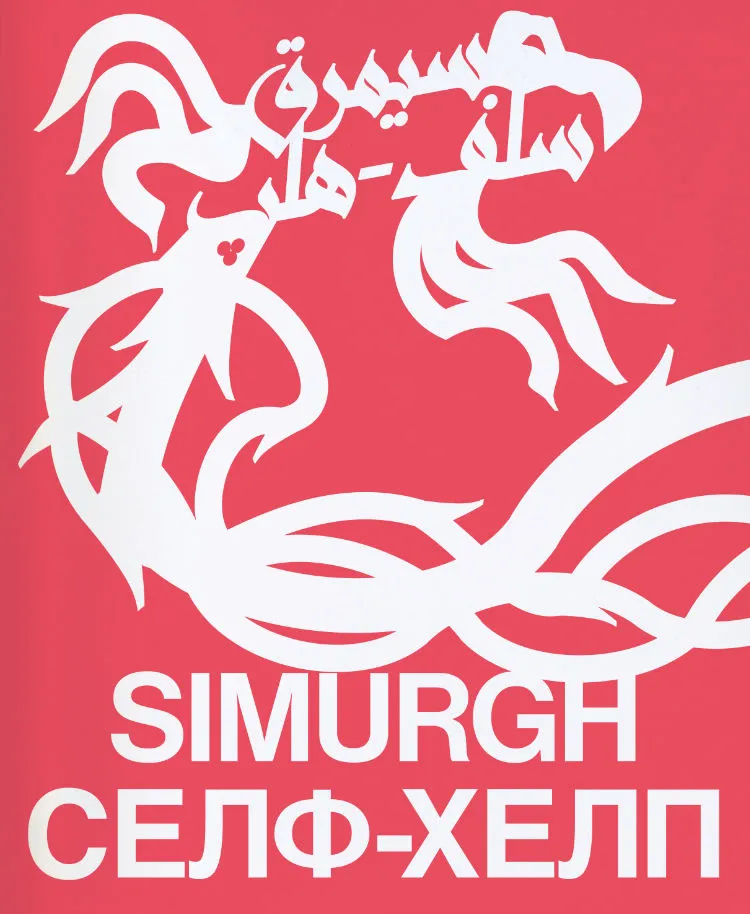
Simurgh Self-Help
The 2025 Ringier annual report (artist's book).
Since 1998, Ringier, the Swiss-based global media company, has traditionally commissioned an artist to design its annual report. Publisher Michael Ringier and curator Beatrix Ruf initiated this series as a means of reinforcing the links between art and the activities of the company.
For the 2025 edition, Slavs and Tatars' Simurgh Self-Help revisits Marcel Broodthaers' seminal work Musée d'Art Moderne: Département des Aigles (1968–1972), replacing or "translating" the eagle—a symbol of power and empire that is used to challenge our understanding of authority and value—with the Simurgh, a mythical bird found across the Turkic-Persianate world. Whilst the eagle is often associated with nation-states and masculinity, the Simurgh is decidedly transnational, metaphysical, and flamboyant, if not gender-fluid.
Much like the collective's geographic remit—between the former Berlin Wall and the Great Wall of China—this publication attempts to shift our focus elsewhere, eastwards, to regions which too often fall through the cracks of historiography and art history. If modern and contemporary art institutions in Broodthaers' time were largely situated between the Rhineland and Northeast United States, the multipolarity of today's art world is a fait accompli: with biennials in Uzbekistan and museums in Kazakhstan, amongst others, rivalling the traditional centers of power.
Once too a sacred bird—accompanying Zeus, for example—the eagle has, over the past two millennia, undergone a thorough profanation: a brawny, secular flex of nationalism. It would be remiss not to see the parallels in the world of media: print itself and the act of reading, once an activity for the few and anointed, has undergone a similar dynamic of democratization over the past several centuries and, especially in recent years with the internet, a vulgarization which would make medieval Church elders wag their shriveled fingers at us in an I-told-you-so meme meant for the ages. This profanation has challenged the very institution of media and the narratives it disseminates, much as important works of institutional critique challenged contemporary art in the 1970s and beyond—akin to Slavs and Tatars' genre-bending mix of high and low, East and West, sacred and profane does today.
Slavs and Tatars' (founded 2006) extensive publishing activity—some 15 books in 20 years—has treated subjects as diverse as alphabet politics, Uighur literary culture, political satire in the Muslim world, and German anti-Enlightenment thinkers. Alongside sculptures, textile works, installations, sound pieces, and even a brick-and-mortar Pickle Bar in Berlin, the collective's books have cleared new paths for contemporary discourse via a wholly idiosyncratic form of knowledge production that draws on popular culture, spiritual and esoteric traditions, oral histories, modern myths, as well as scholarly research.
Slavs and Tatars is a faction of polemics and intimacies devoted to an area east of the former Berlin Wall and west of the Great Wall of China known as Eurasia. The collective's work spans several media, disciplines, and a broad spectrum of cultural registers (high and low) focusing on an oft-forgotten sphere of influence between Slavs, Caucasians and Central Asians.
Slavs and Tatars has published Kidnapping Mountains (Book Works, 2009), a celebration of complexity in the Caucasus, Love Me, Love Me Not: Changed Names (onestar press, 2010) and are currently preparing solo engagements at Vienna's Secession, Museum of Modern Art, New York and Künstlerhaus Stuttgart.
Mentioned in

Mousse #92
Regions surface often in this issue—across arts, tales, and gatherings of individuals and meanings—as a possibility to bypass the borders of nation-states and the meta-geographies of colonial modernity.
Slavs and Tatars; Hera Chan on Stephanie Comilang; Stephanie Bailey on Ho Tzu Nyen; Drifting into the Atmospheric by Sohrab Mohebbi; Lauren Cook contributes nine newly commissioned note-like fiction pieces; Asad Raza on Édouard Glissant; Mira Dayal in conversation with Shanzhai Lyric, TJ Shin, and jina valentine; Temporary Communities, Four Points on Radically Public Institutions by Elvira Dyangani Ose; A Signature Truer Than the Name by Dani Blanga Gubbay; tidbits: Ruoru Mou by Amy Jones; Virginia Ariu by Brit Barton; Bagus Pandega by Harry Burke; Ceidra Moon Murphy by Alex Bennett; Oshay Green by Ikechúkwú Onyewuenyi; Shafei Xia in conversation with Danielle Shang; books by Christian Rattemeyer; Guest Design: Lamm & Kirch.
This issue comes with different covers, randomly distributed.
Mousse is a bimonthly contemporary art magazine. Established in 2006, Mousse contains interviews, conversations, and essays by some of the most important figures in international criticism, visual arts, and curating today, alternated with a series of distinctive articles in a unique tabloid format.

BRICKS FROM THE KILN #5
Andrew Walsh‐Lister, Matthew Stuart
Bricks from the Kiln is a semi-yearly journal and multifarious publishing platform established in mid-2015 to support critically minded and explorative writing on and around art, design and literature. Edited by Matthew Stuart and Andrew Walsh-Lister, the forthcoming issue, number five, begins with a single sentence:
blankets topologies in glistening snow and blood — produces instructional spattering, again and again — coughs up clotted network diagram hairballs of illegibility — parasitically draws on / from Thomas Browne’s quincunx — meets for The Big ROAR tomorrow, yesterday — lifts loud cows off the page, aloud — flips the coin of language, heads or tails? — politely speaks on writing heard yet seen — twists tongues, transliterates and teases — makes contact with ancestral spirits — traverses the foothills of La Marquesa, past and present — is the Spectre at the feast — (re)traces polymorphous concrete poems — dashes, gestures, speaks, breathes, moves, joyness — is, as ever, tentative, incomplete and inconsistent.
Contributions by Helen Marten, Rebecca May Johnson, Johanna Drucker, Louis Lüthi, Daisy Lafarge, Holly Pester, Ursula K. Le Guin, Quinn Latimer, Stefan Themerson, Slavs and Tatars, Ashanti Harris, Catalina Barroso-Luque, Kevin Lotery, Bronac Ferran with Greg Thomas and Astrid Seme with Alex Balgiu.

The Poetry of Translation
New perspectives on the process of translation from the works of more than thirty international artists.
"[…] what I consider to be one of the most important arts of the future: the art of translation."
—Édouard Glissant
With The Poetry of Translation, Kunst Meran Merano Arte investigates the compelling phenomenon of translation. Over seventy works by over thirty artists shed light on the process of translation from novel perspectives
Inspired by the living multilingual environment of South Tyrol and its eventful history of interethnic cohabitation, Kunst Meran Merano Arte offers the ideal context for a research on translation and questions surrounding identity, multiculturalism, and diversity. The essays and visuals included in the book address translation in its complexity: on the one hand, as a source of inclusion, international understanding, creativity, genius and poetry, while on the other as a cause of misunderstanding and exclusion. It is understood here as a creative process through which something new is always created.
Published on the occasion of the eponymous exhibition at Kunst Meran Merano Arte in 2021-2022, with Amelia Etlinger, Anna Esposito, Annika Kahrs, Anri Sala, Augusto De Campos, Babi Badalov, Ben Vautier, Carla Accardi, Cerith Wyn Evans, Christine Sun Kim & Thomas Mader, Elisabetta Gut, Ettore Favini, Franco Marini, Franz Pichler, Freundeskreis, Jorel Heid & Alexandra Griess, Heinz Gappmayr, Irma Blank, Johann Georg Hettinger, Jorinde Voigt, Kader Attia, Katja Aufleger, Ketty La Rocca, Kinkaleri, Lawrence Abu Hamdan, Lawrence Weiner, Leander Schwazer, Lena Iglisonis, Lenora De Barros, Lucia Marcucci, Maria Stockner, Marilla Battilana, Michele Galluzzo & Franziska Weitgruber, Mirella Bentivoglio, Otto Neurath, Siggi Hofer, Slavs and Tatars, Tomaso Binga.

1 Million Roses for Angela Davis / 1 Million Rosen für Angela Davis
"1 Million Roses for Angela Davis" traces Davis' immense influence and legacy as activist and scholar on contemporary artists today, while simultaneously teasing out the contradictions her presence and agenda posed to the GDR's interpretation and application of Marxism.
"A Million Roses for Angela Davis" was the motto of a 1970–72 solidarity campaign in East Germany in support of US philosopher, Communist, and Black Power revolutionary Angela Davis, who at the time was being held on terrorism charges in California.
The large-scale movement firmly anchored the "heroine of the other America" within the cultural memory of a now-vanished social utopia, which after her acquittal welcomed her as a state guest. For her part, Davis had hoped for an internationalist movement promoting a socialist, feminist, and non-racist democracy—the antithesis of her experiences of violence and oppression as a Black woman in the United States. This moment of hope provides the historical starting point for the exhibition at the Albertinum in Dresden. The group show features archival materials, historical portraits of Davis by state painters of the GDR, new commissions, and other works by an array of contemporary artists focusing on the issues that the now emeritus professor campaigned for at the time, which are still pressing today. It aspires to initiate discussion on the background, flaws, and unfulfilled potential of the unusual relationship between Davis and the GDR.
The contributions in this accompanying reader unfold how Davis's iconic image came to be inscribed within a global history of resistance, and introduce all of the participating artists with short texts.
"And if we believe that revolutions are possible, then we have to be able to imagine different modes of being, different ways of existing in society, different social relations. In this sense art is crucial. Art is at the forefront of social change. Art often allows us to grasp what we cannot yet understand." —Angela Davis
Works by Yael Bartana, Jean-Michel Basquiat, Sophie Calle, Contemporary And, Sadie Barnette, CHTO DELAT?, Melvin Edwards, Ângela Ferreira, Bernhard Franke, Coco Fusco, Ellen Gallagher, Claudia Martínez Garay, Lawrence Abu Hamdan, Arthur Jafa, Steffani Jemison & Justin Hicks (Mikrokosmos), Iris Kensmil, Hassan Khan, Kapwani Kiwanga, Raja Lubinetzki & Petra Schramm, Julie Mehretu, Heinz-Detlef Moosdorf, Senga Nengudi, Ahmet Öğüt, Slavs and Tatars, Julia Phillips, Alex Martinis Roe, Elske Rosenfeld, Anri Sala, Willi Sitte, Cauleen Smith, Nancy Spero, Gabriele Stötzer, Strawalde (Jürgen Böttcher), Nasan Tur, Lewis Watts, Carrie Mae Weems, Christoph Wetzel, Charles White, Heinz Wodzicka.
Published on the occasion of the eponymous exhibition at Staatliche Kunstsammlungen Dresden, from October 10, 2020 to January 24, 2021.

Le Dictateur #05 – FAQ
Myriam Ben Salah, Maurizio Cattelan
FAQ is an accordion-fold art publication edited by Maurizio Cattelan and Myriam Ben Salah and commissioned by Le Dictateur. Coinciding with the 10th anniversary edition of Le Dictateur, the first volume will expand into a yearly series.
FAQ stands for Frequently Asked Questions, referencing an attempt to synthesize a recurrent flow, a tenor, an ideal visual representation of a given and very subjective “now”.
Born out of an accute image eating disorder, FAQ reflects the mental assimilation of a relentless roving within physical and virtual art spaces: from galleries to tumblr accounts, museums, or artists studios; it can be seen as a portable exhibition, a show on paper, a project of restitution, a hybrid object that you can leaf and scroll through. Far from being a rational enterprise because of its lack of rules, hierarchy, order—or concept for that matter—it is expressly and brazenly as personal and biased as possible and reflects the obsessive mannerism of its authors.
Works by Korakrit Arunanondchai, Thomas Bayrle, Neil Beloufa, Judith Bernstein, David Douard, Carroll Dunham, Dan Finsel, Llyn Foulkes, Kathy Grannan, Camille Henrot, Charles Irvin, Elad Lassry, Jon Rafman, Steven Shaerer, Emily Mae Smith, Peter Sutherland, Slavs and Tatars, Andra Ursuta, Aleksandra Waliszewska, Charlie White, Jakub Julian Ziolkowski...