rile*books

Search books

Search books by title, author, publisher, keywords...

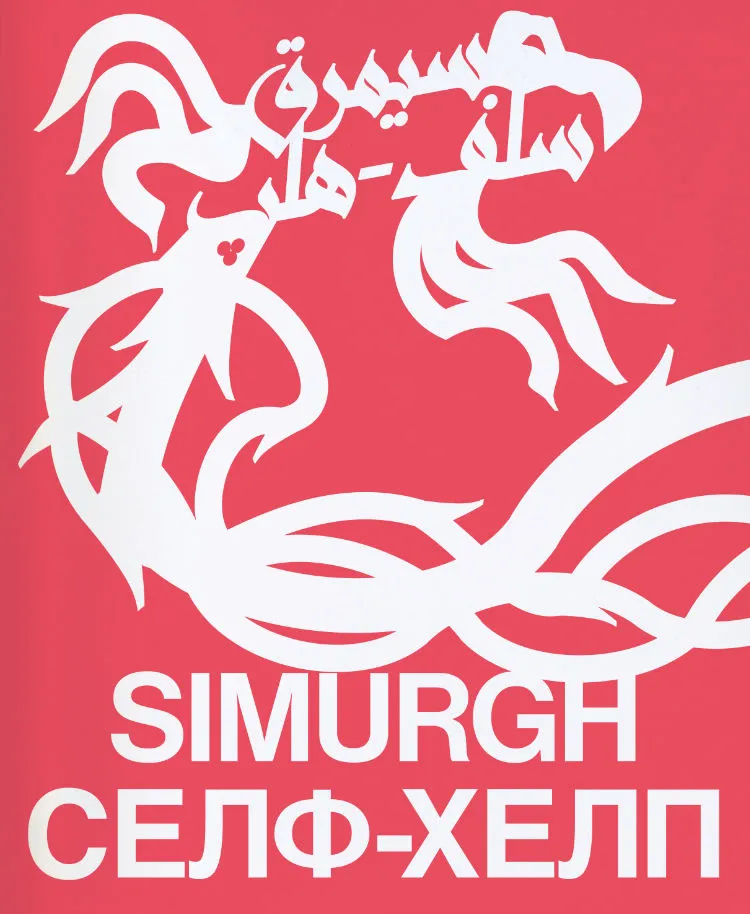
Cover of Simurgh Self-Help

JRP Editions

Simurgh Self-Help

Slavs and Tatars

€38.00

The 2025 Ringier annual report (artist's book).

Since 1998, Ringier, the Swiss-based global media company, has traditionally commissioned an artist to design its annual report. Publisher Michael Ringier and curator Beatrix Ruf initiated this series as a means of reinforcing the links between art and the activities of the company.

For the 2025 edition, Slavs and Tatars' Simurgh Self-Help revisits Marcel Broodthaers' seminal work Musée d'Art Moderne: Département des Aigles (1968–1972), replacing or "translating" the eagle—a symbol of power and empire that is used to challenge our understanding of authority and value—with the Simurgh, a mythical bird found across the Turkic-Persianate world. Whilst the eagle is often associated with nation-states and masculinity, the Simurgh is decidedly transnational, metaphysical, and flamboyant, if not gender-fluid.

Much like the collective's geographic remit—between the former Berlin Wall and the Great Wall of China—this publication attempts to shift our focus elsewhere, eastwards, to regions which too often fall through the cracks of historiography and art history. If modern and contemporary art institutions in Broodthaers' time were largely situated between the Rhineland and Northeast United States, the multipolarity of today's art world is a fait accompli: with biennials in Uzbekistan and museums in Kazakhstan, amongst others, rivalling the traditional centers of power.

Once too a sacred bird—accompanying Zeus, for example—the eagle has, over the past two millennia, undergone a thorough profanation: a brawny, secular flex of nationalism. It would be remiss not to see the parallels in the world of media: print itself and the act of reading, once an activity for the few and anointed, has undergone a similar dynamic of democratization over the past several centuries and, especially in recent years with the internet, a vulgarization which would make medieval Church elders wag their shriveled fingers at us in an I-told-you-so meme meant for the ages. This profanation has challenged the very institution of media and the narratives it disseminates, much as important works of institutional critique challenged contemporary art in the 1970s and beyond—akin to Slavs and Tatars' genre-bending mix of high and low, East and West, sacred and profane does today.

Slavs and Tatars' (founded 2006) extensive publishing activity—some 15 books in 20 years—has treated subjects as diverse as alphabet politics, Uighur literary culture, political satire in the Muslim world, and German anti-Enlightenment thinkers. Alongside sculptures, textile works, installations, sound pieces, and even a brick-and-mortar Pickle Bar in Berlin, the collective's books have cleared new paths for contemporary discourse via a wholly idiosyncratic form of knowledge production that draws on popular culture, spiritual and esoteric traditions, oral histories, modern myths, as well as scholarly research.

Slavs and Tatars is a faction of polemics and intimacies devoted to an area east of the former Berlin Wall and west of the Great Wall of China known as Eurasia. The collective's work spans several media, disciplines, and a broad spectrum of cultural registers (high and low) focusing on an oft-forgotten sphere of influence between Slavs, Caucasians and Central Asians. 

Slavs and Tatars has published Kidnapping Mountains (Book Works, 2009), a celebration of complexity in the Caucasus, Love Me, Love Me Not: Changed Names (onestar press, 2010) and are currently preparing solo engagements at Vienna's Secession,  Museum of Modern Art, New York and Künstlerhaus Stuttgart.

Published in 2026 ┊ 224 pages ┊ Language: English

recommendations

Cover of Disobedience

JRP Editions

Disobedience

Jacqueline de Jong

Monograph €42.00

Published to accompany the artist's retrospective at the Kunstmuseum St. Gallen (September 2025–March 2026), this comprehensive monograph offers a detailed overview of the work of Dutch artist Jacqueline de Jong. Designed by Sabo Day and edited by Melanie Bühler, curator of the exhibition, this publication spans De Jong's entire artistic journey of from her editorial activities and bold figurative paintings of the 1960s to her "Billiards" series in the 1970s, and her latest series of the 2020s that reflect the current state of the world. 

It features new essays by Karen Kurczynski (Professor of History of Art and Architecture at the University of Massachusetts Amherst), Emily LaBarge (writer and critic), Tiana Reid (Assistant Professor of English at York University), Paul Bernard (Director of Kunsthaus Biel), as well as an as-yet-unpublished conversation with the artist and McKenzie Wark (writer and theoretician). 

Organized through six sections entitled "Disobedience," "Publishing," "Chaos," "Pop," "Play," and "Politics," all lavishly illustrated, it underlines the challenging approach to art and life developed by De Jong formally, visually, and conceptually from the early 1960s until 2024.

Edited by Melanie Bühler
Texts by Emily LaBarge, Gianni Jetzer, Jacqueline de Jong, Karen Kurczynski, McKenzie Wark, Melanie Bühler, Paul Bernard, Tiana Reid.

Cover of Tehran North

JRP Editions

Tehran North

Shirana Shahbazi

Published on the occasion of her exhibition at the Palais de l'Athénée, Geneva (September 18–October 18, 2025) following her Prix de la Société des Arts de Genève award in 2025, this new artist's book by Shirana Shahbazi is fully dedicated to her "Displacement" series (2023–2025). To describe it, she states: "I use multiple exposure and overlapping to create an independent experience of time and space. The simultaneity of different realities is relevant to many of us. I think a lot about how to depict these complex realities."

Designed by Norm, Zurich, this publication is itself an inquiry into space and time, and our relationship to them. Each alternate page is trimmed short, creating new perceptions. The artist adds: "I enjoy deconstructing rooms, creating new ways of experiencing them. Sharpening the awareness while you see the works." The latest book in a series of acclaimed photography publications, this volume is characteristic of Shahbazi's distinctive and conceptually rigorous approach to photography in which light, vibrant color field, and layering play key roles. Flipping through the pages of An Exciting Opportunity Lies Ahead of You is a dream-like journey through architecture and senses. 

Born in Tehran in 1974, Shirana Shahbazi moved to Germany at the age of 11. She studied photography in Dortmund and Zurich, where she lives and works today. Her practice has been dedicated to generating a hybrid visual language that defies simple categorization and can be experienced on multiple levels. It challenges the translation and the transcultural construction of meaning. The physical presence of her work is just as important as its semantic underpinnings.

Cover of Ik ben Elias of het gevecht met de nachtegalen, door Maurice Gilliams

Time has fallen asleep in the afternoon sunshine

Ik ben Elias of het gevecht met de nachtegalen, door Maurice Gilliams

Wouter Krokaert

Performance €12.00

For the project Time has fallen asleep in the afternoon sunshine a group of people/ performers memorize a book of their choice. Together they form a library collection consisting of living books. After years of learning by heart and reciting for readers, some of the books have now been written down from memory to create new editions, versions resulting from this process. This book is one of those books, chosen by one person, learned by heart and recited many times, and now written down again from memory. This edition is not a re-edition of the original text. It is a re-writing of the text after the process of reading, memorizing and reciting, with all the alterations that might have occured in the course of this process.

Cover of RUSTIQUE

ness books

RUSTIQUE

Nicola Godman

“RUSTIQUE” is an artist book created by Nicola Godman. This book is sprung out of a residency in September 2021 at Hôtel Chevillon, a former Scandinavian artist colony in Grez-sur-Loing, France. Barbizon, the village where the painter Jean-François Millet (1814–1875) lived and died, is located 20 km away from there. The book interweaves the life and work of Millet with Godman’s photographs, drawings and personal anecdotes.

“RUSTIQUE” wishes to put forward the artistic gaze towards rural life by artists who themselves are born peasants. Nicola Godman (b. 1989, Rute) is an artist working with photography, video, books and stories, currently based in Stockholm, Sweden. Having grown up on an organic dairy farm, she is researching depictions of rural life in art history and contemporary culture.

Cover of Seltsame Sterne starren zur Erde

Time has fallen asleep in the afternoon sunshine

Seltsame Sterne starren zur Erde

Sonia Si Ahmed

For the project Time has fallen asleep in the afternoon sunshine a group of people/ performers memorize a book of their choice. Together they form a library collection consisting of living books. After years of learning by heart and reciting for readers, some of the books have now been written down from memory to create new editions, versions resulting from this process. This book is one of those books, chosen by one person, learned by heart and recited many times, and now written down again from memory. This edition is not a re-edition of the original text. It is a re-writing of the text after the process of reading, memorizing and reciting, with all the alterations that might have occured in the course of this process.

Cover of Cologne art fair 1977

Verlag der Buchhandlung Walther König

Cologne art fair 1977

Michael Krebber, Jack Smith

Jack Smith presented his performance Irrational Landlordism of Bagdad as part of the Cologne Art Fair fringe in the summer of 1977. Many other events were documented photographically and can now be found in the Cologne Art Fair archives - not so Smith's performance.

This book shows him in his fair stall and during his performance for the first time. The pictures are perfect documents of a completely eccentric transaction by this pioneering director and performance artist.

Cover of Installation Views

Lenz Press

Installation Views

Charlotte Posenenske

Conceived as a visual résumé, Installation Views provides both a comprehensive overview of Charlotte Posenenske's solo exhibitions and a record of her numerous group shows.

In her Manifesto, Charlotte Posenenske stated: "I find it difficult to come to terms with the fact that art can contribute nothing to the solution of pressing social problems."
Developing her artistic practice throughout the 1960s, Posenenske produced a body of work that uniquely combined several strands of the art of the period: conceptualism, minimalism, and socially engaged participatory art. Her Manifesto, published in Art International in May 1968, lays out the social demands on art as well as the impossibility of fulfilling those demands. Shortly after its publication, Posenenske left the art world behind to pursue her studies in sociology, undertaking a new career in that field.

Conceived as a visual résumé, Installation Views provides both a comprehensive overview of Charlotte Posenenske's solo exhibitions and a record of her numerous group shows. The book features an essay written by curator Erlend Hammer on the role of documentary photographs in the circulation of works of art. 

The book was published in conjunction with the eponymous show at the Haugar Art Museum in Tønsberg, Norway—the first full-scale presentation of the artist's oeuvre in Scandinavia. The exhibition showcased works from all the artist's major series of modular sculpture. Consisting of works made over the course of less than 12 months, between 1967 and 1968, preceding the abrupt end to Posenenske's career as an artist, the exhibition had the character of a snapshot. We are left wondering whether her withdrawal from the art world was a logical or necessary consequence of the development of the series. What are we to do with Posenenske's assertion that art is powerless to effectively change society for the better?