Drawing & Illustration
Drawing & Illustration

I Was Going to Work
“Invest in a floating city or gentrify a submerged one.”
Nourhan Maayouf’s I Was Going to Work is a hybrid sci-fi picture book by the Cairo-based artist, in which the proto-cyborg citizens of Happy Land Nation establish new-fashioned diurnal rhythms against the ever-present backdrop of a monorail to nowhere and its pillars, idle and idolatrous.
Across forty-four spreads of what might be thought of as a picture book for adults, Maayouf delves into every aspect of a deeply familiar society in which retrograde devolution is billboarded as reinvention by Orwellian technocrats and speculators.
And yet pockets of the cyborg population continue striving, dreaming, craving, protesting, gleaning, and inventing. For a situation to be bleak, some notion of beauty must remain tenaciously rooted where it matters most.

Nawar's Sketchbook
I am not deep, although my eyes are, like a black sea that has been forgotten, as many have told me.
Noura Alsouma’s zine “Nawar’s Sketchbook” is a liquid lament by the Berlin-based Syrian visual artist and printmaker, riveted to eyes that see and therefore shed tears, channeling the heartfelt exposure of the sketchbooks Noura fills to the bleed.
With a moving text by the artist in the original Arabic, reproduced in her handwriting, as well as in English translation by Suja Sawafta.

Plans for Sentences
"These sentences—they—will begin having already been sentences somewhere else, and this will mark their afterlife, and this will be their debut." So begins Renee Gladman’s latest interdisciplinary project, Plans for Sentences. A tour de force of dizzying brilliance, Gladman’s book blurs the distinctions between text and image, recognizing that drawing can be a form of writing, and vice versa: a generative act in which the two practices not only inform each other but propel each other into futures. In this radical way, drawing and writing become part of a limitless loop of energy, unearthing fertile possibilities for the ways we think about poetry.
If Gladman ascribes to any particular type of poetics, here in Plans for Sentences, we are sure to find that it is robustly grounded in a poetics of infinite language.

Les arbres la nuit
Rosanna Puyol Boralevi, Pablo Réol
An artist's book for children, with text by Rosanna Puyol Boralevi and drawings by Pablo Réol, printed in risography.
New edition of the book published in a limited edition of 50 copies in 2024.
Rosanna Puyol Boralevi is a French poet, translator and editor. Co-founder of Brook editions, she publishes translations of texts inspired by feminist and anti-racist struggles, a literature that is both poetic and analytical. She collaborates with artists on exhibitions, video and performance programs, and organizes reading groups, writing and translation workshops, often with friends.
Pablo Réol (born 1989 in Bordeaux) is a French artist.

What does an oracle look like?
What does an oracle look like? gathers essays and drawings made by Perri MacKenzie between 2020 and 2024, themed loosely around pottery painting and vocal expression. The drawings, rendered in splashy India ink and collage, range from expressive sketches to theatrical still lives and experimental bandes dessinées. The book presents for the first time the essay Cathedral. Part memoir, part literary/sonic investigation, it meditates on the vocal texture of a Hollywood actor.
Designed by Ilke Gers.

Dreaming Water
Dreaming Water is the most thorough monograph dedicated to the work of Chilean artist Cecilia Vicuña to date. Vicuña coined the term “Arte Precario” in the mid-1960s as a new category for her works composed of debris and structures that disappear in the landscape, and which also include her quipus (“knot” in Quechua), envisioned as poems in space.
Dreaming Water brings together over 200 works—including paintings, drawings, screenprints, collages, textiles, videos, photographs, installations, poetry, artist books and performances—created throughout the artist’s remarkable career. It also features several stimulating texts—a lengthy epistolary piece by curator and editor Miguel A. López as well as new essays by anthropologist Elizabeth A. Povinelli, curator Catherine de Zegher and art historian José de Nordenflycht. Vicuña herself contributes two texts, reflecting on her drawings from the “Palabrarmas” project and the activism of the group Artists for Democracy, which she cofounded in 1974. A rousing conversation between Vicuña, anthropologist Marisol de la Cadena and curator Camila Marambio also figures in the book, blending the artist’s voice with those who are experts in fields pertinent to her practice.

Deer Book/Libro Venado
Inspired initially by Jerome Rothenberg’s translation Flower World Variations, which Cecilia Vicuña first encountered in 1985, Deer Book brings together nearly forty years of the artist’s poetry, “poethical” translations, and drawings related to cosmologies and mythologies surrounding the deer, and sacrificial dance in cultures around the world.
Woven like one of her quipu installations, Vicuña’s texts—which include original compositions in Spanish as well as English translations by Daniel Borzutzky—become meditations on translation, not just of the sacred nature of this animal but on how our understandings of ceremony and ritual are transformed, by this ongoing process. Taken as inspiration rather than conundrum, the impossibility of translation opens up poetic possibilities for Vicuña as she continues her lifelong exploration into the nature of communication across eras and distant lands, languages and shared symbols within Indigenous spiritualities.

Fous Moi La Paix
Goswell Road presents Fous Moi La Paix a book of drawings by multidisciplinary artist Vava Dudu. Vava made 37 exclusive drawings for the publication, which launched at Paris Ass Book Fair 2024 at Palais de Tokyo. The drawings are offset with her texts, poems and several images of her iconic clothing and accessories.
"The multidisciplinary artist Vava Dudu refuses to follow convention: she draws and writes poetry, makes clothes and accessories, and builds furniture and guitars. She asserts her position as an outsider in contemporary art by stating that she “prefers extremes to the middle ground.” Her work as an independent stylist goes hand in hand with her activity as a singer in La Chatte, an electro-zouk punk new wave band founded in 2013 with Stéphane Argillet and Nicolas Jorio, aka “Nikolu.” Her underground artistic world, which joyously combines text and image, is expressed through various media.
Vava Dudu was born in 1970 in Paris, where she lives and works."
Text from Lafayette Anticipations website

Sketchbook 1-10
“Sketchbook 1-10” with Antoinette d’Ansembourg bundles a complete collection of pocket sketches created between 2020 and 2023, stretched across ten different notebooks. These sketches, despite their two-dimensionality, form the mainstay of her sculptural output, offering a glimpse into the intimate process behind her stately installations.

Of Planters; an Herbarium
Published in tumult of “Planters, a garden show” by COUR: with Noëmi Orgaer, Orson Van Beek, Charlotte Bombel, Moreno Schweikle, Shun Yoon, Yen Proesmans, Benny Van den Meulengracht-Vrancx, HansWuyts, Malte van der Meyden, Fritz Adamski, Hannah Kuhlmann, Delphine Lejeune, Grażyna Mielech and Giseok Kim.

Aisopika Aesopica
The bilingual book ‘Aesopica’ documents and extends Rūta Junevičiūtė’s research on the Aesopian language and the influence of political censorship to contemporary collective body, first presented in 2020 as the eponymous solo exhibition at the National Gallery of Art and as a permanent outdoor installation at the Rupert Art Center, Vilnius.
Taking as a starting point the historical phenomenon of Aesopian language, which was widespread in Lithuanian culture during the Soviet era, and in parts of the Russian Empire as early as the 19th century, Junevičiūtė aims to investigate the interrelationship between generations, the gray zones of collective identity creation and the processes of (un)censoring the archives of our bodies.
Aesopian language – a term coined after Ancient Greek fabulist Aesop (gr. Aísōpos), is a type of cryptic communication system, where a text has several layers of meaning often contradictory to each other and which seek to convey official and subversive hidden meanings simultaneously. It is usually employed under conditions of omnipresent state censorship to communicate officially forbidden or taboo subjects and opinions. As a system it contains three members – an author, a censor, and a reader. It uses various modes of circumlocution and euphemisation, innuendo and poetic paraphrasing, which can also be seen as an aesthetic style. It has been advocated for artistic benefits as poetics of omissions, concealment, and travesty. On the other hand, it has been criticized as a sign of conformity and humiliation. In Lithuania, after the fall of the Soviet Union, it has been popularly regarded as a position of dissent, but such an interpretation received criticism from contemporary scholars. “Such a mode of expression is probably as old as censorship itself” – a historian told us.
Text contributors: Alfonsas Andriuškevičius, Edgaras Gerasimovičius, Rūta Junevičiūtė, Goshka Macuga, Anastasia Sosunova, Grėtė Šmitaitė, Tomas Venclova, Ana Vujanović
Language editors: Dangė Vitkienė, Aira Niauronytė, Gemma Lloyd
Translators: Alexandra Bondarev, Erika Lastovskytė, Justinas Šuliokas, Mantė Zagurskytė-Tamulevičienė, Aistis Žekevičius.
Illustrations: Rūta Junevičiūtė.

ZILCH
In banana boxes, Maxime Le Bon collects and stores a lot of documents in a jumble. Most of them are printed, cut out from newspapers, magazines, old publications, erratas and other fragments of texts. Added to this are drawings that he improvises - some of them torn or stained that he don't want to display or throw away. This collection of heterogeneous items is then being rearranged and slipped into plastic pockets where he stores them. Unstable and in constant change, this improbable archive grows with the years. It sedimented layers of experiences and constitutes this heterogeneous deposit from which can emerge all sorts of fragmentary narratives and accidental arrangements. The publication ZILCH brings together a selection of images from this extensive archive.

Russian Colonialism 101
For years, Ukrainian journalist Maksym Eristavi has been mainstreaming the global awareness about the legacy of Russian colonialism. A few days before Russia launched a full-scale invasion of Ukraine, he started a Twitter thread listing all Russian colonial invasions over the last century and highlighting one specific pattern that they all went by. The post has gone viral and is now dubbed the "mother of all Russian colonialism tweets". Together with a group of Ukrainian artists, Eristavi transformed it into an illustrated pocket guide to the 48 most recent invasions of Russian colonialism — to bring everyone’s attention to a pattern of serial behavior by the largest colonial empire.
Publication is prepared with the support of the MOCA NGO and the Ukrainian Emergency Art Fund in collaboration with the Sigrid Rausing Trust. Some illustrations created during the illustrative workshop for the book Russian Colonialism 101 have been donated to the Ukrainian Museum of Contemporary Art (UMCA).

Dreams of a Dreamless Night
The publication is the first institutional monograph on the multimedia practice of artist and director Ali Cherri. It aims to highlight the constellation of ideas, themes, and formal concerns running through his most recent, highly significant projects.
Edited by Alessandro Rabottini and Leonardo Bigazzi, with Bianca Stoppani, this book provides an overview of the artist's output over the past three years, teasing out both new strands for interpretation and formal links between his films, videos, sculptures, drawings, and installations.
Texts by: Cecilia Alemani, Erika Balsom, Étienne Bernard, Leonardo Bigazzi, Ali Cherri, Lorenzo Giusti, Stefanie Hessler, Priyesh Mistry, Alessandro Rabottini, Stefan Tarnowski.
Video and visual artist Ali Cherri (born 1976 in Beirut, lives and works in Paris and Beirut) received a BA in graphic design from the American University in Beirut in 2000, and an MA in performing arts from DasArts, Amsterdam, in 2005. His current project looks at the place of the archaeological object in the construction of historical narratives.

Going to Love You
This new body of work consists of paintings featuring heart-headed figures in various emotional states and situations that sometimes teeter between the ordinary and extraordinary. From tender amorous moments to unexpected skate scenes, the work is full of the next iteration of emotive "schmoo" characters.
Mark Gonzales ("The Gonz") is an American artist and professional skateboarder best known for his profound contribution to the development of street skateboarding from the mid-1980s onward. Gonzales' creative outlook is evident in his ability to perform inventive new tricks using the existing framework of urban architecture like handrails, stairs, and ledges. His artwork grew out of the same environment as his skateboarding and includes illustrating zines, which often have surreal and humorous characters, as well as producing and collaborating on projects with Harmony Korine and Spike Jonze. Born on June 1, 1968 in South Gate, CA, he began skateboarding by the age of 13 and formed the company Blind Skateboards in 1989. While pursuing his sporting career, the artist began drawing in his free time and created graphics for Krooked Skateboards. Since then, he has collaborated with the clothing brand Supreme and Adidas to name just a few. He lives and works in New York.

Greer Lankton: Sketchbook, September 1977
A fascinating account of Lankton's inquisitive, sociological and emotional ruminations in advance of her gender-affirming surgery.
This is one of the earliest of Greer Lankton's (1958-96) journals, sketchbooks and daybooks to appear in the artist's archives, and the first to be published in facsimile form. Written during her time as an art student at the School of the Art Institute of Chicago, the journal offers key insights into Lankton's mind at work before her career-defining move to New York in 1978, where she would become an important figure of the East Village art scene in the 1980s and early '90s with her lifelike dolls and theatrical sets.
Containing drawings, behavioral diagrams and aspirational, occasionally confessional writing, the journal is a record of imagining the body and mind reconciled through transformation. In these pages, the 19-year-old turns an inquisitive, sociological eye toward the emotional landscape and somatic effects of the days recorded here; days leading up to her decision to undergo hormone treatment and gender-affirming surgery in 1979. Lankton reflects with raw vulnerability and keen self-awareness on critical questions of self-image, social perception, gender normativity and human behavior.

Cadavres
Phœbe Hadjimarkos-Clarke, Rozenn Voyer
Cadavres rassemble 13 poèmes écrits par Phœbe Hadjimarkos - Clarke sur les errances dans les villes âpres, les campagnes humides et les maisons branlantes. Les poèmes sont accompagnés de 15 dessins de Rozenn Voyer.

Carmelina: Figures
Ronaldo V. Wilson’s Carmelina: Figures excavates the territory between memory, nation, and embodiment, exploring place as a discipline of the body and an extension of the hand. Through poems, photographs, drawings, records of performance, and home movies recorded in Guam, Tennessee, and the Subic Bay between 1962 and 1979, Wilson reckons with familial heritage, diaspora, and legacies of militarism.
The book pays homage to Wilson’s mother, Carmelina, who served for most of her working life as a certified nursing assistant at Florin Convalescent, an assisted living facility in South Sacramento, California. A glut of signals and media recovers Carmelina’s vivid and urgent experience of exile from the Philippines to marry Wilson’s father—a Black American soldier—being disowned, and before that, of her parents’ assassinations during the Japanese Occupation. Through a visual logic of repetition and reenactment that works to unmoor sensory expectation and narrative logic, Wilson renders her figure as trace, melody against paper, drawing within song, mixed media, dance, and through improvised, masked, and recorded performances in the Berkshires, MA; Long Island, NY; Emeryville, CA; and Boulder, CO. Carmelina: Figures is a book of the Psoas, ice, smudge, and light.

TIME
TIME by Spencer Longo is a collection of printed work depicting government raids, religious visions, environmental catastrophe, and extremist fundamentalism tangled together in a narrative web of salvation, annihilation, and transcendence. Using pen plotter graphics directly on uncollated pages of Time magazine, Longo explores the conspiratorial trope that messages are secretly embedded in mass media, coaxing our millenarian anxieties out through an additive printing process using graphics from survivalist publications, end-times evangelical cartoons, and marginalia from the borders of underground occult material, all sprinkled with ecstatic bursts of star-spangled clipart. A must-have for your fallout shelter's library.

William Scott
Covering the past thirty years of William Scott's practice, this monograph offers the largest comprehensive selection of paintings, drawings, masks and architectural models, as well as an unique insight on his creative and transformative approach.
Published on the occasion of Malmö Konsthall William Scott's exhibition at Mälmo Konsthall en 2022.
William Scott (born 1962 in San Francisco) has developed his own artistic practice while working at Creative Growth, an art center in Oakland where people with development disabilities are given the opportunity to work and advance creatively as artists. Combining image and text, his colourful paintings tie in stylistically with current popular culture. Scott's vividly graphic and highly detailed paintings, drawings, and sculptures explore the intersections of community, cultural memory, faith, and science fiction. "Rebirth" is a constant subject for the artist, who reimagines the social topography of his native San Francisco as well as new, interstellar organizations. His portraits depict family members and neighbors, and celebrate Black actors, musicians, and civil rights leaders. For Scott, painting is a transformative as well as a documentary tool; a way to re-craft his personal narrative and even undertake extraordinary acts.
Edited by Nicola Wright
Texts by Carson Cole Arthur, Nana Biamah-Ofosu, Helen Delaney, Tom di Maria, Simona Dumitriu, Nathan Hamelberg, Kathleen Henderson, Matthew Higgs, William Scott, Nicola Wright

Luna
"Luna" (2021) is a graphic novel by Artist and illustrator Anat Martkovich, developed in collaboration with artist and illustrator Haithem Haddad. It was self published, with support by the Pais Foundation for the Arts.
The novel follows two days in the life of a family, and at its center is a dramatic event which drastically affects the lives of the family members.
The story develops in an a-linear and fantastic fashion, and attempts to present the impossible reality of violence within and outside the home.
The book is comprised of detailed black and white illustrations, with very little text accompanying them.
The little text alternated between different languages: Russian, Hebrew, Arabic, English and Hebrew sign language, depicting a complex and multi layer urban existence. The story is open to the reader's interpretation, though it is firmly set in a mundane everyday reality it opens up and presents us with fantastic possibilities of existence.

Sforzando - Pastels 2020 - 2022
At midday, March 17th, 2020, Macron’s government decided to place France in suspended animation. Total confinement. The first in a series of strict debilitating lockdowns to combat the spiralling Covid-19 pandemic. This first confinement lasted 55 days. It ended on 11th May 2020. The first part of a dramatic trilogy.
One month in, in April 2020, David West picked up a box of pastels that used to belong to his mother. He had had them for many years but never used them. New to the medium, locked in his Paris studio, he sets himself to the task. Naturally, violence ensues. Folk horror. Animals are disembowelled. Faceless sexualised female bodies perform. Screaming faces educate. Covered figures stand motionless. Shadows. Hooded beings populate. Stabbing, scratching, fading, softening, sforzando. Crescendo. Schadenfreude.
Occasional respite comes when West ventures outside - andante - but the externalised screaming pushes him back in. Hagazussa. Ghosts from West’s past, real and unreal, appear and disappear, figures and shapes, compositional arcs, a slimy snaking emerald hand parts the waves for colour to gush forth a new language verde fosforescente, worm purple, rosa shocking, vermillion, cobalt, ultra-black.
This book reproduces a small selection of some 300 works, in chronological order, in an attempt to document time, evolution, revolt, epiphany and joy. Joy in colour, horror, form, symphony, and finally, West’s visions of a new utopia. Marcato. Decrescendo.
Softcover (21cm x 29.7cm)
100 Pages
50 copies
Signed and numbered by David West

Anna Oppermann: Drawings
Surreal, psychedelic riffs on domestic objects from a trailblazing feminist artist.
From her beginning in the mid-1960s through the early '70s, German artist Anna Oppermann (1940-1993) - best known for her encyclopedic, immersive installations - created an astonishing series of surreal, almost psychedelic drawings that quietly explode the private space of the home, and her experience within it. These early drawings contribute to a feminist reentering of spheres traditionally associated with women, casting everyday objects as symbolic, consequential protagonists: houseplants sprawl to take over the picture plane, windows and mirrors provide views into other worlds and tables display drawings that themselves open out into new domestic scenes. By placing her own body—her knees, arms, the back of her head—as reference points in the work, Oppermann emphasizes the gendered realms of the home and the relationships that we form to our private spaces.
This volume gathers these drawings and early installations in an English-language publication for the first time.
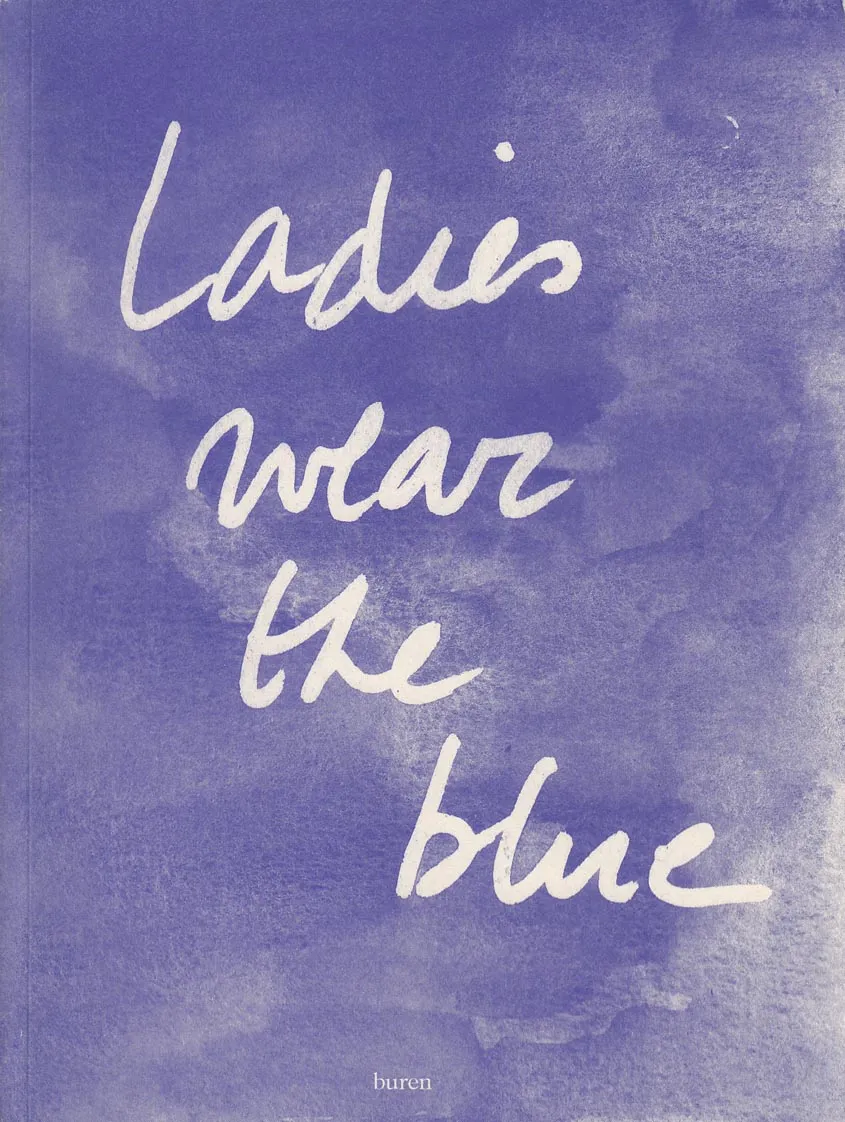
Ladies Wear the Blue
Ladies wear the blue is a collection of watercolour drawings by the hand of Melissa Mabesoone and Oshin Albrecht. The blue watercolours portray women from different moments in time. The adjacent texts describe these women's existence, roles, desires or ideosyncrasies deriving from the 'blue' in their lives. From the first female police officers and Alices all around, to Courtney Love's blue baby dolls and the girl with the blue tattoo Olive Oatman, this publication is an ode to women venturing into the world, and a way to continue telling their herstories.