rile*books

Search books

Search books by title, author, publisher, keywords...

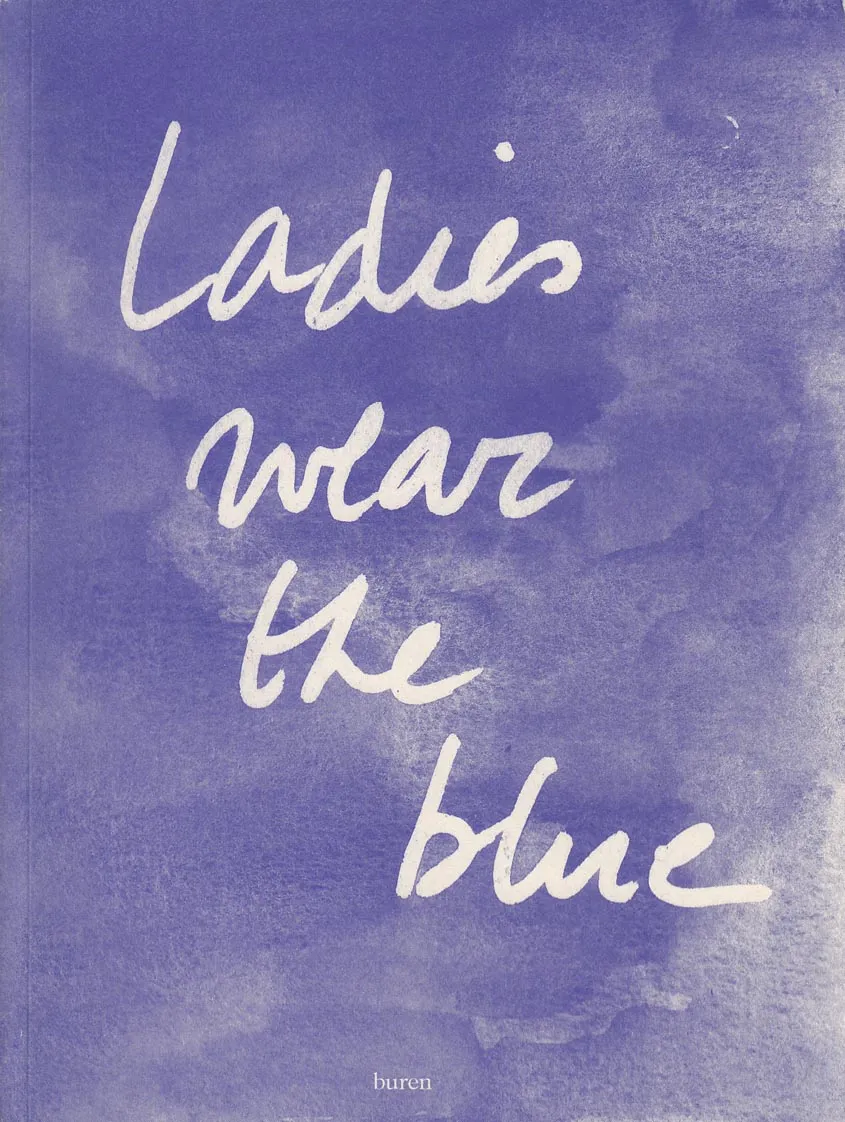
Cover of Ladies Wear the Blue

Self-Published

Ladies Wear the Blue

buren

€22.00

Ladies wear the blue is a collection of watercolour drawings by the hand of Melissa Mabesoone and Oshin Albrecht. The blue watercolours portray women from different moments in time. The adjacent texts describe these women's existence, roles, desires or ideosyncrasies deriving from the 'blue' in their lives. From the first female police officers and Alices all around, to Courtney Love's blue baby dolls and the girl with the blue tattoo Olive Oatman, this publication is an ode to women venturing into the world, and a way to continue telling their herstories.
Language: English

recommendations

Cover of Notes on a life not lived

Self-Published

Notes on a life not lived

Despina Vassiliadou

Poetry €30.00

This publication is based on a project by Despina Vassiliadou that ran from 2015-16. It presents a collection of photographs taken during the period, accompanied by fictional short stories.

Cover of Knee Balance

Self-Published

Knee Balance

Matty Davis

Performance €35.00

KNEE BALANCE (2021) is a performance that uses choreography, writing, photography, and design to traverse particular anatomical, personal, and sociopolitical arcs. Time oscillates and fractures movement. Space unfolds. Situated before a hearth in the throes of balance, the performer becomes a crucible for memory, durability, and the reciprocal relationship between the present and the unforeseen.

Comes nested inside ad hoc polyvinyl sleeve with text by Matty Davis printed on front

This work marks the first in a series of performances by Matty Davis arranged for print by Matt Wolff. Distinct in content and form, each work weaves psychosomatic realities with the spatial and temporal possibilities of print.

Vital contributions have been made to this series of performances by artists including Will Arbery, Whitney Browne, Mark Davis, Eryka Dellenbach, Nile Harris, Jonah Rosenberg, Holly Sass, Matt Shalzi, and Bobbi Jene Smith.

Cover of rosa rosa rosae rosae

Self-Published

rosa rosa rosae rosae

Pauline Hatzigeorgiou

Produced in conjunction with the exhibition that took place at Maison Pelgrims (10/9-23/10/2021), the book presents original interventions by the artists of the rosa rosae rosae project : Alicia Jeannin, Alicja Melzacka, Angela Detanico & Rafael Lain, Annaïk Lou Pitteloud, Audrey Cottin, buren, Charlie Usher, Eleanor Ivory Weber, Eva Giolo, Henry Andersen, Jan Vercruysse, Maíra Dietrich, Marc Buchy, Maxime Jean-Baptiste, Niels Poiz, Oriol Vilanova, Sabir (Lucie Guien, Amélie Derlon Cordina, Sophie Sénécaut / Perrine Estienne,  Kevin Senant, Maud Marique, Pauline Allié, Carole Louis), Slow Reading Club, Sofia Caesar, Surya Ibrahim, Yiannis Papadopoulos, Yoann Van Parys

Edited by Pauline Hatzigeorgiou / SB34
Graphic design by Tipode Office
The book was produced with the support of Fédération Wallonie-Bruxelles (aide à l'édition) and Région Bruxelles-Capitale (Image de Bruxelles)

Cover of Stili Drama XIII-XXI / La Giostra di Lulu XLI-XLIV

Self-Published

Stili Drama XIII-XXI / La Giostra di Lulu XLI-XLIV

STILI DRAMA

The materials collected in the publication have been developed departing from the documentation, transcription and translation of textual, visual, sculptural and audio materials produced between March and November 2021 for STILI DRAMA. 

STILI DRAMA is an open-ended episodic para-cinematographic project, which functions as a spontaneous expression of MRZB research. STILI DRAMA XVIII-XXI and LA GIOSTRA DI LULU XLI-XLIV are the two first fragments of the work.

Language: English, Italian
Edition of 100 copies

Cover of Swamp, City, Forest

Self-Published

Swamp, City, Forest

Valentina Bianchi

Zines €7.00

This zine is the result of the research residency "Plotting with the archive" that took place at Komplot between September 2025 and January 2026. The publication contains a subjective timeline of Komplot — its strategies, relations and projects — with the aim of organising them and at the same time speculating on possible future developments. The material was produced during a collective workshop in which the archive was explored and activated.

Cover of David Robilliard Notebooks 1983-1988

Rob Tufnell

David Robilliard Notebooks 1983-1988

David Robilliard

Poetry €32.00

This book follows the first exhibition of Robilliard’s notebooks, ‘Disorganised Writings and Sketches’ with Rob Tufnell in Cologne in April 2019. It was made with support from the Elephant Trust and the book’s designers, A Practice for Everyday Life and with assistance from James Birch, one of David’s gallerists, and Chris Hall, custodian of the estate of Andrew Heard. The book is dedicated to Andrew Heard.

Rob Tufnell presents a new publication of extracts from the notebooks of the poet and artist David Robilliard (b.1952 – d.1988). After his premature death from an AIDS-related illness in 1988, Robilliard left a large number of notebooks in the care of his close friend and fellow artist Andrew Heard. These were obsessively filled with drafts of poems, diary entries, addresses and telephone numbers, blunt observations, quiet reflections, short stories, ideas for paintings, portraits and crude drawings. Robilliard’s superficially simple, pithy prose and verse is riddled with the dichotomies of an era that was both exuberant and miserable. His notebooks reveal his creative process, his interests, ideas, ambitions and then his illness but always embody his often repeated belief that ‘Life’s not good it’s excellent.’ 

Many of the books contain the inscription: ‘If found please return to 12 Fournier Street, London E1. Thank you’ – the home and studio of his patrons, Gilbert & George. In their lament ‘Our David’ (1990) they describe their protégé as: 

“...the sweetest, kindest, most infuriating, artistic, foul-mouthed, witty, sexy, charming, handsome, thoughtful, unhappy, loving and friendly person we ever met... Starting with pockets filled with disorganised writings and sketches, he went on to produce highly original poetry, drawings and paintings.”

The publication exists in two editions: yellow and pink.

Cover of In the forest of grief I grew into a shrub of gold

Archivist Addendum

In the forest of grief I grew into a shrub of gold

Delaine Le Bas

For British artist Delaine Le Bas, dress is divine. Clothes appear as both mask a nd memorial within an expansive body of work exploring mythologies of Le Bas’s Romani ancestry. Embroidered and hand-painted textile is central to the artist’s lyrically activist practice, alongside costume, writing and performance. In a new series of portraits by the British photographer Tara Darby, directed by Jane Howard, gold leaf dances across the planes of Le Bas’s face in repose, it wraps and jangles around her wrists, glimmers across her clothes. In a notebook she has inscribed: “In the forest of grief I grew into a shrub of gold.” The grief is alchemical.

As Stephen Ellcock writes:

‘The maxim ‘Know Thyself’ was inscribed in gold on a column on the threshold of Pythia’s temple, serving as a warning that wisdom, understanding, empathy and anything remotely resembling peace of mind are unachievable without selfawareness, reflection and ruthless self-criticism.’

The fragments of hope, anger, magic and curiosity redolent in Le Bas’s work form a call to action. A reminder of the racism, exclusion and subjugation that abound. Photographs of Le Bas, which Darby has been making for more than a decade, present the artist as truth sayer, inquisitive goddess and modern-day Sibyl.

Through the incorporation of texts—a conversation between gallerists John Marchant and Keiko Yamamoto with curator Claire Jackson—drawings from Le Bas’s journals, archival images taken at her home and the restyling—and reflection—of her own personal wardrobe, In the forest of grief I grew into a shrub of gold radiates psychological, social and political wisdom. Fashion is revealed as both tyrannical disguise and liberating regalia.

Cover of Broken Villas

Bricks from the Kiln

Broken Villas

Helen Marten

Written in response to three “physical” photographs, ‘Broken Villas’ contains and considers how a vessel might clasp tightly to known volumetric identities, but also loom with a set of accentuated clues towards otherness: the excavated seams in the earth and what we fill those holes with, imaginary or otherwise; the glacial erraticism of the boulder; the queer crimping of a hotel pillowcase; the modes via which objects are housed as display, but also packaged away, with sorrow, with fear, with erotism etc.