Children's Books
Children's Books

Wednesday
Duck is back! When Cat hits Duck’s handball out of the park, it boing boing boings all the way from the court to outer space to a sewer and bonks a giant Alligator on the head! Follow Alligator search through city streets for the mysterious owner of the missing ball. Eugene Terry returns to his endearing characters for the second installment in the series. Sprinkled with easter eggs for all ages throughout the soft and intricate illustrations, Terry whimsically weaves a tale of friendship and discovery.
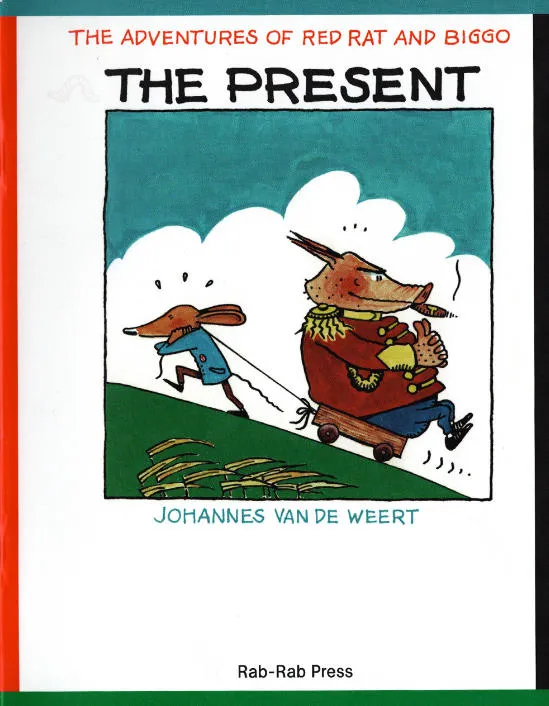
The Adventures of Red Rat and BIGGO – The Present
A children's book by Johannes van de Weert, a veteran of the punk underground (Rondos, The Ex, Red Rat, Raket).
The Adventures of Red Rat and BIGGO – The Present is a remake of Bram konijn en Piet de muis [Bram the Rabbit and Piet the Mouse], a 1982 children's book by Johannes van de Weert, a veteran of the Dutch punk underground who played with Rondos and The Ex, and who was the force behind Red Rat and Raket editions.
The Present is a 2010 remake telling the story of a bully pig who terrifies a poor rat on a daily basis. After a while, the rat falls ill with fear and has to stay in bed. The lonely, evil pig has no one to play with and becomes depressed. The pig gives the rat a present—a bunch of beautiful flowers—and all is well. Now the two can play together.
The 2010 remake, featuring different characters and intended for a North Korean audience, was never published. The 2025 English version opens with an introduction by Van de Weert, telling a bizarre story of a failed political career and an absurd vaudeville class struggle behind the seemingly harmless educational children's book.
Johannes van de Weert was a cartoonist active in the Rotterdam punk and squatter's movements of the 1980s. He was a singer with the punk band De Rondos and he started self-publishing small comic booklets in the late 1970s. He created his character "Redrat" for the fanzine Raket in 1980. The character soon became an icon for the squatter's movement.

Knigi
The new, adapted and expanded edition of Benjamin Sommerhalder's children's book (the story of the little ghost Knigi, learning how to read).
On little Ghost Knigi's birthnight he receives a book from his Aunt Abel. When she hands it to him all she says is, ‘I hope you enjoy reading this!' Knigi is quite young, but still at an age when human children normally learn to read. And it's the same for ghost children. ‘But something is wrong', Knigi worries. The book is absolutely white – every page, from cover to cover. Knigi is forced to embark on a journey to find out how to read.
Ghost Knigi is the first book drawn and written by Benjamin Sommerhalder and published in a first edition by Nieves in Zurich.
Graphic designer and publisher based in Zurich, Benjamin Sommerhalder is the founder and editor-in-chief of Nieves.

Life with Fifi
Kris Dittel, Angelica Falkeling
A children’s book without a specific age category, offering a glimpse into the small rituals and shared moments that shape a day with Fifi Paris.
Fifi, a Pomeranian-Chihuahua mix, came into the lives of Angelica and Kris a few years ago. Taking care of a puppy is taking responsibility for building their world and letting the small animal transform yours. As her human caretakers, the authors created Fifi’s world with toys, cuddles, rules, snacks and walks in the park. In return, she transforms our world by bringing our community together and reminding us of the importance of caring for one another. In this book, Kris and Angelica narrate a day in the life of Fifi, from the moment she wakes up to when she falls asleep at night. Along the way, they share how they connect with her, how they see her understanding her surroundings and what she has taught them about companionship.
Design by Amy Suo Wu
Copy-editing by Clem Edwards
Photography by Lili Huston-Hertreich

Katrin – The Tale of a Young Writer
Unica Zürn, Louis Bazalgette Zanetti
A partly autobiographical novel that the German surrealist artist and author Unica Zürn (1916-1970) wrote for her ten-year-old daughter in 1953, although it would never be published in her lifetime. This is the first translation of the tale from German into English.
Unica Zürn tells the story of fifteen-year-old motherless Katrin, an aspiring writer, who lives with her father, also a writer. The novel is set in an imaginary world, a metropolis called Linit, split into three levels: Oberstadt (Hightown), Mittelstadt (Middletown) and Unterstadt (Lowtown), overlooked by a Volcano where the artists live and crossed by the river Emil. Presented as a book for children, apparently written for her own daughter (named Katrin), Katrin also draws on the personal biography of Zürn herself, in terms of her relationship with her father and the city of Berlin after WWII, and her experience with people on the margins of a society characterised by great tensions.
About Unica Zürn
Nora Berta "Unika" Ruth Zürn, originally known as Ruth, was born on 6 July 1916 in Berlin. Raised in Berlin, Zürn had a contentious relationship with her mother, while she idolized her absent father. While at school she published her first short stories in magazines for young people, and in 1933 she began to work at the UFA film studios in Berlin (acronym for Universum-Film Aktiengesellschaft, a major German film company producing and distributing motion pictures from 1917 until the end of the Nazi era). In 1942 she married and had two children, Katrin and Christian. Shortly after, she lost the custody of her children. For the next few years she survived by writing short stories for newspapers and radio plays. After the war, she became part of the Bohemian group of Berlin and began to call herself Unika (after her aunt Unika Pudor). She frequented the artistic milieu revolving around the DADA-surrealist cabaret Die Badewanne ("The Bathtub"). In 1953, Zürn met the artist Hans Bellmer, best known for his disassembled dolls in unconventional poses directed at the cult of the perfect body then prominent in Germany, and became his muse. They lived together in Paris for many years, albeit in a conflictual relationship. Zürn concentrated on producing poetic anagrams supplemented by drawings, thus developing her own multidimensional surreal style. From the late 1950s, she suffered from forms of anxiety, later diagnosed as schizophrenia, and produced a wealth of remarkable textual and visual material while in psychiatric institutions across Germany and France. From 1956 to 1964, Zürn had four solo exhibitions of her drawings, and her work was included in the Exposition Internationale du Surréalisme. The exploration of the unconscious dimension would increasingly lose its liberating, positive aspect and turn into a fixation on a narrow space, one in which the self is tormented by distressing visions. Her psychological difficulties inspired much of her writing, especially Der Mann im Jasmin (The Man of Jasmine, published in English in 1971). Other published texts by Zürn include Hexentexte (1954) and Dunkler Frühling (Dark Spring, 1967). Zürn died on 19 October 1970 in Paris, throwing herself from the sixth floor.

Les arbres la nuit
Rosanna Puyol Boralevi, Pablo Réol
An artist's book for children, with text by Rosanna Puyol Boralevi and drawings by Pablo Réol, printed in risography.
New edition of the book published in a limited edition of 50 copies in 2024.
Rosanna Puyol Boralevi is a French poet, translator and editor. Co-founder of Brook editions, she publishes translations of texts inspired by feminist and anti-racist struggles, a literature that is both poetic and analytical. She collaborates with artists on exhibitions, video and performance programs, and organizes reading groups, writing and translation workshops, often with friends.
Pablo Réol (born 1989 in Bordeaux) is a French artist.

Stories of Wounds and Wonder
This experimental children’s book narrates cross-species practices of survival across the Indonesian archipelago, centring the perspectives of local animals such as endangered monkeys, cosmopolitan rats, migrant sparrows and fugitive dogs. Written in the form of a play, its six episodes ground the readers in the animals’ struggles and aspirations as they go about their daily lives and face the consequences of postcolonial erasure, ecological destruction and capitalist expansion. While the stories unfold, their interconnected existences become an archive of uncertainties, where the fate of many different creatures, humans included, is inseparable from each other.
As a script for intergenerational transmission, the book thoughtfully combines dialogues, songs and drawings, with contextualising essays and extensive notations. Through these different modes of reading, children and adults alike will learn about cross-species solidarity and rebellious movements, but also about disappearing Indigenous cosmologies, and the brave women who wove cloths around the mountains in eco-political resistance.

Questions to Ask Before Your Bat Mitzvah
Questions to Ask Before Your Bat Mitzvah invites 38 writers, artists, scholars, and activists to offer accessible reflections on 36 questions to help young Jews—and anyone else who picks up this book—feel grounded in the Jewish radical tradition, unlearn Zionism, and deepen their solidarity with Palestinians, offering the B’nai Mitzvah as an opportunity for political awakening open to all. Edited by comedic performance artist and activist Morgan Bassichis with artist and educator Jay Saper and writer Rachel Valinsky, with a foreword by seminal scholar-activist Angela Y. Davis, and illustrations by the artist Nicole Eisenman, this essential volume offers an accessible and challenging set of personal and collective responses to critical questions for our time.
Questions included range from “What even is a Bat Mitzvah?” and “I’m queer/nonbinary/secular/old/not even Jewish—are Bat Mitzvahs for me?” to “Why are there Israeli and American flags in my synagogue?” and “Why do people plant trees in Israel as a Bat Mitzvah gift?” and “What does the olive tree symbolize to Palestinians?” and “What does the watermelon symbolize to Palestinians?” and “What do Palestinian kids do when they turn thirteen?” and “How do I talk to my family about this stuff?”

In the Jungle There Is Much to Do
Originally written as letters from enclosure, In the Jungle There Is Much to Do came out of the words and drawings sent by Mauricio Gatti, a young anarchist, to his three-year-old daughter, while he was imprisoned in military barracks in Montevideo. In 1972 the compiled letters were made into a book published by his comrades from the commune Comunidad del Sur. It tells the story of an elephant, a snail, a turtle, a seal, and a bird. They are all trapped by a hunter, who understands nothing of the jungle and who locks them up in the city zoo, where they miss their home and little ones. This fable for all ages about political prison was republished by different small organizations associated with the international solidarity movement supporting Latin American political refugees in the 1970s and 1980s.
Among these editions was a coloring book published in the GDR, which we used as a basis for a new German edition. The original text by Gatti was translated into English for the first time. Both language editions were published by the 11th Berlin Biennale in the fall of 2019. The curatorial team of the Berlin Biennale has decided to make these publications freely accessible on the website. The book is available for download and print-out, and a special black-and-white version has been created for free coloring.

"Tu verras quand tu seras grand!"
Un livre qui t’expliquera tout sur l’argent, l’économie capitaliste, le système bancaire, la police et la révolution !
"Tu verras quand tu seras grand!", premier livre pour enfants des éditions L'Amazone, explique l’économie capitaliste mondialisée à travers quatre chapitres sur l'argent, le système bancaire, la police et la révolution. Il a été réalisé à partir des livres cités par l’auteure Marie L’or Kaeppelin-Billaudot dans Il sera une fois… Essai sur le contenu des livres pour enfants (Espaces féminins, La pensée sauvage, 1978). "Tu verras quand tu seras grand!" part du constat que peu de livres pour enfants traitent ouvertement de la question économique alors qu’elle est omniprésente dans leur quotidien. Le détournement de ces ouvrages, plus de quarante ans après leurs publications, nous permet de repenser notre rapport à ces mythes fondateurs, de la même manière qu’un conte joue un rôle dans la construction d’une histoire commune.
À partir de 6 ans.
Conception d’ouvrage : Tiphanie Blanc
Design Graphique : Tiphanie Blanc & Roxanne Maillet
Impression riso : Autobahn
Couverture sérigraphiée : Chromodrome
Papier : Arena Natural Rough 200g & Sirio Color Foglia 350g
Typographies : Ovo de Nicole Fally, Gaya de Raphaël de la Morinerie, DinDong de Clara Sambot, Zarathustra de Lorène Ceccon, Cormorant de Catharsis Fonts & Zipper de Bob Newman
Exemplaires : 250

Catwings Return
A mini-edition sequel to Catwings follows four winged tabby cats as they return to the city of their birth to find their mother and a new companion.
Wishing to visit their mother, two winged cats leave their new country home to return to the city, where they discover a winged kitten in a building about to be demolished.

Wonderful Alexander and the Catwings: A Catwings Tale
When a spoiled kitten named Wonderful Alexander gets caught in a tree, it's up to Jane to save him. Once he is rescued and adopted by the catwings, Alexander decides to repay Jane's favor by helping her to overcome her mysterious fear of speaking.
Ursula Le Guin writes both poetry and prose, and in various modes including children's books, YA books, fantasy, science fiction and fiction.