Books
Books
in random order
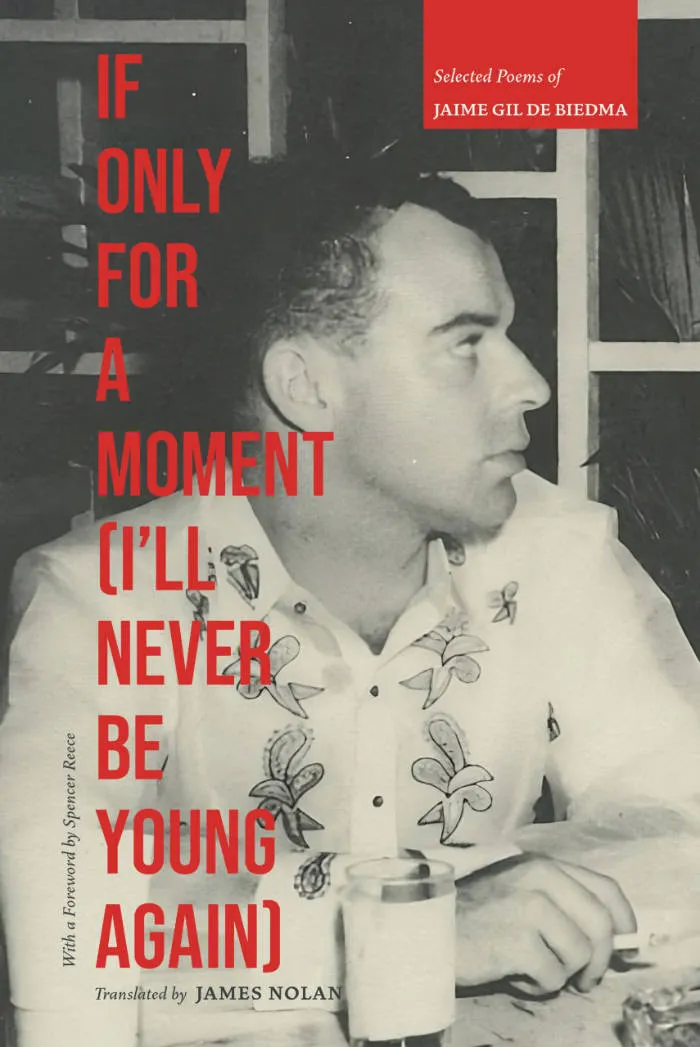
If Only For a Moment (I’ll Never Be Young Again)
Jaime Gil de Biedma, James Nolan
Jaime Gil de Biedma is the most original and influential among the poets known as the ‘50’s Generation in Spain, and is considered the greatest Spanish poet to emerge in the second half of the 20th century. His life and literary career were bracketed almost entirely by the rise and fall of Generalissimo Francisco Franco, notorious for the suppression of literature. Born in 1929, Gil de Biedma was six years old when García Lorca was murdered in Granada at the outbreak of the Civil War, and his collected poems, Las personas del verbo, first appeared in 1975, the year Franco died. What is surprising is that Gil de Biedma was a leftist, homosexual poet from the Catalan capitol, Barcelona – all of Franco’s favorite things – who not only published books of autobiographical poetry in Spain but was known as a poet of social conscience as well as erotic lyricism. Like other Spanish poets of his time, he chose his words carefully. Gil de Biedma died of AIDS in 1990.
If Only For a Moment (I’ll Never Be Young Again) consists of an extensive bilingual selection of Gil de Biedma’s poetry, including all of his most well-known work. The book additionally consists of a Foreword by Spencer Reece, Jaime Gil de Biedma’s short essay “I wanted to be the poem,” and two different essays on Gil de Biedma and the art of translation by James Nolan, the volume’s translator.

The Book of Na
In The Book of Na, translation acts at the edge of perception. Tracing across projects in film, video, and performance, Na Mira reflects on the violent fragmentation of bodies while refusing the containment of geographic and corporeal borders. In 1977, a name is cut at an immigration office. This gap turns into an intergenerational score for becoming heat, hexagram, hologram. Using oracular and glitching technologies, Mira witnesses what escapes data: doppelgängers, dreams, endangered tigers, tesseracts, A. Turiyasangitananda Coltrane's stairs, Theresa Hak Kyung Cha in a theater, Korean shamanism, frozen ligaments, wildfires, borderlands, subatomic particles, and pink. Syncing to a clock with neither face nor hands, Mira’s hauntological permutations in time, death, and relation travel outside the symbolic order and draw energy from the void.
Na Mira’s autobody rites have been presented at sites including Seoul Museum of Art; Museum of Contemporary Art, Los Angeles; Portland Institute of Contemporary Art; Participant Inc., New York; and Whitney Museum of American Art, New York. She earned an MFA from the University of California, Los Angeles. She grew up between the US and East Asia and teaches outside.

Beloved
Staring unflinchingly into the abyss of slavery, this spellbinding novel transforms history into a story as powerful as Exodus and as intimate as a lullaby.
Sethe, its protagonist, was born a slave and escaped to Ohio, but eighteen years later she is still not free. She has too many memories of Sweet Home, the beautiful farm where so many hideous things happened. And Sethe's new home is haunted by the ghost of her baby, who died nameless and whose tombstone is engraved with a single word: Beloved. Filled with bitter poetry and suspense as taut as a rope, Beloved is a towering achievement by Nobel Prize laureate Toni Morrison.

Salvage: Readings from the Wreck
Dionne Brand explores English and American literature, and the colonial aesthetic that shaped her sense of self and the world, of what was possible and what was not.
In Salvage: Readings from the Wreck, Dionne Brand’s first major book of nonfiction since her classic A Map to the Door of No Return, the acclaimed poet and novelist offers a bracing look at the intersections of reading and life, and what remains in the wreck of empire. Blending literary criticism and autobiography-as-artifact, Brand reads Aphra Behn’s Oroonoko, Daniel Defoe’s Robinson Crusoe, and Jane Austen’s Mansfield Park, among other still widely studied works, to explore encounters with colonial, imperialist, and racist tropes from the seventeenth to the nineteenth centuries—tropes that continue in new forms today. Brand vividly shows how contemporary practices of reading and writing are shaped by the narrative structures of these and related works, and explores how, in the face of this, one writes a narrative of Black life that attends to its own consciousness and expression.
With the power and eloquence of a great poet coupled with the rigor of a deep and subtle thinker, Brand reveals how she learned to read the literature of two empires, British and American, in an anticolonial light—in order to survive, and in order to live.
This is the library, the wreck, and the potential for salvage she offers us now, in a brilliant, groundbreaking, and essential work.

A Drink of Red Mirror
A landmark feminist poet and critic in her native South Korea, Kim Hyesoon’s surreal, dagger-sharp poetry has spread from hemisphere to hemisphere in the past ten years, her works translated to Chinese, Swedish, English, French, German, Dutch, and beyond. In A Drink of Red Mirror, Kim Hyesoon raises a glass to the reader in the form of a series of riddles, poems conjuring the you inside the me, the night inside the day, the outside inside the inside, the ocean inside the tear. Kim’s radical, paradoxical intimacies entail sites of pain as well as wonder, opening onto impossible—which is to say, visionary—vistas. Again and again, in these poems as across her career, Kim unlocks a horizon inside the vanishing point.

Terminal Boundaries and A natural water course diverted reduced or displaced
Made in 1969 but never published, Terminal Boundaries is an artist book by Lawrence Weiner, a sculptor whose medium was language. The manuscript for the publication, which was recently brought to light, contains two related bodies of work represented as typewritten statements on paper that Weiner pasted to the pages of a small composition notebook. The book’s absence from Weiner’s oeuvre plagued him as it marked a terminus of his relationship to the physical construction of his artworks, and illustrated the principle of “specific” and “general” which he applied to his art.
Created from a standard notebook purchased in a stationery store, the manuscript is two books in one: Terminal Boundaries and A natural watercourse diverted reduced or displaced. A tête-bêche with two front covers, the book can begin from either cover by turning it upside down.
Weiner was a traveler by nature and the materials he refers to in these works are those that one can encounter on a road trip. The artist was traveling across Europe when this manuscript was composed. Struck by the tumultuous times and the critical illuminations about the climate from the Club of Rome discussions, the works in this book are in Weiner’s words, “concerned with the relationship of natural resources in relation to human beings.” Distinct from his contemporaries associated with the Land Art movement, in Terminal Boundaries and A natural water course diverted reduced or displaced, Weiner constructs his landscape interventions in language—the specific and/or general act and the location are stated—offering the reader/viewer the opportunity to consider each work’s existence, to build it in their mind’s eye. One can only wonder what Weiner did to divert, reduce, or displace a natural water course in Saltsrumen, Norway, the location of the world’s strongest maelstrom, or in nearby Bodø at the site of Svartisen glacier. A work in Terminal Boundaries titled The joining of France Germany and Switzerland by rope demonstrates the geopolitical perspective of Weiner’s land art. Requiring physical and mental borders to be transgressed in performing this work; how and where could this happen?
Terminal Boundaries finds Weiner just off the cusp of his decision to make art that lived centered in language, emphasizing the viewer’s responsibility to engage with it to make it whole. The book marks a crucial inflection point in the artist’s practice, defining his direction to make work that “attempts to present something to people that is not just about me,” but about materials and the world we find ourselves in here and now.

rosa rosa rosae rosae
Produced in conjunction with the exhibition that took place at Maison Pelgrims (10/9-23/10/2021), the book presents original interventions by the artists of the rosa rosae rosae project : Alicia Jeannin, Alicja Melzacka, Angela Detanico & Rafael Lain, Annaïk Lou Pitteloud, Audrey Cottin, buren, Charlie Usher, Eleanor Ivory Weber, Eva Giolo, Henry Andersen, Jan Vercruysse, Maíra Dietrich, Marc Buchy, Maxime Jean-Baptiste, Niels Poiz, Oriol Vilanova, Sabir (Lucie Guien, Amélie Derlon Cordina, Sophie Sénécaut / Perrine Estienne, Kevin Senant, Maud Marique, Pauline Allié, Carole Louis), Slow Reading Club, Sofia Caesar, Surya Ibrahim, Yiannis Papadopoulos, Yoann Van Parys
Edited by Pauline Hatzigeorgiou / SB34
Graphic design by Tipode Office
The book was produced with the support of Fédération Wallonie-Bruxelles (aide à l'édition) and Région Bruxelles-Capitale (Image de Bruxelles)

MAKAN #2 / Manufacturing Narratives
In its second issue, Manufacturing Narratives, Makan focuses on how interrogating narrativity can provoke fundamental questions about how societies define or choose to accept societal or historical truths in today’s world. Spanning across [and beyond] the Mashreq and Maghreb, the various contributions reflect a shared space of inquiry that bridges geographies and fosters emergent dialogues across shifting territorialities. This issue invited contributors to right (as much as write) narratives: to question authorship and its social collectivities, to retell alternative public histories, to explore gender roles, and to unsettle the exoticism, folklorization, and political textures of fiction as a practice of indiscipline. Together, these contributions re-articulate the genealogies of our present through the pluralities of the past, offering tools to imagine and manufacture alternative futures, and realities otherwise.
With contributions by Ala Younis, Bari Abbassi, George Bajalia, Karim Kattan, Karima Kadaoui, Tamkeen, Kenza Sefrioui, Lahbib El Moumi, Laila Hida, Maureen Mougin, Mohamed Amer Meziane, Monica Basbous, Nadia Tazi, Sénamé Koffi Agbodjinou, Salma Barmani, Sonia Terrab, Soufiane Hennani, Yto Barrada.

Elad Lassry: On Onions
An artist's book presenting a photographic study of onions.
On Onions is a photographic study of onions by artist Elad Lassry (born 1977). Characteristically highlighting the spectrum of hues and shapes for the vegetable, Lassry's selected taxonomy includes sections on red, yellow and white onions, each of which possesses its own distinct taste and benefits. On Onions is Lassry's first artist's book, and the work will exist only in book form; it is at once wry, refreshing and disorienting in its biology workbook style, which makes fruitful use of "the confusion that results when there is something just slightly wrong in a photograph" (as the artist has described his practice in general).
Composed by the artist and arranged by Stuart Bailey, the book includes an essay written by Angie Keefer about the effects of sliced onions on human tear ducts.

Afghanistan
Afghanistan is my father’s homeland. He was born in Kabul in 1945 and later moved first to France, then to Switzerland in the 1970s. In my mind, Afghanistan exists as a geography with blurred edges, something I feel the need to reconcile with. It’s a place I’ve only ever known through stories, a source of memories that, over time, have shifted and become distorted.
Contributors: Luca Cerizza, Farid Rahimi, Said Rahimi, Susanna Ravelli, Francesca Recchia, Zafar Sayan, and Dawood Tawana

Ductus
DUCTUS is the latest solo project by Paul Abbott, featuring 51 minutes of audio, across 12 tracks, and a 42 page booklet featuring new writing. DUCTUS was written and recorded in Edinburgh and Porto in 2019.
DUCTUS presents a playful weave of collapsing time through a number of speculative elements and fictional characters. Abbott feels his way through learning drums, rhythm and writing as fleshy research technologies. DUCTUS is the latest stage in a process considering sound, the body, imagination, and language through music. This features as part of ongoing investigations using real and imaginary drums, synthetic sounds, performance and writing.

Solidaires!!!
Solidaires est un syndicat de lutte et de transformation sociale qui défend les travailleuses et travailleurs de France.
Cet ouvrage réunit une sélection de plus de 70 visuels créés par la graphiste Anaïs Enjalbert et des militant·e·s pour l'Union syndicale Solidaires.
Ce livre est une archive sélective de visuels dont les slogans accompagnent des valeurs et des pratiques émancipatrices allant du féminisme à l’antiracisme, de l’internationalisme à l’anti fascisme, de la lutte contre les lgbtphobies à celle contre le validisme. Ils soutiennent la lutte contre le capitalisme et pour les services publics.
Format 14 x 19,5 cm
Conception graphique: Magali Brueder

How to Sleep Faster 2
How to Sleep Faster 2 is the second of our biannually published journals that form the backbone of Arcadia Missa’ critical collaborative discourse on participation, post-digital visual-production and institutional subjectivity.This issue explores moments of collapse, shift and potential in a cultural moment framed by economic, political and societal disturbance.
Arcadia Missa Publication; eds Rozsa Farkas, Tom Clark et al.

University of California Press
Novel Palestine
Palestinian writing imagines the nation, not as a nation-in-waiting but as a living, changing structure that joins people, place, and time into a distinct set of formations. Novel Palestine examines these imaginative structures so that we might move beyond the idea of an incomplete or fragmented reality and speak frankly about the nation that exists and the freedom it seeks. Engaging the writings of Ibrahim Nasrallah, Nora E. H. Parr traces a vocabulary through which Palestine can be discussed as a changing and flexible national network linking people across and within space, time, and community. Through an exploration of the Palestinian literary scene subsequent to its canonical writers, Parr makes the life and work of Nasrallah available to an English-language audience for the first time, offering an intervention in geography while bringing literary theory into conversation with politics and history.
NORA E. H. PARR is a Research Fellow at the University of Birmingham and at the Center for Lebanese Studies. She coedits Middle Eastern Literatures.

Fleshed Out For All The Corners Of The Slip
This major new work is thought, spirit and sense (in every sense) ‘fleshed out’ in ‘all the corners’ by being unmade – as poetry, as music, as (black and white) images, and as attention to the interconnected circuitries the One has with the social, historical and environmental ‘to / link us outside’. These elements are no sooner embodied than they slip, shift, carousel and spin away. As Goodwin puts it: ‘no longer a bodily reference to an individual subject’s presence; not obliterated but made into an element, air or breath, as black poetry’s condition of im/possibility for, and refusal of subjecthood.’ Hence it is that this poetry achieves ‘flightacross precipitous intransigence’ (Will Alexander), perhaps flights of manifestations of spirit, ‘ghostly crowned / apogees’, like duppies, which is to say, sacred. Hence too the work’s urgent task to avoid ‘thingification’: the conscription and exploitation of thought &/or body for neo-colonialist, which is to say, neo-liberal ends. Goodwin eschews identity politics for a phenomenology that is more properly radical in both the etymological sense of the term – rooted and vital to life – as well as situated within a history of experimental black thought which, simultaneously, rejects normative traditions of meaning, signification and value. Both meanings are central to the anti-racist core of this important work – ‘when i don’t know you but you must know who i am’ – in a poetry that’s as breath-taking as it is breath-making. ‘Inexpressibly full with what words can do’.
— Emily Critchley, author of Home (London: Protoype, 2021), Arrangements (Shearsman Books, 2018) and Ten Thousand Things (UEA: Boiler House Press, 2017)
James Goodwin is a poet doing a PhD in English and Humanities at Birkbeck, University of London with a thesis on the blacksociopoetics of marronage, breath, sacrality and emanation. His pamphlet, aspects caught in the headspace we’re in: composition for friends, was published by Face Press; and his debut book, Fleshed Out For All The Corners Of The Slip, is forthcoming with the87press. He serves on the Editorial Advisory Board for the Journal of British and Irish Innovative Poetry.

Understanding Molecular Typography
Molecular typography is the study of the chemical and physical underpinnings of letters. All characters are formed from seven basic atomic building blocks, known as typtoms. These typtoms come together in various combinations and configurations to form letters, numbers, and punctuation. Typtoms are not just theoretical tools for exploring the anatomy of type, but actual particles. Letters are molecules.
H.F. Henderson’s work, Understanding Molecular Typography, originally published in 1992, was a seminal work in the field. By condensing information pulled from nearly forty years of publications from the top molecular typographic scientists, Henderson made the science approachable to the everyday American for the first time. Part primer, part field guide, it lays out the basic principles, followed by detailed diagrams of the molecular formation of letters, numbers, and punctuation. A conclusion sums up the field of molecular typography to date, and a comprehensive bibliography provides valuable reference for the reader looking to learn more.
With the demise of the field of molecular typography as a whole in the mid-to-late ‘90s, (perhaps even due to its increased popularity brought on by Henderson’s work), Understanding Molecular Typography ran out of print, and has long since been forgotten. Peculiar as it may be, molecular typography is nevertheless a science worthy of being brought back to mainstream attention, if for no other reason than demonstrating humanity’s frequent scientific misconceptions throughout history. This reprint edition, with a new introduction by Woody Leslie, seeks to do just that.
"Until Henderson's incredible analysis, no one had created a conceptual framework sophisticated enough to do the analytic work in graphical physics that the alphabet required if it was to be fully understood. True, some of the Russian futurists, like Ilia Zdanevich, in their examinations of the properties of language, had begun to grasp the vague outlines of a modern scientific approach to molecular components, to the formation of compounds, and their behavior as chemical substances, within the structure of poetics. But Henderson's research was comprehensive and the results nothing short of astonishing." —Johanna Drucker

David Robilliard Notebooks 1983-1988
This book follows the first exhibition of Robilliard’s notebooks, ‘Disorganised Writings and Sketches’ with Rob Tufnell in Cologne in April 2019. It was made with support from the Elephant Trust and the book’s designers, A Practice for Everyday Life and with assistance from James Birch, one of David’s gallerists, and Chris Hall, custodian of the estate of Andrew Heard. The book is dedicated to Andrew Heard.
Rob Tufnell presents a new publication of extracts from the notebooks of the poet and artist David Robilliard (b.1952 – d.1988). After his premature death from an AIDS-related illness in 1988, Robilliard left a large number of notebooks in the care of his close friend and fellow artist Andrew Heard. These were obsessively filled with drafts of poems, diary entries, addresses and telephone numbers, blunt observations, quiet reflections, short stories, ideas for paintings, portraits and crude drawings. Robilliard’s superficially simple, pithy prose and verse is riddled with the dichotomies of an era that was both exuberant and miserable. His notebooks reveal his creative process, his interests, ideas, ambitions and then his illness but always embody his often repeated belief that ‘Life’s not good it’s excellent.’
Many of the books contain the inscription: ‘If found please return to 12 Fournier Street, London E1. Thank you’ – the home and studio of his patrons, Gilbert & George. In their lament ‘Our David’ (1990) they describe their protégé as:
“...the sweetest, kindest, most infuriating, artistic, foul-mouthed, witty, sexy, charming, handsome, thoughtful, unhappy, loving and friendly person we ever met... Starting with pockets filled with disorganised writings and sketches, he went on to produce highly original poetry, drawings and paintings.”
The publication exists in two editions: yellow and pink.

Nova Scotia House
Nova Scotia House takes us to the heart of a relationship, a community and an era, both a love story and a lament.
In this profound meditation on grief, Johnny looks back at his relationship with his life partner, Jerry, after his AIDS-related death. When they met, nearly thirty years ago, Johnny was 19, Jerry was 45. They made a life on their own terms in Jerry’s flat: 1, Nova Scotia House. Johnny is still there today—but Jerry is gone, and so is the world they knew.
Intimate, visionary, and profoundly original—as well as raw, hot, and hilarious—Nova Scotia House marks the debut of a vibrant new voice in contemporary fiction.

The pedestrian
Emerging from the dark ecology between lullaby and ghost story, The pedestrian meanders down a labyrinth of divinatory time where crimes demand a more defective detective. To conjure the source of this text’s trauma, the poet becomes a ritual detective, tracing the wound by its shadow. Meaning emerges through distortion and echo—courting what cannot be seen head-on to create a haunted grammar of grief. An ill pastoral of displacement, The pedestrian turns domestic spaces into underworlds, the body of the exiled child into a prophetic threshold—it listens as much as it speaks, attuned to forces beyond itself.
The pedestrian is a map to a terrain of shards and shadows. While reading it, I felt lost only to the land of the normative, a lush fugitivity. I traveled far with, because of, and in this book. Hsiung trusts in the politics of decomposition, making syntaxes that have been distorted by grief, and thus sharpened to what cannot be colonially extracted. Writers like this know that grammar, vocabulary, and the sentence itself are haunted, so they write not to exorcise or cure this condition of its ghosts, but to make a place for them to live, a place they belong.
— Johanna Hedva
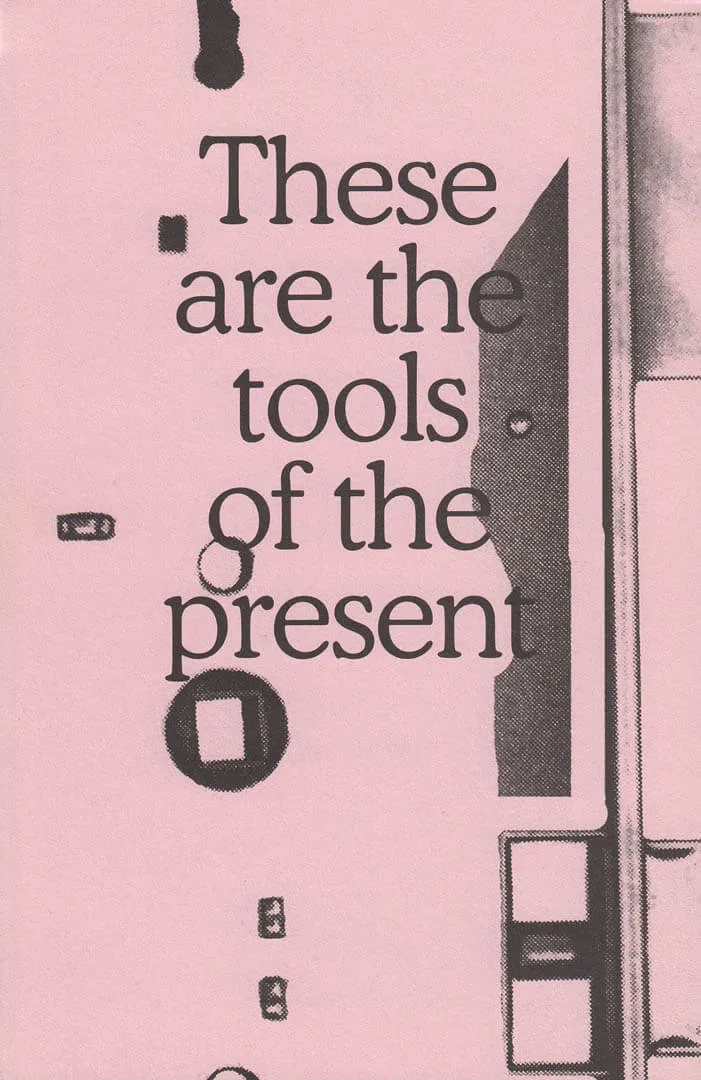
These are the tools of the present
Mai Abu ElDahab, November Paynter and 1 more
This publication comprises a series of interviews with contemporary artists, musicians, and writers who are in dialogue with Beirut and Cairo. While not purporting to be an overview of the art scenes in these cities, this book begins to draw a picture of how artists think about what it means to be active in the contexts of these cities. It offers insight into the circumstances that structured these artists’ stories, and the often accidental influences that have shaped how their practices have developed.

Pages 11 - Stage So Near So Far
Nasrin Tabatabai, Babak Afrassiabi
The new issue consists of 8 plays and performance texts by Iranian women writers living in or outside Iran. Whether based on actual experience, fictional, or drawn from archives, these texts deal in one way or another with the question of the stage. They produce a contested space of performance that is inevitably linked to the performer's body, whose thresholds are stretched and contracted into potentially new forms of staging. The authors in this issue place their writing in performative relation to the specific historical and sociopolitical conditions in which they live and work. In many ways, the writings interrogate the politics that delineate the stage itself.
The authors in this special issue are: Nasim Ahmadpour, Nil (Alista) Aghaee, Naghmeh Manavi, Athena Farrokhzad, Nazanin Sanatkar, Azade Shahmiri, Zahra Mohseni and Naghmeh Samini.

Schizo-Culture: The Event, The Book
Sylvère Lotringer, David Morris
The legendary 1975 "Schizo-Culture" conference, conceived by the early Semiotext(e) collective, began as an attempt to introduce the then-unknown radical philosophies of post-'68 France to the American avant-garde. The event featured a series of seminal papers, from Deleuze's first presentation of the concept of the "rhizome" to Foucault's introduction of his History of Sexuality project. The conference was equally important on a political level, and brought together a diverse group of activists, thinkers, patients, and ex-cons in order to address the challenge of penal and psychiatric institutions. The combination proved to be explosive, but amid the fighting and confusion "Schizo-Culture" revealed deep ruptures in left politics, French thought, and American culture.
The "Schizo-Culture" issue of the Semiotext(e) journal came three years later. Designed by a group of artists and filmmakers including Kathryn Bigelow and Denise Green, it documented the chaotic creativity of an emerging downtown New York scene, and offered interviews with artists, theorists, writers, and No Wave and pre-punk musicians together with new texts from Deleuze, Foucault, R. D. Laing, and other conference participants.
This slip-cased edition includes The Book: 1978, a facsimile reproduction of the original Schizo-Culture publication; and The Event: 1975, a previously unpublished and comprehensive record of the conference that set it all off. It assembles many previously unpublished texts, including a detailed selection of interviews reconstructing the events, and features Félix Guattari, William Burroughs, Kathy Acker, Michel Foucault, Sylvère Lotringer, Guy Hocquenghem, Gilles Deleuze, John Rajchman, Robert Wilson, Joel Kovel, Jack Smith, Jean-François Lyotard, Ti-Grace Atkinson, François Peraldi, and John Cage.

Hopelessness
"The brilliant Verity Spott has a new book out, called Hopelessness and published by the 87 Press. The work defies categorisation: Verity is a poet, and this book is certainly poetry, but large parts are in prose form and towards the end it even takes on the structure of an absurdist play. There seems to be a loose narrative, and even recurring character voices, so I’m tempted to call it a short experimental novel, in the vein of Kenneth Patchen’s The Journal Of Albion Moonlight (a personal favourite). Ultimately though I’d just call it a book; one full of words that are profound, moving, silly, sad, challenging and beautiful in equal measure. Even though it’s still a boldly experimental piece, in some ways Hopelessness feels like the most accessible thing Verity’s done. Without wanting to sound condescending, it’s also the most mature. You don’t get much more universal than death, love and loss, and these seem to be the main themes explored here. Another is language itself, the way it defines and limits our experience, and the way that we’re constantly at the mercy of words and phrases as they’re deployed by the authorities, the media, and eventually our own thought processes. Dissenting voices continually talk over one another throughout Hopelessness, often sampled from outside sources, or parodies thereof: Sappho, MR James, traditional hymns and folk songs, Hollywood movies, talk radio, tabloid newspapers, dreams and demagogues. Through it all there’s a painful lesson about how loss can make us bitter and hard, and how by refusing to move forward we become empty caricatures mouthing meaningless clichés to wound and hurt. But grief and loss can also teach us about love, if we let them, and there is so much grief and love in this book. Verity continually rearranges reality (that is, language) as if searching desperately for a way out, but in the end, as always, there is just life, love, and death. Hopelessness is a bravura performance, wholeheartedly recommended." — Ben Graham
Verity Spott is a poet from Brighton. Verity is the author of several books including Hopelessness (the 87 Press), Click Away Close Door Say (Contraband Books), We Will Bury You (Veer Books) and Poems of Sappho (in translation, Face Press). From 2018 to 2019 Verity was Poet in Residence at the University of Surrey. Verity teaches poetry in Brighton with The Creative Writing Programme and (alongside Kat Addis) with the Hollingdean Wednesdays project where they hold a poetry reading and writing group in Hollingdean Community Centre. Verity's poems have been translated into Greek, Spanish, Portuguese, Dutch and German and their book Hopelessness has been translated into French and published by Même pas l'hiver. Verity plays cello in the improvised tune duo Benzo Fury and the free jazz trio In Threads. Since 2006 Verity has run the monthly poetry, performance and music event Horseplay.

It Was Like Watching
Dear ____,
I happened to look for a while out of “my” window on the 17th floor Palliativstation of the Wiener Allgemeinen Krankenhauses last night, where an enormous orange moon was hanging about, consorting with a lick of dark cloud, near to the tiny gaggle of skyscrapers. I didn’t have much to say for myself and so it just sort of looked back at me.
Every day friends and well-wishers come here and as always I want to run to my room and read a book until they’ve left but for the first time in my life my room is also the room they want to visit, and so I can’t. I wrote down yesterday as best as I could the words of my last long conversation with Marina: there might be more, but the words are running away from her now, which only makes you realise how small and insignificant they are, fleeing from something (from someone) who remains exactly who they were even in their absence: like dust falling from the sun.
*
A voyage in the insight which comes as a kiss and follows as a curse, made after you ran out of things to say.——first halting efforts at mutual understanding——love letters from twelve years ago. journal entries from fifteen years before lick at the edges like flames. Opaque coloured shadows, projected in three dimensions——of a——future that——has. never ceased to exist and which——Doesn’t——.——.——arrive to speak about their fears.—— Beginning with a naked bathroom selfie.
An attempt to live nonjudgmentally and without fear, against the desire to be something other than who you were, as a basic form of class hatred, a fear of the common and of everything that happens there, near speechlessness, trailing off, only sometimes coming back to life again, shame dies so that everything else can be saved, and everything else remains present against the background of this absence, beneath the harsh overhead light, as you pull on the pathetic, unassuming string of the pullcord.
Dedicated to one person, written by one another. “Poems written by / different poets / are my nakedness.”