Books
Books
in random order

Minibieb
Infrastructural systems define our ways of seeing and responding to the world around us. Today, our everyday lives and visual cultures have become saturated by digital communications systems whose physical footprint has been rendered largely invisible from the public sphere.
In an age of ever-expanding computation and a foolish believe in AI’s utopian potential, resistance can seem futile. But if we detach our gaze from increasingly narrow realm of digital imaginaries, a new world of radically different infrastructural opportunities opens up in front of our eyes.
Street libraries, or Minibiebs, as they are called in Dutch, are an under-appreciated piece of urban technology. Part manifesto, part research note, this mini publication dives into the radical potential of public book sharing structures and what they might tell us about our broken information ecosystem.
Printing: Risograph, Grafische Werkplaats Den Haag; Research and Photography: Livio Liechti; Design: Apsara Flury.
First print run – May 2025: 35 copies.

The Interjection Calendar 005
Emily Pope, Christiane Blattmann
For the Interjection Calendar each month Montez Press invites an artist, a writer, a poet or a doer of some sorts to say things. All 12 pieces have introspection and reflection in common. They are a subjective overview of writing in the expanded field of contemporary art and writing in the year 2019. This is the Interjection Calendar 2019, the fifth collection in this series.
With contributions by sabrina soyer, Lisa Robertson, Hatty Nestor, Adrianna Whittingham, Sondria, Claudia Pagès, Laetitia Paviani, Bella Milroy, Georgina Tyson, Son Kit, Alix Jean Vollum, Rene Matic and bleubaglife.
Find the last 12 PDF's on montezpress.com.

One Big Bang
One Big Bang brings together 78 charcoal and pastel drawings from Adel Abdessemed's recent series Nature Morte and Politics of Drawing, where everyday objects, animals, and flowers are subtly charged with tension. Through these works, Abdessemed explores the intersections of beauty, fragility, and unrest. With texts by Hélène Cixous and David Elliott, One Big Bang offers a thoughtful entry into an artist's visual language shaped by memory, myth, and political urgency.
Published following the eponymous exhibition at Projeckt Brussels in 2024.
Adel Abdessemed (born 1971 in Constantine, Algeria, lives and works in Paris and Berlin) deconstructs identity codes, tackling head-on the tensions that permeate our society. His works, with their typical simplicity—sculptural installations, drawings, photographs, videos and performances—echo precise facts and familiar situations, but go beyond narrative commentary and militant criticism. Adel Abdessemed questions, among other things, the social and economic status of the artist in a system where his foothold is slight, by shrewdly keeping a distance in a gesture of subversive and committed resignation.
Abdessemed refuses to be limited to a single ideology. In his early works he passionately tackled religious, sexual, and taboos subjects and his later exhibitions have often focused on the theme of global violence. In an interview with Elisabeth Lebovici he stated, "I do not live between two cultures. I am not a postcolonial artist. I am not working on the scar and am not mending anything. I am just a detector … In the public sphere, I use passion and rage. Nothing else. I don't do illusions."
Sometimes reduced to a simple word, as in "Mohammedkarlpolpot" (1999), a condensation of names evoking totalitarism and religion, and sometimes complex and monumental installations such as "Habibi" (2004), a suspended skeleton of 17 meters propelled by a jet engine, Abdessemed's practice belongs to a new generation of artists who appeared recently on the French art scene, looking to offer another perspective on culture and identity.

Cancelled Confessions (or Disavowals)
First published in 1930 by anti-fascist, avant-garde publisher Éditions du Carrefour in Paris as Aveux non Avenus, Cancelled Confessions (or Disavowals) is Claude Cahun’s wildly radical answer to an invitation to write a memoir. Shattering the very premise of the “memoir”—the singularity of identity—into sharp and prismatic fragments, Cahun assembles an ever-mutating inquiry into the instability of “self” and its many masks.
Masculine? Feminine? It depends on the situation. Neuter is the only gender that always suits me.
Using a multitude of forms (fables, jokes, aphorisms, letters, dialogues, dreams, hymns, pronouncements, etc.), to plumb the subjects of desire, love, gender, sex, fear, faith, religion, and vanity (among others), Cancelled Confessions (or Disavowals) is a tour-de-force work of resistance: it provokes the reader to enter the capacious, provocative, playful, and deeply imaginative space constructed by Cahun in defiance of all categorization, to repudiate a delimited, censured world and embrace, instead, the outcasts and cast-offs, the unknowable and the unknown.
I believe, but in the conditional: I would like to believe.
Thoughtfully redesigned to emulate the original artist’s book, this revised edition of the out-of-print English translation by Susan de Muth—originally published in the UK by the Tate in 2007 and in the U.S. by MIT Press in 2008—includes novelist and critic Pierre Mac Orlan’s original 1930 preface along with contemporary essays by scholar Amelia Groom and translator de Muth. Almost 100-years-old, it is not only prescient, but urgent, in.
It’s not enough to be vanquished, you also have to know how to turn defeat to your advantage.
Translated by Susan de Muth, preface by Pierre Mac Orlan, essay by Amelia Groom.

Art is Magic
Jeremy Deller, Sandra von Lucius
First monograph in French: from Rod Stewart to the Industrial Revolution, Art is Magic collates all of acclaimed artist Jeremy Deller's cultural touchstones into one lovingly curated volume, balancing these artistic inspirations with examples of Deller's visionary work.
Published on the occasion of the exhibition Jeremy Deller: Art is Magic at Frac Bretagne, Musée des beaux-arts and La Criée art center, Rennes, in 2023.
Texts by Jeremy Deller; interview with Jeremy Deller by Daniel Scott, Alan Kane, Mary Beard, Jonny Banger, Cheerio. Translated from the English by Sandra von Lucius.

Tendrils: Ecopoetics of Community and Justice
Tendrils threads through grief, joy and solidarity toward futures shaped by collaboration and care. Reaching through ecological crises, these poems seek new ways of living kinship in the more-than-human world.
This anthology gathers international voices that entangle, illuminate and resist: a collective turn to the future with renewal and possibility.
Edited and introduced by fieldnotes collective: Pratyusha, Jessica J. Lee, Alycia Pirmohamed and Nina Mingya Powles.
With contributions by Shasta Hanif Ali, Hala Alyan, Hana Pera Aoake, Polly Atkin, Kara Barlow, Khairani Barokka, Kat Benedict, Ahimsa Timoteo Bodhrán, Corinna Board, Jody Chan, Supriya Kaur Dhaliwal, Kerri ní Dochartaigh, Carlina Duan, Chloe Elliott, Zoë Fay-Stindt, Sophie Hoyle, Petero Kalulé (petals), Bhanu Kapil, Jayant Kashyap, Maija Makela, Lola Olufemi, Carl Phillips, Nat Raha, Shumin Tan, Dženana Vucic and Alice Willitts.

The Stone House
A vivid, haunting tale of intergenerational trauma and survival under Israeli occupation.
A New Arab Book of the Year 2021.
The year is 1968. The recent Arab defeat in the Naksa has led to the loss of all of historic Palestine. In the midst of violent political upheaval, Mahmoud, a young Palestinian boy living in the Galilee, embarks on a school trip to visit the West Bank for the first time.
For Mahmoud, his mother and his grandmother, the journey sets off a flood of memories, tracing moments that bond three generations together. How do these personal experiences become collective history? Why do some feel guilty for surviving war? Is it strange to long for a time never lived?
In this groundbreaking novella, Yara Hawari harnesses the enduring power of memory in defiance of the constrictions on Palestinian life. Against a system bent on the erasure of their people, the family’s perseverance is unbroken in the decades-long struggle for their stone house.
Yara Hawari is a Palestinian writer and political commentator. She completed her PhD in Middle East Politics at the University of Exeter, where her research focused on oral history and Indigenous Studies. She currently works as a senior analyst at Al-Shabaka, a Palestinian think tank. The Stone House is her first book.

A Seed Under Our Tongue
Set in various Uzbek landscapes spanning time and place, Ismailova's films weave a storied tapestry of ancestral folklore, traditional craft and colonial resistance. By Saodat Ismailova, with Roberta Tenconi, Erika Balsom, Marcella Lista, Dilda Ramazan and Rolando Vázquez.
Uzbek artist Saodat Ismailova (born 1981) is part of the first generation of Central Asian filmmakers following the collapse of the Soviet Union. Her films emphasize long shots that evoke the aesthetics of slow cinema, often combined with archival footage and installed within textile sculptural elements drawn from vernacular traditions, as in the exhibition at Pirelli Hangar Bicocca in Milan, which this volume refers to. Exploring the collective memories of her home region, Ismailova interweaves myths with personal dreams to address social issues such as women's emancipation, identity and the colonial past.

Noa & Snow – Poem #9
This book/catalogue is published on the occasion of the final event of Noa & Snow, a gentle experiment between the everyday and the event, at the Volkskundemuseum, Vienna.
Publication Concept Alix Eynaudi, Goda Budvytytė
Design Goda Budvytytė
Printing Robstolk, Amsterdam
Edition 600 copies
Proofreading Bella Marrin
ENVELOPE Pattern design based on the Lila Dress and its signature cording by An Breugelmans
LE VESTIAIRE
Costumes & objects An Breugelmans Tapestries & trompe-l’oeil Cécile Tonizzo Weaves Lydia McGlinchey Photos taken inside of Jason Dodge’ show Cut a Door in the Wolf at Macro Museum by Carlotta Pierleoni Photos in Vienna Samuel Feldhandler
THEM, PROTEXTIONS
Han-Gyeol Lie, Mette Edvartsen, Lydia McGlinchey, Clara Amaral, Ujjwal Kanishka Utkarsh, Jennifer Lacey, Cécile Tonizzo, Sabina Holzer, Alice Chauchat, Jason Dodge, Joachim Hamou, Quim Pujol, Litó Walkey, Serena Lee, Mihret Kebede
PUBLIC MEDITATIONS
Anne Faucheret, Elizabeth Ward, Kirsty Bell, Tony Just, Sabina Holzer, Samuel Feldhandler, Frida Robles
TEXTURAGES Paula Caspão VIGNETTES Alix Eynaudi
Poster picture of Claire Lefèvre’s Grimoire/Giant Notebook/Bison Book Rasa Juškevičiūtė
INSTITUTE OF REST(S)
Alix Eynaudi, Paula Caspão, Quim Pujol
Back side A thread for Alix Eynaudi, woven as a table placement by Genė Janušauskaitė in 1936, out of the flax she had sawn and harvested herself. Photographed by Kristien Daem in 2022, after Aldona Malašauskienė revealed the placement to her son Raimundas.

God Is a Bitch Too
María Paz Guerrero, Camilo Roldán
God Is a Bitch Too is the accelerated and acidic English-language debut of Colombian poet María Paz Guerrero. In this chapbook, god is needy, Latin American, and an overweight woman. No one asks god to dance. Someone speaks, someone tries: “One is the measure of their body.”
God Is a Bitch Too is #13 in the Señal series for contemporary Latin American poetry in bilingual editions.

Primetime Contemporary Art: Art by the Gala Committee as Seen on Melrose Place
A facsimile of the GALA Committee's mock auction catalog for an artistic intervention into the props and plots of Melrose Place.
Originally published in a limited run in 1998, Primetime Contemporary Art documented In the Name of the Place, a radical two-year intervention by a group of artists, initiated by Mel Chin and known as the GALA Committee, on the primetime television show Melrose Place. This extremely rare artist's book is reproduced for the first time as a facsimile edition.
The artists comprising the GALA Committee worked with the producers of Melrose Place to develop a series of political works that were used as props and plot devices across two seasons of the show, providing surreptitious commentary on reproductive rights, HIV/AIDS, the Gulf War, domestic terrorism, corporate malfeasance and substance abuse. Some of these topics were banned by the FCC at the time, and the group's works allowed for the artists and the show to create political commentary that went unnoticed by censors. The artworks they produced were exhibited at the Los Angeles Museum of Contemporary Art in 1997 and then sold at an auction at Sotheby's to support several charities. Primetime Contemporary Art was created by Mel Chin and Helen Nagge as a mock auction catalog documenting the artwork made for the show and the conceptual framework of the GALA Committee.

Meriem Bennani: Life on the Caps
Meriem Bennani's Life on the CAPS is the final chapter in her film trilogy of the same name. Set in a supernatural, dystopian future surrounding a fictional island in the middle of the Atlantic Ocean, it is rooted in Bennani’s research and reflections on the histories of island societies, biotechnology, and vernacular music. Layering live-action footage and computer-generated animation, Bennani intuitively adapts editing techniques that evoke documentary film, science fiction, phone footage, music videos, and reality TV. Her one-person exhibition at the Renaissance Society marked the debut of this personal, electric yet melancholic consideration of what it is to live in a state of limbo, and this accompanying book captures the film through a combination of still images and selections from a transcript of the film.
This volume includes essays by Emily LaBarge and Elvia Wilk and transcripts of conversations between Meriem Bennani and: Omar Berrada; Fatima Al Quadiri, Negar Azimi, and Tiffany Malakooti; Amal Benzekri; and Aziz Bouyabrine.

The Difficulties
If there is a centre around which the language of this pamphlet circulates, then it is Palestine. As this centre, Palestine enables a transformative power that persistently and steadfastly turns repression and silencing into solidarity. Essay-fiction, prose poetry, radical philosophy, speculative nonfiction — this uncategorizable collection of texts brings militant inquiry to each utterance, each narrative turn, in acts of transnational and transhistorical becoming.

Clara Istlerová: a Life Among Letters
Anežka Minaříková, Clara Istlerová
Clara Istlerová: A Life Among Letters is the first publication in the United States to delve into the design landscape of the former Czechoslovakia through the lens of Czech designer Clara Istlerová (born 1944). A trailblazer in her field, Istlerová was one of the few women in the male-dominated field of Czech typography. This publication introduces readers to Istlerová’s renowned book designs, particularly highlighting the analog processes she utilized to create one of the most influential books on Czech architecture, Švácha, Rostislav. From Modernity to Functionalism (Odeon, 1985).
The publication features an intimate interview with Istlerová conducted by editor Anežka Minaříková, accompanied by work from Istlerová’s personal archive alongside discussions detailing her creative process. Offering a vivid portrayal of an era where design was a tangible, labor-intensive endeavor carried out in close collaboration with typesetters and printers, the publication unveils the Czech design narrative of the twentieth century to English-speaking readers, highlighting Istlerová’s lasting impact and central role.
Design by Anežka Minaříková and Marek Nedelka
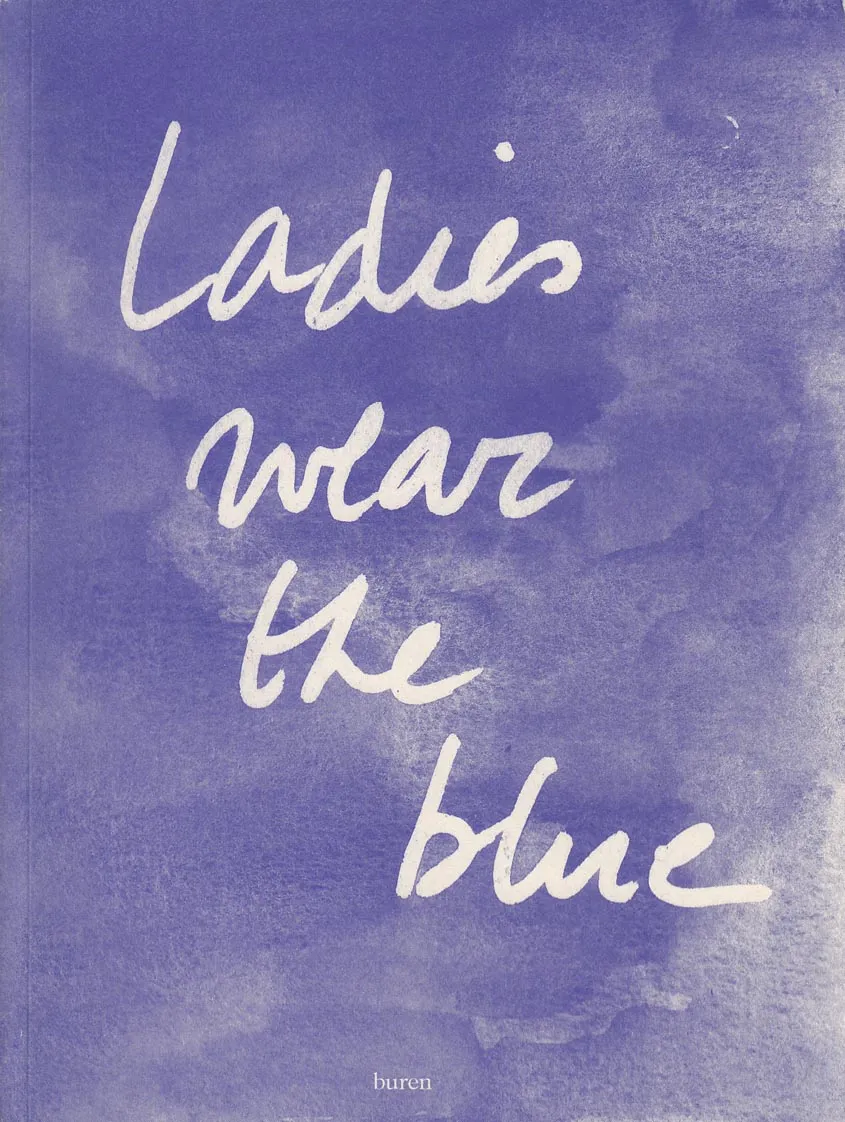
Ladies Wear the Blue
Ladies wear the blue is a collection of watercolour drawings by the hand of Melissa Mabesoone and Oshin Albrecht. The blue watercolours portray women from different moments in time. The adjacent texts describe these women's existence, roles, desires or ideosyncrasies deriving from the 'blue' in their lives. From the first female police officers and Alices all around, to Courtney Love's blue baby dolls and the girl with the blue tattoo Olive Oatman, this publication is an ode to women venturing into the world, and a way to continue telling their herstories.

Disobedience
Published to accompany the artist's retrospective at the Kunstmuseum St. Gallen (September 2025–March 2026), this comprehensive monograph offers a detailed overview of the work of Dutch artist Jacqueline de Jong. Designed by Sabo Day and edited by Melanie Bühler, curator of the exhibition, this publication spans De Jong's entire artistic journey of from her editorial activities and bold figurative paintings of the 1960s to her "Billiards" series in the 1970s, and her latest series of the 2020s that reflect the current state of the world.
It features new essays by Karen Kurczynski (Professor of History of Art and Architecture at the University of Massachusetts Amherst), Emily LaBarge (writer and critic), Tiana Reid (Assistant Professor of English at York University), Paul Bernard (Director of Kunsthaus Biel), as well as an as-yet-unpublished conversation with the artist and McKenzie Wark (writer and theoretician).
Organized through six sections entitled "Disobedience," "Publishing," "Chaos," "Pop," "Play," and "Politics," all lavishly illustrated, it underlines the challenging approach to art and life developed by De Jong formally, visually, and conceptually from the early 1960s until 2024.
Edited by Melanie Bühler
Texts by Emily LaBarge, Gianni Jetzer, Jacqueline de Jong, Karen Kurczynski, McKenzie Wark, Melanie Bühler, Paul Bernard, Tiana Reid.

Land Keepers
EcoRove’s Land Keepers Reader brings together writers, activists, journalists, farmers, and ecologists from across Bilad al-Sham — Lebanon, Syria, and Palestine — to tell stories of green resistance in the Jabal al-Sheikh ecological zone. Spanning South Lebanon, the occupied Jawlan, and the occupied Galilee, this landscape faces ongoing ecocide, defined as the deliberate destruction of land and ecologies used by the settler-colonial regime to erode livelihoods, cultures, and environments. The Reader highlights these struggles through essays, research and testimonies that show how native communities remain rooted in place, resisting colonial environmental orientalism, greenwashing, and scorched-earth tactics. As part of a wider body of work that includes a documentary film, tapestries, and sculptural pieces, the Reader amplifies indigenous ecological knowledge and envisions regenerative futures for threatened landscapes.
with contributions by Mahdi Sabbagh, Hamza Hamouchene, Public Works, Hussein Chaabane, Hisham Younes, Nadine El-Khoury, Michelle Eid, and Munira Khayyat
From the intro by Ecorove:
"Return, Al’Awda in Arabic, signals the right of return to homeland, a central tenet of the Palestinian struggle. Al’Awda affirms the fundamental historical, legal, collective, and individual right of Palestinians to return to their homeland. But how do we return to the earth after it has been damaged and scorched? In landscapes marked by war, ruins, rubbles, and ecological destruction, can Al’Awda take another form? Can generations of Palestinian diaspora exercise Al’Awda differently? At a time when international legal systems and institutions have failed to secure justice, can return to land be understood beyond legal definitions alone? In times of mass displacement and ecological devastation, Al’Awda may therefore exceed juridical meaning, and live through those who remain on the land and their acts of love, labour, and agriculture."
Each book comes with a 2-color, double-sided risograph-printed bookmark.
Ecorove is Iyad Abou Gaida and Jumanah Abbas.

Juggling (Practices)
In Juggling , Stewart Lawrence Sinclair explores the four-thousand-year history and practice of juggling as seen through his life as a juggler. Sinclair—who learned to juggle as a child and paid his way through college by busking—shares his experiences of taking up juggling after an episode of suicidal ideation, his time juggling on the streets, and ultimately finding comfort in juggling during the COVID-19 pandemic. In many ways, this is a book about loss and recovery. From his own juggling story to clowns braving military checkpoints in Bosnia and Rwanda to perform in refugee camps to contemporary avant-garde performances, Sinclair shows how the universal language of juggling provides joy as well as a respite from difficulties during hard times.

The Formation of Calcium
A horror story of one woman's awful reinvention, M. S. Coe's The Formation of Calcium is disturbingly funny and completely unexpected.
Middle-aged Mary Ellen Washie has finally freed herself of her stultified past life in western New York state and moved to Florida. With the husband she's grown to hate firmly in her rearview mirror, and all ties to her family cut off, she changes her name, bleaches her hair, and befriends Natalie, a seemingly kind, martini-loving woman whom she promptly begins to manipulate. As her machinations propel her beyond the brink of who she used to be, Mary Ellen seeks to unburden herself—but not one to sit down with pen and paper, she narrates the events of her new life into a cassette tape recorder, giving each tape an innocuous name to keep the curious away. A riveting account of one woman's awful reinvention, M. S. Coe's new novel is disturbingly funny and completely unexpected. With elements of pulp noir and confessional literature, The Formation of Calcium depicts the bland misery of modern American life as one woman seeks her own ill-fated transformation.
Born in Las Vegas, Nevada, M. S. Coe is an American writer living in Guadalajara, Mexico. After she graduated with an MFA in creative writing from Cornell University, Clash Books published her first novel, New Veronia, in 2019. Coe's stories have appeared in The Antioch Review, Cosmonauts Avenue, Electric Literature, Nashville Review, Waxwing, and elsewhere. She has held residencies from the Herbert Hoover National Historic Site, Petrified Forest National Park, and Ora Lerman Trust.

Holy Smoke
Why they said, “Your real name is Anon,” I’ll never know ... But now that I have a name, I know I must write ... I’m scared, but feel it is time to be really bad.
Republished for the first time since its 1979 release, in a new revised edition, Holy Smoke is an account of the frenzy and paranoia of United States politics refracted through one individual’s psyche. With her theme of a child disappeared – and all that that phrase carries with it – Howe captures the chaos of reality in her salient mix of poetry and prose. Readers will find it hard to believe that this book, which gives fresh sense to the demand for universal human rights, was written in the last century.
At once evocative and subtly incisive, Howe’s writing seems almost like a new language, a language that has been in hiding. She can make the familiar haunting and the ordinary a provocation. She has written some of the remarkable books of her time. —Adam Phillips
A wonder of acid wit and Americana, Holy Smoke turns grief into a game and chaos into canticles. Bricolage at its best: incisive, inventive and intimate. It’s the exact work I needed in my life. —Navid Sinaki

Citizens of the Cosmos
This book on the films of Anton Vidokle features essays and conversations by theorists, curators, and artists exploring the themes of technological immortality and resurrection informed by Cosmist philosophy.
Citizens of the Cosmos examines the artist Anton Vidokle's films and the Cosmist philosophy underpinning them. It features essays and conversations with Vidokle by seminal contemporary theorists, curators, and artists: Franco "Bifo" Berardi, Keti Chukhrov, Liam Gillick, Boris Groys, Daniel Muzyczuk, Miguel Amado and Georgia Perkins, Elizabeth Povinelli, and Raqs Media Collective. This is the first book to survey Vidokle's Cosmism-related filmic output, begun in 2014, and includes full scripts from the films.
The book's contributors speculate on Vidokle's Cosmist conceptions of technological immortality, utopian resurrection, museology, and space travel, grappling with how these ideas embroil or crystallize contemporary theories, practices, and technologies: atmospheric manipulation, cryonics, biopolitics, extraplanetary prospecting, geo-engineering, transhumanism, genetics.
Franco "Bifo" Berardi disagrees with the Cosmist conjecture of death as a flaw in the conception of the human being. Elizabeth Povinelli digests the life-nonlife mattering of dust through relationships to and from the human and more-than-human ancestors to come.
Boris Groys contemplates the gravitational forces between Cosmism and communism according to cosmic and social orders, grounded as they are in the laws of both physics and socialist politics. Keti Chukhrov considers the formation of thinking through madness, dying, and reasoning according to Cosmist philosophical and religious debates and beliefs.
Raqs Media Collective and Anton Vidokle discuss different cultures of death, finitude, and rituals. Miguel Amado and Georgia Perkins examine the in-betweeness of the categories of life and death through the designs of terraforming vehicles navigating interplanetary space travel.
Daniel Muzyczuk investigates Vidokle's interests in the context of the history of the collection at the Muzeum Sztuki in Łódź, while Liam Gillick and Anton Vidokle converse about filmmaking references and methods, from voiceover narrative to editing processes.
Edited by Miguel Amado. Contributions by Franco "Bifo" Berardi, Keti Chukhrov, Raqs Media Collective, Liam Gillick, Boris Groys, Daniel Muzyczuk, Miguel Amado and Georgia Perkins, Elizabeth A. Povinelli.

Girlbeast
Highly acclaimed in Denmark, Girlbeast is a fearless, unsettling, and poetic reimagining of the Lolita narrative, where power shifts unpredictably, and desire and coercion become indistinguishable. In a world that fetishises girlhood, it asks whether a girl be blamed for internalising the roles imposed upon her? Can she wield her youth as power in a system designed to render her powerless?
With sharp, fast-paced prose and an addictive plot, Cecilie Lind crafts a daring examination of female agency, sexuality, and the complexities of consent. The novel evokes the idea of the girl as animal – a creature conditioned to be both docile pet and wild beast, torn between submission and rebellion, innocence and desire.
Brave, provocative, and unflinching, Girlbeast is a gripping, vital novel for our times.
WINNER OF THE 2023 DANISH CRITICS PRIZE, SHORTLISTED FOR THE DR NOVEL PRIZE, MONTANA’S LITERATURE PRIZE & THE JYLLANDS-POSTEN FICTION PRIZE
Cecilie Lind (b. 1991) studied at Forfatterskolen (The Danish Academy of Creative Writing), and debuted in 2010 with The Wolf Ate My Eyeliner. Lind’s breakthrough in Denmark came with the publication of the highly acclaimed book-length poem My Child, which was shortlisted for the 2020 Critic’s Prize and the Politiken’s Literary Award. She was awarded The Native Language Prize in 2020, and Girlbeast won the Danish Critics Prize in 2023. Lind’s most recent novel, Bristefærdig (Ripe), was published to critical acclaim in 2025.
Hazel Evans (b. 1994) is an artist, writer and literary translator based near Aarhus, Denmark. She was the 2022/23 emerging translator for Danish to English at the National Centre for Writing, and her debut translation, Into a Star by Puk Qvortrup, was published by Hamish Hamilton. In 2024, she received The Inger and Jens Bruun Translation Prize for her translation of Rasmus Daugbjerg’s Troll, forthcoming from Penguin Press.

The All Night Movie
Created by Mary Heilmann in 1999, The All Night Movie beautifully wraps a memoir inside of a monograph, creating an artist book in which each page is designed as though it were a painting. The artist delicately utilizes color, text, candid photographs, reproductions of paintings, and song lyrics that unfold seamlessly to create an immersive visual experience. Heilmann has described the book as “the story of my life, told in words, painted images and photographs.”
Across eight chapters, Heilmann recounts her life, from childhood in California through New York in the 1990s, providing intimate insight into the development of her work, friendships, and formative life experiences. Snapshots by the artist and others provide a portrait of Heilmann’s evolving artistic community, which included Gordon Matta-Clark, Pat Hearn, Dicky Landry, Jack Pierson, Keith Sonnier, Pat Steir, William Wegman, and Jackie Winsor, among others. And this is just the first half of the book. Included with the artist’s memoir is an essay by Jutta Koether and a survey of paintings from 1972-1999. This highly revered and extremely scarce publication was co-designed with Mark Magill and is reproduced here as a facsimile edition. The All Night Movie was originally published by Hauser & Wirth and Offizin Verlag.
Mary Heilmann was born in San Francisco in 1940. She studied at the University of California at Santa Barbara, San Francisco State University and the University of California at Berkeley before moving to New York in 1968. Heilmann began her career creating sculpture before quickly pivoting into abstract painting once on the East Coast, experimenting with bright colors and unusual geometries that bridge two-dimensional and three-dimensional elements. She has been the recipient of the Anonymous Was a Woman Foundation Award as well as a Guggenheim Foundation award.

Season of the Swamp
New Orleans, 1853. A young Zapotec exile from Mexico named Benito Juárez disembarks at a fetid port city at the edge of a swamp. Years later, he will become the first indigenous head of state in the postcolonial Americas, but now he is as anonymous and invisible as any other migrant to the roiling and alluring city.
Accompanied by a small group of fellow exiles who plot their return and hoped-for victory over the Mexican dictatorship, Juárez immerses himself in the city, which absorbs him like a sponge. He and his compatriots work odd jobs, fall victim to the cons and confusions of a strange young nation, succumb to the hallucinations of yellow fever, and fall in love with the music and food all around them. But unavoidable, too, is the stark trade in human beings.
With the extraordinary linguistic play and love of popular forms that have characterized all of Herrera’s fiction, Season of the Swamp is a magnificent work of speculative history, a love letter to the city of New Orleans and its polyglot culture, and a cautionary statement that informs our understanding of the world we live in.