Books
Books
in random order

Raving
McKenzie Wark takes readers into the undisclosed locations of New York's thriving queer rave scene, showing how raving to techno is an art and technique at which queer and trans bodies might be particularly adept, but which is for anyone who lets the beat seduce them.
Contents
1. Rave as Practice
2. Xeno-euphoria
3. Ketamine Femmunism
4. Enlustment
5. Resonant Abstraction
6. Excessive Machine
"How to write a book about raving as a practice that practices rave? From k-nights spent on Brooklyn's and Berlin's junkspace dance floors, McKenzie Wark abstracts a life practice of ressociation in a dance of autoconceptualization and allotheorization. In crossing toward the stranger's gift of 'letting go of ourselves as private property, ' Raving is nothing less than Wark's femmunist manifesto, her tractatus on techno's blackness, her treatise for a twenty-first-century trans ethics."—Kodwo Eshun

Reclaiming Mythological Rituals
The first monograph dedicated to the Neapolitan feminist and pacifist artists' collective: unpublished documents, images, photographs, and manifestos are accompanied by new creative, political, and historical contributions, evoking the collective joy of Le Nemesiache's history so as to bring a sense of myth back into the world, rewriting and embodying it anew.
Nemesiache is an informal feminist group co-founded in Naples in 1970 by the multidisciplinary and visionary artist and writer Lina Mangiacapre (1946-2002). The collective, which included up to twelve women (centered around Claudia Aglione, Fausta Base, Silvana Campese, Consuelo Campone, Conni Capobianco, Bruna Felletti, Anna Grieco, and Teresa Mangiacapre), fostered an experimental artistic practice and a way of being in the world rooted in feminism, mythology, folktales, sci-fi, and radical imagination, while also introducing "transfeminism" in the early '80s.
Throughout their long-lasting practice spanning several decades, the group retrieved an androgynous mythosophy to transcend art as mere representation and challenge the feminine as a modern identity category. Their distinct transformative approach within both Italian and Western feminist art history led not only to the emergence of an interdisciplinary practice—encompassing film, performance, writing, rituals, poetry, music, collage, costumes, protests, and conferences—but also the creation of a new political language, grounded in cosmological creativity and justice through mythological rituals.
Edited by Sonia D'Alto.
Texts by Chiara Bottici, Federica Bueti, Cairo Clarke, Sonia D'Alto, Giulia Damiani, Giusi Palomba, Imma Tralli & Roberto Pontecorvo, Elvira Vannini, Giovanna Zapperi, Arnisa Zeqo.

The Psychoanalyst And The Artist
In these essays, New York psychoanalyst and author Jamieson Webster considers the relationship between the studio and the psychoanalyst's couch. From the scopophilic instinct of the viewer and the artist's anticipation of it to the pursuit of perfection and it's connection to the girl-child's curiosity about her mother's body, she asks us to think about art and analysis as connected practices. Focusing on Carroll Dunham and Louise Bourgeois, she argues for an embrace of our wildest symptoms in theory and in art.

Archive Dora Diamant #06
A collection of photographs from the archives of the icon of underground and alternative Parisian nights Dora Diamant.
A self-taught photographer, Dora Diamant has left thousands of photos. The Dora Diamant Association, custodian of this archive, and Éditions L'Amazone have joined forces to bring them to life by devoting a series of publications to them. Each volume of the Dora Diamant Archive was created by a different person and is the result of a subjective selection and arrangement specific to its author.
Figurehead of the Parisian underground and queer nights, photographer, DJ, multimedia and polymorphic artist, Dora Diamant was the daughter of Pascal Doury.
Selected by Leopold Duchemin.

Oriental Cyborg
Who is the Oriental Cyborg? asks Aditi Kini in this collection of notes, jokes, and queries into the provenance of a creature designed for labor, 3-D printed in the technoscientific post-colonies, modeled on old automata. Race is a technology, that we know, and technology can be raced — so why inquire into this at all? Perhaps this, the Oriental Cyborg, is a fantasy more than a memory, or an echo more than a form — or just an essayist’s extraction of personal anguish and humor from globalist decay.
Taking on the form of historical analysis / lyrical essay / documentary poem / experimental buzzword / positionality statement, this chapbook and its titular character might still be an elusive mystery even after reading.
“’What is a ghost but a person removed from corporeality?’ This is one among layers of questions Aditi Kini poses in Oriental Cyborg, a lyrical excavation into survival in the era of techno racial capitalism, and its “deleting touch” that so easily voids—reduces to faceless services—the exploited individuals performing various acts of techno-labor. A grieved searching drives this hybrid essay, which feels urgent and necessary as threats from AI grab headlines. This work compels us to see our culture’s love affair with technological progress as a means for continued colonization and domination. It also reminds us, and celebrates, that those erased don’t stay silent forever. We privileged may not be able to hear them yet, but those who are listening know. They roar.” — Allison Cobb
“In the mirror of Aditi Kini’s Oriental Cyborg, I become the monster—a hopeless automaton, an intelligence stripped of roar. With titanium-threaded theory, Kini radiantly stitches together the ideal Asian working machine. Get your own Oriental cyborg today: super dazzling and sexy, historically embroidered, an oracular truth who never tires, never complains, forever mute, what perfection!” — Lily Hoàng
Aditi Kini is an undisciplined writer. They’ve done both NYC and the MFA (at UC San Diego). They were a finalist/alternate for the 2020-22 Jerome Award for Literature. They edit Lumpenpockets, “a nonquarterly sick rag.” Read their words in Hayden’s Ferry Review, The Rumpus, Denver Quarterly, The New York Times, and elsewhere. They’re at work on multiple projects, all at once. They are blessed with two dogs, Lucy the Happy and Charly Kong, who make life worth living.

She Will Last as Long as Stones
Weaving together the matter of geology, migration, and computation, kathy wu’s debut book She Will Last as Long as Stones mines data from the United States Geological Survey, pairing it with (mis)translations of conversations with the author’s mother, narratives of racialized and gendered labor, and elegies on end-of-life care. Through text, photo-collage, and diagrammatic circuitry, wu mobilizes language toward the edges of things, where glitch and failure meet grief, outpour.
kathy wu's She Will Last as Long as Stones is the 2024 Open Reading Period Book Prize winner, and was selected by guest judge Bhanu Kapil.
kathy wu is a Chinese–American artist, poet, and designer living in Providence, Rhode Island, on Narragansett land. She works across digital media, fiber, book arts, and language to pull at histories of science and technology. Her work has appeared via The New School, Dialogist, Rain Taxi, NatBrut, and Tilted House, and has been anthologized by Fonograf Editions and Nightboat Books. She has been awarded fine arts residencies at Blue Mountain Center, Black Mountain College Museum, and Pao Arts Center. She currently teaches full-time at Rhode Island School of Design (RISD), and holds an MFA from Brown University’s Literary Arts program.
She Will Last as Long as Stones has the inter-genre brilliance of asking where materials originate, and following that question until writing becomes a kind of listening with stone, with metal, for magnetic reverberations, for the thinking at the back of the cave.
— Bhanu Kapil
There just might be currents coursing through landscape, language, software, and labor—presences that escape extraction and will not be denied. She Will Last as Long as Stones looks into the multiple temporalities and operations of many things: material place, mining, social and scientific documentation, computation, migrant women's work, and mother-daughter relations, constellating them into a poetics of wondrous design and resonant beauty.
— Kimberly Alidio
She Will Last as Long as Stones is a subtle circuit that conducts a charge but (paradoxically) remains open. wu's intricate parataxis offers readers fertile resistance, while simultaneously leading us to grounded revelations about the intertwined materialities of technology, language, and memory.
— Allison Parrish

كيف تلتئم – عن الأمومة وأشباحها - How to Mend: Motherhood and Its Ghosts
A highly personal and sensitive exploration of motherhood.
In How to Mend: On Motherhood and its Ghosts, Iman Mersal navigates a long and winding road, from the only surviving picture of the author has with her mother, to a deep search through what memory, photography, dreams and writing, a search of what is lost between the mainstream and more personal representations of motherhood and its struggles. How to mend the gap between the representation and the real, the photograph and its subject, the self and the other, the mother and her child.
"If I'd been more aware and someone had asked me about 'my mother's picture' I would have shown them the bird she'd stitched onto the canvas herself. It is not aesthetic vision or skill that summons my mother's presence in this canvas, but the slight punctum the bird gives me. I get nothing of this sort from our studio portrait. The bird's eyes are always looking at me, as though they belong to her. The bird: motionless, for whose sake my mother sat and stitched by the window where the light came in, each pinprick a symbolic laceration in the process of its embodiment: cuts by the hundred to make it whole."
Iman Mersal (born 1966 à Mit 'Adlan) is an Egyptian poet, writer, academic and translator. She works as an Associate professor of Arabic literature and Middle Eastern studies at the University of Alberta, Canada. An anthology of her works was translated into more than twenty languages and she has five poetry collections published.

Crystal Pantomime
Recognized as a poet, less so as a visual artist […] Mina Loy also wrote in the style of Crystal Pantomime, a text from one hundred years ago [c. 1915] describing a ballet in prose. The writing evokes images with which actual theater effects can only interfere. It projects in the mind as onto a screen. But this restless writing does more than that, shifting registers and unfolded in equal parts fairy tale description, precise impossible stage directions, notes for impossible costumes and sets, guidelines for impossible choreography, and a glancing archeology of personal association, opinion, art historical commentary, and psychoanalysis, all floating in suspension, all shading into poetry, and with this manner of overflowing every frame defining its poetics. — Matthew Goulish
This first standalone edition of Crystal Pantomime opens with a biographical introduction by Mina Loy’s literary executor—poet Roger Conover—originally published in Eliot Weinberger’s journal Montemora in 1981, as well as a dramaturgical introduction by Matthew Goulish of Chicago performance group Every house has a door, originally prepared as opening remarks to Every house’s reading of Loy’s Pantomime at the Arts Club of Chicago in spring of 2024. In tandem these supplementary texts begin to frame what is a rather strange and singular sketch for a work never realized.

SAPPHO TERROR
Maura Modeya’s SAPPHO TERROR is a book haunted—by empire, by sleeplessness, by Sappho herself. In it, queerness becomes both the agent of terror and its object. “I want to be consumed. I want to disappear twice.” Extending the experiments of Mayer, Lonidier, and Stein, Modeya’s poems are as much about desire as they are about violence. They let us in on a secret: “Logic sometimes is so disgusting.” At once delirious and hyperalert, performance and document of a performance, SAPPHO TERROR disrupts the routines of everyday life from within. “Tending to the eros of writing something down.”
A fist is something that blooms inside a lover, a hand held up in revolutionary camaraderie, and the weapon of bare-knuckle combat. In Maura Modeya’s SAPPHO TERROR, the poet probes, in a language that possesses an addictive deliquescence, the body as policy and the devotional as daily, where intimacy is all at once risked, tenderized, and disciplined. We begin in a space of betweenness—between street and bed, between conquest and abandon—and are then submerged into tidal pools of sleeplessness where the poet is overtaken, exquisitely, by forces beyond themselves. Sculpted into vigilant word-reliquaries, these poems exalt the femi-themme of the night while holding fast to danger. Inside this edge-space lives the chasm—the danger that lives in the distance from one edge to another—where sex, politics, and liminal states of consciousness collide, exposing how power is enforced, negotiated, and sometimes utterly undone through the body. —Valerie Hsiung
In SAPPHO TERROR Maura Modeya drifts with eros between the “war intestine,” and a restless dreamscape where desire demands disorientation and the rapture of invasion teeters in tension between queer love and the horrors of militaristic and domestic terrorism. Modeya offers us a vulnerable and familiar sorrow: “Why when I want to speak of love, violence surfaces?” In communion with Sappho’s fragments—those invocations of desire intensified by their historical devastation—Modeya’s poems project that eros is to want is to risk.
Leaning into the “deathless language” of queer love, Modeya allows herself to be haunted by the unreasonable logic of eros and finds herself caught between an insomnia that threatens the poet’s coherence of self, and a sleep that risks waking to the repulsive logics adorning our daily violences.In striking and visceral exhaustion, this book performs the desire of possession—by a lover, by language, by loss. SAPPHO TERROR brings us into the poet’s rapture, one that is profoundly balanced between the paradoxical and perilous forces of eros. —Serena Chopra
What arises out of sleeplessness? In SAPPHO TERROR, all boundaries fall away into ritual. There is a permeability, an eros, a freedom from all structures and institutions, even from our own self. Our human guardrails fall away to a place where we forget the boots on our necks, that our money buys weapons for the state, or even that we are separate unique beings. Is it wrong to forget, or is it a healing? Perhaps both. Modeya says that in sleeplessness, “to submit means to surrender into what is wanted so badly.” In the face of terror, our letting go is a kind of purity. It tells us we can travel beyond repression, not to escape, but to reach the most natural state of our being, even before survival. It is a reminder of life. —Samuel Ace
Maura Modeya’s SAPPHO TERROR takes back Plato’s Cave for the dykes. In these poems eros’ shadows reign sovereign: language is chained and casts haptic forms onto Modeya’s bedroom wall lit by Sappho’s famous fires. These poems join her chorus of “You Burn Me” with the desperate velocity only the insomniac knows. Modeya’s verse is exquisite and relentless, creaking out of the dead of night, bargaining for the possibility of touch. An assembly of aching towardness, SAPPHO TERROR is part elegy, part manifesto, part love letter that sabotages the war intestines we live in order to undivide us from our desire. —Rosie Stockton

Time has fallen asleep in the afternoon sunshine
Appendix #3: Orality
Victoria Pérez Royo, Léa Poiré and 1 more
Time has fallen asleep in the afternoon sunshine Appendix #3 Orality includes contributions by Simon Asencio, Bruno De Wachter, Peter Szendy, Clara Amaral, Itziar Okariz, Jude Joseph, Léa Poiré and Mette Edvardsen.
Time has The Appendixes #1–4 is an editorial series by Mette Edvardsen, Léa Poiré and Victoria Pérez Royo that developed out of the project Time has fallen asleep in the afternoon sunshine. For a two-year residency at Les Laboratoires d’Aubervilliers* (2022–23), they came together as a small work group, shaping the work process, hosting presentation formats and making this publication series on paper as four cahiers.
The cahiers comprise a collection of commissioned texts and contributions created for this context, selected documents and traces from work sessions and encounters organized during their residency, texts read together and republished for this occasion, a collection of references, notes in progress, unfinished thoughts and loose fragments – on paper, between pages.
The Appendixes are organized around four themes: (1) The gesture of writing, (2) How to organize a library, (3) Orality and (4) Translation. In addition to being published on paper, the editorial series also consisted of other formats of presentations, exchanges and meetings organized as workshops, fieldwork, performances, conferences, collective readings and oral publications, taking place during their residency at Les Laboratoires d’Aubervilliers and in the vicinity.
The Appendixes is the work that continues, material that adds on, some of it perhaps too long or too detailed, unfit or unfinished. The four themes that their research is formulated around originate in specific experiences and questions from the practices of Time has fallen asleep in the afternoon sunshine (2010 – ongoing), and also the large publication on the project ‘A book on reading, writing, memory and forgetting in a library of living books’ (2019). The research was both a means of exploring these themes in greater depth and also of bringing them into contact with other artists and researchers working on similar or related subjects. The Appendixes offered them both the contexts and the pretexts for things to happen (in time, in space, on paper).
The Appendixes #1–4, published in these cahiers, do not present an overview or a summary of all of the activities and presentations that took place during the two years at Les Laboratoires d’Aubervilliers. What these cahiers offer is a space in which to hold some thoughts together and to share them in this form. It is one more step along the way, extending the research and work already begun and that will now continue.

After Institutions
The current crisis of museums and the future of Institutional Critique.
Faced with waning state support, declining revenue, and forced entrepreneurialism, museums have become a threatened public space. Simultaneously, they have assumed the role of institutional arbiter in issues of social justice and accountability. The canon of Institutional Critique has responded to the social embeddedness of art institutions by looking at the inner workings of such organizations. In After Institutions, Karen Archey expands the definition of Institutional Critique to develop a broader understanding of contemporary art's sociopolitical entanglements, looking beyond what cultural institutions were to what they are and what they might become.
Karen Archey is curator of contemporary art at the Stedelijk Museum Amsterdam. She is a 2015 Creative Capital | Warhol Foundation Arts Writers Grant recipient for short-form writing. Since joining the Stedelijk Museum in April 2017, Archey has organized solo exhibitions by artists Rineke Dijkstra, Stefan Tcherepnin, Catherine Christer Hennix, Steffani Jemison, Metahaven, Jeff Preiss, Charlie Prodger, and Hito Steyerl. She has written numerous catalogue essays and is a contributor to several art publications, including Artforum and Frieze.

Get Rid of Meaning: A Journal of Interdisciplinary Writing #4
Get Rid of Meaning: A Journal of Interdisciplinary Writing is a biannual periodical by Sticky Fingers Publishing, exploring how and where meaning is produced, maintained and distributed. Through its first three issues, Get Rid of Meaning has become a site for interrogating the material conditions and affective systems of meaning-making, and strategies for surviving an intentionally nonsensical political landscape, through experimental non-fiction. This fourth issue builds on this by uncovering forms and methods of fugitive knowledge, from the heat of the land and the vibrations of the night, to the stoney rumblings of rivers and rock.
Featuring contributions from Alberto Álvarez, e v, Florence Hannah Evans, Lucy Petersen, Mark Sauter, mars k margetson & teresa amrita braggs.
LOOK HERE FOR: BLOOD BOILING, WHAT DEBT DOES, SEEING PURPLE, A PING-PONG BALL BENEATH THE RUBBLE, PSYCHOPOLITICS, ALIEN GOO, A ROD UP YOUR ASS, STONE SUMMONING FORTH, A MIRACLE, & THE BEGINNING OF THE END.

The Rebound
In The Rebound, a short story by author Natasha Stagg (Surveys, Artless), a young woman takes a work trip in the wake of a humiliating break-up, and agrees to be set up on a blind date...
The erotic works of Anaïs Nin started out as a freelance job. To support their bohemian lifestyles, Nin and her writer friends earned a dollar a page writing pornography for an anonymous client. The writers hated The Collector, as they called him, for his repeated instructions to “Concentrate on sex. Leave out the poetry”.
The Collector, a new series of short stories published by jouissance, seeks to pay homage to writers, like Nin, who explored the erotic, the taboo and the connection between jouissance and the creative process. It also honours their chosen, but much maligned, genre. By commissioning some of our favourite female writers to compose erotic short stories, we begin what we hope will be an ever-growing collection of compelling and provocative fiction that will inspire conversation, debate and further creative expression.
Munken Pure 80gsm paper publication with red Singer Sewn binding. Featuring an illustration by Emma Rose Schwartz.

Appendix Project
Written in the course of the year following the publication of Book of Mutter, and inspired by the lectures of Roland Barthes, Anne Carson, and Jorge Luis Borges, Appendix Project collects eleven talks and essays. These surprising and moving performances, underscored by the sleeplessness of the first year of their child’s life, contain their dazzling thinking through the work of On Kawara, Roland Barthes, W.G. Sebald, Bhanu Kapil, Walter Benjamin, Theresa Hak Kyung Cha, Marguerite Duras, Marlene Dumas, Louise Bourgeois, Doris Salcedo, Jenny Holzer, and more.

First Nettles
First Nettles collects poems written between 2021 and 2024, from precarious off-key lyrics to sprawling elegies of damaged life. A book of flailing, desperate music, hurt and hopeful, held together by pins and gaffer tape, art and courage and comradeship. Includes the sequence “Seizures” (2022) – “perfect in its openness and lyrical disfigurement” (Danny Hayward).
“[An] exhilarating collection […]. The sequences here are ferociously and admirably radical, with some superb political satire and verve to the poems.” —Adam Piette, Blackbox Manifold, no. 34
Designed and typeset by Phil Baber; cover collage by Sam Keogh

Murder
Murder is Danielle Collobert’s first novel. Originally published in 1964 by Éditions Gallimard while Collobert was living as a political exile in Italy, this prose work was written against the backdrop of the Algerian War. Uncompromising in its exposure of the calculated cruelty of the quotidian, Murder’s accusations have photographic precision, inculpating instants of habitual violence.
Born in Rostrenen in 1940, Danielle Collobert left Bretagne for Paris at the age of eighteen where she worked in an art gallery and self-published her first poems in a book entitled Chants des guerres (1961). Both of Collobert’s parents, and her aunt, who survived deportation to Ravensbrück, were members of the Résistance during World War II. Herself a supporter of Algerian independence, Collobert joined the FLN (the Algerian National Liberation Front), precipitating her exile in Italy, during which time she completed work on Meurtre, first published in 1964 by Éditions Gallimard with the unwavering support of Raymond Queneau. She worked for Révolution africaine, a short-lived journal created at the end of the Algerian war. Collobert’s extensive travels, to Czechoslovakia, Indonesia, Bolivia, Ecuador, Venezuela, Mexico, Spain, Greece, Egypt, etc., did not prevent her from becoming a member of the group formed around Jean-Pierre Faye and the journal, Change. Her other works include Dire I et II (1972), a radio play the following year, Polyphonie, aired by France Culture, Il donc (1976) and Survie (1978). Upon her return from a trip to New York, Danielle Collobert took her own life in a hotel in Paris on her thirty-eighth birthday. Her complete works, in two volumes, edited by Françoise Morvan, augmented by several unpublished texts, were published by P.O.L. in 2005. Collobert’s works available in English include In the Environs of a Film (Litmus Press, 2019), Notebooks, 1956-1978 (Litmus Press, 2003) and It Then (O Books, 1989).

Tripwire 22
Featuring work by Sara M Saleh, Joni Prince, Shatr Collective, Carlos Soto Román, Petra Kuppers, Diane Ward, Dianna Settles, Mayra Santos-Febres translated by Seth Michelson, Elena Gomez & Chelsea Hart, Noah Mazer, Daniel Borzutzky, Ash(ley) Michelle C., Ghazal Mosadeq, Darius Simpson, Mohammed Zenia, Mario Payeras translated by Dan Eltringham, Ferreira Gullar translated by Chris Daniels, Christophe Tarkos translated & read by Marty Hiatt, Andrew Spragg on Tom Raworth, Matthew Rana on Ida Börjel, & Paisley Conrad on Harryette Mullen

The Carrier Bag Theory of Fiction
In The Carrier Bag Theory of Fiction, visionary author Ursula K. Le Guin tells the story of human origin by redefining technology as a cultural carrier bag rather than a weapon of domination.
Hacking the linear, progressive mode of the Techno-Heroic, the Carrier Bag Theory of human evolution proposes: ‘before the tool that forces energy outward, we made the tool that brings energy home.’ Prior to the preeminence of sticks, swords and the Hero’s killing tools, our ancestors’ greatest invention was the container: the basket of wild oats, the medicine bundle, the net made of your own hair, the home, the shrine, the place that contains whatever is sacred. The recipient, the holder, the story. The bag of stars.
This influential essay opens a portal to terra ignota, where the possibilities of human experience and knowledge can be discovered anew.

Miam 08 : Artefact
"Cet ouvrage est un magazine participatif regroupant les oeuvres de 48 artistes autour d'un thème commun, l'artefact. Vertige du passé ou projection contemporaine, l'artefact nous parle. Il raconte les cultures, en façonne le souvenir et promet ainsi un voyage à travers les créations humaines. Ce sont ces témoignages tangibles de l'existence que nous souhaitons vous offrir grâce aux interprétations captivantes de l'artefact. Chaque page de ce nouveau numéro est une invitation à plonger dans les méandres de l'histoire ou de la fiction, à explorer les différentes strates de l'humanité à travers le primes de ses réalisations matérielles."
Alexandre Daram, Alice Royer, Audrey Poujoula, Audrey Ramos, Basile, Bordel j’ai glissé, Cel, Charlie Udave, Collectif IPN, Elliott Sanchez, Emilia Pesty, Marie Derrien, Fils Kurylak, Flora Rushiti, Hélène Berlemon, Inès Day, Julie Plantefeve, Kaspar kaspar.wtf, Kawani DS, Kiara Patry, Laura Zanti, Lauriane Rolo, Le Bayou Club Graphique, Lea Canovas, Lili Archer, Lily Terrible, Lisa Dehove, Lola Marty, Louis Kervel, Lutine Cabarrou, Maeva Iorio, Maké, Martin Régnier, Maxoy, Meuneurol, Nathanael Brelin, Nurzen & Jack Montaly, Oscar, Pierre Touron, Ptit Lylou, Rachel Roland, Rose Meybeck, Sarah Josserand, Theo Grandchamp.

University of California Press
Screen Writings
"Ask audience to cut the part of the image on the screen that they don't like. Supply scissors."—Yoko Ono, Tokyo, June 1964
A dazzling range of unconventional film scripts and texts, many published for the first time, make up Scott MacDonald's newest collection. Illustrated with nearly 100 film stills, this fascinating book is at once a reference work of film history and an unparalleled sampling of experimental "language art." It contributes to the very dissipation of boundaries between cinematic, literary, and artistic expression thematized in the films themselves. Each text and script is introduced and contextualized by MacDonald; a filmography and a bibliography round out the volume.
This is a readable—often quite funny—literature that investigates differences between seeing and reading. Represented are avant-garde classics such as Hollis Frampton's Poetic Justice and Zorns Lemma and Morgan Fisher's Standard Gauge, and William Greaves's recently rediscovered Symbiopsychotaxiplasm: Take One. Michael Snow turns film loose on language in So Is This; Peter Rose turns language loose on theory in Pressures of the Text.
Some of the most influential feminist filmscripts of recent decades—Laura Mulvey and Peter Wollen's Riddles of the Sphinx, Su Friedrich's Gently Down the Stream, Trinh T. Minh-ha's Reassemblage, Yvonne Rainer's Privilege—confirm this book's importance for readers in gender and cultural studies as well as for filmmakers and admirers of experimental writing, independent cinema, and the visual arts in general.

Gaza, un génocide annoncé
La nouvelle catastrophe subie par le peuple palestinien est pire que la Nakba de 1948. C'est le premier génocide perpétré par un État industriel avancé depuis 1945, avec la participation des États-Unis et la soutien de l'Occident, France incluse. Chercheur franco-libanais spécialiste du Moyen-Orient, auteur de nombreux ouvrages traduit en vingt langues et contributeur régulier au Monde diplomatique, Gilbert Achcar dévoile le processus historique qui a mené à ce génocide et mène une réflexion rigoureuse et documentée sur ses conséquences pour le peuple palestinien, les peuples de la région et pour l'ensemble des relations internationales.

My Earliest Person
Lyrical drifts warped by syntax into blizzarding softness; odes to beauty, meaning, and inexperience splintered by history and grammar. An aqueous surface marbled with the lightest possible touch, lost footings arrested by change’s near-griplessness.
None of this matters. It’s only supposed
to save you from yourself. None of this
matters, when I try to take it out of me into
the world, which to find I can praise
I go out to
Composed across two winters between late 2022 and early 2024. Contains 43 poems.
“This luscious and needle sharp collection is a real feat of the textual imagination, wow.” —Adam Piette, Blackbox Manifold, no. 34

A Dance Mag - Issue 04: Structure
Issue 04, Structure, traces the scaffolding of our lives, seen and unseen. We travel from the palaces of Versailles to the basements of Russian resistance, from origami folds to mechanized labor, from cosmic geometry to the twitch of a stimming hand. These are the choreographies that hold us, train us, divide us, and sometimes set us free. This issue moves through power's choreography with Vinícius Portella tracing repression from TikTok algorithms to Candomblé persecution, Sasha Portyannikova documenting dance as survival under Russian authoritarianism, and Ellen Jeffrey revealing how stimming becomes its own radical dance practice. Mariam Ala-Rashi finds cosmic alignment in contortion while Michael O'Connor explores the body as origami, structure folded into self. Katja Vaghi contrasts baroque precision with contemporary chaos, and Nathaniel Moore exposes the market forces shaping European dance. Cover and insert artist, Maria Harfouche, captures structure through double-exposed analog photography and layered compositions that reveal how moments build upon each other.
A Dance Mag is an independent magazine that looks at the world through the lens of dance. It transcends differences, distances, and disciplines to tell the stories of people from all over the world, who are dancing their lives and giving their bodies a voice.
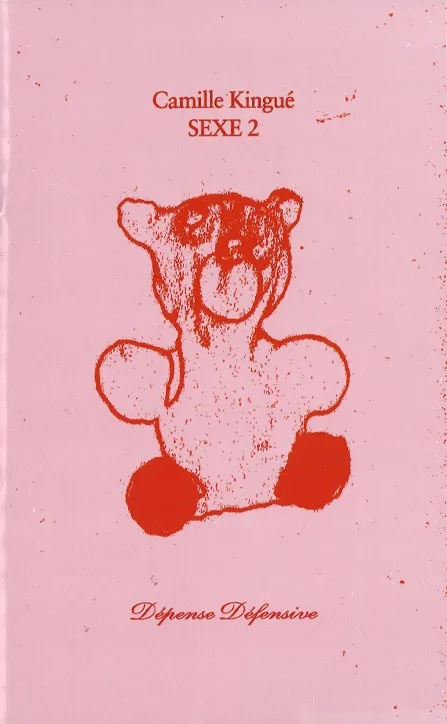
Sexe 2
Confession sur le désir (l’action et l’objet du), les liens de mutualité et de résistance, Sexe 2 alterne prose et versification en 27 fragments numérotés à l’adresse plus ou moins dure, plus ou moins sincère, plus ou moins formulée car plus ou moins éloignée du Toi et du Je. Camille Kingué s’attache à révéler, à voir quelque chose à travers son image réelle et virtuelle, agrandie et rétrécie, droite et renversée, déployant une recherche des principes de l’amour (l’amour comme amour, pourquoi est ce qu’il y a de l’amour) où la métaphysique et la compréhension de soi – donc de l’autre – n’ont jamais été aussi sexy.
Claire Star Finch, dans la magnifique préface qu’iel signe au début de l’ouvrage, écrit : « Après avoir lu tous les livres de Kingué, je ne sais pas si je crois en “l’amour”, que ce soit en tant que substantif absolu ou en tant que proto-résidu de tout ce que “le sexe” peut signifier. Mais je crois définitivement qu’il faut l’écrire. » Définitivement.