rile*books

Search books

Search books by title, author, publisher, keywords...

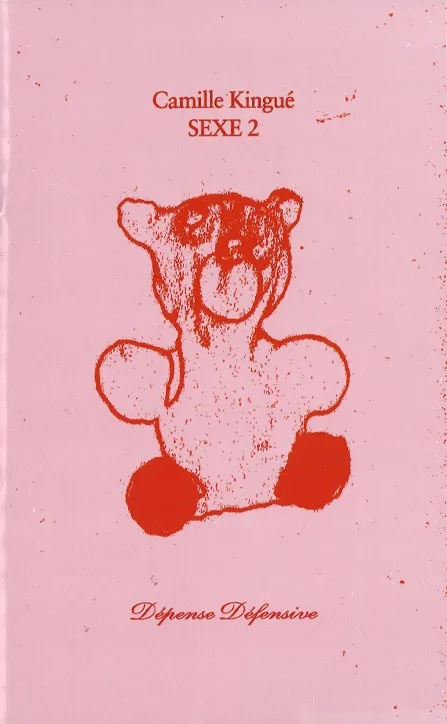
Cover of Sexe 2

Dépense Défensive

Sexe 2

Camille Kingué

€12.00

Confession sur le désir (l’action et l’objet du), les liens de mutualité et de résistance, Sexe 2 alterne prose et versification en 27 fragments numérotés à l’adresse plus ou moins dure, plus ou moins sincère, plus ou moins formulée car plus ou moins éloignée du Toi et du Je. Camille Kingué s’attache à révéler, à voir quelque chose à travers son image réelle et virtuelle, agrandie et rétrécie, droite et renversée, déployant une recherche des principes de l’amour (l’amour comme amour, pourquoi est ce qu’il y a de l’amour) où la métaphysique et la compréhension de soi – donc de l’autre – n’ont jamais été aussi sexy.

Claire Star Finch, dans la magnifique préface qu’iel signe au début de l’ouvrage, écrit : « Après avoir lu tous les livres de Kingué, je ne sais pas si je crois en “l’amour”, que ce soit en tant que substantif absolu ou en tant que proto-résidu de tout ce que “le sexe” peut signifier. Mais je crois définitivement qu’il faut l’écrire. » Définitivement.

Published in 2026 ┊ 56 pages ┊ Language: French

recommendations

Cover of Crue

Dépense Défensive

Crue

Théo Robine-Langlois

Poetry €12.00

L’Île-de-France a été engloutie. Submergée par de l’eau liquide. C’est à peu près tout ce que l’on sait. Crue est un long poème construit sur un rythme ternaire, une suite de tercets libres entrecoupés de symboles typographiques étranges dont la signification exacte semble avoir été perdue dans l’inondation. Il y a dans le va-et-vient soutenu du texte comme dans celui de la mer, ses gestes répétés, toujours successifs, quelque chose de l’automation ; l’acceptation sans révolte d’une nouvelle nature sous-marine hybride, plus uniquement humaine, à la langue noyée, gorgée de néologismes, méthodique, néanmoins sentimentale. Car ici la cruauté sinistre de la nature fait écho aux émotions du narrateur. Le paysage-état d’âme est désolé, apocalyptique mais comme résigné, nu. Crue sonde les abysses de la civilisation et des comportements humains. Peut-être un des textes les plus personnels de Théo Robine-Langlois.

Cover of Secrèt

Dépense Défensive

Secrèt

Théo Robine-Langlois

Fiction €12.00

Mystique des rues vides et peu éclatantes des banlieues pavillonnaires, ce court poème en prose interpelle par sa langue sombre. Dans une parodie de messe noire – beigeasse comme le crépis des façades –, Théo Robine-Langlois dépeint le monde mystérieux des maisons individuelles, du repli sur soi démonique, et des vieilles qui marmonnent entre leurs gencives au retour du marché, le panier plein de gros sel et de radis noirs en guise d'hostie. Les mots occitans qui ponctuent le texte comme des conjurations en accroissent l’escur.

Cover of Oraison funèbre pour Zelda1990

Dépense Défensive

Oraison funèbre pour Zelda1990

Romane Constant

Fiction €15.00

D’eux, il ne reste que les mots de celle qui a croisé leur route. Le crissement de pneus qui sifflent avant un malheur qui tarde à se produire. Sanctification plus que célébration, Oraison funèbre pour Zelda1990 est une tentative de communication au-delà de la matière physique de l’énonciation, un dialogue interne qui convoque « par moment le frère, par moment l’ami parti », toujours la ruine, la consommation de la séparation avec le tout. À travers quatre parties qui font écho à la structure des éloges funèbres de la Grèce antique, Romane Constant réouvre la poésie des plaies larges et profondes que les vers lapidaires d’Hélène Bessette – sur qui l’autrice mène un travail de recherche – ont laissé dans l’histoire moderne de la littérature, et signe un texte bouleversant sur la difficulté des choses qui ne (se) passent pas, la force de celles que l’on voit suspendues par le cou au bord d’une paix impossible à trouver. Oraison funèbre pour Zelda1990 est une douleur croissante, avec écoulement et rougeur.

Romane Constant vit et travaille à Paris. Elle explore à travers différents supports les questions relationnelles, d’intimité, du corps et du genre. Attachée aux Ardennes où elle a grandi, elle s’intéresse également à l’héritage de la classe ouvrière et aux traumatismes intergénérationnels.

Cover of New York Temps

Dépense Défensive

New York Temps

Aurelia Guo, Salomé Burstein

Poetry €15.00

Composé à la fois de récits personnels, de citations et de collages provenant notamment du New York Times, New York Temps suggère une discontinuité des états intérieurs, accentuée par la multiplicité des orateur.ices : les voix se succèdent à elles-mêmes, sont à chaque moment ce qu’elles n’étaient pas celui d’avant, apprenantes et à l’écoute de tout ce qui n’est pas elles. À travers des questions d’intertextualité et de sampling en poésie, le texte porte en lui une violence immanente – rendue plus intérieure, faite sienne –, une gêne, non seulement ressentie, mais aussi imposée, comme une protestation.

Titre original : NYT. Publié pour la première fois chez Gauss PDF en 2018. Traduit de l’anglais par Salomé Burstein.

Aurelia Guo est écrivaine et chercheuse à Londres. Elle est également l’autrice de World of Interiors (Divided Publishing, 2022).

Cover of Tongue Ring: Issue 01

Tongue Ring

Tongue Ring: Issue 01

Aodhan Madden, Claire Star Finch

Periodicals €13.12

Oh oh this is the first issue of Tongue Ring, a journal of experimental writing in English & French, with original contributions and translations of texts* by Ariana Reines*, CAConrad*, Camille Kingué, Kaur Alia Ahmed*, Rafael Moreno, Taos Bertrand, and Théo Robine-Langlois*. 

Vous voyez, c’est ça mon genre. Je ne sais pas ce que c’est. 
Mais c’est mon genre. J’ai cet esprit en moi—qui est très ému
par la féminité. Je pourrais me mettre à pleurer. Je veux poser
mon manteau par terre pour la laisser marcher dessus
—Ariana Reines

Premier numéro de la nouvelle revue fantastique et bilingue (FR + EN) d’écriture expérimentale Tongue Ring, avec des contributions originales ainsi que des traductions* de textes de Ariana Reines*, CAConrad*, Camille Kingué, Kaur Alia Ahmed*, Rafael Moreno, Taos Bertrand, and Théo Robine-Langlois*. 

Cover of Open Box (IMPROVISATIONS)

Belladonna* Collaborative

Open Box (IMPROVISATIONS)

Carla Harryman

Poetry €15.00

This expanded new edition of Carla Harryman's early-'00s classic, OPEN BOX, features a new introduction by Rachel Levitsky and new afterwords by erica kaufman and Carla Harryman. 

GRNN alert just in—Joseph Cornell is doing the can-can over the delicious debris organization in Harryman’s OPEN BOX. This dance of demi-characters—half half, semiquaver, three hooks quarter—places (a State) under an obligation not to maintain armed forces. Next up: removing oneself to another place; migration.
—Tina Darragh

Carla Harryman’s Open Box is a meditation-in-process on the possibility of a poetry available to cultural, social and political critique that does not unwittingly reinscribe the political, social and cultural formations (textual and otherwise) against which it is posed. Because Harryman wants to preserve a ‘place,’ if not ‘places,’ for an aesthetic and procedure resistant to reification, she deploys improvisation as writing, as textual practices open to the future and, more ambitiously, to the past, to the written.
—Tyrone Williams

Carla Harryman is an innovator in interdisciplinary performance, poetry, and prose. She has authored seventeen books including W— /M— (2013), Adorno’s Noise (2008), Gardener of Stars (2001), and the multi-authored work The Grand Piano, an Experiment in Autobiography: San Francisco, 1975-1980. Her Poets Theater, interdisciplinary, and bi-lingual performances have been presented nationally and internationally. She has received many grants and awards including from The Foundation for Contemporary Art, Opera America Next Stage, Fund for Poetry, and The Wallace Alexander Gerbode Foundation.

Carla Harryman is also the author of The Wide Road, a collaborative book with Lyn Hejinian (Belladonna*, 2011, reprinted 2026).

Cover of Salamander's Wool

Inpatient Press

Salamander's Wool

V Manuscript

Poetry €20.00

The involuntary whispering of the dew-harvest.

A grimoire carved in scarlet, SALAMANDER'S WOOL is the inaugural full-length collection of writing by V Manuscript, amalgamating a vast array of arcane rituals into an ensorcelling poetic corpus. To read SALAMANDER'S WOOL is to consort with spirits and scry with dæmons, a linguistic alchemy which transmutes both language and reader.

V Manuscript is a poet and scriptomancer living in New York City.

Cover of The Mirror of Simple Souls

Winter Editions

The Mirror of Simple Souls

Leah Flax Barber

Poetry €20.00

In her first book of poems, Leah Flax Barber revives an actress figure of the commedia dell'arte to consider her own destiny as a soon-to-be historical subject. Taking its title from Marguerite Porete's fourteenth-century Beguine classic, The Mirror of Simple Souls embodies the metaphysical thorniness of the book-as-object through sources as wide-ranging as Renaissance theater, Low German and Old French mystical texts, Kate Bush lyrics, and the melancholy dialectics of Walter Benjamin. In Flax Barber's stark, brutally compressed poems, the performance of writing is charged with the eros and anxiety of coming after: "Will it all be destroyed? / Definitely / I will hear it on my radio / In the 22nd century."

The Mirror of Simple Souls, a series of repeated beginnings and endings, is a form of speech act which, through a Freudian Durcharbeiten, or working through, brings about a new beginning. And, in its movement from this Freudian "working through" to a Hegelian Aufhebung, lets us begin, again, at the beginning, at the end. —CYNTHIA CRUZ

The spare poems of The Mirror of Simple Souls evoke and then draw back into shimmer. Herein, a performance that suffuses the horizon with beautiful absurdity: a shirt sewn with mirrors that reflect a strange and evanescing world-at-large, “an I where the nay was.” Drawing from film, mystical texts, commedia dell'arte, the reader finds that there “is paraphernalia of life / all over.” This paraphernalia is a kind of “segue music” for the endlessly indeterminate. The old adage claims that we can’t step into the same river twice, but Leah Flax Barber creates an evocative, provocative current through which each step is at once past, present, and future. —ELIZABETH ROBINSON

Leah Flax Barber is a daring and brilliant new poet. Her voice is restless and coiled and sprung as we discover "The demonic finalist / Of material culture / Is love / There is paraphernalia of life / All over / A woman.” There is also a take-no-prisoners attitude throughout this startling and powerful book. These poems are vital and necessary and perform “The wounded chance / To think in public.” This book will move you, scare you, and blow you away. —PETER GIZZI

Leah Flax Barber's first book reads like a journey, a kind of anabasis, passing back through the myth and history which are its own antecedents. It manifests, in the encounter, a saturnalian world: ludic, dark and sensuous, strange and vibrant with thought. I was delighted to travel with it. —CLAIRE DeVOOGD