Books
Books
in random order

Men in Aïda
David J. Melnick published the first book of Men in Aida, a homophonic, but also homoeroticized translation of Homer's epic Iliad, in December 1983 in an edition of 450 at Tuumba Press. After appearing in many guises and fragments, Book Two was published online in 2002 as part of the Eclipse Archive. Book Three appears for the first time in the present publication, which brings together all three books of one of the most important American avant-garde poems.
According to Sean Gurd, who wrote the introduction to this unified edition: "The labor of more than 20 years, Men in Aïda filters the sound of Homer's Iliad through the words and phraseology of English. Far more than an exercise in homophonic translation, David J. Melnick's epoch-marking poem packs thousands of years of linguistic history into three riotous books."

William Scott
Covering the past thirty years of William Scott's practice, this monograph offers the largest comprehensive selection of paintings, drawings, masks and architectural models, as well as an unique insight on his creative and transformative approach.
Published on the occasion of Malmö Konsthall William Scott's exhibition at Mälmo Konsthall en 2022.
William Scott (born 1962 in San Francisco) has developed his own artistic practice while working at Creative Growth, an art center in Oakland where people with development disabilities are given the opportunity to work and advance creatively as artists. Combining image and text, his colourful paintings tie in stylistically with current popular culture. Scott's vividly graphic and highly detailed paintings, drawings, and sculptures explore the intersections of community, cultural memory, faith, and science fiction. "Rebirth" is a constant subject for the artist, who reimagines the social topography of his native San Francisco as well as new, interstellar organizations. His portraits depict family members and neighbors, and celebrate Black actors, musicians, and civil rights leaders. For Scott, painting is a transformative as well as a documentary tool; a way to re-craft his personal narrative and even undertake extraordinary acts.
Edited by Nicola Wright
Texts by Carson Cole Arthur, Nana Biamah-Ofosu, Helen Delaney, Tom di Maria, Simona Dumitriu, Nathan Hamelberg, Kathleen Henderson, Matthew Higgs, William Scott, Nicola Wright

Of · The · Abyss
A sequence of ten poems; in separated continuance, an outcry that ventriloquises and manifests languages of exclusion and yet with dogged persistence protests them.
“Oh strike the light, float the boat, for sake of common peril they are fallen away as gathered up in sight of lamentable in- difference and will go down against us”.

God Is a Bitch Too
María Paz Guerrero, Camilo Roldán
God Is a Bitch Too is the accelerated and acidic English-language debut of Colombian poet María Paz Guerrero. In this chapbook, god is needy, Latin American, and an overweight woman. No one asks god to dance. Someone speaks, someone tries: “One is the measure of their body.”
God Is a Bitch Too is #13 in the Señal series for contemporary Latin American poetry in bilingual editions.

New Forms of Art and Contagious Mental Illness
Carl Julius Salomonsen, Andrew Hodgson
Over the years 1919–20, the celebrated medical scientist and doctor Carl Julius Salomonsen began giving public lectures and publishing pamphlets regarding a new “epidemic” that had begun to affect the European populace: the increasing ubiquity of modernist art.
In a 1919 pamphlet titled New Forms of Art and Contagious Mental Illness, he wrote: “We stand, at this moment, before a movement in art which is psychopathic in character, and whose victorious journey through all countries is probably caused by the same spiritual disease that gave the older, religious spiritual epidemic such a powerful spread.” This pamphlet and the accompanying talks were countered by a retaliatory pamphlet published by members of Grønningen, a Copenhagen modernist painters group, to which Salomonsen responded with a further pamphlet.
Translated into English for the first time by literary theorist Andrew Hodgson, the entire altercation is gathered in this book, documenting one of the earliest rejections of modernist art.
Edited & Translated by Andrew Hodgson.

A Book for Disappearance
Yuri Tuma, Gabriel Alonso and 2 more
A Book for Disappearance explores themes of extinction and ecology through the lens of contemporary technology and using AI and image-generation platforms as collective tools. It grapples with the contradictions of living in this world full of worlds and full of crises, while revindicating processes of nomadic becoming, transcending fixed identities, and collective emergence. While disappearance may seem abstract or esoteric, it has tangible implications for both individual and collective action. In this book, the concept of disappearance emerges as an alternative, including a variety of short poetic and experimental texts on the multiple possibilities that surface from our engagement with AI alter-egos and a collective artistic exercise with image generation technologies.
Texts by Laura Tripaldi, Institute of Queer Ecologies, and Stacy Alaimo provide further food for thought, and invite readers into recondite explorations—of parasitic spaces and ghost bodies through materialist feminisms; of oak archives and the previous lives that forests can narrate to us; of acid oceans and the psychedelic trips they might afford.

Sea-oath
Sea-oath is a catalog of internal and generational mythologies, a procedural formalist poetic experiment, and a transcript of an internal trial between the speaker and God.
Alter approaches the central theological reckoning of the collection through constructed metrical forms, neologistic indexing, and paratactic syntax in an attempt to articulate and organize memories and histories that had originally been buried by dissociation, self-punishment, and mental and physical escape.
What kind of God permits and witnesses the cyclical transmission of suffering, and how can I understand my life and my path within my inheritance?

Postmortem issue 1
Marina Mardas, François Peyroux and 1 more
How can we define and document our present?
Postmortem is a sensitive yet critical metaphor for a world suspended between collapse and reinvention—a diary of the now. Drawing together writers and artists from Europe and the SWANA region, this issue locates areas of tension that define our era. Far from a mere dialogue between regions, it exposes the inner and outer fractures of Western hegemony, unearthing shared emotions.
From reclaiming histories and narratives in the Arab world to deconstructing digital spaces as arenas of control and resistance—even exposing systemic exclusions embedded in blood donation policies—contributors reveal these tensions as a fertile terrain for dialogue and reflection.
Through critical essays, narrative writing, poetry, interviews, and contemporary art, the concept of Postmortem unfolds an in-between state where death and rebirth occur simultaneously. Across three interwoven chapters—Metaconnexion, Dissociation, and Fragmentation—the issue engages radically with body politics, othering, post-orientalism, surveillance, decoloniality, freedom, and resistance.
Both a chronicle and a hybrid object where text, design, and image interact, Postmortem archives a world in flux. Rather than prognosticate, it dissects the present as the essential site for reimagining our future.
Contributors : Sara El-Jazara, François Peyroux, Nadine Makarem, Soukaina Melhaoui, Louise Mervelet, Manon Schaefle, Marina Mardas, Irina Breitenstein, Amer Al-Dakar

Facing Blackness
“In Facing Blackness, Ashley Clark traces the contours of Bamboozled, guiding readers through Lee’s intricate representation of race, politics, and popular culture. Clark moves beyond straightforward film criticism to situate the film within a complex history of blackness and American entertainment, making a powerful argument for its ongoing relevance and vitality. Thoughtful, rigorous, and witty, Facing Blackness is a thoroughly engaging analysis of this monumental film that is imperative reading for fans of Spike Lee and cinephiles more broadly.” — Racquel Gates, author of Double Negative: The Black Image and Popular Culture
Ashley Clark is a writer, critic and film programmer. He was born in London, lives in Jersey City, and works in Manhattan. Facing Blackness, initially published in 2015, is his first book. This revised second edition contains a new foreword.

Where Will My Mouth Lead Me – New York Diary
The artist's travel diary in New York.
Where will my mouth lead me? This question arises already in the first days of Hamza Halloubi's residency in New York. It characterises his diary entries from August to November 2024. He observes the art world, comments on cultural and political events and thinks about writers and artists who have long intrigued him and what his body and their ideas are doing in this city–and what this city does not do to him and them: David Hammons, Edward Saïd, Mohamed Choukri, Félix González-Torres… How they also appear like ghosts in his work. Hamza Halloubi approaches the viewer of his visual work, and here also the reader, as a social and political presence. In addition to his diary and image fragments from his films and exhibitions, this pocket book also includes two interviews with the artist.
Hamza Halloubi (born 1982 in Tangier, Morocco, lives and works between Brussels, Tangier, and Amsterdam) is a multi-disciplinary artist with a focus on video and painting.

SABR N°03 - Perles à compter
« Quelques perles coulent entre ses doigts. Les récits de Larem se délient du temps que l’on connaît. Elle raconte, superpose, recule et avance, jouissant des temps qu’elle invoque. »
Emma Berger-Pierre est artiste plasticienne et chercheuse. Dans son travail, elle reprend les objets de ses grands-parents pour tirer des récits familiaux de l’immigration algérienne, les enjeux liés aux guerres coloniales et aux banlieues françaises, plus particulièrement Mantes-la-Jolie. Liée à la silenciation de ces histoires et des violences, elle tisse les liens intimes et systémiques de continuation des stratégies et ambiance de guerre, et des résistances, qui se perpétuent dans les quartiers populaires et dans la sphère familiale.
SABR/Collection est une série de publications qui rassemble des œuvres littéraires de format court et de genres variés. Dirigée par Nesrine Salem, la collection souhaite mettre en avant les macro-réalités des auteur·ices choisi·es pour rendre visible le caractère intersectionnel des luttes.

Publiek Park
Jef Declercq, Anna Laganovska and 2 more
The third Publiek Park publication – Walking Guide – combines essays, archival fragments, and artistic voices to trace both the exhibition route at Plantentuin Meise and the historical path that led from the creation of the Jardin Botanique in the heart of Brussels to its relocation outside the city. Following the logic of a quilt, layering different perspectives, textures, and timelines, the book connects artistic narratives with history and reflections on urban gardens, public space, and botanical imaginaries. Just like the exhibition, the publication offers not merely a portrait of a place, but a reflection on the multiplicity that defines it.
Alongside documentation of the exhibition and contributions from the participating artists, this year’s Walking Guide features writings by Nikolaos Akritidis, Denis Diagre-Vanderpelen, Koen Es, Lana Jones, François Makanga, Noam Youngrak Son, and Jean Watt. The two parks are portrayed in photographs by Michiel de Cleene, with book design by Victor Verhelst and Corbin Mahieu bringing all of these elements together.
This publication is made with the generous support of Plantentuin Meise and all partners.

My Dead Book: A Novel
My Dead Book is a novel composed of nonlinear vignettes and fragments about a queer man approaching his fiftieth birthday who is haunted by insomnia and his past. In the dead of night, he remembers his friends who died in the late 1980s and 1990s, his years as a teenage throwaway and sex worker, and ruminates on working class survival, queer aging, AIDS, and whether he has outlived his place in the world.
“What a blistering book—with My Dead Book, Nate Lippens has created something truly fucking great. It's as if the storied stars of Lou Reed's 'Walk on the Wild Side' overshot Manhattan and wound up in Wisconsin, broke and blue with cold and depressed beyond belief by the thought that this nowhere is now home. It's a bitter pill, but I love bitterness, and who doesn't love pills?”— Derek McCormack, author of Castle Faggot
“There’s no doubt to this book. You’d think that was a flaw but it’s been burned away. My Dead Book is not short though it is brief. It’s loving, bittersweet, and actually courageous because it tells a story that is slightly unbearable because it’s all secret, awful hard bad secrets and funny as hell. Nate’s balancing act works because the heart of it (this novel) is true even though it’s often heartless. It’s simple. He knows what things are worth. When you need the sea or a bird they’re there like they never were before.”
— Eileen Myles, author of Afterglow


Fleshed Out For All The Corners Of The Slip
This major new work is thought, spirit and sense (in every sense) ‘fleshed out’ in ‘all the corners’ by being unmade – as poetry, as music, as (black and white) images, and as attention to the interconnected circuitries the One has with the social, historical and environmental ‘to / link us outside’. These elements are no sooner embodied than they slip, shift, carousel and spin away. As Goodwin puts it: ‘no longer a bodily reference to an individual subject’s presence; not obliterated but made into an element, air or breath, as black poetry’s condition of im/possibility for, and refusal of subjecthood.’ Hence it is that this poetry achieves ‘flightacross precipitous intransigence’ (Will Alexander), perhaps flights of manifestations of spirit, ‘ghostly crowned / apogees’, like duppies, which is to say, sacred. Hence too the work’s urgent task to avoid ‘thingification’: the conscription and exploitation of thought &/or body for neo-colonialist, which is to say, neo-liberal ends. Goodwin eschews identity politics for a phenomenology that is more properly radical in both the etymological sense of the term – rooted and vital to life – as well as situated within a history of experimental black thought which, simultaneously, rejects normative traditions of meaning, signification and value. Both meanings are central to the anti-racist core of this important work – ‘when i don’t know you but you must know who i am’ – in a poetry that’s as breath-taking as it is breath-making. ‘Inexpressibly full with what words can do’.
— Emily Critchley, author of Home (London: Protoype, 2021), Arrangements (Shearsman Books, 2018) and Ten Thousand Things (UEA: Boiler House Press, 2017)
James Goodwin is a poet doing a PhD in English and Humanities at Birkbeck, University of London with a thesis on the blacksociopoetics of marronage, breath, sacrality and emanation. His pamphlet, aspects caught in the headspace we’re in: composition for friends, was published by Face Press; and his debut book, Fleshed Out For All The Corners Of The Slip, is forthcoming with the87press. He serves on the Editorial Advisory Board for the Journal of British and Irish Innovative Poetry.
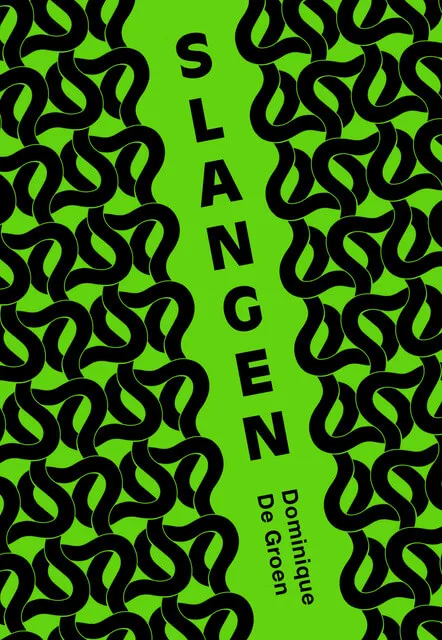
Slangen
Slangen krioelen in de sarcofaag van het heden, in de krochten van de popcultuur, in de mummie van de natuur, in wondes en rot vlees, in artificiële woestijnen en op geoliede dad bods. Ze wentelen zich rond beursgrafieken, raken verstrengeld met wurgende algoritmes, orkestreren een trage ondergrondse revolutie. Een meisje snijdt zich aan een nepdiamanten piramide en werpt haar slangenvel van zich af.
Dominique De Groen is schrijver en beeldend kunstenaar. Ze publiceerde de dichtbundels Shop Girl (2017), Sticky Drama (2019) en offerlam (2020). Ze werd genomineerd voor de Poëziedebuutprijs Aan Zee 2018, de Herman de Coninckprijs 2020 en de Fintroliteratuurprijs 2021 en won de Frans Vogel Poëzieprijs 2019 en de Fintropublieksprijs 2021.

Things You May Find Hidden in My Ear: Poems from Gaza
Winner of the 2022 Palestine Book Awards Creative Award
Finalist for the National Book Critics Circle Award in Poetry
These poems emerge directly from the experience of growing up and living one’s entire life in Gaza, making a life for one’s family and raising a family in constant lockdown, and often under direct attack.
In this poetry debut, conceived during the Israeli bombing campaign of May 2021, Mosab Abu Toha writes about his life under siege, first as a child, and then as a young father. A survivor of four brutal military attacks, he bears witness to a grinding cycle of destruction and assault, and yet, his poetry is inspired by a profoundly universal humanity.
In direct, vivid language, Abu Toha tells of being wounded by shrapnel at the age of 16 and, a few years later, watching his home and his university get hit by IDF warplanes in a bombing campaign that killed two of his closest friends. These poems are filled with rubble and the ever-present menace of surveillance drones policing a people unwelcome in their own land, and they are also suffused with the smell of tea, roses in bloom, and the view of the sea at sunset. Children are born, families continue traditions, students attend university, and libraries rise from the ruins as Palestinians go on about their lives, creating beauty and finding new ways to survive.

After Sex
Who decides what happens after sex? The last decade has seen many significant changes to the laws governing women’s reproductive rights around the world, from liberalisation in Ireland to new restrictions in the USA. After Sex offers personal and political perspectives from the mid-20th century to the present day, setting feminist classics alongside contemporary accounts. These essays, short stories and poems trace the debates and tell the stories; together, they ask us to consider what reproductive justice might look like, and how it could reshape sex.
The writers pay special attention to people — both fictional and real — who have sought control over their sexual lives, and the joy, comedy, difficulties and disappointments that entails. But above all, After Sex testifies to the power of great writing to show us why that freedom is worth pursuing — without shame and without apology.
With contributions from:
Lauren Berlant, Joanna Biggs, Edna Bonhomme, Gwendolyn Brooks, Beverley Bryan, Stella Dadzie and Suzanne Scafe, Storm Cecile, Lucille Clifton, Rachel Connolly, T.L. Cowan, ’Jane Does’, Maggie Doherty, Nell Dunn, Andrea Dworkin, Anne Enright, Deborah Friedell, Tracy Fuad, Kristen Ghodsee, Vivian Gornick, Donna Haraway, bell hooks, Barbara Johnson, Jayne Kavanagh, Lisa Hallgarten and Angela Poulter, Jamaica Kincaid, Patricia Knight, R.O. Kwon, Ursula K. Le Guin, Natasha Lennard, Sophie Lewis, Audre Lorde, Amelia Loulli, Erin Maglaque, Holly Pester, Adrienne Rich, Denise Riley, Sally Rooney, Loretta J. Ross, Madeleine Schwartz, SisterSong, Sophie Smith, Annabel Sowemimo, Amia Srinivasan, Keeanga-Yamahtta Taylor, Judith Jarvis Thomson, Alice Walker and Bernard Williams.

The Difficulties
If there is a centre around which the language of this pamphlet circulates, then it is Palestine. As this centre, Palestine enables a transformative power that persistently and steadfastly turns repression and silencing into solidarity. Essay-fiction, prose poetry, radical philosophy, speculative nonfiction — this uncategorizable collection of texts brings militant inquiry to each utterance, each narrative turn, in acts of transnational and transhistorical becoming.

The Obscene Madame D
Nathanaël, Hilda Hilst and 1 more
A wickedly funny work of depraved genius by one of Brazil’s most radical twentieth-century writers; imagine the Marquis de Sade as written by Clarice Lispecter.
An electrifying masterpiece by one of modern Brazilian literature’s most significant and controversial writers, Hilda Hilst takes us into the disorder and beauty of a mind restlessly testing its own limits.
Every month I ingested the body of God, not in the way one swallows green peas or agrostis, or swallows swords, I ingested the body of God the way people do when they know they are swallowing the More, the All, the Incommensurable, for not believing in finitude I would lose myself in absolute infinity…
The Obscene Madame D tells the story of Hillé, a sixty-year-old woman who has decided to abandon conventional life and spend the rest of her days in contemplation in a recess under the stairs. There, she is haunted by the perplexity of her recently deceased lover, Ehud, who cannot understand her rejection of common sense, sex and a simple life in favour of metaphysical speculations that he considers delusional and vain.
In a stream-of-consciousness monologue that’s part James Joyce, part Clarice Lispector, and part de Sade, Hillé speaks of her search for spiritual fulfilment from a space of dereliction, as she searches for answers to great questions of life, death and the relationship between body and soul.
Translated by Nathanaël and Rachel Gontijo Araujo

Grammar of the Cage
What words made this world of captivity and extinction? If written language is a biological adaptation, how can a text reshape the environment? These are the questions at the heart of Grammar of the Cage, a startling first collection of poetry by Pam Ore. The Compulsive Reader calls Ore "a poet of great promise," and poet Eloise Klein Healy says she has found Ore's book "haunting but necessary...a stunning debut collection."
Grammar of the Cage is clean and heartbreaking as a bone, and yet, as poet Ingrid Wendt writes in her Introduction, "[like] Emily Dickinson, Ore's 'business' is 'to sing.' And sing she does."

Alice Notley, Live in Seattle
Entirely comprised of poems contained in her latest collection, 2016’s Certain Magical Acts, Live in Seattle elucidates why Alice Notley is one of the world’s most revered poets, the recipient of the Los Angeles TimesBook Award, the Griffin Prize, the Shelley Memorial Award, the Lenore Marshall Prize, and the Poetry Foundation’s Ruth Lilly Prize. “I am alive outside written memory” is how one of the speakers of Notley’s poem “Voices” puts it and listening to the poet read her work live, in front of an entranced audience, serves to detail the intangibility of sound vis-à-vis language.
Live in Seattle also includes excerpts of the onstage conversation Notley had with Seattle poets John Marshall, Christine Deavel and Rebecca Hoogs. Among other topics, the talk revolves around concepts of success, what it means to write a female poetry circa 2017, and the importance of always creating from a position of disobedience.
As part of Seattle Arts & Lectures’ Poetry Series, Live in Seattle was recorded at McCaw Hall in Seattle, Washington on Wednesday, April 5th, 2017 and mastered and engineered by Gus Elg at Sky Onion in Portland, Oregon in the Summer of 2017.
Purchase of Live in Seattle includes a 11×11 insert of Notley’s poem “FOUND WORK (lost lace),” as well as a download card for the entire album. Live in Seattle can also be found digitally on Spotify and Bandcamp. The record itself is not black but clear.
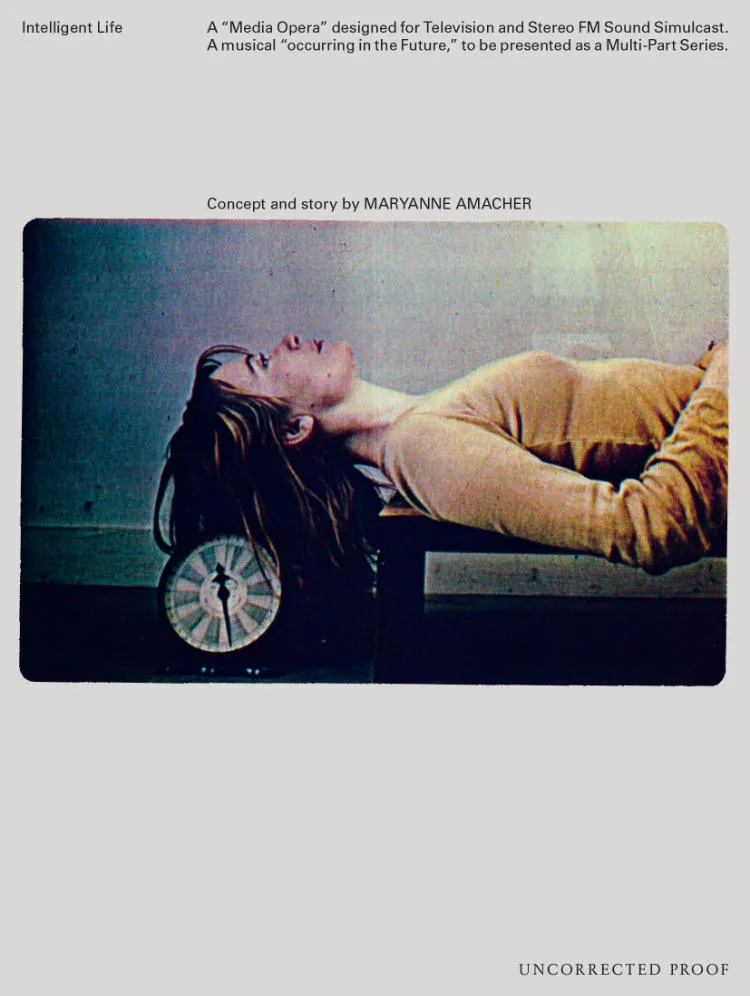
Intelligent Life
Comprehensive and previously unpublished documentation on the American composer's unproduced magnum opus.
Had it been produced, Maryanne Amacher's media opera Intelligent Life would have represented the summation of the composer's concept to date. As she wrote to John Cage in the autumn of 1983, following the untimely deaths of the opera's patrons—Wies Smals, founder of De Appel, and curator Josine van Droffelaar, in a plane crash in the Swiss Alps—she would have at last had the support to "communicate the finest of my thought to others." Amacher's serial, intended for broadcast, sought to transmit her evolving ideas about perception, listening, and composition to a broader public—shifting music away from "nod and tap recognition" toward a transformative practice that could awaken intelligence to "unrecognized and new perceptual modes."
Set in the year 2021, Intelligent Life follows the employees of Supreme Connections LLC, a music entertainment corporation navigating a future in which artificial intelligence generates music faster than composers can. Anticipating an industry-wide downturn, Supreme Connections president Aplisa Kandel seeks advanced technologies that will revolutionize the act of listening and the future of music, including a bio-music script that lets the user hear Bach from the aural perspective of a reindeer and a wearable device that goes beyond replicating the mechanical tympanic resonances of the listening subject to produce the "listening mind" or the "sophisticated perceiver"—capturing and reproducing all the emotional and psychological associations unique to each individual.
Though Amacher could not realize Intelligent Life in any of its intended forms—she theorized its publication as a serialized radio broadcast and television simulcast, among other configurations—she continued designing "treatments" for the opera for much of her career. This volume makes the most complete of these working documents—including episodic scripts, notes on the use of LaserDisc, and an illustrated storyboard for the pilot—available to the public for the first time.
Maryanne Amacher (1938-2009) was a composer of large-scale fixed-duration sound installations and a highly original thinker in the areas of perception, sound spatialization, creative intelligence, and aural architecture. She is frequently cited as a pioneer of what has come to be called “sound art,” although her thought and creative practice consistently challenges key assumptions about the capacities and limitations of that genre. Often considered to be a part of a post-Cagean lineage, her work anticipates some of the most important developments in network culture, media arts, acoustic ecology, and sound studies.

Bookmarks of sorts
Afternoon Editions no. 5: a collection of found papers annotated by Jeroen Peeters, titled Bookmarks of sorts. During several years Jeroen Peeters collected notes left by readers in library books: faded reader tickets, scraps with notes, a shopping list, train tickets and other little papers used as bookmarks. He noted each time the date and the book in which they were found. Afterwards he wrote commentaries to this collection, an essay on alternative reading practices, marginalia and extra-illustration, on the exchange between readers and the imaginary community lingering in all those library books.