Books
Books
in random order

This Reasonable Habit
Rainer Diana Hamilton, Violet Spurlock
Violet and Rainer, over the course of a long phone call, become hosts of an imaginary literary summit where attendees spar over casualwear, animal metaphors, fascist art, bodily autonomy, and other problems of the everyday. A collaborative work of friendship as much as the occasion for philosophical scholarship, where one can find the answers to burning questions like: What makes sex good? What constitutes a good reason to dislike someone? What does my nipple piercing mean for your nipples? And how have you been, lately?

Wound Building: Dispatches from the Latest Disasters in UK Poetry
Wound Building is a volume of essays, with digressions, on one group of contemporary poets active in a self-organizing political poetry scene in the UK, most of whom have little to no audience outside of the little magazines that they publish and the reading series they put on. The book is a front-line report on the rapid development of this poetry in the period between 2015 and 2020, with a particular focus on the relationship of poetry to violence and its representation. The poets discussed here write violent love poems and violent elegies as well as violent fantasies composed in stabs of violent verse and violet prose. The poems themselves comprise fantasies of killing David Cameron, dreams of being split open along a seam, basement songs, hundreds of pages of notes on working life in a privatized care home in Hove, East Sussex, a four-line slogan about the Cologne groping scandal of New Year 2016, variations on the Refugees Medical Phrasebook, a life wasted in a factory in Guangzhou, an autobiographical sci-fi internet fever dream, an anarchist elegy, and a refusal to argue. Ultimately, Hayward argues that the lessons this poetry teaches is never to write a "worthy" narrative when a fucked up collage will do. Rather than a cohesive "account" of a "school" of poets, or a "contribution" to the boring tittle-tattle of aesthetic debates over British poetry as an institution, Wound Building is a front-line report on the local disasters of a contemporary UK poetry caught in the grip of the historical cataclysm of capitalist culture.
Wound Building is further concerned with aesthetic problems related to Marxism, anarchism, contemporary trans politics, and class, though its "theoretical" preoccupations are subordinated to its desire to provide a ground-level view on the writing itself, its production, its intellectual aporia, and the ways it finds itself outstripped by the ongoing "march of events." The book will be of interest not only for those concerned with contemporary British political and experimental poetry, but also more generally for anyone who wishes to think carefully about what it means to make art about present-day history and its many horrible enormities.
The book's title is derived from the idea of sublime woundedness that subtends the context of the poets discussed here: the impressions of wounds opening up like LED-lit shopfronts in the night, in a parallel universe in which injury is intoxicatingly impersonal and structural, and which forms the environment in which the poems fight to absolutize the value of every last breath, or face into the reality of extravagantly violent wish fulfillment, or dissolve themselves in a search for new ways of professing love, or transform into a kind of expressionism of vomiting up medical-diagnostic categories found in abstract social labor, or pump their verses full of the convulsive rhythms of surprise and sudden relief, without any guarantee that this is the right thing to do or that anyone will even fucking hear. Wound Building does not historicize this state of affairs as much as it attempts to live alongside the immediacy of this work, in order to see what is still possible for poetry, and criticism, to make and do.

BUTT 37
Lots of straight-talking in BUTT no. 37. Catch Édouard Louis shot by Nan Goldin, Bruce LaBruce meeting Omar Apollo, real talk with Brazilian deputy Erika Hilton and dirty talk with Martin Margiela and Jean Paul Gaultier. Plus a lesbian threeway, Bogotá’s sauna/museum, cocks in sock and oh so much more. Bangers only.

Prompt Thinking
Prompt Thinking explores how artificial intelligence is fundamentally transforming the nature of thought. In the age of generative AI, prompting becomes more than a technical instruction: it emerges as a philosophical practice.
This book arises from an experiment with AI in which the fictional philosopher Jianwei Xun sparked global debate by publishing a book about power and perception in the digital age. That book, Hypnocracy: Trump, Musk, and the New Architecture of Reality, was written with the assistance of AI. Rather than casting AI as either savior or threat, Prompt Thinking proposes a third way: conscious dialogue with artificial intelligence as a means to expand critical awareness. The book shows how critical philosophical engagement with AI can produce unexpected insights while preserving intellectual autonomy.
Part theoretical framework, part methodological provocation, Prompt Thinking offers tools for navigating cognitive transformation. It proposes an ethics of the threshold, neither rejecting technological change nor surrendering to it.

Wages For Wages Against – Volume 4 – Be There When and Where – Art and Anti-ableism
The fourth volume of a new series of publications by the collective Wages For Wages Against, acting for better work conditions in the visual arts and against all forms of discrimination, on the topics of accessibility in the arts and ableism.
Wages For Wages Against has been doing pioneering work for the fair remuneration of artists in Switzerland since 2017. It is committed to social and economic justice for all artists. This volume brings together texts by artists who create spaces—fields of possibility. Texts that seek to amplify moments of struggle and negotiation. Texts that speak of interdependence, trauma and adaptations. Texts driven by a desire and a sense of urgency to address the accessibility of spaces where art is created and experienced.
Wages For Wages Against (WFWA, wfwa.ch) is a a militant collective and a campaign for the fair remuneration of artists in Switzerland, better work conditions, and an alternative economy of the arts.
Edited by Wages For Wages Against.
Contributions by Michaëla Danjé, Quiplash, Park MacArthur, Lari Medawar & Ostensible, Sabrina Röthlisberger Belkacem.
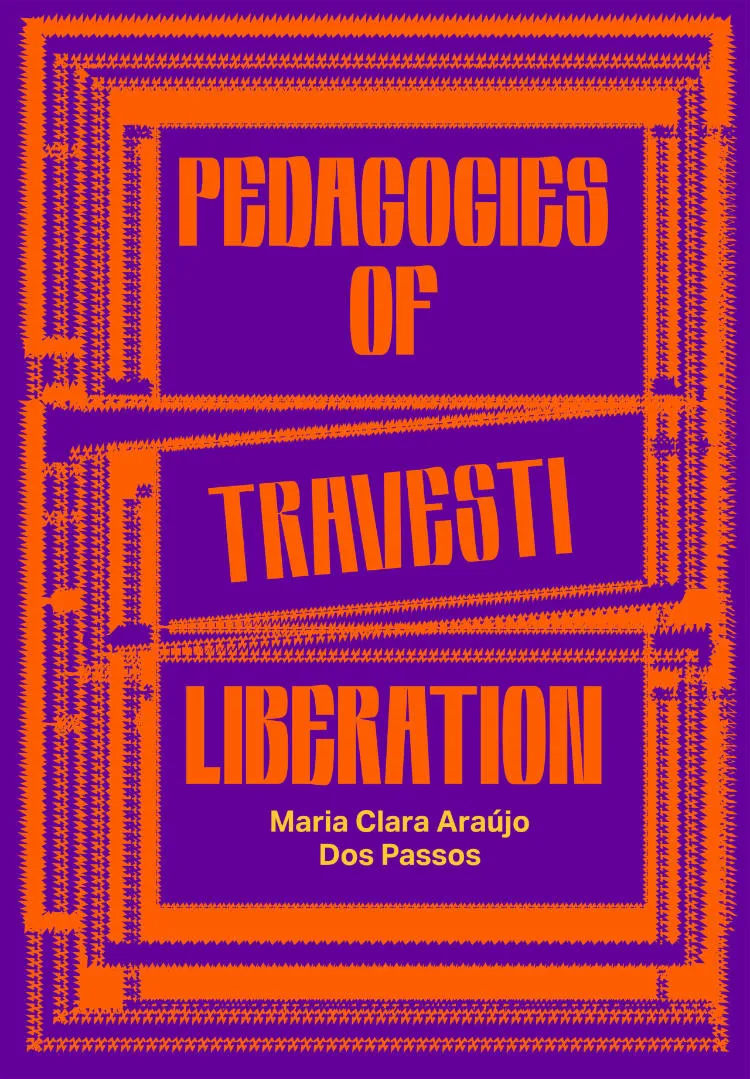
Pedagogies of Travesti Liberation
Maria Clara Araújo dos Passos, Natália Affonso
Maria Clara Araújo dos Passos examines the interplay of education, identity, and liberation in Brazil's travesti community.
In Pedagogies of Travesti Liberation, Maria Clara Araújo dos Passos critiques traditional pedagogical frameworks that marginalize gender nonconforming narratives and highlights the effects of systemic discrimination on travestis' psychosocial well-being. The book advocates for inclusive educational practices and emphasizes the need for affirmative curricula.
Newly translated from Portuguese, this work contributes towards connecting political struggles globally and navigating the complexities of translation—particularly of the term "travesti"—across various geographical and political contexts, featuring a conversation between Araújo dos Passos and translator Natália Affonso.
Maria Clara Araújo dos Passos (born 1996 in Recife) is a Brazilian Afro-transfeminist educator and sociologist, and an activist for LGBT rights.

Ezio Gribaudo - The Weight of the Concrete
Lilou Vidal, Tom Engels and 1 more
The Weight of the Concrete explores the legacy of the Turinese artist and publisher Ezio Gribaudo (1929–2022), examining his multifaceted oeuvre at the confluence of image and language. This publication, named after Il Peso del Concreto (1968)—a seminal work that featured Gribaudo’s early graphic creations alongside an anthology of concrete poetry edited by the poet Adriano Spatola (1941–88)—places Gribaudo’s work in conversation with approximately forty artists and poets from different generations, all of whom similarly engage with explorations of text, form, and visual expression.
Reflecting the editorial premise of Il Peso del Concreto, The Weight of the Concrete revisits the influential anthology, including archive material that documents its production, and reimagines it, pairing Gribaudo’s graphic work with a new selection of historical and contemporary concrete and experimental poetry.
At the heart of the volume is Gribaudo’s emblematic Logogrifi series, developed from the 1960s onward. The Logogrifi reveal his deep engagement with the art of bookmaking and fascination with industrial printing processes, relief matrices, typefaces, and language games.
In this new edition, the editors take the opportunity to revisit Gribaudo’s pioneering work, examining previously overlooked dimensions—gendered, geographical, and technological—and exploring contemporary associations beyond the original context. The book also includes essays that elucidate the poetic and political interplay between image, language, and materiality.
This publication is released following Ezio Gribaudo – The Weight of the Concrete, an exhibition held at the Grazer Kunstverein in Graz, Austria (2023–24), and at the Museion—Museum of Modern and Contemporary Art in Bolzano-Bozen, Italy (2024).
Edited by Tom Engels and Lilou Vidal
Published by Axis Axis and Grazer Kunstverein
Contributions by Anni Albers, Mirella Bentivoglio, Tomaso Binga, Irma Blank, Al Cartio, Paula Claire, CAConrad, Natalie Czech, Betty Danon, Constance DeJong, Mirtha Dermisache, Johanna Drucker, Bryana Fritz, Ilse Garnier, Liliane Giraudon, Susan Howe, Alison Knowles, Katalin Ladik, Liliane Lijn, Hanne Lippard, Sara Magenheimer, Françoise Mairey, Nadia Marcus, Giulia Niccolai, Alice Notley, Ewa Partum, sadé powell, N. H. Pritchard, Cia Rinne, Neide Dias de Sá, Giovanna Sandri, Mary Ellen Solt, Alice Theobald, Colleen Thibaudeau, Patrizia Vicinelli, Pascal Vonlanthen, Hannah Weiner, and Ruth Wolf-Rehfeldt
Essays by Alex Balgiu, Tom Engels, Nadia Marcus, Luca Lo Pinto, Mónica de la Torre, and Lilou Vidal

Peau d’Ana
Ana Jotta, Alice Dusapin and 2 more
A long conversation about the work and life of Portuguese artist Ana Jotta, accompanied by 60 previously unpublished photographs of her homes (in Brazil, Morocco, and Zanzibar) and her years in theater in the late 1970s.
“Peau d’Ana” is a conversation with the Portuguese artist Ana Jotta (1946), conducted in January 2024 by Alice Dusapin, Martin Laborde, and Baptiste Pinteaux in the Lisbon apartment that Ana has occupied for over forty years. Through the history of both this unique place and the various other homes in which she has lived — Tangier, Madeira, Brazil, and the Portuguese countryside — Ana Jotta mischievously and playfully invites us to revisit fragments of her life. She discusses her childhood, her work as an actress and set designer, her first exhibitions in the mid-1980s, and her life in the studio. She talks about the importance of pleasure and frustration, her love of painting and literature, and the role of the irrational in her work. She shares her dislike of families, her friendships with artists and other animals, and the detours necessary for finding, and preserving, the energy essential for work… and for sleep. She disarms with the precision of her words, which describe a solitary, demanding, and profoundly vivid existence where mediocrity has no place. The interview, published in French and English, is accompanied by some sixty previously unpublished photographs and documents.

Import – Export, Friperie
This book brings together a selection of photographs by artist Mekhitar Garabedian, documenting the warehouse of his late father’s company, Melantex, which exported second-hand clothing from Belgium to the Middle East, Asia, and Africa. The images inspired a one-year sculptural intervention by Garabedian, commissioned by the Antwerp Public Art Collection.
Import—Export, Friperie tells a compelling personal and collective story of how displacement can be turned into economic livelihood while creating connections between old and new homes, languages, and textiles.
The photographs are accompanied by an in-depth conversation between Garabedian and curator Samuel Saelemakers about the relationship between photography and sculpture, public representation, and diasporic thinking.

One Big Bang
One Big Bang brings together 78 charcoal and pastel drawings from Adel Abdessemed's recent series Nature Morte and Politics of Drawing, where everyday objects, animals, and flowers are subtly charged with tension. Through these works, Abdessemed explores the intersections of beauty, fragility, and unrest. With texts by Hélène Cixous and David Elliott, One Big Bang offers a thoughtful entry into an artist's visual language shaped by memory, myth, and political urgency.
Published following the eponymous exhibition at Projeckt Brussels in 2024.
Adel Abdessemed (born 1971 in Constantine, Algeria, lives and works in Paris and Berlin) deconstructs identity codes, tackling head-on the tensions that permeate our society. His works, with their typical simplicity—sculptural installations, drawings, photographs, videos and performances—echo precise facts and familiar situations, but go beyond narrative commentary and militant criticism. Adel Abdessemed questions, among other things, the social and economic status of the artist in a system where his foothold is slight, by shrewdly keeping a distance in a gesture of subversive and committed resignation.
Abdessemed refuses to be limited to a single ideology. In his early works he passionately tackled religious, sexual, and taboos subjects and his later exhibitions have often focused on the theme of global violence. In an interview with Elisabeth Lebovici he stated, "I do not live between two cultures. I am not a postcolonial artist. I am not working on the scar and am not mending anything. I am just a detector … In the public sphere, I use passion and rage. Nothing else. I don't do illusions."
Sometimes reduced to a simple word, as in "Mohammedkarlpolpot" (1999), a condensation of names evoking totalitarism and religion, and sometimes complex and monumental installations such as "Habibi" (2004), a suspended skeleton of 17 meters propelled by a jet engine, Abdessemed's practice belongs to a new generation of artists who appeared recently on the French art scene, looking to offer another perspective on culture and identity.

TIME
TIME by Spencer Longo is a collection of printed work depicting government raids, religious visions, environmental catastrophe, and extremist fundamentalism tangled together in a narrative web of salvation, annihilation, and transcendence. Using pen plotter graphics directly on uncollated pages of Time magazine, Longo explores the conspiratorial trope that messages are secretly embedded in mass media, coaxing our millenarian anxieties out through an additive printing process using graphics from survivalist publications, end-times evangelical cartoons, and marginalia from the borders of underground occult material, all sprinkled with ecstatic bursts of star-spangled clipart. A must-have for your fallout shelter's library.

Good Looking Pomes
"Joseph Matick is a former poet, now bird. He flies over pastures and eats chemtrails as his karmic sentence for spending so many years without flying. (You still have time, kids). Remarkably, he wrote this book in Paris with Jack before his transformation into Frank 0' Hara for the front cover. This book is dedicated to his father and his son. And to all the gum chewing geniuses of the lower canal. He wrote this in the 9éme and was inspired by baseball, flowers, and getting money so as not to die. These are his simplest and most penetrating words."
KATE FOR AVEC JACK VERA INTL
Joseph Matick is an American poet and filmmaker based in Paris. He grew up on a farm in small-town America, moved to Chicago, and eventually to Paris, where he stayed. He studied at the Jack Kerouac School of Disembodied Poetics at Naropa University — of which he has said: “that place ripped the rug from under my feet” — and has been writing ever since. He is the author of four books: three published by Far West Press — The Baba Books (New American Babble, Post Meridiem Seasick Fuzz, Animal My Soul), Cherry Wagon, and Good Looking Pomes (March 31, 2026). His work appears in King Kong Magazine and is held in the collection of the American Library in Paris.
Translated to English for the first time.

How to see palace pillars as if they were palm trees
Hussein Nasseraddine, Ben Koerber
For so it happens that when the poets speak, objects appear closer to their own shadows. The poet's mouth fills up with horses and marble, and his verses start to shine like rivers. These rivers then turn back to flow through the very palace he is depicting. The poet's own words begin to weigh down on him, as though he were holding up a palace with his palms. Then he travels, and the palace is obliterated. Countries and nations change, and naught remains but what the poets had seen. Of what the poets had seen, naught remains but its image in anthologies. And when the libraries have been flooded or burned to the ground, nothing but the commentaries on those anthologies are left, and all that one finds in these commentaries is that which was appropriated and wrought a thousand times over.
Hussein Nassereddine is a multidisciplinary artist. His work in installation, writing, video and performance originates from a practice around language that builds fragile monuments - some verbal, some sonic, some tactile - rooted in collective histories and resources of poetry, ruins, construction and image-making.
Translated from Arabic by Ben Koerber.

From static oblivion
A reflection about the status of the image as a balance of forces in tension and a paradoxical act of cancellation of the body through its own representation.
In Ion Grigorescu’s work, as in the book, the body is continually shown in different ways - from photography to film, from performance to drawing - and yet it remains absent, obscuring its own identity in an attempt to question the collective one. As it is impossible to show his art during the regime, it ends up hiding, disappearing inside the image. Instead of showing, the image conceals, because it is non-documentary and non-transmittable; it is an act of birth, a prove of the artist’s resistance, especially as a human being inside (or against) any geographical or historical background. In the rituals of his gestures and in the symbolism of his performances, Grigorescu finds a way to stay alive, preserving his own intellectual status while also defending the dignity of everyday life.
The book traces the progression, both expansive and inclusive, of his work, which inscribes itself into the space of the body and of the world. Grigorescu absorbs elements of the surrounding reality, showing us a continuity between art and life: his act of dissidence is not an outcry of provocation, nor is it extreme; it is an anti-aesthetic operation which uses experimentation and rough techniques to uncover the fiction of art, to denounce the artifice of representation and to affirm images as an instrument of subversive power.
Ion Grigorescu (Bucharest, 1945) is one of the most significant Romanian contemporary artists of the Post-War period and an iconic figure of the conceptual and performative art since the early 70s. He represented Romania at Venice Biennial in 1997 and 2011; his works are in the main public collections, such as MoMA, New York; mumok and Erste Foundation, Vienna; Tate Modern and Deutsche Bank AG, London; Centre Pompidou, Paris.

Discipline Park
Toby Altman’s Discipline Park documents the demolition of Prentice Women's Hospital in Chicago, a landmark of architectural brutalism designed by Bertrand Goldberg in the 1970s. Altman was born in the building, and years later, was employed by Northwestern University when they tore it down. His personal proximity to the site leads to a wider critical evaluation of the cruelty of a neoliberalism that asks us to draw sustenance from the very institutions that poison and erase our bodies, habitats, and histories. But, as it indicts the present and its claustrophobic, ruinous politics, Discipline Park also recovers or reinvents utopian vistas through an extended engagement with Goldberg's architectural practices.

Wages For Wages Against – Volume 1 – We are not where we need to be, but we ain't where we were
Ramaya Tegegne, Lili Reynaud-Dewar and 1 more
We are not where we need to be but, we ain't where we were is the first volume of a new series of publications by the collective Wages For Wages Against that reports on active research engaged within the artistic professions and institutions since 2017. Its aim is to question the underlying neoliberal logics in the contemporary art world, by orienting our object of study towards the struggles that impact it. With this publication, our hope is to put into practice various values specific to the campaign: the existence of a systematic and fair remuneration, a desire for transparency, the sharing of knowledge, and the visibilization of demands proper to the field of the visual arts and concomitant struggles. It is the result of militant experiences, at the convergence of our individual experiences and collective questionings.
With texts by Tiphanie Blanc, Antonella Corsani, Fanny Lallart, Lili Reynaud-Dewar, Ramaya Tegegne and an interview with Outrage Collectif.

Weaknesses
Afternoon Editions no. 2: text and drawings by Chrysa Parkinson titled Weaknesses. Between January and March 2019 Time has fallen asleep in the afternoon sunshine was presented as a solo-exhibition at Index Foundation in Stockholm. During this period Chrysa Parkinson was invited as a guest writer for Afternoon Editions. Weaknesses is a leap in memory.

Earth, Fire, Water
Born in Beirut, Ali Cherri lives and works between Beirut and Paris. He belongs to this generation of Lebanese artists born during the civil war whose work has been strongly affected by this context of instability.
Through an introduction by the artist, 4 essays and an interview, this first monograph reveals the political, aesthetic and dreamlike dimensions of a work that the artist has been developing for over fifteen years. Ali Cherri's interdisciplinary work explores the myths and classifications of ancient worlds and contemporary societies

Grab Bag
Cult novelist Dennis Cooper launches the third title of Little House on the Bowery, the Akashic series he is editing and promoting.
Grab Bag is comprised of two interrelated novels, Dark Rides and Wish Book, from one of Canada’s most important young writers. Both books are set in the same small rural city, in different eras (1950s, 1930s), each characterized by McCormack’s spare and elliptical prose.

Lesson on Gravity
Lesson on Gravity is a slice of Anne Juren’s ongoing artistic research into ‘fantasmical anatomies’. ‘What happens when our sense of ground, orientation and support is lost? What are the risk and the promise of detaching ourselves from the pull of gravity?’ As this apocryphal Feldenkrais lesson embraces moments of intrusion and fragmentation, poetry and flights of fancy, it shows how language is alive, embodied and liquid. It also invites the reader to treat the book itself as a body, an unruly tongue sticking somewhere in its folds and creases
Anne Juren is a choreographer, dancer and Feldenkrais practitioner. In 2021 she finished her PhD at Stockholm University of the Arts with the project Studies on Fantasmical Anatomies.
Published by Varamo Press in the essay series Gestures
First edition, March 2023
Graphic design by Michaël Bussaer

Ana Patova Crosses a Bridge
“Ana Patova Crosses a Bridge is the third volume of Renee Gladman’s magnificent, melancholy series about the city-state of Ravicka, or about the architectures of its absence. It is tempting to read the Ravickian books as an extended allegory—of architecture itself, perhaps, except that architecture is already half-allegorical, its every element raised to prefigure whatever meanings can make their way to them. If any can. In Ravicka, meanings—indeed most contact of any kind—remain in abeyance, building, in absentia, the constitutive negative spaces of the narrative. There is a plot; it lays out zones of sheer ambience. Experiences, of which there are many, unfold as a redolent lingering in the structures of immateriality, the radical realities of the insubstantial. Gladman is a philosopher of architecture, though not that of buildings. Rather, she thinks (and writes) the drifts, partitions, and immobilities of identity, affect, communication, the very possibility of being human. Profound, compelling—haunting, even—the story of Ravicka is astonishingly ours.” - Lyn Hejinian

About Ed
A moving story about love, AIDS, grief, and memory by one of the most adventurous writers to come out of San Francisco's LGBTQ+ scene.
Bob Glück met Ed Aulerich-Sugai in 1970. Ed was an aspiring artist; Bob wanted to write. They were young men in San Francisco at the high tide of sexual liberation and soon, and for eight years, they were lovers, after which they were friends. Ed was an explorer in the realms of sex. He was beautiful, fragile, exasperating, serious, unassuaged. In 1994 he died of HIV. His dream notebooks became a touchstone for this book, which Glück has been working on for some two decades, while also making his name as a proponent of New Narrative writing and as one of America's most unusual, venturesome, and lyrical authors. About Ed is about Ed, who remains, as our dead do, both familiar and unknowable, faraway and close. It is about Bob too.
The book is a hybrid, at once fiction and fact, like memory, and it takes in many things through tales of political activism and domestic comedy and fury to questions of art and love and experiences of longing and horror. The book also shifts in register, from the delicate to the analytic, to funny and explicit and heartbroken. It begins in the San Francisco of the early 1980s, when Ed and Bob have been broken up for a while. aIds is spreading, but Ed has yet to receive his diagnosis. It follows him backward through his life with Bob in the 1970s and forward through the harrowing particulars of death. It holds on to him and explores his art. It ends in his dreams.

Assembling a Black Counter Culture
DeForrest Brown, Jr.’s Assembling a Black Counter Culture presents a comprehensive account of techno with a focus on the history of Black experiences in industrialized labor systems—repositioning the genre as a unique form of Black musical and cultural production.
Brown traces the genealogy and current developments in techno, locating its origins in the 1980s in the historically emblematic city of Detroit and the broader landscape of Black musical forms. Reaching back from the transatlantic slave trade to Emancipation, the Industrial Revolution, and the Great Migration from the rural South to the industrialized North, Brown details an extended history of techno rooted in the transformation of urban centers and the new forms of industrial capitalism that gave rise to the African American working class. Following the groundbreaking work of key early players like The Belleville Three, the multimedia output of Underground Resistance and the mythscience of Drexciya, Brown illuminates the networks of collaboration, production, and circulation of techno from Detroit to other cities around the world.
Assembling a Black Counter Culture reframes techno from a Black theoretical perspective distinct from its cultural assimilation within predominantly white, European electronic music contexts and discourse. With references to Theodore Roszak’s Making of a Counter Culture, writings by African American autoworker and political activist James Boggs, and the “techno rebels” of Alvin Toffler’s Third Wave, among others, Brown draws parallels between movements in Black electronic music and Afrofuturist, speculative, and Afrodiasporic practices to imagine a world-building sonic fiction and futurity embodied in techno.
DeForrest Brown, Jr. is an Alabama-raised rhythmanalyst, writer, and representative of the Make Techno Black Again campaign. As Speaker Music, he channels the African American modernist tradition of rhythm and soul music as an intellectual site and sound of generational trauma. On Juneteenth of 2020, he released the album Black Nationalist Sonic Weaponry on Planet Mu. His written work explores the links between the Black experience in industrialized labor systems and Black innovation in electronic music, and has appeared in Artforum, Triple Canopy, NPR, CTM Festival, Mixmag, among many others. He has performed or presented work at Haus der Kulturen der Welt, Berlin; Camden Arts Centre, UK; Unsound Festival, Krakow; Sónar, Barcelona; Issue Project Room, New York; and elsewhere. Assembling a Black Counter Culture is Brown’s debut book.
—
Editor: Rachel Valinsky
Editorial Consultant: Ting Ding and Camille Crain Drummond
Designer: Scott Ponik
Copy Editor: Madeleine Compagnon

Pâle Copie
Basse résolution affective, zéro confession, full dispositif : entre artifice et exposition, le « je » de ces poèmes est soigneusement mis en scène. C’est une critique du flux en devenant soi-même le flux. Ce n’est pas juste : « je te dis un secret », mais plutôt : « regarde comme un poème fait semblant d’avoir un secret. » Sam Riviere sample un langage déjà-là — celui d’Internet, de la publicité et des réseaux sociaux — pour le redistribuer en poèmes tentés par l’auto-sabotage et la blague, qui analysent le moment de leur naissance et doutent, au passage, de leur propre valeur.
81 Austérités — Le Mariage de Kim Kardashian — Post-célébrité (poèmes sélectionnés et traduits de l'anglais par Jules Leroy)