Books
Books
in random order

Something Medieval
James Kirtland Randall (1929 - ) was born in Cleveland, Ohio. He studied at the Cleveland Institute of Music from 1934 to 1947, and subsequently attended Columbia University (B.A., 1955), Harvard (M.A., 1956) and Princeton (M.F.A., 1958). He studied piano with Leonard Shure and composition with Herbert Elwell, Thad Jones, Roger Sessions and Milton Babbitt. From 1958 to 1991 he taught at Princeton, where he was professor of music. He was a founding member of the American Society of University Composers and has written articles on composing and music theory for several journals, notably Perspectives of New Music (some of these were collected in the monograph Compose Yourself: A Manual for the Young (Open Space, 1995)). He also collaborated with Benjamin Boretz on the book Being About Music: Textworks 1960-2003 (Open Space, 2003).
From the early 1960s into the 1970s, Randall engaged principally in computer synthesis of sound and, with Godfrey Winham, developed facilities for this at Princeton University. His tape compositions were generated by the MUSIC IV B program, a version of MUSIC IV introduced at Princeton. He designed his own software "instruments," which enabled him to specify every aspect of every sound and structure developments within single notes in ways that reflect principles of development used in whole compositions as, for example in Lyric Variations for Violin and Computer (1966-1968).
In 1980 he turned his attention to improvised musical performance and began a series of explorations of spontaneous group performance, or "real-time co-creation," involving many kinds of musicians and other artists (painters, dancers) as well. The ongoing efforts, preserved on hundreds of sound recordings and videotapes (under the project name Inter/Play), document the emergence of idiosyncratic group styles and performing conventions. Randall is himself a regular participant in these performances. In 1990, Randall, along with Elaine Barkin and Benjamin Boretz, started the publications series Open Space.

Modern Love
Constance DeJong’s long-neglected 1977 novel, Modern Love, is one thing made up of many: It is science fiction. It is a detective story. It is a historical episode in the time of the Armada and the dislocation of Sephardic Jews from Spain to an eventual location in New York’s Lower East Side. It is a first-person narrator’s story; Charlotte’s story; and Roderigo’s; and Fifi Corday’s. It is a 150-year-old story about Oregon and the story of a house in Oregon. Modern Love’s continuity is made of flow and motion; like an experience, it accumulates as you read, at that moment, through successive moments, right to the end.
An important figure of downtown New York’s performance art and burgeoning media art scene in the late 1970s and early 1980s, DeJong designed Modern Love herself and published it with help from Dorothea Tanning on the short-lived Standard Editions imprint. Critically acclaimed in its time, Modern Love is now back in print on the 40th anniversary of its original publication.
Constance DeJong is an artist and writer who has worked for thirty years on narrative form within the context of avant-garde music and contemporary art. Considered one of the progenitors of media art, or “time-based media,” DeJong shapes her intricate narrative form through performances, audio installations, print texts, electronic objects, and video works. Since the 1980s, DeJong has collaborated with Phillip Glass, Tony Oursler, and the Builders Association on performances and videos at Walker Art Museum, Minneapolis, MN; the Wexner Center, Columbus, OH; Philadelphia Museum of Art; and in New York, at The Kitchen, Thread Waxing Space, the Whitney Museum of American Art, and the Dia Center for the Arts. Her books include I.T.I.L.O.E. and SpeakChamber, and her work is included in the anthologies Up is Up, But So is Down: New York’s Downtown Literary Scene, 1974–1991 (NYU Press, 2006); Blasted Allegories (New Museum/MIT, 1987); and Wild History (Tanam Press, 1985).

Pfeil Magazine #19 – Rest
There is no pause without prior exertion, and this issue of the magazine explores rest and all its associated contexts and contradictions. Amidst increasing environmental pollution, a tenuous global political climate, and a performance-oriented society demanding ever greater productivity, the balance between rest and labour becomes skewed. Pausing carries the risk of falling behind, but this risk can be mitigated by knowing when to rest. This issue examines rest as activity and as resistance. It questions how the individual body, in cohesion with a community, can generate weight through relaxation and distribute it.
Contributors: Asma Ben Slama, Camila Cañeque, Christiane Blattmann, Eileen Myles, Federico Tosi, Gelare Khoshgozaran, Hanne Loreck, Hans-Christian Dany, Hyemin Yang, Ingrid Jäger, Jenni Bohn, Jochen Lempert, Julia Schulze Darup, Mariona Berenguer, Matthias Schubert, Mikołaj Sobczak, Mirene Arsanios, Nat Raha, Nicholas Grafia, Niclas Riepshoff, Omar Hahad, Sarah Drath, Stacy Skolnik, Thomas Laprade, Vir Andres Hera
Within the format of a magazine, each page of Pfeil represents the floor, walls, or ceiling which together create an imagined room displaying a printed exhibition. Each issue is dedicated to a specific word, and artists are invited and given space to work on and with this term, and to construct or deconstruct the architecture around it. Combined, the contributions transform into an organic display surrounding the leitmotif.

Nights of the Dispossessed
Natasha Ginwala, Gal Kirn and 1 more
Riots are extraordinary events that have been recurring with increasing frequency and occupy a highly controversial space in the political imagination. Despite their often negative portrayals, it is undeniable that riots have played a pivotal role in the confrontation between authority and dissent. Recently, with the deepening crises of capitalism, racial violence, and communal tension, an “age of riots” has powerfully begun. As master fictions of the sovereign nation-state implode, and the hegemonic silencing of the dispossessed reveals the cracks in governability, Nights of the Dispossessed: Riots Unbound brings together artistic works, political texts, critical urban analyses, and research projects from across the world in an endeavor to “sense,” chronicle, and think through recent riots and uprisings—evoking a phenomenology of the multitude and surplus population.
With contributions from Asef Bayat, Joshua Clover, Vaginal Davis, Keller Easterling, Zena Edwards, Nadine El-Enany, Dilip Parameshwar Gaonkar, Gauri Gill, Natasha Ginwala, Natascha Sadr Haghighian, Louis Henderson, Satch Hoyt, Hamid Khan, Gal Kirn, Josh Kun, Léopold Lambert, Margit Mayer, Vivek Narayanan, Ai Ogawa, Oana Pârvan, Elizabeth A. Povinelli, SAHMAT, Thomas Seibert, Niloufar Tajeri, Chandraguptha Thenuwara, Dariouche Tehrani, and Ala Younis.

Arthur’s Whims
Arthur’s Whims is the tale of “a modern saint,” a love story born of a childhood dream of being “alone on a boat with a boy, a friend.” Arthur and his beloved Bichon—a young man who, after drinking Arthur’s tears, becomes pregnant with his child—drift through a stream of identities and circumstances: birdcatchers for a French taxidermist; sailors shipwrecked in an ice fortress; explorers of the Isles of Traitors, Babies, and Sadness; famous magicians in Oklahoma; religious and medical marvels. It is an anarchic, outrageous novel, in the tradition of Edgar Allan Poe and Comte de Lautréamont, now available in English for the first time in translation by Dana Lupo. This edition includes Hervé Guibert’s essay “The Bear,” in which he compares his books to rooms in a house, writing: “Arthur’s Whims would be the library of the house, and the bedroom of a child who will never be.” It is “a true adventure novel in the tradition of the genre, or what I believed to be its tradition, with great journeys, disasters, shipwrecks, cataclysms.”
“This short novel, offered here along with an essay by Guibert, reads like a madcap picaresque—one in which bodies can transform, the pace is constantly accelerating, and geography proves to be malleable. A gloriously surreal account of an unexpected voyage.” — Tobias Carroll, Words Without Borders
Hervé Guibert was a French photographer, critic, and author. Born in 1955, he published works of autofiction, novels, short stories, and essays, including many on photography. His writing was often deeply personal, ironic, and centered on illness and the body. Guibert died from complications of AIDS in 1991, at the age of thirty-six.
Dana Lupo is a writer and translator based in New York. Their work has appeared in Entropy, Bone & Ink Press, Arcturus (Chicago Review of Books), Apricity Press, and elsewhere. Arthur’s Whims is their first published translation.

Thirty-Odd Functions of Voice in the Poetry of Alice Notley
Alice Notley has consistently peopled her poetry with the voices of those around her: kids, friends, husbands, strangers, and the dead. Thirty-Odd Functions of Voice in the Poetry of Alice Notley offers an array of interpretations of this technique. While not aspiring to completeness, and limiting its attention to one formal aspect of a single author's work, this poem-essay sketches relationships between intimate speech and literary language.
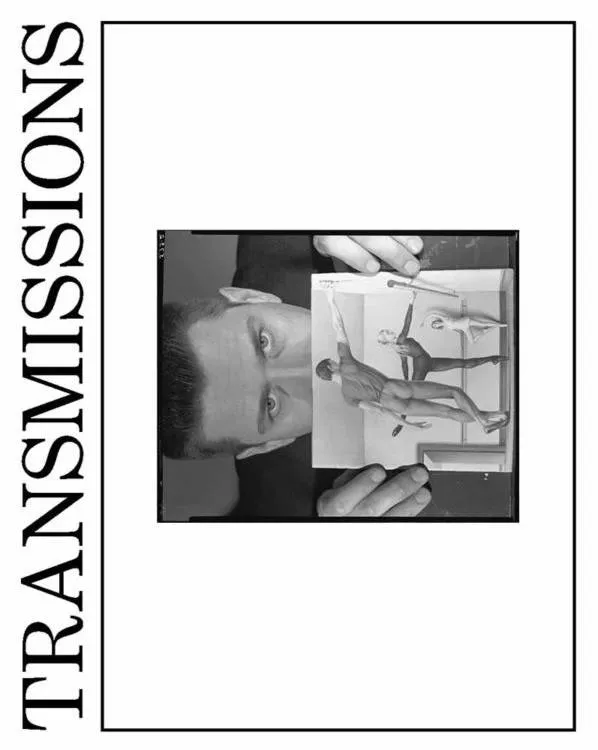
Transmissions
An aesthetic and social history of art and dance in mid-20th-century New York interpreted by contemporary artist Nick Mauss.
Over the past decade, Nick Mauss (b. 1980) has pursued a hybrid mode of working that melds the roles of curator, artist, and scholar. This catalogue leans heavily into the scholarship side of his practice, building on his 2018 Whitney Museum exhibition with a closer look at the relationship between modernist ballet and the New York avant-garde. In the 1930s through 1950s, ballet was introduced to a popular audience in New York and was simultaneously influenced by developments in Europe in painting, photography, fashion, music, and poetry. Mauss reflects on this period of rich cross-media production and synergy, ultimately arguing for the inseparability of dance and art history.

stewarding
stewarding maps the joyful and embodied ways we can resist oppressive structures that control our food, housing, and socialisation. We begin in an abandoned school, previously the union headquarters for a coal board, which became a legal guardianship, now condemned. We witness acts of communing between human inhabitants, composting worms, microbes in fermentation, and learn working class histories along the way. Here, complex networks emerge between agents, and thrive, disrupting the monolithic power of corporate extraction. Sean Roy Parker’s debut collection of poetry is a generous account of hopeful ways to eat and ways to live.

It's Too Late. Do It Anyway!
Cassie Thornton, Magdalena Jadwiga Härtelova
Hey culture worker! Are you feeling alone and afraid while the world burns? It’s Too Late. Do It Anyway! is two books in one, created for cultural workers who want to get off the racial capitalist high-speed-train-to-nowhere and start structuring revolution through collective care.
It’s Too Late. Do It Anyway! offers two routes into a fractal support network designed to shed absurd, useless forms of artworld prestige in favor of collectively producing a world organized to support caregivers. It’s Too Late tells the true story of an exhibition about care that exposed the difference between making symbolic gestures and actually doing something. Do It Anyway! serves as a manual for The Hologram, a prism-shaped collective care protocol conceptualized by artist Cassie Thornton, inspired by the Social Solidarity Clinic of Thessaloniki in Greece, and now practiced by people all over the world.
In It’s Too Late. Do It Anyway! multiple voices weave The Hologram into the present, the past, and the future all at once, ultimately putting the story and the tools it describes into each reader’s life-wizened hands. This is not really a book; it’s a pathway out of the tough spot we are all in right now. Anyone can make use of it, even you.

GABOR
Told through contradicting, unreliable narrators and almost entirely in dialogue, Seyed Qader Hedayati's GABOR fuses the experimentation of George Saunders with the absurdist satire of Joseph Heller to deliver a seldom explored portrait of friendship and boyhood under the anarchy of occupation.
In a Kurdish village under military occupation, a group of boys scrape together their savings and buy a hand-stitched football to prove they aren't losers to the other kids. When it lands inside the opposing military base, Karim sneaks in and takes it back—only for the soldiers to burn the neighborhood to the ground looking for it. Streets are bombed, homes are raided, snipers take aim at pedestrians, residents are dragged off and imprisoned. As the casualty rate skyrockets, Karim and his friends retaliate by firing junkyard scraps from their slingshots while raging bulls escape slaughterhouses to stampede into warfare.

Real Estate Portfolio
Real Estate Portfolio by Claire Barrow
7 panel concertina + covers / total of 16 pages
9.6 × 14 cm folded / 98 cm extended
Riso 250gsm recycled offset exterior, litho 135gsm recycled offset interior
Glassine sleeve, digitally printed on the front & back
Self-published edition of 300, signed by the artist
Constructed in the UK (£0.016 per cm²)
The zine was drawn in one session using the right wrong hand.

Atelier E.B 2026 Calendar
Atelier E.B's 2026 calendar is dedicated to the duo's spectacular window displays (2019-2025). These exhibitions feature garments from their fashion label arranged by professional window dressers—integrating the shopping experience into the exhibition context.
Atelier E.B (Edinburgh Bruxelles) is the company name under which designer Beca Lipscombe and artist Lucy McKenzie develop their joint projects.

Pervert or Detective?
Artists Reba Maybury and Lucy McKenzie dissect power and desire in a provocative conversation that probes the material erotic, appropriation, and sex.
Maybury, who integrates her work as a political dominatrix into her artistic practice, manipulates dynamics of control, compelling her male submissives to create art under her direction, only to claim it as her own. Through confession and humiliation, she dismantles notions of authorship, masculinity, and labor. McKenzie, known for her intricate trompe l’oeil paintings and conceptual installations, similarly blurs boundaries—between art and commerce, and authenticity and illusion. Her work challenges power structures and exposes the unstable nature of representation.
Maybury and McKenzie, through an expansive discussion with French art critic Marie Canet, interrogate the logic of seduction and domination, pushing against rigid binaries to probe the material erotic, appropriation, and transformation. With an introduction by curators Fredi Fischli and Niels Olsen, an afterword by writer Susan Finlay, and extensive reading and viewing lists, Pervert or Detective? offers a compelling exchange between artists committed to unsettling the familiar and redefining artistic agency.
Introduction by Fredi Fischli and Niels Olsen
Afterword by Susan Finlay

Hyperpolitics: Extreme Politicization without Political Consequences
What happens when politics is everywhere, yet nothing seems to change? From the abandoned dance floors of Thatcher’s London to the mass mobilizations of Black Lives Matter, Anton Jäger traces how public life has become infused with protest, spectacle, and moral urgency — while the old infrastructure of parties, unions, and civic solidarity has been hollowed out.
Hyperpolitics revisits the illusions of the “end of history” and dissects the strange energies that replaced them: viral outrage, endless culture wars, and the digital rush of causes that flare and vanish overnight. Jäger shows how the promises of post–Cold War liberalism gave way to a restless, unsteady public sphere where private passions overflow into politics but rarely build enduring power.
Ranging from Guy Debord and Wolfgang Tillmans to Houellebecq’s disenchanted fictions, Hyperpolitics makes sense of a world in which collective action remains fragmented and the social fabric thinner than ever. For anyone trying to grasp why our age feels so charged yet so inconsequential, this book offers a vital map through the new contradictions of our hyperpolitical moment.

Positions of the Sun
The second work in Belladonna* Collaborative’s Germinal Texts series, Lyn Hejinian’s Positions of the Sun is a book of twenty-six interlocking “essays with characters” that explores the mid-2000s financial “crisis” through the movements and daily lives of a wide-ranging cast of characters located in the Bay Area.
In Positions, Hejinian plays the bricoleur, bringing together whatever’s needed in her to approach to the subject—whether the paratactic tactics of poetry, scholarship’s critical patchwork, or dramatis personae set in time that evokes but frustrates narrative.
Earlier iterations of essays 4, 14, and 17 appeared in Belladonna*’s Elders Series #5, edited by Jennifer Scappettone with work by Etel Adnan, Lyn Hejinian, and Jennifer Scappettone.

Là
Laszlo Umbreit, Sirah Foighel Brutmann and 1 more
Là is an immersive, politically charged sound journey – a lament for the Al Naqab desert in Palestine. It is the result of a collaboration between Sirah Foighel Brutmann, Eitan Efrat, Laszlo Umbreit, and Ot Lemmens. The album combines acoustic instruments like flute and cymbals with processed electronics and mechanical sounds.
The track Ensemble is made from sound recordings of eleven 16mm film projectors, playing simultaneously and in intervals, creating a texture centered around a single pitch – La/A.
The tracks For Her, There, and No are recordings of live sessions played by Laszlo Umbreit and Eitan Efrat.
The album also features an extended text by Rose Higham-Stainton titled Strategies for Survival, spread across a 12-page booklet.

Survival Is a Promise: The Eternal Life of Audre Lorde
A bold, innovative biography that offers a new understanding of the life, work, and enduring impact of Audre Lorde.
We remember Audre Lorde as an iconic writer, a quotable teacher whose words and face grace T-shirts, nonprofit annual reports, and campus diversity-center walls. But even those who are inspired by Lorde's teachings on "the creative power of difference" may be missing something fundamental about her life and work, and what they can mean for us today.
Lorde's understanding of survival was not simply about getting through to the other side of oppression or being resilient in the face of cancer. It was about the total stakes of what it means to be in relationship with a planet in transformation. Possibly the focus on Lorde's quotable essays, to the neglect of her complex poems, has led us to ignore her deep engagement with the natural world, the planetary dynamics of geology, meteorology, and biology. For her, ecological images are not simply metaphors but rather literal guides to how to be of earth on earth, and how to survive—to live the ethics that a Black feminist lesbian warrior poetics demands.In Survival Is a Promise, Alexis Pauline Gumbs, the first researcher to explore the full depths of Lorde's manuscript archives, illuminates the eternal life of Lorde. Her life and work become more than a sound bite; they become a cosmic force, teaching us the grand contingency of life together on earth.

Sore 2
Sore is a serial anthology that brings together authors whose writing practices oscillate between the genres of diary keeping and fiction. For the second issue of Sore, ten contributors – both authors and visual artists – were invited to collectively develop their work through a series of informal critiques over the course of five months.
In the first issue of Sore, observations of everyday life intertwined with memories and cultural references to denote the significance of a certain soreness we each carry within us as we negotiate the various challenges of social existence. In this second ensemble, seven new authors widen our understanding of the term ‘sore’ by underlining a need to orient one’s gaze towards what’s hidden underneath, to enter the anatomy of all these necessary contortions and u-turns one performs in order to escape the grip of expected compliance.
With contributions from: Mathilde Heuliez, Lisa Lagova, Muyeong Kim, Nour Ben Saïd, Masha Ryabova, Adrienne Chung, Richard Dmitri Hees, Oscar Le Merle, Morra Kozlitina, Tindra Eliason, Helmer Stuyt, Ilya Stasevich, Kristina Stallvik.
Published by cover crop, Mathilde Heuliez & Lisa Lagova.

Where does a Body begin? Biology's function in contemporary capitalism
While presented as a contiguous work, the book is formed of different essays that have been dissected, recomposed with artificial connective tissue. The result lies somewhere between the rhizomatic continuity of a Body-without-Organs, and the disjointed assemblage of roadkill; either way, the question of where to even begin remains the same.
These essays each grow out of a particular resentment that developed through years of experience as a working-student of biology, but the task of the book was to transform this into something productive, something that sticks granular propositions into Biology like acupuncture needles. Inherent sexism within Biological research is, after all, not entirely disconnected to Pharmaceutical giants flooding the streets with opiates—and it is simply a writer’s hope that some well positioned words can remind enough people of how its all connected.
In what could be perceived as a philosophical turn, the importance of talking about science, as much as doing it, is re-entering the popular scientific consciousness, and it is high time, too. What was already getting bad under Biden, became catastrophic under Trump, and the infiltration into public research by private institutions and capitalist enterprises, which this book highlights, is proving dire. The capitalisation of all things bio, whether -yoghurt, -metric data or -logical institutions, is necrotic—MeltdownYourBooks didn’t flinch, they just grabbed the scalpel, dowsed the flesh in ethanol, and asked the question we all forget needs answering: where first, Doc?
Meltdown Your Books (M.Y.B.), the pen name, was made as a portmanteau of the seminal essay Meltdown by Nick Land, and the landmark film Throw Away Your Books, Rally in the Streets by Shuji Terayama. I chose the name, almost 3 years ago now, to reflect the political and digital black hole I saw hovering at the edge of contemporary media experience, and to present my work without the muddy veneer of personal identity. It has remained, since its inception, an anonymous project in only the loosest terms. The dedicated could always find my real identity, and some have, and so its anonymous character existed primarily as an element of presentation. Its anonymity existed to emphasize its deindividuated character. The things I discuss and emphasize under the M.Y.B. label are not items with definitive characteristics, they are collective experiences. M.Y.B. is something I cherish beyond self.
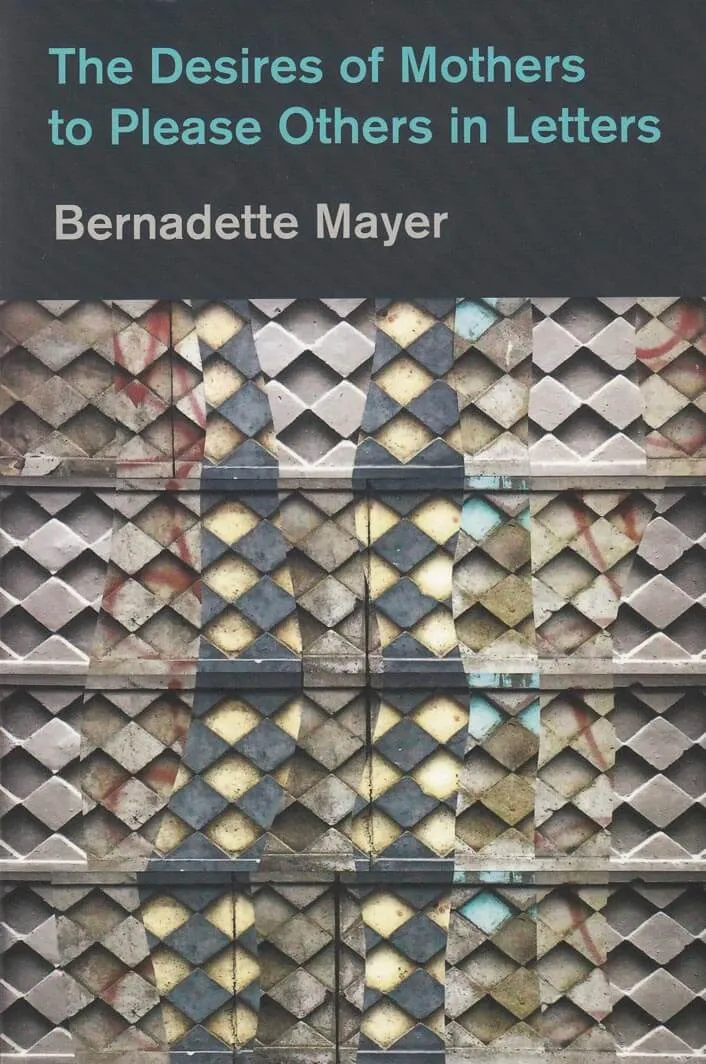
The Desires of Mothers to Please Other in Letters
A reissue of Bernadette Mayer's classic fugitive intergenre text. Endlessly inclusive, The Desires of Mothers to Please Others in Letters, first published in 1994 and long out of print, evokes the complexity of real persons as it simultaneously reinvents multiple genres: epistle, prose poem, and memoir.
Written between 1979 and 1980 while pregnant with her third child, Mayer extends her imaginative letters into meditations for us all on life as it is lived in real time, with its responsibilities and manifold desires. Fierce, lyrical, intimate, and wise, both new and familiar readers, both mothers and non–mothers, will find this book beckoning again and again to offer delicious writing, timely information, consolation, and advice.
With Introduction by Laynie Browne.

Eros the Bittersweet: An Essay
Anne Carson's remarkable first book about the paradoxical nature of romantic love. Since it was first published, Eros the Bittersweet, Anne Carson's lyrical meditation on love in ancient Greek literature and philosophy, has established itself as a favorite among an unusually broad audience, including classicists, essayists, poets, and general readers.
Beginning with the poet Sappho's invention of the word "bittersweet" to describe Eros, Carson's original and beautifully written book is a wide-ranging reflection on the conflicted nature of romantic love, which is both "miserable" and "one of the greatest pleasures we have."

This Reasonable Habit
Rainer Diana Hamilton, Violet Spurlock
Violet and Rainer, over the course of a long phone call, become hosts of an imaginary literary summit where attendees spar over casualwear, animal metaphors, fascist art, bodily autonomy, and other problems of the everyday. A collaborative work of friendship as much as the occasion for philosophical scholarship, where one can find the answers to burning questions like: What makes sex good? What constitutes a good reason to dislike someone? What does my nipple piercing mean for your nipples? And how have you been, lately?

Early Works
Early Works collects Alice Notley’s first four out of print poetry collections, along with 80 pages of previously uncollected material. A must have for any Notley fan. Includes original collection cover artwork by Philip Guston, Philip Whalen and George Schneeman, among others.
From editor Nick Sturm’s “Introduction” to Early Works:
In the author’s note that begins Grave of Light: New and Selected Poems 1970-2005, Alice Notley writes, “My publishing history is awkward and untidy, though colorful and even beautiful.” I have always been enamored of this sentence, which reminds us that an array of dispersed and varying publishing contexts are the original sites that give shape to such a book’s form. It is also something of an invitation into that color and untidiness, a prompt to become more curious about the awkwardness and beauty of Notley’s publishing history. This book, Early Works, accounts for a significant portion of that history by bringing back into print the complete versions of her first four books, a little-known 22-poem sonnet sequence, and a large selection of early uncollected poems gathered from little magazines. In doing so, Early Works joins an important set of recent volumes that put Notley’s earlier poetry back into circulation, including Manhattan Luck (Hearts Desire, 2014), which collects four long poems written between 1978 and 1984, and Songs for the Unborn Second Baby, originally published by United Artists in 1979 and reissued in a facsimile edition by London-based Distance No Object in 2021. Each in their own way, and especially taken together, these books continue to confirm that, as Ted Berrigan writes in The Poetry Project Newsletter in 1981, “Alice Notley is even better than anyone has yet said she is.”

DAISYWORLD MAGAZINE #4
CONTRIBUTORS Anna Bierler, India Boxall, Craig P Burrows, Alex Hampshire, Kayla Adara Lee, Marijn van der Leeuw, Melanie Matthieu, Gabriella T Moreno, Amira Prescott, Harrison Pickering, Astarte Posch, Ananda Serné, Zazie Stevens, Gedvile Tamosiunaite, Mia You.
cover image Ananda Serné & Poyen Wang
DAISYWORLD MAGAZINE is a seasonal art publication on perception, the sensory, the non-human, ecology & erotica with an emphasis on interconnectedness. The artist's intimate knowledge based on observation, questioning anthropocentrism through beauty & language. Reflecting on the past season while softly moving into the next, each issue launches in-between seasons; appreciating experience, transition, and metamorphosis instead of anticipating the next big thing.