rile*books

Search books

Search books by title, author, publisher, keywords...

Cover of Calculations

Risiko Press

Calculations

Ines Cox

€25.00

Ines Cox is an artist living between the Nièvre department in central-eastern France and Antwerp. This book consists of some 300 obsessive pages of her handwritten calculations—76% of which are actually true.

Cover by Bonni Cox, back cover by Toni Matthé. Printed in Borgerhout, bound by Gazelle in Deurne. Supported by Centre de la Paresse and Flanders—State of the Art. First presented at Kransen, 23.11.2024. Edition of 100.

Published in 2026 ┊ 304 pages ┊ Language: English

recommendations

Cover of Eselsohren Dog Ears

Risiko Press

Eselsohren Dog Ears

Pol Matthé

"The impossible takes a little longer. [pen scribbling]"

Presented at Kransen in Borgerhout, 1—3 March 2024, with an exhibition titled Dog Ears and a remote reading by fellow-Stockholmian artist Dave Allen.

Cover of Twenty Bookmarks

Risiko Press

Twenty Bookmarks

Zines €12.00

Twenty Bookmarks is a result of Production & Workflow class of Graphic Design Department at the Royal Academy of Fine Arts Antwerp, Ba1 Class of 2026.

Cover of Manifest ( ) gathered angry woman loving

Risiko Press

Manifest ( ) gathered angry woman loving

Chiara Di Luca, Emma Burel and 2 more

Zines €7.00

Words gathered from The Carrier Bag Theory of Fiction (Ursula K. Le Guin, 1986), Natural Enemies of Books (MMS, 2020), Non credere di avere dei diritti (Libreria delle donne di Milano, 1987), Dada Cannibalistic Manifesto (Francis Picabia, 1920) and WITCH (Rebecca Tamás, 2019). A first version of this poem/pamphlet was made in the context of See What I Mean, a workshop by Phil Baber at Antwerp’s Royal Academy of Fine Arts, october 2024.

Cover of Biarritz

Risiko Press

Biarritz

Jan Matthé

Poetry €10.00

Written and edited in Biarritz, Borgerhout and Midsommarkransen, 2016—2021. Dedicated to Räffi, with much love. Another version of this text was published in Pfeil Magazin 10 (Montez Press, 2018); editor: Anja Dietmann, copy-editor: Stacy Skulnik. Epigraph from Numéro Deux (1975) by Anne-Marie Miéville and Jean-Luc Godard. Presented on Saturday February 5th 2022 at Kransen, Borgerhout.

128x201mm, 40p, staple bound. Riso-printed on Arcoprint Edizioni Avorio 90g and Clairefontaine Blue 210g. Design by Kaye–Matthé, typefaces: Tribute, Gillies Gothic Light. Printed by Risiko Press at Kransen, covers silkscreened at Afreux, bound by Drukkerijcollectief De Wrikker. Edition of around 200.

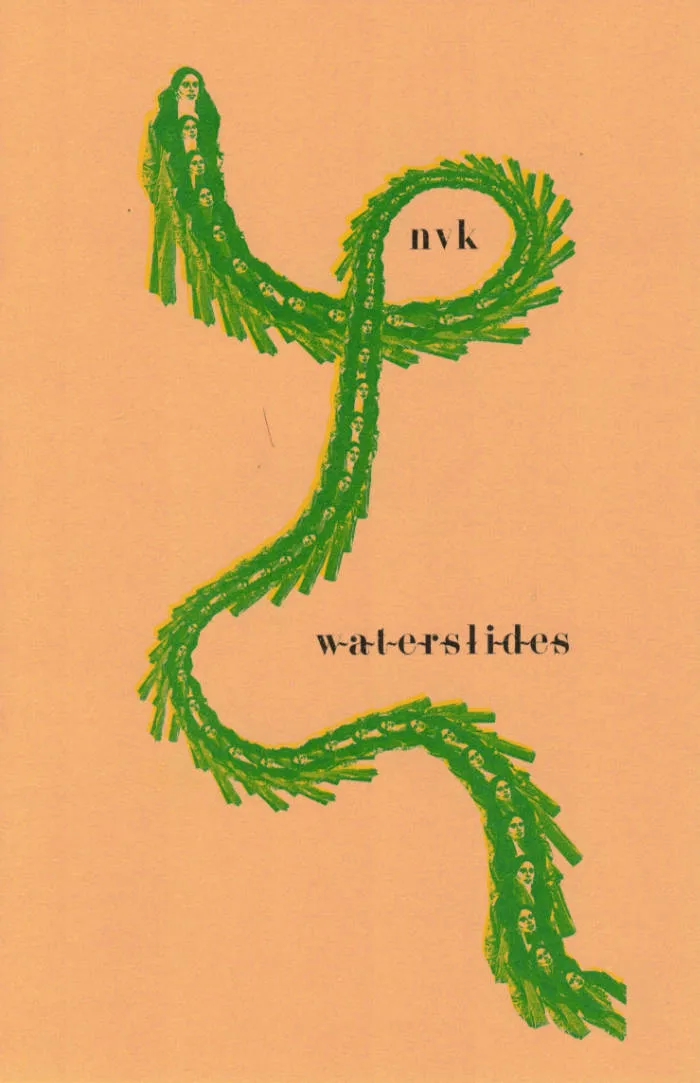
Cover of Waterslides

Risiko Press

Waterslides

nvk

Poetry €10.00

"Waterslides is a falling and plunging, short starts and stops aided by movement, until we splash, climb and plunge again. Each sliding is the same but different—with each descent new expectations and thoughts swirl, shifting focus and gaining new insights or blockages. Waterslides are brief moments of remembering, remembering as a present tense activity, one that happens as we think of it, projected on our now. The waterslide is the moment of past and present working in tandem, a movement of repeating, revisiting and remembering all at once.”

Written by nvk 2021-2023. Dedicated to Judi, MM & TNN.

A version of these poems was published as an audio work through Ignota Press’ The Mountain (2023) and included in a reading with James Loop on Montez Press Radio (2023). nvk would like to thank Jan Matthé, Stine Sampers and Michelangelo Miccolis for their patience & love.

This book was first presented at Kransen in Antwerp, May 6th 2023, with a performance by Sassy (costume by Rosa Schützendorf). Printed and bound at Risiko Press, Borgerhout. Cover image by nvk. Fonts: Adonis, Garamond Pro. Limited to 150 copies.

128x195mm, 16p., stapled, cover: green, yellow and black risoprint on 160gsm caramel paper, inside: black and blue riso on 120gsm Munken Pure paper.

Cover of Simurgh Self-Help

JRP Editions

Simurgh Self-Help

Slavs and Tatars

The 2025 Ringier annual report (artist's book).

Since 1998, Ringier, the Swiss-based global media company, has traditionally commissioned an artist to design its annual report. Publisher Michael Ringier and curator Beatrix Ruf initiated this series as a means of reinforcing the links between art and the activities of the company.

For the 2025 edition, Slavs and Tatars' Simurgh Self-Help revisits Marcel Broodthaers' seminal work Musée d'Art Moderne: Département des Aigles (1968–1972), replacing or "translating" the eagle—a symbol of power and empire that is used to challenge our understanding of authority and value—with the Simurgh, a mythical bird found across the Turkic-Persianate world. Whilst the eagle is often associated with nation-states and masculinity, the Simurgh is decidedly transnational, metaphysical, and flamboyant, if not gender-fluid.

Much like the collective's geographic remit—between the former Berlin Wall and the Great Wall of China—this publication attempts to shift our focus elsewhere, eastwards, to regions which too often fall through the cracks of historiography and art history. If modern and contemporary art institutions in Broodthaers' time were largely situated between the Rhineland and Northeast United States, the multipolarity of today's art world is a fait accompli: with biennials in Uzbekistan and museums in Kazakhstan, amongst others, rivalling the traditional centers of power.

Once too a sacred bird—accompanying Zeus, for example—the eagle has, over the past two millennia, undergone a thorough profanation: a brawny, secular flex of nationalism. It would be remiss not to see the parallels in the world of media: print itself and the act of reading, once an activity for the few and anointed, has undergone a similar dynamic of democratization over the past several centuries and, especially in recent years with the internet, a vulgarization which would make medieval Church elders wag their shriveled fingers at us in an I-told-you-so meme meant for the ages. This profanation has challenged the very institution of media and the narratives it disseminates, much as important works of institutional critique challenged contemporary art in the 1970s and beyond—akin to Slavs and Tatars' genre-bending mix of high and low, East and West, sacred and profane does today.

Slavs and Tatars' (founded 2006) extensive publishing activity—some 15 books in 20 years—has treated subjects as diverse as alphabet politics, Uighur literary culture, political satire in the Muslim world, and German anti-Enlightenment thinkers. Alongside sculptures, textile works, installations, sound pieces, and even a brick-and-mortar Pickle Bar in Berlin, the collective's books have cleared new paths for contemporary discourse via a wholly idiosyncratic form of knowledge production that draws on popular culture, spiritual and esoteric traditions, oral histories, modern myths, as well as scholarly research.

Slavs and Tatars is a faction of polemics and intimacies devoted to an area east of the former Berlin Wall and west of the Great Wall of China known as Eurasia. The collective's work spans several media, disciplines, and a broad spectrum of cultural registers (high and low) focusing on an oft-forgotten sphere of influence between Slavs, Caucasians and Central Asians. 

Slavs and Tatars has published Kidnapping Mountains (Book Works, 2009), a celebration of complexity in the Caucasus, Love Me, Love Me Not: Changed Names (onestar press, 2010) and are currently preparing solo engagements at Vienna's Secession,  Museum of Modern Art, New York and Künstlerhaus Stuttgart.

Cover of Le Chauffage — Issue #2

Le Chauffage

Le Chauffage — Issue #2

Francesca Percival, Felix Rapp and 1 more

Le Chauffage (french for “The Heater”) is an artist-run publication based in Brussels and Vancouver. It is conceived as a cross-continental, community oriented platform. Le Chauffage brings together the work and writing of artists / friends from different cities with the  intent to spark discussion and fuel casual forms of critical discourse.

The second issue of Le Chauffage contains photographs and texts, photographs of text, photographs as text and vice versa. Loosely thinking through the format of The Photo Essay celebrated by John Szarkowski in an eponymously titled exhibition at MoMA in 1965, this issue considers some of the artistic possibilities that can be found in such an archaic and historically male-dominated form. 

Many of the contributions that make up this second issue are not photo essays per se. But each one of them considers the printed page as a space in its own right. The magazine becomes an interior where words and images entertain a malleable and distinctly porous relationship. At times, it is also a space where artists and writers from different cities were invited to meet and collaborate. And since interest in other people is also an interest in yourself, it is always unclear who is really transforming who?

Contributions by: Bob Cain & Linda Miller, Moyra Davey, Laurie Kang, Niklas Taleb, Madeleine Paré & Diane Severin Nguyen, Josephine Pryde, Slow Reading Club, Ken Lum, Isaac Thomas, Vijai Maia Patchineelam, Artun Alaska Arasli & Graeme Wahn, Stephen Waddell, Maya Beaudry & Chloe Chignell, Lisa Robertson, groana melendez, Victoria Antoinette Megens and Will Holder.

Editors: Emile Rubino and Felix Rapp
Co-Editor: Francesca Percival
Design: Francesca Percival and Felix Rapp
Cover Design: Francesca Percival
Printed by: Cassochrome, Belgium
Edition of 350

Cover of Dreaming Water

Pinacoteca de Sao Paulo

Dreaming Water

Cecilia Vicuña

Dreaming Water is the most thorough monograph dedicated to the work of Chilean artist Cecilia Vicuña to date. Vicuña coined the term “Arte Precario” in the mid-1960s as a new category for her works composed of debris and structures that disappear in the landscape, and which also include her quipus (“knot” in Quechua), envisioned as poems in space.

Dreaming Water brings together over 200 works—including paintings, drawings, screenprints, collages, textiles, videos, photographs, installations, poetry, artist books and performances—created throughout the artist’s remarkable career. It also features several stimulating texts—a lengthy epistolary piece by curator and editor Miguel A. López as well as new essays by anthropologist Elizabeth A. Povinelli, curator Catherine de Zegher and art historian José de Nordenflycht. Vicuña herself contributes two texts, reflecting on her drawings from the “Palabrarmas” project and the activism of the group Artists for Democracy, which she cofounded in 1974. A rousing conversation between Vicuña, anthropologist Marisol de la Cadena and curator Camila Marambio also figures in the book, blending the artist’s voice with those who are experts in fields pertinent to her practice.

Cover of Although

S*I*G

Although

Bernadette Van-Huy

CSV Edition + CSV Edition (Extended Version)

Cover of Aftershow

Sternberg Press

Aftershow

Pauline Boudry/ Renate Lorenz

Performance €25.00

A monograph / artists' book that engages with the recent film installations of Pauline Boudry / Renate Lorenz. Installation shots, research material, scripts, and film stills give an insight into the artists' investigation of performance in film and their dense net of references to experimental film, the history of photography, sound, and underground (drag) performances.

The book's title alludes to an interest in opaque events that are belated, left backstage or off-screen. A number of (fictitious) letters to friends and collaborators such as Sharon Hayes, Yvonne Rainer, Ginger Brooks-Takahashi, and Jack Smith place the work of Boudry & Lorenz in a context of debates around temporalities, activism, the archival, decolonizing practices, and queer histories. Published following the exhibition “Patriarchal Poetry” at the Badischer Kunstverein, September 27– November 24, 2013.