Books
Books
published in 2019

HULL
In this debut collection by African American poet Xandria Phillips, HULL explores emotional impacts of colonialism and racism on the Black queer body and the present-day emotional impacts of enslavement in urban, rural, and international settings. HULL is lyrical, layered, history-ridden, experimental, textured, adorned, ecstatic, and emotionally investigative.
Xandria Phillips is a poet and visual artist from rural Ohio. They are the author of Reasons For Smoking, which won the 2016 Seattle Review chapbook contest judged by Claudia Rankine. Their poem "For a Burial Free of Sharks" won the 2016 Gigantic Sequins poetry contest judged by Lucas De Lima. Xandria is the poetry editor at Honeysuckle Press, and a teaching artist for Winter Tangerine's NYC workshops. Their work is featured or forthcoming from Virginia Quarterly Review, Black Warrior Review, Crazyhorse, West Branch, and elsewhere.

Me and Other Writing
A guidebook to the extraordinary breadth of Duras's nonfiction. From the stunning one-page "Me" to the sprawling 70-page "Summer 80," there is not a piece in this collection that can be easily categorized. These are essayistic works written for their times but too virtuosic to be relegated to history, works of commentary or recollection or reportage that are also, unmistakably, works of art.

Vrouwelijke Geesten
Femme Ghosts is the result of Mona Kareem’s residency at Poetry International 2019, published in collaboration with Publication Studio Rotterdam. In this series of eight poems, Kareem continues her echoing of women’s voices—the pirate women, busy with their dreams, dwelling on future pasts, indulging in their loneliness. Femme Ghosts is double-direction bound trilingual publication, and includes Kareem’s poetry in Arabic, English and Dutch.

We Both Laughed in Pleasure
Drawn from Lou Sullivan’s meticulously kept journals, this landmark book records the life of arguably the first publicly gay trans man to medically transition.
We Both Laughed In Pleasure: The Selected Diaries of Lou Sullivan narrates the inner life of a gay trans man moving through the shifting social, political, and medical mores of the second half of the 20th century. Sullivan kept comprehensive journals from age eleven until his AIDS-related death at thirty-nine. Sensual, lascivious, challenging, quotidian and poetic, the diaries complicate and disrupt normative trans narratives. Entries from twenty-four diaries reveal Sullivan’s self-articulation and the complexity of a fascinating and courageous figure.
Edited by: Ellis Martin and Zach Ozma
Introduction by: Susan Stryker

All That Beauty
A pathbreaking new volume of poems from Fred Moten, All That Beauty combine's Moten's penchant for lyrical prosody, radical thought, and African American theory to produce writing unlike any other poetry in the world: "What is it to reside without settling? Is that is or is that ain't like being stuck in sweetness, held in life?"
"The line between Fred Moten’s theory and poetry is increasingly cloudy; the distinction almost seems (but isn’t quite) irrelevant. In All That Beauty, his new poetry collection, the poems come closer than ever before to the capacious, disorienting density of his prose writing: not just for their hairpin turns of speculative reasoning, or even their gleeful embrace of specialized academic terminology, but because they are strewn with names, citations and allusions that situate the text in a range of discourses – from Black studies to sound studies to the philosophy of maths." —Steven Zultanski

Time
On October 27, 2003, Etel Adnan received a postcard from poet Khaled Najar, who she had met in the late seventies. Originally in French, the poems it sparked collapse time, then expand it. War and love intertwine with coffee and bombs, memory and the present, evoking life in non- linear time.
Time continues Etel Adnan's recent series of short meditative works on single themes: Sea & Fog, Night, Surge and now Time, expanding her already rich philosophical and poetic lexicon. This book is a collection of six short works originally written in French.
(June 2019)

The Black Condition Ft. Narcissus
The Black Condition ft. Narcissus is preemptive memoir, documenting the beginning of the author's gender transition and paralleling the inauguration of our latest Administration. These poems speak to and from fears holed up inside while contextualizing the cosmic impacts of our political landscape. Ranging from autobiographic melancholy to rigorously meditative, here is a necessary voice to process the world, predicated on unknowable desire and blossoming tragedy.
jayy dodd is a blxk trans femme from Los Angeles. They are a literary & performance artist. their work has appeared / will appear in Broadly, The Establishment, Entropy, LitHub, BOAAT Press, Duende, & The Poetry Foundation among others. they're the Workshops Director for Winter Tangerine, editor of A Portrait in Blues (Platypus Press 2017), author of Mannish Tongues (Platypus Press 2017) & The Black Condition ft. Narcissus (Nightboat Books 2019). their work has been featured in Teen Vogue & Entropy. they are also a volunteer gender-terrorist & artificial intellectual. find them talking trash online or taking a selfie.

Blackfishing the IUD
Blackfishing the IUD is a daring and demanding memoir by author, Caren Beilin, about reproductive health and the IUD, gendered illness, medical gaslighting, and activism in the chronic illness community. Rhapsodic and unabashedly polemical, Beilin scrutinizes the literary, artistic, and medical history of Rheumatoid Arthritis, as she considers the copper IUD's role in triggering her sudden onset of chronic autoimmunity. As the title makes abundantly clear, the book is an argument that the copper IUD is sickening quite a lot of women—and that we listen first and foremost to women's testimony to begin to resolve it.
As I read I thought of alchemy, Beilin is an alchemist. She transmutes metal, in this case copper, into something that flames and sings and questions and fights. It's a supranatural work that quests after healing but also finds and makes sense in its paradoxes."—Johanna Hedva

Loudermilk
A tale of two idiots—the handsome, charismatic Troy Augustus Loudermilk and his unassuming, socially anxious friend Harry Rego—who, in the early days of the new millennium, scam their way into a fellowship at the most prestigious creative writing program in the country.
"It's the end of summer, 2003. George W. Bush has recently declared the mission in Iraq accomplished and the unemployment rate is at its highest level in years. Meanwhile, somewhere in the Midwest, Troy Augustus Loudermilk (fair-haired, statuesque, charismatic) and his companion Harry Rego (definitely none of those things) step out of a silver Land Cruiser and onto the campus of The Seminars, America's most prestigious creative writing program, to which Loudermilk has recently been accepted for his excellence in poetry. However, Loudermilk has never written a poem in his life. For all Troy Loudermilk is—and, in the eyes of his fellow students and instructors, he is many things: a cipher to be solved, a hero to be championed, a rival to be disgraced—a poet he most certainly is not." — publishers note
Lucy Ives is the author of the novel Impossible Views of the World. Her writing has appeared in Art in America, Artforum, the Baffler, frieze, Granta, Lapham's Quarterly, Vogue, and at newyorker.com. For five years she was an editor with the online magazine Triple Canopy. A graduate of Harvard University and the Iowa Writers' Workshop, she holds a PhD in comparative literature from New York University. She currently teaches in the Image Text interdisciplinary MFA program at Ithaca College, as well as at NYU's XE: Experimental Humanities & Social Engagement Master's program. She is the recipient of a 2018 Creative Capital - Andy Warhol Foundation Arts Writers Grant.

The White Card: A Play
The White Card stages a conversation that is both informed and derailed by the black/white American drama. The scenes in this one-act play, for all the characters' disagreements, stalemates, and seeming impasses, explore what happens if one is willing to stay in the room when it is painful to bear the pressure to listen and the obligation to respond.
—from the introduction by Claudia Rankine
Claudia Rankine's first published play, The White Card, poses the essential question: Can American society progress if whiteness remains invisible?
Composed of two scenes, the play opens with a dinner party thrown by Virginia and Charles, an influential Manhattan couple, for the up-and-coming artist Charlotte. Their conversation about art and representations of race spirals toward the devastation of Virginia and Charles's intentions. One year later, the second scene brings Charlotte and Charles into the artist's studio, and their confrontation raises both the stakes and the questions of what—and who—is actually on display.

Notes on Choreography
On the occasion of Merce Cunningham's centennial comes this edition of his classic and long-out-of-print artist's book Changes: Notes on Choreography, first published in 1968 by Dick Higgins' Something Else Press. The book presents a revealing exposition of Cunningham's compositional process by way of his working notebooks, containing in-progress notations of individual dances with extensive speculations about the choreographic and artistic problems he was facing.
Illustrated with over 170 photographs and printed in color and black and white, the book was described by its original publisher as "the most comprehensive book on choreography to emerge from the new dance ... [which] will come to stand with Eisenstein's and Stanislavsky's classics on the artistic process." By the time these notebooks were published, Cunningham had already led the Merce Cunningham Dance Company for 15 years, and had collaborated with Cage and others on milestones such as Variations V (1966) and RainForest (1968), the latter with Andy Warhol, David Tudor and Jasper Johns.
Along with his essay collection Dancing in Space and Time (1978), Changes is one of the most significant publications on Cunningham's enduring contributions to dance, which developed through collaboration with John Cage to incorporate formal innovation with regard to chance, silence and stillness.

MAL, Nº 4: Real Girls
Kathryn Maris, Maria Dimitrova
On projection in three stories, four poems and a sequence of poems. Featuring illustrations by Birdie Hall.
First published: October 2019
This issue of Mal Journal considers projection, transgression and adolescence, bringing together texts that challenge received notions of innocence and moral reasoning. It features new fiction by Chris Kraus, Luke Brown and Natasha Stagg, poetry by Rachel Long and a sequence of poems by Sasha Dugdale.

MAL, Nº 3: PLANTSEX
Kathryn Maris, Maria Dimitrova
On botany and eroticism in twelve essays, stories and poems. Published in collaboration with Serpentine Galleries.
First published: April 2019.
This issue of Mal Journal features an essay by Chloe Aridjis on Mexican flora and its foreigners, a sequence of poems by Bhanu Kapil, an essay on the sex lives of plants by Emanuele Coccia, a sci-fi story by artist Victoria Sin, a personal exploration of the queerness of gardening by Julia Bell, an essay on queer botanics by film critic Teresa Castro, a sequence of botanical nursery rhymes and artworks by artist, poet and gardener Alex Cecchetti, a new poem (and somatic poetry ritual) by CAConrad, an essay by writer and poet Daisy Lafarge asking ‘Can you be a revolutionary & still love flowers?’, excerpts from the Song of Songs and Ovid's Fasti V and Metamorphoses, and illustrations by Australian artist Yi Xiao Chen.

MAL, Nº 2: Made in Heaven
Kathryn Maris, Maria Dimitrova
On transcendence in two essays, a short story and four poems. Featuring illustrations by Franz Lang.
First published January 2019.
This issue of Mal features Fiona Alison Duncan on a legal case interrogating the blurred lines between sex work and spiritual practice, a personal essay on trans pleasure by Gabrielle Bellot, a short story on the volatility of mortal love by Sheila Heti and a series of poems by Mary Ruefle.

The Middle Matter – Sound as interstice
Caroline Profanter, Henry Andersen and 1 more
This reader brings together artistic and theoretical contributions on the instertitial nature of sound. This issue is addressed through a variety of prisms, such as format, language, politics, or new technologies.
The Middle Matter is a reader which brings together thoughts on the nature of sound; its substance, specific qualities, and potential—with a specific curiosity to its propensity to occupy the spaces in-between, the instertitial gaps between different spaces, times, cultures, and world views, between the interior body and the exterior space.
Through a number of artistic and theoretical contributions, observations are made around the notion of “audience” and the attendant questions of format, on the effects of old and new technologies, of communal working processes, and the complexity of language, the contributors reveal sound to be a material particularly apt at negotiating these zones of and between contact.
It is a large field of in-betweenness, sound travels, hops borders, passes through walls, its messages for a large part being transported involuntarily and even unconsciously. In this sense sound is extensively participative, entangled in the complicated gaps between bodies, minds and objects through and against which it resonates.

Choreography as Conditioning: Practicing Futures through Voicing
Tawny Andersen, Heike Langsdorf
The books included in the series Choreography as Conditioning are rooted in a cycle of work sessions entitled CASC at KASK, in which students work together with invited guests. They explore the notions of choreography, understood as ways of organizing subjects in their surroundings, and conditioning in both art-making and society-making. Where, how, and by whom are things organized and what kind of landscapes of experience are made (im)possible by the practices we enact and encounter?
Practicing Futures through Voicing, the second book in this series, connects with the first book’s concern with how practices destabilize and (re)constitute the concept of conditioning. It does so by questioning how to process life in a way that allows us to create volume, take space, and find our (tone of) voice—first in our immediate surroundings and, through this, in the world as it struggles and moves toward ongoing futures.
October 2019

The Orphans of Tar – A Speculative Opera
Julien de Smet, Vanessa Müller and 1 more
Contributions by: Julien de Smet, Ronny Heiremans, Heike Langsdorf, Vanessa Müller, Filip Van Dingenen, Stijn Van Dorpe, Clémentine Vaultier, Katleen Vermeir.
The books included in the series Choreography as Conditioning are rooted in a cycle of work sessions entitled CASC at KASK, in which students work together with invited guests. They explore the notions of choreography, understood as ways of organizing subjects in their surroundings, and conditioning in both art-making and society-making. Where, how, and by whom are things organized and what kind of landscapes of experience are made (im)possible by the practices we enact and encounter?
The Orphans of Tar – A Speculative Opera answers the question posed in the second book by transforming life into voices and presenting possible mindsets through co-authoring a factual fiction. As such, it constitutes a mental space in which fictitious characters find an almost disturbing expansion of their thoughts. Accordingly, the book can be considered as an allegory of human thoughts as (possible) actions: what could happen becomes what does happen. For better and worse.
October 2019
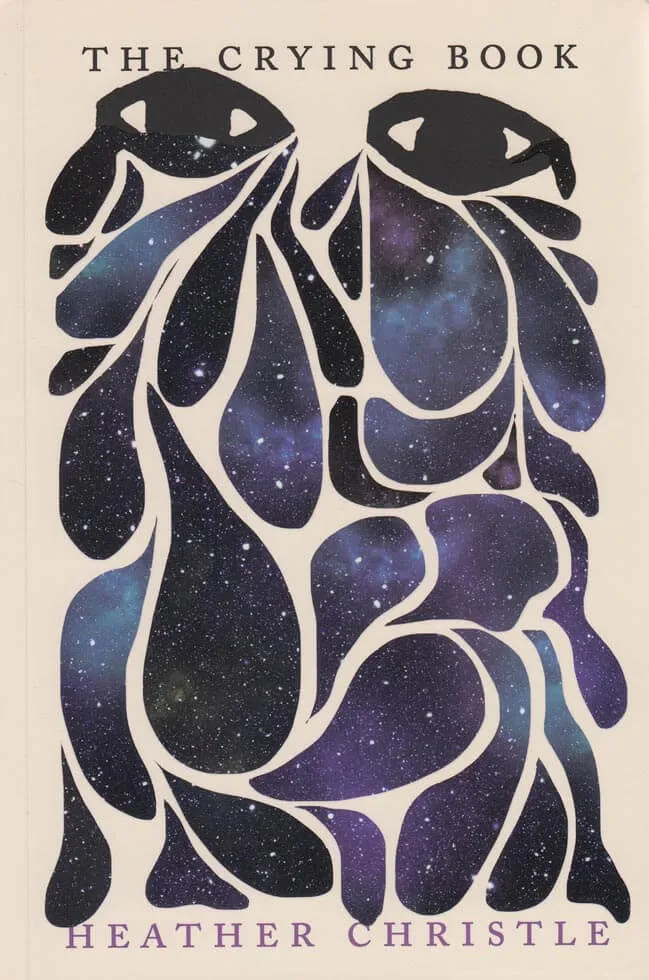
The Crying Book
A young poet on the cusp of motherhood shares a scientific, cultural, and artistic examination of why and how people cry and what crying means. Heather Christle has just lost a dear friend to suicide and must reckon with her own struggles with depression and the birth of her first child. How she faces her joy, grief, anxiety, impending motherhood, and conflicted truce with the world results in a moving meditation on the nature, rapture, and perils of crying—from the history of tear-catching gadgets (including the woman who designed a gun that shoots tears) to the science behind animal tears (including moths who drink them) to the fraught role of white women's tears in racist violence.
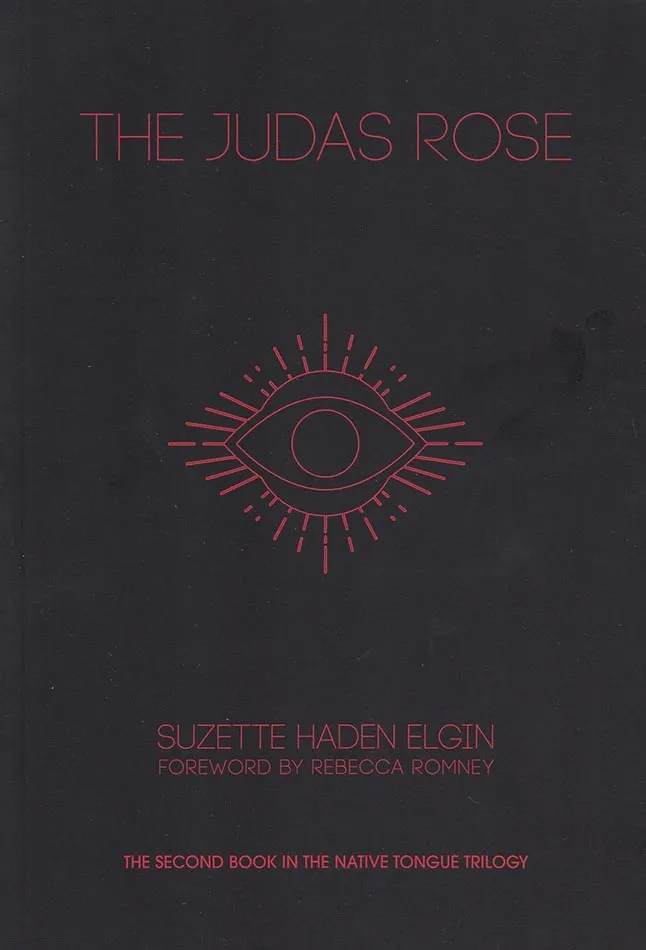
The Judas Rose
In the second volume of the Native Tongue trilogy, the time has come for Láadan—the secret language created to resist an oppressive patriarchy—to empower womankind worldwide. To expand the language’s reach, female linguists translate the Bible into Láadan, and a group of Roman Catholic nuns are tasked to spread the language. But when outraged priests detect their sabotage, they send a double agent to infiltrate and destroy the movement from the inside.
With a foreword by Rebecca Romney
Suzette Haden Elgin (born Patricia Anne Wilkins; 1936–2015) was an American science fiction author. She founded the Science Fiction Poetry Association, and was considered an important figure in the field of science fiction constructed languages. Elgin was also a linguist; she published non-fiction, of which the best-known is the Gentle Art of Verbal Self-Defense series.
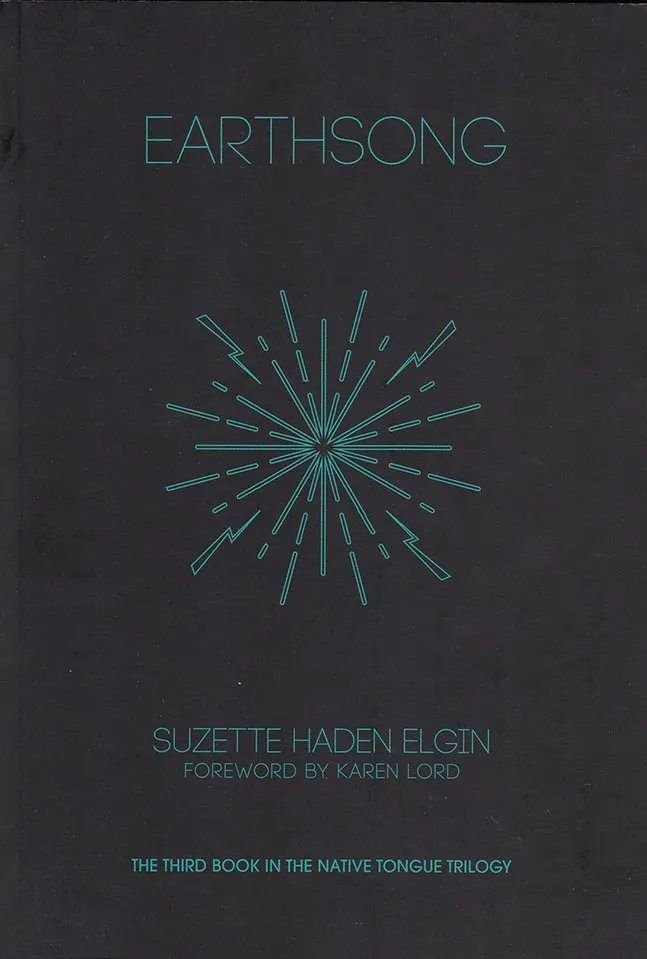
Earthsong
The final book in the Native Tongue Trilogy.
The interstellar Consortium of Planets has forsaken the irredeemably violent Earth, condemning the planet to economic and ecological chaos. As the Consortium prepares to euthanize the planet, women freedom fighters are offered one last chance to correct men’s brutal nature and stop the planet’s annihilation. In the stunning conclusion to the Native Tongue trilogy, female linguists must once again come forward to ensure the survival of humanity.
Suzette Haden Elgin (born Patricia Anne Wilkins; 1936–2015) was an American science fiction author. She founded the Science Fiction Poetry Association, and was considered an important figure in the field of science fiction constructed languages. Elgin was also a linguist; she published non-fiction, of which the best-known is the Gentle Art of Verbal Self-Defense series.
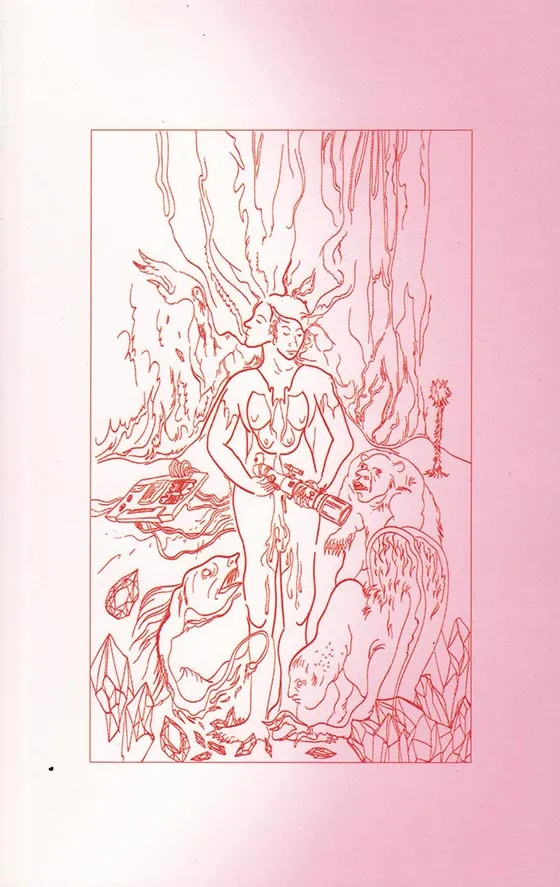
The Blazing World
Published in 1666, The Blazing World stands as one of the first Western works of Science Fiction. In its assertion that all animal flesh is made of rational matter (including that of the female body) Margaret Cavendish wrote the only 17th century text of its kind - a book of gendered natural philosophy.
Caught in frost at the North Pole, Cavendish tells the story of a woman who is saved by crossing over from our world, to a whole new Utopia. Amongst gems and stars she finds a city of half-human half-beast scientists. Worm- Men, Bear-Men, Bird-Men and Fish-Men welcome her to their land. Together they toil in their investigations, describing Nature afresh.
Cavendish predicted motors, submarines and nautical machinery long before these technologies came to exist in the present. As more than just a work of fantastical invention, The Blazing World is important for its portrayal of invention itself. Enlightenment technology is described here as a recourse to protect the world. All of it. The feeling and reasoning matter of all animals, minerals, trees and plants is significant for its proto-environmentalism and for its path-setting form: philosophy as poetry; science as poetry.
With a foreword by Emile Frankel.
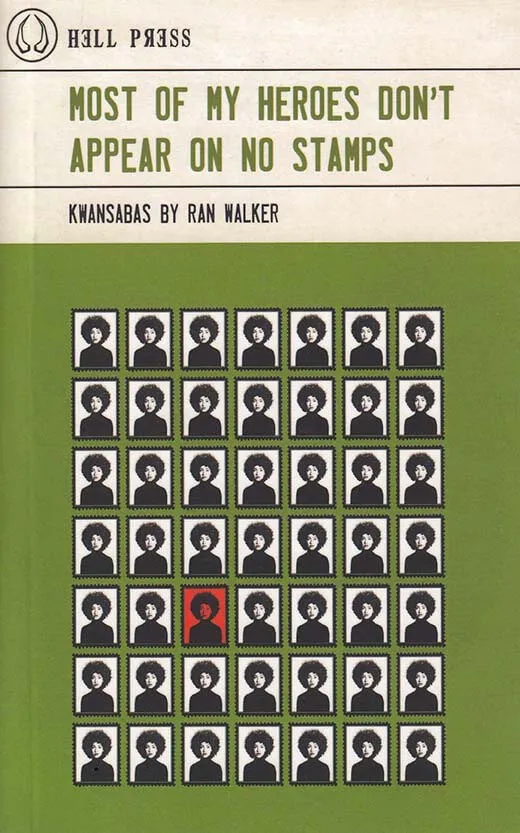
Most of my heroes don't appear on no stamps
The poems in Ran Walker's collection use an African-American poetic form called the Kwansaba, which was created in 1995 by Dr. Eugene Redmond. The poems follow a seven-line, seven-words per line pattern with no word more than seven letters (save proper nouns and foreign terms). All language within the form speaks to aspects of African-American history and culture. With these forty-nine poems, each chapter of forty-nine lines, Walker offers profound commentary on a wide variety of topics ranging from interrogations of celebrity culture to issues that speak directly to the Black Lives Matter movement.

Pisti, 80 rue de Belleville
Pisti, 80 rue de Belleville is Estelle Hoy’s latest novel.
Elke is a young academic with a troubled past that keeps spilling onto her present. Just as she is about to leave town for a writing retreat, she meets Pisti, a charismatic, hard-boiled but luscious Hungarian left activist, who runs an anarchist collective in Paris. Over one night in a Belleville apartment, old friends and new lovers discuss–and act–polyamory, politics, and the art of conversation.
A wry exploration of the seductive allure of tropes and cliché in the art world and politics, Pisti is also an experiment in writing, shamelessly flirting with namedropping and appropriation. The character of Pisti was appropriated from Chris Kraus’ novel Torpor.
Pisti and it's blasphemy against the left and art world is not apostasy, but rather a stepping away from a teleological view of politics and instead, a radical reimagining of the role of incompatibilities, partial identities, cliché and perhaps ultimately, the unresolvedness of hypocrisy. Which is to say, not taking things too seriously, in order to take them seriously. - Estelle Hoy

Meet Me There
Samuel Ace’s / Linda Smukler’s Meet Me There is the third volume in Belladonna*’s Germinal Texts series—works that trace feminist avant-garde histories and the poetic lineages they produce. Meet Me There is a paired republication of Normal Sex (Firebrand Books, 1994) and Home in three days. Don’t wash. (Hard Press, 1996).
In the present edition, the texts are accompanied by a new introduction and poem by Samuel Ace, and by a collection of short essays and reflections on Ace and Smukler’s poetics by Cameron Awkward-Rich, Ari Banias, Kay Gabriel, Andrea Lawlor, Eileen Myles, Joan Nestle, Pamela Sneed, TC Tolbert, and Yanyi.
Meet Me There brings together Ace / Smukler’s remarkable explorations of the interplay of language, desire, sex, and identity, and repositions this work, 25 years later, in the midst of burgeoning contemporary conversations about gender, sexuality, sociality, language, politics, and poetics.