rile*books

Search books

Search books by title, author, publisher, keywords...

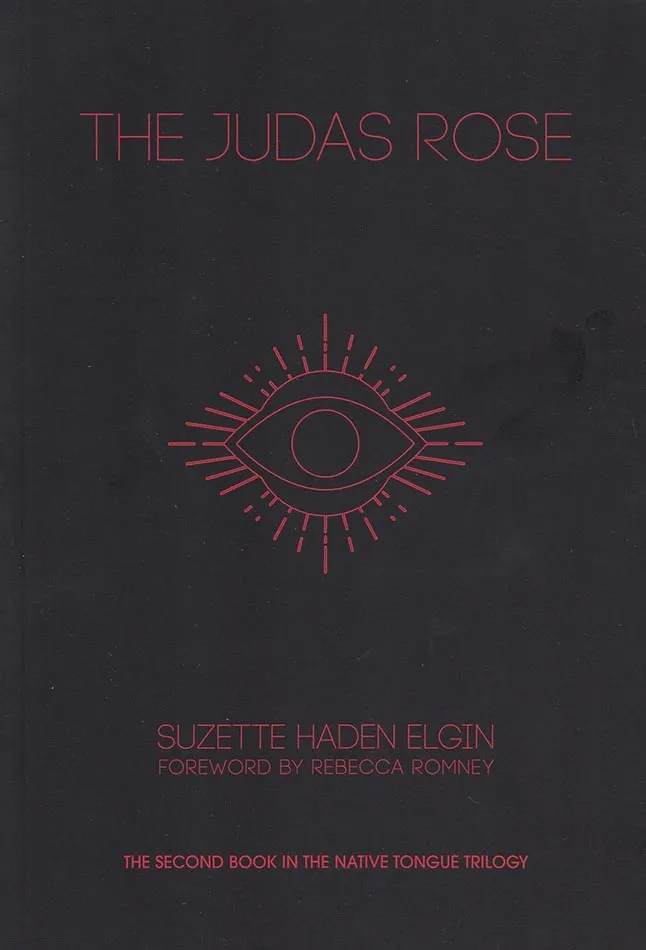
Cover of The Judas Rose

Feminist Press

The Judas Rose

Suzette Haden Elgin

€18.00

In the second volume of the Native Tongue trilogy, the time has come for Láadan—the secret language created to resist an oppressive patriarchy—to empower womankind worldwide. To expand the language’s reach, female linguists translate the Bible into Láadan, and a group of Roman Catholic nuns are tasked to spread the language. But when outraged priests detect their sabotage, they send a double agent to infiltrate and destroy the movement from the inside.

With a foreword by Rebecca Romney

Suzette Haden Elgin (born Patricia Anne Wilkins; 1936–2015) was an American science fiction author. She founded the Science Fiction Poetry Association, and was considered an important figure in the field of science fiction constructed languages. Elgin was also a linguist; she published non-fiction, of which the best-known is the Gentle Art of Verbal Self-Defense series.

Published in 2019 ┊ 425 pages ┊ Language: English

recommendations

Cover of Cockfight

Feminist Press

Cockfight

María Fernanda Ampuero

Fiction €16.00

Thirteen stories explore domestic horrors and everyday violence, providing an intimate and unflinching portrait of twenty-first-century Latin America.

Named one of the ten best fiction books of 2018 by the New York Times en Español, Cockfight is the debut work by Ecuadorian writer and journalist María Fernanda Ampuero.

In lucid and compelling prose, Ampuero sheds light on the hidden aspects of the home: the grotesque realities of family, coming of age, religion, and class struggle. A family’s maids witness a horrible cycle of abuse, a girl is auctioned off by a gang of criminals, and two sisters find themselves at the mercy of their spiteful brother. With violence masquerading as love, characters spend their lives trapped reenacting their past traumas.

Cover of Little F

Feminist Press

Little F

Michelle Tea

A new epic novel about a teenage queer runaway from cult classic author of Black Wave and Valencia Michelle Tea. A Literary Hub Notable Small Press Book of 2025.

In Spencer's fantasies, the breezy, queer streets of Provincetown, MA, are utopia, a place where he can be free. Yet when a violent attack in his suburban Arizona schoolyard sends him to the hospital, he decides queer utopia can't wait. And one night, with the help of his best friend, the teenage witch Joy, he hitches a ride to find it.

The cross-country road odyssey that follows brings Spencer from new moon rituals in Arizona canyons to Texas bus stations, from the luxe drag stages of Houston's Montrose district to the jazz-soaked streets of the French Quarter and beyond. This new novel from Michelle Tea tells the story, by turns raw, romantic, and sweet, of a sheltered boy taking his first leap into queer life, among all the complicated queers who live it.

"Tea's conversational tone and her way of writing deeply personal experience . . . presents a very necessary counter-narrative to mainstream histories of American punk, feminism, and sexual identity." – The Brooklyn Rail

Michelle Tea is the author of over twenty books of fiction, memoir, poetry and children's literature. Her autofiction Valencia, a cult classic, won the Lambda Literary Award for Best Fiction. Her essay collection Against Memoir was awarded the PEN/Diamonstein-Spielvogel Award for The Art of the Essay. Tea is also the recipient of awards from the Rona Jaffe Foundation and the Guggenheim Foundation. The founder of Drag Queen Story Hour, she has received honors from the American Library Association and Logo Television. Tea curated the Sister Spit Books series at City Lights Publishers and founded the ongoing imprint Amethyst Edition at the Feminist Press.

Cover of Johnny Would You Love Me If My Dick Were Bigger

Feminist Press

Johnny Would You Love Me If My Dick Were Bigger

Brontez Purnell

Fiction €18.00

A dirty cult-classic put out in a small batch by an underground publisher (Rudos and Rubes) in 2015, Johnny Would You Love Me If My Dick Were Bigger recounts the life of an artist and "old school homosexual" who bears a big resemblance to author Brontez Purnell.

Our hero doesn't trust the new breed of fags taking over San Francisco, though. They wear bicycle helmets, seat belts, and condoms. Meanwhile, he sabotages his relationships, hallucinating affection while cruising in late night parks, bath-houses, and other nooks and crannies of a newly-conservative, ruined city.

Furiously original, vital, and messy, this funny "non-memoir" uncovers a revelatory truth for the age: there are things far scarier than HIV.

Cover of I will pay to make it bigger

Prototype Publishing

I will pay to make it bigger

Ahren Warner

You wake up in the footwell of a mid-sized hatchback somewhere on a highway in outer Bangkok. You compile neurotic spreadsheets of the best ‘party destinations’ in Europe, whilst your work emails pile up without ever being read. You quit your job. You launch a banal start-up. You grieve for a past relationship. You stare endlessly at the waves coming in from a beach in Koh Pha Ngan. You vape intensely. You spend money on feelings, on the performance of your own persona, whilst you observe yourself with a detached sense of horror.

i will pay to make it bigger is a novella, by poet and artist Ahren Warner, in which ‘you’ are the main character. Through text and image – autofiction, docufiction, and just plain fiction – you work your way through a tangle of preoccupations: from what it means to buy enjoyment, to the fragile construction of your own self as a cultural product.

i will pay to make it bigger is also a photobook, a collection of images produced whilst living in Thai ‘party hostels’. Although these photographs might seem to exist as the documentation of intimate or ecstatic moments, they are in fact quite painstakingly, and artificially, constructed: composited and manipulated from multiple still frames of film footage to produce images that advertise the calculated artifice of their own hedonism, emotion and seemingly raw experience.


With a Coda by Hana K. Ohnewehr, commissioned by Yu’an Huang

Cover of Little Joy: Selected Stories

Semiotext(e)

Little Joy: Selected Stories

Cecilia Pavón

Fiction €18.00

Poet, writer, and translator Cecilia Pavón emerged in the late 1990s as one of the most prolific and central figures of the young Argentine literary scene—the so-called “Generation of the 90s”: artists and writers whose aesthetics and politics were an earnest response to the disastrous impact of American-exported neoliberal policies and the resulting economic crisis of 2001. Their publications were fragile—xeroxed, painted on cardboard—but their cultural impact, indelible.

A cofounder of Buenos Aires’s independent art space and publishing press Belleza y Felicidad—where a whole generation of soon-to-be-famous Argentine artists showed their work for the first time—Pavón pioneered the use of “unpoetic” and intimate content—her verses often lifted from text messages or chat rooms, her tone often impish, yet brutally sincere.

In 2015, Pavón’s first volume of collected poems, ‘A Hotel with My Name’, was published in English. Contemporary writers in the United States, Australasia, and Europe discovered a deep affinity with her work. Pavón’s protagonists, Ariana Reines noted, “are absolute women, guileless dreamers, saints in sneakers, on sidewalks, in jail, in Zara, on buses, in nightclubs, in bed.”

Translated by Pavón’s own poetic protégé Jacob Steinberg, ‘Little Joy’ collects the best of Pavón’s short stories written between 1999-2020, originally published in three volumes in Spanish.

Cover of Vesicapiscis

Cloak

Vesicapiscis

Aubrey Birch

Fiction €13.00

Vesicapiscis details a poetics of self-reflection / self-projection. What cannot be defined is pulled into the body, examined, dissected, regurgitated. Its form is prodded and rearranged. Every word / phrase / sentence is suseptible to mutation. And these mutations inevtiably proliferate onto the speaker's tongues, their throat, deep into their nervous system. Language is a virus, and as such, it must be studied.

Here we are, at the abyss.

Cover of All About Love: New Visions

William Morrow

All About Love: New Visions

bell hooks

The acclaimed first volume in feminist icon bell hooks' Love Song to the Nation, All About Love is a revelation about what causes a polarized society and how to heal the divisions that cause suffering. Here is the truth about love, and inspiration to help us instill caring, compassion, and strength in our homes, schools, and workplaces.

"The word 'love' is most often defined as a noun, yet we would all love better if we used it as a verb," writes bell hooks as she comes out fighting and on fire in All About Love. Here, at her most provocative and intensely personal, renowned scholar, cultural critic and feminist bell hooks offers a proactive new ethic for a society bereft with lovelessness—not the lack of romance, but the lack of care, compassion, and unity. People are divided, she declares, by society's failure to provide a model for learning to love.

As bell hooks uses her incisive mind to explore the question "What is love?" her answers strike at both the mind and heart. Razing the cultural paradigm that the ideal love is infused with sex and desire, she provides a new path to love that is sacred, redemptive, and healing for individuals and for a nation. The Utne Reader declared bell hooks one of the "100 Visionaries Who Can Change Your Life." All About Love is a powerful, timely affirmation of just how profoundly her revelations can change hearts and minds for the better.

Cover of Some Monologues

Wendy's Subway

Some Monologues

Tyler Coburn

Performance €25.00

Working at the nexus of performance, art writing, and fiction, Tyler Coburn creates monologues that explore how the “I” is marked in speech. His myriad topics—alternate history, legal personhood, digital labor, and resonant frequency, to name a few—defy straightforward modes of presentation, often insisting on site-specificity and social intimacy at the expense of conventional documentation. 

Some Monologues collects, for the first time, the scripts of Coburn’s work from the past fifteen years, many of which have not previously been published. Accompanying them are texts by eleven artists, writers, curators, and scholars who experienced these performances firsthand, collaborated in their making, conversed with the artist about them, or share an interest in the subjects they engage. Written in theoretical, poetic, and autobiographical registers, these contributions offer new perspectives on the monologue as an expansive and relational form.

Introduction by Elvia Wilk. Contributions by Yu Araki, A.E. Benenson, Mashinka Firunts Hakopian, Sven Lütticken, Kameelah Janan Rasheed, Spyros Papapetros, Camille Richert, Théo Robine-Langlois, Ian Wallace, and Michelle Wun Ting Wong.

Tyler’s scripts refuse to fix an authorial voice; instead, they make the conditions of authorship itself their subject. Blurring the boundaries between fiction and document, the human and the bureaucratic, the self and its doubles, his work thinks through systems from the inside, often using language as both architecture and trap. In their precision and porousness, I recognize a shared pursuit: how to locate agency within constraint, and how to turn the administrative or the technological into a site of intimacy. — Jill Magid

In Tyler Coburn’s Some Monologues, a binary that remains constitutive for the ideological continuity of modern life, in all its colonial and capital forms, is undone: digital vs. physical. In troubling that chasm, Coburn plays out the repercussions of these ideologies of anthropomorphic naturalism, guiding us through their resonances, doubles, codings, and relays. But he also renders himself as the relay of these transferences, in the process expanding art’s premodern calling: to exist as an invocation. Reification suddenly appears as what is situated between embodiment and disembodiment, with both potentially destabilized. Some Monologues, the book, is this destabilization’s ideal format: as much documentation, an echo, of Coburn’s works through their scripts, as it is an instruction manual for denaturalizing our sense/s. — Kerstin Stakemeier

Tyler Coburn is an artist, writer, and professor based in New York. He received a 2024 Andy Warhol Foundation Arts Writers Grant, and his writing has appeared in ArtReview, BOMB, C Magazine, Dis, e-flux journal, frieze, LEAP, Metropolis M, Mousse, and Rhizome. Coburn is the author of four books: I’m that angel (self-published, 2012), Robots Building Robots (CCA Glasgow, 2013), Richard Roe (Sternberg, 2019), and Solitary (Sternberg and Art Sonje Center, 2022). He has presented artwork at such venues as Centre Pompidou, Paris; Bergen Kunsthall; Hayward Gallery, London; Para Site, Hong Kong; and Kunstverein Munich.