rile*books

Search books

Search books by title, author, publisher, keywords...

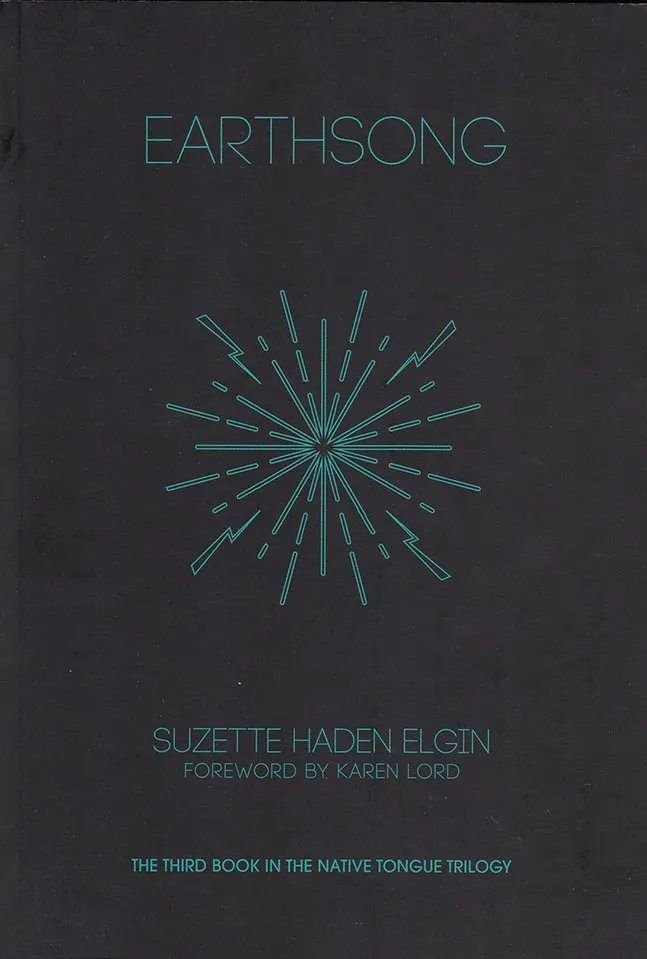
Cover of Earthsong

Feminist Press

Earthsong

Suzette Haden Elgin

€18.00

The final book in the Native Tongue Trilogy.

The interstellar Consortium of Planets has forsaken the irredeemably violent Earth, condemning the planet to economic and ecological chaos. As the Consortium prepares to euthanize the planet, women freedom fighters are offered one last chance to correct men’s brutal nature and stop the planet’s annihilation. In the stunning conclusion to the Native Tongue trilogy, female linguists must once again come forward to ensure the survival of humanity.

Suzette Haden Elgin (born Patricia Anne Wilkins; 1936–2015) was an American science fiction author. She founded the Science Fiction Poetry Association, and was considered an important figure in the field of science fiction constructed languages. Elgin was also a linguist; she published non-fiction, of which the best-known is the Gentle Art of Verbal Self-Defense series.

Published in 2019 ┊ 236 pages ┊ Language: English

recommendations

Cover of Cockfight

Feminist Press

Cockfight

María Fernanda Ampuero

Fiction €16.00

Thirteen stories explore domestic horrors and everyday violence, providing an intimate and unflinching portrait of twenty-first-century Latin America.

Named one of the ten best fiction books of 2018 by the New York Times en Español, Cockfight is the debut work by Ecuadorian writer and journalist María Fernanda Ampuero.

In lucid and compelling prose, Ampuero sheds light on the hidden aspects of the home: the grotesque realities of family, coming of age, religion, and class struggle. A family’s maids witness a horrible cycle of abuse, a girl is auctioned off by a gang of criminals, and two sisters find themselves at the mercy of their spiteful brother. With violence masquerading as love, characters spend their lives trapped reenacting their past traumas.

Cover of Johnny Would You Love Me If My Dick Were Bigger

Feminist Press

Johnny Would You Love Me If My Dick Were Bigger

Brontez Purnell

LGBTQI+ €18.00

A dirty cult-classic put out in a small batch by an underground publisher (Rudos and Rubes) in 2015, Johnny Would You Love Me If My Dick Were Bigger recounts the life of an artist and "old school homosexual" who bears a big resemblance to author Brontez Purnell.

Our hero doesn't trust the new breed of fags taking over San Francisco, though. They wear bicycle helmets, seat belts, and condoms. Meanwhile, he sabotages his relationships, hallucinating affection while cruising in late night parks, bath-houses, and other nooks and crannies of a newly-conservative, ruined city.

Furiously original, vital, and messy, this funny "non-memoir" uncovers a revelatory truth for the age: there are things far scarier than HIV.

Cover of Experiments in Imagining Otherwise

Hajar Press

Experiments in Imagining Otherwise

Lola Olufemi

Fiction €18.00

This is a book of failure and mistakes; it begins with what is stolen from us and proposes only an invitation to imagine.

In these playful written experiments, Lola Olufemi navigates the space between what is and what could be. Weaving together fragmentary reflections in prose and poetry, this is an exploration of the possibility of living differently, grounded in black feminist scholarship and political organising.

Olufemi shows that the horizon is not an immaterial state we gesture toward. Instead, propelled by the motion of thinking against and beyond, we must invent the future now and never let go of the otherwise.

Lola Olufemi is a black feminist writer and CREAM/Stuart Hall Foundation researcher from London. Her work focuses on the uses of the feminist imagination and its relationship to futurity, political demands and imaginative-revolutionary potential. She is the author of Experiments in Imagining Otherwise and Feminism, Interrupted: Disrupting Power, the co-author of A FLY Girl’s Guide to University, and a member of ‘bare minimum’, an interdisciplinary anti-work arts collective.

Cover of Playboy

Semiotext(e)

Playboy

Constance Debré

The prequel to Love Me Tender, narrating Debré's transformation from affluent career woman to broke single lesbian and writer.

I see all her beauty, I see the beauty of women. I see my own body, new. I tell myself there are so many things that are possible.

First published in France in 2018, Playboy is the first volume of Constance Debré's renowned autobiographical trilogy that describes her decision, at age forty-three, to abandon her marriage, her legal career, and her bourgeois Parisian life to become a lesbian and a writer.

The novel unfolds in a series of short, sharp vignettes. The narrator's descriptions of her first female lovers—a married woman fifteen years older than her, a model ten years her junior—are punctuated by encounters with her ex-husband, her father, and her son.

As Debré recently told Granta: “It was a bit like Saint Augustine and his conversion. In the same week, I had sex with a girl and I had the feeling that I could write. I had this incredible feeling that I could catch things, that life was there to be caught.”

Looking at the world through fresh eyes, the narrator of Playboy questions everything that once lay beneath the surface of her well-managed life. Laconic, aggressive, and radically truthful, she examines gender and marriage, selfishness and sacrifice, money and family, even the privilege inherent in her downward mobility.

Writing her way toward her own liberation, Debré chronicles the process that made her one of the most brilliant, important French writers today.

Cover of Memory

Siglio Press

Memory

Bernadette Mayer

Fiction €45.00

In July 1971, Bernadette Mayer embarked on an experiment: for one month she shot a roll of 35mm film each day and kept a journal. The result was a conceptual work that investigates the nature of memory, its surfaces, textures and material. Memory is both monumental in scope (over 1,100 photographs, two hundred pages of text and six hours of audio recording) and a groundbreaking work by a poet who is widely regarded as one of the most innovative experimental writers of her generation. Presaging Mayer's durational, constraint-based diaristic works of poetry, it also evinces her extraordinary —and often unheralded— contribution to conceptual art.

Mayer has called Memory "an emotional science project," but it is far from confessional. This boldly experimental record follows the poet's eye as she traverses early morning into night, as quotidian minutiae metamorphose into the lyrical, as her stream of consciousness becomes incantatory. In text and image, Mayer constructs the mercurial consciousness of the present moment from which memory is —as she says— "always there, to be entered, like the world of dreams or an ongoing TV show."

This publication brings together the full sequence of images and text for the first time in book form, making space for a work that has been legendary but mostly invisible. Originally exhibited in 1972 by pioneering gallerist Holly Solomon, it was not shown again in its entirety until 2016 at the Poetry Foundation in Chicago and then again in 2017 in New York City at the CANADA Gallery. The text was published without the photographs in 1975 by North Atlantic Books in an edition that has long been out of print.

Bernadette Mayer (born 1945) is the author of over 30 books, including the acclaimed Midwinter Day (1982), a book-length poem written during a single day in Lenox, Massachusetts, The Desires of Mothers to Please Others in Letters (1994) and Work and Days (2016), which was a finalist for the National Book Critics Circle Award. Associated with the New York School as well as the Language poets, Mayer has also been an influential teacher and editor. In the art world, she is best known for her collaboration with Vito Acconci as editors of the influential mimeographed magazine 0 TO 9.

Cover of saké blue. Selected Writings

After 8 Books

saké blue. Selected Writings

Estelle Hoy

Fiction €16.00

Can critical thinking spring from both a fortune cookie and Jacques Lacan’s most obscure seminar footnote? Estelle Hoy says yes. In saké blue, overpriced cheesecakes are the starting point for an essay on art writing; shoplifting in Berlin opens to a reflection on the economies of activist practices; fiction allows us to discuss the legacy of institutional critique, queer mélanges, or quiet melancholy. To her, the story of art becomes more nuanced in light of lyrics by Arthur Russell, the posthumous sorrow of Sylvia Plath, or a poem by Yvonne Rainer.

saké blue gathers critical essays, art reviews, and poetic fiction. Written in dialogue with the work of Martine Syms, Marlene Dumas, Hervé Guibert, or Camille Henrot, these texts combine the subjective and analytic, addressing power relations and the force of affect. Hoy spares nothing—and no one, exposing cultural clichés and urgent political issues through fast-paced acerbity. She advocates the work of women artists, mocks stereotypes, questions myths, and champions desire, sadness, and boredom. Simultaneously beautiful, lyrical, and cutthroat, her writing echoes to the reader like l’esprit d’escalier—we think of the perfect reply just a little too late.

“Estelle Hoy practises philosophy as an unsettled but deeply committed query into existing together. She reads, she looks, she writes, to find out something essential about the future and living for it.”
—Lisa Robertson, author of The Baudelaire Fractal

“Estelle Hoy's prose slap and bite, saké blue is a sharp pleasure to read.”
—Calla Henkel, author of Scrap

“Hoy’s renditions of all-too familiar scenes are made more visceral than life with sparkling prose and a sly attention to life’s many shifting values that feels more than appropriate for anyone truly interested in art.”
—Natasha Stagg, author of Artless

Edited by Antonia Carrara
With an introduction by Lisa Robertson

Cover of The Carrier Bag Theory of Fiction

Silver Press

The Carrier Bag Theory of Fiction

Ursula K. Le Guin

Sci-Fi €10.00

In The Carrier Bag Theory of Fiction, visionary author Ursula K. Le Guin tells the story of human origin by redefining technology as a cultural carrier bag rather than a weapon of domination.

Hacking the linear, progressive mode of the Techno-Heroic, the Carrier Bag Theory of human evolution proposes: ‘before the tool that forces energy outward, we made the tool that brings energy home.’ Prior to the preeminence of sticks, swords and the Hero’s killing tools, our ancestors’ greatest invention was the container: the basket of wild oats, the medicine bundle, the net made of your own hair, the home, the shrine, the place that contains whatever is sacred. The recipient, the holder, the story. The bag of stars. 

This influential essay opens a portal to terra ignota, where the possibilities of human experience and knowledge can be discovered anew.