Books
Books
Paperback

Goblinhood - en mode gobelin !
Enfin la traduction en français du best-seller de Jen Calleja, qui sera présente pour une lecture croisée. Repassez vos capes et astiquez vos chaînettes.
La figure du gobelin est espiègle, marginale, répugnante et fascinante et le mode gobelin peut être envisagé comme un mode de vie à part entière.
Jen Calleja, depuis son obsession pour les objets verts et les marionettes, ses souvenirs familiaux, son rapport au corps et au dégoût de soi, au chagrin, au sexe et au deuil, propose avec malice une pensée hybride entre essai, auto-fiction, poésie et théorie de la gobelinité.
En chacunx de nous, suggère-t-elle, sommeille un gobelin qu’il est temps de libérer.

Vrai travail
Various
Le Collectif Occasionnel a organisé en Suisse deux expositions qui présentaient les oeuvres de personnes à la fois artistes et travailleureuses du sexe. Cet ouvrage prolonge leur travail en proposant des textes et des entretiens avec des Tds ou des alliéxes. Permettant l’auto-représentation des personnes interrogées, les entretiens mettent en lumière la pluralité des pratique du travail du sexe, mais aussi l’importance de construire des solidarités travailleuses, des outils pour défaire les stigmates et des perspectives de luttes intersectionnelles.

Affiliation
Mira Mattar, Judith Abensour and 1 more
Affiliation, de Mira Mattar, autrice londonienne issue de la diaspora palestinienne, explore des thèmes tels que le genre, la famille, la religion, la guerre, l’écologie, le colonialisme et l’amour, en lien avec des lieux comme la Jordanie, le Liban, la Palestine et le Royaume-Uni. Interrogeant nos affiliations personnelles et collectives, et la manière dont les systèmes de pouvoir influencent nos désirs et nos identités, le livre s’ouvre sur quatre Lettres d’Amman qui propulsent le texte poétique dans le mouvement du monde et attestent de la dynamique de l’exil palestinien, où l’éclatement, l’effacement et l’appropriation se mêlent avec les effets contemporains de la mondialisation.
La deuxième partie du livre, intitulée Affiliation (pour mon père) est un long poème rétrospectif qui court sur une trentaine de pages. L’écriture à la première personne de Mira Mattar met en tension des contextes politiques, domestiques, intimes, économiques où se déploient des affiliations coloniales, capitalistes, patriarcales, nationalistes. Elle en restitue les violents processus internes, passant du refus de se soumettre à l’impossible échappée. Dans Affiliation, on fait l’expérience d’être en dehors: en dehors de son corps, en dehors d’un pays, en dehors d’une pièce. Il n’y a aucune position stable, et le sujet se construit dans un éclatement constant. Peu de livres articulent aussi finement expérimentation formelle et nécessité de l’expression verbale. Affiliation est un flux de langage dont on peut sentir l’urgence à chaque vers.

Heights of Macchu Picchu
Pablo Neruda’s Alturas de Macchu Picchu is a poem that distrusts solitary authority even as it passes through a single voice, moving from the lyric “I” toward a collective utterance grounded in labor, history, and shared breath.
Producing the first collaborative translation of Alturas de Macchu Picchu is not incidental but consonant with its deepest claims. Attentive to Neruda’s unique lyric pressure, this new English version resists the tradition of singular, authoritative renderings by allowing meaning, rhythm, and decision to emerge through dialogue and negotiation.
In this way, the translation does not merely transmit Neruda’s poem but enacts its insistence that voice is a collective achievement, not a solitary possession.

Midnight Mass Press & Heretic House
WITCHES
A collection of portraits by original riot grrrl, filmmaker, and zine queen, G.B. Jones. All of them witches – from the silverscreen, woodlands, and the streets.
Featuring provocative essays by Caroline Azar, Paul P., Leafshimmer, Jenna Danchuk, Blake Baron Ray, and Scott Treleaven – each exploring how witches have been perceived, presented, and portrayed in popular culture. “Realer than real, stranger than fiction.”
PRAISE FOR G.B. JONES WITCHES
Witches by G.B. Jones is a summoning spell posing as a book, a paper potion like the potion Nicky gives Gillian in Bell, Book and Candle. It draws me to it and to what’s in it, Jones’ divine drawings of the witches we both worship, the witches of TV and film and true life. I go to it gladly. I go to it gayly. I pore over it and prize it and purr like Pyewacket.
— Derek McCormack, author of Castle Faggot
G.B. Jones is the original Foxy Genius. Her zines, drawings, music, and Super 8 films inspired both the Queer zine explosion and the Riot Grrrl movement of the 90s. Witches sees G.B. once again crafting her magic.
— Kathleen Hanna, singer, writer, artist, and front-woman of the bands Bikini Kill and Le Tigre
With her illustrated procession of witches, post-punk icon G.B. Jones acts as medium to a dazzling diversity of disrupters from across screen history, as well as a pantheon of real-life hellraisers, from Sybil Leek and Rosaleen Norton to Vali Myers and beyond – all woven through with astute commentary by a host of countercultural collaborators. A captivating book; I was certainly under its spell.
— Kier-La Janisse, author of House of Psychotic Women

Not A Cookbook
TBW Books is proud to announce the release of Not a Cookbook, the debut book by Canadian filmmaker and artist Robby Reis.
At first glance, Not a Cookbook appears to be just what its title implies—but beneath the surface lies a layered, collage-style portrait of a restaurant and the family that holds it together. Centered on Resto Palme, a Caribbean restaurant in Montreal run by married duo Lee-Anne Millaire Lafleur and Ralph Alerte, the book offers a deeply personal and provocative exploration of kitchen culture, where food becomes a lens through which to examine family, friendship, labor, and resistance.
A longtime friend of the family, Reis takes an embedded, nonlinear approach to storytelling. Through photographs, texts, and contributions from customers and staff, Not a Cookbook captures not just the daily challenges of running a family business, but also the peripheral stories—of racism, activism, and the emotional labor required to build and protect something shared and sacred.
Despite its name, Not a Cookbook does offer some treasured family recipes—however, when it comes to a few key ingredients that make a certain sauce so special, Alerte leaves us simply with, “sorry blood, I can’t give it away.” The result is a new model for the cookbook: a radical kitchen guide rooted in community, resilience, and love. Less about what’s on the plate, and more about everything that makes the plate possible.

Steak Zine
Various
Steak Zine is the new issue of Cake Zine. Cake Zine is a literary print magazine exploring art, history, and pop culture through food.
For this pocket-sized special issue, Cake Zine is setting off into carnivorous territory. Serving up 208 pages of non-fiction and fiction exploring the cultural impact of red meat, including:
The last days of Acropolis, Portland’s beloved strip club-steakhouse, by Sophia June
A profile on the women going viral by eating raw meat online by Ella Quittner
A night at a fictionalized steakhouse kaleidoscoped through the roles of maître d’, bartender, server, chef, and guest, by Leah Abrams, Isle McElroy, Lillian Fishman, Stephanie Wambugu, and Hannah Kingsley-Ma
Examinations of the enduring escapism of Outback Steakhouse and Fogo de Chão by Ruby Robina Saha and Adam Dalva
A trip through Nebraska to trace how historic stockyard closures in the late 1990s have affected those serving up beef in the Beef State, by Jamal Dauda
A wistful look back at a romance fueled by ribeye and red leather booths, by Emma Specter
NDA-risking testimony from a lab tech at a plant-based food start up who went from vegetarian to carnivore in the noble name of research, by AUTHOR REDACTED
Tracing the roots and uncertain future of Hong Kong’s sizzling steak by Madeline Leung Coleman
Plus the steak heists prompting retailers to put meat behind lock and key, the body horror of cannibalist cinema, revisiting molecular gastronomy’s embrace of meat glue, the social tensions behind ordering well-done meat, the trauma of growing up on an Australian cattle ranch, and much more.

Good Looking Pomes
"Joseph Matick is a former poet, now bird. He flies over pastures and eats chemtrails as his karmic sentence for spending so many years without flying. (You still have time, kids). Remarkably, he wrote this book in Paris with Jack before his transformation into Frank 0' Hara for the front cover. This book is dedicated to his father and his son. And to all the gum chewing geniuses of the lower canal. He wrote this in the 9éme and was inspired by baseball, flowers, and getting money so as not to die. These are his simplest and most penetrating words."
KATE FOR AVEC JACK VERA INTL
Joseph Matick is an American poet and filmmaker based in Paris. He grew up on a farm in small-town America, moved to Chicago, and eventually to Paris, where he stayed. He studied at the Jack Kerouac School of Disembodied Poetics at Naropa University — of which he has said: “that place ripped the rug from under my feet” — and has been writing ever since. He is the author of four books: three published by Far West Press — The Baba Books (New American Babble, Post Meridiem Seasick Fuzz, Animal My Soul), Cherry Wagon, and Good Looking Pomes (March 31, 2026). His work appears in King Kong Magazine and is held in the collection of the American Library in Paris.
Translated to English for the first time.

Transchool: Volume 2
Various
Transchool: Volume 2 is an anthology featuring the multifaceted work — poetry, fiction, nonfiction, screenplays, genre-defying writing — by the second class of Transchool creative writers and their mentors, including Amos Mac, Cameron Awkward-Rich, Sylan Oswald, and torrin a. greathouse, with introduction letters from Chase Strangio and Kyle Lasky of @Transanta, Drew Denny, and Ren Heintz. Allies in Arts founded Transchool to empower the voices of trans and nonbinary writers ages 18-25. This volume of the Transchool anthology includes work that was created by these writers in June, 2024.
“These are the crevices that these writers have found and put to words while much of the world tries to turn us into a soundbite cliché, an emulsified reduction of what cannot be contained. There is a glow to each of these writers, and to the worlds they are bringing us towards.” – Dr. Ren Heintz
Contributors:
Chase Strangio
Kyle Lasky
Ren Heintz
Park Walters
J. Martel
Cassandra R. Flowers
Jo(rdan) Snow
Cameron Awkward-Rich
E.F. Tate
KB
Amos Mac
CL
R. David
Shea S. Davis
Sal Kang
torrin a. greathouse
Elijah Bendiner
Sylvan Oswald
Quinlan Owens
D. Ezra
Shoshana Katz
Dominic Emerson Wing

For the Love of Cookie Mueller
Various
For the Love of Cookie Mueller attempts to capture some of our favorite aspects of Cookie Mueller, mostly her good humor and absurdity. A girl who just stumbled onto wildness, Cookie became a counter cultural icon, a writer, a mother, a victim of Governmental negligence but she never let a thing get her down. Cookie Mueller is a guru of the 20th century. In today’s era of war and political instability, her writing feels more important today than ever. This is for hardcore Cookie fans and novices alike.

Crue
L’Île-de-France a été engloutie. Submergée par de l’eau liquide. C’est à peu près tout ce que l’on sait. Crue est un long poème construit sur un rythme ternaire, une suite de tercets libres entrecoupés de symboles typographiques étranges dont la signification exacte semble avoir été perdue dans l’inondation. Il y a dans le va-et-vient soutenu du texte comme dans celui de la mer, ses gestes répétés, toujours successifs, quelque chose de l’automation ; l’acceptation sans révolte d’une nouvelle nature sous-marine hybride, plus uniquement humaine, à la langue noyée, gorgée de néologismes, méthodique, néanmoins sentimentale. Car ici la cruauté sinistre de la nature fait écho aux émotions du narrateur. Le paysage-état d’âme est désolé, apocalyptique mais comme résigné, nu. Crue sonde les abysses de la civilisation et des comportements humains. Peut-être un des textes les plus personnels de Théo Robine-Langlois.
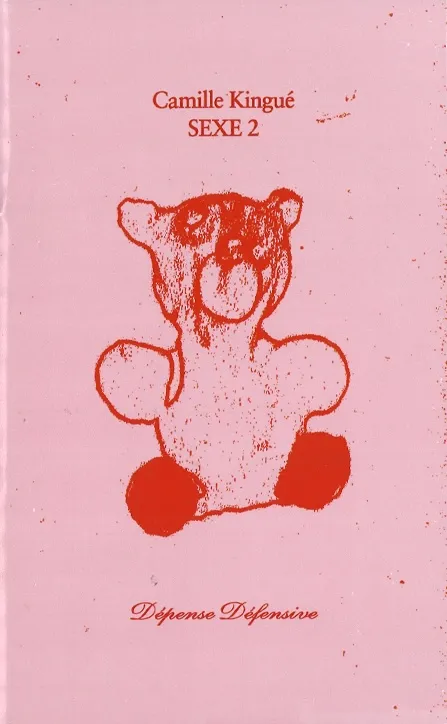
Sexe 2
Confession sur le désir (l’action et l’objet du), les liens de mutualité et de résistance, Sexe 2 alterne prose et versification en 27 fragments numérotés à l’adresse plus ou moins dure, plus ou moins sincère, plus ou moins formulée car plus ou moins éloignée du Toi et du Je. Camille Kingué s’attache à révéler, à voir quelque chose à travers son image réelle et virtuelle, agrandie et rétrécie, droite et renversée, déployant une recherche des principes de l’amour (l’amour comme amour, pourquoi est ce qu’il y a de l’amour) où la métaphysique et la compréhension de soi – donc de l’autre – n’ont jamais été aussi sexy.
Claire Star Finch, dans la magnifique préface qu’iel signe au début de l’ouvrage, écrit : « Après avoir lu tous les livres de Kingué, je ne sais pas si je crois en “l’amour”, que ce soit en tant que substantif absolu ou en tant que proto-résidu de tout ce que “le sexe” peut signifier. Mais je crois définitivement qu’il faut l’écrire. » Définitivement.

Intifadas
A subversive collection about Palestinian resistance, liberation and art.
Written across Palestine and its diaspora—from Gaza and the West Bank to the United States—Intifadas is a subtly transgressive poetry collection about uprising in its many forms—in art, politics, and in our most personal relationships. Whether by dumping black paint on a park where a tank and fighter jet commemorate a war, or by trying to rescue a moth trapped in a garage, the defiant and resilient voices in this collection subvert traditional narratives of loss. Furious, tender, and darkly funny, Intifadas asks what art can do in the face of catastrophe, and answers with poems that refuse easy consolations.

SAPPHO TERROR
Maura Modeya’s SAPPHO TERROR is a book haunted—by empire, by sleeplessness, by Sappho herself. In it, queerness becomes both the agent of terror and its object. “I want to be consumed. I want to disappear twice.” Extending the experiments of Mayer, Lonidier, and Stein, Modeya’s poems are as much about desire as they are about violence. They let us in on a secret: “Logic sometimes is so disgusting.” At once delirious and hyperalert, performance and document of a performance, SAPPHO TERROR disrupts the routines of everyday life from within. “Tending to the eros of writing something down.”
A fist is something that blooms inside a lover, a hand held up in revolutionary camaraderie, and the weapon of bare-knuckle combat. In Maura Modeya’s SAPPHO TERROR, the poet probes, in a language that possesses an addictive deliquescence, the body as policy and the devotional as daily, where intimacy is all at once risked, tenderized, and disciplined. We begin in a space of betweenness—between street and bed, between conquest and abandon—and are then submerged into tidal pools of sleeplessness where the poet is overtaken, exquisitely, by forces beyond themselves. Sculpted into vigilant word-reliquaries, these poems exalt the femi-themme of the night while holding fast to danger. Inside this edge-space lives the chasm—the danger that lives in the distance from one edge to another—where sex, politics, and liminal states of consciousness collide, exposing how power is enforced, negotiated, and sometimes utterly undone through the body. —Valerie Hsiung
In SAPPHO TERROR Maura Modeya drifts with eros between the “war intestine,” and a restless dreamscape where desire demands disorientation and the rapture of invasion teeters in tension between queer love and the horrors of militaristic and domestic terrorism. Modeya offers us a vulnerable and familiar sorrow: “Why when I want to speak of love, violence surfaces?” In communion with Sappho’s fragments—those invocations of desire intensified by their historical devastation—Modeya’s poems project that eros is to want is to risk.
Leaning into the “deathless language” of queer love, Modeya allows herself to be haunted by the unreasonable logic of eros and finds herself caught between an insomnia that threatens the poet’s coherence of self, and a sleep that risks waking to the repulsive logics adorning our daily violences.In striking and visceral exhaustion, this book performs the desire of possession—by a lover, by language, by loss. SAPPHO TERROR brings us into the poet’s rapture, one that is profoundly balanced between the paradoxical and perilous forces of eros. —Serena Chopra
What arises out of sleeplessness? In SAPPHO TERROR, all boundaries fall away into ritual. There is a permeability, an eros, a freedom from all structures and institutions, even from our own self. Our human guardrails fall away to a place where we forget the boots on our necks, that our money buys weapons for the state, or even that we are separate unique beings. Is it wrong to forget, or is it a healing? Perhaps both. Modeya says that in sleeplessness, “to submit means to surrender into what is wanted so badly.” In the face of terror, our letting go is a kind of purity. It tells us we can travel beyond repression, not to escape, but to reach the most natural state of our being, even before survival. It is a reminder of life. —Samuel Ace
Maura Modeya’s SAPPHO TERROR takes back Plato’s Cave for the dykes. In these poems eros’ shadows reign sovereign: language is chained and casts haptic forms onto Modeya’s bedroom wall lit by Sappho’s famous fires. These poems join her chorus of “You Burn Me” with the desperate velocity only the insomniac knows. Modeya’s verse is exquisite and relentless, creaking out of the dead of night, bargaining for the possibility of touch. An assembly of aching towardness, SAPPHO TERROR is part elegy, part manifesto, part love letter that sabotages the war intestines we live in order to undivide us from our desire. —Rosie Stockton

Recto verso – An Anthology of Works and Writings by Asier Mendizabal
A comprehensive retrospective of the Spanish artist's work, covering his major exhibitions (Manifesta, Reina Sofia, MACBA, Raven Row, etc.) and including all of his texts published as fanzines over a period of twenty years, a new critical essay by Kim West, and a wide-ranging conversation.
Conceived as a compilation of works and writings of the last two decades, this book is structured as an alternating succession of four different registers: four recurrent modes. A long-form interview, a series of questions from different collaborators, documentation of a selection of projects, and a compilation of the facsimilia of the brochures published by the author since 2008. The aim of this concatenation of recurring sections is to delay the linear progression suggested by the narrative of a compilation, by the apparent causal string of decisions, ideas, references and works displayed as an accumulative "biography" of the artist's practice. However, this being a bound book, the suggestion of an interwoven relation between all the works, regardless of when, where or how they were made, must submit to the order locked by the sewn spine of its signatures, the folder of bound pages that forms each section of a book.
Designed by Filiep Tacq, the book includes an essay by Kim West and a long-form interview by Beatriz Herráez, punctuated by questions from Filiep Tacq, Lisa Tan, Jon Mikel Euba, Antonio Menchen, Alex Valijani, Johanna Gustafsson Fürst, Itziar Okariz, Olatz Otalora, Antonia Majaca, Pablo Lafuente and Koenraad Dedobbeleer.

Pivot
Pivot is an experimental, book-length poem exploring the profound act of "turning", with the Haitian Revolution as its cornerstone.
Pivot moves beyond historical narrative, scrutinizing this epochal event through its pivotal moments—critical junctures of rupture and radical reorientation. Mason Jordan masterfully employs repetition, metaphor, and other minimalist abstractions of language to delve into the visceral and conceptual mechanics of turning: a turning away from colonial subjugation, a turning towards new vocabularies of freedom, and the cyclical turning of memory. Through linguistic architectures and etymology, akin to the likes of Fred Moten, N. H. Pritchard, and M. NourbeSe Philip, Pivot examines international revolt, revolutionary fervor, and the development of Black Marxism(s) through a critical reflection on Haitian revolutionary history.

The Brotherhood
Carolina Bianchi, Thomas Resendes
The Brotherhood fait suite à La Mariée et Bonne nuit Cendrillon qui avait provoqué une onde de choc lors de sa première à Avignon où Carolina Bianchi amenait des réflexions sur la performance et la théâtralité, sur un lit d'histoires de viols brutaux et de meurtres de femmes.
Dans ce deuxième chapitre de la Trilogie des chiennes, Carolina Bianchi se penche sur la complexité de certains « pactes de masculinité », notamment sur les origines de la fraternité entre les hommes, mettant en lumière les codes mutuels violents qui contribuent à normaliser et perpétuer le viol et la violence sexuelle à travers leur lexique. Carolina Bianchi utilise les principes du théâtre pour articuler des voies possibles à cette discussion, créant des liens forts entre la représentation et le traumatisme réel, les structures de pouvoir dans l'art et la poésie radicale, les origines de la misogynie et une sexualité en crise. La structure de cette réflexion se révèle être un piège, affaiblissant l'auteurité de Bianchi et la transformant en un personnage qui subit les conséquences d'avoir scruté cette « fraternité » de si près.
Texte portugais (Brésil) traduit par Thomas Resendes.
-
The Brotherhood follows La Mariée and Bonne nuit Cendrillon, which caused a shockwave when it premiered in Avignon, where Carolina Bianchi explored reflections on performance and theatricality against a backdrop of stories of brutal rapes and murders of women.
In this second chapter of the Trilogie des chiennes, Carolina Bianchi examines the complexity of certain “pacts of masculinity,” particularly the origins of male brotherhood, highlighting the violent codes of conduct that contribute to normalizing and perpetuating rape and sexual violence through their lexicon. Carolina Bianchi uses the principles of theater to articulate possible avenues for this discussion, creating strong links between representation and real trauma, power structures in art and radical poetry, the origins of misogyny, and a sexuality in crisis. The structure of this reflection turns out to be a trap, undermining Bianchi’s authority and transforming her into a character who suffers the consequences of having scrutinized this “brotherhood” so closely.
Translated by Thomas Resendes.

Le Sacrifice comme acte poétique
Angélica Liddell, Christilla Vasserot
Mise en scène, écriture – pièces de théâtre, poésie, récits, journaux – et présence sur scène : tout est lié chez Angélica Liddell. L’art et la vie, la fiction et la biographie, la création poétique et la réflexion théorique entretiennent les uns avec les autres des liens évidents et complexes. Ce volume inclut une série de textes qui, depuis une perspective théorique, éclairent en partie la pratique théâtrale de leur auteur, contribuant à la construction d’une poétique toujours inachevée, basée sur une expérience vitale.
Dans cet essai recueillant douze conférences et entretiens, Angélica Liddell évoque la création artistique ainsi que son processus dramaturgique très organique et très violent car « la violence poétique est nécessaire pour combattre la violence réelle ».
-
Direction, writing—plays, poetry, stories, journals—and stage presence: everything is interconnected in Angélica Liddell’s work. Art and life, fiction and biography, poetic creation and theoretical reflection maintain obvious yet complex connections with one another. This volume includes a series of texts that, from a theoretical perspective, shed light on the author’s theatrical practice, contributing to the construction of an ever-unfinished poetics rooted in lived experience.
In this essay, which brings together twelve lectures and interviews, Angélica Liddell discusses artistic creation as well as her highly organic and violent dramaturgical process, for “poetic violence is necessary to combat real violence.”

CUNY Center for the Humanities
“This Great River”—Translating the Beats into Arabic
Sargon Boulus, Khaled al-Hilli
The Great River—Translating the Beats into Arabic traces the literary encounters of Sargon Boulus (1944-2007), an Iraqi poet who was part of the vibrant literary scene of late 60’s San Francisco. His life was marked by a period of restless traveling, that he would later describe as an attempt to pursue a poetic imaginary. This project continues to map his proximity to the Beat poets, his short-lived Bay Area poetry journal, Tigris, and his other English language publications.
This publication includes a facsimile reproduction of Tigris, featuring a long poem “Jebu” by Boulus’ good friend Etel Adnan.

All My Dead Jesters
All My Dead Jesters is an assembly of select poems previously published in de Vries’ first two English language collections—Dark Hour and I Failed to Swoon (Dostoyevsky Wannabe, 2018 and 2021 respectively). These old works have been lightly revised for republication, and are paired with poems drawn from a manuscript-in-process to institute an autotelic kaleidoscope of some ten years worth of work in verse.
De Vries’ poems are spare, terse and epigrammatical—a barroom Bashō—dedicated to the glimmer of a compact glance; the chance, glamour and negative capability of a passing thought; and the slow drip of liquid crystal as colours our present. All My Dead Jesters is a torch song for our ‘poor subjectivity,’ a slow dance with sour times, a ‘[steering] away from [the] gratuitous provocation’ that litters our contemporary outlook. ‘Her competence as a poet lies in her ability to translate visceral vulnerability’ for the page (The Kelvingrove Review / University of Glasgow), as she patchworks a heroic ‘poetry without [a] hero, a blanket leaving you colder somehow, [...] the map of a world we like to think we know’ [CA Conrad].

Help
Death-obsessed, disengaged and overinvested—the four long poems assembled in Steven Zultanski’s Help theatricalise morbid fascinations, self-protective impulses, and unfocused desire. Help is, at its core, a set of conversations; the result of games played between friends that were then transcribed, edited, and embellished. Participants were asked to talk about loss, the death of acquaintances, secret hiding places, mislaid time, and unmet demands. The resulting poems read like meandering scripts for unrealised plays; incidental excavations of persona and place.
Somewhat reminiscent of Linda Rosenkrantz’s Talk (1968) or Alice Notley’s transcription poems of the 1970s, in Help the poet pretends to be a recording device, and the poem an act of remembering. Zultanski’s writing is at once skeletal and overstuffed, dryly unsentimental and yet dripping with melodrama. Help foregrounds its own contradictions in a collection that is at once both extremely personal and distinctly artificial.
Help brilliantly extends Steven Zultanski’s current phase of writing—looser, more documentary, more situational. In setting up explicit objects of inquiry and conversation—love, death, childhood—the book shows that to know these things is to also know our friends and ourselves. Sustained by an orchestration of relation and memory (and thus reality), affect here is modular, the product of what happens when we transform things by talking about them. A careful and astute experiment in writing and living.
— Jennifer Soong

Tripwire 23 - Work/Anti-work
Work/Anti-work issue with writing by Nat Raha /. lisa minerva luxx /Ghayath Almadhoun, trans. Catherine Cobham / Jacqui Germain / Jazra Khaleed, trans. Peter Constantine / Finn Finneran / Cait O’Kane / Rebecca Kosick / Lara Durback Skye /Lotta Thießen / William Rowe / Danny Hayward / Rona Lorimer / Zoe Beloff / Jike Ayou, trans. Yě Yě / Miguel de Vallester, trans. Erasmo Pantoja / Lucas Martínez / ko ko thett / Hung Q. Tu / Raymond de Borja / etaïnn zwer, trans. Ilan A.L.S. Erikson Weisbrod / Annie Raab on Taylor Portela / Rachael Guynn Wilson on Lyn Hejinian / Will Rowe on Danny Hayward / Chloe Watlington on Joshua Clover.

they/she/he: ritual to forget your (un)becoming
they/she/he: ritual to forget your (un)becoming by dezireé a. brown is a momentous debut, tracking a self-proclaimed anti-hero’s quest for liberation through the transformative ritual of writing through the past, present, and future. Influenced by video game worlds, choose-your-own adventures, and a multifaceted collective of Mesopotamian goddesses, this collection is a conjuring of selves encountered through gender, and they arise to meet one another in all their Black queer joy and rage.
Communing with an ancestry of writers, healers and found family, brown's collection maps the odyssey of a life lived in transition and serves as an archive of Black transmasc experience, of every burning crucible, and every hard-won survival. “NO SPECTATORS ALLOWED” they/she/he asserts, insisting on our implication in this narrative, inviting us to traverse the intricate worlds crafted through its experimental poetic forms.

Red Seed: Poems for Luno
Cruz Alejandra Lucas Juárez, Wendy Call and 1 more
Through a voice at once intimate and collective, Lucas Juárez expands the powerful presence of Tutunakú roots to open up territories and to interweave desirous bodies, dream relationships, and the memories of women ancestors. This beautiful translation by Wendy Call and Whitney DeVos, in a precious handmade edition, affirms the trilingual (Tutunakú, Spanish and English) as an ethical strategy of listening to and translating the world. Red Seed collects twelve poems of women's sexualities and spirits in which body, language and territory are political spaces that Indigenous memory expands within and renews.
—Maricela Guerrero, author of The Dream of Every Cell