Books
Books
in random order

Homie
Homie is Danez Smith’s magnificent anthem about the saving grace of friendship. Rooted in the loss of one of Smith’s close friends, this book comes out of the search for joy and intimacy within a nation where both can seem scarce and getting scarcer. In poems of rare power and generosity, Smith acknowledges that in a country overrun by violence, xenophobia, and disparity, and in a body defined by race, queerness, and diagnosis, it can be hard to survive, even harder to remember reasons for living. But then the phone lights up, or a shout comes up to the window, and family—blood and chosen—arrives with just the right food and some redemption.
Part friendship diary, part bright elegy, part war cry, Homie is the exuberant new book written for Danez and for Danez’s friends and for you and for yours.
& colin kaepernick is my president, who kneels on the air
bent toward a branch, throwing apples down to the children
& vets & rihanna is my president, walking out of global summitswith wine glass in hand, our taxes returned in goldto dust our faces into coins
& my mama is my president, her grace stuntson amazing, brown hands breaking brown bread overmouths of the hungry until there are none unfed & my grandma is my president
& her cabinet is her cabinetcause she knows to trust what the pan knowshow the skillet wins the war
—from “my president”

The Subtle Rules The Dense
Moulded from clay, between 2021 and 2023, The subtle rules the dense is a series of ceramic chest plates, by the artist Phoebe Collings-James. Inspired by Makonde and Yoruba body masks and Roman muscle cuirasses, the sculptures explore the interplay between ritualistic objects’ violent histories and their contemporary presentation as fetishistic ornaments. This publication brings together responses to the series from artists SERAFINE1369 and Rehana Zaman and geographer Professor Kathryn Yusoff; exploring layered references to tarot, Shakespeare and post-colonial theory; probing the materiality and extractive politics of geology; and reflecting the plural multifaceted nature of Collings-James’ practice.
A series by Phoebe Collings-James
With Texts by Serafine1369, Rehana Zaman, Kathryn Yussof.

Rat Bohemia
First published in 1995, this award-winning novel is a bold, achingly honest story set in the "rat bohemia" of New York City, whose huddled masses include gay men and lesbians abandoned by their families and forced to find new bonds with one another in the wake of this loss. Navigating the currents of the city are three friends: Rita Mae, a rat exterminator; Killer, a career plant-waterer; and David, an HIV-positive writer. Together, they seek new ways to be truthful and honest about their lives as others around them avert their glances. Alternately elegiac, defiant, and funny, Rat Bohemia is an expansive novel about how one can cope with loss and heal the wounds of the past by reinventing oneself in the city.
Rat Bohemia won the Ferro-Grumley Award for Lesbian Fiction and was named one of the "100 Best Gay and Lesbian Novels of All Time" by the Publishing Triangle.
Sarah Schulman is the author of eleven previous books, including eight novels, the latest being The Child (2006). As a journalist, her essays have appeared in The New York Times, The Nation, and Interview. She has won a Guggenheim Fellowship and two American Library Association Gay & Lesbian Book Awards. She lives in New York.
Published 2008

Twenty Shadows
[Available for preorders. Shipping 26 October.]
Twenty Shadows tells of a man’s spiritual change following the suicide of his son after a long addiction. Haunted by this loss and the unknown desire of his only child, thinking and writing with a new emptiness, he finds a form of expression that was previously impossible.
This singular book brings together the reflections of one of our greatest living philosophers with a father’s grief. —Todd McGowan
Taking its title from Shakespeare’s Richard II—“Each substance of grief hath twenty shadows”—this book follows personal tragedy into the murky place where memory and interpretation become indistinguishable. What lies at its heart is a meditation on the unknowability of the other. —Charlotte Northall
Richard Boothby is right that no amount of intellect curbs the impulses of real experience, but that doesn’t mean you have to remain in a state of ignorance. Composed from the leftovers of terrible, unassimilable events, this book gives us bracing indications of ways to live on in a diminished aftermath. —Justin Clemens
Richard Boothby is professor emeritus of philosophy at Loyola University Maryland. Boothby’s books include Death and Desire: Psychoanalytic Theory in Lacan’s Return to Freud (1991), Freud as Philosopher: Metapsychology after Lacan (2001), Sex on the Couch: What Freud Still Has to Teach Us about Sex and Gender (2006), and Embracing the Void: Rethinking the Origin of the Sacred (2023). He lives in Baltimore.

L'Écriture de Monique Wittig À La Couleur De Sappho
Invitation au voyage à travers l’œuvre littéraire de Monique Wittig, ce livre nous embarque dans une passionnante exploration de ses textes de fiction, de L’opponax à Virgile, non. Il rend compte de la lutte amoureuse qu’elle livre au langage – matériau brut qu’elle travaille au corps pour faire advenir dans la réalité ce qui n’y a pas (encore) droit de cité. La convocation malicieuse et grave des grands récits du passé, les nombreux emprunts aux auteurs anciens, la pratique de la citation font des Guérillères une formidable épopée féministe, du Corps lesbien un Évangile selon Sappho, du Voyage sans fin le combat drôle et tragique d’une Quichotte féministe et lesbienne.
En soulignant la cohérence des textes et leur fragmentation, Catherine Écarnot met en évidence la passion poétique qui habite ces livres que Wittig concevait comme des « chevaux de Troie » : des machines de guerre destinées à fissurer la réalité pour y inscrire une subjectivité mouvante, échappée du continent noir de la féminité, rétive aux assignations de genre. Uniques et radicalement disruptives, les fictions ainsi créées ouvrent grands les chemins qui relient littérature et lesbianisme.
Publié pour la première fois en 2002, cet ouvrage, le premier consacré en Europe à l’œuvre witigienne, reparaît dans une nouvelle édition remaniée, actualisée et enrichie de nombreuses références aux études publiées depuis sa parution.

I of Song
"Between the 8th and the 10th of January in the year of 2019, we became Na Castelloza, she who in Auvergne at the beginning of the 13th century composed a cycle of cansos about—finding—unrequited love. If there exists a lyric subject, we are of her heritage."

Fugue
Aaron Amar Bhamra, Céline Mathieu
Fugue is published on the occasion of the eponymous duo exhibition by artists Aaron Amar Bhamra and Céline Mathieu, presented at Jester in Genk, Belgium. The title, derived from the Latin fuga (flight), evokes both its musical and psychological meanings: a contrapuntal compositional technique and a state of dissociation. These dual connotations—aural and mental—resonate throughout the exhibition and this accompanying publication.
Céline Mathieu's work moves between the sensory and the conceptual, integrating multiple media to explore the circulation of thoughts and materials in relation to specific sites. Aaron Amar Bhamra's practice draws on recurring forms and materials to construct evolving personal and social archives, often reactivating exhibition spaces by engaging with their historical contexts.
In addition to documenting the exhibition, the publication features an introduction by Jester's artistic director Koi Persyn, a visual score of a sound composition by Charlie Usher, written contributions by Céline Mathieu, curator Eloise Sweetman, and researcher Johanna Schindler, as well as a series of analog photographs by Aaron Amar Bhamra.
Contributions by Koi Persyn, Céline Mathieu, Charlie Usher, Eloise Sweetman, Johanna Schindler, Aaron Amar Bhamra.
Austrian artist Aaron Amar Bhamra (born 1992) often procures exhibition spaces that subtly expose their systematics and physical experience by incorporating imprints reminiscent of other spaces or past exhibitions. He occasionally uses recurring forms and materials, weaving a site of shifting personal and social archives.
Céline Mathieu (born 1989) is a Belgian artist and writer. Her practice is often site and condition specific, using sound, scent, sculpture, performance, text and different materials in performative installations. The work is both sensory and conceptual. Her work looks into the circulation of thoughts and materials. Material and economic cycles merge with hyper-personal items, resulting in fluid work that cannot quite be pinned down.
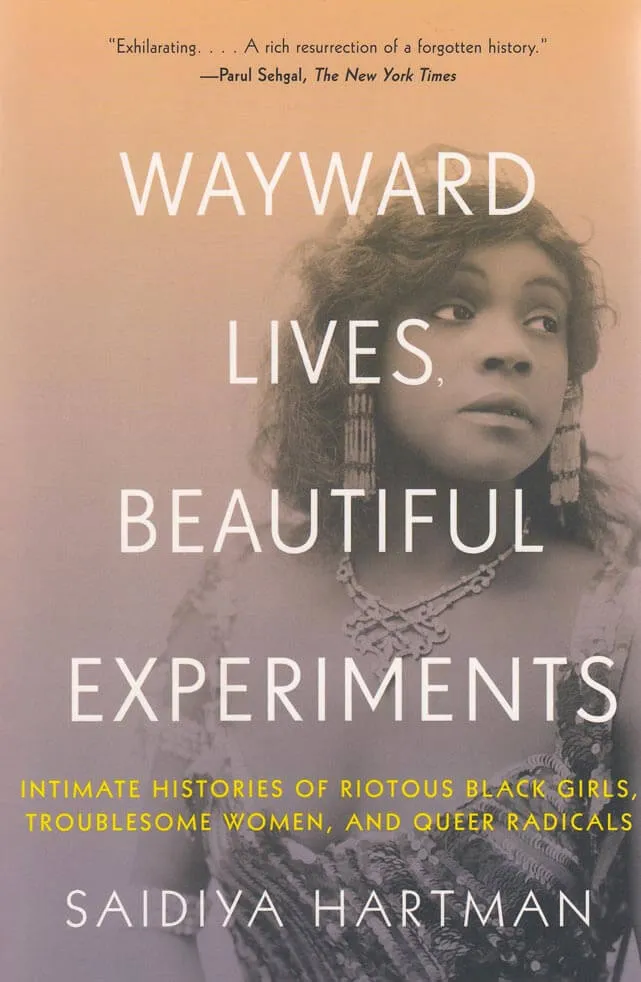
Wayward Lives, Beautiful Experiments
Wayward Lives, Beautiful Experiments examines the revolution of black intimate life that unfolded in Philadelphia and New York at the beginning of the twentieth century. In wrestling with the question of what a free life is, many young black women created forms of intimacy and kinship indifferent to the dictates of respectability and outside the bounds of law. They cleaved to and cast off lovers, exchanged sex to subsist, and revised the meaning of marriage. Longing and desire fueled their experiments in how to live. They refused to labor like slaves or to accept degrading conditions of work. Here, for the first time, these women are credited with shaping a cultural movement that transformed the urban landscape. Through a melding of history and literary imagination, Wayward Lives, Beautiful Experiments recovers these women's radical aspirations and insurgent desires.

Mother Media: Hot and Cool Parenting in the Twentieth Century
An essential history for understanding how we mother now, and how motherhood itself became a medium—winner of the Brooke Hindle Award from the Society for the History of Technology.
From the nursery to the prison, from the clinic to the commune, Mother Media tells the story of how we arrived at our contemporary understanding of what a mother is and how understandings of “bad” mothering formed our contemporary panics about “bad” media. In this book, leading historian of psychology Hannah Zeavin examines twentieth-century pediatric, psychological, educational, industrial, and economic norms around mediated mothering and technologized parenting. The book charts the crisis of the family across the twentieth century and the many ingenious attempts to remediate nursemaid and mother via speculative technologies and screen media.
Growing out of her previous award-winning book The Distance Cure, which considered technologized care, the book lays bare the contradictions of techno-parenting and how it relates to conceptions of “maternal fitness,” medical redlining, and surveillance of children, parents, and other caregivers. The author offers narratives of parenting in its extremity (for example, Shaken Baby Syndrome) and its ostensible banality (for example, the Nanny Cam) and how the two are often intertwined. Ultimately, Zeavin grapples with a simple contradiction: technology is seen and judged as harmful in domestic and educational spaces, even as it is a saving grace in the unending labor of raising a family.
Hannah Zeavin is Associate Professor of the History of Science in the Department of History and the Berkeley Center for New Media at UC Berkeley. She is the author of The Distance Cure and Mother Media (MIT Press) and Founding Editor of Parapraxis. In 2021, she cofounded The Psychosocial Foundation.

We Both Laughed in Pleasure
Drawn from Lou Sullivan’s meticulously kept journals, this landmark book records the life of arguably the first publicly gay trans man to medically transition.
We Both Laughed In Pleasure: The Selected Diaries of Lou Sullivan narrates the inner life of a gay trans man moving through the shifting social, political, and medical mores of the second half of the 20th century. Sullivan kept comprehensive journals from age eleven until his AIDS-related death at thirty-nine. Sensual, lascivious, challenging, quotidian and poetic, the diaries complicate and disrupt normative trans narratives. Entries from twenty-four diaries reveal Sullivan’s self-articulation and the complexity of a fascinating and courageous figure.
Edited by: Ellis Martin and Zach Ozma
Introduction by: Susan Stryker

Steering The Craft
A Twenty-First-Century Guide to Sailing the Sea of Story.
With an introduction by Theo Downes-Le Guin, Karen Joy Fowler, Molly Gloss and Kelly Link.
Steering the Craft is Ursula K. Le Guin’s carrier bag of the tools of a writer’s craft: how – and why – to write. From the sound of language to tenses to point of view, Le Guin offers a comprehensive and generous guide to the fundamental components of narrative, illustrating her incisive analysis with examples from some of her favourite writers. Revised and updated for the twenty-first century, this handbook includes exercises that the writer can do alone or in a group.

Every Moment Is a Life: Gaza in the Time of Genocide
susan abulhawa, Huzama Hubayeb
In early 2024, writer and activist susan abulhawa managed to enter Gaza twice through the Rafah crossing. There, at the Culture and Free Thought Association, susan held a series of workshops for young people who had been displaced to tent encampments. The lives of all participants were marked by unrelenting Israeli violence and extraordinary loss—of home, family, safety, education, electricity, and all the structures of life. They’d fled from place to place as Israel’s colonial violence swirled around them, complete with food and water insecurity and constant threat. Still, despite the bitterness of life in tents and the dangers of travel, they came together to share in the refuge of writing and community.
Samya recounts a tender moment with an old man mending shoes in the street, while her cousin Saja hides books in her closet, hoping they and her home will still be there when she returns. Ghassan is haunted by the baby he rescued from the rubble, who for a time became his son. Fatima risks it all retrieve her clothes from a danger zone buzzing with drones and warplanes. Maram’s loving aunt is gone, and chaos inhabits Amr’s mind. Samah, Lubna, Rizq, and Nebal take us by the hand through raining death, trails of tears, classroom shelters, and shared clothes in crowded tents.
Every Moment Is a Life delivers rare, unfiltered portraits of life under genocide, platforming the emerging voices struggling to survive in Gaza today. These essays are raw and real, capturing human moments—buying bread, going to the bathroom, sharing a meal, drinking coffee—all set against the backdrop of history’s first livestreamed ethnic cleansing. With courage, anger, love, agony, and—impossibly—hope, these achingly tender voices from Gaza will stay with us, captured in these pages, forever.

Zipper Mouth
Dreamy, bratty and brash, Zipper Mouth is a potent gut-punch of a novel by an icon of 90's queer lit.
In this extraordinary novel, Laurie Weeks captures the exuberance and mortification of a lesbian junkie as she navigates the chaos and horror of everyday life. Through longing monologues to Vivian Leigh, ranting letters to Sylvia Plath and to-do lists that never get done, Zipper Mouth gives us an unforgettable protagonist caught in a spiral of addiction, unrequited love, and mental health crises, and the effortlessly hilarious and strange inner workings of her mind.
A messy and raw depiction of striving to live in a world that doesn’t cater to your brain chemistry, Zipper Mouth is an outstanding work of queer fiction. Come for the exalted nightclub epiphanies, stay for the devastating morning-after hangovers.

Conflict Is Not Abuse
From intimate relationships to global politics, Sarah Schulman observes a continuum: that inflated accusations of harm are used to avoid accountability. Illuminating the difference between Conflict and Abuse, Schulman directly addresses our contemporary culture of scapegoating. This deep, brave, and bold work reveals how punishment replaces personal and collective self-criticism, and shows why difference is so often used to justify cruelty and shunning.

Mud … and the Earth System
Mud … and the Earth System explores groundbreaking research in Earth system sciences and highlights the challenges of communicating these findings to the public.
As once-stable “mudscapes” transform, they become both symptoms and symbols of a rapidly warming planet. This book delves into humanity’s connection to these changes through the study of ancient organic and inorganic compounds that have come alive after millennia. It poses essential questions about what these evolving ‘mud’ compounds reveal about Earth’s deep past and our imminent future.
Born from collaborative research led by artist Rikke Luther at the Interdisciplinary Research of Ocean, Climate and Society (ROCS) at the University of Copenhagen in collaboration with Earth scientist, Professor Katherine Richardson, this publication showcases how artistic practices – such as image-making, conceptual mapping, and filmmaking – enhance scientific representation.
Mud… and the Earth System features commissioned essays from experts in Earth Science, Political Aesthetics, and Molecular Geobiology. The book pairs their insights with compelling artwork, including large-scale maps of emerging ‘mudscapes’ in Svalbard, Iceland, Greenland, and Gotland.
The essays give perspectives on the DNA that is collected and stored in mud, which connects life across timescales as an evolutionary resource framing the interactions of human societies with the extreme complexities of the Earth system. Esther Leslie’s “Mud Crystal and Polar Thinking” sets the scene, followed by Karina K. Sand’s “Death and Life: in Mud: Two Million Years in a Split Second,” and Earth scientist Katherine Richardson’s contribution “A Muddy Diary.”
As Richardson sums up, “Mud is an important medium for storing the archives that describe the history of both life and climate on Earth, and we are only just beginning to understand the fantastic stories that mud can tell.”
Contributions by Esther Leslie, Rikke Luther, Katherine Richardson, Karina Sand

CARA Center for Art, Research and Alliances
The Earth, the Fire, the Water, and the Winds
The first publication dedicated to Glissant's art collection and project for a museum of memory-in-transit.
Titled after Édouard Glissant's (1928–2011) anthology, La Terre, le feu, l'eau et les vents (2010), this publication offers a polyphonic extension of the writer's foundational thinking on art to museology, philosophy and poetry. The Museum of Errantry reflects Glissant's conception of the museum itself as an archipelago—a space open to ruptures, disappearances, and reinventions without forced synthesis. The Earth, the Fire, the Water, and the Winds features detailed artist entries, archival fragments and visual documents to illuminate the many relational, diasporic, migratory trajectories that inform Glissant's personal art collection and meditations. The volume also features never-before-published excerpts from L'Abécédaire d'Édouard Glissant (2008), a long-form recorded dialogue between the author and acclaimed Martinican writer Patrick Chamoiseau, as well as a facsimile of Notebook of a Journey on the Nile (1988), a poetic-philosophical travelog composed during a felucca trip through Egypt.
Edited with text by Ana Roman, Paulo Miyada. Foreword by Sylvie Séma Glissant, Mathieu Glissant, Isabelle Vestris, Manuela Moscoso, Anne Louyot. Text by Catalina Bergues, Patrick Chamoiseau, Sabrina Fontenele, Édouard Glissant, Cecília Vilela.

Against Morality
A manifesto against the current moralizing trend in the arts.
Should art be determined by political ideals? In recent decades art institutions have sought to embody liberal values of universal equality and social justice. This move toward greater inclusivity has borne witness to a countervailing trend: artworks are increasingly scrutinized for their political implications, and artists must take care not to transgress particular moral fault lines.
Examining contemporary exhibitions as well as works of art and film, and the broader cultural reactions to them, Rosanna McLaughlin investigates the consequences of this moralizing approach to creative work. She invites us to rethink the connection between political values and art—and to ask whether a relationship between them should exist at all. In arguing against morality in the arts, McLaughlin lays the groundwork for a more expansive concept of difference in twenty-first-century art making.
"What if ambivalences were seen as productive, and not a danger to erase? Would we not begin to know ourselves better? What is it that we are so afraid of finding out? Art is a testing ground for ideas, a means of reaching. What a shame, if we use the space it offers to destroy it entirely."
Rosanna McLaughlin is a writer based in East Sussex and the author of Double-Tracking: Studies in Duplicity (2019) and Sinkhole (2023). Her writing on art and culture has featured in ArtReview, Frieze, Granta, The Guardian, and The White Review, among other publications. Between 2021 and 2023 she was co-editor of The White Review.

Thing
Robert Ford, Trent Adkins and 1 more
Started in 1989 by designer and writer Robert Ford, THING magazine was the voice of the Queer Black music and art scene in the early 1990s. Ford and his editors were part of the burgeoning House music scene, which originated in Chicago’s Queer underground, and some of the top DJs and musicians from that time were featured in the magazine, including Frankie Knuckles, Gemini, Larry Heard, Rupaul, and Deee-Lite. THING published ten issues from 1989-1993, before it was cut short by Ford’s death from AIDS-related illness. All ten issues of THING are collected and published here for the first time.
As House music thrived, THING captured the multidisciplinary nature of the scene, opening its pages to a wide range of subjects: poetry and gossip, fiction and art, interviews and polemics. The HIV/AIDS crisis loomed large in its contents, particularly in the personal reflections and vital treatment resources that it published. An essay by poet Essex Hemphill was published alongside the gossip columnist Michael Musto and Rupaul dished wisdom alongside a diary from the March on Washington for Lesbian, Gay, and Bi Equal Rights and Liberation. Joan Jett Blakk’s revolutionary presidential campaign is contained in these pages, as are some of the most underground, influential literary voices of the time, such as Dennis Cooper, Vaginal Davis, Gary Indiana, Marlon Riggs, David Wojnarowicz, and even David Sedaris.
THING was very much in dialogue with the club kids in New York and other Queer publishing ventures, but in many ways, it fostered an entirely unique perspective—one with more serious ambitions. In a moment when the gay community was besieged by the HIV/AIDS crisis and a wantonly cruel government, the influence and significance of this cheaply-produced newsprint magazine vastly exceeded its humble means, presenting a beautiful portrait of the ball and club culture that existed in Chicago with deep intellectual reflections. THING was a publication by and for its community and understood the fleetingness of its moment. To reencounter this work today, is to reinstate the Black voices who were so central to the history of HIV/AIDS activism and Queer and club culture, but which were often sidelined by white Queer discourse. In many ways, THING offered a blueprint for the fundamental role a magazine plays in bringing together a community, its tagline summing up the bold stakes of this important venture: “She Knows Who She Is.”
The magazine included contributions from Trent D. Adkins, Joey Arias, Aaron Avant Garde, Ed Bailey, Freddie Bain, Basscut, Belasco, Joan Jett Blakk, Simone Bouyer, Lady Bunny, Bunny & Pussy, Derrick Carter, Fire Chick, Chicklet, Stephanie Coleman, Bill Coleman, Lee Collins, Gregory Conerly, Mark Contratto, Dennis Cooper, Dorian Corey, Ed Crosby, The Darva, Vaginal Davis, Deee-Lite, Tor Dettwiler, Riley Evans, Evil, The Fabulous Pop Tarts, Mark Farina, Larry Flick, Robert Ford, Scott Free, David Gandy, Gemini, Gabriel Gomez, Roy Gonsalves, Chuck Gonzales, Tony Greene, André Halmon, Lyle Ashton Harris, Larry Heard, Essex Hemphill, Kathryn Hixson, Sterling Houston, Ishmael Houston-Jones, Gary Indiana, Candy J, Jamoo, Jazzmun, Gant Johnson, Owen Keehnen, Lady Miss Kier, Spencer Kincy, Iris Kit, Erin Krystle, Steve LaFreniere, Larvetta Larvon, Marc Loveless, Lypsinka, Malone, Marjorie Marginal, Terry A. Martin, Rodney McCoy Jr., Alan Miller, Bobby Miller, Michael Musto, Ultra Naté, Willi Ninja, Scott “Spunk” O’Hara, DeAundra Peek, Earl Pleasure, Marlon Riggs, Robert Rodi, Todd Roulette, RuPaul, Chantay Savage, David Sedaris, Rosser Shymanski, Larry Tee, Voice Farm, Lawrence D. Warren, Martha Wash, LeRoy Whitfield, Stephen Winter, David Wojnarowicz, and Hector Xtravaganza.

Mirrorstage
A raw and profound novel in verse about mental health, addiction, queerness and shame that explores ideas of hybridity and identity.
Following their discharge from hospital, Mirrorstage follows its narrator on a road trip through the grey, liminal landscapes of modern Britain. As they pass graffitied bus shelters, construction sites and flooded motorways, factories and high-rises, the narrator’s internal and external journeys begin to converge, leading them down paths they have been trying to avoid: the mental illness and substance use that led them to the inpatient ward, the uneasy balance of their own gender identity, their troubled relationship with their estranged father, the perils and pleasures of the queer scene, and the shame that has haunted them throughout their life.
Woven around the psychoanalytic concept of its title, Mirrorstage is an experimental fable exploring the boundaries of selfhood and literary forms, told in fragments of prose and verse that are equal parts heartbreaking, sexy, and witty.

Selected Poems
Pat Parker, SaraEllen Strongman
'Her Black Woman’s voice rings true and deep and gentle, with an iron echo. It is merciless and vulnerable and far ranging.' —Audre Lorde
Alongside her invaluable contributions to social justice, Pat Parker (1944-1989) wrote five collections of poetry during her lifetime and is widely recognised as one of the leading African-American, lesbian-feminist voices of the 20th Century.
Selected Poems collects her most loved works into an accessible volume, introducing new readers to Parker's fire for justice, tenderness, and vision for the world.
This is the first time Pat Parker's poetry has been published in the United Kingdom.
Readers interested in Pat Parker’s life may also enjoy The Letters of Audre Lorde and Pat Parker 1974–1989, an archival work documenting their intimate friendship and important work as activist-poets.

Or, on Being the Other Woman
Throughout this book-length poem, Simone White considers the dynamics of contemporary black feminist life, attesting to the narrative complexities of writing and living as a black woman and artist.
In Or, on being the other woman, Simone White considers the dynamics of contemporary black feminist life. Throughout this book-length poem, White writes through a hybrid of poetry, essay, personal narrative, and critical theory, attesting to the narrative complexities of writing and living as a black woman and artist. She considers black social life—from art and motherhood to trap music and love—as unspeakably troubling and reflects on the degree to which it strands and punishes black women. She also explores what constitutes sexual freedom and the rewards and dangers that come with it. White meditates on trap music and the ways artists such as Future and Meek Mill and the sonic waves of the drum machine convey desire and the black experience. Charting the pressures of ordinary black womanhood, White pushes the limits of language, showing how those limits can be the basis for new modes of expression.

Carroll Dunham: Drawing Sculpture
Drawing has long been foundational to American painter Carroll Dunham's (born 1949) practice. In this collection of recent, never-before-shown works, we witness Dunham thinking about sculpture through a series of drawings produced over the course of a year. A sampling of his drawings across time offers a chart of his artistic evolution; the 80 drawings presented here are distinctive to a new page within that history. Spurred by a desire to explore the saggy, open-frame cubic boxes that he found himself doodling along the edges of a new series of paintings, Dunham began drawing fantasies of sculpture as a respite whenever he needed a break from working on the paintings. This turned into an ongoing practice that lasted until it unexpectedly segued into a material investigation with the making of sculpture in real space. Offering intimate access to Dunham's process, this book is the first to document his thinking about spatial relationships, presentation and materials for sculptures that don't exist.
Carroll Dunham has developed an extensive oeuvre since the late 1970s in painting, drawing, and printmaking. His work has been the subject of numerous solo exhibitions, most recently a drawing retrospective at the Art Institute of Chicago (2026), and presented in group exhibitions at institutions in the United States and abroad. He lives and works in Connecticut.

the mind is the body
Printed on thick cardboard, this book throws you right back into the child-like explorer mode we know from when we were young. It illustrates the mindful written words of Lisa Gutscher journey through the inner body based on a large archive from found images, screenshots and other image sources to unfold a whole new world in front of your eyes.

Confidences / Oracle
Oracles don’t require belief—they now theatrically suspend disbelief. No longer advisors of world policy, they run Locus Solus, a town that has come to ramble around an eponymous theatre and chocolate factories. Theo, a centuries-old vampire intent on remaining contemporary through performance, visits Locus Solus, which is hosting Praise Estate, an international theatre festival. He uses the festival as an opportunity to stay with Gean, his oracle boyfriend, who is there visiting family. Theo has a fetish for the future, fixated on the one thing he is in no shortage of.
Confidences / Oracle is a lover’s trip to a weeklong theatre festival. A vehicle for recontextualising recent performance scripts and texts, Oracle is the third instalment in Ivan Cheng’s Confidences series, which intertwines vampires and performance as sites for circulation and recognition.