Books
Books
in random order

Murder
Murder is Danielle Collobert’s first novel. Originally published in 1964 by Éditions Gallimard while Collobert was living as a political exile in Italy, this prose work was written against the backdrop of the Algerian War. Uncompromising in its exposure of the calculated cruelty of the quotidian, Murder’s accusations have photographic precision, inculpating instants of habitual violence.
Born in Rostrenen in 1940, Danielle Collobert left Bretagne for Paris at the age of eighteen where she worked in an art gallery and self-published her first poems in a book entitled Chants des guerres (1961). Both of Collobert’s parents, and her aunt, who survived deportation to Ravensbrück, were members of the Résistance during World War II. Herself a supporter of Algerian independence, Collobert joined the FLN (the Algerian National Liberation Front), precipitating her exile in Italy, during which time she completed work on Meurtre, first published in 1964 by Éditions Gallimard with the unwavering support of Raymond Queneau. She worked for Révolution africaine, a short-lived journal created at the end of the Algerian war. Collobert’s extensive travels, to Czechoslovakia, Indonesia, Bolivia, Ecuador, Venezuela, Mexico, Spain, Greece, Egypt, etc., did not prevent her from becoming a member of the group formed around Jean-Pierre Faye and the journal, Change. Her other works include Dire I et II (1972), a radio play the following year, Polyphonie, aired by France Culture, Il donc (1976) and Survie (1978). Upon her return from a trip to New York, Danielle Collobert took her own life in a hotel in Paris on her thirty-eighth birthday. Her complete works, in two volumes, edited by Françoise Morvan, augmented by several unpublished texts, were published by P.O.L. in 2005. Collobert’s works available in English include In the Environs of a Film (Litmus Press, 2019), Notebooks, 1956-1978 (Litmus Press, 2003) and It Then (O Books, 1989).

Poetry, or else...
The poet, the unknown being… a loony, a dreamer, a hermit. The poet writes poetry… but really, what is poetry? Arts, politics, mere amusement?
This little book is an insight into the mindset of someone who just can’t help but to be a poet. It is a manifesto for the freedom of thought and expression, an essential source of motivation and inspiration for readers and writers alike.
Anisur Rahman (b.1978) made his poetic debut in 2003. As a journalist, translator and playwright he has further contemplated the poetic mind. Born in Bangladesh, he writes in both Bengali and English, but nowadays lives exiled in Sweden.

Local Warming
For Sebastian Black, 2020 was a year like no other: a pandemic; three exhibitions; a move to Los Angeles; a presidential election; a baby, too. Local Warming is Black's tale of it all, as recorded in his diary.
One million years ago, when I started making the paintings compiled here, I was listening to lots of audiobooks and recorded philosophy lectures. It was the winter of 2019, my paintings were about this and about that, and every brushstroke drifted safely over a net of ideas. I was gathering a list of things that I knew to be true because I was sick of having nothing to say when people asked me to explain myself. Then a professor, who to me is now a holy exegete, said that difference precedes identity as the substance of reality. I'd been eavesdropping on YouTube as he taught a continuing-ed class on Deleuze for a claque of narrative therapists. Difference before identity. I couldn't grasp the idea— only touch it. That's okay, said the professor, as though speaking directly to me, the point of thinking isn't to grasp things that are true but rather to prod things that are interesting. — Sebastian Black
Sebastian Black is an artist/writer. He was born in New York City in 1985. He lives and works in Los Angeles.

Document
Amelia Rosselli, Roberta Antognini and 1 more
The pivotal 1976 work of one of Italy's most significant post-war voices asks how poetry can document lived experience while dialoguing with the Petrarchan sonnet tradition. Long fascinated by the classical sonnet as an ideal model, Rosselli took on the Petrarchan structure of a canzoniere—a text in which meaning is generated by sequence—to contain the flood of 175 poems for her third collection. Speaking of Document, Rosselli said: “It was hard work; those who do not write poetry cannot imagine to what lengths poets go in order to compose, even if they barely scrape by, and even if it’s still the case that poetry is either inspired or worthless.” This “hard work” conveyed the pain, intensity, and turmoil of her existence and of our own violent chaotic times. Originally published in 1976, Document is the last of her major collections to be translated into English.
I think the great anti-fascist poet Amelia Rosselli has always been in a "lockdown" mode of existence. Document documents Rosselli's internal well, an echo chamber-she orchestrates the signals of global turmoil of war, violence, class struggle, religion, consumerism, financial capitalism. Nothing goes amiss inside her chamber. Rosselli’s oblique, taut, and mocking entries pile up relentlessly—they make up an anti-fascist soliloquy that also echoes the "lockdown" of our current troubled era. — DON MEE CHOI
Amelia Rosselli is one of the towering poets of the twentieth century, so we owe immense gratitude to Roberta Antognini & Deborah Woodard for bringing Documento, Rosselli’s third book, to an anglophone public in full for the first time, in a sharp translation with helpful notes. Less overtly biting and difficult than Rosselli’s previous work-at least at first-these barbed lyrics will initiate new readers into her mind-bending oeuvre. As she writes at the start, "in the end I wrote beautiful things, all of them / for you." Yes: that means you. — BARRY SCHWABSKY

The Premise of a Better Life
An artist's book by New York-based author and artist Sam Pulitzer (born 1984), The Premise of a Better Life combines photographs with ethical and existential questions addressed to the viewer, in an allegory of the contemporary condition. These photographs of everyday things, ambiguous details, nondescript landscapes and cityscapes were mostly taken in New York, although the city appears as the pale reflection of a model city.
Each picture is accompanied by a question: "Can you afford yourself?" "Are you waiting for a moment that just won't come?" "If you knew then what you know now, would it make a difference?" "Do you trust happiness?" The montages offer a complex, personal, at times satirical image of the present age.
An original essay by Pulitzer unfolds the project's philosophical and political issues, notably discussing a key reference for the project, Ernst Bloch's The Principle of Hope.

Exercises of Poetic Communication with Other Aesthetic Operators
Ernesto de Sousa (1921–1988) was a major and multifaceted figure from the Portuguese avant-garde—artist, poet, critic, essayist, curator, editor, filmmaker, and a promoter of experimental ideas and artistic expressions.
Reflecting questions of hierarchy, authorship, and the complexity of framing or dividing within the multiple and complementary practices of Ernesto de Sousa—whose motto “Your Body is My Body, My Body is Your Body” serves as a poetic manifesto—this publication explores the various aspects of his oeuvre (visual, poetical, and theoretical) and his outstanding inventiveness of concepts.
The volume brings together a selection of works, unpublished archives and their translations, and theoretical texts by Ernesto de Sousa, including the first complete translation in English of «Orality, the future of art?» (1968). Richly illustrated, the book reunites an introductory text by Lilou Vidal, two new essays by Paula Parente Pinto and by José Miranda Justo along with a text by Hugo Canoilas.
"There was a time when bread was sacred; and in a general sense, all fabricated objects deserved the respect that resulted from (for the conscience of those who used them) concretely diving into their own motivations. Human gestures, like aesthetic objects, were inseparable from their relevant functions. Naturalism prompted us to look at natural and fabricated objects with a vision that was cosmic and indifferent at the same time. The objects, today, object. In the future, objects and gestures will perhaps clothe themselves once again in their lost dignity. The word love, a bit of bread, the letter A will stop being mortal accidents of daily life. Desacralized, they will once again be as decisive as the tiniest brushstroke the painter made on his canvas. And each of these brushstrokes will reveal the structure of the world. Life can then be compared to a vast work of art. Everything will be absolutely aesthetic.."
— Ernesto de Sousa
Contributors: Hugo Canoilas, Ernesto de Sousa, Tobi Maier, José Miranda Justo, Paula Parente Pinto, Lilou Vidal

Forms Of Life Of Forms
FORMS OF LIFE OF FORMS brings artistic research into form – not merely as an aesthetic question but as a social and political one. Indeed, there are no politics without form! With Forms of Life, Rob Ritzen curated several “Moments” that assembled works, collective readings, and other references into a single installation. This publication reshuffles documentation of these “Moments” as a visual reflection of the trajectory of this research.
Rob Ritzen works as a curator with a background in philosophy. His curatorial practice is focusing on self-organized and cooperative formats. Consciously positioned at the margins of established institutions and outside of market-oriented spaces, his practice is placed in close association with communities of cultural practitioners. His initiatives are attempts to reconfigure the politics of making art and alternative forms of production and presentation.

The Prime Times Vol.2
Sophie T. Lvoff revient avec « The Prime Times, Volume 2 » à l'occasion de la fin de sa résidence aux ateliers de la ville de Marseille, bye, bye! Au travers de poèmes en haïku, de gros titres et de photographies de son atelier traversé par la lumière du jour au milieu de l’après-midi, le journal chronique la torpeur des longues journées de travail mêlées d’attente, de glimpses et de glances. En attendant the prime time, Sophie lit les nouvelles sur son téléphone, parcourt paresseusement sa bibliothèque, écrit des emails à des amix éloigné·es et parfois à elle-même. Elle note des blagues et des poèmes dans son cahier, mange des snacks, doute d’elle-même, fume, jette des regards autour d’elle, jusqu’au moment précis où la photo doit être prise.
Sophie T. Lvoff is back with « The Prime Times, Volume 2 »! Through haiku poems, headlines, doodles and photographs of her studio pierced by mid-afternoon daylight, the journal chronicles the torpor of long workdays mixed with waiting, glimpses, and glances. While waiting for the prime time, Sophie reads the news on her phone and lazily reads her collection of books, writes emails to far-away friends and sometimes to herself. She notes things in notebooks and writes jokes and poems, stretches, eats snacks, doubts herself, smokes, glances around, until the precise moment when the picture has to be taken.

Dregs, Beacons
Poems on light and remnants. Light as mordant, as acid that etches through surface, as something that wraps itself around and between things, revealing form. The writing touches on dregs, remnants, residue and how we make sense of them, by making constellations and navigating through those diagrams.
Anna-Rose Stefatou (b.1996, Athens) is a Greek-British artist based between Athens and London, working between moving image, installation, photography, and writing. Stefatou’s interdisciplinary works attend to stories attached to place and beginning to exist through writing, whether they become a structure to hold it, or whether language simply runs through them. Language is used both as an outset and as a distillation mechanism for ideas, with materials and imagery in visual works responding directly to the text. Gathering and repositioning knowledge guides her creative process: research includes archival footage, taking interviews, collecting objects, and location visits. This process is made visible through her material approach to the photographic image, transformed through different materials, forms and uses, as it unfolds and re-invents itself within new contexts. Stefatou graduated from the Slade School of Fine Art in 2019. Recently, she undertook a residency at Hospitalfield House, Scotland in 2023. Upcoming projects include an exhibition at Pharmakeion, Athens in 2025 as well as a publication Dregs, Beacons that will be realised in 2025.

the mind is the body
Printed on thick cardboard, this book throws you right back into the child-like explorer mode we know from when we were young. It illustrates the mindful written words of Lisa Gutscher journey through the inner body based on a large archive from found images, screenshots and other image sources to unfold a whole new world in front of your eyes.

Sea and Fog
These interrelated meditations explore the nature of the individual spirit and the individual spiritedness of the natural world. As skilled a philosopher as she is a poet, in Sea & Fog, Adnan weaves multiple sonic, theoretical, and syntactic pleasures at once.
Sea and Fog won the 2013 Lambda Book Prize in Poetry and the 2013 California Book Award in Poetry.
Etel Adnan was born in Beirut, Lebanon in 1925. She studied philosophy at the Sorbonne, U.C. Berkeley, and at Harvard, and taught at Dominican College in San Rafael, California, from 1958-1972. In solidarity with the Algerian War of Independence (1954-1962), Adnan began to resist the political implications of writing in French and became a painter. Then, through her participation in the movement against the Vietnam War (1959-1975), she began to write poetry and became, in her words, "an American poet." In 1972, she returned to Beirut and worked as cultural editor for two daily newspapers—first for Al Safa, then for L'Orient le Jour. Her novel Sitt Marie-Rose, published in Paris in 1977, won the France-Pays Arabes award and has been translated into more than ten languages. In 1977, Adnan re-established herself in California, making Sausalito her home, with frequent stays in Paris. Adnan is the author of more than a dozen books in English, including Journey to Mount Tamalpais (1986) The Arab Apocalypse (1989), In the Heart of the Heart of Another Country (2005), and Sea and Fog (2012), winner of the Lambda Literary Award for Lesbian Poetry and the California Book Award for Poetry. In 2014, she was awarded one of France's highest cultural honors: l'Ordre de Chevalier des Arts et Lettres. Many of her poems have been put to music by Tania Leon, Henry Treadgill, Gavin Bryars, Zad Moultaka, Annea Lockwood, and Bun Ching Lam. Her paintings have been widely exhibited, including Documenta 13, the 2014 Whitney Biennial, CCA Wattis Institute for Contemporary Arts, The New Museum, and Museum der Moderne Salzburg. In 2014, Mathaf: Arab Museum of Modern Art mounted a retrospective of her work.

Biography of a Fiction
Biography of a Fiction collects poems written between 2020 to 2025. These poems were written in a diaristic way, mostly in short form, while working on larger pieces, some of which also collected here or elsewhere. What started, seemingly, as notes on reproductive desire, gender, and sexuality soon matured into a meditation on the role of fiction in the exercise of writing (and idealizing) a biography, including the thorny aspect of artistic license and the uses of one’s own life and of others.

Malibongwe: Poems from the Struggle by ANC Women
In the late 1970s, Lindiwe Mabuza, a.k.a. Sono Molefe, sent out a call for poems written by women in anc camps and offices throughout Africa and the world. The book that resulted, published and distributed in Europe in the early 1980s, was banned by the apartheid regime.
Authorised by the editor, this re-issue of Malibongwe re-establishes a place for women artists in the history of South Africa's liberation. These are the struggles within the Struggle: a book that records the hopes and fears, the drives and disappointments, and the motivation and resilience of women at the front lines of the battle against apartheid. Here we see the evidence, too often airbrushed out of the narratives of national liberation, of a deep and unrelenting radicalism within women; of a dream of a South Africa in which not only freedom reigned, but justice too.

“If It's For The People, It Needs To Be Beautiful,” She Said
Accompanying a series of solo collaborations in 2020, this publication offers the first comprehensive and global perspective on Jeremiah Day's work as an artist, performer, researcher and teacher. As it details Day's specific works and evolution between visual and performing arts and between political reflection and engagement the result also serves as sourcebook for the legacy of the intersection between dance and the visual arts of the 1960s and 70's and the models of cultural practice emerging from the work of Hannah Arendt.
In his work, the Berlin-based American artist Jeremiah Day (born 1974 in Plymouth) re-examines recent political struggles and conflicts, revealing their subjective contexts and traces. To do this, he has developed a narrative and choreographic form in which personal and political realities intermingle, thus offering a thoroughly singular vision of these at times forgotten moments of history.
The distinctive feature of his method lies in a transversal approach. As a student of and regular collaborator with Simone Forti, one of the pioneers of Post-Modern Dance, he has turned performance into a now central and structure-providing practice. Since 2014, Jeremiah Day has in effect presented many performances, which contain movement, improvisation, photography and the spoken word, in order to broach universal historical and political subjects, but within an intimate and incarnated context.

Fleshed Out For All The Corners Of The Slip
This major new work is thought, spirit and sense (in every sense) ‘fleshed out’ in ‘all the corners’ by being unmade – as poetry, as music, as (black and white) images, and as attention to the interconnected circuitries the One has with the social, historical and environmental ‘to / link us outside’. These elements are no sooner embodied than they slip, shift, carousel and spin away. As Goodwin puts it: ‘no longer a bodily reference to an individual subject’s presence; not obliterated but made into an element, air or breath, as black poetry’s condition of im/possibility for, and refusal of subjecthood.’ Hence it is that this poetry achieves ‘flightacross precipitous intransigence’ (Will Alexander), perhaps flights of manifestations of spirit, ‘ghostly crowned / apogees’, like duppies, which is to say, sacred. Hence too the work’s urgent task to avoid ‘thingification’: the conscription and exploitation of thought &/or body for neo-colonialist, which is to say, neo-liberal ends. Goodwin eschews identity politics for a phenomenology that is more properly radical in both the etymological sense of the term – rooted and vital to life – as well as situated within a history of experimental black thought which, simultaneously, rejects normative traditions of meaning, signification and value. Both meanings are central to the anti-racist core of this important work – ‘when i don’t know you but you must know who i am’ – in a poetry that’s as breath-taking as it is breath-making. ‘Inexpressibly full with what words can do’.
— Emily Critchley, author of Home (London: Protoype, 2021), Arrangements (Shearsman Books, 2018) and Ten Thousand Things (UEA: Boiler House Press, 2017)
James Goodwin is a poet doing a PhD in English and Humanities at Birkbeck, University of London with a thesis on the blacksociopoetics of marronage, breath, sacrality and emanation. His pamphlet, aspects caught in the headspace we’re in: composition for friends, was published by Face Press; and his debut book, Fleshed Out For All The Corners Of The Slip, is forthcoming with the87press. He serves on the Editorial Advisory Board for the Journal of British and Irish Innovative Poetry.
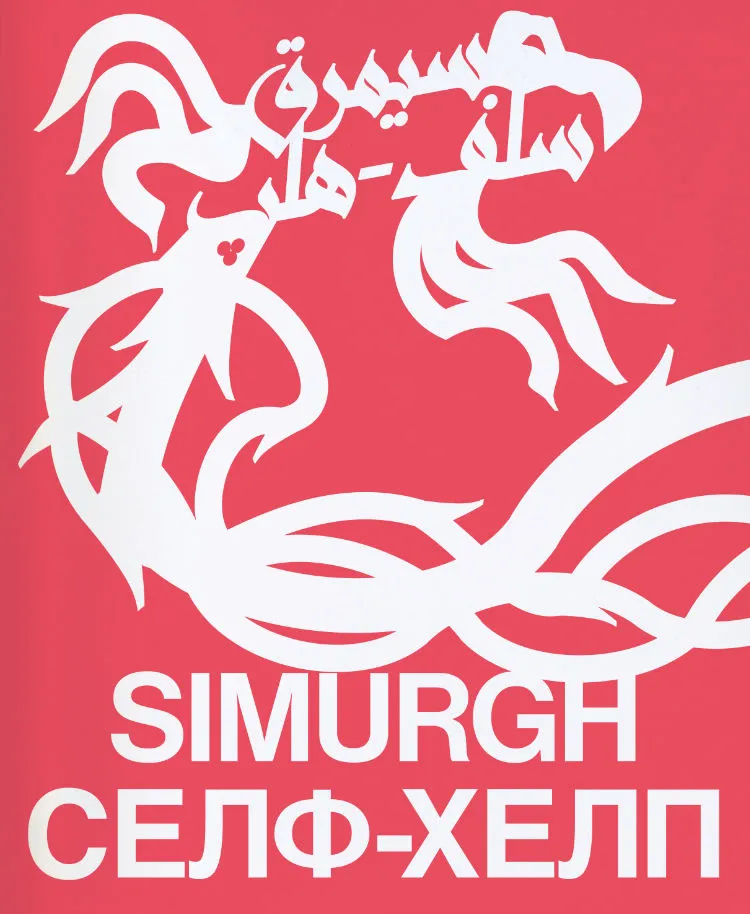
Simurgh Self-Help
The 2025 Ringier annual report (artist's book).
Since 1998, Ringier, the Swiss-based global media company, has traditionally commissioned an artist to design its annual report. Publisher Michael Ringier and curator Beatrix Ruf initiated this series as a means of reinforcing the links between art and the activities of the company.
For the 2025 edition, Slavs and Tatars' Simurgh Self-Help revisits Marcel Broodthaers' seminal work Musée d'Art Moderne: Département des Aigles (1968–1972), replacing or "translating" the eagle—a symbol of power and empire that is used to challenge our understanding of authority and value—with the Simurgh, a mythical bird found across the Turkic-Persianate world. Whilst the eagle is often associated with nation-states and masculinity, the Simurgh is decidedly transnational, metaphysical, and flamboyant, if not gender-fluid.
Much like the collective's geographic remit—between the former Berlin Wall and the Great Wall of China—this publication attempts to shift our focus elsewhere, eastwards, to regions which too often fall through the cracks of historiography and art history. If modern and contemporary art institutions in Broodthaers' time were largely situated between the Rhineland and Northeast United States, the multipolarity of today's art world is a fait accompli: with biennials in Uzbekistan and museums in Kazakhstan, amongst others, rivalling the traditional centers of power.
Once too a sacred bird—accompanying Zeus, for example—the eagle has, over the past two millennia, undergone a thorough profanation: a brawny, secular flex of nationalism. It would be remiss not to see the parallels in the world of media: print itself and the act of reading, once an activity for the few and anointed, has undergone a similar dynamic of democratization over the past several centuries and, especially in recent years with the internet, a vulgarization which would make medieval Church elders wag their shriveled fingers at us in an I-told-you-so meme meant for the ages. This profanation has challenged the very institution of media and the narratives it disseminates, much as important works of institutional critique challenged contemporary art in the 1970s and beyond—akin to Slavs and Tatars' genre-bending mix of high and low, East and West, sacred and profane does today.
Slavs and Tatars' (founded 2006) extensive publishing activity—some 15 books in 20 years—has treated subjects as diverse as alphabet politics, Uighur literary culture, political satire in the Muslim world, and German anti-Enlightenment thinkers. Alongside sculptures, textile works, installations, sound pieces, and even a brick-and-mortar Pickle Bar in Berlin, the collective's books have cleared new paths for contemporary discourse via a wholly idiosyncratic form of knowledge production that draws on popular culture, spiritual and esoteric traditions, oral histories, modern myths, as well as scholarly research.
Slavs and Tatars is a faction of polemics and intimacies devoted to an area east of the former Berlin Wall and west of the Great Wall of China known as Eurasia. The collective's work spans several media, disciplines, and a broad spectrum of cultural registers (high and low) focusing on an oft-forgotten sphere of influence between Slavs, Caucasians and Central Asians.
Slavs and Tatars has published Kidnapping Mountains (Book Works, 2009), a celebration of complexity in the Caucasus, Love Me, Love Me Not: Changed Names (onestar press, 2010) and are currently preparing solo engagements at Vienna's Secession, Museum of Modern Art, New York and Künstlerhaus Stuttgart.

And Death Shall Have No Dominion / Killing ‘The Mother’
Victoria Guerrero-Peirano, Honora Spicer
And death shall have no dominion / Killing ‘The Mother’ charts death inside healthcare bureaucracy through brutal, surreal and fragmentary poetic prose, grappling with the capitalist devastation of systems of social care and how writing might enact forms of conception in the face of such conditions. Victoria Guerrero-Peirano has been recognized as one of the most singular and powerful voices of contemporary Peruvian poetry.

On the Origin of Species and Other Stories
Straddling science fiction, fantasy and myth, the writings of award-winning author Bo-Young Kim have garnered a cult following in South Korea, where she is widely acknowledged as a pioneer and inspiration. On the Origin of Species makes available for the first time in English some of Kim's most acclaimed stories, as well as an essay on science fiction. Her strikingly original, thought-provoking work teems with human and non-human beings, all of whom are striving to survive through evolution, whether biologically, technologically or socially. Kim's literature of ideas offers some of the most rigorous and surprisingly poignant reflections on posthuman existence being written today.
Bo-Young Kim (born 1975) won the inaugural Korean Science & Technology Creative Writing Award with her first published novella in 2004 and has gone on to win the annual South Korean SF Novel Award three times. In addition to writing, she regularly serves as a lecturer, juror and editor of sci-fi anthologies, and served as a consultant to Parasite director Bong Joon Ho's earlier sci-fi film Snowpiercer. She has novellas forthcoming from HarperCollins in 2021. She lives in Gangwon Province, South Korea, with her family.

À Reclasser
This publication shows the waiting archive of the Museum of Resistance. The Brussels Museum of Resistance is undergoing renovation. Hidden in the basements of the civil affairs department, the stacked archive awaits a new home. Boxes filled with recognition files, photo albums, exhibition panels, books, flags, furniture, and other scenographic materials are scattered throughout the entire floor plan. The recently appointed archivist Samuel and historian Agnes are sorting through the archive pieces and are striving to ensure a future.

Shagging the Boss
Rebecca Rowland is one of the sharpest writers that I know. This little book combines elements of life in the publishing industry, #MeToo, and a literal boogeyman. It’s long been my desire to do more “social horror.” And Shagging the Boss is the stick I use to measure other submissions in that vein. (Back Cover Text) “Lesson number one: don’t get attached to anyone. Being a cannibal is the only way to truly succeed in this business.” He placed one hand on the door handle, then thought a moment and smiled to himself. “The problem is, once you take a bite, it will never be enough.” After a fortuitous encounter at a local book convention, a liberal arts graduate accepts a position at a flashy publishing company under the tutelage of its charismatic owner only to learn that the press is led, and fed, by a literal boogeyman.
“Rowland tells an exceptionally tight and fast-paced tale about a unique legendary creature stalking the modern publishing industry” — Michael Arnzen, Bram Stoker Award-winning author of Licker and 100 Jolts
“Rowland’s tale is a transgressive mindf*ck that will leave you irreparably unnerved” — L. Stephenson, author of The Goners
“Rowland has a narrative mastery that makes you feel as if a good friend is pulling you in close to tell you some special secret…You’ll be left shook” —Tim Murr, Stranger With Friction

An Archive of Feelings
In this bold new work of cultural criticism, Ann Cvetkovich develops a queer approach to trauma. She argues for the importance of recognizing—and archiving—accounts of trauma that belong as much to the ordinary and everyday as to the domain of catastrophe. An Archive of Feelings contends that the field of trauma studies, limited by too strict a division between the public and the private, has overlooked the experiences of women and queers. Rejecting the pathologizing understandings of trauma that permeate medical and clinical discourses on the subject, Cvetkovich develops instead a sex-positive approach missing even from most feminist work on trauma. She challenges the field to engage more fully with sexual trauma and the wide range of feelings in its vicinity, including those associated with butch-femme sex and aids activism and caretaking.
An Archive of Feelings brings together oral histories from lesbian activists involved in act up/New York; readings of literature by Dorothy Allison, Leslie Feinberg, Cherríe Moraga, and Shani Mootoo; videos by Jean Carlomusto and Pratibha Parmar; and performances by Lisa Kron, Carmelita Tropicana, and the bands Le Tigre and Tribe 8. Cvetkovich reveals how activism, performance, and literature give rise to public cultures that work through trauma and transform the conditions producing it. By looking closely at connections between sexuality, trauma, and the creation of lesbian public cultures, Cvetkovich makes those experiences that have been pushed to the peripheries of trauma culture the defining principles of a new construction of sexual trauma—one in which trauma catalyzes the creation of cultural archives and political communities.

The Swarm
A shape-shifting, metaphysical thriller where sensorial, sexual, and revolutionary impulses are aligned for the purpose for anarcho-transcendent-communal escape, The Swarm circles around a sundry of anomalous and dead beings who plot their way out of Hungarian fascist rule in the thermal baths of Budapest.
Based in Berlin, Dalia Neis is a writer, filmmaker, and lyricist and vocalist for Dali Muru & The Polyphonic Swarm. Previous publications include Zephyrian Spools: An Essay, a Wind (Knives, Forks & Spoons), and Hercules Road (Ma Bibliothèque).

Near, At
Near, At follows the inherent strangeness of one’s consciousness as it observes and comes into contact with the physical world. A sustained exploration of language, capitalism, gender, and nature, Near, At traverses and measures the movement of silence against the movement of thought and its pauses. Divided into five parts, each with its own form, and followed by a series of ongoing love poems called MY CHRISTOPHER POEMS, this debut collection is slow to assume but quick to adjust. Rooted in both the traditional and the experimental, it asks just how little of ourselves we can be.
"Jennifer Soong’s collection displays her nuanced understanding of how the philosophical-treatise-as-poem can birth an emotional and embodied intelligence, placing her in a line of affinity with contemporary writers such as Lyn Hejinian, Lisa Robertson and Anne Boyer. Simultaneously, Soong accomplishes something utterly unexpected in 2019: she casts a harpoon into the New England landscape poem – long linked to the genteel, the male, the WASP – and brings it vibrant and expansive into the twenty-first century. Certain poetry collections are written to be 'of the moment,' but a collection such as Near, At is written to give pace to those moments, with each carefully placed word a further step taken by the poet and reader together. Come near, these poems tell us, and we feel we’ll arrive at exactly the time and place we need to be."
—Mia You

Ik hier jij daar
'In de poëzie kunnen twee verschillende werelden elkaar ontmoeten, door gedichten kunnen we zonder ID denkbeeldige grenzen overschrijden en in dezelfde denkbeeldige ruimte verblijven. Maar is die ruimte wel dezelfde? Kunnen we losbreken uit onze rollen van slachtoffer en medeplichtige? Kunnen gedichten ons leren ons te identificeren met ongevoelde pijn? Wat spreekt er uit onze ontmoeting op papier?' - Anne Vegter
'Een dichter moet egoïstisch zijn, moet een eenzame wolf zijn, maar soms ontmoeten eenzame wolven elkaar in de wouden en jagen ze samen. Twee dichters, één boek: niet noodzakelijkerwijs om iets nieuws te bouwen, maar om de muren af te breken die ons tegenhouden wanneer we naar de andere oever willen oversteken. De Steen van Rosetta, die ervoor zorgt dat we het ongelezene lezen.' - Ghayath Almadhoun
Ghayath Almadhoun (1979) werd geboren in het Palestijnse vluchtelingenkamp Yarmouk in Damascus als zoon van een Palestijnse vader en een Syrische moeder. Hij studeerde Arabische literatuur aan de Universiteit van Damascus en werkte als cultureel journalist. Sinds 2008 woont hij in Stockholm. In Nederland verscheen in 2014 zijn lovend besproken dichtbundel 'Weg van Damascus'. Anne Vegter woont en werkt in Rotterdam. Van haar hand verschenen onder andere de verhalenbundels 'Ongekuiste versies' en 'Harries hoofdingang' en de dichtbundels 'Aandelen en obligaties', 'Spamfighter' en 'Eiland berg gletsjer'. Haar werk werd meermaals bekroond. De afgelopen vier jaar was ze Dichter des Vaderlands. De gedichten van Ghayath Almadhoun zijn uit het Arabisch vertaald door Djûke Poppinga.