Books
Books
in random order

SAPPHO TERROR
Maura Modeya’s SAPPHO TERROR is a book haunted—by empire, by sleeplessness, by Sappho herself. In it, queerness becomes both the agent of terror and its object. “I want to be consumed. I want to disappear twice.” Extending the experiments of Mayer, Lonidier, and Stein, Modeya’s poems are as much about desire as they are about violence. They let us in on a secret: “Logic sometimes is so disgusting.” At once delirious and hyperalert, performance and document of a performance, SAPPHO TERROR disrupts the routines of everyday life from within. “Tending to the eros of writing something down.”
A fist is something that blooms inside a lover, a hand held up in revolutionary camaraderie, and the weapon of bare-knuckle combat. In Maura Modeya’s SAPPHO TERROR, the poet probes, in a language that possesses an addictive deliquescence, the body as policy and the devotional as daily, where intimacy is all at once risked, tenderized, and disciplined. We begin in a space of betweenness—between street and bed, between conquest and abandon—and are then submerged into tidal pools of sleeplessness where the poet is overtaken, exquisitely, by forces beyond themselves. Sculpted into vigilant word-reliquaries, these poems exalt the femi-themme of the night while holding fast to danger. Inside this edge-space lives the chasm—the danger that lives in the distance from one edge to another—where sex, politics, and liminal states of consciousness collide, exposing how power is enforced, negotiated, and sometimes utterly undone through the body. —Valerie Hsiung
In SAPPHO TERROR Maura Modeya drifts with eros between the “war intestine,” and a restless dreamscape where desire demands disorientation and the rapture of invasion teeters in tension between queer love and the horrors of militaristic and domestic terrorism. Modeya offers us a vulnerable and familiar sorrow: “Why when I want to speak of love, violence surfaces?” In communion with Sappho’s fragments—those invocations of desire intensified by their historical devastation—Modeya’s poems project that eros is to want is to risk.
Leaning into the “deathless language” of queer love, Modeya allows herself to be haunted by the unreasonable logic of eros and finds herself caught between an insomnia that threatens the poet’s coherence of self, and a sleep that risks waking to the repulsive logics adorning our daily violences.In striking and visceral exhaustion, this book performs the desire of possession—by a lover, by language, by loss. SAPPHO TERROR brings us into the poet’s rapture, one that is profoundly balanced between the paradoxical and perilous forces of eros. —Serena Chopra
What arises out of sleeplessness? In SAPPHO TERROR, all boundaries fall away into ritual. There is a permeability, an eros, a freedom from all structures and institutions, even from our own self. Our human guardrails fall away to a place where we forget the boots on our necks, that our money buys weapons for the state, or even that we are separate unique beings. Is it wrong to forget, or is it a healing? Perhaps both. Modeya says that in sleeplessness, “to submit means to surrender into what is wanted so badly.” In the face of terror, our letting go is a kind of purity. It tells us we can travel beyond repression, not to escape, but to reach the most natural state of our being, even before survival. It is a reminder of life. —Samuel Ace
Maura Modeya’s SAPPHO TERROR takes back Plato’s Cave for the dykes. In these poems eros’ shadows reign sovereign: language is chained and casts haptic forms onto Modeya’s bedroom wall lit by Sappho’s famous fires. These poems join her chorus of “You Burn Me” with the desperate velocity only the insomniac knows. Modeya’s verse is exquisite and relentless, creaking out of the dead of night, bargaining for the possibility of touch. An assembly of aching towardness, SAPPHO TERROR is part elegy, part manifesto, part love letter that sabotages the war intestines we live in order to undivide us from our desire. —Rosie Stockton
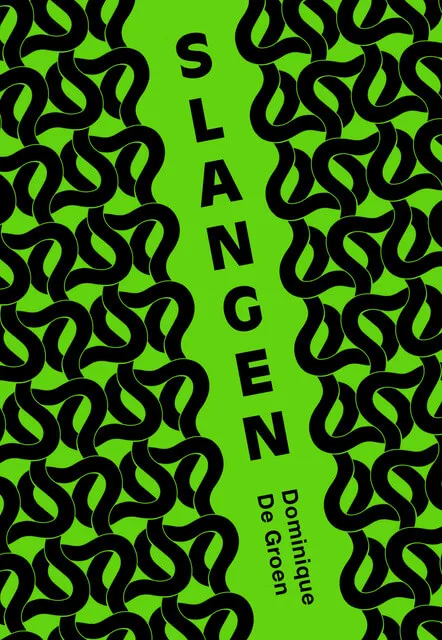
Slangen
Slangen krioelen in de sarcofaag van het heden, in de krochten van de popcultuur, in de mummie van de natuur, in wondes en rot vlees, in artificiële woestijnen en op geoliede dad bods. Ze wentelen zich rond beursgrafieken, raken verstrengeld met wurgende algoritmes, orkestreren een trage ondergrondse revolutie. Een meisje snijdt zich aan een nepdiamanten piramide en werpt haar slangenvel van zich af.
Dominique De Groen is schrijver en beeldend kunstenaar. Ze publiceerde de dichtbundels Shop Girl (2017), Sticky Drama (2019) en offerlam (2020). Ze werd genomineerd voor de Poëziedebuutprijs Aan Zee 2018, de Herman de Coninckprijs 2020 en de Fintroliteratuurprijs 2021 en won de Frans Vogel Poëzieprijs 2019 en de Fintropublieksprijs 2021.

Hyperpolitics: Extreme Politicization without Political Consequences
What happens when politics is everywhere, yet nothing seems to change? From the abandoned dance floors of Thatcher’s London to the mass mobilizations of Black Lives Matter, Anton Jäger traces how public life has become infused with protest, spectacle, and moral urgency — while the old infrastructure of parties, unions, and civic solidarity has been hollowed out.
Hyperpolitics revisits the illusions of the “end of history” and dissects the strange energies that replaced them: viral outrage, endless culture wars, and the digital rush of causes that flare and vanish overnight. Jäger shows how the promises of post–Cold War liberalism gave way to a restless, unsteady public sphere where private passions overflow into politics but rarely build enduring power.
Ranging from Guy Debord and Wolfgang Tillmans to Houellebecq’s disenchanted fictions, Hyperpolitics makes sense of a world in which collective action remains fragmented and the social fabric thinner than ever. For anyone trying to grasp why our age feels so charged yet so inconsequential, this book offers a vital map through the new contradictions of our hyperpolitical moment.

Wages For Wages Against – Volume 1 – We are not where we need to be, but we ain't where we were
Ramaya Tegegne, Lili Reynaud-Dewar and 1 more
We are not where we need to be but, we ain't where we were is the first volume of a new series of publications by the collective Wages For Wages Against that reports on active research engaged within the artistic professions and institutions since 2017. Its aim is to question the underlying neoliberal logics in the contemporary art world, by orienting our object of study towards the struggles that impact it. With this publication, our hope is to put into practice various values specific to the campaign: the existence of a systematic and fair remuneration, a desire for transparency, the sharing of knowledge, and the visibilization of demands proper to the field of the visual arts and concomitant struggles. It is the result of militant experiences, at the convergence of our individual experiences and collective questionings.
With texts by Tiphanie Blanc, Antonella Corsani, Fanny Lallart, Lili Reynaud-Dewar, Ramaya Tegegne and an interview with Outrage Collectif.

F.R. David - Spin Cycle
F.R.DAVID is a typographical journal, dealing with the organisation of reading and writing in contemporary art practises.
This issue, "Spin Cycle", is concerned with captioning, commentary and description. Edited with Mike Sperlinger.

Life with Fifi
Kris Dittel, Angelica Falkeling
A children’s book without a specific age category, offering a glimpse into the small rituals and shared moments that shape a day with Fifi Paris.
Fifi, a Pomeranian-Chihuahua mix, came into the lives of Angelica and Kris a few years ago. Taking care of a puppy is taking responsibility for building their world and letting the small animal transform yours. As her human caretakers, the authors created Fifi’s world with toys, cuddles, rules, snacks and walks in the park. In return, she transforms our world by bringing our community together and reminding us of the importance of caring for one another. In this book, Kris and Angelica narrate a day in the life of Fifi, from the moment she wakes up to when she falls asleep at night. Along the way, they share how they connect with her, how they see her understanding her surroundings and what she has taught them about companionship.
Design by Amy Suo Wu
Copy-editing by Clem Edwards
Photography by Lili Huston-Hertreich

Nilling
NILLING: PROSE is a sequence of five loosely linked prose essays about noise, pornography, the codex, melancholy, Lucretius, folds, cities and related aporias: in short, these are essays on reading.
"I have tried to make a sketch or a model in several dimensions of the potency of Arendt's idea of invisibility, the necessary inconspicuousness of thinking and reading, and the ambivalently joyous and knotted agency to be found there. Just beneath the surface of the phonemes, a gendered name rhythmically explodes into a founding variousness. And then the strictures of the text assert again themselves. I want to claim for this inconspicuousness a transformational agency that runs counter to the teleology of readerly intention. Syllables might call to gods who do and don't exist. That is, they appear in the text's absences and densities as a motile graphic and phonemic force that abnegates its own necessity. Overwhelmingly in my submission to reading's supple snare, I feel love."

The Brotherhood
Carolina Bianchi, Thomas Resendes
The Brotherhood fait suite à La Mariée et Bonne nuit Cendrillon qui avait provoqué une onde de choc lors de sa première à Avignon où Carolina Bianchi amenait des réflexions sur la performance et la théâtralité, sur un lit d'histoires de viols brutaux et de meurtres de femmes.
Dans ce deuxième chapitre de la Trilogie des chiennes, Carolina Bianchi se penche sur la complexité de certains « pactes de masculinité », notamment sur les origines de la fraternité entre les hommes, mettant en lumière les codes mutuels violents qui contribuent à normaliser et perpétuer le viol et la violence sexuelle à travers leur lexique. Carolina Bianchi utilise les principes du théâtre pour articuler des voies possibles à cette discussion, créant des liens forts entre la représentation et le traumatisme réel, les structures de pouvoir dans l'art et la poésie radicale, les origines de la misogynie et une sexualité en crise. La structure de cette réflexion se révèle être un piège, affaiblissant l'auteurité de Bianchi et la transformant en un personnage qui subit les conséquences d'avoir scruté cette « fraternité » de si près.
Texte portugais (Brésil) traduit par Thomas Resendes.
-
The Brotherhood follows La Mariée and Bonne nuit Cendrillon, which caused a shockwave when it premiered in Avignon, where Carolina Bianchi explored reflections on performance and theatricality against a backdrop of stories of brutal rapes and murders of women.
In this second chapter of the Trilogie des chiennes, Carolina Bianchi examines the complexity of certain “pacts of masculinity,” particularly the origins of male brotherhood, highlighting the violent codes of conduct that contribute to normalizing and perpetuating rape and sexual violence through their lexicon. Carolina Bianchi uses the principles of theater to articulate possible avenues for this discussion, creating strong links between representation and real trauma, power structures in art and radical poetry, the origins of misogyny, and a sexuality in crisis. The structure of this reflection turns out to be a trap, undermining Bianchi’s authority and transforming her into a character who suffers the consequences of having scrutinized this “brotherhood” so closely.
Translated by Thomas Resendes.

Inhabiting the 0.6%: The reality of Seoul's Black Hole
Cette édition documente la surpopulation de Séoul et les statistiques tragiques qui s'y rapportent. Elle rassemble les voix de ceux qui y vivent, de ceux qui y ont vécu, de ceux qui doivent s'y rendre et de ceux qui l'ont quittée. La production suit les principes écologiques énoncés par la graphiste, Sara de Bondt en 2014. Pour éviter le gaspillage, des formats standard (A4) et du papier 100% recyclé ont été choisis, avec une impression en risographie. Pourquoi cet exode massif vers Séoul ? Comment Séoul est-elle devenue un trou noir ?
This edition documents Seoul’s overpopulation and the tragic statistics associated with it. It gathers the voices of those who live there, those who have lived there, those who must travel there, and those who have left. The production follows the ecological principles set forth by the graphic designer Sara de Bondt in 2014. To avoid waste, standard formats (A4) and 100% recycled paper were chosen, with an impression in risography. Why this massive exodus toward Seoul? How has Seoul become a black hole?
[KO] 이 책은 서울의 인구 과밀화와 이와 관련된 비극적인 통계들을 기록한다. 서울 거주자, 과거의 거주자, 가야만 하는 자, 그리고 이방인까지. 이들의 목소리를 인터뷰로 담았다. 2014년 그래픽 디자이너 사라 드 본트가 제시한 생태적 원칙을 따라 A4 규격 사이즈의 100% 재생용지 위에 리소그래피로 인쇄되었다. 왜 모두가 이토록 서울로 몰려드는 것일까? 서울은 어쩌다 블랙홀이 되었을까?
Pillage Laud
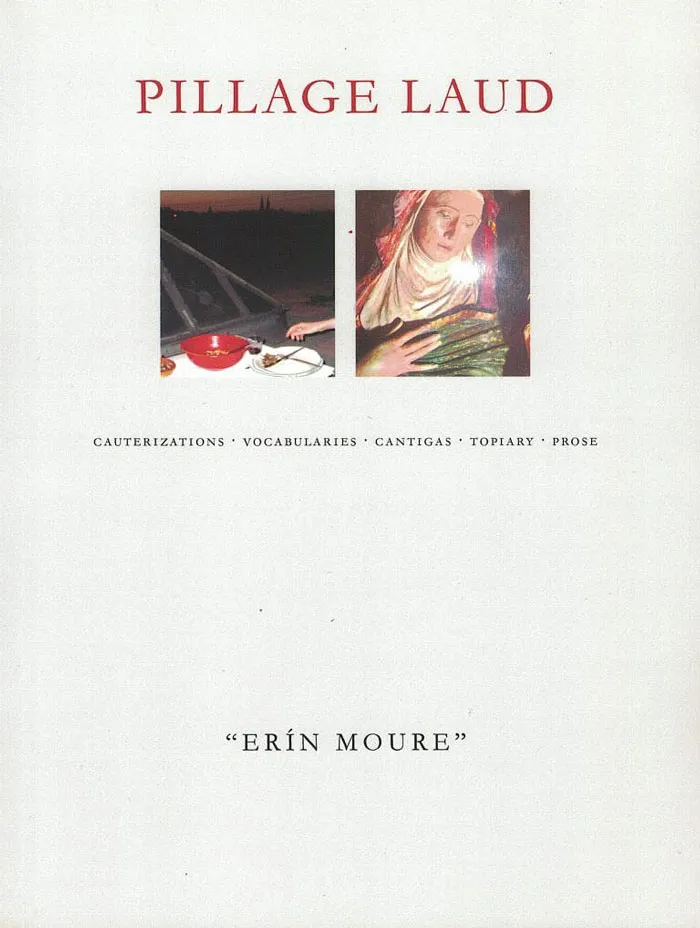
First published in 1999 in an edition of 300 perfectbound copies and 26 spiralbound copies lettered A-Z and signed, Pillage Laud is a lost cult item that now returns to print. As the 1999 edition announced, Pillage Laud selects from pages of computer-generated sentences to produce lesbian sex poems (cauterizations, vocabularies, cantigas, topiary and prose) by pulling through certain found vocabularies, relying on context: boy plug vagina library fate tool doctrine bath discipline belt beds pioneer book ambition finger fist flow.
It used MacProse, a freeware designed by American poet and jazz musician Charles O. Hartman as a generator of random sentences based on syntax and lexicon instructions internal to the program; the program worked on Apple systems prior to OSX and is now in the dustbins of computer history. In 1999, the news was shocking: Moure’s poems are written by a computer. In 2011, now that everyone is a computer, the book can be read anew.

Thing
Robert Ford, Trent Adkins and 1 more
Started in 1989 by designer and writer Robert Ford, THING magazine was the voice of the Queer Black music and art scene in the early 1990s. Ford and his editors were part of the burgeoning House music scene, which originated in Chicago’s Queer underground, and some of the top DJs and musicians from that time were featured in the magazine, including Frankie Knuckles, Gemini, Larry Heard, Rupaul, and Deee-Lite. THING published ten issues from 1989-1993, before it was cut short by Ford’s death from AIDS-related illness. All ten issues of THING are collected and published here for the first time.
As House music thrived, THING captured the multidisciplinary nature of the scene, opening its pages to a wide range of subjects: poetry and gossip, fiction and art, interviews and polemics. The HIV/AIDS crisis loomed large in its contents, particularly in the personal reflections and vital treatment resources that it published. An essay by poet Essex Hemphill was published alongside the gossip columnist Michael Musto and Rupaul dished wisdom alongside a diary from the March on Washington for Lesbian, Gay, and Bi Equal Rights and Liberation. Joan Jett Blakk’s revolutionary presidential campaign is contained in these pages, as are some of the most underground, influential literary voices of the time, such as Dennis Cooper, Vaginal Davis, Gary Indiana, Marlon Riggs, David Wojnarowicz, and even David Sedaris.
THING was very much in dialogue with the club kids in New York and other Queer publishing ventures, but in many ways, it fostered an entirely unique perspective—one with more serious ambitions. In a moment when the gay community was besieged by the HIV/AIDS crisis and a wantonly cruel government, the influence and significance of this cheaply-produced newsprint magazine vastly exceeded its humble means, presenting a beautiful portrait of the ball and club culture that existed in Chicago with deep intellectual reflections. THING was a publication by and for its community and understood the fleetingness of its moment. To reencounter this work today, is to reinstate the Black voices who were so central to the history of HIV/AIDS activism and Queer and club culture, but which were often sidelined by white Queer discourse. In many ways, THING offered a blueprint for the fundamental role a magazine plays in bringing together a community, its tagline summing up the bold stakes of this important venture: “She Knows Who She Is.”
The magazine included contributions from Trent D. Adkins, Joey Arias, Aaron Avant Garde, Ed Bailey, Freddie Bain, Basscut, Belasco, Joan Jett Blakk, Simone Bouyer, Lady Bunny, Bunny & Pussy, Derrick Carter, Fire Chick, Chicklet, Stephanie Coleman, Bill Coleman, Lee Collins, Gregory Conerly, Mark Contratto, Dennis Cooper, Dorian Corey, Ed Crosby, The Darva, Vaginal Davis, Deee-Lite, Tor Dettwiler, Riley Evans, Evil, The Fabulous Pop Tarts, Mark Farina, Larry Flick, Robert Ford, Scott Free, David Gandy, Gemini, Gabriel Gomez, Roy Gonsalves, Chuck Gonzales, Tony Greene, André Halmon, Lyle Ashton Harris, Larry Heard, Essex Hemphill, Kathryn Hixson, Sterling Houston, Ishmael Houston-Jones, Gary Indiana, Candy J, Jamoo, Jazzmun, Gant Johnson, Owen Keehnen, Lady Miss Kier, Spencer Kincy, Iris Kit, Erin Krystle, Steve LaFreniere, Larvetta Larvon, Marc Loveless, Lypsinka, Malone, Marjorie Marginal, Terry A. Martin, Rodney McCoy Jr., Alan Miller, Bobby Miller, Michael Musto, Ultra Naté, Willi Ninja, Scott “Spunk” O’Hara, DeAundra Peek, Earl Pleasure, Marlon Riggs, Robert Rodi, Todd Roulette, RuPaul, Chantay Savage, David Sedaris, Rosser Shymanski, Larry Tee, Voice Farm, Lawrence D. Warren, Martha Wash, LeRoy Whitfield, Stephen Winter, David Wojnarowicz, and Hector Xtravaganza.

The Lesbian Body
In this genre- and gender-breaking work of theory-fiction, legendary writer and cofounder of the 1970s French feminist movement Monique Wittig celebrates the body—lesbian, literary and defiantly political—and challenges the order of heterosexuality in literature.
First published in French in 1973, The Lesbian Body mines the relationship between a lover and a beloved—also a writer and a text—to explore the ideological and historical constructions of the female subject. Organized according to the principle of montage, poetic passages are juxtaposed with anatomic lists that mark lesbian eros. Through expressions of joy, violence, and tenderness, the site of pleasure is celebrated. In her transfiguration of gender and its paradigms, Wittig transformed French vocabulary, feminizing grammar and lesbianizing myths. This edition brings the English translation of Wittig’s groundbreaking work back into circulation for the first time since the mid-1980s, revised according to the author's notes, and with an introduction by Paul B. Preciado.
“The Lesbian Body is a fundamental work of lesbian existence. Wittig's applied vision is a state of natural delirium, a revolutionary excess of utopianism, refusal, and mutual self-creation. Revisiting it reveals how much passionate free thought has been lost, and simultaneously, how many of her tropes and discoveries have integrated into our collective consciousness.” — Sarah Schulman
“In this stunning new rendering of The Lesbian Body by the French author, theorist, activist and teacher, the late Monique Wittig, we are plunged into an imagined world of passionate violence and erotic lesbian mayhem intertwined in strikingly bold poetic images. Wittig, in the reach and volatility of her imagination, stands alongside such important American writers as Audre Lorde, Adrienne Rich, and Valerie Solanas, all of whose work deserves to be read again, or for the first time.” — Esther Newton
“To read the book is to be forced by Wittig into another grammar and happily contaminated by its strange forms. You will never think straight again.” — Jack Halberstam
“For me, Wittig opened up a sense of the world that had been, quite literally, unimaginable. She tore us apart.” — Judith Butler
“Together with Ursula Le Guin and Samuel R. Delany, Wittig is the first to design a nonbinary utopia, a world in which the binary categorization of sexes and genders will have ceased to exist.” — Paul B. Preciado
Introduction by Paul B. Preciado
Translated by David Le Vay

A Faggot is a Unit
This publication brings together two original screenplays for yet-realized video works by Robinson along with a collection of research material presented as a retrograde calendar. The screenplays, / Imagine Prompt: Catfish Monogamy and The Jealousy of Sagittarius A*, both deal with contemporary life and creative labor as they intersect with digital culture and current anxieties regarding AI. In addition, the screenplays are followed by A Faggot is a Unit (Homage to Hanne Darboven), a collection of archival photographs, scanned objects and ephemera, as well as stock imagery and graphics from the internet collected by Robinson over the course of seven years (2015–2021). The imagery further splits the disorienting narratives presented in the two screenplays to offer a kaleidoscopic and unpredictable way of reading stories while functioning simultaneously as visual companion and counterpoint to the scripts.
Writing and editing is central to Robinson’s published and film work, inquiring into queer histories and the contemporary economy of the image, not as novelty subjects in themselves, but as forms of knowledge integral to questioning histories of perceived liberation. We are committed to representing diverse voices and perspectives that challenge and build upon our vision of bringing material from the fast-paced digital experience to the book form.
Padraig Robinson is a Berlin-based artist, filmmaker and writer.

The Hut
Oswell Blakeston (1907–1985), though one of the great British masters of short horror and supernatural fiction, has never before had these tales collected. Here, for the first time, the bulk of his output in the genre is brought together, including numerous extremely hard to find pieces. Added to this are two appendices, the subject of which is the artist and occultist Austin Osman Spare (1886-1956), who Blakeston was closely associated with.

nnn.1 - no no no celestial journal
published commonly, no no no expounds an experimental poetic offering, both text & art.
each issue features a limited edition artwork. which can be tacked or framed or stored in a drawer.
celestial in nature, no no no takes the form required, and necessary.

The Power of Adrienne Rich: A Biography
The first comprehensive biography of Adrienne Rich, feminist and queer icon and internationally revered National Book Award winning poet.
Adrienne Rich was the female face of American poetry for decades. Her forceful, uncompromising writing has more than stood the test of time, and the life of the woman behind the words is equally impressive. Motivated by personal revelations, Rich transformed herself from a traditional, Radcliffe-educated lyric poet and married mother of three sons into a path-breaking lesbian-feminist author of prose as well as poetry. In doing so, she emerged as both architect and exemplar of the modern feminist movement, breaking ranks to denounce the male-dominated literary establishment and paving the way for the many queer women of letters to take their places in the cultural mainstream. Drawing on a wealth of unpublished materials, including Rich's correspondence and in-depth interviews with numerous people who knew her, Hilary Holladay digs deep into never-before-accessed sources to portray Rich in full dimension and vivid, human detail.

Theory of the Voice and Dream
Liliana Ponce , Michael Martin Shea
Obsessing on the relationship between creation and absence, Argentine poet Liliana Ponce presents an unsettling meditation on body, language, and self. For the first time in English, this edition brings together Ponce’s serial poems from the closing years of the twentieth century, the widely anthologized Theory of the Voice and Dream and Fudekara, a shorter sequence written in response to a Japanese calligraphy course. In these major works, Ponce questions the nature of writing itself, of how to write when to write today is an emptiness, or when mouth and voice cannot find each other. Breaking with Argentine poetic conventions, Ponce charts a new model for poesis—oneiric, embodied, and urgent. As she says, I write so I don’t have to speak, so I don’t have to watch.

Pommes Girl / أحتفل بالحياة التي تحتفل بي
Rim Battal, Abdelilah Khattabi
The story of a meeting between a woman and a man linked by music for one night, in a nuptial dance of bodies and words doomed to failure: an ode to desire by the Franco-Moroccan poetess.
Rim Battal (born 1987 in Casablanca, lives and works between Paris and Rabat since 2012) is a French artist and poet.
Edited by Yasmina Naji.
Translated into Arabic by Abdelilah Khattabi.

A conversation, Nick Zedd & Marie Canet
“What happened to my book?”
This was the last email we received from Nick, in December 2021. A short, concise demand, which we responded to, telling him that the transcription was coming soon and that Marie was finalising the introduction. Little did we know, what Nick surely already knew: he was dying. The urgency should have given it away, but Nick was always blunt in our email exchanges.
Nick passed away on February 27th, 2022. We regret not getting the transcription to him while he could still edit it, so this book in your hands remains an unabridged testament.
The only thing he did edit were his final words, in an unsolicited email in September 2021:
“I was thinking about when you asked me if I had any final words, that it would be better to have me say: Freedom or death. At the crossroads. With a key.”
So we leave you with this; a homage to the legendary founder of the Cinema Of Transgression - a brilliant artist, a sharp mind, a loving father, a kind revolutionary, a boot stamping on the face of modernity forever, an underground phenomenon.
Nick Zedd, rest in peace.
[Note by the publisher.]
With a foreword by Goswell Road. Includes a conversation with Nick Zedd, and the manifesto 'Cinema of Transgression'.
Softcover (11 cm x 18 cm)
84 Pages
75 copies
Language : English

Anatomy of a Refusal
Written after the Beirut Port Explosion on August 4, 2020, when 2,750 tonnes of ammonium nitrate exploded in the commercial and residential port of Beirut after years of warning and mismanagement, Anatomy of a Refusal drifts between lineated and prose poetry, creating a transitional space of mourning. Comprised of three sections, “Mutually Assured Destruction” confronts displacement; “Blast” erases and rescribes bureaucratic documents written about the explosion, and “Deterrence” “return[s] to the place of injury.”
Intertextually poetic, Sahar Khraibani writes in conversation with other writers and philosophers to question, “who owns my language?” and “What does it mean to be in / place?" And yet, between bureaucracy and philosophy, there are moments of intimacy, friendship coexisting in the shared space of the poem—between speaker and addressee, the body and the living world—where belonging carries the weight of grief.
—Blurb written by Clarise Reichley

Tuesday or September or the End
During a residency on Fire Island, artist and writer Hannah Black decided to tackle a highly daunting project: the 2020 novel.
The result of her efforts, Tuesday of September or the End, is a slim, playful work of speculative fiction. Written in the aftermath of the early months of the pandemic and the uprisings of summer 2020, the novel explores the ruptures of the year with a satirical sci-fi bent. Black chronicles the lives of two characters, Bird and Dog, as they contend with rapidly changing political possibilities during the pandemic while the run of Moley Salamanders (i.e. Bernie Sanders) concludes and aliens finally invade earth. Through a galvanic vision of how the riots of 2020 might have turned revolutionary, Black offers a meditation on collective life. This crucial novel invites readers to consider who we are—and, by extension, what we are here for—when our normal referents are muted, deleted and upended.
Hannah Black (born 1981) is a New York-based visual artist, critic and writer from Manchester, England. Her work spans video, text and performance and draws from communist, feminist and Afro-pessimist theory. She is the author of Life (2017, with Juliana Huxtable) and Dark Pool Party (2016). Black is represented by the gallery Arcadia Missa in London and Isabella Bortolozzi in Berlin.

Where Will My Mouth Lead Me – New York Diary
The artist's travel diary in New York.
Where will my mouth lead me? This question arises already in the first days of Hamza Halloubi's residency in New York. It characterises his diary entries from August to November 2024. He observes the art world, comments on cultural and political events and thinks about writers and artists who have long intrigued him and what his body and their ideas are doing in this city–and what this city does not do to him and them: David Hammons, Edward Saïd, Mohamed Choukri, Félix González-Torres… How they also appear like ghosts in his work. Hamza Halloubi approaches the viewer of his visual work, and here also the reader, as a social and political presence. In addition to his diary and image fragments from his films and exhibitions, this pocket book also includes two interviews with the artist.
Hamza Halloubi (born 1982 in Tangier, Morocco, lives and works between Brussels, Tangier, and Amsterdam) is a multi-disciplinary artist with a focus on video and painting.

Why Call it Labor? On Motherhood and Art Work
This publication comprises four essays and one conversation with contemporary artists and curators discussing their experience of becoming mothers as professionals in the arts, its reality and effects. While their reflections represent a similar strata of art worker in terms of background, class, and career trajectory, the impact of instruments of patriarchy on rendering maternity invisible that they describe is recognizable and insidious.
Contributions by Mai Abu ElDahab, Basma Alsharif, Lara Khaldi, Mary Jirmanus Saba, and Mirene Arsanios with Nikki Columbus.
Edited by Mai Abu ElDahab
Published by Mophradat and Archive Books
Text design layout by Valerie Arif
Arabic and English

CUNY Center for the Humanities
“This Great River”—Translating the Beats into Arabic
Sargon Boulus, Khaled al-Hilli
The Great River—Translating the Beats into Arabic traces the literary encounters of Sargon Boulus (1944-2007), an Iraqi poet who was part of the vibrant literary scene of late 60’s San Francisco. His life was marked by a period of restless traveling, that he would later describe as an attempt to pursue a poetic imaginary. This project continues to map his proximity to the Beat poets, his short-lived Bay Area poetry journal, Tigris, and his other English language publications.
This publication includes a facsimile reproduction of Tigris, featuring a long poem “Jebu” by Boulus’ good friend Etel Adnan.