Books
Books
in random order

Love in a F*cked-Up World
Around the globe, people are faced with a spiraling succession of crises, from the pandemic and climate change-induced disasters to the ongoing horrors of mass incarceration, racist policing, endemic gender violence, and severe wealth inequality. Many of us feel mobilized to organize and collectively combat these issues on both a personal and political level, often dedicating our lives to the forwarding of progressive ideas and the daunting goal of trying to bend the world toward justice.
But even those of us who long for change seem to have trouble when it comes to interpersonal relationships. Too often we think of our political values as outward-facing positions again dominant systems of power. Rarely, if ever, do we pursue the same kind of justice close to home, in our personal connections. Many activist projects and resistance groups fall apart because people treat each other poorly, trying desperately to live out the cultural myths about dating and relationships that we are fed from an early age.
How do we divest from the idea that one romantic partner will be the solution to all our problems? How do we separate our expectations of love from the troubling dynamics left to us by our parents? How do we bring our best thinking about freedom and justice into step with our desires for healing and connection?
Lifelong activist and educator Dean Spade dares us to decide that our interpersonal actions are not separate from our politics of liberation and resistance. Love in a F*cked-Up World is a resounding call to action and a practical manifesto for how to combat cultural scripts and take our relationships into our own hands, preparing us for the work of changing the world.

Mela Roda Da Fortuna / Half Wheel of Fortune
An inscription of time at the coast, singing crows, albatrosses and seagulls. STOP. Extracted from the earth a whole alphabet. The waves uplifted countries and washed mountains until the storm came undone. The plantation of tobacco was maintained among the meadows and cafes flourished as the core of erudition, the power was theirs - you could see it in cinema- the actors spoke feverishly with enthusiasm, rather than breathless, meticulous and austere. The scars healed on mysterious skin that came out of the shadow to cross the day.

Sonia's Book
I acquired Sonia’s copy of Fraser Darlingʼs book in 2010 when my cousins, sister, and I were going through Soniaʼs house following her death. From one of her glassed-in bookshelves, the spineʼs distinctive artwork caught my eye. When I put my hand in to grab it, it was immediately apparent there was something odd. Turning it over, I realised the book contained enclosures. It had been used as a flower press. Between its pages were eleven sheets of specimens, each sheet masked off with two pieces of neatly arranged blotting paper. All the sheets were titled in pencil: ‘Aviemore—May 1961’.
Sonia Campbell Penney was a professional gardener, keen botanist, and the author’s aunt. Her ‘book’ is a copy of Natural History in the Highlands and Islands by F. Fraser Darling, interleaved with eleven sheets of plant specimens, guarded by blotting paper, which Sonia collected around Aviemore in the Scottish Highlands in May 1961. Functionally, if sporadically, annotated with plant names and, occasionally, places of finding, these sheets might be interpreted as a form of nature writing or a holiday diary almost without words. Sixty years on, Bridget Penney asks what a close, though thoroughly unscientific, consideration of these unmediated traces might reveal.

Art Monsters: Unruly Bodies in Feminist Art
In this dazzlingly original reassessment of women’s stories, bodies, and art, Lauren Elkin—the celebrated author of Flâneuse—explores the ways in which feminist artists have taken up the challenge of their work and how they not only react against the patriarchy but redefine their own aesthetic aims. How do we tell the truth about our experiences as bodies? What is the language, what are the materials, that we need to transcribe them? And what are the unique questions facing those engaged with female bodies, queer bodies, sick bodies, racialized bodies?
Encompassing a rich genealogy of work across the literary and artistic landscape, Elkin makes daring links between disparate points of reference—among them Julia Margaret Cameron’s photography, Kara Walker’s silhouettes, Vanessa Bell’s portraits, Eva Hesse’s rope sculptures, Carolee Schneemann’s body art, Theresa Hak Kyung Cha’s trilingual masterpiece DICTEE—and steps into the tradition of cultural criticism established by Susan Sontag, Hélène Cixous, and Maggie Nelson.
An erudite, potent examination of beauty and excess, sentiment and touch, the personal and the political, the ambiguous and the opaque, Art Monsters is a radical intervention that forces us to consider how the idea of the art monster might transform the way we imagine—and enact—our lives.
Destined to become a new classic . . . Elkin shatters the truisms that have evolved around feminist thought.
—Chris Kraus

Celebrating the Michigan Womyn's Music Festival
Sinister Wisdom 103: Celebrating the Michigan Womyn's Music Festival honors the forty-year legacy of the Michigan Womyn’s Music Festival (1976–2015). Sinister Wisdom 103: Celebrating the Michigan Womyn's Music Festival celebrates this embodiment of radical feminist separatist collaboration, transformational self-defined autonomous spaces, a commitment to sisterhood and matriarchal culture, and a musical city sprung from the earth for one week in the woods.
A collective of five womyn each with a deep connection to Fest operated by consensus to create this issue. Striving to represent a range of womyn’s voices, values, traditions, and experiences of Fest, the collective highlighted what Fest has meant to generations of womyn, documented its chronology, and bore witness to the power of this community. Sinister Wisdom 103: Celebrating the Michigan Womyn's Music Festival includes womyn from multiple races, geographies, sexualities, generations, and gender and other social identities. Just as Fest brought together womyn from various backgrounds, our collection includes a range of artistic experience, from seasoned authors and photographers to those womyn new to publishing.
Sinister Wisdom 103: Celebrating the Michigan Womyn's Music Festival remembers the transformations, possibilities, and hopes for spaces cultivating the ongoing empowerment of womyn.

Holy Smoke
Why they said, “Your real name is Anon,” I’ll never know ... But now that I have a name, I know I must write ... I’m scared, but feel it is time to be really bad.
Republished for the first time since its 1979 release, in a new revised edition, Holy Smoke is an account of the frenzy and paranoia of United States politics refracted through one individual’s psyche. With her theme of a child disappeared – and all that that phrase carries with it – Howe captures the chaos of reality in her salient mix of poetry and prose. Readers will find it hard to believe that this book, which gives fresh sense to the demand for universal human rights, was written in the last century.
At once evocative and subtly incisive, Howe’s writing seems almost like a new language, a language that has been in hiding. She can make the familiar haunting and the ordinary a provocation. She has written some of the remarkable books of her time. —Adam Phillips
A wonder of acid wit and Americana, Holy Smoke turns grief into a game and chaos into canticles. Bricolage at its best: incisive, inventive and intimate. It’s the exact work I needed in my life. —Navid Sinaki

Radical Intimacy
An impassioned discussion about the alternative ways to form relationships and resist capitalism.
Capitalist ideology wants us to believe that there is an optimal way to live. 'Making connections' means networking for work. Our emotional needs are to be fulfilled by a single romantic partner, and self-care equates to taking personal responsibility for our suffering. We must be productive and heterosexual, we must have babies and buy a house. But the kicker is most people cannot and do not want to achieve all, or any of these life goals. Instead we are left feeling atomised, exhausted and disempowered.
Radical Intimacy shows that it doesn't need to be this way. A punchy and impassioned account of inspiring ideas about alternative ways to live, Sophie K Rosa demands we use our radical imagination to discover a new form of intimacy and to transform our personal lives and in turn society as a whole.
Including critiques of the 'wellness' industry that ignores rising poverty rates, the mental health crisis and racist and misogynist state violence; transcending love and sex under capitalism to move towards feminist, decolonial and queer thinking; asking whether we should abolish the family; interrogating the framing of ageing and death and much more, Radical Intimacy is the compassionate antidote to a callous society.

Impossible Princess
Impossible Princess is the third collection of gay short fiction by PEN Award–winning San Francisco–based author Kevin Killian. A member of the “new narrative” circle including Dennis Cooper and Kathy Acker, Killian is a master short story writer, crafting campy and edgy tales that explore the humor and darkness of desire. A former director of Small Press Traffic and a co-editor of Mirage/Periodical, Killian co-wrote Jack Spicer’s biography, Poet Be Like God, and co-edited three Spicer books, including My Vocabulary Did This To Me: Collected Poems. His latest book, Action Kylie, is a collection of poems devoted to Kylie Minogue.

Tuesday or September or the End
During a residency on Fire Island, artist and writer Hannah Black decided to tackle a highly daunting project: the 2020 novel.
The result of her efforts, Tuesday of September or the End, is a slim, playful work of speculative fiction. Written in the aftermath of the early months of the pandemic and the uprisings of summer 2020, the novel explores the ruptures of the year with a satirical sci-fi bent. Black chronicles the lives of two characters, Bird and Dog, as they contend with rapidly changing political possibilities during the pandemic while the run of Moley Salamanders (i.e. Bernie Sanders) concludes and aliens finally invade earth. Through a galvanic vision of how the riots of 2020 might have turned revolutionary, Black offers a meditation on collective life. This crucial novel invites readers to consider who we are—and, by extension, what we are here for—when our normal referents are muted, deleted and upended.
Hannah Black (born 1981) is a New York-based visual artist, critic and writer from Manchester, England. Her work spans video, text and performance and draws from communist, feminist and Afro-pessimist theory. She is the author of Life (2017, with Juliana Huxtable) and Dark Pool Party (2016). Black is represented by the gallery Arcadia Missa in London and Isabella Bortolozzi in Berlin.

Rab-Rab, Issue 5
The fifth issue of Rab-Rab: Journal of Political and Formal Inquiries in Art includes stories about nation traitors, fierce masses, socialist women struggles, love-forms, psychedelic counter-revolutionaries, workers unions, Brecht fiddlers, jazz surrealism, Soviet trains, and anti-fascism.
Among the contributors to the fifth issue are Anna Thew, Yehuda Safran, Peter Gidal, Cana Bilir-Meier, David Black, Marjo Liukkonen, Alejandro Pedregal, Peter Hallward, Minna Henriksson, and Jyrki Siukonen.
It has also two extensive dossiers. One dedicated to Franklin Rosemont is presented by Joe Feinberg and is introducing some unpublished and difficult to find texts parallel with writings of T-Bone Slim and Joe Hill. The other dossier on Robert Linhart is presented by Tevfik Rada, and it includes a translation of a chapter from Linhart's book on productivism, an article against Western bourgeois dissidents, and an interview with him.

The German Library Pyongyang
From December 11, 2015, until April 10, 2016, the German Library in Guangzhou, China, became The German Library Pyongyang, a reimagining of an initiative of the Goethe-Institut that originally operated in North Korea between 2004 and 2009. This temporary intervention by Sara van der Heide is an imaginary transformation of the current geography of the German Library in Guangzhou. Van der Heide’s project is a contemporary version of the Goethe-Institut’s original library initiative in North Korea, devised as a vessel to discuss national cultural policy in a post-Cold War and postcolonial era that looks critically toward the parallel histories of Germany and the two Koreas. The German Library Pyongyang offers a space for critical questions, but it also functions as a context for transcending thinking that is prescribed by the lines of the nation-state, language, and geography. The several artistic, linguistic, and graphic interventions in the library merge with the continuing activities of the German learning center in Guangzhou, and all institutional printed matter in Chinese is replaced by Korean.
This publication brings together the four original exhibition booklets in German, Korean, English, and Chinese. An additional reader is included with critical reflections as well as documentation of the exhibition and the organized seminar.
Design by Dongyoung Lee
English/German/Korean/Chinese

For a Time
Published in conjunction with the exhibition For a Time Light Must Be Called Darkness. Lina Selander in collaboration with Oscar Mangione held at Argos, Centre for Art & Media, Brussels, 24.09.2017 - 17.12.2017.
About the exhibition:
For a Time Light Must Be Called Darkness features six video installations, most of them made in collaboration with Oscar Mangione. These works take us to Bredäng (a suburb in south-west Stockholm), Berlin, the West Bank, Pripyat and Chernobyl. All of these places are the occasion and the starting point for broader reflections about our present in relation to historical facts. Selander visits these sites and like an archaeologist digs in their past, their monuments, museums and archives. She looks for visual documents, focuses on details and analytically sketches new hypothesis. In this way, she tries to retrace hidden links between distant imageries, correspondences and analogies, in order to create new narratives. In her essayistic approach, Selander combines her own texts and footage along with still images, quotes and archive material. In this way a constant tension springs within these multiple-layered audiovisual works and reminds us that seeing is never an innocent act.

toi, moi, la pluie
toi, moi, la pluie is a sequence of cards that can be assembled into three-dimensional configurations. The cards present two sides of the same moment: rain falling outdoors, and an art exhibition taking place indoors.
With humour and a sense of casual abandon, Sara Graça reduces the exhibition space to a dry place offering shelter from the rain. Despite a moment of intense intimacy—a passionate kiss—the space is largely inhabited by figures who do not seem to know one another, or to get along. The same kiss takes place outdoors; lovers, after all, do not care about the weather. Drawn in a caricatural style, recalling Ad Reinhardt’s How to Look series, these characters speak English, French, and Portuguese. We cannot tell whether they are visiting or staying; we do not know where they are.
The cards are accompanied by a small cut-out horse that can also be assembled and added. A memory of a past life, a lingering presence, a sense of “other”, the horse becomes the final piece of the puzzle. It acts as an exclamation point to these otherwise trivial human exchanges—cutting across inside and outside, shelter and rain, intimacy, cohabitation, and distance.
The publication is disguised as a book, revealing its playful nature only once opened, and inviting the reader to assemble, rearrange, and make choices of their own.
Sara Graça (Lisbon, 1993) lives in London and works in interdisciplinary ways, mainly using sculpture, drawing, photography and video. Her practice often questions ideas of value, authenticity and impermanence.
All copies are numbered & signed.

All That Beauty
A pathbreaking new volume of poems from Fred Moten, All That Beauty combine's Moten's penchant for lyrical prosody, radical thought, and African American theory to produce writing unlike any other poetry in the world: "What is it to reside without settling? Is that is or is that ain't like being stuck in sweetness, held in life?"
"The line between Fred Moten’s theory and poetry is increasingly cloudy; the distinction almost seems (but isn’t quite) irrelevant. In All That Beauty, his new poetry collection, the poems come closer than ever before to the capacious, disorienting density of his prose writing: not just for their hairpin turns of speculative reasoning, or even their gleeful embrace of specialized academic terminology, but because they are strewn with names, citations and allusions that situate the text in a range of discourses – from Black studies to sound studies to the philosophy of maths." —Steven Zultanski

Sonnet(s)
A lost gem of permutational conceptualism from a key figure in artist's book culture, available again
Known internationally as one of Mexico's most important conceptual artists, Ulises Carrión (1941-89) played a decisive role in defining and conceptualizing the genre of the artists' book through his manifesto, The New Art of Making Books (1975), which he wrote soon after the 1972 publication of SONNET(S) and his move from Mexico City to Amsterdam, where he opened the legendary bookshop gallery, Other Books and So, the first space dedicated exclusively to artists' publications and an important precursor to such artists' book hubs as Printed Matter.
One of Carrión's earliest bookworks, SONNET(S) represents a landmark shift in the artist's output from poetry to artists' books. Here, Carrión takes a single poem by Dante Gabriel Rossetti through 50 typographic and procedural permutations. This republication is supplemented by new essays on Carrión's bookworks by contemporary artists, writers, and scholars from Mexico, Europe and the US.
Published March 2021

EURO—VISION: Undergrounding the Critical Mineral
'EURO—VISION: Undergrounding the Critical Material' explores extraction beyond the removal of minerals, delving into their financialization, management, and policy-driven circulation through the lens of the EU’s Critical Raw Materials Act. This volume examines resource extraction’s genealogies, valuation paradigms, and structural entanglements, offering a critical reassessment of extractive practices. Part of K. Verlag’s Processing Process series, the book features interviews with scholars, activists, and journalists, alongside commissioned texts and visual essays from FRAUD’s research. By interrogating the “extractive gaze” embedded in EUpolicies, it unveils the material poetics and transformative potential of minerals, fostering reflections on their complex entanglements.
Lithium, copper, uranium, child labor, and the bed of the deep sea—the mining sector is one of the most contested and problematic arenas of consumer complicity today. EURO—VISION: Undergrounding the Critical Mineral begins not with a location or a specific resource, but with a fundamental question: what counts as extraction today? While we might picture drills and quarries, the deeper story unfolds across financial markets, trade policies, legal frameworks, and the metrics used to define what is “critical” in the first place. Taking the EU’s Critical Raw Materials Act as a point of departure, this richly layered volume traces the hidden infrastructures and governing logics that shape how the mining industry moves substances from and across the Earth—and what these minerals, in turn, move with them.
Developed by the artist duo FRAUD (Francisco Gallardo & Audrey Samson) in close collaboration with environmental humanities scholar Michaela Büsse, the book gathers a wide range of voices—artists, scholars, economists, activists, lawyers, and journalists—to reflect on the long genealogies of resource extraction, the valuation paradigms that uphold them, and the terminologies that give them legitimacy. But the story doesn’t stop there. In the context of EURO–VISION, “undergrounding” becomes a tactic: a means of unsettling the structural violence concealed behind seemingly neutral data, and of turning toward the mineral itself—its material presence, its histories, its speculative potential.
Published in K. Verlag’s Processing Process series, EURO—VISION draws on FRAUD’s ongoing, research-led inquiry into critical mineral governance. Combining interviews, visual essays, and commissioned texts, it opens new pathways for thinking about the entanglements between geology, economy, and power. At once analytical and imaginative, the book invites us to see the subterranean anew—not simply as a resource, but as a site of resistance, relation, and possible futures.
Edited by Francisco Gallardo & Audrey Samson (FRAUD) in collaboration with Michaela Büsse. With essays and visual contributions by Adekeye Adebajo, Michaela Büsse, Liam Campling, Stephen Cornford, Jeff Diamanti, FRAUD, Matthew Fuller, Iman Ganji, Peo Hansen, Stefan Jonsson, Bahar Noorizadeh, Sophia Pickles, Ndongo Samba Sylla, Jennifer Telesca, Aleksandra Wojewska, and Mi You. Design by K. Verlag with Wolfgang Hückel & Katharina Tauer. Processing Process series editors: Anna-Sophie Springer & Etienne Turpin.

Archive Dora Diamant #08
A collection of photographs from the archives of the icon of underground and alternative Parisian nights Dora Diamant.
A self-taught photographer, Dora Diamant has left thousands of photos. The Dora Diamant Association, custodian of this archive, and Éditions L'Amazone have joined forces to bring them to life by devoting a series of publications to them. Each volume of the Dora Diamant Archive was created by a different person and is the result of a subjective selection and arrangement specific to its author.
Figurehead of the Parisian underground and queer nights, photographer, DJ, multimedia and polymorphic artist, Dora Diamant was the daughter of Pascal Doury.
Selected by Sivan Medioni.

Mousse #94
Petrit Halilaj and Danh Vo in conversation; Forensic Architecture (Eyal Weizman, Nour Abuzaid, and Elizabeth Breiner); Gabrielle Goliath; Edward W. Said; Shumon Basar; Dani Blanga Gubbay; Yvonne Rainer; Thomas Eggerer and Jochen Klein; Tobias Pils; Travis Jeppesen...
Collective intelligence (along with its wildly popular counterpart, brain rot) is a recurring subject of late. This issue is woven together through reflections on methodologies of the collective, larger-than-ourselves dynamics and "what goes unuttered (of, perhaps, what is painfully unutterable)," as Zoé Samudzi writes about Gabrielle Goliath—whose project for the South African pavilion at the upcoming Venice Biennale has been cancelled by the Arts and Culture Minister of her country for being "divisive." We stand in solidarity with the artist. Forensic Architecture's Eyal Weizman speaks of new ways of detecting "hyper-relations" as strategies to confront systemic violence. Edward W. Said, in his crucial 1993 essay "Speaking Truth to Power" (reprinted here), argues that "the intellectual's voice is lonely, but it has resonance because it associates itself freely with [. . .] the common pursuit of a shared ideal." And in our Curators section, Shumon Basar memetically reaffirms that now more than ever, "Comment is king."
Let's not shy away from commenting.
This issue comes with different covers, randomly distributed.

Event Factory
A “linguist-traveler” arrives by plane to Ravicka, a city of yellow air in which an undefined crisis is causing the inhabitants to flee. Although fluent in the native language, she quickly finds herself on the outside of every experience. Things happen to her, events transpire, but it is as if the city itself, the performance of life there, eludes her. Setting out to uncover the source of the city’s erosion, she is beset by this other crisis—an ontological crisis—as she struggles to retain a sense of what is happening.
Event Factory is the first in a series of novels (also available are the second, The Ravickians; the third, Ana Patova Crosses a Bridge; and the fourth, Houses of Ravicka) that Renee Gladman is writing about the invented city-state of Ravicka, a foreign “other” place fraught with the crises of American urban experience, not least the fundamental problem of how to move through the world at all.

Letterpress Revolution
While the stock image of the anarchist as a masked bomber or brick thrower prevails in the public eye, a more representative figure should be a printer at a printing press. In Letterpress Revolution, Kathy E. Ferguson explores the importance of printers, whose materials galvanized anarchist movements across the United States and Great Britain from the late nineteenth century to the 1940s. Ferguson shows how printers—whether working at presses in homes, offices, or community centers—arranged text, ink, images, graphic markers, and blank space within the architecture of the page. Printers' extensive correspondence with fellow anarchists and the radical ideas they published created dynamic and entangled networks that brought the decentralized anarchist movements together. Printers and presses did more than report on the movement; they were constitutive of it, and their vitality in anarchist communities helps explain anarchism’s remarkable persistence in the face of continuous harassment, arrest, assault, deportation, and exile. By inquiring into the political, material, and aesthetic practices of anarchist print culture, Ferguson points to possible methods for cultivating contemporary political resistance.
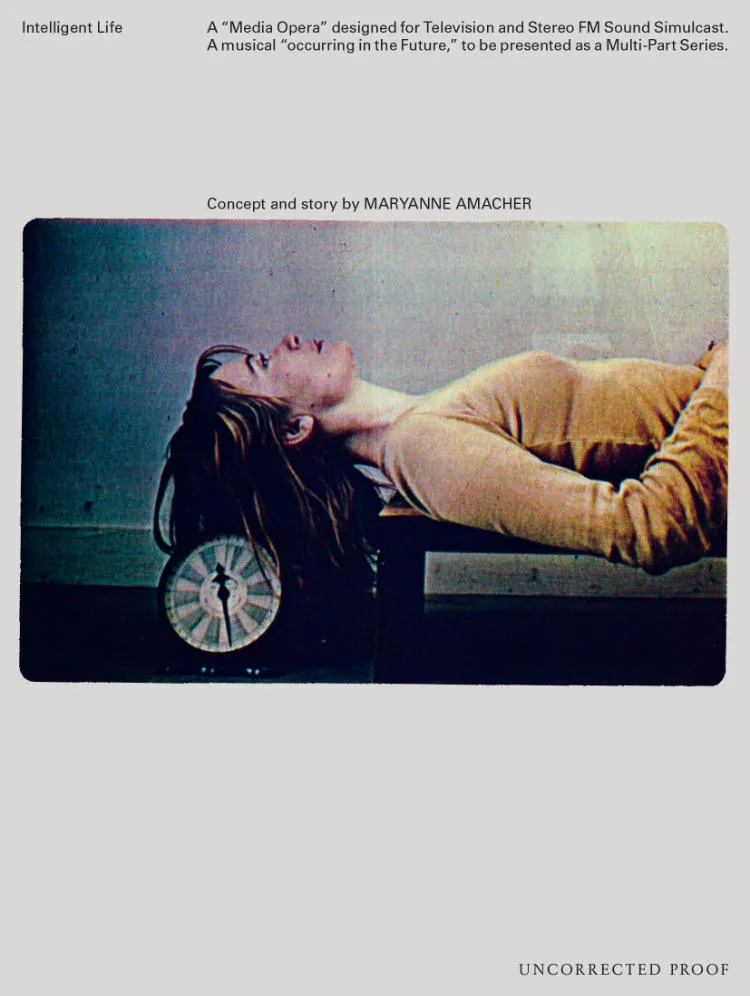
Intelligent Life
Comprehensive and previously unpublished documentation on the American composer's unproduced magnum opus.
Had it been produced, Maryanne Amacher's media opera Intelligent Life would have represented the summation of the composer's concept to date. As she wrote to John Cage in the autumn of 1983, following the untimely deaths of the opera's patrons—Wies Smals, founder of De Appel, and curator Josine van Droffelaar, in a plane crash in the Swiss Alps—she would have at last had the support to "communicate the finest of my thought to others." Amacher's serial, intended for broadcast, sought to transmit her evolving ideas about perception, listening, and composition to a broader public—shifting music away from "nod and tap recognition" toward a transformative practice that could awaken intelligence to "unrecognized and new perceptual modes."
Set in the year 2021, Intelligent Life follows the employees of Supreme Connections LLC, a music entertainment corporation navigating a future in which artificial intelligence generates music faster than composers can. Anticipating an industry-wide downturn, Supreme Connections president Aplisa Kandel seeks advanced technologies that will revolutionize the act of listening and the future of music, including a bio-music script that lets the user hear Bach from the aural perspective of a reindeer and a wearable device that goes beyond replicating the mechanical tympanic resonances of the listening subject to produce the "listening mind" or the "sophisticated perceiver"—capturing and reproducing all the emotional and psychological associations unique to each individual.
Though Amacher could not realize Intelligent Life in any of its intended forms—she theorized its publication as a serialized radio broadcast and television simulcast, among other configurations—she continued designing "treatments" for the opera for much of her career. This volume makes the most complete of these working documents—including episodic scripts, notes on the use of LaserDisc, and an illustrated storyboard for the pilot—available to the public for the first time.
Maryanne Amacher (1938-2009) was a composer of large-scale fixed-duration sound installations and a highly original thinker in the areas of perception, sound spatialization, creative intelligence, and aural architecture. She is frequently cited as a pioneer of what has come to be called “sound art,” although her thought and creative practice consistently challenges key assumptions about the capacities and limitations of that genre. Often considered to be a part of a post-Cagean lineage, her work anticipates some of the most important developments in network culture, media arts, acoustic ecology, and sound studies.

Painting Photographs
TBW Books is pleased to announce the publication of Painting Photographs, a new book by Creative Growth Art Center artist Alice Wong. Wong's bold interpretation of vintage vernacular photographs breathes new life into family album kitsch and cliché shots of plants and landscapes, transforming them into a hyper-color plane of vivid abstraction. Using paint markers to enhance and obscure the formal qualities of appropriated imagery, Wong's hand brings energy to each underlying image, recalibrating the viewer's eye and sparking appreciation for otherwise still compositions. With fluid mark-making and a striking approach to color-blocking, Wong's craft merges with the photographic process to create work that feels at once of times past and completely contemporary.
Creative Growth Art Center is the oldest and largest nonprofit art studio for artists with developmental disabilities in the United States. Since 1974, Creative Growth has played a significant role in increasing public interest in the artistic capabilities and achievements of people with disabilities, providing a professional studio environment for artistic development, gallery exhibition and representation.

Shakespeare and Ethics
Shakespeare’s plays are full of philosophical ideas, but they are rarely examined systematically. In this pamphlet philosopher Colin McGinn analyzes the plays to distill Shakespeare’s ideas about ethics. McGinn concludes that the “plays are about good and evil,” and that Shakespeare is “a great moral psychologist,” who expertly stages how his characters are defined by their moral qualities (their naturalistic virtues and vices).

Grand Rapids
Installed alongside the Grand River in downtown Grand Rapids, Michigan, Alexander Calder’s public sculpture La Grande Vitesse has come to symbolize the city. Tess moves there from Ypsilanti, Michigan in 2001—the same year that her mother dies, when everything begins to move, for her, in slow motion. Thrust into adolescence nearly rudderless, fifteen-year-old Tess is intoxicated, angsty, and sexually awake. A decade later, inspired by diary entries and TV reruns, she remembers this summer in the suburbs as the one that redefined her. Its echoes of death are frozen in time like the waves represented in the Calder sculpture or the concrete steps leading down to the churning river. She comes to see Grand Rapids as a collection of architecture and emblems, another home to which she cannot return.
Natasha Stagg is the author of Sleeveless: Fashion, Image, Media, New York 2011–2019 and Surveys: A Novel, both published by Semiotext(e). Her work has appeared in Artforum, Bookforum, Texte Zur Kunst, n+1, Spike Art, Flash Art, Dazed, V, Vice, 032c, and other publications.