rile*books

Search books

Search books by title, author, publisher, keywords...

Cover of Celebrating the Michigan Womyn's Music Festival

Sinister Wisdom

Celebrating the Michigan Womyn's Music Festival

Sinister Wisdom

€10.00

Sinister Wisdom 103: Celebrating the Michigan Womyn's Music Festival honors the forty-year legacy of the Michigan Womyn’s Music Festival (1976–2015). Sinister Wisdom 103: Celebrating the Michigan Womyn's Music Festival celebrates this embodiment of radical feminist separatist collaboration, transformational self-defined autonomous spaces, a commitment to sisterhood and matriarchal culture, and a musical city sprung from the earth for one week in the woods.

A collective of five womyn each with a deep connection to Fest operated by consensus to create this issue. Striving to represent a range of womyn’s voices, values, traditions, and experiences of Fest, the collective highlighted what Fest has meant to generations of womyn, documented its chronology, and bore witness to the power of this community. Sinister Wisdom 103: Celebrating the Michigan Womyn's Music Festival includes womyn from multiple races, geographies, sexualities, generations, and gender and other social identities. Just as Fest brought together womyn from various backgrounds, our collection includes a range of artistic experience, from seasoned authors and photographers to those womyn new to publishing.
Sinister Wisdom 103: Celebrating the Michigan Womyn's Music Festival remembers the transformations, possibilities, and hopes for spaces cultivating the ongoing empowerment of womyn.
Language: English

recommendations

Cover of Sister Love: The Letters of Audre Lorde and Pat Parker 1974-1989

Sinister Wisdom

Sister Love: The Letters of Audre Lorde and Pat Parker 1974-1989

Julie R. Enszer

Poets Audre Lorde and Pat Parker first met in 1969; they began exchanging letters regularly five years later. Over the next fifteen years, Lorde and Parker shared ideas, advice, and confidences through the mail. They sent each other handwritten and typewritten letters and postcards often with inserted items including articles, money, and video tapes.

Sister Love: The Letters of Audre Lorde and Pat Parker 1974-1989 gathers this correspondence for readers to eavesdrop on Lorde and Parker. They discuss their work as writers as well as intimate details of their lives, including periods when each lived with cancer. Sister Love is a rare opportunity to glimpse inside the minds and friendship of two great twentieth century poets.

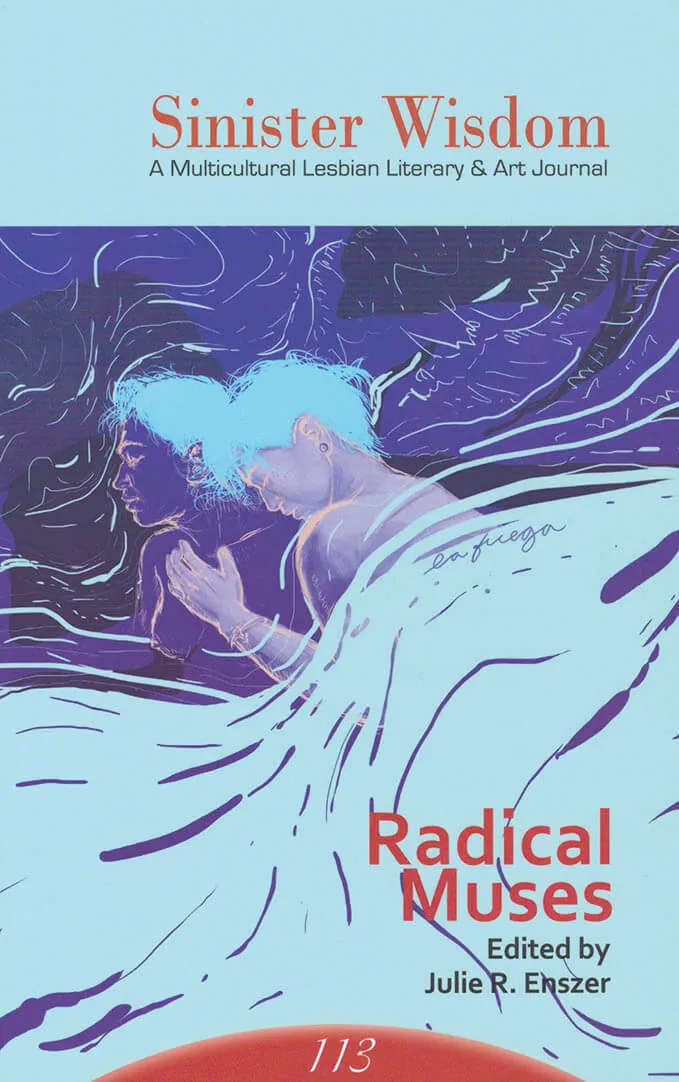
Cover of Radical Muses (Sinister Wisdom nr. 113)

Sinister Wisdom

Radical Muses (Sinister Wisdom nr. 113)

Julie R. Enszer

Sinister Wisdom 113: Radical Muses features an eclectic array of contemporary poetry, prose, and art by lesbians from around the world, including new work by: Andrea Assaf, Tara Shea Burke, Cheryl Clarke, Marina Chirkova, Estela González, Barbara Haas, Nancy E. Lake, Vi Khi Nao, H. Ní Aódagaín and much more!

Cover of The Lip Anthology: An Australian Feminist Arts Journal 1976–1984

Kunstverein Amsterdam

The Lip Anthology: An Australian Feminist Arts Journal 1976–1984

Vivian Ziherl

Lip Magazine was self-published by women in Melbourne from 1976 to 1984 and stood as a lightning rod for Australian feminist artistic practice throughout the Women’s Liberation era. The art and ideas expressed over Lip’s lifetime track groundbreaking moves in performance, ecology, social-engagement and labour politics—all at an intersection with local realities. Collecting and presenting the materials of Lip for the first time since their original appearance, The Lip Anthology, edited by Vivian Ziherl, privileges the range and dynamism of contesting feminisms that comprised the Lip project.

Designed by: Marc Hollenstein

Cover of Le Chauffage — Issue #1

Le Chauffage

Le Chauffage — Issue #1

Emile Rubino, Felix Rapp

Periodicals €20.00

Le Chauffage (french for “The Heater”) is an artist-run publication based in Brussels. It is conceived as a cross-continental, community oriented platform. Bringing together the work and writing of artists / friends from different cities, Le Chauffage intends to spark discussions and fuel casual forms of critical discourse.

Cover of Fanzine Grrrls

Monsa

Fanzine Grrrls

Gemma Villegas

Zines €32.00

Making a fanzine is an act of rebellion, even more so if it is published and produced by a woman. The grrrls of today use them to inspire countless young people around the world, to take control of their lives and to create their own culture. These homemade publications are a quick and cheap way to spread their ideas and dismantle the usual stereotypes. Traditionally hand-drawn, photocopied, and stapled together, the format of fanzines are now as diverse as their subject matter, with online platforms and social networks fast becoming the norm. The fanzine is more alive than ever!

Gemma Villegas runs her graphic design studio based from Barcelona. She works in close dialog with commissioners and collaborators on a broad range of projects, including visual identities, exhibitions, publications, and digital platforms, overseeing the creative process during all the phases of a project. Her work is characterized by a fresh and powerful visual language focused on detail with special attention to typography.

Cover of Sore 2

cover crop

Sore 2

Lisa Lagova, Mathilde Heuliez

Periodicals €15.00

Sore is a serial anthology that brings together authors whose writing practices oscillate between the genres of diary keeping and fiction. For the second issue of Sore, ten contributors – both authors and visual artists – were invited to collectively develop their work through a series of informal critiques over the course of five months.

In the first issue of Sore, observations of everyday life intertwined with memories and cultural references to denote the significance of a certain soreness we each carry within us as we negotiate the various challenges of social existence. In this second ensemble, seven new authors widen our understanding of the term ‘sore’ by underlining a need to orient one’s gaze towards what’s hidden underneath, to enter the anatomy of all these necessary contortions and u-turns one performs in order to escape the grip of expected compliance.

With contributions from: Mathilde Heuliez, Lisa Lagova, Muyeong Kim, Nour Ben Saïd, Masha Ryabova, Adrienne Chung, Richard Dmitri Hees, Oscar Le Merle, Morra Kozlitina, Tindra Eliason, Helmer Stuyt, Ilya Stasevich, Kristina Stallvik.

Published by cover crop, Mathilde Heuliez & Lisa Lagova.

Cover of Parapraxis 06: Resistance

Parapraxis

Parapraxis 06: Resistance

Periodicals €25.00

In 1911, Sigmund Freud addressed his followers gathered at Nuremberg, where he restated the import of his practice: “the task of psychoanalysis lies not at all in the discovering of complexes, but in the dissolving of resistances.” A formal antipode to political resistance, psychoanalytic resistance dams up desire and obstructs traumatic knowledge. It is conservative, allergic to change, and aims for the kind of frictionless normativity against which the unconscious drives rail. Meanwhile, we associate political resistance with change itself, with a blockade that pushes for revolution—rather than a blockage that censors its very possibility. If we read Freud as urging his followers to help their patients move through their resistance, psychoanalysis is a project on the side of material and political reality by bringing patients out of isolation and into social struggles. However, psychoanalysis is often glossed in reverse: as a project of isolated relief for the stubborn individual.

Should psychoanalysis only succeed at rendering patients compliant in their cure? Is psychoanalysis a tool for nullifying political resistance? If so, Freud’s edict for the aim of psychoanalysis is now but an epitaph. It would be easy, then, to give up the ghost, to let psychoanalysis go. But why should psychoanalysis retreat from collective symptoms back into the consulting room for individual treatment—away from strikes, riots, and uprisings, and toward complacency and normativity, if not quite literally marriage and babies? Why should the clinic not dare to be in and of the world?

Feeling restless. Hunger tactics. Laughing in the face of fascism. Breaking through. Diagnosing revolution. Madness in the Maghreb. Essays by Fady Joudah, Jamieson Webster, Dylan Saba, Yasmin El-Rifae, Ussama Makdisi, Mary Turfah, Hannah Proctor, and more.

In Memory of Joshua Clover (1962-2025).