rile*books

Search books

Search books by title, author, publisher, keywords...

Explore

Categories
Visit
Collections
Publishers
Back in stock
Any books
Cover of Sister Love: The Letters of Audre Lorde and Pat Parker 1974-1989

Sinister Wisdom

Sister Love: The Letters of Audre Lorde and Pat Parker 1974-1989

Julie R. Enszer ed.

€16.00

Poets Audre Lorde and Pat Parker first met in 1969; they began exchanging letters regularly five years later. Over the next fifteen years, Lorde and Parker shared ideas, advice, and confidences through the mail. They sent each other handwritten and typewritten letters and postcards often with inserted items including articles, money, and video tapes.

Sister Love: The Letters of Audre Lorde and Pat Parker 1974-1989 gathers this correspondence for readers to eavesdrop on Lorde and Parker. They discuss their work as writers as well as intimate details of their lives, including periods when each lived with cancer. Sister Love is a rare opportunity to glimpse inside the minds and friendship of two great twentieth century poets.

Language: English

recommendations

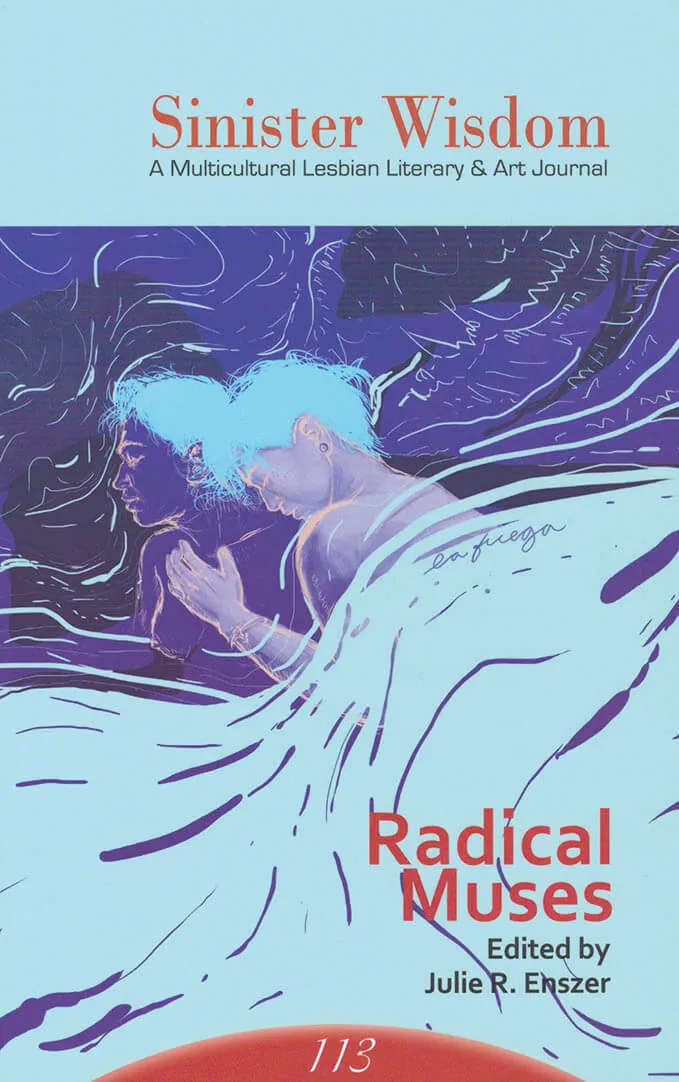
Cover of Radical Muses (Sinister Wisdom nr. 113)

Sinister Wisdom

Radical Muses (Sinister Wisdom nr. 113)

Julie R. Enszer

Sinister Wisdom 113: Radical Muses features an eclectic array of contemporary poetry, prose, and art by lesbians from around the world, including new work by: Andrea Assaf, Tara Shea Burke, Cheryl Clarke, Marina Chirkova, Estela González, Barbara Haas, Nancy E. Lake, Vi Khi Nao, H. Ní Aódagaín and much more!

Cover of Celebrating the Michigan Womyn's Music Festival

Sinister Wisdom

Celebrating the Michigan Womyn's Music Festival

Sinister Wisdom

Sinister Wisdom 103: Celebrating the Michigan Womyn's Music Festival honors the forty-year legacy of the Michigan Womyn’s Music Festival (1976–2015). Sinister Wisdom 103: Celebrating the Michigan Womyn's Music Festival celebrates this embodiment of radical feminist separatist collaboration, transformational self-defined autonomous spaces, a commitment to sisterhood and matriarchal culture, and a musical city sprung from the earth for one week in the woods.

A collective of five womyn each with a deep connection to Fest operated by consensus to create this issue. Striving to represent a range of womyn’s voices, values, traditions, and experiences of Fest, the collective highlighted what Fest has meant to generations of womyn, documented its chronology, and bore witness to the power of this community. Sinister Wisdom 103: Celebrating the Michigan Womyn's Music Festival includes womyn from multiple races, geographies, sexualities, generations, and gender and other social identities. Just as Fest brought together womyn from various backgrounds, our collection includes a range of artistic experience, from seasoned authors and photographers to those womyn new to publishing.
Sinister Wisdom 103: Celebrating the Michigan Womyn's Music Festival remembers the transformations, possibilities, and hopes for spaces cultivating the ongoing empowerment of womyn.

Cover of The Letters of Audre Lorde and Pat Parker 1974-1989

the87press

The Letters of Audre Lorde and Pat Parker 1974-1989

Julie R. Enszer

Poets Audre Lorde and Pat Parker first met in 1969; they began exchanging letters regularly five years later. Over the next fifteen years, Lorde and Parker shared ideas, advice, and confidence through the mail. They sent each other handwritten and typewritten letters and postcards often with inserted items including articles, money, and videotapes.

The Letters of Audre Lorde and Pat Parker 1974-1989 gathers this unique correspondence in which Lorde and Parker discuss their work as writers as well as the intimate details of their lives, including periods when each lived with cancer. These letters are a rare opportunity to glimpse inside the minds and friendship of two great twentieth century poets.

Introduction by Mecca Jamilah Sullivan.

Cover of Selected Poems

the87press

Selected Poems

Pat Parker, SaraEllen Strongman

Poetry €20.00

'Her Black Woman’s voice rings true and deep and gentle, with an iron echo. It is merciless and vulnerable and far ranging.' —Audre Lorde

Alongside her invaluable contributions to social justice, Pat Parker (1944-1989) wrote five collections of poetry during her lifetime and is widely recognised as one of the leading African-American, lesbian-feminist voices of the 20th Century.

Selected Poems collects her most loved works into an accessible volume, introducing new readers to Parker's fire for justice, tenderness, and vision for the world.

This is the first time Pat Parker's poetry has been published in the United Kingdom.

Readers interested in Pat Parker’s life may also enjoy The Letters of Audre Lorde and Pat Parker 1974–1989, an archival work documenting their intimate friendship and important work as activist-poets.

Cover of After Sex

Silver Press

After Sex

Alice Spawls, Edna Bonhomme

Essays €18.00

Who decides what happens after sex? The last decade has seen many significant changes to the laws governing women’s reproductive rights around the world, from liberalisation in Ireland to new restrictions in the USA. After Sex offers personal and political perspectives from the mid-20th century to the present day, setting feminist classics alongside contemporary accounts. These essays, short stories and poems trace the debates and tell the stories; together, they ask us to consider what reproductive justice might look like, and how it could reshape sex.

The writers pay special attention to people — both fictional and real — who have sought control over their sexual lives, and the joy, comedy, difficulties and disappointments that entails. But above all, After Sex testifies to the power of great writing to show us why that freedom is worth pursuing — without shame and without apology.

With contributions from: 
Lauren Berlant, Joanna Biggs, Edna Bonhomme, Gwendolyn Brooks, Beverley Bryan, Stella Dadzie and Suzanne Scafe, Storm Cecile, Lucille Clifton, Rachel Connolly, T.L. Cowan, ’Jane Does’, Maggie Doherty, Nell Dunn, Andrea Dworkin, Anne Enright, Deborah Friedell, Tracy Fuad, Kristen Ghodsee, Vivian Gornick, Donna Haraway, bell hooks, Barbara Johnson, Jayne Kavanagh, Lisa Hallgarten and Angela Poulter, Jamaica Kincaid, Patricia Knight, R.O. Kwon, Ursula K. Le Guin, Natasha Lennard, Sophie Lewis, Audre Lorde, Amelia Loulli, Erin Maglaque, Holly Pester, Adrienne Rich, Denise Riley, Sally Rooney, Loretta J. Ross, Madeleine Schwartz, SisterSong, Sophie Smith, Annabel Sowemimo, Amia Srinivasan, Keeanga-Yamahtta Taylor, Judith Jarvis Thomson, Alice Walker and Bernard Williams.

Cover of The Gloria Anzaldúa Reader

Duke University Press

The Gloria Anzaldúa Reader

Gloria Anzaldua, AnaLouise Keating

A collection of published and unpublished writings of the groundbreaking Chicana writer and self-described "chicana dyke-feminist, tejana patlache poet, writer and cultural theorist" Gloria Anzaldua.

Gloria Anzaldúa (1942-2004) was a visionary writer whose work was recognized with many honors, including the Before Columbus Foundation American Book Award, a Lambda literary award, the National Endowment for the Arts Fiction Award, and the Bode-Pearson Prize for Outstanding Contributions to American Studies. Her book Borderlands/La frontera was selected as one of the 100 Best Books of the Century by Hungry Mind Review and the Utne Reader. AnaLouise Keating, Professor of Women's Studies at Texas Woman's University, is the author of Women Reading, Women Writing: Self-Invention in Paula Gunn Allen, Gloria Anzaldúa, and Audre Lorde; editor of Anzaldúa's Interviews/Entrevistas and EntreMundos/AmongWorlds: New Perspectives on Gloria Anzaldúa; and co-editor, with Anzaldúa, of this bridge we call home: radical visions for transformation.

AnaLouise Keating, Professor of Women's Studies at Texas Woman's University, is the author of Women Reading, Women Writing: Self-Invention in Paula Gunn Allen, Gloria Anzaldúa, and Audre Lorde; editor of Anzaldúa's Interviews/Entrevistas and EntreMundos/AmongWorlds: New Perspectives on Gloria Anzaldúa; and co-editor, with Anzaldúa, of this bridge we call home: radical visions for transformation.

Cover of Superior and Inferior

Crackers

Superior and Inferior

Carla Accardi

Superior and Inferior presents a facsimile reprint of Italian abstract artist and feminist Carla Accardi's provocatory publication Superiore e Inferiore and the first ever English translation of the full text.

"In this book, I have bought together the transcripts of dialogues I recorded on tape in three girls' classes from the first, second and third year of a state middle school. For having proposed this unauthorised activity, I was dismissed from teaching in the light of a formal complaint". – Carla Accardi introducing her book Superiore e Inferiore, 1972.

First published in 1972 by Carla Accardi, the book Superiore e Inferiore features discussions among girls at a middle school—all between 10 and 13—about society's discriminatory behaviour towards women. They also commented the Manifesto of the revolutionary feminist group Rivolta Femminile—collectively written by Accardi, art critic and feminist activist Carla Lonzi, and Elvira Banotti—which first appeared posted on city walls in Rome in July 1970. For having discussed sex-related issues with pupils, Accardi was fired and permanently suspended from teaching. (Her letter of dismissal issued by the Italian Ministry of Education forms part of the introduction to the book.) Along the lines of Pasolini's Comizi d'Amore (Love Meetings), Accardi's own voice is secondary in the book, giving way to the thoughts, narratives, opinions, and debates expressed among girls on the role of women and girls, family conflicts and intimate relations.

Carla Accardi (1924–2014) was an Italian abstract painter associated with the Arte Informale and Arte Povera movements, and a founding member of the Italian art groups Forma (1947) and Continuità (1961). She experimented with different forms of art, such as black and white painting and Sicofoil. During the late 1970s, she became part of the feminist movement with critic Carla Lonzi. Together, they founded Rivolta femminile in 1970, one of Italy's first feminist groups. Accardi's first solo exhibition in the United States was in 2001 at MoMA PS1.

Cover of Up Your Ass

Sternberg Press

Up Your Ass

Valerie Solanas

Fiction €12.00

Valerie Solanas's rarely published, legendary play, Up Your Ass, explodes social and sexual mores and the hypocritical, patriarchal culture that produces them through her signature irreverence and wit, incisiveness and camp.

The play, whose full title is Up Your Ass Or From the Cradle to the Boat Or The Big Suck Or Up from the Slime, marches out a cast of screwy stereotypes: the unknowing john, the frothy career girl, the boring male narcissist, two catty drag queens, the sex-depraved housewife, and a pair of racialized pickup artists, among others. At the center is protagonist Bongi Perez—a thinly veiled Solanas—a sardonic, gender-bending hustler who escorts us through the back alleys of her street life. The fictionalized predecessor to SCUM Manifesto, the play shares the same grand, subversive, implicative language, equally spitting and winking, embracing the margins, the scum, and selling a trick along the way.

Valerie Solanas (1936-1988) is an American radical feminist intellectual, known for her SCUM Manifesto—a pamphlet with which she declares the power of women and imagines a political future through the margin—, and for having tried to assassinate Andy Warhol.

Edited by Leah Whitman-Salkin.
With a contribution by Paul B. Preciado.
Graphic design: Roxanne Maillet.

Cover of Theory, A Sunday

Belladonna* Collaborative

Theory, A Sunday

Louky Bersianik, Nicole Brossard and 4 more

Collectively authored by Louky Bersianik, Nicole Brossard, France Théoret, Gail Scott, Louise Cotnoir, Louise Dupré, Lisa Robertson, and Rachel Levitsky. Twenty-five years after its first French language publication, Theory, A Sunday (2013), a collaborative feminist poetics text, marks the first in Belladonna’s new Germinal Texts series. Written through Sunday meetings in Montreal, this volume gathers six women’s theoretical feminist texts, with a new introduction by Lisa Robertson and afterword by Gail Scott and Rachel Levitsky. Translators of this text include Erica Weitzman, Luise von Flotow, Popahna Brandes, and Nicole Peyrafitte.

Germinal Texts trace feminist avant-garde histories and the poetic lineages they produce. Focused on authors and texts that provide generative grounds for other writers and their work, Germinal Texts gesture to networks of affiliation, whether explicit or subterranean; to kinships and inheritances; to the unfolding of a text through its readership; and to always provisional origins without endings. Germinal Texts are works that gather dense histories and, for this reason, the series is designed to hold a space for critical discussion, with contextualizing front and back matter that launches new conversations.

Louky Bersianik (1930-2011) is the author of twelve books of poetry and prose. Essayist, novelist and poet, her much admired novel L’Eugélionne is considered Québec’s first feminist novel (translated by Howard Scott as The Eugélionne (1996). Her novel Permafrost, 1937-38, won the Governor General’s award in 1997. Louky was born in Montréal and studied at Université de Montréal, the Sorbonne, and Centre d’études de radio et de television.

Nicole Brossard was born in Montréal. Poet, novelist and essayist, she has published more than forty books. Her work has been influential on a generation of poets and feminists. Her work has been widely acknowledged and translated in many languages. Her most recent book, translated into English by Erin Mouré and Robert Majzels, is WHITE PIANO (Coach House Books, 2013). Nicole Brossard lives in Montréal.

Louise Cotnoir has published seventeen books of poetry, fiction and drama. She was twice nominated for the Governor General’s Award for Poetry, most recently for Les îles (2005). Dis-moi que j’imagine was a finalist for the prestigious Académie des lettres du Québec poetry prize (1996). She has participated in numerous conferences on women and writing, notably “Women and Words” (Vancouver, 1983), “L’écriture des femmes au Québec” (Sweden, 1992), “L’originalité de l’écriture au féminin au Québec” (New Jersey, 1995). She has contributed to or served on the editorial boards of Sorcières (Paris), Estuaire, Arcade, Tessera, Matrix, Moebius, Room of One’s Own, Ellipse, Trivia (USA), Silencíada Festada Palabra (Barcelona), El Ciervo (Barcelona) and Cahiers internationaux du symbolisme (Brussels). Her work has been translated into English, Spanish, Catalan, Finnish and Chinese. Her last collection of poetry, Les soeurs de, appeared with Éditions du Noroît (2011), with a stage adaptation in Ottawa (2012) and Montréal (2013). Les îles, translated by Oana Avasilichioaei, appeared as The Islands in 2011. She lives in Montréal.

Poet, novelist and essayist, Louise Dupré has published twenty books. Her work has received numerous awards and has been translated in various languages. She has collaborated with artists of visual arts, cinema, video and dance. Her play Tout comme elle was produced on stage and directed by Brigitte Haentjens in Montréal in 2006 and in Toronto in 2011, during the Luminato Festival. Plus haut que les flammes won the Governor General’s Award for poetry as well as the Grand Prix du Festival international de la poésie de Trois- Rivières in 2011. She is a member of the Académie des lettres du Québec and the Royal Society of Canada. She was professor of creative writing and women’s writing in Université du Québec à Montréal for twenty years.

Gail Scott’s fourth novel, THE OBITUARY (Nightboat Books, 2012), was a finalist for the 2011 Montréal Book of the Year (Grand prix du livre de Montréal). Scott’s other experimental novels include My Paris (Dalkey Archive), HEROINE (Talonbooks, 1999), and Main Brides. She has published collections of essays, stories, manifestos, and collaborations with Robert Glück et al BITING THE ERROR (Coach House Books, 2004), shortlisted for a Lambda award (2005). Scott’s translation of Michael Delisle’s Le Déasarroi du matelot was a finalist for the Canadian Governor General’s award in translation. The Canadian journal Open Letter devoted its autumn 2012 edition to Scott’s work. She lives, mostly, in Montréal and teaches Creative Writing at Université de Montréal.

France Théoret is a Montreal poet, novelist and essayist. She holds a doctorate in French studies from the University of Sherbrooke, and taught literary studies from 1968 to 1987. She was a member of the editorial board of the journal La Barre du jour from 1967 to 1969, and is the author of one of the monologues in the 1976 theatre piece La Nef des sorcières. In that same year she co-founded the feminist journal Les Têtes de pioche and in 1979, the cultural magazine Spirale, which she directed from 1981 to 1984. She has published over twenty books and been nominated for many prizes. Most of her work has been translated into English. Her poetry is available in Italian, Spanish, and Portuguese and has appeared in anthologies in Quebec and abroad. In 2012, she was awarded the Athanase-David Prix du Québec for her entire oeuvre. She lives in Montreal.

Cover of MW Collected Texts (Bootleg)

Self-Published

MW Collected Texts (Bootleg)

Monique Wittig

This bootleg edition collects scanned copies of Monique Wittig's writing. It includes; The Lesbian Body, Les Guérillères, The Opoponax, and Lesbian Peoples: material for a dictionary— In true bootleg style, punk enough to carry the truly radical words of Wittig: scans, a little grainy, with marginalia of unknown origins. Now, we can dress ourselves in the ravishingly erotic, violent splendorous brilliance to become baby Wittigs.  

This edition was assembled out of a deep love of Wittig's work by Chloe Chignell.

Monique Wittig was a French author and feminist theorist particularly interested in overcoming gender and the heterosexual contract. She published her first novel, L'opoponax, in 1964. Her second novel, Les Guérillères (1969), was a landmark in lesbian feminism.

Cover of Orlando

Mariner Books

Orlando

Virginia Woolf

"Come, come! I'm sick to death of this particular self. I want another."

Virginia Woolf described "Orlando" as "an escapade, half-laughing, half-serious; with great splashes of exaggeration, " but many think Woolf's escapade is one of the most wickedly imaginative and sharply observed considerations of androgyny that this century will see.

Orlando is, in fact, a character liberated from the restraints of time and sex. Born in the Elizabethan Age to wealth and position, he is a young male aristocrat at the beginning of the story - and a modern woman four centuries later. The hero-heroine sees monarchs come and go, hobnobs with great literary figures, and slips in and out of each new fashion. Woolf presents a brilliant pageant of history, society, and literature as well as subtle appreciation of the interplay between endings and beginnings, past and present, male and female.

Virginia Woolf(1882-1941) was one of the major literary figures of the twentieth century. An admired literary critic, she authored many essays, letters, journals, and short stories in addition to her groundbreaking novels, including Mrs. Dalloway, To The Lighthouse, and Orlando.