rile*books

Search books

Search books by title, author, publisher, keywords...

Cover of The Highest Apple: Sappho and the Lesbian Poetic Tradition

Sinister Wisdom

The Highest Apple: Sappho and the Lesbian Poetic Tradition

Judy Grahn

€23.00

In 1985, Judy Grahn boldly declared that lesbians have a poetic tradition and mapped it from Sappho to the present day in the groundbreaking book, The Highest Apple. In this new and updated edition of The Highest Apple: Sappho and the Lesbian Poetic Tradition, Grahn revisits the original text with her characteristic ferocious intellect, passion for historical research, careful close readings, and dynamic storytelling. Grahn situates poetry by Sappho, Emily Dickinson, Amy Lowell, H.D., Gertrude Stein, Adrienne Rich Paula Gunn Allen, Audre Lorde, Pat Parker, and Olga Broumas as central to lesbian culture—and more radically as central to society as a whole.

This new edition of The Highest Apple: Sappho and the Lesbian Poetic Tradition includes Grahn’s in depth analysis of poetic work by her friend and comrade Pat Parker and suggests a transactional approach to poetry as uncovering layers of the self. Grahn assembled this text in conversation with two younger lesbian poets, Alicia Mountain and Alyse Knorr, demonstrating the continued relevance and dynamism of The Highest Apple for contemporary readers. A new introduction by Grahn, a foreword by Alyse Knorr, and editor notes by Alicia Mountain along with six responses by contemporary poets Donika Kelly, Kim Shuck, Serena Chopra, Zoe Tuck, Saretta Morgan, and Khadijah Queen highlight the on-going significance of The Highest Apple to readers, writers, and thinkers.

Published in 2023 ┊ 304 pages ┊ Language: English

recommendations

Cover of Celebrating the Michigan Womyn's Music Festival

Sinister Wisdom

Celebrating the Michigan Womyn's Music Festival

Sinister Wisdom

Sinister Wisdom 103: Celebrating the Michigan Womyn's Music Festival honors the forty-year legacy of the Michigan Womyn’s Music Festival (1976–2015). Sinister Wisdom 103: Celebrating the Michigan Womyn's Music Festival celebrates this embodiment of radical feminist separatist collaboration, transformational self-defined autonomous spaces, a commitment to sisterhood and matriarchal culture, and a musical city sprung from the earth for one week in the woods.

A collective of five womyn each with a deep connection to Fest operated by consensus to create this issue. Striving to represent a range of womyn’s voices, values, traditions, and experiences of Fest, the collective highlighted what Fest has meant to generations of womyn, documented its chronology, and bore witness to the power of this community. Sinister Wisdom 103: Celebrating the Michigan Womyn's Music Festival includes womyn from multiple races, geographies, sexualities, generations, and gender and other social identities. Just as Fest brought together womyn from various backgrounds, our collection includes a range of artistic experience, from seasoned authors and photographers to those womyn new to publishing.
Sinister Wisdom 103: Celebrating the Michigan Womyn's Music Festival remembers the transformations, possibilities, and hopes for spaces cultivating the ongoing empowerment of womyn.

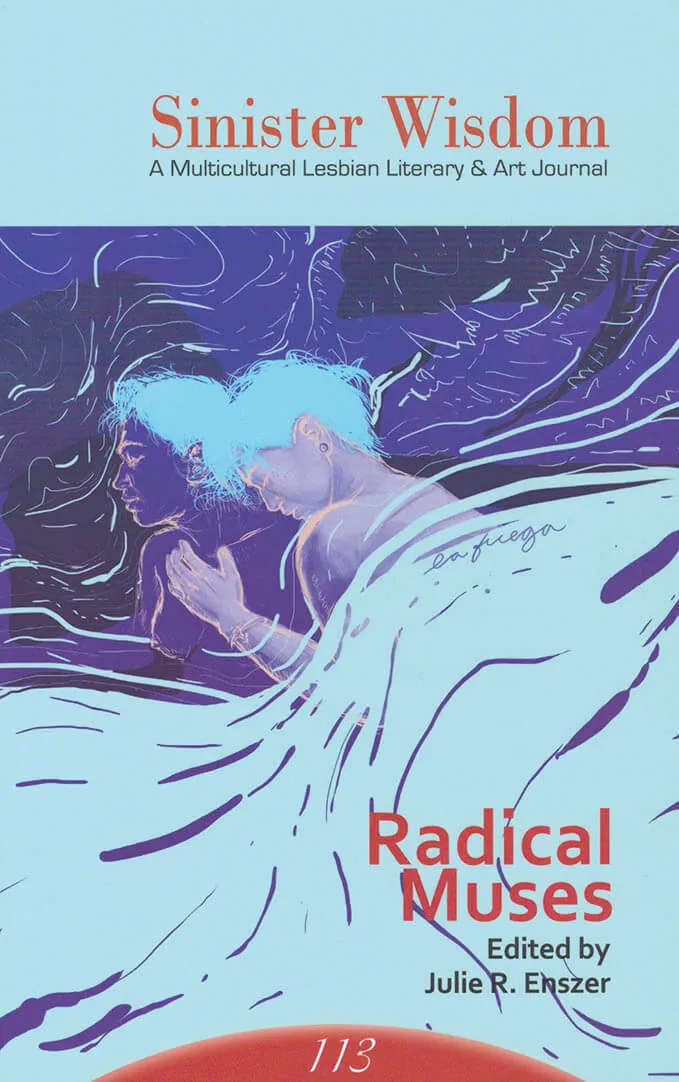
Cover of Radical Muses (Sinister Wisdom nr. 113)

Sinister Wisdom

Radical Muses (Sinister Wisdom nr. 113)

Julie R. Enszer

Sinister Wisdom 113: Radical Muses features an eclectic array of contemporary poetry, prose, and art by lesbians from around the world, including new work by: Andrea Assaf, Tara Shea Burke, Cheryl Clarke, Marina Chirkova, Estela González, Barbara Haas, Nancy E. Lake, Vi Khi Nao, H. Ní Aódagaín and much more!

Cover of Lost & Found: The CUNY Poetics Document Initiative, Series IV

CUNY Center for the Humanities

Lost & Found: The CUNY Poetics Document Initiative, Series IV

CUNY

From a never before seen manuscript of poems by Harlem Renaissance poet Helene Johnson to a treasure trove of Adrienne Rich's teaching materials from City College, this new series overturns all expectations. We have brought you facsimile reproductions and variorum editions, notes, storyboards, memos, screenplays, letters and of course, poetry from all around America. Building cultural history from the ground up, Series IV provides a completely different vantage point from which to further explore our literary heritage. LOST & FOUND: THE CUNY POETICS DOCUMENT INITIATIVE SERIES IV consists of eight beautifully printed chapbooks (600 pages in all), featuring rare and unpublished texts, including late work by Harlem Renaissance poet Helene Johnson, Adrienne Rich's teaching materials, a newly discovered film script by Edward Dorn, the formative correspondence of Pauline Kael & Robert Duncan, and a facsimile reproduction of Vincent Ferrini's 1946 Tidal Wave: Poems of the Great Strikes.

SERIES IV includes:

Edward Dorn: Abilene! Abilene! (Parts I & II) (ed. Kyle Waugh)

Vincent Ferrini: Before Gloucester (eds. Ammiel Alcalay & Kate Tarlow Morgan)

Helene Johnson: After the Harlem Renaissance (ed. Emily Rosamond Claman)

Pauline Kael & Robert Duncan: Selected Letters 1945-1946 (PARTS I & II) (ed. Bradley Lubin)

Adrienne Rich: Teaching at CUNY, 1968-1974 (Parts I & II) (eds. Iemanjá Brown, Stefania Heim, erica kaufman, Kristin Moriah, Conor Tomás Reed, Talia Shalev & Wendy Tronrud)

Cover of Slips of the Mind: Poetry as Forgetting

University of Chicago Press

Slips of the Mind: Poetry as Forgetting

Jennifer Soong

Poetry €30.00

An audacious account of what happens when forgetting becomes a way of writing and writing becomes a way of forgetting.  

In Slips of the Mind, poet and critic Jennifer Soong turns away from forgetting’s long-standing associations with suppression, privation, and error to argue that the absence or failure of memory has often functioned as a generative creative principle. Exploring forgetting not as the mere rejection of a literary past or a form of negative poetics, Soong puts to the test its very aesthetic meaning. What new structures, forms of desires, styles, and long and short feelings do lapses in time allow? What is oblivion’s relationship to composition? And how does the twentieth-century poet come to figure as the quintessential embodiment of such questions? 

Soong uncovers forgetting’s influence on Gertrude Stein, Lyn Hejinian, Tan Lin, Harryette Mullen, Lissa Wolsak, and New York School poets John Ashbery, James Schuyler, Bernadette Mayer, and Ted Berrigan, among others. She reveals that forgetting’s shapeshifting produces differences in poetic genre, interest, and degrees of intentionality—and that such malleability is part of forgetting’s nature. Most provocatively, Soong shows how losing track of things, leaving them behind, or finding them already gone resists overdetermination and causality in the name of surprise, as poets leverage forgetting in order to replace identity with style. Slips of the Mind is the kind of literary criticism that will reward all readers of modern and contemporary poetry.

Cover of The Lesbian Avenger Handbook

Homocom

The Lesbian Avenger Handbook

Sarah Schulman

LGBTQI+ €10.00

Launched in New York City, in 1992, the Lesbian Avengers rejected the picket line and ordinary demo for media-savvy, nonviolent direct action.

They were superheroes arriving "to make the world safe for baby dykes everywhere;" warriors with capes and shields doing a line dance; dykes "Lusting for Power," pushing a giant bed float down Sixth Avenue in New York (with lesbians on it); nationally-ambitious Avengers eating fire in front of a hostile White House; lovers reuniting a statue of Alice B. Toklas with Gertrude Stein, then waltzing in the snow in Bryant Park. And homos who shamelessly chanted, "Ten percent is not enough, recruit, recruit, recruit."

Originally published in 1993, Homocom edition 2021

Cover of The Lesbian Body

Winter Editions

The Lesbian Body

Monique Wittig

Non-fiction €22.00

In this genre- and gender-breaking work of theory-fiction, legendary writer and cofounder of the 1970s French feminist movement Monique Wittig celebrates the body—lesbian, literary and defiantly political—and challenges the order of heterosexuality in literature. 

First published in French in 1973, The Lesbian Body mines the relationship between a lover and a beloved—also a writer and a text—to explore the ideological and historical constructions of the female subject. Organized according to the principle of montage, poetic passages are juxtaposed with anatomic lists that mark lesbian eros. Through expressions of joy, violence, and tenderness, the site of pleasure is celebrated. In her transfiguration of gender and its paradigms, Wittig transformed French vocabulary, feminizing grammar and lesbianizing myths. This edition brings the English translation of Wittig’s groundbreaking work back into circulation for the first time since the mid-1980s, revised according to the author's notes, and with an introduction by Paul B. Preciado.

The Lesbian Body is a fundamental work of lesbian existence. Wittig's applied vision is a state of natural delirium, a revolutionary excess of utopianism, refusal, and mutual self-creation. Revisiting it reveals how much passionate free thought has been lost, and simultaneously, how many of her tropes and discoveries have integrated into our collective consciousness.” — Sarah Schulman

“In this stunning new rendering of The Lesbian Body by the French author, theorist, activist and teacher, the late Monique Wittig, we are plunged into an imagined world of passionate violence and erotic lesbian mayhem intertwined in strikingly bold poetic images. Wittig, in the reach and volatility of her imagination, stands alongside such important American writers as Audre Lorde, Adrienne Rich, and Valerie Solanas, all of whose work deserves to be read again, or for the first time.” — Esther Newton

“To read the book is to be forced by Wittig into another grammar and happily contaminated by its strange forms. You will never think straight again.” — Jack Halberstam

“For me, Wittig opened up a sense of the world that had been, quite literally, unimaginable. She tore us apart.” — Judith Butler

“Together with Ursula Le Guin and Samuel R. Delany, Wittig is the first to design a nonbinary utopia, a world in which the binary categorization of sexes and genders will have ceased to exist.” — Paul B. Preciado

Introduction by Paul B. Preciado
Translated by David Le Vay

Cover of Reynaldo Rivera

Semiotext(e)

Reynaldo Rivera

Lauren Mackler, Hedi El Kholti

Photography €35.00

Throughout the 1980s and 1990s, Reynaldo Rivera took personal photos of the Los Angeles that he lived in and knew: a world of cheap rent, house parties, subversive fashion, underground bands, and a handful of Latino gay and transvestite bars: Mugi’s, The Silverlake Lounge, and La Plaza. Most of these bars are long closed and many of the performers have died. But in Rivera’s photographs, these men and women live on in a silvery landscape of makeshift old-style cinematic glamour, a fabulous flight from unacceptable reality. 

As a teenager, Rivera took refuge in used bookstores and thrift stores, where he discovered old  photo books of Mexican film stars and the work of Lisette Model, Brassai, and Bresson. Inspired, he bought a camera and began  photographing people at his hotel. In 1981 he moved to Echo Park and began taking photos for the LA Weekly. 

This book is an ensemble of almost 200 images selected by Hedi El Kholti and Lauren Mackler spanning more than two decades in Los Angeles and Mexico. The  book also includes Luis Bauz’s story, “Tatiana,” about one of the  subjects of these photographs; a critical essay on Rivera’s work by Chris Kraus; and a novella-length conversation between Rivera and his  friend and contemporary Vaginal Davis about their lives, work, fantasies, and collective histories.

Edited by Hedi El Kholti and Lauren Mackler
With Luis Bauz, Vaginal Davis and Chris Kraus