Books
Books
in random order

The Nancy Reagan Collection
THE NANCY REAGAN COLLECTION is a response to growing up queer and trans under the rise of HIV-AIDS. Crossing genres and generations, this performance novel remixes the AIDS archive through an ever-spiraling politics and aesthetics of mourning. Alternating chapters offer up a narrative throughline composed of hallucinogenic episodes from the perspective of a nameless, grieving protagonist in the midst of the global carnage of the Reagan dynasty. Part revenge, part fantasy, the book experiments with poetic practices that challenge conceptions of memory and morality, activism and escapism, grief and beauty.
Maxe Crandall is a poet, playwright, and director. He is the author of the chapbooks Emoji for Cher Heart (Belladonna*, 2015) and Together Men Make Paradigms (Portable Press @ Yo-Yo Labs, 2014), and is the founder of the theater company Beautiful Moments in Popular Culture, which produces a poets theater series at the Stud in San Francisco. He has received fellowships from the Poetry Project, Poets House, Lambda Literary, and the Millay Colony for the Arts. Maxe is a lecturer in the Feminist, Gender, and Sexuality Studies Program at Stanford University.

Trans Girl Suicide Museum
One part ketamine spiral, one part confessional travelogue from the edge of gender, TGSM is a hallucinatory transmission on sex, identity, the internet, and the flickering wish not to exist in a given body at a given point in time. TGSM raises questions with which we have begun to negotiate broadly as a culture: what is actually happening to someone when they transition? how should we understand or describe such processes? what is the role of drugs, of hallucination, of imagination, in transition? is being a trans person in this moment in history, when the identity is ever more carefully traced [and tracked] by larger cultural forces, more liberated than before?
Drawing its source material from chance encounters, wordless interactions in basements or bathrooms or hotel rooms, to archives of 20th century critical theory, sleepover secrets exchanged between old friends, rhetorical barbs deployed in the classrooms of elite universities, arguments on the phone with your parents across timezones, the nonverbal codes of high and low fashion, and scribbled notes on the backs of receipts for medicines you don't know how they work, TGSM is a morbid yet strangely hopeful meditation on the possibilities and meanings of gender variation in our time.
Hannah Baer runs the meme account @malefragility on instagram, and studies clinical psychology in new york city.

The Secret History Of Kate Bush (And The Strange Art Of Pop)
The Secret History of Kate Bush, first published in 1982 as Kate was on the verge of superstardom, is a daring and unorthodox dive into the world of music, fame, and cultural obsession. Written by Fred Vermorel—a close associate of Malcolm McLaren and Vivienne Westwood, and renowned for his subversive "anti-biographies"—the book shatters the boundaries of traditional celebrity profiles. Told from the perspective of a die-hard fan, it unveils the mystique of one of pop’s most elusive icons while exposing the capitalist machinery driving the entertainment industry. Part biography, part cultural critique, and entirely provocative, this is not just a book about Kate Bush but a rebellious manifesto against the commodification of art.
Republished in 2022 by Le Gospel in France, this special edition goes even deeper with unpublished treasures from Vermorel’s personal archive. Featuring an exclusive interview with Kate’s father, Dr. Robert Bush, a razor-sharp foreword by novelist and musician Tony O’Neill (Digging the Vein), and Vermorel’s own afterword reflecting on his explosive work four decades later, this is a must-read for anyone fascinated by Kate Bush, the art of fandom, and the raw power of creative rebellion. Fred Vermorel is a pioneer of the in-depth study of celebrity and fan cultures, best known for his controversial "anti-biographies" of pop icons including the Sex Pistols, Kate Bush, Vivienne Westwood, and Kate Moss.

Mount Horeb Palestine
In 1962 at the age of 71, Joseph Elmer Yoakum (circa 1891–1972) reported having a dream that inspired him to draw. Thereafter the retired veteran began a daily practice and over the next 10 years produced some 2,000 works.
Yoakum was born into poverty, had very little schooling, and at an early age left home to join a circus. He wound up working with several circuses, traveling across the United States as well as abroad and becoming intimately familiar with the world's various landscapes. These experiences would provide the foundational memories that fueled his deeply spiritual vision decades later.
When he began to put that vision to paper in his apartment on Chicago's South Side in the early 1960s, Yoakum quickly developed a unique visual language, independent and distinct from other artists in the city, such as those involved in the flourishing Black Arts Movement or the up-and-coming Chicago Imagist group. His drawings—predominantly landscapes in ballpoint pen, colored pencil, pastel, and watercolor and inscribed with locations from all seven continents—reflect the scope of his national and international travels as well as his idiosyncratic and poetic vision of the natural world.

CARA Center for Art, Research and Alliances
Art Notes, Art
Since the 1970s, Cynthia Hawkins has investigated the potentials of abstract painting. While often beginning a work or series with a predetermined concept or strategy, Hawkins’s process-oriented practice simultaneously embraces the improvisational to create a systemized space for her continually evolving vocabulary. From 1979 to 1981, important early years in the elaboration of her work, Hawkins documented these developments in a journal. A record of routine and the everyday, the journal also gathers sketches, notes for new and in-progress works, and responses to contemporary art and criticism, bringing the artist’s process, experimentation, and reflections on materials, formalism, abstraction, and figuration into relief.
Art Notes, Art also offers a picture of the burgeoning Black-owned gallery scene in 1970s and ‘80s New York that Hawkins was an important participant in—including Cinque Gallery, Kenkeleba Gallery, and Just Above Midtown, where she had her first solo exhibition in 1981–as well as the women artists’ circle she was an active member of, which hosted weekly shares, critiques, exchange, and amplification of each others’ work. An important glimpse into Hawkins’s creative process and artistic community, Art Notes, Art is richly illustrated with works by the artist produced during this key period–some of which are now lost–photographs and ephemera, and a visual archive of contemporaneous work by her peers.
Editor: Ananth Shastri
Managing Editor: Rachel Valinsky

Broken Villas
Written in response to three “physical” photographs, ‘Broken Villas’ contains and considers how a vessel might clasp tightly to known volumetric identities, but also loom with a set of accentuated clues towards otherness: the excavated seams in the earth and what we fill those holes with, imaginary or otherwise; the glacial erraticism of the boulder; the queer crimping of a hotel pillowcase; the modes via which objects are housed as display, but also packaged away, with sorrow, with fear, with erotism etc.

How To Wash A Heart
How To Wash A Heart, Kapil's first full-length collection published in the U.K., depicts the complex relations that emerge between an immigrant guest and a citizen host. Drawn from a first performance at the ICA in London in 2019, and using poetry as a mode of interrogation that is both rigorous, compassionate, surreal, comic, painful and tender, by turn, Kapil begins to ask difficult and urgent questions about the limits of inclusion, hospitality and care.
Winner of the T.S. Eliot Prize 2020.
Poetry Book Society Choice for Summer 2020.

Postcommodity, Alex Waterman and Ociciwan: “in memoriam…”
Ociciwan Contemporary Art Collective
Eighty-page programme book score, and libretto, for performances by Indigenous musicians of in memoriam…Mary Cecil,Victoria Callihoo (née Belcourt), and Eleanor (Helene) Thomas Garneau and Robert Ashley’s in memoriam... Curated and edited by Ociciwan Contemporary Art Collective.
[from back cover] …in memoriam Mary Cecil,Victoria Callihoo (née Belcourt), and Eleanor (Helene) Thomas Garneau adds a new score and production by Postcommodity and Alex Waterman to a suite of four early scores by the American composer Robert Ashley. The fifth score honours the lives of Mary Cecil, Victoria Callihoo (née Belcourt), and Eleanor (Helene) Thomas Garneau, three Indigenous women from territory at the turn of the Century as it became the province of Alberta. This significant addition continues Ashley’s project investigating the connections between musical forms and constructs of historicization, opening a conversation regarding whom and how we memorialize individuals and inscribe their legacies.
[from essay by Candice Hopkins] What histories are remembered and who is doing the remembering? What form do these rememberings take? It is not as simple as taking down one monument and replacing it with another. We need to ask more questions, take note of the voids that stand in for the past, and actively make way for other voices, particularly those are trapped under the ‘sea ice of English’. “Listen for sounds”, writes the Tlingit poet and anthropologist Nora Marks Dauenhauer, “They are as important as voices. Listen. Listen. Listen. Listen.”

Água Viva
In Água Viva Clarice Lispector aims to 'capture the present'. Her direct, confessional and unfiltered meditations on everything from life and time to perfume and sleep are strange and hypnotic in their emotional power and have been a huge influence on many artists and writers, including one Brazilian musician who read it one hundred and eleven times. Despite its apparent spontaneity, this is a masterly work of art, which rearranges language and plays in the gaps between reality and fiction.
Clarice Lispector (December 10, 1920 – December 9, 1977) was a Brazilian writer acclaimed internationally for her innovative novels and short stories. Born to a Jewish family in Podolia in Western Ukraine, as an infant she moved to Brazil with her family, amidst the disasters engulfing her native land following the First World War.

The Close Chaplet
Long out of print, The Close Chaplet is Laura Riding's first book, originally published in 1926. Riding deliberately ceased writing poems after 1940, when she came to see poetry as irrevocably flawed as a means of expression. These poems demonstrate Riding's early desire to depart from the close and well-tilled ground of traditional lyric poetry. According to her biographer, Elizabeth Friedman, many of the poems for THE CLOSE CHAPLET were brought in typescript from New York, a few were added in Egypt, and the entire text was carefully edited by Robert Graves.
In his introduction, Mark Jacobs writes that Riding was identifying herself with the pre-moment, the 'what-was-there' before Creation. How did the world, the universe, come to exist, why does it exist, why does it die, why do we? From these questions, Riding begins to develop a theory about the role of women as the origin of all human beings, the only animals with written language. This edition also includes Riding's essay A Prophecy or a Plea, a statement of her poetics initially published in 1926.
Laura Riding was a poet, novelist, short-story writer, essayist, and publisher. While primarily known for the critical works that she co-authored with Robert Graves — A Pamphlet Against Anthologies and A Survey of Modernist Poetry — Riding also left behind an incredibly powerful body of poetry and prose works that, regrettably, remain little read today. These include THE CLOSE CHAPLET (Ugly Duckling Press, 2020), EXPERTS ARE PUZZLED (Ugly Duckling Presse, 2018), CONVALESCENT CONVERSATIONS (Ugly Duckling Presse, 2018), The Lives of Wives, and The Progress of Stories. Famously rejecting poetry early in her career, she spent the last decades of her life co-writing a theoretical work on linguistics, Rational Meaning, with her husband Schuyler Jackson. She was awarded the Bollingen Prize in 1991, the very same year she died.

We Circle Through The Night and Are Consumed by Fire
Simon Asencio, Pauline Hatzigeorgiou
This publication acts as a postscriptum to the exhibition project Through The Valley of The Nest of Spiders by Simon Asencio for SB34—The Pool in Brussels. Dedicated to Samuel R. Delany's sci-fi and sexutopia novel, the exhibition was conceived as a process of annotating the book, expanding on the ethics discussed by the characters of the novel through installation, performative readings and with the complicity of other artists and their works. This devious object pursues such an intertextual process, extending and disseminating the writings forged by the exhibition.
Cette publication se présente comme le post-scriptum de l'exposition de Simon Asencio Through The Valley of The Nest of Spiders pour SB34—The Pool à Bruxelles. Dédiée au roman de science-fiction et de sexutopie de Samuel R. Delany dont elle porte le titre, l'exposition a été pensée comme un processus d'annotation de ce livre, développant les formes éthiques mises en pratique par les personnages du récit, à travers des installations, des lectures et situations performatives, avec la complicité d'autres artistes. Cet objet interlope poursuit ce processus intertextuel, en prolongeant et disséminant les écritures forgées par l'exposition.
With contributions by / avec les contributions de: Reinhold Aman, Henry Andersen, Simon Asencio, Jen Brodie, Chloe Chignell, Jack Cox, Samuel R. Delany, Diana Duta, Loucka Fiagan, gladys, Stefa Govaart, Sean Gurd, Pauline Hatzigeorgiou, Maxime Jean-Baptiste, Bernard-Marie Koltès, David J. Melnick, Matthieu Michaut, Margaret Miller, LaTasha N. Nevada Diggs, Anouchka Oler Nussbaum, Grisélidis Réal, Páola Revenióti, Sabrina Seifried, Raphaëlle Serres, Valerie Solanas, sabrina soyer, Megan Susman.

Manifestly Haraway
Electrifying, provocative, and controversial when first published thirty years ago, Donna Haraway's "Cyborg Manifesto" is even more relevant today, when the divisions that she so eloquently challenges—of human and machine but also of gender, class, race, ethnicity, sexuality, and location—are increasingly complex. The subsequent "Companion Species Manifesto," which further questions the human-nonhuman disjunction, is no less urgently needed in our time of environmental crisis and profound polarization.
Manifestly Haraway brings together these momentous manifestos to expose the continuity and ramifying force of Haraway's thought, whose significance emerges with engaging immediacy in a sustained conversation between the author and her long-term friend and colleague Cary Wolfe. Reading cyborgs and companion species through and with each other, Haraway and Wolfe join in a wide-ranging exchange on the history and meaning of the manifestos in the context of biopolitics, feminism, Marxism, human-nonhuman relationships, making kin, literary tropes, material semiotics, the negative way of knowing, secular Catholicism, and more.
The conversation ends by revealing the early stages of Haraway's "Chthulucene Manifesto," in tension with the teleologies of the doleful Anthropocene and the exterminationist Capitalocene. Deeply dedicated to a diverse and robust earthly flourishing, Manifestly Haraway promises to reignite needed discussion in and out of the academy about biologies, technologies, histories, and still possible futures.
Donna J. Haraway is distinguished professor emerita in the History of Consciousness Department at the University of California, Santa Cruz, where she is also affiliated with the departments of anthropology, feminist studies, environmental studies, and film and digital media. She is an active participant in UCSC's Science and Justice Research Center and the Center for Cultural Studies.
Published 2016

Mountainish
Zsuzsanna Gahse, Katy Derbyshire
A narrator and her dog are criss-crossing the Swiss Alps. She travels with friends who share her interest in food, languages and their topographical contexts. They collect colours, even look for colourlessness, and develop the idea of a walk-in diary, a vain attempt to archive their observations, encompassing portraits, descriptions and ruminations on mountains, hotels, people, language, food, flora and fauna.
Gradually, other mountains appear in their observations and memories, as do the mountains of literature and art. Mountains may be sites of fear and awe, of narrow-mindedness, racism and ever-looming collapse; Alpine lodges may be places of hospitality, retreat and unexpected encounters; of nature under threat.
In 515 notes, Zsuzsanna Gahse unfolds a finely woven interplay between her six characters while giving us a vivid panorama of mountain worlds, a multi-layered typology of all things mountainish.

Entropia Vol. 1 & 2
Entropia (vol. I & II) – written by William Kherbek and edited in collaboration with Jack Clarke – is a publication which seeks to recount and re-examine a decade of artistic curation, production, and critique between London, Berlin, and other urban art centres from 2010 to 2020.
Comprised of two volumes, this publication contains a compendium of over one hundred reviews and interviews with luminaries of contemporary art (Vol I), as well as a speculative attempt to create a newly generated algorithmic art(ificial) critic (Vol II). Together they serve to document, excoriate, and theorise an art world which is simultaneously hegemonic and precarious, complicit and constructive, driven by values, yet fed by extraction, all filtered through Kherbek’s precise, aphoristic, acerbic, lens.
The publications include contextual contributions from both Josie Thaddeus-Johns, writer for the New York Times, The Financial Times, Frieze; and Rozsa Farkas, director of London-based gallery Arcadia Missa.

Livre d'images sans images (LP)
Iben Edvardsen, Mette Edvardsen
Livre d’images sans images by Mette Edvardsen & Iben Edvardsen borrows its title from a book by H.C. Andersen, also referred to as The Moon Chronicler. The book follows a conversation between a painter and the Moon, where the Moon describes to the painter what she sees on her journey around the world every evening, telling the painter to paint what she describes. “This conversation, as in the now obsolete meaning of the word (‘a place where one lives or dwells’), was the starting point for our work. Using the weather report as dramaturgy, (‘the moon did not show up every evening, sometimes a cloud came in between’), we have created and collected materials from our conversations in the form of recordings, text, voice, drawings, references, found images, loose connections, inspirations and imaginations, in the order they came to us. They are at the same time sources and traces, material and support for new imaginations or events to come.” The work consists of three different media: vinyl, paper and live performance.
Mette Edvardsen is a choreographer and performer eager to explore the performing arts as a practice and situation, also in relation to other media such as books and writing. This work is in collaboration with her daughter, Iben Edvardsen.
Published by Xing & Varamo Press
XONG collection – artist records XX10 (2023)
First edition, September 2023
Recorded and edited by Mette Edvardsen & Iben Edvardsen
Format white 12’ vinyl LP in cardboard sleeve
Released in a numbered edition of 300 copies, including collector’s edition of 25 copies, each accompanied by a unique poster hand drawn with black marker by Mette Edvardsen & Iben Edvardsen, 59,4 x 84 cm, folded, signed by the artists

A Nazi Word for a Nazi Thing
An essay on art, bodies and fascism.
In an era where identity politics is being weaponised against the very people it has sought to make visible, how can we reclaim complexity?
In 1937 the Nazis staged an exhibition of seized modernist artworks. Named Entartete ‘Kunst’ – Degenerate ‘Art’ – it sought to define degeneracy, display it and destroy it.This act of violent appropriation is one episode in a long and ongoing history of the erasure of queer and non-normative cultures.
A Nazi Word for a Nazi Thing works against this erasure; it is a manifesto – a catalogue for an exhibition that could never take place. Drawing on work from dissident sexologist Magnus Hirschfeld to South African artist Zanele Muholi, as well as a century of queer cinema from Sergei Eisenstein to Pedro Almodóvar, So Mayer creates an archive of resistance.
‘This book is a small revolution that becomes a party that you won’t be leaving soon. I believe we’re living in a time of fresh erasures, systemic violences working that global pandemic to take some other bodies out. Looking so freshly at the history of queerness, sexual deviance and the long long coordinated erasures of colonialism, bigotry and transphobia the essential non binary nature of art opens up right here like the wildly singing flower it is and So Mayer’s compelling version makes sense, makes me listen.’
— Eileen Myles
‘A Nazi Word for a Nazi Thing is a reflective, creative walk through some of the worst – and best – people of the last hundred years, looking at the power of images and their relationship(s) with text. In a time of rising fascism, So Mayer highlights ways that artists have found strategies of resistance, and offers hope in historical analysis.’
— Juliet Jacques

The Brotherhood
Carolina Bianchi, Thomas Resendes
The Brotherhood fait suite à La Mariée et Bonne nuit Cendrillon qui avait provoqué une onde de choc lors de sa première à Avignon où Carolina Bianchi amenait des réflexions sur la performance et la théâtralité, sur un lit d'histoires de viols brutaux et de meurtres de femmes.
Dans ce deuxième chapitre de la Trilogie des chiennes, Carolina Bianchi se penche sur la complexité de certains « pactes de masculinité », notamment sur les origines de la fraternité entre les hommes, mettant en lumière les codes mutuels violents qui contribuent à normaliser et perpétuer le viol et la violence sexuelle à travers leur lexique. Carolina Bianchi utilise les principes du théâtre pour articuler des voies possibles à cette discussion, créant des liens forts entre la représentation et le traumatisme réel, les structures de pouvoir dans l'art et la poésie radicale, les origines de la misogynie et une sexualité en crise. La structure de cette réflexion se révèle être un piège, affaiblissant l'auteurité de Bianchi et la transformant en un personnage qui subit les conséquences d'avoir scruté cette « fraternité » de si près.
Texte portugais (Brésil) traduit par Thomas Resendes.
-
The Brotherhood follows La Mariée and Bonne nuit Cendrillon, which caused a shockwave when it premiered in Avignon, where Carolina Bianchi explored reflections on performance and theatricality against a backdrop of stories of brutal rapes and murders of women.
In this second chapter of the Trilogie des chiennes, Carolina Bianchi examines the complexity of certain “pacts of masculinity,” particularly the origins of male brotherhood, highlighting the violent codes of conduct that contribute to normalizing and perpetuating rape and sexual violence through their lexicon. Carolina Bianchi uses the principles of theater to articulate possible avenues for this discussion, creating strong links between representation and real trauma, power structures in art and radical poetry, the origins of misogyny, and a sexuality in crisis. The structure of this reflection turns out to be a trap, undermining Bianchi’s authority and transforming her into a character who suffers the consequences of having scrutinized this “brotherhood” so closely.
Translated by Thomas Resendes.

Aunonomic Reasoning
Precipitous philosophies. Synaptic-nerve narrations. Syntactic spirals. Hyper-coiled horizons. Will Alexander’s mental range has arrived. An anomalous scripting of the word “automatic,” Aunonomic Reasoning is a whirlwind of lingual torrents triggered by creative mishearing that at once exposes the occupations of orthodox surrealism, summons a voice for the scathed populace of imperial affliction, and forges new paths of phonetic potentiality to mend semantic injury. Pushing prosaic margins beyond their boundaries, these texts take on the etymological condition of the essay as “attempt” with iridescent siege, prepositional frenzy, paratactic provocation, noetic disreckoning, and a critical demand to dismantle: all of which signatures of Alexander’s unilateral poetic innovations.

Thievery and Songs
Publication accompanying the exhibition Gernot Wieland (08.02.-05.07.2020).
One can summarize Gernot Wieland and his work as an intertwining of the man, the artist, and the artwork. With Gernot, we experience in his artwork and in his presence more of a quiet, constant fascination with what is around him and what has affected or influenced or indeed shaped him sinde his childhood. These impressions - whether quirky memories or indeed tragic experiences and the non-stop grappliing with what has happened - arise in his artwork or in his conversation, whether directly or not. Alongside self-analysis and presentation through his artwork is an analysis of societal norms and indeed repressed aspects of society as it expresses itself, even violently, in hegemonic structures - in the classroom and upon children, for example. From his sketches or film narratives we catch a powerful glimpse upon a concentration of trauma, repression, and guilt placed upon his generation, an Austrian condition manifesting itself in obscene and absurd ways.
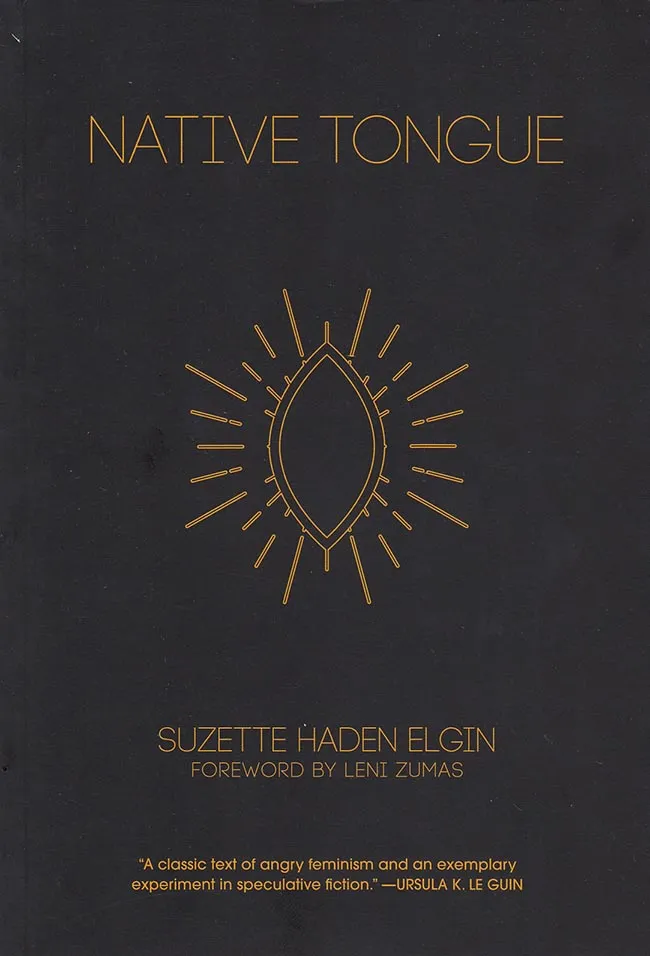
Native Tongue
Originally published in 1984, this classic dystopian trilogy is a testament to the power of language and women's collective action.
In 2205, the Nineteenth Amendment has long been repealed and women are only valued for their utility. The Earth's economy depends on an insular group of linguists who "breed" women to be perfect interstellar translators until they are sent to the Barren House to await death. But instead, these women are slowly creating a language of their own to make resistance possible. Ignorant to this brewing revolution, Nazareth, a brilliant linguist, and Michaela, a servant, both seek emancipation in their own ways. But their personal rebellions risk exposing the secret language, and threaten the possibility of freedom for all.

24 European Ethnographic Museums
With the series '24 European Ethnographic Museums' Van der Heide questions the construction and identity of the ethnographic museum today. Here, the project becomes a collection of artefacts in and upon itself and by recording the names of these institutions Van der Heide places the viewer in front of the dilemma: who is authorized to decide what is an artefact, and what should be collected and for what reason? In the 19th century, with the birth of the current European nations, museums openly referred to their colonial past. Today the museums bare more euphemistic names like: ‘Museum der Kulturen’ or ‘World Museum’ but still place the West as the self-acclaimed center of the world. The existence of the ethnographic museum, which is intertwined with the complicated and loaded colonial past, has been subject to contemporary criticism. While some of the European ethnographic institutions have attempted to come to terms with the past of their collections and their heritage, Van der Heide focuses upon how language continues to reflect the political present of the institutions.

Fair Arts Almanac 2019
In 2019 SOTA finished the first Fair Arts Almanac. The content of the book was generated during a week long summer camp in 2018 with about 70 contributors. The result was a bundling of tips & tricks, statements & demands, visions & ideas, dates & data, testimonies & voices, addresses & announcements on fairness within the complex relationships between the artistic, political and economic sphere. The compilation of various contributions in this first edition was deliberately associative and open for debate, full of contradictions, loose ends and inconsistencies.
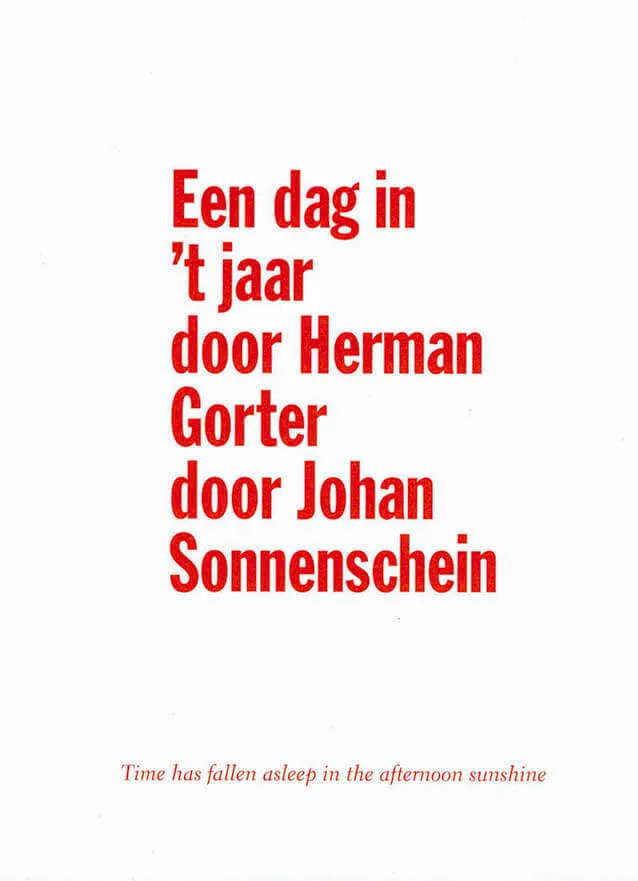
Time has fallen asleep in the afternoon sunshine
Een dag in 't jaar door Herman Gorter
For the project Time has fallen asleep in the afternoon sunshine a group of people/ performers memorize a book of their choice. Together they form a library collection consisting of living books. After years of learning by heart and reciting for readers, some of the books have now been written down from memory to create new editions, versions resulting from this process. This book is one of those books, chosen by one person, learned by heart and recited many times, and now written down again from memory. This edition is not a re-edition of the original text. It is a re-writing of the text after the process of reading, memorizing and reciting, with all the alterations that might have occured in the course of this process.

The Letters of Rosemary & Bernadette Mayer, 1976-1980
Bernadette Mayer, Rosemary Mayer
This collection of the correspondence between artist Rosemary Mayer (1943-2014) and poet Bernadette Mayer (born 1945) occurs between the years of 1976 and 1980, a period of rich creativity in New York's artistic avant-garde, and one which includes the development of major bodies of work by the two women.
Rosemary Mayer was creating sculptures, watercolors, books and temporary monuments from weather balloons and snow, while Bernadette Mayer was working on some of her best-known publications, including the book-length poem Midwinter Day and the poetry collection The Golden Book of Words.
Spanning the worlds of Conceptual art, Postminimalism, feminism, the New York School, Language poetry and more, these letters elucidate the bonds of sisterhood through intimate exchanges about art, relationships and everyday life.