Books
Books
in random order

ESDS Archives 3 : Pascal Doury - carnet inédit c.97-99
Facsimilé d'un carnet inédit de Pascal Doury réalisé par Jonas Delaborde (Der Vierte Pförtner Verlag) et co-produit par les Editions l'Amazone, réalisé dans le cadre de la publication des Archives Elles Sont de Sortie suite à la parution de Choquer le monde à mort. Elles Sont de sortie. Bruno Richard - Pascal Doury.

Nilling
NILLING: PROSE is a sequence of five loosely linked prose essays about noise, pornography, the codex, melancholy, Lucretius, folds, cities and related aporias: in short, these are essays on reading.
"I have tried to make a sketch or a model in several dimensions of the potency of Arendt's idea of invisibility, the necessary inconspicuousness of thinking and reading, and the ambivalently joyous and knotted agency to be found there. Just beneath the surface of the phonemes, a gendered name rhythmically explodes into a founding variousness. And then the strictures of the text assert again themselves. I want to claim for this inconspicuousness a transformational agency that runs counter to the teleology of readerly intention. Syllables might call to gods who do and don't exist. That is, they appear in the text's absences and densities as a motile graphic and phonemic force that abnegates its own necessity. Overwhelmingly in my submission to reading's supple snare, I feel love."

Affiliation
Mira Mattar, Judith Abensour and 1 more
Affiliation, de Mira Mattar, autrice londonienne issue de la diaspora palestinienne, explore des thèmes tels que le genre, la famille, la religion, la guerre, l’écologie, le colonialisme et l’amour, en lien avec des lieux comme la Jordanie, le Liban, la Palestine et le Royaume-Uni. Interrogeant nos affiliations personnelles et collectives, et la manière dont les systèmes de pouvoir influencent nos désirs et nos identités, le livre s’ouvre sur quatre Lettres d’Amman qui propulsent le texte poétique dans le mouvement du monde et attestent de la dynamique de l’exil palestinien, où l’éclatement, l’effacement et l’appropriation se mêlent avec les effets contemporains de la mondialisation.
La deuxième partie du livre, intitulée Affiliation (pour mon père) est un long poème rétrospectif qui court sur une trentaine de pages. L’écriture à la première personne de Mira Mattar met en tension des contextes politiques, domestiques, intimes, économiques où se déploient des affiliations coloniales, capitalistes, patriarcales, nationalistes. Elle en restitue les violents processus internes, passant du refus de se soumettre à l’impossible échappée. Dans Affiliation, on fait l’expérience d’être en dehors: en dehors de son corps, en dehors d’un pays, en dehors d’une pièce. Il n’y a aucune position stable, et le sujet se construit dans un éclatement constant. Peu de livres articulent aussi finement expérimentation formelle et nécessité de l’expression verbale. Affiliation est un flux de langage dont on peut sentir l’urgence à chaque vers.

Female Masculinity
In this quintessential work of queer theory, Jack Halberstam takes aim at the protected status of male masculinity and shows that female masculinity has offered a distinct alternative to it for well over two centuries. Demonstrating how female masculinity is not some bad imitation of virility, but a lively and dramatic staging of hybrid and minority genders, Halberstam catalogs the diversity of gender expressions among masculine women from nineteenth-century pre-lesbian practices to contemporary drag king performances.
Through detailed textual readings as well as empirical research, Halberstam uncovers a hidden history of female masculinities while arguing for a more nuanced understanding of gender categories that would incorporate rather than pathologize them. He rereads Anne Lister's diaries and Radclyffe Hall's The Well of Loneliness as foundational assertions of female masculine identity; considers the enigma of the stone butch and the politics surrounding butch/femme roles within lesbian communities; and explores issues of transsexuality among “transgender dykes”—lesbians who pass as men—and female-to-male transsexuals who may find the label of “lesbian” a temporary refuge. Halberstam also tackles such topics as women and boxing, butches in Hollywood and independent cinema, and the phenomenon of male impersonators.
Featuring a new preface by the author, this twentieth anniversary edition of Female Masculinity remains as insightful, timely, and necessary as ever.

Papillon de verre
Raphaëlle Milone's first novel, a dive into the heart of desires, acclaimed by Simon Liberati as well as by Jean-Luc Nancy.
Raphaëlle Milone (born 1991 in Riom) is a French writer.

Riverwork
Some ruins are invisible.
Under the pavements of Paris there lies buried an ancient river, the Bièvre. For years, Lucy Frost has walked along these streets, unaware of the water and history under her feet, on her way to clean the apartments of Paris’s academic class. As she begins to study and transcribe the inherited notebooks and papers of her great-aunt, a teacher and researcher who disappeared years earlier, she commits to continuing her aunt’s youthful research on the Bièvre, mining the river’s documentary traces in the works of Rousseau, Rabelais, Hugo, Chateaubriand, and the like. She uncovers a history of industry: paper mills, dyeing workshops, tanneries, and textile manufacturers – and laundries.
She finds resonances of her own labour in the history of the river’s laundresses. On stolen time at work, and in her insomniac hours of nightwriting, she fills notebooks with these woven stories and descriptions of obsolete sites, textiles, cosmologies, and voices, constructing her own forms of relation with the lost.
Riverwork unearths not just an urban river but also a philosophy of research and the archive, a politics of hydrology, an ontology of ageing and belatedness, and a consideration of the unrepresented labour of women, past and present. Along the way it brings to life, in pyrotechnic prose, a long-gone Paris and both its domestic workers and its writers.

SABR N°01 - Trois dattes et une dent
« [...] la stratégie de la terre brûlée c’est aussi un héritage mais adaptation 2024 on brûle désormais des arrêts de bus et des commissariats et si à la télé iels disent ces jeunes sont complètements cons détruire leur propre ville c’est que Bolloré a rien compris [...] »
Fanny Souade Sow est artiste plasticienne, son travail est habité par des questionnements d’ordre sociopolitique et historique et évoque en outre la violence latente des structures urbaines qui excluent, séparent, condamnent et contraignent un certain nombre de corps et d’existences minorisées.
SABR/Collection est une série de publications qui rassemble des œuvres littéraires de format court et de genres variés. Dirigée par Nesrine Salem, la collection souhaite mettre en avant les macro-réalités des auteur·ices choisi·es pour rendre visible le caractère intersectionnel des luttes.

First Meeting
Santiago de Paoli, Martina Panelli
First Meeting is the first monograph on Argentinian artist Santiago de Paoli. Covering de Paoli’s oeuvre from his early, experimental projects to his most recent explorations, the book delves into his innovative approach of painting on unconventional materials, from plaster to bread, felt to canvas, aluminum to wool, and socks to fur. It features newly commissioned essays by Fernanda Brenner, and Mariano Mayer, as well as a conversation between Christian Rattemeyer and the artist.

Aftershow
A monograph / artists' book that engages with the recent film installations of Pauline Boudry / Renate Lorenz. Installation shots, research material, scripts, and film stills give an insight into the artists' investigation of performance in film and their dense net of references to experimental film, the history of photography, sound, and underground (drag) performances.
The book's title alludes to an interest in opaque events that are belated, left backstage or off-screen. A number of (fictitious) letters to friends and collaborators such as Sharon Hayes, Yvonne Rainer, Ginger Brooks-Takahashi, and Jack Smith place the work of Boudry & Lorenz in a context of debates around temporalities, activism, the archival, decolonizing practices, and queer histories. Published following the exhibition “Patriarchal Poetry” at the Badischer Kunstverein, September 27– November 24, 2013.

Devenir minéral | L’éditeur du dimanche
Echoing Jean Dubuffet's idea that thought must arise from material in artistic practice, Giuliana Prucca, through this essay, reinterprets a moment in the history of 20th-century art using materials such as stone, sand, earth, and dust. She employs the mineral to illustrate that the creative act would be a trace of the body's disappearance. The loss of humanity and the deconstruction of the subject objectify themselves in the image. In other words, art resides in the tension between representation and its loss, ultimately leaving nothing but an image.
Drawing from the influential figure of Antonin Artaud, she weaves critical and poetic connections between the texts and works of various artists, writers, and thinkers, ranging from Jean Dubuffet to Jan Fabre and Anselm Kiefer, Yves Klein and Gutaï, Joë Bousquet to Camille Bryen and Francis Ponge, Gaston Bachelard to Gilles Deleuze, and Georges Bataille to Aby Warburg.
The material is not merely a thematic pretext; it is an active and explosive catapult that questions the arbitrary linearity of a conventionally assimilated art history. Following Ponge's example, Prucca applies the principles of poetry to criticism, starting from Artaud's material, the most undisciplined of poet-artist-thinkers of the modern era. This results in a critically inventive approach dangerously suited to its object, celebrating an anti-critique. The chosen writing materials, stonepaper for the cover and recycled paper for the pages, is consistent, intending to give the impression of being covered in dust.
The essay disrupts traditional reading habits and shatters the conservatism of art criticism by inhabiting writing space differently, presenting a physically engaging interaction. This is an essay in the literal sense, an experience where form never contradicts content, urging readers to take the risk of thinking deeply and embracing a new rhythm. A complex and challenging design invites them to choose different reading options, ultimately treating criticism as one would poetry.
Giuliana Prucca [Paris | Berlin] is an independent curator, researcher, and writer. She is the founder and art director of the publishing house AVARIE, specialising in contemporary art books that explore the relationships between text and image, body and space.
Graphic design, art direction by Vito Raimondi

OEI #86/87 Publishing Practices, Publishing Poetics
Tobi Maier, Cecilia Grönberg and 1 more
Once more, an astonishing issue of OEI – a thrilling, compelling, stimulating feast of ideas regarding publishing and the book: the perfect big companion to read and hug in bed while the virus spreads outside.
Bringing together contributions from circa 130 publishing structures, publishing communities, magazines, small press endeavors, artists, poets, writers, editors, theoreticians, curators, scholars, and art bookstores, OEI # 86–87 reflects upon the challenges, pressures and possibilities of publishing and creating publics in different contexts and places in a time of far-reaching – economical, medial, political, social, technological – transformations.
The potential and the versatility of publishing open it to a diversity of practices and approaches in the arts, but as an eminently social form of art, a collective or micro-collective work with shared responsibilities, it is also a never-ending process of “crafting a variegated approach to how you create, publish, distribute, and build a social ecosystem around your efforts”, of trying to “build up and strengthen the community around these printed forms” (Temporary Services).
It is the conviction of OEI #86–87 that print has the power to play an important part in the construction of social spaces, of a social world. As Benjamin Thorel puts it in one of the essays in the issue, “conceiving of the dynamics of publishing as making publics as well as making things public is not a pun – insofar as the artists/publishers encompass, beyond the book itself, its possible ‘lives’, imagining the different spaces, and the different people, amongst whom a publication will circulate.” This is what Michael Warner has called “a public [as] poetic worldmaking”, implying “that all discourse or performance addressed to a public must characterize the world in which it attempts to circulate, projecting for that world a concrete and livable shape, and attempting to realize that world through address.”
This is also, as stressed by Annette Gilbert and others, what can make publishing such an active force, a force co-constituting texts and publications and publics. Indeed, with Michalis Pichler, it is tempting to say that in publishing as practice – perhaps more than in any other art field – “artists have been able to assert the aesthetic value of their own socio-politically informed concerns and to engage, often under precarious conditions, in cultural activities fully aligned with their political values.”
OEI #86–87 also includes sections on and with contemporary poetry from Canada; Fluxus publishing; Krister Brandt/Astrid Gogglesworth; Kalas på BORD (Öyvind Fahlström); Lars Fredrikson; Claude Royet-Journoud’s poetry magazines; Carl Einstein; Gail Scott; Ållebergshändelser; OEI #79: edit/publish/distribute!; “det offentligas försvinnande” and many many other things. [publisher’s note]
Design by Konst & Teknik

Local Ecology – Moulin des Ribes
A contemplative photographic series by Jochen Lempert, created during a residency at the Moulin des Ribes in Grasse, a former mill nestled in the Provençal landscape.
Known for his background in biology and his distinctive analogue black-and-white photography, Lempert brings a scientific sensitivity and poetic restraint to his exploration of the site's immediate environment.
Shot entirely on location, the images focus on subtle interactions between natural forms and their surroundings. Rather than constructing grand ecological narratives, Lempert observes everyday life in and around the mill, drawing attention to the interdependencies and ephemeral presences that define a place.
With the intimacy of field notes and the tactility of silver gelatin prints, Local Ecology. Moulin des Ribes is both a document and a meditation. It reveals the overlooked ecologies that persist on the periphery of human attention, transforming the act of looking into a form of ecological engagement. In the silence of these photographs, Lempert proposes a different kind of knowledge—rooted in slowness, attunement, and care.
The photographs included in this publication were taken in the summer of 2021 during a residency at La Società delle Api, Moulin des Ribes, Grasse, based on an idea by Cristiano Raimondi.
Jochen Lempert (born 1958 in Moers) is a German photographer. Trained as a biologist specializing in dragonflies, he began his career as a photographer in 1989, at the age of 31, developing an artistic practice based on this scientific heritage, marked by images of nature where the animal and vegetal go hand in hand.

Tips of the sung
Tips of the Sung is a collection of interdisciplinary texts from Samuel Brzeski composed over the five years whilst he was Associate Artist at Lydgalleriet. The collection brings together performance scripts for voice and video with newly composed texts for the page. Centring on the vibrations of the voice, the texts exist somewhere between signification and delirium, at times making more sound than sense.
The texts are full of bumbling mumbles, meandering hums, homophones, inner voices, affirmations, motivations, subvocalisations, resolutions, errors in speech production, peach seduction, car maintenance manuals, self-help fallacies, roomy echo chambers, overheard language lessons, morning meditations, and other forms of verbal rehearsal at the limits of language.


Fraitaxtsēs sores tsîn ge ra≠gâ – Ondjembo yo Null Vier
A complete documentation on a multimedia exhibition by Berlin-based artist Ixmucané Aguila, giving voice to voiceless descendants of victims of genocide in Namibia.
Genocide in Namibia is an especially sensitive matter—its history has at times been ignored, underestimated, or even denied outright. In the artistic documentary Fraitaxtsēs sores tsîn ge ra≠gâ – Ondjembo yo Null Vier, Ixmucané Aguilar has worked in close collaboration with Nama and OvaHerero people who vividly evoke memories and rituals of mourning caused by human loss and land dispossession under Imperial Germany's violent occupation.
From these personal encounters emerge portraits, visuals and narratives as documental fragments, consisting of living voices which insist on defending memory as an invocation to witness and never to remain passive in the face of social injustice. Rather than a linear collection of data referring to distant places and its distant past, this work engages with stories as chronicles calling to be recognised as pieces of humanity and time.
Alongside Aguilar's portraits, this publication also contains contributions by human rights attorney Wolfgang Kaleck and the curator of the work Tristan Pranyko, along with poetry by Namibian artists Nesindano Namises, Fritz Isak Dirkse and Prince Kamaazegi, and narratives, testimonies, chants and mourning rituals shared by OvaHerero and Nama people in present-day Namiba.
Published on the occasion of the eponymous exhibition at National Art Gallery of Namibia, Windhoek, in 2023
Ixmucané Aguilar (born 1983) is a Guatemalan Berlin-based visual artist/designer who, through multi-layered documentary photography, engages in extensive field research to put out installations and art publications to relay her work in an artistic language.
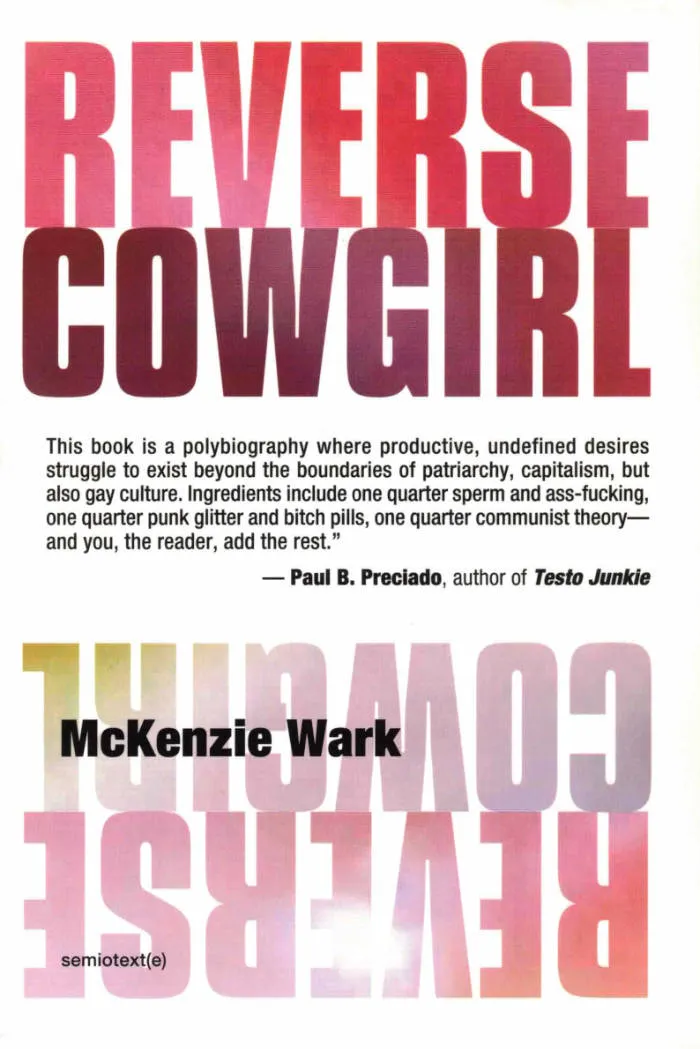
Reverse Cowgirl
McKenzie Wark invents a new genre for another gender: not a memoir but an auto-ethnography of the opacity of the self.
Another genre for another gender.
What if you were trans and didn't know it? What if there were some hole in your life and you didn't even know it was there? What if you went through life not knowing why you only felt at home in your body at peak moments of drugs and sex? What if you expended your days avoiding an absence, a hole in being? Reverse Cowgirl is not exactly a memoir. The author doesn't, in the end, have any answers as to who she really is or was, although maybe she figures out what she could become.
Traveling from Sydney in the 1980s to New York today, Reverse Cowgirl is a comedy of errors, chronicling the author's failed attempts at being gay and at being straight across the shifting political and media landscapes of the late twentieth century. Finding that the established narratives of being transgender don't seem to apply to her, Wark borrows from the genres of autofiction, fictocriticism, and new narrative to create a writing practice that can discover the form of a life outside existing accounts of trans experience: an auto-ethnography of the opacity of the self.

Solidarité, entre fantasme et nécessité
Sarah Schulman, fervente militante pour les droits humains, livre dans cet essai une brillante analyse des défis sociaux et psychologiques inhérents à tout mouvement de solidarité. En prenant appui sur plusieurs exemples historiques (lutte pour le droit à l’avortement dans l’Espagne postfranquiste, lutte contre le VIH/sida dans le New York des années 1990, mobilisation contre le génocide à Gaza…) ainsi que sur sa propre expérience de femme queer et juive, l’autrice décortique les rouages de la solidarité et entreprend de questionner les fantasmes qui y sont traditionnellement associés.
En filigrane, cet ouvrage pose une question fondamentale : quelle place pouvons-nous prendre dans un monde de plus en plus polarisé, et comment agir en solidarité avec les populations opprimées à l’échelle mondiale, locale ou individuelle ? L’autrice analyse les conditions nécessaires à tout mouvement de solidarité et montre l’importance de l’écoute active, la nécessité d’intervenir lorsque l’on est confronté à une injustice, la capacité à tolérer l’imperfection, ou encore la reconnaissance du coût moral et social inhérent à toute mobilisation.
En dressant des parallèles entre différents mouvements sociaux, Sarah Schulman met en lumière certaines dynamiques transversales à tout acte de solidarité et montre l’importance de la convergence des luttes dans un contexte mondialisé. Ode à la libération des populations opprimées, cet ouvrage apparaît aujourd’hui indispensable pour quiconque souhaite oeuvrer à la construction d’un monde plus juste.

Antilogy
Drawing from notions of "bad poetry" as the critical undoing of normative taste, Antilogy brings together works by the Brazilian artist and poet Alex Hamburger.
Central to Hamburger's practice and engagement with poetry is a focus on writing as the expression of a performative disruption and playful reworking of semiotic systems. With references to Fluxus intermediality, Brazilian concretism, experimental music, and sound poetry, Hamburger's work dynamically collapses the distinctions between fact and fiction, theory and performance, system and noise. From visual poems to abstract narrative to personal fantasy, Antilogy reminds us about the potent sense of refusal and experimentation that all art should carry.
Alex Hamburger was born in Belgrade, Serbia, in 1948. From the 80s onward his researches and proposals turned to the possibilities of fusion and intertwining of languages, developing works in Verbal, Visual and Sound Poetry, Object-Poem, Artist's books, Installation, Performance art, etc. He has published seven books in various poetical genres, three CDs of Sound Poetry and has performed several performance pieces, some in partnership with the visual artist Marcia X, with whom he established a fruitful relationship throughout the 80s, contributing decisively for a better understanding and acceptance of the above practices in the local art circuit of Rio de Janeiro. His work is held in the collections of contemporary art institutions, in Brazil and abroad, including The Museum of Modern Art, RJ, The Museum of Modern Art, SP, Printed Matter Bookstore, New York, Compendium of Contemporary Fine Prints, Hamburg, ICA, London among others. Alex Hamburger continues to live and work in Rio de Janeiro, Brazil.

The Witch Studies Reader
Stories about witches are by their nature stories about the most basic and profound of human experiences—healing, sex, violence, tragedies, aging, death, and encountering the mystery and magic of the unknown. It is no surprise, then, that witches loom large in our cultural imaginations. In academia, studies of witches rarely emerge from scholars who are themselves witches and/or embedded in communities of witchcraft practitioners. The Witch Studies Reader brings together a diverse group of scholars, practitioners, and scholar-practitioners who examine witchcraft from a critical decolonial feminist perspective that decenters Europe and departs from exoticizing and pathologizing writing on witchcraft in the global South. The authors show how witches are keepers of suppressed knowledges, builders of new futures, exemplars of praxis, and theorists in their own right. Throughout, they account for the vastly different national, political-economic, and cultural contexts in which “the witch” is currently being claimed and repudiated. Offering a pathbreaking transnational feminist examination of witches and witchcraft that upends white supremacist, colonial, patriarchal knowledge regimes, this volume brings into being the interdisciplinary field of feminist witch studies.
Contributors: Maria Amir, Ruth Asiimwe, Bernadette Barton, Ethel Brooks, Shelina Brown, Ruth Charnock, Soma Chaudhuri, Carolyn Chernoff, Saira Chhibber, Simon Clay, Krystal Cleary, Adrianna L. Ernstberger, Tina Escaja, Laurie Essig, Marcelitte Failla, D Ferrett, Marion Goldman, Jaime Hartless, Margaretha Haughwout, Patricia Humura, Apoorvaa Joshi, Govind Kelkar, Oliver Kellhammer, Ayça Kurtoğlu, Helen Macdonald, Isabel Machado, Brandy Renee McCann, Dev Nathan, Mary Jo Neitz, Amy Nichols-Belo, Allison (or AP) Pierce, Emma Quilty, Anna Rogel, Karen Schaller, Jacquelyn Marie Shannon, Shashank Shekhar Sinha, Gabriella V. Smith, Nathan Snaza, Shannon Hughes Spence, Eric Steinhart, Morena Tartari, Nicole Trigg, Katie Von Wald, Tushabe wa Tushabe, Jane Ward

Femmephilia
From the author of Enemy Feminisms and Abolish the Family, an original diagnosis of femmephobia in our culture, and a vision of a life-giving femme feminism for all.
To be femme is to embody a dispossessed femininity, to be freighted with freedom, to refuse to be made proper or institutionalized. To love it is to embrace love for women (be they butch or not) in the broadest sense. In Femmephilia, Sophie Lewis makes the case for the vital importance of politicized femme-ness: a feminism that is self-consciously artificial, extravagant in its erotic and political appetites, and staunchly anti-work, abolitionist, and utopian. Femme labors deserve our care, respect, and support, but instead face dismissal from masculinist antagonists and feminist allies alike.
Where neoliberal women’s empowerment has failed to combat the eruption of right-wing, anti-trans, and anti-feminist attacks, Lewis argues that femmephilia can help us imagine a radical future. In essays on the high femme genius of Marilyn Monroe and trans yearning in the myth of Apollo and Daphne; on octopuses and girlbosses, reluctant heterosexuals, lesbian separatists, and anti-work cats; and on a mother on strike from maternity, Femmephilia offers a new logic of liberation for all feminized people.

Regaining Unconsciousness: Poems
Harryette Mullen is one of contemporary poetry’s most influential voices, for her inventive language play, keen wit, formal experimentation, and pointed critique of American culture. In Regaining Unconsciousness, her first new collection in twelve years, Mullen confronts the imminent dangers of our present to sound an alarm for our future, to wake us out of our complicity and despondency: Can we, even still, find our way to our unconscious selves, beyond our capacity to harm, subdue, and consume?
In eleven taut sections written in the eleventh hour of our collective being, these poems address climate change, corporate greed, racist violence, artificial intelligence, the pollution of our oceans, individualism at the cost of mutual wellness, and the consequences of not addressing these pressing issues. Mullen imagines, as we must, our apocalypse, and yet, in an astounding feat, she does so with playfulness and wry referentiality that make these poems surprisingly buoyant, funny, and readable. Our end may be inevitable, Mullen admits, but maybe we begin with gratitude.

Or, on Being the Other Woman
Throughout this book-length poem, Simone White considers the dynamics of contemporary black feminist life, attesting to the narrative complexities of writing and living as a black woman and artist.
In Or, on being the other woman, Simone White considers the dynamics of contemporary black feminist life. Throughout this book-length poem, White writes through a hybrid of poetry, essay, personal narrative, and critical theory, attesting to the narrative complexities of writing and living as a black woman and artist. She considers black social life—from art and motherhood to trap music and love—as unspeakably troubling and reflects on the degree to which it strands and punishes black women. She also explores what constitutes sexual freedom and the rewards and dangers that come with it. White meditates on trap music and the ways artists such as Future and Meek Mill and the sonic waves of the drum machine convey desire and the black experience. Charting the pressures of ordinary black womanhood, White pushes the limits of language, showing how those limits can be the basis for new modes of expression.

Les liens qui empêchent: L'homophobie familiale et ses conséquences
Dans Les liens qui empêchent, Sarah Schulman analyse la reproduction de l’homophobie au sein du cercle familial, quand bien même ce dernier devrait être le lieu du développement et de l’épanouissement de chacun·e.
En s’appuyant aussi bien sur des théories sociologiques que sur des témoignages individuels, l’autrice décortique les mécanismes qui conduisent les familles à exclure certains de leurs membres. Bien que l’homosexualité soit de plus en plus représentée dans les médias et dans la culture populaire, Sarah Schulman montre en quoi celle-ci est souvent caricaturée et pathologisée. Ainsi, cette visibilisation ne s’accompagne pas nécessairement d’une meilleure acceptation des personnes homosexuelles dans le cercle familial.
Virulent plaidoyer visant à faire de l’homophobie une question de société qui ne serait plus uniquement reléguée à la sphère privée, Sarah Schulman offre ici des pistes permettant de mettre un terme à la souffrance endurée par de nombreux·ses homosexuel·les au sein du foyer familial.

Love, Leda
Newly discovered in the author’s archives and published for the first time in the UK in 2023, this portrait of queer, working class London drifts from coffee shop to house party, in search of the next tryst.
Leda is lost. He spends his days steeped in ennui, watching the hours pass, waiting for the night to arrive. Trysts in the rubble of a bombsite follow hours spent in bed with near strangers, as Leda seeks out intimacy in unlikely places. Semi-homeless and estranged from his family of origin, he relies on the support of his chosen one: a community of older gay men and divorced women who feed and clothe him, gently encouraging him to find a foothold in a society which excludes him at every turn. And then there is Daniel, a buttoned-up man of the Lord, for whom Leda nurses an unrequited obsession—one which sends him spiraling into self-destruction. Pre-dating the British Sexual Offences Act of 1967, Love, Leda was first published in 2023 in the UK. This long lost novel is a portrait of London’s Soho that is now lost, an important document of queer working-class life from a voice long overlooked.