Books
Books
in random order

Theory & Practice
With echoes of Shirley Hazzard and Virginia Woolf, a new novel of startling intelligence from prize–winning author Michelle de Kretser, following a woman looking back on her young adulthood, and grappling with the collision of her emotions and her values.
In the late 1980s, the narrator of Theory & Practice—a first generation immigrant from Sri Lanka who moved to Sydney in her childhood—sets up a life in Melbourne for graduate school. Jilted by a lover who cheats on her with another self-described "feminist," she is thrown into deeper confusion about her identity and the people around her.
The narrator begins to fall for a man named Kit, who is in a “deconstructed relationship” with a woman named Olivia. She struggles to square her feminism against her jealousy toward Olivia—and her anti-colonialism against her feelings about Virginia Woolf, whose work she is called to despite her racism.
What happens when our desires run contrary to our beliefs? What should we do when the failings of revered figures come to light? Who is shamed when the truth is told? In Theory & Practice, Michelle de Kretser offers a spellbinding meditation on the moral complexities that arise in this gap. Peopled with brilliantly drawn characters, the novel also stitches together fiction and essay, taking up Woolf’s quest for adventurous literary form.

Survival Takes a Wild Imagination: Poems
In the powerful follow up to her critically acclaimed debut collection, poet and activist Fariha Róisín is writing, praying, clawing, and scratching her way out of the grips of generational trauma on the search for the freedom her mother never received and the kindness she couldn’t give.
This collection of poetry asks a kaleidoscope of Who is my family? My father? How do I love a mother no longer here? Can I see myself? What does it mean to be Bangladeshi? What is a border? Innately hopeful and resolutely strong, Fariha's voice turns to the optimism and beauty inherent in rebuilding the self, and in turn, the world that the self moves through. Ubiquitous to the human experience, Survival Takes a Wild Imagination is an illuminating breath of fresh air from a powerful poetic voice.

How to see palace pillars as if they were palm trees
Hussein Nasseraddine, Ben Koerber
For so it happens that when the poets speak, objects appear closer to their own shadows. The poet's mouth fills up with horses and marble, and his verses start to shine like rivers. These rivers then turn back to flow through the very palace he is depicting. The poet's own words begin to weigh down on him, as though he were holding up a palace with his palms. Then he travels, and the palace is obliterated. Countries and nations change, and naught remains but what the poets had seen. Of what the poets had seen, naught remains but its image in anthologies. And when the libraries have been flooded or burned to the ground, nothing but the commentaries on those anthologies are left, and all that one finds in these commentaries is that which was appropriated and wrought a thousand times over.
Hussein Nassereddine is a multidisciplinary artist. His work in installation, writing, video and performance originates from a practice around language that builds fragile monuments - some verbal, some sonic, some tactile - rooted in collective histories and resources of poetry, ruins, construction and image-making.
Translated from Arabic by Ben Koerber.

Barge Life: On Jean Vigo's L'Atalante
How to live together in cramped quarters? How to create a microcosm against hostile surroundings? In Barge Life, Florian Deroo tackles these questions by looking at a mythical classic of French cinema: Jean Vigo’s 1934 film L’Atalante. A work brimming with the energies of surrealism and anarchism, L’Atalante follows a young couple, two shipmates, and a clowder of cats who dwell in the belly of a river barge. Deroo offers a wide-ranging essay on the film, revealing how it lovingly delineates a small group that withdraws from the rhythms of modern life to establish a different kind of existence elsewhere. In L’Atalante’s most riveting moments, the river barge becomes a vehicle for a powerful fantasy: a supple and mobile collective life, lived in sensuous interdependence.
Combining film criticism, philosophy, and biography, Deroo’s Barge Life reconsiders an important forerunner to the French New Wave and the early death of its director. Drawing readers into the intimately cramped living spaces of L’Atalante, Deroo explores the allure of retreating into a self-sufficient shelter, along with its intractable problems.

Time Also Will Make It Interesting: Selected Journals
The selected journals of trans, mixed-race artist and dyke erotica writer Red Jordan Arobateau.
Best known for his erotic lesbian fiction, Red Jordan Arobateau was also a prolific painter who maintained and self-published a journal for roughly twenty years, documenting his experiences at the “abject bottom” of life in the US. Edited and introduced by poet and scholar Cameron Awkward-Rich with a foreword by Michelle Tea and paintings by Arobateau, Time Also Will Make It Interesting captures Arobateau’s life as a young dyke in the criminalized cultures of 1950s-60s gay bars of Chicago and New York; his transition from dyke to trans man in late 1990s San Francisco; and his return to painting and an unfolding spirituality within that rapidly gentrifying city.
Queerly messy, ornery, and stuffed with Arobateau’s wisdom, this volume is what he might have called, “a novel combined with a journal—da novel/journal! Taking all the liberty in the world! A domain where verse can be inserted, dreams recorded, my everyday political rants printed out, combined with my forté—fiction! All under one binding & title!”
Foreword by Michelle Tea.

Ten Bridges I’ve Burnt
In Ten Bridges I’ve Burnt, Brontez Purnell—the bard of the underloved and overlooked—turns his gaze inward. A storyteller with a musical eye for the absurdity of his own existence, he is peerless in his ability to find the levity within the stormiest of crises. Here, in his first collection of genre-defying verse, Purnell reflects on his peripatetic life, whose ups and downs have nothing on the turmoil within. “The most high-risk homosexual behavior I engage in,” Purnell writes, “is simply existing.”
The thirty-eight autobiographical pieces pulsing in Ten Bridges I’ve Burnt find Purnell at his no-holds-barred best. He remembers a vicious brawl he participated in at a poetry conference and reckons with packaging his trauma for TV writers’ rooms; wrestles with the curses, and gifts, passed down from generations of family members; and chronicles, with breathless verve, a list of hell-raising misadventures and sexcapades. Through it all, he muses on everything from love and loneliness to capitalism and Blackness to jogging and the ethics of art, always with unpredictable clarity and movement.
With the same balance of wit and wisdom that made 100 Boyfriends a sensation, Purnell unleashes another collection of boundary-pushing writing with Ten Bridges I’ve Burnt, a book as original and thrilling as the author himself.

BRAIDS
Natalia Irena Nikoniuk, Gabriela Galeao Batres
BRAIDS is a 130 pages-long publication that features both visual and written works of 20 young creatives. The desire of BRAIDS is to expand the idea of queerness beyond the borders of identity. The journal exists to host bodies that deny framing and dare to expose the vulnerability of their difference. The publication is thus a woven story of the contemporary globalised queer, insecure but daring, honey-glazed yet continuously aching.

An Anarchist Playbook. Radical Translation Workshop
Cristina Viti, Jacob McGuinn and 2 more
The Conspiracy of Equals (1796) is often hailed as the first revolution against a revolutionary state. Even if the conspirators were soon found out and put on trial, their ideas of radical equality and liberty shaped future generations of revolutionaries worldwide. An Anarchist Playbook—the first publication in Tenement’s new imprint, No University Press—gathers together many of the key documents from their trial across a myriad forms, with a number of these texts appearing herein in their first English-language translation.
Assembled in the Playbook are the last words of Gracchus Babeuf, the leader of the conspiracy and a radical proponent of the abolition of private property, and of his fellow conspirator Augustin Darthé, as they faced the guillotine. We’ve a letter, written in the popular idiom of the sans-culottes, that urges the common soldier to rebel; the score and lyrics of a street song that names the new class enemy: the wealthy bourgeoisie who have profited from the revolution; a first-time English translation of ‘The Last Judgement of All Kings’—an extraordinary one-act play by Sylvain Maréchal, the unofficial poet of the Conspiracy, that was performed to considerable acclaim in Year II of the Revolution (and that the Workshop is in the process of adapting for contemporary audiences).
Many of these texts were never published in their own time, and form a part of the testament left behind by Philippe Buonarroti, a leading conspirator who inspired new generations of revolutionaries across Europe over the course of the nineteenth and early twentieth centuries. Among the best known works included is the Manifesto of Equals, long considered a founding text of social, communist and anarchist revolutions. The Playbook presents a translation of the Manifesto alongside other key texts by the conspirators, reconstructing the richness and variety of revolutionary communication that informs the editorship, shape, and scope of this volume.

Sore 2
Sore is a serial anthology that brings together authors whose writing practices oscillate between the genres of diary keeping and fiction. For the second issue of Sore, ten contributors – both authors and visual artists – were invited to collectively develop their work through a series of informal critiques over the course of five months.
In the first issue of Sore, observations of everyday life intertwined with memories and cultural references to denote the significance of a certain soreness we each carry within us as we negotiate the various challenges of social existence. In this second ensemble, seven new authors widen our understanding of the term ‘sore’ by underlining a need to orient one’s gaze towards what’s hidden underneath, to enter the anatomy of all these necessary contortions and u-turns one performs in order to escape the grip of expected compliance.
With contributions from: Mathilde Heuliez, Lisa Lagova, Muyeong Kim, Nour Ben Saïd, Masha Ryabova, Adrienne Chung, Richard Dmitri Hees, Oscar Le Merle, Morra Kozlitina, Tindra Eliason, Helmer Stuyt, Ilya Stasevich, Kristina Stallvik.
Published by cover crop, Mathilde Heuliez & Lisa Lagova.

Studies on Squats
Studies on Squats is an evocative exploration of embodied resistance and political movement that uses the multifaceted posture of the “Asian Squat” as a lens through which broader concepts of migration, illness, and resilience are examined. In Studies on Squats, the body—in its most vulnerable and potent states—becomes a speculative site for reclaiming agency by crafting new forms of protest that draw from ancestral strength, humor and eroticism. This posture, rich with cultural resonance, offers as an entry point to imagine ways in which the body can engage in acts of defiance against systems of oppression. Studies on Squats invites the audience to consider how dance and choreographic thinking can serve as tools for envisioning alternative futures, where artistry empowers those enduring systemic social injustices to transform their realities.

The Tenant
The Tenant is a monographic critical essay by Marie Canet. It is the first text to directly address the connections between McKenzie’s work, pornography, and special effects. The title refers to the way the artist moves through different periods and aesthetic spaces, appropriating their codes in order to construct new visual fictions. The book is infused with post-#MeToo feminist thinking, alternative uses of biography, reflections on the art world, and contemporary debates surrounding appropriation, embodiment, and the status of the artwork.
McKenzie and Canet worked with each other for over eight years, on projects like Atelier E.B: Passer-by catalogue, published on the occasion of the Fondation Galeries Lafayette exhibition, or the book Pervert or Detective, a conversation between Lucy McKenzie and artist Reba Maybury. This collaboration now culminated in an exhibition and a book: Plastic Newspaper (presented at CRAC Sète in March 2026) and Lucy McKenzie, The Tenant.
Texts by Marie Canet and Lucy McKenzie
Translations: Catherine Petit & Paul Buck (Marie Canet), Juliette Desorgues (Lucy McKenzie)
Published in connection with the exhibition Lucy McKenzie, Plastic Newspaper, at Crac Occitanie, Centre régional d‘art contemporain Occitanie/Pyrénées-Méditerranée à Sète, 21.03.-06.09.26
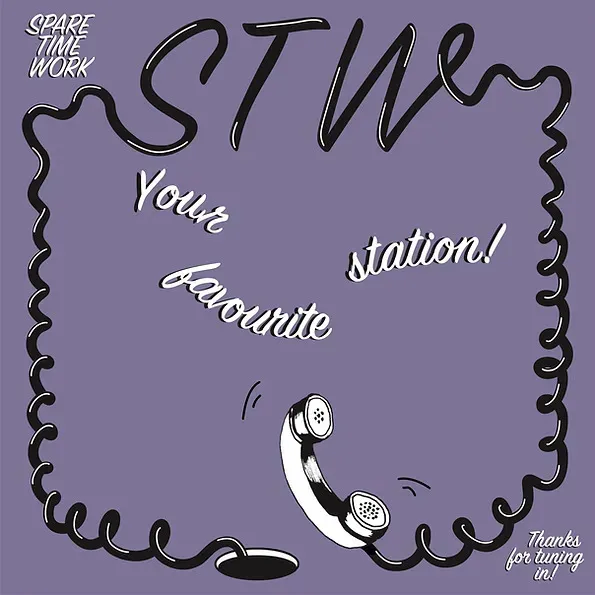
STW, your favourite station!
STW, your favourite station! functioneert als een radioprogramma. Een boek dat lyrisch proza uitzendt van We make stuff up for a living (een CV medley) tot COMPUTER_SONG, een ceremoniële quiz met Adult Hood & Young als protagonisten, een grillige anekdote van iemand die zich ergert aan een Call Service, en meer! Thanks for tuning in!

Homophone Dictionary
Homophone Dictionary was originally a file that is compiled by the now 96-year-old former schoolteacher Susan Nixon. She has build up many collections throughout her life, almost all of them exist out of objects, except one: after her retirement she compiled a word document that by now exist out of almost 1000 homophones; two, or more words that you pronounce similar but have a different meaning, often the spelling is also different.
The document is structured as a dictionary and the homophones are illustrated with examples that are based on autobiographical information. The structure of Homophone Dictionary also refers to speech therapy exercises and concrete poetry.
“As a student nurse learning medical terminology, I became fascinated with understanding the roots of words. When I had a young family, words were a principal source of entertainment: it was not unusual for one of the children to slip from their chair at the dinner table and fetch a dictionary in order to settle a dispute or satisfy someone’s curiosity. Then I became a teacher and brought this love of words into the classroom. My habit of word collecting became the children’s habit – my pupils became ‘word-lovers’ and ‘list-makers.’
I casually collected homophones for years. When introducing homophones into the classroom, the kids found definitions dull; the typical reaction was, ‘Yes, but give me a sentence using the word!’ and this idea emerged: a book of sentences demonstrating the meanings of homophone pairs or sets.”
Offset print
20,4 × 12,4 cm
edition of 500

Devenir minéral | L’éditeur du dimanche
Echoing Jean Dubuffet's idea that thought must arise from material in artistic practice, Giuliana Prucca, through this essay, reinterprets a moment in the history of 20th-century art using materials such as stone, sand, earth, and dust. She employs the mineral to illustrate that the creative act would be a trace of the body's disappearance. The loss of humanity and the deconstruction of the subject objectify themselves in the image. In other words, art resides in the tension between representation and its loss, ultimately leaving nothing but an image.
Drawing from the influential figure of Antonin Artaud, she weaves critical and poetic connections between the texts and works of various artists, writers, and thinkers, ranging from Jean Dubuffet to Jan Fabre and Anselm Kiefer, Yves Klein and Gutaï, Joë Bousquet to Camille Bryen and Francis Ponge, Gaston Bachelard to Gilles Deleuze, and Georges Bataille to Aby Warburg.
The material is not merely a thematic pretext; it is an active and explosive catapult that questions the arbitrary linearity of a conventionally assimilated art history. Following Ponge's example, Prucca applies the principles of poetry to criticism, starting from Artaud's material, the most undisciplined of poet-artist-thinkers of the modern era. This results in a critically inventive approach dangerously suited to its object, celebrating an anti-critique. The chosen writing materials, stonepaper for the cover and recycled paper for the pages, is consistent, intending to give the impression of being covered in dust.
The essay disrupts traditional reading habits and shatters the conservatism of art criticism by inhabiting writing space differently, presenting a physically engaging interaction. This is an essay in the literal sense, an experience where form never contradicts content, urging readers to take the risk of thinking deeply and embracing a new rhythm. A complex and challenging design invites them to choose different reading options, ultimately treating criticism as one would poetry.
Giuliana Prucca [Paris | Berlin] is an independent curator, researcher, and writer. She is the founder and art director of the publishing house AVARIE, specialising in contemporary art books that explore the relationships between text and image, body and space.
Graphic design, art direction by Vito Raimondi

Erotism: Death and Sensuality
Taboo and sacrifice, transgression and language, death and sensuality—Georges Bataille pursues these themes with an original, often startling perspective. He challenges any single discourse on the erotic. The scope of his inquiry ranges from Emily Bronte to Sade, from St. Therese to Claude Levi-Strauss, and Dr. Kinsey; and the subjects he covers include prostitution, mythical ecstasy, cruelty, and organized war. Investigating desire prior to and extending beyond the realm of sexuality, he argues that eroticism is "a psychological quest not alien to death."

The Word for World: The Maps of Ursula K. Le Guin
When Ursula K. Le Guin started writing a new story, she would begin by drawing a map. The Word for World presents a selection of these images by the celebrated author, many of which have never been published before, to consider how her imaginary worlds enable us to re-envision our own.
Le Guin’s maps offer journeys of consciousness beyond conventional cartography, from the Rorschach-like archipelagos of Earthsea to the talismanic maps of Always Coming Home. Rather than remaining within known terrain, they open up paradigms of knowledge, exemplified by the map’s edges and how a map is read, made and re-made, together. The Word for World brings her maps together with poems, stories, interviews, recipes and essays by contributors from a variety of perspectives to enquire into the relationship between worlds and how they are represented and imagined.
Contributors: Federico Campagna, Theo Downes-Le Guin, Daniel Heath Justice, Bhanu Kapil, Canisia Lubrin, Una McCormack, David Naimon, Nisha Ramayya, Shoshone Collective, Standard Deviation, Marilyn Strathern.
Co-published by Spiral House and AA Publications to coincide with an exhibition of Ursula K. Le Guin’s maps at the Architectural Association, London, opening on 10 October 2025.
”One of the literary greats of the 20th century.” Margaret Atwood

Crossings: Creative Ecologies of Cruising
It’s difficult to pinpoint the origins of cruising. While the term was used by men seeking casual encounters with other men in the parks and streets of New York City as early as the 1920s, historical records show the practice is much older. Cruising has existed for as long as anyone outside the dominant sex and gender systems has sought sexual encounters outside of sanctioned norms. This book offers a serious exploration of queer sex and sex cultures, exploring cruising as a mode of thinking with the body and communicating through sexuality.
A creative dialogue between a queer artist and a queer academic reminiscing about and thinking with their cruising experiences, Crossings takes queer sex practices and cultures seriously as ways of knowing and world-making. The result is an erotic hybrid form hovering between scholarship and avant-garde experimentation, between critical manifesto and sex memoir. Here, the voices of each author, merged together in one, invite the reader to inhabit the erotic spacetime between self and other, the familiar and the strange, desire and pleasure, climax and release. That is, the spaces and temporalities of cruising itself.

EURO—VISION: Undergrounding the Critical Mineral
'EURO—VISION: Undergrounding the Critical Material' explores extraction beyond the removal of minerals, delving into their financialization, management, and policy-driven circulation through the lens of the EU’s Critical Raw Materials Act. This volume examines resource extraction’s genealogies, valuation paradigms, and structural entanglements, offering a critical reassessment of extractive practices. Part of K. Verlag’s Processing Process series, the book features interviews with scholars, activists, and journalists, alongside commissioned texts and visual essays from FRAUD’s research. By interrogating the “extractive gaze” embedded in EUpolicies, it unveils the material poetics and transformative potential of minerals, fostering reflections on their complex entanglements.
Lithium, copper, uranium, child labor, and the bed of the deep sea—the mining sector is one of the most contested and problematic arenas of consumer complicity today. EURO—VISION: Undergrounding the Critical Mineral begins not with a location or a specific resource, but with a fundamental question: what counts as extraction today? While we might picture drills and quarries, the deeper story unfolds across financial markets, trade policies, legal frameworks, and the metrics used to define what is “critical” in the first place. Taking the EU’s Critical Raw Materials Act as a point of departure, this richly layered volume traces the hidden infrastructures and governing logics that shape how the mining industry moves substances from and across the Earth—and what these minerals, in turn, move with them.
Developed by the artist duo FRAUD (Francisco Gallardo & Audrey Samson) in close collaboration with environmental humanities scholar Michaela Büsse, the book gathers a wide range of voices—artists, scholars, economists, activists, lawyers, and journalists—to reflect on the long genealogies of resource extraction, the valuation paradigms that uphold them, and the terminologies that give them legitimacy. But the story doesn’t stop there. In the context of EURO–VISION, “undergrounding” becomes a tactic: a means of unsettling the structural violence concealed behind seemingly neutral data, and of turning toward the mineral itself—its material presence, its histories, its speculative potential.
Published in K. Verlag’s Processing Process series, EURO—VISION draws on FRAUD’s ongoing, research-led inquiry into critical mineral governance. Combining interviews, visual essays, and commissioned texts, it opens new pathways for thinking about the entanglements between geology, economy, and power. At once analytical and imaginative, the book invites us to see the subterranean anew—not simply as a resource, but as a site of resistance, relation, and possible futures.
Edited by Francisco Gallardo & Audrey Samson (FRAUD) in collaboration with Michaela Büsse. With essays and visual contributions by Adekeye Adebajo, Michaela Büsse, Liam Campling, Stephen Cornford, Jeff Diamanti, FRAUD, Matthew Fuller, Iman Ganji, Peo Hansen, Stefan Jonsson, Bahar Noorizadeh, Sophia Pickles, Ndongo Samba Sylla, Jennifer Telesca, Aleksandra Wojewska, and Mi You. Design by K. Verlag with Wolfgang Hückel & Katharina Tauer. Processing Process series editors: Anna-Sophie Springer & Etienne Turpin.

Metal Works
A complete survey of the cast, forged, and fabricated metal sculptures made by Danish artist Sidsel Meineche Hansen since 2017.
The artist's practice addresses the industrial complex of virtual and robotic bodies and their relationship to labor in tech, pornography and gaming. While some sculptures were conceived as individual pieces, others were created with digital counterparts within installations that typically include CGI animation, documentary video, drawing and prints.
By presenting the metal works as stand-alone pieces, this book adheres to Meineche Hansen's concern with the material means of production, highlighting their concrete yet elusive nature. Several pieces in the publication are accompanied by poems written by artist Diego Marcon in response to the works. As an artist's project and an archival document, the publication echoes the tradition of documentary photography devoted to sculpture.
Sidsel Meineche Hansen (born 1981 in Denmark, lives and works in London) is a Danish artist. She produces exhibitions, interdisciplinary seminars and publications that foreground the body and its industrial complex, in what she refers to as a "techno-somatic variant of institutional critique". Meineche Hansen questions the body in the field of industrial representations: robotic or virtual bodies, and their relationship with the working world of industries of gaming, pornography, and new technologies. Her research-led practice has taken the form of woodcut prints, sculptures and CGI animations, often made by combining her own low-tech manual craft with outsourced, skilled digital labour.
Edited by Fredi Fischli and Niels Olsen.
Poems by Diego Marcon.

That They Were at the Beach
For this collection of poems and prose, Leslie Scalapino has gathered four sequences into what she calls an “aeolotropic series.” The poems reflect each other like crystals and change like highly polished glass illuminated by a shifting light. They follow the mind from thought and observation to afterthought, reflection, and obsession.
Leslie Scalapino (1947-2010) is the author of thirty books of poetry, prose, inter-genre fiction, plays, and essays, including numerous collaborations with artists, writers, and dancers. Her long poem way (North Point Press, 1988) won the Poetry Center Award, the Lawrence Lipton Prize, and the American Book Award from the Before Columbus Foundation. Scalapino taught at the Naropa Institute, Bard College, Mills College, and UC San Diego. She was the editor and founder of O Books.

My Mother My Home
Who claims abstraction? What are the limits of abstraction? Are statelessness, dislocation and feelings of (un) belonging embodiments of an abstracted self that is in itself a work in progress? How could performance art—an artistic practice that places significant importance on presence and legibility of form—transgress into the realm of the abstract and the illegible in an effort to protect the artist’s likeness while shedding light on what it means to be in their body in relation to this world?
Chipo Chipaziwa’s My Mother My Home establishes itself as a query on the aspects of belonging and the artist’s own personhood that acts as the foundation of her practice. The question of where one’s personhood begins and ends within an artwork has appeared to be ever prevalent within the realm of visual art and is more relevant within the canon of performance art.
Writers: Chipo Chipaziwa, Denise Ferreira da Silva, Olumoroti George
Contributing artists: Margaret Joba-Woodruff, Sophia Lapres, and David Ezra Wang
Edited by Katrina Geotjen

Beefy's Tune (Dean Blunt Edit)
Dean Blunt is one of the most important British artist of the current century because he fundamentally does not care about Britain. His importance makes it shocking that such little critical attention has been paid to his work. His indifference explains it.
Dhanveer Singh Brar’s ‘Beefy’s Tune (Dean Blunt Edit)’ looks to initiate a conversation that needs to be had about Dean Blunt, about Britain (through Blunt’s indifference to it), and about Blackness in Britain (through the depth and complexity of Blunt’s feeling for it). Using the 2016 album ‘BBF Hosted By DJ Escrow’ as a means of navigation, Brar hears Blunt in order to access the long contested dream of Britain’s disappearance that was conducted under the name of Black British Arts. Partial (in the sense of his relation to Blunt) and partial (in the sense of unfinished), ‘Beefy’s Tune (Dean Blunt Edit)’ see’s Dhanveer Singh Brar give the dream a grammar, if not a name.
Dhanveer Singh Brar is a theorist and scholar who teaches in the Department of Visual Cultures at Goldsmiths, University of London. His is a member of Le Mardi Gras Listening Collective and Lovers Discourse. Brar’s second book ‘Teklife, Ghettoville, Eski: The Sonic Ecologies of Black Music in the Early Twenty-First Century’ will be published by Goldsmiths Press/MIT Press in Spring 2021
"To encounter BBF Hosted by DJ Escrow through Dhanveer Brar’s ears is to see Babylon through his eyes, and to sense Britain—to uncover with 'accuracy, brutality and beauty' the complexities of its meaning—through the social music, social vision and social feel of those who refuse the Britishness that is withheld from them. Brar discerns Dean Blunt’s rightful place in a cultural field where critical discourse and sonic dream are fundaments of a dub university curriculum whose various approaches show the absolute necessity and generativity of stealth, flaw and the resistance to category. Blunt’s “love letter to the blackness of Hackney” deserves the most rigorous, gentle, erudite attention. Happily, Dhanveer Brar is here to provide it." – Fred Moten.

Blank Stare
Blank Stare is the first publication in the CommonWealth series, published by Chillzone.
Compiled of graffiti written in the streets of Iran, combining the urgency of emotional expression amidst the political suffocation of people during the 2026 government-imposed internet blackout.

I will pay to make it bigger
You wake up in the footwell of a mid-sized hatchback somewhere on a highway in outer Bangkok. You compile neurotic spreadsheets of the best ‘party destinations’ in Europe, whilst your work emails pile up without ever being read. You quit your job. You launch a banal start-up. You grieve for a past relationship. You stare endlessly at the waves coming in from a beach in Koh Pha Ngan. You vape intensely. You spend money on feelings, on the performance of your own persona, whilst you observe yourself with a detached sense of horror.
i will pay to make it bigger is a novella, by poet and artist Ahren Warner, in which ‘you’ are the main character. Through text and image – autofiction, docufiction, and just plain fiction – you work your way through a tangle of preoccupations: from what it means to buy enjoyment, to the fragile construction of your own self as a cultural product.
i will pay to make it bigger is also a photobook, a collection of images produced whilst living in Thai ‘party hostels’. Although these photographs might seem to exist as the documentation of intimate or ecstatic moments, they are in fact quite painstakingly, and artificially, constructed: composited and manipulated from multiple still frames of film footage to produce images that advertise the calculated artifice of their own hedonism, emotion and seemingly raw experience.
With a Coda by Hana K. Ohnewehr, commissioned by Yu’an Huang