Books
Books
in random order

NIGHTNIGHT
In collaboration with Laurent Poleo-Garnier, NIGHTNIGHT is an archive of images and texts from different sources addressing the theme of the night. Over the book as a party that degenerates with fatigue, alcohol and other stimulants, images and layout deteriorate, the subjects get tired, the vision is cloudy...

Pivot
Pivot is an experimental, book-length poem exploring the profound act of "turning", with the Haitian Revolution as its cornerstone.
Pivot moves beyond historical narrative, scrutinizing this epochal event through its pivotal moments—critical junctures of rupture and radical reorientation. Mason Jordan masterfully employs repetition, metaphor, and other minimalist abstractions of language to delve into the visceral and conceptual mechanics of turning: a turning away from colonial subjugation, a turning towards new vocabularies of freedom, and the cyclical turning of memory. Through linguistic architectures and etymology, akin to the likes of Fred Moten, N. H. Pritchard, and M. NourbeSe Philip, Pivot examines international revolt, revolutionary fervor, and the development of Black Marxism(s) through a critical reflection on Haitian revolutionary history.

Sustaining the Otherwise
Sustaining the Otherwise is a collaborative research and artistic project about restitution, reparation and transformation taking place in multiple locations over several years. Initiated and conceptualized by researchers and curators Amal Alhaag & Selene Wendt, it offers a space for artists, activists, scholars and writers to be in dialogue and to explore the topic of restitution in relation to both material and immaterial culture, through a program that frames restitution within the context of contemporary art practice.
Edited by Amal Alhaag & Selene Wendt
Featuring an introduction by Amal Alhaag & Selene Wendt as well as provocations, reflections, and essays by Barby Asante, Michael Barrett, Quinsy Gario, Sana Ginwalla, Aude Christel Mgba, Lennon Mhsishi, Ogutu Muraya, in addition to a sonic contribution by Robert Machiri.

Forgetful Secretary
After diagnosis, the fact was that Austin Gross lived in his home country. He sat on the porch squinting like a potato and it was a comforting thing to imagine: rock-climbing with a blindfold. ‘Can swim, eyes open,’ he jotted and covered his eyes again. Sun, centrifuge, prognosis, bird-listening. The collision shaped genres like tectonic ripples. Windows open, a story while forgetting. ‘I am a memory eater.’
Aras was furloughed from prison that summer. Five years before, she’d missed their movie plan, and the fact was that since then, she lived in her home country. Furlough, Aras wrote, was ‘no-time.’ They investigated the situation together.
Austin Gross is an essayist and collaborator in elliptical orbit. His home discipline is philosophy and language English, on one condition: having left home. Trans-disciplinarity gives us a chance to be hosts and guests.
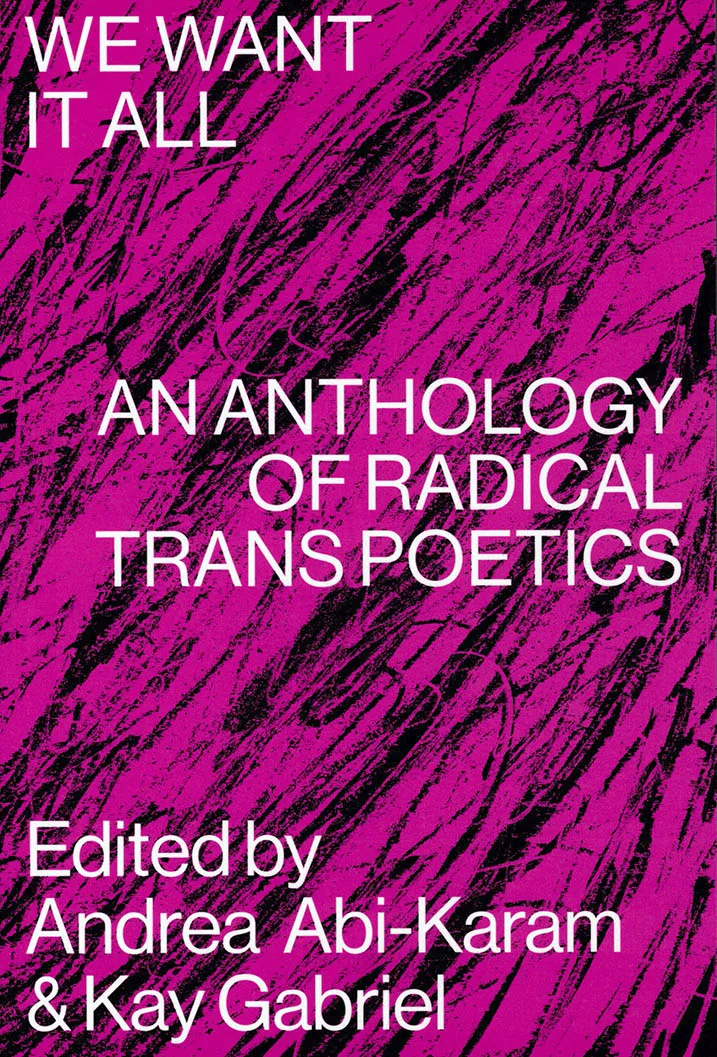
We Want It All: An Anthology of Radical Transpoetics
An anthology of formally inventive writing by trans poets against capital and empire.
With texts by: Andrea Abi-Karam, New York City Sam Ace, South Hadley, MA Bahaar Ahsan, Berkeley, CA jasper avery, Philadelphia, PA Ari Banias, Berkeley, CA Jo Barchi, Chicago, IL Joss Barton, St. Louis, MO Levi Bentley, Philadelphia, PA Jessica Bet, Baltimore, MA Rocket Caleshu, Los Angeles, CA Ching-in Chen, Seattle, WA listen chen, Vancouver, BC Faye Chevalier, Philadelphia, PA Cody-Rose Clevidence, Arkansas Miles Collins-Sibley, Easthampton, MA Valentine Conaty, New York City CA Conrad, Philadelphia, PA Jimmy Cooper, Rochester, MI Maxe Crandall, Oakland, CA José Díaz, Boston, MA Aaron El Sabrout, New Mexico Ian Khara Ellasante, Lewiston, ME Caelan Ernest, New York City, NY NM Esc, San Diego, CA joshua jennifer espinoza, Los Angeles, CA Logan February, Ibadan, Nigeria Ray Filar, Brighton, UK Nora Collen Fulton, Montreal, Canada Kay Gabriel, New York City Callie Gardner, Cardiff, Wales Jesi Gaston, Chicago, IL Harry Josephine Giles, Edinburgh, Scotland Aeon Ginsberg, Baltimore, MD Caspar Heinemann, Berlin, Germany Kamden Hilliard, Greenville, SC Stephen Ira, New York City Cyrée Jarelle Johnson, New York City Peach Kander, New York City Jayson Keery, Western, MA Evan Kleekamp, Los Angeles, CA Noah LeBien, New York City Ty Little, Richmond, VA Zavé Martohardjono, New York City Amy Marvin, Philadelphia, PA Natalie Mesnard, New York City Bianca Rae Messinger, Iowa City, IA Liam O'Brien, New York City Xandria Phillips, Madison, WI Rowan Powell, Santa Cruz, CA Nat Raha, Edinburgh, Scotland Holly Raymond, Philadelphia, PA Jackie S, New York City Trish Salah, Toronto, Canada Raquel Salas Rivera, Philadelphia, PA Mai Schwartz, New York City Kashif Sharma-Patel, London, UK Julian Talamantez Brolaski, Oakland, CA Charles Theonia, New York City Jamie Townsend, Oakland, CA Nora Treatbaby Laurel Uziell, London, UK Rachel Franklin Wood, Boulder, CO Clara Zornado Akasha-Mitra xtian w. and Anaïs Duplan, NYC.
Kay Gabriel is a poet and essayist. She's the author of Elegy Department Spring / Candy Sonnets 1 (BOAAT Press, 2017), the recipient of fellowships from Lambda Literary and the Poetry Project, and recently completed her PhD at Princeton University.
Andrea Abi-Karam is an arab-american genderqueer punk poet-performer cyborg, writing on the art of killing bros, the intricacies of cyborg bodies, trauma & delayed healing. Their chapbook, THE AFTERMATH (Commune Editions), attempts to queer Fanon's vision of how poetry fails to inspire revolution. Andrea's first book, EXTRATRANSMISSION (Kelsey Street Press, 2019), is a poetic critique of the U.S. military's role in the War on Terror.

Oostende
Oostende is a book about displacement and the sometimes-overwhelming internal monologue we live with. In between poetry, diary and novel, the book reflects on Zicari’s life in Buenos Aires and Belgium, as he navigates work fragility, friendship, sex and love, migration and the fiction laying behind everyday actions and life changing decisions.
Zícari's portrayal of his private life is far from the domain of the concrete, instead he ventures into the uncontrollable production of fantasies that sustain his inner discourse. It is around this dichotomy between the real and the imaginary, the tension between the experienced and the illusion, that Martín Zícari builds a book sustained in orality and proximity.
Martín Zícari, PhD, is a writer and producer based in Brussels. He has published poetry collections such as "Oostende" (Paripé Books, Madrid, 2023), "Del Príncipe Azul al Hombre Invisible en una Semana" (Editorial Municipal de Rosario, Argentina, 2018), and "Pequellpu" (LUMA Foundation, Switzerland, 2015), as well as the short novel "Scalabritney" (Entropia, Argentina, 2014), among others. His research has been featured in scientific journals such as Performance Research, Memory Studies, and the Journal of Latin American Cultural Studies.

The Gloria Anzaldúa Reader
Gloria Anzaldua, AnaLouise Keating
A collection of published and unpublished writings of the groundbreaking Chicana writer and self-described "chicana dyke-feminist, tejana patlache poet, writer and cultural theorist" Gloria Anzaldua.
Gloria Anzaldúa (1942-2004) was a visionary writer whose work was recognized with many honors, including the Before Columbus Foundation American Book Award, a Lambda literary award, the National Endowment for the Arts Fiction Award, and the Bode-Pearson Prize for Outstanding Contributions to American Studies. Her book Borderlands/La frontera was selected as one of the 100 Best Books of the Century by Hungry Mind Review and the Utne Reader. AnaLouise Keating, Professor of Women's Studies at Texas Woman's University, is the author of Women Reading, Women Writing: Self-Invention in Paula Gunn Allen, Gloria Anzaldúa, and Audre Lorde; editor of Anzaldúa's Interviews/Entrevistas and EntreMundos/AmongWorlds: New Perspectives on Gloria Anzaldúa; and co-editor, with Anzaldúa, of this bridge we call home: radical visions for transformation.
AnaLouise Keating, Professor of Women's Studies at Texas Woman's University, is the author of Women Reading, Women Writing: Self-Invention in Paula Gunn Allen, Gloria Anzaldúa, and Audre Lorde; editor of Anzaldúa's Interviews/Entrevistas and EntreMundos/AmongWorlds: New Perspectives on Gloria Anzaldúa; and co-editor, with Anzaldúa, of this bridge we call home: radical visions for transformation.

48Kg.
Cristina Viti, Batool Abu Akleen and 4 more
One of the most viscerally affecting collections of poems I have ever read. Devastatingly precise and unforgettable images emerge from every line. The Arabic and the English sit side by side on the pages of this book but the effect is deeper than language, it meets the reader in the heart. I wept reading this brilliant, natural, gifted young poet and wished her subject was something other than this atrocity visited upon her and her people.
What is happening in Gaza is a genocide not a war, but not since Akhmatova have I read poetry that so potently reckons with the relationship between war and the body. They create a new category of literary grace out of the cataclysm. These are poems of fire and agony, bombing and starvation, but they are also poems of grace, cleverness, tenderness and yearning. A great international poet arrives with this collection, but it is also a landmark work of resistance. No human should have to write their poetry from inside death's dominion, but Batool Abu Akleen has done it and the result is truly astonishing.
— Max Porter
A debut collection from the Palestinian poet—Modern Poetry in Translation’s ‘Poet in Residence,’ 2024—a bilingual assembly of forty-eight poems in which each work accounts for a single kilogram; a body’s mass; a testament to a sieged city; a vivid and visceral voicing of the personal and the public in the midsts of unspeakable violence.
Translated from the Arabic by the poet with Graham Liddell, Wiam El-Tamami, Cristina Viti & Yasmin Zaher

Coeur de Lion
A reissue of the instant cult-classic love poem, an investigation of poetic address.
Now that I am not addressing you
But the "you" of poetry
I am probably doing something horrible and destructive.
But this "I" is the I of poetry
And it should be able to do more than I can do.

Choquer le monde à mort – Elles sont de sortie – Pascal Doury – Bruno Richard
Bruno Richard, Pascal Doury and 1 more
"Elles sont de sortie" is the title of a periodic publication launched in 1977 by Pascal Doury and Bruno Richard. The plural and feminine form of the enigmatic phrase "elles sont de sortie," chosen almost by chance, announces a protean work and often collective experience. From its origins to the most recent iterations, including Doury's more confidential individual trajectory after "Elles sont de sortie," Choquer le Monde à Mort traces five decades of a corpus of nearly three hundred publications. It addresses some of the most emblematic editorial works, as well as others that remain unpublished, alongside ambitious and sometimes scandalous exhibitions, few of which are documented.
This work is the result of several years of research, enriched by numerous firsthand interviews, and unfolds in three parts: a chronology and analysis of a singular and marginal artistic history, works and iconographic documents, and an anthology bibliography. Together, these elements reveal the complexity of an editorial object with porous boundaries, both in its forms and its contents, oscillating between graphzine, artist book, poetry collection, and personal journal. Its ramifications, status, and legacy retrospectively reveal the importance of a discreet yet seminal work.
Thus, "Elles Sont de Sortie" also serves as an opportunity to revisit the paths of two aesthetic and provocative artists, deeply devoted to their art and true free spirits in an art world often too narrow for them. It immerses us in a plethora of works that are intimate and raw, as well as subtle and refined, all in service of a project that, in Doury's words, aims to "shock the world to death."
Edited by Tiphanie Blanc, Jonas Delaborde, Anna Lejemmetel.
Contribution by Anna Lejemmetel.
![Cover of أحمد [Ahmed] – Writing](https://rile.space/storage/4500/conversions/01KTRKW207R5ABRVS27RYCB9M1-webp.webp)
أحمد [Ahmed] – Writing
[Ahmed] is the quartet of Pat Thomas (piano), Joel Grip (double bass), Antonin Gerbal (drums) and Seymour Wright (alto saxophone). Since 2014, أحمد [Ahmed] have excavated and re-imagined the music of Ahmed Abdul-Malik, in an ever ongoing search for future music.
[Ahmed] – Writing (EXV01) gathers together the [Ahmed] ‘paper’ texts from the last decade: liner-notes; covers of the releases; and writing by the band members – Antonin and Joel have written two fresh ones for this book, Seymour’s have appeared alongside the records, and some of Pat’s come from a time (long) before [Ahmed]. “Together, the ideas-energy in these things gives a sense of what we have done, do, think together (and apart) in living music, how our different ways come together, and how, together, we learn through be-doing [Ahmed]… These texts are woven together (the etymology of text is from weave) through (and into) a rich fabric of enquiry. A collaborative weaving together of difference(s) to make a whole (thing).” (Seymour Wright)
Contributions by Pat Thomas, Seymour Wright, Antonin Gerbal, Joel Grip, Robert Levin, James G. Spady, John Chantler, Edward George, Fred Moten
Edited by [Ahmed]
Series Editors: Stoffel Debuysere, Jef Lambrechts, Will Holder
Initiated by Stoffel Debuysere
Produced and designed by Will Holder [lps’ original design: Maja Larsson]

Comme des œufs, comme des pierres
Dans l’imaginaire collectif, l’œuf évoque la fragilité et la promesse de vie, tandis que la pierre renvoie à la permanence et à la disparition. Cette édition tente de déplacer cette opposition à travers une forme fragmentaire. Il rassemble des notes écrites au fil du temps. Sa production suit cette logique : imprimé en offset, le projet prend en compte les formats de papier afin d’en optimiser l’usage. Les chutes sont utilisées dans un cahier complémentaire, rassemblant textes et images laissés en marge. La reliure, cousue à la main au fil de coton, reste simple et légère. L’objet se conçoit comme quelque chose à manipuler et découvrir, entre publication et transmission plus intime.
« J’ai donc cherché une forme simple, en évitant tout formalisme superflu. Le projet repose sur une question : est-il nécessaire de produire ce type d’objet, et pourquoi ? »
In the collective imagination, the egg suggests fragility and the promise of life, while stone evokes permanence and disappearance. This edition seeks to move beyond this opposition through a fragmentary form. It gathers notes written over time. Its production follows the same logic: printed in offset, the project takes paper formats into account in order to optimize their use. Offcuts are used in a supplementary section, gathering texts and images left aside. The binding is hand-sewn with cotton thread, remaining simple and lightweight. The object is conceived as something to handle and discover, between publication and a more intimate form of transmission.
“So I sought a simple form, avoiding unnecessary formalism. The project rests on a question: is it necessary to produce this type of object, and why?”

Imperfect Solidarities
Art, empathy and political solidarity.
Can empathy deliver political change? Does art that elicits emotional identification with others take us where we need to go? In Imperfect Solidarities, writer and art historian Aruna D'Souza offers observations pulled from current events as well as contemporary art that suggest that a feeling of understanding or closeness based on emotion is an imperfect ground for solidarity. Empathy—and its correlate, love—is a distraction from the hard work that needs to be done to achieve justice. Rather, D'Souza contends, we need to imagine a form of political solidarity that is not based on empathy, but on the much more difficult obligation of care. When we can respect the unknowability of the other and still care for and with them, without translating ourselves into their terms, perhaps we will fare better at building political bridges.
Aruna D'Souza is a writer and critic based in New York. She is a regular contributor to The New York Times and 4Columns.org, where she is a member of the editorial advisory board. Her writing has also appeared in The Wall Street Journal, CNN.com, Bookforum, Frieze, Momus, and Art in America, among other places. Her book, Whitewalling: Art, Race, and Protest in 3 Acts (Badlands Unlimited), was named one of the best art books of 2018 by The New York Times. She is the recipient of the 2021 Rabkin Prize for art journalism and a 2019 Andy Warhol Foundation Art Writers Grant.

Sarahland
Sarahland est un ouvrage de fiction américain contemporain qui se découpe en dix nouvelles, toutes reliées par les personnages de Sarahs et leurs parcours initiatiques à la fin de l’adolescence. Sam Cohen, autrice queer et juive, déploie un univers drôle et piquant autour des notions d’identité, de transition, de transformation, d’émancipation et d’apprentissage. Au fil d’histoires inventives, l’autrice explore la manière dont les narratifs qui nous sont assignés, les récits traditionnels, les identités qui nous pré-existent, sont dépassables. Elle construit alors avec ses personnages — presque toutes prénommées Sarah — de nouvelles histoires pour leurs passés ou leurs futurs, de nouvelles façon d’aimer la terre et ceux qui la peuplent, de nouvelles possibilités de vie en soi. Dans le refus pour chaque Sarah d’adhérer à un récit unique et uniformisant, l’autrice propose un lieu potentiellement meilleur pour nous toustes, un espace narratif qui n’exige aucune fixation de soi, aucune injonction consumériste, aucun compromis corporel: un lieu appelé Sarahland.
Née à Detroit aux États-unis, Sam Cohen vit et travaille actuellement à Los Angeles. Elle est une autrice de fiction dont les romans explorent des thèmes à l’intersection du féminisme, des études queers, et des pensées juives. Après avoir publié dans différentes anthologies et revues littéraires (Queer Flora, Fauna, and Funga, Weird Sister Collection, etc.), elle publie en 2021 Sarahland, un recueil de nouvelles. Elle enseigne l’écriture à l’université en tant que professeur d’écriture créative. Elle a été nommée et à gagné à de nombreux prix littéraires, notamment le ALMA Award (Best Jewish Story Collection of 2021), le Jewish Women’s Archive Book List, le Golden Poppy Award in Fiction (finaliste) ou encore le Chautauqua Janus Prize. Elle est en cours d’écriture de son prochain livre.

Three moments of a script that never was written but might have happened
This publication departs from three video works by the artist Hu Wei, exploring the possibilities of devising new scripts within the manifold connections between materials for creative works, images, and texts.
The first part of the publication transcribes and recompiles the narrations in his videos into three sets of juxtaposed scripts. Each of these textual fragments showcases an “anatomical section of an era” from disparate geopolitical contexts: a family letter from Sabah, a set of Rashomonian testimony, and an anecdote about the anonymous.
The second part is a notebook-like atlas that unfolds following the clues of three keywords: “Fabrication,” “Anonymity,” and “Boundary.” Within this section, different types of images and texts, including factual materials, embodied research and survey records, as well as fabricated documents, interlace with each other. They serve as an interrogation, extension, reconstruction, and reassemblage of three muted histories or events.

Vostok
The theme was built around the idiom “VOSTOK”, the title given by Stéphanie Pécourt to her cycle dedicated to performative semantics, in which carte-blanches signed by guest curators at the Centre Wallonie-Bruxelles are deployed. Buried beneath several kilometers of ice, Lake Vostok acts as an invitation that both fascinates and refuses us. This sub-glacial lake on the edge of Antarctica, the largest identified, becomes the mirror-object of our desires and fears for the abyssal depths. The title of the program, Now I am a Lake, is taken from Sylvia Plath's poem Mirror (1961).
This booklet includes the scripts and texts of the performances, translated exclusively into French for the occasion, as well as images from the videos presented at the eponymous event. The compilation focuses on Sylvia Plath's poem Mirror, and includes an introductory text by curator Pauline Hatzigeorgiou.
edited by SB34
graphic design by Raphaëlle Serres / Solid Éditons
Contributions by Signe Frederiksen, Pauline Hatzigeorgiou, Margaux Schwarz, Hagar Tenenbaum, Sylvia Plath & Eleanor Ivory Weber

Immediacy: Or, the Style of Too Late Capitalism
Why speed, flow, and direct expression now dominate cultural style.
Contemporary cultural style boosts transparency and instantaneity. These are values absorbed from our current economic conditions of "disintermediation": cutting out the middleman. Like Uber, but for art. Immediacy names this style to make sense of what we lose when the contradictions of twenty-first-century capitalism demand that aesthetics negate mediation. Surging realness as an aesthetic program synchs with the economic imperative to intensify circulation when production stagnates. "Flow" is the ultimate twenty-first-century buzzword, but speedy circulation grinds art down to the nub. And the bad news is that political turmoil and social challenges require more mediation. Collective will, inspiring ideas, and deliberate construction are the only way out, but our dominant style forgoes them.
Considering original streaming TV, popular literature, artworld trends, and academic theories, Immediacy explains the recent obsession with immersion and today's intolerance of representation, and points to alternative forms in photography, TV, novels, and constructive theory that prioritize distance, impersonality, and big ideas instead.

Information Activism: A Queer History of Lesbian Media Technologies
Cait McKinney traces how lesbian feminist activists in the United States and Canada between the 1970s and the present developed communication networks, databases, and digital archives to use as a foundation for their feminist, antiracist, and trans-inclusive work.
For decades, lesbian feminists across the United States and Canada have created information to build movements and survive in a world that doesn't want them.
In Information Activism Cait McKinney traces how these women developed communication networks, databases, and digital archives that formed the foundation for their work. Often learning on the fly and using everything from index cards to computers, these activists brought people and their visions of justice together to organize, store, and provide access to information.
Focusing on the transition from paper to digital-based archival techniques from the 1970s to the present, McKinney shows how media technologies animate the collective and unspectacular labor that sustains social movements, including their antiracist and trans-inclusive endeavors. By bringing sexuality studies to bear on media history, McKinney demonstrates how groups with precarious access to control over information create their own innovative and resourceful techniques for generating and sharing knowledge.

The Circle: Chronologie pour une constellation
A visual and text based investigation led by Moroccan artist Bouchra Khalili during many years following the traces left by the Mouvement des travailleurs arabes, a group fighting for the rights of the Arab workers in France at the turn of the 1970s.
Khalili focused her attention on the theatre groups Al Assifa and Al Halaka who were created in this political environment. The publication unfolds from The Circle (2023), a video installation shown for the first time at the 15th Sharjah Biennale (2023), at Macba (2023) and at the Luma Foundation (in Arles in 2023-2024 and Zurich in 2025).
The book is published in conjunction with Bouchra Khalili's exhibitions as guest visual artist of the Festival d'Automne in Paris in 2025.
Texts by KJ Abudu, Bouchra Khalili, Mohamed Amer Meziane, Abdellali Hajjat ; interviews with Saïd Bouziri, Hedi Akkari, Smaïne Idri, Mustapha Mohammadi, Philippe Tancelin, Mia Radford, Lucas Yahiaoui.

Postcommodity, Alex Waterman and Ociciwan: “in memoriam…”
Ociciwan Contemporary Art Collective
Eighty-page programme book score, and libretto, for performances by Indigenous musicians of in memoriam…Mary Cecil,Victoria Callihoo (née Belcourt), and Eleanor (Helene) Thomas Garneau and Robert Ashley’s in memoriam... Curated and edited by Ociciwan Contemporary Art Collective.
[from back cover] …in memoriam Mary Cecil,Victoria Callihoo (née Belcourt), and Eleanor (Helene) Thomas Garneau adds a new score and production by Postcommodity and Alex Waterman to a suite of four early scores by the American composer Robert Ashley. The fifth score honours the lives of Mary Cecil, Victoria Callihoo (née Belcourt), and Eleanor (Helene) Thomas Garneau, three Indigenous women from territory at the turn of the Century as it became the province of Alberta. This significant addition continues Ashley’s project investigating the connections between musical forms and constructs of historicization, opening a conversation regarding whom and how we memorialize individuals and inscribe their legacies.
[from essay by Candice Hopkins] What histories are remembered and who is doing the remembering? What form do these rememberings take? It is not as simple as taking down one monument and replacing it with another. We need to ask more questions, take note of the voids that stand in for the past, and actively make way for other voices, particularly those are trapped under the ‘sea ice of English’. “Listen for sounds”, writes the Tlingit poet and anthropologist Nora Marks Dauenhauer, “They are as important as voices. Listen. Listen. Listen. Listen.”

Wound Building: Dispatches from the Latest Disasters in UK Poetry
Wound Building is a volume of essays, with digressions, on one group of contemporary poets active in a self-organizing political poetry scene in the UK, most of whom have little to no audience outside of the little magazines that they publish and the reading series they put on. The book is a front-line report on the rapid development of this poetry in the period between 2015 and 2020, with a particular focus on the relationship of poetry to violence and its representation. The poets discussed here write violent love poems and violent elegies as well as violent fantasies composed in stabs of violent verse and violet prose. The poems themselves comprise fantasies of killing David Cameron, dreams of being split open along a seam, basement songs, hundreds of pages of notes on working life in a privatized care home in Hove, East Sussex, a four-line slogan about the Cologne groping scandal of New Year 2016, variations on the Refugees Medical Phrasebook, a life wasted in a factory in Guangzhou, an autobiographical sci-fi internet fever dream, an anarchist elegy, and a refusal to argue. Ultimately, Hayward argues that the lessons this poetry teaches is never to write a "worthy" narrative when a fucked up collage will do. Rather than a cohesive "account" of a "school" of poets, or a "contribution" to the boring tittle-tattle of aesthetic debates over British poetry as an institution, Wound Building is a front-line report on the local disasters of a contemporary UK poetry caught in the grip of the historical cataclysm of capitalist culture.
Wound Building is further concerned with aesthetic problems related to Marxism, anarchism, contemporary trans politics, and class, though its "theoretical" preoccupations are subordinated to its desire to provide a ground-level view on the writing itself, its production, its intellectual aporia, and the ways it finds itself outstripped by the ongoing "march of events." The book will be of interest not only for those concerned with contemporary British political and experimental poetry, but also more generally for anyone who wishes to think carefully about what it means to make art about present-day history and its many horrible enormities.
The book's title is derived from the idea of sublime woundedness that subtends the context of the poets discussed here: the impressions of wounds opening up like LED-lit shopfronts in the night, in a parallel universe in which injury is intoxicatingly impersonal and structural, and which forms the environment in which the poems fight to absolutize the value of every last breath, or face into the reality of extravagantly violent wish fulfillment, or dissolve themselves in a search for new ways of professing love, or transform into a kind of expressionism of vomiting up medical-diagnostic categories found in abstract social labor, or pump their verses full of the convulsive rhythms of surprise and sudden relief, without any guarantee that this is the right thing to do or that anyone will even fucking hear. Wound Building does not historicize this state of affairs as much as it attempts to live alongside the immediacy of this work, in order to see what is still possible for poetry, and criticism, to make and do.

Twenty Bookmarks
Twenty Bookmarks is a result of Production & Workflow class of Graphic Design Department at the Royal Academy of Fine Arts Antwerp, Ba1 Class of 2026.

CUNY Center for the Humanities
Algeria: Capital Algiers
Algeria, Capital: Algiers by Anna Gréki is co-published by Pinsapo Press and CUNY Lost & Found, translated by Marine Cornuet, and introduced by Ammiel Alcalay.
Anna Gréki (1931-1966) was an Algerian poet of French descent. A member of the Algerian Communist Party, she was arrested and imprisoned for her participation in the Algerian liberation struggle in Algiers, in 1957. Algérie, capitale Alger, a collection of poems written during Gréki's imprisonment, was published in 1963 in a French and Arabic bilingual edition. Algeria, Capital: Algiers makes this work available to English readers for the first time.
"Anna Gréki was a particularly inconvenient pied noir—not loyal enough for the French colonists and too compromised for the Algerian nationalists—and so she was shunted to the margins of Algerian literary history. Nevertheless, it’s time she takes her place at the center of that narrative, and these accomplished translations constitute a necessary English-language introduction to this secret garden of Maghrebi poetry. Gréki’s poetry is electrified by the heady heights of the war of liberation, but arguably it finds its truest expression in her paeans to the wild hills and impregnable peaks of the Aurès mountains, where she was born and where she found a sense of peace which otherwise eluded her in her brief life." —André Naffis-Sahely
“Nothing happens here but everything burns.” From the prison where she was tortured by French authorities in 1950s Algeria, Anna Greki stays in touch, feverishly, with “this world of vulnerable flesh.” Addressed to her friends and comrades in struggle, to the land and the leaves and the birds, these poems defy “the war, this male ax,” invoking the future with “a trust so total / I can almost touch it.” Marine Cornuet’s translation deftly conveys Greki’s intimate language of the senses, to “transcribe with words what is done without them.” —Omar Berrada
"How fitting that a bilingual edition of Anna Gréki’s poems should be published now: a French poet born in Algeria, anti-colonialist (imprisoned for that) as Algeria battled for independence, writing in French, like Kateb Yacine, to show her freedom from French hegemony, but also her freedom as a woman writer to forge a transcendent and engaged poetics." —Marilyn Hacker

SMALLTOWNNOVELLA
Ronald M. Schernikau, Lucy Jones
An homage and reimagining of the classic German Bildungsroman, Schernikau paid tribute to the form even as he challenged stylistic, sexual, and political conventions. Written in all lower-case, SMALLTOWNNOVELLA is a brilliant stream-of-consciousness narrative that follows b, a teenager navigating politics and queer desire in a small, West German town. When b—who is interested in communism and knitting—falls in love with leif, a popular jock, b’s life at school is very predictably upended.
“A mighty, slender record of the provocative intelligence of a queer teenage mind.” —Eliot Duncan
Ronald M. Schernikau was born in 1960 in Magdeburg, East Germany and grew up in Hanover, West Germany. After completing his Abitur in 1980, he moved to West Berlin and studied German literature, philosophy, and psychology. In 1986, he started studying at the Institut für Literatur Johannes R. Becher (German Institute for Literature) in Leipzig, GDR. In 1989 he obtained GDR citizenship and relocated to Berlin. He worked as a dramaturge, and in radio and TV until his death in 1991. His publications include Kleinstadtnovelle (Small-Town Novella, 1980); Die Tage in L. (The Days in L., 1989); Legende (Legends, 1999); Königin im Dreck (Queen in the Dirt, 2009); and Irene Binz. Die Befragung (Irene Binz. The Interview, 2010).
Lucy Jones is a British translator and writer based in Berlin. She is the translator of Brigitte Reimann’s Siblings, (Penguin Modern Classics), Anke Stelling’s Higher Ground (Scribe) and Annemarie Schwarzenbach’s Lyric Novella (Seagull Books), among others. Her translations and book reviews have appeared in Asymptote, Words Without Borders and CulturMag. She is the runner-up for the Society of Author’s Schlegel-Tieck Prize in 2023.
PRAISE
“This slender book is a fierce account of queer teenage imagination: provocative, haughty, coy, insolent, and wild. As angsty as it is intelligent, Schernikau’s prose also feels protective and sweet. SMALLTOWNNOVELLA is the book, the friend, I wish I had in high school.” —Eliot Duncan
“…an earnest, seemingly offhand account of a brilliant young man growing up in a small town and realizing that his queerness and his communist politics will come to structure his life. (…) the first of Schernikau’s many attempts to lay out a gay politics that would open him to the world rather than fating him to a specific lot within it: an identity politics not constructed to elaborate and defend a single perspective, but one that sought to locate the self within a broader movement to transform society." —Ben Miller & Nicholas Courtman, LARB