Books
Books
published in 2015

On Being Human as Praxis
The Jamaican writer and cultural theorist Sylvia Wynter is best known for her diverse writings that pull together insights from theories in history, literature, science, and black studies, to explore race, the legacy of colonialism, and representations of humanness.
Sylvia Wynter: On Being Human as Praxis is a critical genealogy of Wynter’s work, highlighting her insights on how race, location, and time together inform what it means to be human. The contributors explore Wynter’s stunning reconceptualization of the human in relation to concepts of blackness, modernity, urban space, the Caribbean, science studies, migratory politics, and the interconnectedness of creative and theoretical resistances.
The collection includes an extensive conversation between Sylvia Wynter and Katherine McKittrick that delineates Wynter’s engagement with writers such as Frantz Fanon, W. E. B. DuBois, and Aimé Césaire, among others; the interview also reveals the ever-extending range and power of Wynter’s intellectual project, and elucidates her attempts to rehistoricize humanness as praxis.

Jangal
Ana Pi, Léna Araguas and 2 more
Jangal est un ouvrage collectif avec la participation d’Ana Pi, Julien Creuzet, Léna Araguas et Éva Barois De Caevel. Il a été conçu lors de l’exposition « Cet ailleurs, qui rejaillit en moi, lorsque je suis là (…) » de Julien Creuzet à la galerie NaMiMa de l’École nationale supérieure d’art et de design de Nancy.

Ban En Banlieue
Bhanu Kapil's 'Ban en Banlieue' follows a brown (black) girl as she walks home from school in the first moments of a riot. An April night in London, in 1979, is the axis of this startling work of overlapping arcs and varying approaches. By the end of the night, Ban moves into an incarnate and untethered presence, becoming all matter - soot, meat, diesel oil and force - as she loops the city with the energy of global weather. Derived from performances in India, England and throughout the U.S., 'Ban en Banlieue' is written at the limit of somatic and civic aims.

Fairy Tales: Dramolettes
Fairy Tales gathers the unconventional verse dramolettes of the Swiss writer Robert Walser. Narrated in Walser's inimitable, playful language, these theatrical pieces overturn traditional notions of the fairy tale, transforming the Brothers Grimm into metatheater, even metareflections.
Snow White forgives the evil queen for trying to kill her, Cinderella doubts her prince and enjoys being hated by her evil stepsisters; the Fairy Tale itself is a character who encourages her to stay within the confines of the story. Sleeping Beauty, the royal family, and its retainers are not happy about being woken from their sleep by an absurd, unpretentious, Walser-like hero. Mary and Joseph are taken aback by what lies in store for their baby Jesus.
Robert Walser (1878-1956) was born in Switzerland. He left school at fourteen and led a wandering and precarious existence working as a bank clerk, a butler in a castle, and an inventor's assistant while producing essays, stories, and novels. In 1933 he abandoned writing and entered a sanatorium—where he remained for the rest of his life. "I am not here to write," Walser said, "but to be mad."
Published 2015

Tropisms
Nathalie Sarraute, Maria Jolas
Nathalie Sarraute's Tropisms is considered one of the defining texts of the nouveau roman movement. Tropisms was championed as a masterpiece by Jean Genet, Marguerite Duras, and Jean-Paul Sartre, who hailed Sarraute as his favorite "anti-novelist." Sarraute defined her Tropisms as the "movements that are hidden under the commonplace, seemingly harmless instances of our everyday lives." Like figures in a grainy and shadowy photo, the characters in Tropisms are barely defined, the narrative never developed beyond a stressed moment. Instead, Sarraute brilliantly highlights the shift in tone through remarks or subtle details when a relationship changes, when we fall slightly deeper into or begin to emerge out of love or trust, or when something innocent tilts by the smallest degree toward suspicion.
Tropisms—something like 'prose poems'—as Sarraute calls them that— this is her form! Her texture is anti-novelistic, though she's decided to write 'novels' and launched an important critique of the novel on the basis of her method.—Susan Sontag
Translated by Maria Jolas.
Published 2015.

Costume En Face
As the founding father of the radical dance form that he called Butoh, Tatsumi Hijikata (1928-1986) is a legendary figure in the history of art and contemporary dance. Though influenced by Western artists and writers—the expressionist dance of Mary Wigman, the writings of Artaud, de Sade, Bataille, and Genet, and the drawings and paintings of Goya, Picasso, Toyen, Beardsley, and others–he was dedicated to the particular experience of the marginalized, Japanese suffering body after World War II.
In the mid-1970s, Hijikata became concerned with developing notation for his Butoh, and some of these Butoh-fu notations remain, largely in the form of notebooks transcribed by his disciples. Costume en Face is the first publication of one of Hijikata’s notebook notations in either English or Japanese. In it we can see, for the first time, the profound interconnectedness of language and body in Hijikata’s process of composition.
Tatsumi Hijikata was born in Japan in 1928. He founded the radical dance form known as Butoh, which requires dancers to internalize complex and often grotesque images, experiences and perspectives in order to produce precise movements. Even after his abrupt death in 1986, his dance works and writings continue to be extremely influential.

The Mushroom at the End of the World
What a rare mushroom can teach us about sustaining life on a fragile planet. Matsutake is the most valuable mushroom in the world,vand a weed that grows in human-disturbed forests across the northern hemisphere. Through its ability to nurture trees, matsutake helps forests to grow in daunting places. It is also an edible delicacy in Japan, where it sometimes commands astronomical prices. In all its contradictions, matsutake offers insights into areas far beyond just mushrooms and addresses a crucial question: what manages to live in the ruins we have made?
A tale of diversity within our damaged landscapes, The Mushroom at the End of the World follows one of the strangest commodity chains of our times to explore the unexpected corners of capitalism. Here, we witness the varied and peculiar worlds of matsutake commerce: the worlds of Japanese gourmets, capitalist traders, Hmong jungle fighters, industrial forests, Yi Chinese goat herders, Finnish nature guides, and more. These companions also lead us into fungal ecologies and forest histories to better understand the promise of cohabitation in a time of massive human destruction.
By investigating one of the world's most sought-after fungi, The Mushroom at the End of the World presents an original examination into the relation between capitalist destruction and collaborative survival within multispecies landscapes, the prerequisite for continuing life on earth.
"Scientists and artists know that the way to handle an immense topic is often through close attention to a small aspect of it, revealing the whole through the part. In the shape of a finch's beak we can see all of evolution. So through close, indeed loving, attention to a certain fascinating mushroom, the matsutake, Anna Lowenhaupt Tsing discusses how the whole immense crisis of ecology came about and why it continues. Critical of simplistic reductionism, she offers clear analysis, and in place of panicked reaction considers possibilities of rational, humane, resourceful behavior. In a situation where urgency and enormity can overwhelm the mind, she gives us a real way to think about it. I'm very grateful to have this book as a guide through the coming years." - Ursula K. Le Guin
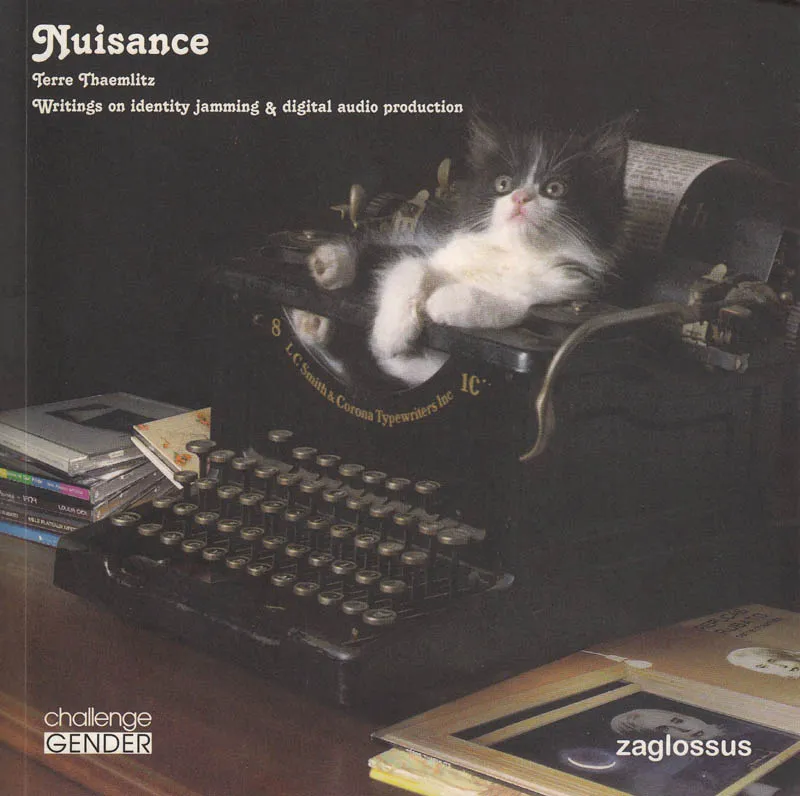
Nuisance
Nuisance compiles articles, essays, lecture transcripts, album annotations and other texts written by queer audio producer and writer Terre Thaemlitz between 1996 and 2015.
The overall theme uniting the texts is a defense of pessimism and a critical rejection of the incessant optimism lurking at the core of virtually all media – even in the “critical fields” themselves, where it reflects our conformity to those First World humanist and capitalist practices we wish to critique.

Master Rock
Master Rock is a repertoire for a mountain.
Rough land, open palm. Bodies are machines that shake. Big boned faces, big hands, big claws, ah Jesus, well-used. Bore. Blast. Smash. Force on loan. Must be hard and clever to survive in this technological age. Granite knows the biological. Gods inside the mountain, just plain men outside.
Working through the cavernous space in Ben Cruachan, the largest peak on the west coast of Scotland, Maria Fusco exhumes three fictional voices from fact: Tunnel tigers, the Irish explosives experts who emptied out the mountain to build a power station; Elizabeth Falconer, the artist who produced a mural inside that only the site’s workers ever see; and Granite, the 450 million year-old rock of Cruachan itself as a main character.

If Our Wealth Is Criminal Then Let's Live with the Criminal Joy of Pirates
If Our Wealth Is Criminal Then Let's Live with the Criminal Joy of Pirates collects two short stories and an essay by Jacob Wren. In the first story, 'The Infiltrator, ' certain ongoing, rarely mentioned, difficulties for the activist Left are explored with unlikely candour. In 'Four Letters from an Ongoing Series, ' the postal service becomes an unwitting accomplice to the gatekeepers of potential culture. Finally, in the essay 'Like a Priest Who Has Lost Faith, ' questions of art and emptiness shift focus in relation to the agency that at all times surrounds us.

#8 Schizm Magazine
SKEPTICAL UNCERTAINTIES (false truths & honest lies)
Contributions by Bob Ajar, Pedro Diego Alvarado, Aureliano Alvarado, Sam Basu, Manuela Barczewski, Iphgenia Baal, John Chilver, Paul Philipp Heinze, Thomas Helbig, Jaakko Juhani Karhunen, Paul Johnson, George Macbeth, Christoph Meier, Sascha Mikloweit, Mocellin Pellegrini, Pages, Tomas Rydin, Adam Rompel, Fiona Sarison, Barry Sykes, Eleanor Vonne Brown, Markus Vater. Schizm Magazine invites contemporary artists and writers to contribute pages in response to a theme which, as the title implies, engages with a paradoxical idea. Each issue combines archival material with original works and texts sent in by between ten to thirty contributors.

Head
Mo-Leeza Robert's novel Head describes the desperate future that clusters around Head Gallery like cockroaches swarming over a pig's head. It is at once critical and complicit, deluded and envious. Jerry-rigging saccharine sci-fi, with a leavened mush of curatorial artspeak, artists, collectors, hanger-ons and other art world actors explode in ecstasy, pain, or self-induced eradication – all, according to the whims of the Head Gallery, which remains an anonymous and inviolate force, the overseer of events and a selfless accumulator of prestige and wealth. Familiar contemporary artists are reanimated for the future, giving the events described an unsettling familiarity. Any reader familiar with the art world should feel both seduced, and infected. It is like Dickens but with laughs induced by our approaching extinction, and like Salò, written, directed and starred in by Barbara Gladstone.

The Library of Helen Chadwick
The 6th installment of The Social Life of the Book series is a section of the catalogue of publications from English conceptual artist Helen Chadwick’s personal library, reproduced by Will Holder for single mothers. The library was acquired in 2006 and is held by the Henry Moore Institute archive, Leeds, UK.

Composition As Publication – And – What Are Margins

CRUMPLED, RUMPLED, CRAPPY, TACKY, RAUNCHY, UNCONSCIOUS, WHATEVER
An artist, a musician, and a publisher based in Brooklyn, NY, James Hoff tells here how books got him into art. He considers the complex and stimulating fabric of anecdotes, gossip, secrets, that are shared around artists’ publications, and, further, the role of printed matter in the building of an artist’s community. The essay pays homage to Edit DeAk through its title, and also comprises some pictures of book covers and LP sleeves from Hoff’s collection.

TABLOID
The poems of TABLOID (Zoe Darsee's Sympathies & Nat Marcus' Interview) reflect the position of its writers as actors and interpreters, as participants in pop and club culture, and as agents within a community. TABLOID is a relic of a social scene (Berlin, 2014), as such, its effects are intended to be both social and literary. The texts are brash, heartfelt, retributive and performative - they place the form of a poem alongside a conversation, rumor, or Facebook message.
Favoring this state of disposal over delicacy, the everyday over the elevated, TABLOID is produced on newsprint. The poems are scaled to the size of a column of gossip or current events; unbound, the pages will wear, shift, and possibly have a falling out. TABLOID is a newspaper founded in Berlin in the late spring of 2014. All poetry included in the first issue was written during that time and through the summer.

Time has fallen asleep in the afternoon sunshine
Een dag in 't jaar door Herman Gorter
For the project Time has fallen asleep in the afternoon sunshine a group of people/ performers memorize a book of their choice. Together they form a library collection consisting of living books. After years of learning by heart and reciting for readers, some of the books have now been written down from memory to create new editions, versions resulting from this process. This book is one of those books, chosen by one person, learned by heart and recited many times, and now written down again from memory. This edition is not a re-edition of the original text. It is a re-writing of the text after the process of reading, memorizing and reciting, with all the alterations that might have occured in the course of this process.

The Xenotext Book
Book I of The Xenotext constitutes a kind of "demonic grimoire," providing a scientific framework for the project with a series of poems, texts, and illustrations. A Virgilian welcome to the Inferno, Book I is the "orphic" volume in a diptych, addressing the pastoral heritage of poets, who have sought to supplant nature in both beauty and terror. The book sets the conceptual groundwork for the second volume, which will document the experiment itself. The Xenotext is experimental poetry in the truest sense of the term.

Enthusiasm
{ENTHUSIASM} is the 7th poetry collection by poet, artist, curator and vanguardist SJ Fowler. It follows highly-acclaimed collections including The Rottweiler's guide to the Dog Owner and Enemies: the selected collaborations of SJ Fowler. The book's 81 poems are intended as individual pieces in their own right, but are interlinked by subjects including battle and violence, infants and infancy, religion, economy and population, the self, modernity, and the past.

How To Sleep Faster 6
“How can we fuck in a way that doesn’t support a patriarchal prism and standard for sex to reflect capitalist relations? Can sex be a site for identity politics, after we are imbued with the lore and failure of the sexual ‘revolution’?”