Books
Books
published in 2026

Paces the Cage
S*an D. Henry-Smith’s second full-length book of poems, PACES THE CAGE, lifts off from their previous book, Wild Peach (2020), by expanding an already-queered language to near breaking point. Through the complexities of Henry-Smith’s personal experiences and the use of a poetically fragmented voice, the literal and metaphorical are here remixed in real time. Henry-Smith’s occasional inclusion of ambient sounds and a musical language and tone used throughout the book helps to build a rich auditory landscape that enhances the immersive quality of the poems, creating a deep and evocative collection by this adventurous and endlessly exciting artist. As if it were an improvised performance itself, PACES THE CAGE actively tunes personal and historical narratives of oppression and adversity with the act of speaking, and what it means to be truly heard by a community of one’s fellow creators and collaborators.
PACES THE CAGE extends S*an D. Henry-Smith’s interdisciplinary, improvisational listening into a poetics of “fissure and measure,” where silence and the sonic converge in boundless motion. Tuning language toward the frequencies of breath, pulse, and sociality, Henry-Smith's poems transport us from natural worlds to communal forms to Bill Gunn’s STOP, recovering wayward images and utterances to compose a surround sound of loss and renewal. What emerges is both reckoning and remedy—a lush sensitivity to the ways language becomes live, as in now, as in “eyes open, full of rage.”
S*an D. Henry-Smith’s reverberant propositions seek the music of mutual renewal, constantly and impatiently approaching the present. This is a field of spiraling, alliterative song, the wild signature of Henry-Smith’s lyric, that renews commitments to militancy by naming and knowing its enemies as doubtlessly as it names and knows it lovers. PACES THE CAGE considers a set of conditions—technical, material phenomena—that produce collective and contradictory imaginations and gives words to the song that makes the gathering last, “all in for all…” PACES THE CAGE is a beautiful rehearsal of attentiveness, a rigorous and generous correspondence with the edges of the frame.
– dove, Christine Kirubi
S*an's PACES THE CAGE recalls to me Akilah Oliver’s 2004 An Arriving Guard of Angels, Thusly Coming to Greet. A lyrical unleashing into the many selves, the author here plays conduit for many beautiful bodies; for those souls wandering at daybreak; for the pudgy greased cheeks and those that murmur in the dew of twilight uncloaked. It is as if the poet has extracted from the marsh, the runoff, roundup and peat to stockpile and make lush a new yet familiar world. S*an has created a collection of diamonds from the salty mines of turtle tears. The divorced defanged possessive absent its apostrophe, left to the mud puddle for butterfly nuptials throughout, tells the reader: How you know me Now will be Different from how you knew me. These buoyant poems that are S*an’s latest songs have not missed the train this time. Make certain that you don’t. I’m in awe.
–LaTasha N. Nevada Diggs
S*an D. Henry-Smith is a poet and photographer, working by extension in sound, performance, and publishing.

Issue № 6 - Winter–Spring 2026 / SENSING BODIES
Coming back to the body is rarely tranquil. Often it is turbulent, interrupting dominant narratives and entrenched meanings. It is the upset of being alive, and awake to it.
The fourteen texts in this new issue do not shy away from that turbulence. There is joy and there is pleasure, there is shame, pain, and liberation... Each text addresses this dense experience from a singular perspective, yet together they explore what emerges and becomes possible when sense-making and making sense(s) are re-anchored in the sensing practices of the body.
With texts by Valérie Hug, Marco Antonini, cassiane c. pfund, Elodie Olson-Coons, Ines Marita Schärer, Bernadette Kolonko, Jo Bahdo, Lotta Beckers, Melanie Jame Wolf, Samuel Brzeski, Madeleine Kaye, Nora Longatti, Rosanna Puyol Boralevi, Larissa Clement-Belhacel
editorial team: Delphine Chapuis Schmitz, Nicole Bachmann, Robert Steinberger, and Shelby Lee Stuart as invited editor

I Speak Radio
Anna Bromley, Achim Lengerer and 1 more
Publishing a selection of her radiophonic essays here for the first time, I Speak Radio reflects Anne Bromley's collaborative radio practice.
Since 2010, Anna Bromley has been inviting artists, activists and cultural researchers into the radio studio to explore language and voice together, in the context of sound, politics and everyday life. What began as an artists' radio research format has developed over the years into a series of exhibition pieces focusing on radio and its visible and invisible transmission bodies.
Publishing a selection of her radiophonic essays here for the first time, I Speak Radio reflects Bromley's collaborative radio practice. The publication also provides insight into the corresponding exhibition formats of these projects, including cooperations with a large number of artists, activists, radio makers and theorists. An index of images and texts on Bromley's other artistic works is inserted into the book.
I Speak Radio opens with Bromley's eponymous multimedia essay on the feminist appropriation of early radio technology in the 1920s. A Voice Exists in Voicing, the series of radio essays and sonic portraits with which Bromley opened the Manifesta Radio in Prishtina in the summer of 2022, comprises the core of the book. The accompanying visual element to this section is a series of drawings by Michael Fesca. Contextualizing texts by Catherine Nichols and Hedwig Fijen provide an introduction to A Voice Exists in Voicing. Finally, Bromley talks to media activist Diana McCarty about the politics of persistent radio voices and considers critical perspectives on radio as a medium within art exhibitions.
The reader series Scriptings: Political Scenarios publishes carefully selected scripts and texts by artists that refer neither to academic forms nor to purely literary forms of writing, but rather embed "text" as a fully integral part of contemporary political and visual art practice.
Contributions by Anna Bromley, Diana McCarty, Hedwig Fijen, Catherine Nichols, Tetsuo Kogawa, Alla Mitrofanova, JD Zazie.

Estonian Academy of Arts / EKA GD MA
to flaunt, really
“… Ever since its inception as a profession, graphic design has exhibited its necessity to make information public. Its urge to expand and to reproduce reflects its capitalist inheritance. This desire however isn’t always shared by all stories molded and articulated by the discipline.
Publishing is preceded by a series of labours, but the act itself consists just of a very instant. It is one loud shriek from the top of a hill. A toppling-over. From then on a story will tumble downhill—distribute and disseminate. However that happens, and who it reaches is an unpredictable process. Thereafter publishing enables, and sets in motion, all its future readings and retellings.
Wondering the many contradictory sensibilities contained in this process, we attempt to grasp their whys, their hows and their ifs. The following essays— written by Sunny Lei, Haron Barashed, Agathe Mathel, Alina Scharnhorst, Villem Sarapuu, Gal Šnajder, Seppe-Hazel Laeremans, Fernanda Saval and Eva Claycomb—stretch and curl in between these various registers of opening up and closing in.
Unraveling the movements, strategies, forms and intentions of publishing, this book attempts to unfold their utterances, platforms, languidities, reinterpretations, identities, tactilities, ambiguities, characters and audiences.”
—from the introduction by Seppe-Hazel Laeremans and Agathe Mathel.

Otherhow: Essays and Documents on Art and Disability 1985–2024
Otherhow brings together four decades of writings, lectures, interviews, and documentation of work by the artist Joseph Grigely. Deaf since the age of ten, his art and writing have long questioned and made use of various modes of communication—photographs, handwritten notes, lipreading, newspaper headlines, paintings, and TV captions—to examine and scrutinize the ableism embedded in cultural and media production. From his brilliant series of postcards addressed to Sophie Calle, where he began to formulate a theory on the intersection of disability and art, to his epic lecture “On Failure,” which brings together the poet Keats, “the first woman of fly tying” Helen Shaw, and the filmmaker Andrei Tarkovsky to the same table for a conversation on beauty, Grigely’s writing is erudite, but clear; righteous with fury, but dryly humorous.
An underlying theme throughout are modes of access and how issues of accessibility and their resolution provide a benefit to everyone, not just the disabled. Chapters devoted to art, access, and advocacy underpin the interconnected nature of these issues in a maddening, but ultimately enlightening manner. Letters of complaint, faxes and emails, unpublished op-eds, exhibition proposals, statements on equality and access; each provide a glimpse into how Grigely’s work has been shaped by—or constructed from—the “tangled process” of opening access.
Joseph Grigely, artist, educator, and activist, is currently a Professor of Visual and Critical Studies at the School of the Art Institute of Chicago. He holds a Doctorate in Philosophy from Oxford in English literature and has taught at Gallaudet University, Stanford University, and the University of Michigan. Exhibiting widely in the US and Europe, his most recent show In What Way Wham? was presented at MASS MoCA in 2023–24. His work is in the collections of the Museum of Modern Art (NY), the Whitney Museum of American Art, the Tate Modern, and the Stedelijk Museum, among others.

Nothing at All
An atmospheric rumination on gendered violence, cosmic collapse, and colonialism.
From deep inside a black hole, comes Nothing at All—the space where everything collapses: form, genre, gender, and being. Olivia Tapiero’s poetic and essayistic fragments overflow with lyric beauty as they explore how colonialism, illness, and desire intertwine amidst personal and collective suffering. Generations, geographies, and desires mingle, contaminating one another in these anarchic, insubordinate texts. Here, the written word disrupts foundations and nations, claiming its own survival.
Olivia Tapiero is a writer, translator and musician. She is the author Les murs (Robert-Cliche Award, Prix Senghor finalist), Espaces (2012), Chairs (2019), Phototaxie / Phototaxis (Nightboat Books, 2017 / 2021, Lambda Literary Awards finalist), and Rien du tout (2021, Grand Prix du livre de Montréal Finalist, Governor General’s Literary Awards finalist). She is editor-in-chief for the literary magazine Moebius, and has contributed poems and essays to various publications in Canada, France, and Korea. She has also translated works of contemporary authors such as Roxane Gay, Anne Boyer and Billy-Ray Belcourt. She lives between Marseille and Montréal.
Foreword by Anne Boyer.

Prompt Thinking
Prompt Thinking explores how artificial intelligence is fundamentally transforming the nature of thought. In the age of generative AI, prompting becomes more than a technical instruction: it emerges as a philosophical practice.
This book arises from an experiment with AI in which the fictional philosopher Jianwei Xun sparked global debate by publishing a book about power and perception in the digital age. That book, Hypnocracy: Trump, Musk, and the New Architecture of Reality, was written with the assistance of AI. Rather than casting AI as either savior or threat, Prompt Thinking proposes a third way: conscious dialogue with artificial intelligence as a means to expand critical awareness. The book shows how critical philosophical engagement with AI can produce unexpected insights while preserving intellectual autonomy.
Part theoretical framework, part methodological provocation, Prompt Thinking offers tools for navigating cognitive transformation. It proposes an ethics of the threshold, neither rejecting technological change nor surrendering to it.
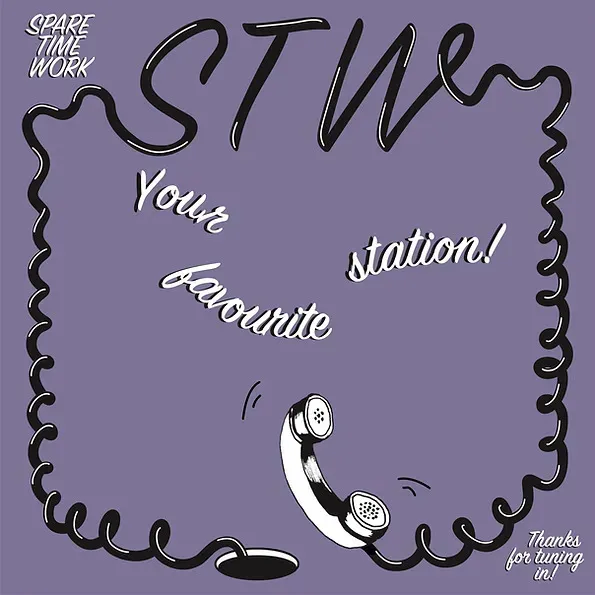
STW, your favourite station!
STW, your favourite station! functioneert als een radioprogramma. Een boek dat lyrisch proza uitzendt van We make stuff up for a living (een CV medley) tot COMPUTER_SONG, een ceremoniële quiz met Adult Hood & Young als protagonisten, een grillige anekdote van iemand die zich ergert aan een Call Service, en meer! Thanks for tuning in!

Unbidden Tongues #10: Professional Agitator
From the beginning, Unbidden Tongues has claimed to publish 'previously produced yet relatively uncirculated work by cultural practitioners busy with questions surrounding civility and civic life-particularly in relation to language and its administration.' However, over the course of the first nine issues, the 'civic' aspect has been relatively less pronounced, though undeniably subtextual. As such, Professional Agitator-a publication that includes two landmark feminist articles by Jo Freeman-is an attempt to bring civic responsibility more overtly to the surface. While first penned in the 1970s, the articles have a timely relevance, not only because, shockingly, many of the issues on the bill for the women's movement at Freeman's time of writing-employment discrimination, affordable childcare, reproductive rights and sexuality- are back on the table in the U.S. and elsewhere with full force, but also because, in thinking intersectionally as the movement taught me to do, we find ourselves in a moment of necessary and urgent mobilisation for Palestine; with speaking up and out being reprimanded with various forms of organised silencing.
(From the foreword)

Nothing About Interior Architecture
Javier Fernández Contreras, Youri Kravtchenko and 1 more
Often dissident, sometimes adherent, Nothing About is, in essence, indefinable because it is adaptive and fluid. Speculative or hands-on, this discipline – if we can call it that – displays all the ambivalences of our contemporary lifestyles: superficial and profound, profane and divine, present everywhere and nowhere, and often regarded as futile, even though it could nonetheless destroy the most beautiful of insides. This book brings together a variety of intellectual tools and insights – polysemic and ambiguous, bespoke and improvised, ornamental and criminal, spanning media, technology, the arts and other, often undefined fields – that analyze the impact of the discipline on contemporary design. In the end, what makes Nothing About charming is that this inside – insofar as it is still defined as such – has only the humble ambition of accompanying beings, both animate and inanimate, within their environment, like a friend who is never far away.
Introduction by Javier Fernández Contreras. Text contributions by Daniel Zamarbide, Line Fontana & David Fagart, Valentin Dubois & Bertrand Van Dorp, Camille Bagnoud & Ahmed Belkhodja, Javier F. Contreras & Roberto Zancan, Paule Perron, Philippe Rahm, Youri Kravtchenko, Leonid Slonimskiy, Simon Husslein, Vera Sacchetti, Jan Dominik Geipel, Valentina De Luigi, Jean-Pierre Greff.

Mousse #94
Petrit Halilaj and Danh Vo in conversation; Forensic Architecture (Eyal Weizman, Nour Abuzaid, and Elizabeth Breiner); Gabrielle Goliath; Edward W. Said; Shumon Basar; Dani Blanga Gubbay; Yvonne Rainer; Thomas Eggerer and Jochen Klein; Tobias Pils; Travis Jeppesen...
Collective intelligence (along with its wildly popular counterpart, brain rot) is a recurring subject of late. This issue is woven together through reflections on methodologies of the collective, larger-than-ourselves dynamics and "what goes unuttered (of, perhaps, what is painfully unutterable)," as Zoé Samudzi writes about Gabrielle Goliath—whose project for the South African pavilion at the upcoming Venice Biennale has been cancelled by the Arts and Culture Minister of her country for being "divisive." We stand in solidarity with the artist. Forensic Architecture's Eyal Weizman speaks of new ways of detecting "hyper-relations" as strategies to confront systemic violence. Edward W. Said, in his crucial 1993 essay "Speaking Truth to Power" (reprinted here), argues that "the intellectual's voice is lonely, but it has resonance because it associates itself freely with [. . .] the common pursuit of a shared ideal." And in our Curators section, Shumon Basar memetically reaffirms that now more than ever, "Comment is king."
Let's not shy away from commenting.
This issue comes with different covers, randomly distributed.

Plastic: A Poem
Set during a single twelve-hour night shift in an injection molding factory, plastic is a book-length poem exploring the life of the industrial worker turned poet.
Bringing together memoir, ekphrasis, and satire, plastic is based on Matthew Rice’s experience working in a plastic molding factory for ten years. Illustrating alienated twenty-first-century Irish labor in poetic form, plastic engages with the inflictions and implications of a “post-industrial,” “post-Troubles” society, all while weaving in depictions of factory work from literature, film, and the visual arts.
Time-stamped to highlight the claustrophobia of the worker’s experience, Rice meditates on masculinity, sectarianism, and intergenerational trauma. But at its core is a poem about feeling a calling while being submerged in the world of menial labor—making plastic airplane parts by night, making poetry by day.
Invoking the brevity of Seamus Heaney, plastic is an expansive and imaginative poem that offers the working class a grace, dignity, and truth not often found in contemporary literature.
MATTHEW RICE was born in Belfast. He holds an MA in poetry from Queen’s University Belfast and is currently undertaking a PhD at the Seamus Heaney Centre at Queen’s. His debut collection, The Last Weather Observer, was published in 2021 to critical acclaim, highly commended for the Forward Prize for Best First Collection, and included in the Arts Council of Northern Ireland’s top ten books of the year.

The Collected Writings (1991–2024) of a Mortal to Death
No Place Press is collaborating with Jalal Toufic on an ambitious publishing project: The Collected Writings (1991–2024) of a Mortal to Death: Jalal Toufic. Spanning three volumes of more than six hundred pages each, the series gathers re-edited versions of his earlier works alongside two newly written books, arranged and organized by the author himself. For new readers, the volumes provide an introduction to Toufic’s central concepts—including the withdrawal of tradition past a surpassing disaster, radical closure, silence-over, the 180-degree over-turn, and the dancer’s two bodies—while for longtime readers they offer a comprehensive view of more than three decades of thought, presented in their most rigorous and fully articulated form. Yet, in keeping with Toufic’s practice—which participates in untimely collaboration (including with future filmmakers, thinkers, and artists) and abides in the suspension of the avenir of messianism/Mahdism—some of these works remain forthcoming even after their inclusion in the Collected Writings.
Volume 1 (2025) includes newly revised editions of Toufic’s first three books—Distracted (1991/2003); (Vampires): An Uneasy Essay on the Undead in Film (1993/2003); and Over-Sensitivity (1996/2009)—together with the script Jouissance in Postwar Beirut (2014) and, new, The Unreviewed Writings of a Peerless Thinker (2024).

Spike #86 – Salad Days!
Spike #86 is turning to the wild season of youth – life’s Salad Days.
Forget all the Boomer panic about a generational crisis; the kids are alright, living out our hyperconnected present to its strangest limits. New kinds of aesthetics, of activism, of entrepreneurship; new images as much as new perspectives on what images are; and, above all, a new, very quantum attitude towards fact and fiction, history and the future: young people are modeling how to be in our very confused times – and producing some of the most interesting forms of culture we’ve ever seen.
Featuring a Zoomer’s guide to the Slopgeneration; an essay of on being young at art in the Instagram age; a rundown of contemporary art’s nepo babies; reality checks on culture’s obsessions with youth and dying young; portraits of couture-sculptor Tenant of Culture, Turner Prize-nominated photographer Rene Matić, e-waste sculptor Brian Oakes, and Austrian painter Lukas Posch; send-ups of teenage fiction’s ecstatic weirdness and youth-quakers’ political promise; a critique from Silicon Valley of the industrialization of young risk-taking; art’s perfect Los Angeles metaphor; and a splash of back-page advice: “You shouldn’t be fun at twenty-one. You should be tortured.”

Black Ark
The point of departure for the book «Black Ark» with Lee “Scratch” Perry (1936–2021), a Jamaican musical and visual artist who was based in Switzerland, is a detailed inventory of photographs and writings (Spring 2021) from the Black Ark Studios in Kingston, Jamaica, where Lee produced his music from 1973 on. He was a seminal pioneer of dub, an electronic subgenre of reggae that uses sampling, looping, remixing, reverb and echoes to create new songs as well as rework and appropriate pre-recorded songs and tracks.
Black Ark Studios was one of the cradles of dub. It’s also where Lee “Scratch” Perry’s musical approach found an enduring visual counterpart in the form of continuously evolving mural paintings and drawings as well as shape-shifting assemblages of records, instruments, found objects, posters, newspaper and magazine clippings, and appropriated books. The artworks form actual layers upon layers that are rhizomatically intertwined with the studio building itself as well as with the furniture inside—and with Perry’s biography and persona.
Perry created his very own, dense and eclectic world—a world that is documented in «Black Ark», before it disappears for good: the premises have recently been sold. The photographic documentation of the studio was supplemented by efforts to secure and preserve Perry’s cultural objects as part of a joint project with various cultural institutions.
«Black Ark» which reflects the rhythm and layering effects of collage both in its content and the materials used to craft the book. Perry was involved in the conception of the book in its early stages. It also interweaves various media and chronologies. The new photographs of the Black Ark Studios will be juxtaposed with stills from old documentaries and archival photos.
The idea of a “house” serves as both a working hypothesis and a metaphor. It will be the starting point and endpoint of various thematic strands, both visual and textual: for example, the book will explore the Black Ark as a “spiritual yard” in the context of African diaspora, as well as looking into archeomusicological aspects. Furthermore, extended captions by Perry’s biographer will provide the backdrop for a kaleidoscopic panorama of Perry’s eclectic and ingenious work.

Insula
Insula est un roman d’anticipation aussi intime que spéculatif qui mêle autofiction, confession intime, esthétique queer, jeu vidéo, et une formidable vision apocalyptique du monde contemporain. Insula (île, en latin), c’est d’abord le nom d’un jeu clandestin de réalité augmentée d’un nouveau genre : il suffit d’ingérer une pilule stupéfiante et illégale pour accéder à la simulation. Théo, le narrateur, en apprend l’existence lors d’une fête de cruising queer, au sommet d’un immeuble désaffecté du centre de Londres, dans une atmosphère d’apocalypse. Un garçon s’effondre à ses pieds quelques minutes après avoir consommé la substance, et pleure des larmes de sperme. Mais Théo doit tout interrompre pour se rendre au chevet de son père mourant, dans un hôpital parisien. C’est le moment de la dernière nuit, du dernier souffle et des derniers aveux. Le mot insula revient, cette fois dans la bouche des médecins, pour désigner une partie flottante du cerveau ravagée par la maladie, comme une île qu’on a dans la tête. Alors que les médias annoncent la disparition de plusieurs personnes qui auraient pris une pilule d’insula, l’étau se resserre sur Théo qui se résout à son tour à prendre un cachet prohibé avec l’intuition que les avatars ne sont que des fantômes, et qu’il pourra ainsi retrouver son père dans l’autre monde.
Ce roman aux accents dantesques (vision d’un enfer digital qui n’est que le double du monde réel), entre vertige technologique et exploration du désir, est marqué par la pensée critique du réel et la pop culture (Final Fantasy, Kanye West). Il ouvre un univers parallèle pour raconter l’histoire d’une traversée intime, convoquer des époques, des territoires et des identités multiples, dans une seule et même histoire qui navigue entre témoignage et fantasme. Dystopie, histoire d’amour et de fantômes, enquête et cauchemar, Insula est un portail entre plusieurs dimensions, le vrai et le faux, le réel et le digital, la vie et la mort.

Parapraxis 07: Romance
It is a particularly unlovely time to be thinking about romance. The heart can be fickle, indulgent, its matters distracting, impractical. But in the heavy boots of our undesirable present, seized by colliding catastrophes, we ask: how do we get out of here? Can the simple math of desire plus futurity break us free? Or is this just a barely veiled expression of our longing for avoidance? When we declare that love is the answer, we often forget the ambivalence of which psychoanalysis warns: love emerges in tandem with hate. It is neither the antidote to aggression nor the basis of a coherent social order.
As a narrative structure, romance insists on the future. Whether it's with a new lover hoping to break the repetition of bad patterns, in emotional growth born of the analytic couple, or inside the tremulous energy of an insurgent crowd that makes yesterday seem historically distinct from tomorrow, romance threads time with the texture of meaning. Perhaps delusional, perhaps heroic in this audacious promise, romance must also always be a fantasy, an imagined structure that has not yet met its match in the present. While this fantasy is vital to our attachment to the world and each other, it can also provide the fuel for self-serving denial and disavowal. When we say that the youth are not fucking and that they don’t care about politics, these separate charges obscure the nature of their common cause. As the world attempts to disavow the death of the earth and the removal of its peoples, our sense of continuity flees; the receding horizon is not an open road, but a vanishing point. Whither romance?
Dependent. Detached. Trauma Bonded. The Incest Lobby. Revolution Against Romance. Reading for Love and Labor. Surrealist Bedfellows. Mad Love. Essays by Nadia Bou Ali, hannah baer, Moon Charania, Davey Davis, Kaleem Hawa, Anna Kornbluh, Thomas Ogden, and more.

A4 review N°4
Gorge Bataille, Marc Buchy and 2 more
Founded in 2023, A4 is a poetry review which showcases and explores contemporary writings practices. Run by Littérature Supersport collective, the object is seen as the extension of their events. The review takes the form of 4 postcards which, when placed side-by-side, form an A4-sheet. A light (even precarious) format for literature that slips into the back pocket of pants and hangs on fridge doors. Each issue features unpublished texts by 4 authors.
This issue presents texts by: Gorge Bataille, Marc Buchy, Samy Manga, Elke de Rijcke.

Metropolitan Voids Agency
Margherita Moscardini, Zasha Colah and 1 more
Metropolitan Voids Agency is the first monographic publication dedicated to the collected works of artist Margherita Moscardini. The book recounts the work carried out by Moscardini spanning seventeen years, between 2008 and 2024, inviting a reading of her practice in its entirety as an investigation into ‘urban voids’: those which Moscardini has recognized and designated as voids, or those she has herself invented in the urban fabric.

Two Revolutions a Day
Two Revolutions a Day marks the first in-depth publication devoted to the work of Sophie Nys, whose artistic practice over the past two decades has unfolded through an enterprising interplay of research, observation, and formal experimentation. Moving between exhibition-making, design, and subtle acts of re-framing, Nys has developed an oeuvre that resists fixed categories while remaining acutely attentive to the structures – historical, linguistic, psychological – that shape how meaning is produced and circulated.
Rather than presenting a linear retrospective, Two Revolutions a Day is organised as an extended conversation between Nys and critic Christophe Van Gerrewey that mirrors the artist’s own methods. Together, they revisit key works and exhibitions from the early 2000s to today, tracing recurring motifs and questions while allowing contradictions and shifts in perspective to remain visible.
Throughout the book, Nys’s fascination with systems of power and authority intersects with a sensitivity to intimacy, subjectivity, and the everyday, engaging with feminist perspectives that examine the politics of representation. Historical figures, marginal anecdotes, and overlooked documents appear alongside reflections on resistance, collaboration, design, and the conditions under which artworks –and the social roles they inhabit – come into being. Language, in particular, emerges as both material and problem: a tool that promises clarity while constantly slipping, misfiring, or revealing its own limits.

Tosquelles: Healing Institutions
Having fled to France in the aftermath of the Spanish Civil War, the Catalan psychiatrist Francesc Tosquelles joined the Saint-Alban psychiatric hospital, where he carried out a transformative clinical practice for over twenty years, in part under the Vichy regime.
Saint-Alban was an extraordinary event, a commune, an informal refuge in a time of extreme danger, a sort of upwelling spread through word of mouth. Those entering the asylum were welcomed, and that welcome never stopped. Care happened through a broad range of communal activities for staff and patients: theater, cinema, collective writing, horticulture, the sorting of colored pearls, gymnastics, singing, a monthly newspaper. The dignity of every patient was of foremost importance.
Now, as then, warmongers are willing to poison and slaughter without blinking, making all of life difficult if not impossible: the pull of such asylums is obvious. Tosquelles is a ground-breaking record of the life and work of the founder of institutional psychotherapy. Assembled by Joana Masó, with many texts translated to English for the first time, it is a direct encounter with Tosquelles’s clinical, intellectual, and political writings.
“Tosquelles’s work serves as a model for dismantling capitalist institutions, a revolutionary venture whose essence Joana Masó captures.”
Paul B. Preciado
“This remarkable collection allows us to experience the genius of Tosquelles in all its dimensions for the first time. We accompany him through his early work in Reus and Barcelona, the development of his therapeutic ideas and inventive practices in war-torn Catalonia and in exile at the Septfonds Camp, his legendary years at Saint Alban and his lesser-known later years in Melun, Nouvelle Forge and La Candélie. Joana Masó guides us to the creative heart of a man whose counter-cultural, counter-intuitive thinking excited generations of intellectuals in France and now inspires the world.”
Rosie Stockton
“Resistance hero, anti-Stalinist Marxist, Surrealist, revolutionary practitioner of social therapy, mentor to Frantz Fanon: Francesc Tosquelles was one of the most innovative thinkers in modern psychiatry, a visionary whose moment may finally have arrived.”
Adam Shatz
With texts by Francesc Tosquelles, trans. Robert Hurley and Mara Faye Lethem

Peau d’Ana
Ana Jotta, Alice Dusapin and 2 more
A long conversation about the work and life of Portuguese artist Ana Jotta, accompanied by 60 previously unpublished photographs of her homes (in Brazil, Morocco, and Zanzibar) and her years in theater in the late 1970s.
“Peau d’Ana” is a conversation with the Portuguese artist Ana Jotta (1946), conducted in January 2024 by Alice Dusapin, Martin Laborde, and Baptiste Pinteaux in the Lisbon apartment that Ana has occupied for over forty years. Through the history of both this unique place and the various other homes in which she has lived — Tangier, Madeira, Brazil, and the Portuguese countryside — Ana Jotta mischievously and playfully invites us to revisit fragments of her life. She discusses her childhood, her work as an actress and set designer, her first exhibitions in the mid-1980s, and her life in the studio. She talks about the importance of pleasure and frustration, her love of painting and literature, and the role of the irrational in her work. She shares her dislike of families, her friendships with artists and other animals, and the detours necessary for finding, and preserving, the energy essential for work… and for sleep. She disarms with the precision of her words, which describe a solitary, demanding, and profoundly vivid existence where mediocrity has no place. The interview, published in French and English, is accompanied by some sixty previously unpublished photographs and documents.

Weird Fucks
A brilliant novella from a legendary figure in American fiction.
A young woman drifts through dimly lit bars and rented rooms, reporting from the erogenous zones of New York and Europe. Encountering increasingly bizarre sexual situations, she turns her curious, comic, and fierce eye onto the contemporary world of sex and desire.
The men of this world evade and simper, they prey, preen, and fall hopelessly in love. In the narrator’s deadpan portraits, we see young women indulging their freedom through hope and disappointment, and young men wearing various guises of masculinity.
This novella surprises with unlikely fucks, disturbing fucks, outlandish fucks, and some truly weird fucks – all written with the smart, elegant, and tough style which could only be that of Lynne Tillman.

A Nazi Word for a Nazi Thing
An essay on art, bodies and fascism.
In an era where identity politics is being weaponised against the very people it has sought to make visible, how can we reclaim complexity?
In 1937 the Nazis staged an exhibition of seized modernist artworks. Named Entartete ‘Kunst’ – Degenerate ‘Art’ – it sought to define degeneracy, display it and destroy it.This act of violent appropriation is one episode in a long and ongoing history of the erasure of queer and non-normative cultures.
A Nazi Word for a Nazi Thing works against this erasure; it is a manifesto – a catalogue for an exhibition that could never take place. Drawing on work from dissident sexologist Magnus Hirschfeld to South African artist Zanele Muholi, as well as a century of queer cinema from Sergei Eisenstein to Pedro Almodóvar, So Mayer creates an archive of resistance.
‘This book is a small revolution that becomes a party that you won’t be leaving soon. I believe we’re living in a time of fresh erasures, systemic violences working that global pandemic to take some other bodies out. Looking so freshly at the history of queerness, sexual deviance and the long long coordinated erasures of colonialism, bigotry and transphobia the essential non binary nature of art opens up right here like the wildly singing flower it is and So Mayer’s compelling version makes sense, makes me listen.’
— Eileen Myles
‘A Nazi Word for a Nazi Thing is a reflective, creative walk through some of the worst – and best – people of the last hundred years, looking at the power of images and their relationship(s) with text. In a time of rising fascism, So Mayer highlights ways that artists have found strategies of resistance, and offers hope in historical analysis.’
— Juliet Jacques