Books
Books
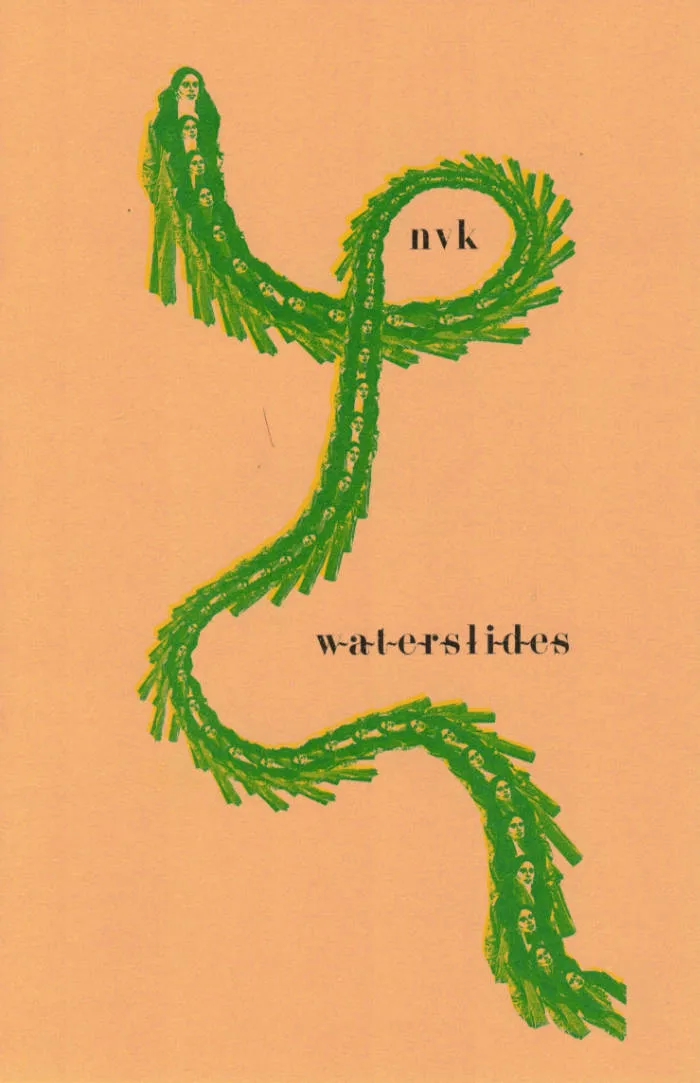
Waterslides
"Waterslides is a falling and plunging, short starts and stops aided by movement, until we splash, climb and plunge again. Each sliding is the same but different—with each descent new expectations and thoughts swirl, shifting focus and gaining new insights or blockages. Waterslides are brief moments of remembering, remembering as a present tense activity, one that happens as we think of it, projected on our now. The waterslide is the moment of past and present working in tandem, a movement of repeating, revisiting and remembering all at once.”
Written by nvk 2021-2023. Dedicated to Judi, MM & TNN.
A version of these poems was published as an audio work through Ignota Press’ The Mountain (2023) and included in a reading with James Loop on Montez Press Radio (2023). nvk would like to thank Jan Matthé, Stine Sampers and Michelangelo Miccolis for their patience & love.
This book was first presented at Kransen in Antwerp, May 6th 2023, with a performance by Sassy (costume by Rosa Schützendorf). Printed and bound at Risiko Press, Borgerhout. Cover image by nvk. Fonts: Adonis, Garamond Pro. Limited to 150 copies.
128x195mm, 16p., stapled, cover: green, yellow and black risoprint on 160gsm caramel paper, inside: black and blue riso on 120gsm Munken Pure paper.

Walking from Scores
An anthology of text and graphic scores to be used while walking, from Fluxus to the critical works of current artists, through the tradition of experimental musicand performance, gathered and presented by Elena Biserna.
Walking from Scores is a hundred or so collection of non site-specific protocols, instructions and textual and graphic scores centred on walking, listening and playing sound in urban environment. It explores the relationship between art and the everyday, the dynamics of sound and listening in various environments and the (porous) frontiers between artists and audiences. It starts with two premises: an interest in walking envisaged as a relational practice and tactic enabling us to read and rewrite space; an interpretation of scores understood as open invitations and catalysers of action in the tradition of Fluxus event scores.
With scores and texts by Peter Ablinger, Milan Adamčiak, G. Douglas Barrett, Elena Biserna, Blank Noise, George Brecht, Cornelius Cardew, Stephen Chase, Giuseppe Chiari, Seth Cluett, Philip Corner, Viv Corringham, Bill Dietz, Amy Dignam, David Dunn, Haytham El-Wardany, Esther Ferrer, Simone Forti, Francesco Gagliardi, Jérôme Giller, Oliver Ginger, Anna & Lawrence Halprin, David Helbich, Dick Higgins, Christopher Hobbs, Jérôme Joy, katrinem, Debbie Kent, Bengt af Klintberg, James Klopfleisch, Milan Knížák, Alison Knowles, Takehisa Kosugi, Jirí Kovanda, Anne Leilehua Lanzilotti, Bob Lens, Ligia Lewis, Alvin Lucier, Walter Marchetti, Larry Miller, iLAND/Jennifer Monson, Max Neuhaus, Alisa Oleva, Pauline Oliveros, Yoko Ono, Open City & Emma Cocker, Nam June Paik, Michael Parsons, Ben Patterson, Cesare Pietroiusti, Mathias Poisson, Anna Raimondo, Pheobe riley Law, Jez riley French, Paul Sharits, Mieko Shiomi, Mark So, Standards, Nicolas Tardy, Davide Tidoni, Ultra-red, Isolde Venrooy, Carole Weber, Manfred Werder, Franziska Windisch, Ben Vautier, La Monte Young.
Elena Biserna is a scholar and independent curator based in Marseille, France. She is associate researcher at PRI SM (AMU / CNRS) and TEAMeD (Université Paris 8). Her interests are focused on listening and on contextual, "situated" art practices in relationship with urban dynamics, sociocultural processes, the public and political sphere. Her writings have appeared in several publications. As a curator, she has collaborated with different organisations and presented her projects internationally.

Inch Aeons
Inch Aeons is a meditation on the form of meaning, the nature of nature, and the locality of tradition in an over-wired-world.
Here, award-winning poet Nuala Archer adopts, breaks and recreates the limits of haiku, evoking moments of collision and convergence, from "Beyond Conception- / Without Regeneration- / Big Bang's Leave let Be" to "Am-Is-Are-Was-Were- / Has-Have-Had-Do-Does-Did-Shall- / Should-Can-Could-Will-Would-."
Poet Juliet Patterson calls Inch Aeons "a complex and wondrous book," while poet Pam Ore says the poems are "like starlight, resonat[ing] with the brightness of an original violence, cooling-healing and coalescing into the word."
Published as part of the TrenchArt Casements series, Inch Aeons includes inside illustrations by Japanese artist Tamzo and visual art (back cover) by American artist Molly Corey.
Nuala Archer is the author of Whale on the Line, Two Women, Two Shores (with Medbh McGuckian), PAN/AMA, and From a Mobile Home. She served as the primary English-language editor for University Over the Abyss: The Story Behind 520 Lecturers & 2,430 Lectures in Kz Theresienstadt 1942-1944. In 1995 she survived a catastrophic car accident; recovering in Jerusalem, she enrolled in a theatre degree program at the School of Visual Theatre. Archer continues to perform with the Jerusalem Theatre Company at festivals around the world, including in Auschwitz, London, Dublin, New Delhi, Bangalore, Seoul and Kagoshima. She is an Associate Professor at Cleveland State University.

Howdunnit 2 - Panorama
Navina Sundaram is sitting in the editing room in Hamburg. She has managed to reduce the complexity of the Kemal Altun case to the required 2 minutes and 40 seconds for the political magazine; a journalistic feat considering the legal terminology and the international political situation, which must be presented in simple terms. She places her interview with the judge at the back. The audience therefore first gets an impression of perhaps the best-known deportation prisoner of the republic on trial here. The phone rings. I imagine she is displeased about the disturbance. It’s the day of the broadcast; the report still needs to be approved. It rings again. She answers. Peter Boultwood is on the phone and says, “Did you hear? Kemal jumped out of the window in the courtroom. He’s dead.”
Merle Kröger lives in Berlin where she works as a novelist, screenwriter and dramaturg. She was a member of the Berlin film collective dog film (1992–1999) and founded pong lm in 2001. Kröger is the co-author of Philip Scheffner’s internationally awarded films Revision (2012), Havarie (2016) and Europe (2022). Kröger has published five novels to date, including Grenzfall (2012), Havarie/ Collision (2015) and Die Experten/ The Experts (2021). Her novels have received numerous awards, including Best Crime Novel of the Year, the Radio Bremen Prize for Crime Fiction and the German Crime Fiction Prize.
Translated by Rubaica Jaliwala

Through The Billboard Promised Land Without Ever Stopping
Through the Billboard Promised Land Without Ever Stopping is Derek Jarman’s only piece of narrative fiction. Written in 1971, it is a surreal, fabular, lyrical work – a literary fairytale acid-trip road movie hybrid – the energies and details of which influenced much of his later work across media. The story serves as a foundational text, laying out many of the themes, images and styling of Jarman’s work in painting, film and design whilst also being haunted by the then emerging ecological crisis in its juxtaposition of the beauty of nature with the reckless consumption of modernity.
This edition features facsimile images of the story’s handwritten drafts from Jarman’s archive, a link to an exclusive audio recording of Jarman himself reading the story in full, and is comprehensively informed by a vivid foreword from Philip Hoare, a deeply researched afterword by Jarman scholar Declan Wiffen, and a warm memoir by the artist Michael Ginsborg, a close friend of Jarman’s throughout the period of the story’s writing.

The Narco-Imaginary: Essays Under the Influence
Written according to its own dictum, "language is the universal inebriant," these epistolary essays, personal narratives, meditations on avant-garde writers, and unorthodox forays into the "narco-imaginary"—the habits and conventions surrounding literary and cultural representations of drug use—attend to the residue of transient impressions that remain, long after the delirium of creative activity subsides.
Ramsey Scott teaches at Brooklyn College, CUNY. His essays, poems, and fiction have appeared in various print and online publications, including the Southwest Review, the Seneca Review, The Massachusetts Review, Shampoo, Tarpaulin Sky, Confrontation, and Mirage #4/Period(ical). The Narco-Imaginary is his first book.

Exercises of Poetic Communication with Other Aesthetic Operators
Ernesto de Sousa (1921–1988) was a major and multifaceted figure from the Portuguese avant-garde—artist, poet, critic, essayist, curator, editor, filmmaker, and a promoter of experimental ideas and artistic expressions.
Reflecting questions of hierarchy, authorship, and the complexity of framing or dividing within the multiple and complementary practices of Ernesto de Sousa—whose motto “Your Body is My Body, My Body is Your Body” serves as a poetic manifesto—this publication explores the various aspects of his oeuvre (visual, poetical, and theoretical) and his outstanding inventiveness of concepts.
The volume brings together a selection of works, unpublished archives and their translations, and theoretical texts by Ernesto de Sousa, including the first complete translation in English of «Orality, the future of art?» (1968). Richly illustrated, the book reunites an introductory text by Lilou Vidal, two new essays by Paula Parente Pinto and by José Miranda Justo along with a text by Hugo Canoilas.
"There was a time when bread was sacred; and in a general sense, all fabricated objects deserved the respect that resulted from (for the conscience of those who used them) concretely diving into their own motivations. Human gestures, like aesthetic objects, were inseparable from their relevant functions. Naturalism prompted us to look at natural and fabricated objects with a vision that was cosmic and indifferent at the same time. The objects, today, object. In the future, objects and gestures will perhaps clothe themselves once again in their lost dignity. The word love, a bit of bread, the letter A will stop being mortal accidents of daily life. Desacralized, they will once again be as decisive as the tiniest brushstroke the painter made on his canvas. And each of these brushstrokes will reveal the structure of the world. Life can then be compared to a vast work of art. Everything will be absolutely aesthetic.."
— Ernesto de Sousa
Contributors: Hugo Canoilas, Ernesto de Sousa, Tobi Maier, José Miranda Justo, Paula Parente Pinto, Lilou Vidal

Invisible Oligarchs
Bill Berkson's Invisible Oligarchs is like a book jotted on the back of a poet's hand—a hand that picks up everything that sings to it, from gold-leaf proverb to chopstick sheath, on its quick trip through a few places in urban Russia, 2006. Across faintly ruled Japanese paper, many pages reproduced here in facsimile, snapshots change hands, new poems blink, and poetry politics meet political gossip over lunch in St. Petersburg. Berkson's educated guesswork about that elusive quality once known the Great Russian Soul, is framed here by letters from his friend Kate Sutton and encompassing encounters with poets and cab drivers, Moscow conceptualists and a White Night at the Mariinsky Ballet. As a sharply observant poet and the most soulful art critic alive, Berkson knows how to get us behind the set, and reading this book is as nice as taking a high dive with him into a perfectly mixed White Russian.
Bill Berkson was born in New York in 1939. He moved to Northern California in 1970 and now divides his time between San Francisco and New York. He is a poet, critic, sometime curator, and professor emeritus at the San Francisco Art Institute, where he taught art history and literature for many years. A corresponding editor for Art in America, he has contributed to such other journals as Artforum, Aperture, Modern Painters, and artcritical.com. His recent books include PORTRAIT AND DREAM: NEW & SELECTED POEMS (Coffee House Press, 2009); BILL, a words-and-images collaboration with Colter Jacobsen; Lady Air; Not an Exit with drawings by Léonie Guyer; REPEAT AFTER ME (Gallery Paule Anglim, 2011), with watercolors by John Zurier; and a collection of his art writings, FOR THE ORDINARY ARTIST (BlazeVOX books, 2010), as well as a new collection of his poems, Expect Delays, from Coffee House Press in 2014 and INVISIBLE ORLIGARCHS out from Ugly Duckloing Presse in 2016.

A Queen in Bucks County
An epistolary sequence about sex, exchange and social space set along the Northeast Corridor.
In A Queen in Bucks County, our protagonist Turner, who both is and is not the writer, makes his pleasurable way through miserable space. Men "buy him things," lovers drive across state lines, users down volatile cocktails to see what happens, landlords turn tenants out, and Turner writes poetic tracts to friends about it. Part pornography, part novel, all love letter, A Queen in Bucks County is an experiment in turning language upside down to see what falls out.
2023 LAMBDA LITERARY AWARD FINALIST

’Est Pas Une
By way of archiving, digital translation and reproduction, Philip Poppek extracts from Magritte’s word paintings twenty-six letters; segmental symbols of a textual system form an alphabet of a, with a familiar apple punctuating a provisional end to the sequence. A poetic correspondence with the letter a speculates on the prehistory of this alphabet, as though searching for some indication as to how we may have come to where we are now, in this ‘post-factual moment’.
Maybe at some point we fell into the foxes’ den, only to re-surface in a landscape of ruins. This book poses a number of necessary questions, perhaps beginning with: ‘Which feminine noun trails after the title script ‘est pas une?
Pomme? Pipe? Histoire? Communauté?

Cadavres
Phœbe Hadjimarkos-Clarke, Rozenn Voyer
Cadavres rassemble 13 poèmes écrits par Phœbe Hadjimarkos - Clarke sur les errances dans les villes âpres, les campagnes humides et les maisons branlantes. Les poèmes sont accompagnés de 15 dessins de Rozenn Voyer.

University of California Press
Dictee (Second Edition, Reissue, Restored)
Dictee is the best-known work of the multidisciplinary Korean American artist Theresa Hak Kyung Cha. This restored edition features the original cover and high-quality reproductions of the interior layout as Cha intended them. Produced in partnership with the Berkeley Art Museum and Pacific Film Archive, this version of Dictee faithfully renders the book as an art object in its authentic form.
A formative text of modern Asian American literature, Dictee is a dynamic autobiography that tells the story of several women: the Korean revolutionary Yu Guan Soon, Joan of Arc, Demeter and Persephone, Cha's mother Hyung Soon Huo (a Korean born in Manchuria to first-generation Korean exiles),and Cha herself. Cha's work manifests in nine parts structured around the Greek Muses. Deploying a variety of texts, documents, images, and forms of address and inquiry, Cha links these women's stories to explore the trauma of dislocation and the fragmentation of memory it causes. The result is an enduringly powerful, beautiful, unparalleled work.

Sonic Meditations
Pauline Oliveros (1932-2016) Pauline Oliveros' life as a composer, performer and humanitarian was about opening her own and others' sensibilities to the universe and facets of sounds. Her career spanned fifty years of boundary dissolving music making. In the '50s she was part of a circle of iconoclastic composers, artists, poets gathered together in San Francisco. In the 1960's she influenced American music profoundly through her inclusive work with improvisation, meditation, electronic music, myth and ritual.
She founded 'Deep Listening(R), ' which came from her childhood fascination with sounds and from her works in concert music with composition, improvisation and electro-acoustics. She described Deep Listening as a way of listening in every possible way to everything possible to hear no matter what you are doing. Such intense listening includes the sounds of daily life, of nature, of one's own thoughts as well as musical sounds. 'Deep Listening is my life practice, ' Oliveros explained, simply. Oliveros founded Deep Listening Institute, formerly Pauline Oliveros Foundation, now the Center For Deep Listening at Rensselaer, NY. Her creative work is currently disseminated through Pauline Oliveros Publications and the Ministry of Maåt, Inc

Eros the Bittersweet: An Essay
Anne Carson's remarkable first book about the paradoxical nature of romantic love. Since it was first published, Eros the Bittersweet, Anne Carson's lyrical meditation on love in ancient Greek literature and philosophy, has established itself as a favorite among an unusually broad audience, including classicists, essayists, poets, and general readers.
Beginning with the poet Sappho's invention of the word "bittersweet" to describe Eros, Carson's original and beautifully written book is a wide-ranging reflection on the conflicted nature of romantic love, which is both "miserable" and "one of the greatest pleasures we have."

The Hour of the Star
The devastating final work by Brazil’s greatest modern writer, The Hour of the Star tells the haunting tale of Macabéa—a typist who lives in the slums of Rio—underfed, sickly, and unloved, yet inwardly free.
Translated from the Portuguese by Benjamin Moser. With a contribution by Paulo Gurgel and Valente Colm Tóibín.
The Hour of the Star, Clarice Lispector's consummate final novel, may well be her masterpiece. Narrated by the cosmopolitan Rodrigo S.M., this brief, strange, and haunting tale is the story of Macabéa, one of life's unfortunates. Living in the slums of Rio de Janeiro and eking out a poor living as a typist, Macabéa loves movies, Coca-Cola, and her rat of a boyfriend; she would like to be like Marilyn Monroe, but she is ugly, underfed, sickly, and unloved. Rodrigo recoils from her wretchedness, and yet he cannot avoid realization that for all her outward misery, Macabéa is inwardly free. She doesn't seem to know how unhappy she should be. Lispector employs her pathetic heroine against her urbane, empty narrator—edge of despair to edge of despair—and, working them like a pair of scissors, she cuts away the reader's preconceived notions about poverty, identity, love, and the art of fiction. In her last novel she takes readers close to the true mystery of life, and leaves us deep in Lispector territory indeed.

the she
‘the she’ compares texts by Virginia Woolf with their French translation, reproducing parts of the novelles ‘The String Quartet' & ‘Blue and Green’ and the novel ‘The Years’. Of the novellas, she kept only the articles the in English and le, la, les in French, exactly as they appear in the editions. Of the novel, only the pronouns she in English and elle in French remain.
The publication includes identical two booklets, one bound and one unbound, both uncut, referring to old books which were often sold bound but uncut.
Offset printing. Printed by Cultura, Wetteren
Edition of 123 numbered copies

Wind & De wilgen - Wind & The Willows
Wind & De Wilgen (English/Dutch) was designed by Lawrence Weiner and published on the occasion of the execution of his work Wind & The Willows in the Openluchtmuseum voor beeldhouwkunst Middelheim, Antwerp.
Lawrence Weiner was an American artist and one of the central figures in the formation of conceptual art in de 60s. His work was strongly language-based and often took form in typographic texts, also visible in this artist book.
Edition of 1000 copies

The Speak Angel Series
The Speak Angel Series is composed of six full-length books in various forms but towards the achievement of a unifying epic narrative in which the poet, as character, leads all the souls of all the living and dead to a point zero where the remaking of the cosmos can be performed. As this is being done, the official public world takes place in Paris, France and the United States, and new “characters” are incorporated from the news and from the poet’s life.
The forms include a long-line narrative broken by lyric stand-alones, an operatic form designed to make the reader chant if reading aloud, two spiritual sequels to the author’s book The Descent of Alette, written in the same stanzaic form, a book that is simply a collection of different kinds of poems, a book formed by literary collaging, and a final, long book that is the volume’s ultimate culmination.
The Speak Angel Series took years to accomplish but is finally ready; it is meant to be read for plot, pleasure, musical experience, wisdom and truth. Why not? The books present something like a cosmology in the philosophical sense, a reading of existence and of death. The dead are very close-by and available in the series, which is a work of stunning ambition.

Early Works
Early Works collects Alice Notley’s first four out of print poetry collections, along with 80 pages of previously uncollected material. A must have for any Notley fan. Includes original collection cover artwork by Philip Guston, Philip Whalen and George Schneeman, among others.
From editor Nick Sturm’s “Introduction” to Early Works:
In the author’s note that begins Grave of Light: New and Selected Poems 1970-2005, Alice Notley writes, “My publishing history is awkward and untidy, though colorful and even beautiful.” I have always been enamored of this sentence, which reminds us that an array of dispersed and varying publishing contexts are the original sites that give shape to such a book’s form. It is also something of an invitation into that color and untidiness, a prompt to become more curious about the awkwardness and beauty of Notley’s publishing history. This book, Early Works, accounts for a significant portion of that history by bringing back into print the complete versions of her first four books, a little-known 22-poem sonnet sequence, and a large selection of early uncollected poems gathered from little magazines. In doing so, Early Works joins an important set of recent volumes that put Notley’s earlier poetry back into circulation, including Manhattan Luck (Hearts Desire, 2014), which collects four long poems written between 1978 and 1984, and Songs for the Unborn Second Baby, originally published by United Artists in 1979 and reissued in a facsimile edition by London-based Distance No Object in 2021. Each in their own way, and especially taken together, these books continue to confirm that, as Ted Berrigan writes in The Poetry Project Newsletter in 1981, “Alice Notley is even better than anyone has yet said she is.”

The Autobiography of a Language
Here the mirror image of the almost hallucinatory, heart-rending loss of the familiar is literary defamiliarization. Arsanios both mourns and blasts apart the notion of the mother tongue, reminding us that for each “mother tongue” at least another tongue is silenced. Desire propels her genre-defying writing, which grief notwithstanding still manages to tongue languages, and that is her genius. — Mónica de la Torre
Mirene Arsanios is the author of the short story collection The City Outside the Sentence (Ashkal Alwan). She has contributed essays and short stories to e-flux journal, Vida, The Brooklyn Rail, The Rumpus, and Guernica, among others. Arsanios co-founded the collective 98weeks Research Project in Beirut and is the founding editor of Makhzin, a bilingual English/Arabic magazine for innovative writing. She teaches at Pratt Institute and holds an MFA in Writing from the Milton Avery Graduate School for the Arts at Bard College. Arsanios currently lives in New York where she was a 2016 LMCC Workspace fellow, and an ART OMI resident in fall 2017. With Rachel Valinsky, she coordinated the Friday night reading series at the Poetry Project from 2017–19.

Lagoon
Part prose poem, part reflection on the relations between writing and place, Lagoon tells the story of the slow undoing of an idyll. In it the narrator walks for hours during long summer nights, gazing through the windows that line the streets. In between, she reflects on how she might write about the shifting space of the lagoon, where she spent summer holidays with her family years ago. In adolescence, the narrator watches quietly as her mother, father and sister go about building their holiday home. But she can sense something is awry, she just does not fully understand what.
Lagoon is the first novella by McCulloch.
Lagoon by Samantha McCulloch is the first title in Kunstverein Amsterdam's new imprint called First Drafts, which, inspired by artist and publisher Anne Turyn, celebrates experimental and commercially unviable work by publishing completed manuscripts that haven’t yet found a home in their first draft form. Importantly, each title is also the first attempt by the author to write in that particular form, or, to write at all.

¶#2: Bundle theory
For #2 in the ¶ (Pilcrow)-series Romy Day Winkel has approached collecting, or hoarding, as an aesthetic of patience. Through her selection of Wikipedia-articles she looks at what happens when objects, magical or otherwise, are all put together. If it is impossible, and perhaps even uninteresting, to know when a collection or archive is finished, how does one start to hoard impatiently
¶#2 consists solely of texts and images found on the online collaborative platform Wikipedia. ¶#2 is assembled by Romy Day Winkel, designed by Tjobo Kho and Wouter Stroet, edited by Jan-Pieter ‘t Hart and published by OUTLINE.

¶#3: The mental traveller
¶#3 consists of texts and images found on the online collaborative encyclopedia Wikipedia, BIC pen drawings by Kim David Bots and the poem The Mental Traveller by William Blake. ¶#3 is assembled by Kim David Bots, designed by Tjobo Kho, edited by Jan-Pieter ‘t Hart and published in an edition of 150 by OUTLINE in May 2022.

Raving
McKenzie Wark takes readers into the undisclosed locations of New York's thriving queer rave scene, showing how raving to techno is an art and technique at which queer and trans bodies might be particularly adept, but which is for anyone who lets the beat seduce them.
Contents
1. Rave as Practice
2. Xeno-euphoria
3. Ketamine Femmunism
4. Enlustment
5. Resonant Abstraction
6. Excessive Machine
"How to write a book about raving as a practice that practices rave? From k-nights spent on Brooklyn's and Berlin's junkspace dance floors, McKenzie Wark abstracts a life practice of ressociation in a dance of autoconceptualization and allotheorization. In crossing toward the stranger's gift of 'letting go of ourselves as private property, ' Raving is nothing less than Wark's femmunist manifesto, her tractatus on techno's blackness, her treatise for a twenty-first-century trans ethics."—Kodwo Eshun