Books
Books
Paperback

Black and Blur
In Black and Blur—the first volume in his sublime and compelling trilogy consent not to be a single being—Fred Moten engages in a capacious consideration of the place and force of blackness in African diaspora arts, politics, and life. In these interrelated essays, Moten attends to entanglement, the blurring of borders, and other practices that trouble notions of self-determination and sovereignty within political and aesthetic realms.
Black and Blur is marked by unlikely juxtapositions: Althusser informs analyses of rappers Pras and Ol' Dirty Bastard; Shakespeare encounters Stokely Carmichael; thinkers like Kant, Adorno, and José Esteban Muñoz and artists and musicians including Thornton Dial and Cecil Taylor play off each other. Moten holds that blackness encompasses a range of social, aesthetic, and theoretical insurgencies that respond to a shared modernity founded upon the sociological catastrophe of the transatlantic slave trade and settler colonialism. In so doing, he unsettles normative ways of reading, hearing, and seeing, thereby reordering the senses to create new means of knowing.
Fred Moten is Professor of Performance Studies at New York University and the author of B Jenkins, also published by Duke University Press, In the Break: The Aesthetics of the Black Radical Tradition, and coauthor of The Undercommons: Fugitive Planning & Black Study.
(Dec 2017)

We Both Laughed in Pleasure
Drawn from Lou Sullivan’s meticulously kept journals, this landmark book records the life of arguably the first publicly gay trans man to medically transition.
We Both Laughed In Pleasure: The Selected Diaries of Lou Sullivan narrates the inner life of a gay trans man moving through the shifting social, political, and medical mores of the second half of the 20th century. Sullivan kept comprehensive journals from age eleven until his AIDS-related death at thirty-nine. Sensual, lascivious, challenging, quotidian and poetic, the diaries complicate and disrupt normative trans narratives. Entries from twenty-four diaries reveal Sullivan’s self-articulation and the complexity of a fascinating and courageous figure.
Edited by: Ellis Martin and Zach Ozma
Introduction by: Susan Stryker

Index Cards: Selected Essays
In these essays, the acclaimed artist, photographer, writer, and filmmaker Moyra Davey often begins with a daily encounter, with a photograph, a memory, or a passage from a book, and links that subject to others, drawing fascinating and unlikely connections, until you can almost feel the texture of her thinking.
While thinking and writing, she weaves together disparate writers and artists, Mary Wollstonecraft, Jean Genet, Virginia Woolf, Janet Malcolm, Chantal Akerman, and Roland Barthes, among many others, in a way that is both elliptical and direct, clearheaded and personal, prismatic and self-examining, layering narratives to reveal the thorny but nourishing relationship between art and life.
Published May 2020.

The Marvelous Arithmetics of Distance
This collection, 39 poems written between 1987 and 1992, is the final volume by "a major American poet whose concerns are international, and whose words have left their mark on many lives, in the words of Adrienne Rich.
Audre Lorde (1934-1992) was the author of ten volumes of poetry and five works of prose. She was named New York State Poet in 1991; her other honors include the Manhattan Borough President s Award for Excellence in the Arts. The Marvelous Arithmetics of Distance was nominated for a National Book Critics Circle Award in 1994."

Sex, or the Unbearable
Sex, or the Unbearable is a dialogue between Lauren Berlant and Lee Edelman, two of our leading theorists of sexuality, politics, and culture. In juxtaposing sex and the unbearable they don't propose that sex is unbearable, only that it unleashes unbearable contradictions that we nonetheless struggle to bear. In Berlant and Edelman's exchange, those terms invoke disturbances produced in encounters with others, ourselves, and the world, disturbances that tap into threats induced by fears of loss or rupture as well as by our hopes for repair.
Through virtuoso interpretations of works of cinema, photography, critical theory, and literature, including Lydia Davis's story "Break It Down" (reprinted in full here), Berlant and Edelman explore what it means to live with negativity, with those divisions that may be irreparable. Together, they consider how such negativity affects politics, theory, and intimately felt encounters. But where their critical approaches differ, neither hesitates to voice disagreement. Their very discussion—punctuated with moments of frustration, misconstruction, anxiety, aggression, recognition, exhilaration, and inspiration—enacts both the difficulty and the potential of encounter, the subject of this unusual exchange between two eminent critics and close friends.

The Mushroom at the End of the World
What a rare mushroom can teach us about sustaining life on a fragile planet. Matsutake is the most valuable mushroom in the world,vand a weed that grows in human-disturbed forests across the northern hemisphere. Through its ability to nurture trees, matsutake helps forests to grow in daunting places. It is also an edible delicacy in Japan, where it sometimes commands astronomical prices. In all its contradictions, matsutake offers insights into areas far beyond just mushrooms and addresses a crucial question: what manages to live in the ruins we have made?
A tale of diversity within our damaged landscapes, The Mushroom at the End of the World follows one of the strangest commodity chains of our times to explore the unexpected corners of capitalism. Here, we witness the varied and peculiar worlds of matsutake commerce: the worlds of Japanese gourmets, capitalist traders, Hmong jungle fighters, industrial forests, Yi Chinese goat herders, Finnish nature guides, and more. These companions also lead us into fungal ecologies and forest histories to better understand the promise of cohabitation in a time of massive human destruction.
By investigating one of the world's most sought-after fungi, The Mushroom at the End of the World presents an original examination into the relation between capitalist destruction and collaborative survival within multispecies landscapes, the prerequisite for continuing life on earth.
"Scientists and artists know that the way to handle an immense topic is often through close attention to a small aspect of it, revealing the whole through the part. In the shape of a finch's beak we can see all of evolution. So through close, indeed loving, attention to a certain fascinating mushroom, the matsutake, Anna Lowenhaupt Tsing discusses how the whole immense crisis of ecology came about and why it continues. Critical of simplistic reductionism, she offers clear analysis, and in place of panicked reaction considers possibilities of rational, humane, resourceful behavior. In a situation where urgency and enormity can overwhelm the mind, she gives us a real way to think about it. I'm very grateful to have this book as a guide through the coming years." - Ursula K. Le Guin

Nightwood
Nightwood, Djuna Barnes' strange and sinuous tour de force, "belongs to that small class of books that somehow reflect a time or an epoch" (Times Literary Supplement). That time is the period between the two World Wars, and Barnes' novel unfolds in the decadent shadows of Europe's great cities, Paris, Berlin, and Vienna—a world in which the boundaries of class, religion, and sexuality are bold but surprisingly porous.
The outsized characters who inhabit this world are some of the most memorable in all of fiction—there is Guido Volkbein, the Wandering Jew and son of a self-proclaimed baron; Robin Vote, the American expatriate who marries him and then engages in a series of affairs, first with Nora Flood and then with Jenny Petherbridge, driving all of her lovers to distraction with her passion for wandering alone in the night; and there is Dr. Matthew-Mighty-Grain-of-Salt-Dante-O'Connor, a transvestite and ostensible gynecologist, whose digressive speeches brim with fury, keen insights, and surprising allusions. Barnes' depiction of these characters and their relationships (Nora says, "A man is another persona woman is yourself, caught as you turn in panic; on her mouth you kiss your own") has made the novel a landmark of feminist and lesbian literature.

Wretched Strangers
In response to surges of violent British nationalism and political paranoia around borders, and to related social and ethical crises, JT Welsch and Ágnes Lehóczky have assembled an anthology to mark the vital contribution of non-UK-born writers to this country’s poetry culture. Wretched Strangers brings together innovative writing from around the globe, celebrating the irreducible diversity such work brings to ‘British’ poetry. While documenting the challenges faced by writers from elsewhere, these pieces offer hopeful re-conceptions of ‘shared foreignness’ as Lila Matsumoto describes it, and the ‘peculiar state of exiled human,’ in Fawzi Karim’s words.
The book is published by Boiler House Press to commemorate the anniversary of the June 2016 EU Referendum and in solidarity through struggles ongoing and to come. Proceeds will be donated to charities fighting for the rights of refugees.
Alireza Abiz • Astrid Alben • Tim Atkins • Andre Bagoo • Veronica Barnsley • Khairani Barokka • Leire Barrera-Medrano • Katherine E. Bash • Áine Belton • Caroline Bergvall • Sujata Bhatt • Rachel Blau DuPlessis • Fióna Bolger • Ben Borek • Andrea Brady • Serena Braida • Wilson Bueno • James Byrne • Kimberly Campanello • J.R. Carpenter • Mary Jean Chan • che • Matthew Cheeseman • Iris Colomb • Giovanna Coppola • Anne Laure Coxam • Sara Crangle • Emily Critchley • Ailbhe Darcy • Nia Davies • Tim Dooley • Benjamin Dorey • Angelina D’Roza • Katherine Ebury • Dan Eltringham • Ruth Fainlight • Kit Fan • León Felipe • Alicia Fernández • Veronica Fibisan • Steven J Fowler • Livia Franchini • Ulli Freer • Anastasia Freygang • Kit Fryatt • Monika Genova • Geoff Gilbert • Peter Gizzi • Chris Gutkind • Cory Hanafin • Edmund Hardy • David Herd • Jeff Hilson • Áilbhe Hines • Alex Houen • Anthony Howell • Nasser Hussain • Zainab Ismail • Maria Jastrzębska • Lisa Jeschke • Evan Jones • Loma Sylvana Jones • Maria Kardel • Fawzi Karim • Kapka Kassabova • Özgecan Kesici • Mimi Khalvati • Robert Kiely • Michael Kindellan • Igor Klikovac • Ágnes Lehóczky • Éireann Lorsung • Patrick Loughnane • John McAuliffe • Aodán McCardle • Niall McDevitt • Luke McMullan • Christodoulos Makris • Ethel Maqeda • Lila Matsumoto • Luna Montenegro • Stephen Mooney • Ghazal Mosadeq • Erín Moure • Vivek Narayanan • Cristina Navazo-Eguía Newton • Alice Notley • Terry O’Connor • Wanda O’Connor • Gizem Okulu • Claire Orchard • Daniele Pantano • Astra Papachristodoulou • Fani Papageorgiou • Richard Parker • Sandeep Parmar • Albert Pellicer • Pascale Petit • Adam Piette • Jèssica Pujol Duran • Alonso Quesada • Ariadne Radi Cor • Nat Raha • Nisha Ramayya • Peter Robinson • William Rowe • Lisa Samuels • Jaya Savige • Ana Seferovic • Sophie Seita • Seni Seneviratne • Timea Sipos • Zoë Skoulding • Irene Solà • Samuel Solomon • Agnieszka Studzinska • James Sutherland-Smith • George Szirtes • Rebecca Tamás • Harriet Tarlo • Shirin Teifouri • Virna Teixeira • David Toms • Sara Torres • Kinga Toth • Claire Trévien • David Troupes • Arto Vaun • Juha Virtanen • J. T. Welsch • David Wheatley • Elżbieta Wójcik-Leese • Jennifer Wong • Isaac Xubín • Jane Yeh

What The Fire Sees
A collection of anti-capitalist poetry, philosophy, cultural analysis, legal studies, manifesto and critique spanning 1996 to the present by Alenka Zupančič, Alexander Kluge, Amy Ireland, Anne Boyer, Aurelia Guo, Bini Adamczak, Carolyn Lazard, Chi Chi Shi, Denis Ekpo, Feminist Judgments Project, Gili Tal, Houria Bouteldja, Huw Lemmey, Keziah Craven, Marina Vishmidt, Nat Raha, Sarah Lamble, Teflon and Vanessa Place.
Divided we fall, but where do we land? This collection explores some of the grounds on which thinking and writing can begin again.
– Sadie Plant

Spinal Catastrophism: A Secret History
Drawing on cryptic intimations in the work of J. G. Ballard, Georges Bataille, William Burroughs, André Leroi-Gourhan, Elaine Morgan, and Friedrich Nietzsche, in the late twentieth century Daniel Barker formulated the axioms of spinal catastrophism: If human morphology, upright posture, and the possibility of language are the ramified accidents of natural history, then psychic ailments are ultimately afflictions of the spine, which itself is a scale model of biogenetic trauma, a portable map of the catastrophic events that shaped that atrocity exhibition of evolutionary traumata, the sick orthograde talking mammal.
Tracing its provenance through the biological notions of phylogeny and "organic memory" that fueled early psychoanalysis, back into idealism, nature philosophy, and romanticism, and across multiform encounters between philosophy, psychology, biology, and geology, Thomas Moynihan reveals the historical continuity of spinal catastrophism. From psychoanalysis and myth to geology and neuroanatomy, from bioanalysis to chronopathy, from spinal colonies of proto-minds to the retroparasitism of the CNS, from "railway spine" to Elizabeth Taylor's lost gill-slits, this extravagantly comprehensive philosophical adventure uses the spinal cord as a guiding thread to rediscover forgotten pathways in modern thought.
Moynihan demonstrates that, far from being an fanciful notion rendered obsolete by advances in biology, spinal catastrophism dramatizes fundamental philosophical problematics of time, identity, continuity, and the transcendental that remain central to any attempt to reconcile human experience with natural history.

a queer anthology of wilderness
Featuring Zoe Leonard, Eileen Myles, Jimmy DeSana, Princess Julia, Olivia Laing, Simon Costin, Timothy Thornton, Mary Manning and many more. Published 2020.

The Middle Matter – Sound as interstice
Caroline Profanter, Henry Andersen and 1 more
This reader brings together artistic and theoretical contributions on the instertitial nature of sound. This issue is addressed through a variety of prisms, such as format, language, politics, or new technologies.
The Middle Matter is a reader which brings together thoughts on the nature of sound; its substance, specific qualities, and potential—with a specific curiosity to its propensity to occupy the spaces in-between, the instertitial gaps between different spaces, times, cultures, and world views, between the interior body and the exterior space.
Through a number of artistic and theoretical contributions, observations are made around the notion of “audience” and the attendant questions of format, on the effects of old and new technologies, of communal working processes, and the complexity of language, the contributors reveal sound to be a material particularly apt at negotiating these zones of and between contact.
It is a large field of in-betweenness, sound travels, hops borders, passes through walls, its messages for a large part being transported involuntarily and even unconsciously. In this sense sound is extensively participative, entangled in the complicated gaps between bodies, minds and objects through and against which it resonates.

The Second Sound
Julia Eckhardt, Leen De Graeve
The Second Sound is an imaginary conversation based on the testimonies of musicians and sound artists on the role of gender and sex within their field.
Gathering anonymous testimonies from artists of different backgrounds into a single stream of (often contrary) opinions, the book addresses discrimination as a paradigm of otherness, the possibility of gendered music and sound art, and how sound artists and musicians navigate the field.
The Second Sound raises questions such as: How do life circumstances find their way into music and sound art? How does music reflect historical and social structures? What does discrimination do, and how can we navigate around it? Is the under-representation of women and LGBTQ people in the field a symptom or a cause? Is art itself gendered? And can it reflect the gender of its maker? Is a different way of listening needed to more accurately understand those voices from outside the historical canon?
Although this book raises more questions than it answers, it came to be a pledge for embracing artistic differences, for the richness of contextual listening, and for honesty in the expression of concerns and doubts. The responses seem to suggest that understanding differences by theme and not as predetermination is a way to provide freedom in a field of seemingly abstract art.

Choreography as Conditioning: Practicing Futures through Voicing
Tawny Andersen, Heike Langsdorf
The books included in the series Choreography as Conditioning are rooted in a cycle of work sessions entitled CASC at KASK, in which students work together with invited guests. They explore the notions of choreography, understood as ways of organizing subjects in their surroundings, and conditioning in both art-making and society-making. Where, how, and by whom are things organized and what kind of landscapes of experience are made (im)possible by the practices we enact and encounter?
Practicing Futures through Voicing, the second book in this series, connects with the first book’s concern with how practices destabilize and (re)constitute the concept of conditioning. It does so by questioning how to process life in a way that allows us to create volume, take space, and find our (tone of) voice—first in our immediate surroundings and, through this, in the world as it struggles and moves toward ongoing futures.
October 2019

Thinking Conditioning through Practice
The books included in the series Choreography as Conditioning are rooted in a cycle of work sessions entitled CASC at KASK, in which students work together with invited guests. They explore the notions of choreography, understood as ways of organizing subjects in their surroundings, and conditioning in both art-making and society-making. Where, how, and by whom are things organized and what kind of landscapes of experience are made (im)possible by the practices we enact and encounter?
Thinking Conditioning through Practice, the first book in this series, addresses the question of how these practices destabilize and (re)constitute the concept of conditioning through six writing processes performed by Alex Arteaga, Julia Barrios de la Mora, Julien Bruneau, Laetitia Gendre & Miram Rohde, Heike Langsdorf and Kristof Van Baarle.
June 2018

The Orphans of Tar – A Speculative Opera
Julien de Smet, Vanessa Müller and 1 more
Contributions by: Julien de Smet, Ronny Heiremans, Heike Langsdorf, Vanessa Müller, Filip Van Dingenen, Stijn Van Dorpe, Clémentine Vaultier, Katleen Vermeir.
The books included in the series Choreography as Conditioning are rooted in a cycle of work sessions entitled CASC at KASK, in which students work together with invited guests. They explore the notions of choreography, understood as ways of organizing subjects in their surroundings, and conditioning in both art-making and society-making. Where, how, and by whom are things organized and what kind of landscapes of experience are made (im)possible by the practices we enact and encounter?
The Orphans of Tar – A Speculative Opera answers the question posed in the second book by transforming life into voices and presenting possible mindsets through co-authoring a factual fiction. As such, it constitutes a mental space in which fictitious characters find an almost disturbing expansion of their thoughts. Accordingly, the book can be considered as an allegory of human thoughts as (possible) actions: what could happen becomes what does happen. For better and worse.
October 2019

Piles of Bricks / Piles de briques
‘Piles of Bricks / Piles de briques’ by Bie Michels presents the working proces of her project ‘Bricks in Madagascar’. This project consists of two films, ‘La couleur de la brique’ and ‘Ingahy Kama’, the installation ‘Circular construction versus human body—referring to Toshikatsu Endo’, which she showed in Madagascar (October 2017) and Argos Brussels (May 2018), and the performance ‘Piles of bricks (working process)’, on which she will work 8 weeks before the book presentation and which will be performed at that moment.
Besides images and stills, five writers deliver a contribution in their own working field related to the project: Hobisoa Raininoro (Art assistent and former director of CRAAM (Centre de Ressources des Arts Actuels de Madagascar, MG), Rafolo Andrianaivoarivony (Professor History University of Antanarivo, MG), Petra Van Brabandt (Doctor philosophy Sint Lucas Antwerp, B), Gwyn Campbell (Professor History Mc Gill University, CA) and Nanne op ‘t Ende (writer, NL)

CUNY Center for the Humanities
Lost & Found: The CUNY Poetics Document Initiative, Series VII
Audre Lorde, Toni Cade Bambara and 3 more
Building on previous projects centered on the pedagogy of poets, and friendship through correspondence, LOST & FOUND SERIES VII breaks new ground to present unpublished and presently unavailable materials by novelist, filmmaker, and activist Toni Cade Bambara; iconic poet-activist-teachers Audre Lorde and June Jordan; scholar, activist, and poet Dr. Jack D. Forbes, and letters between North American poet and translator Paul Blackburn and Argentinian in exile novelist, poet, and translator Julio Cortázar.
While Cortázar and Blackburn forged their own institution of sorts, through a friendship that would help ignite the Latin American boom, Forbes, Bambara, Jordan, and Lorde worked in and out of institutions to help transform the landscape of our educational and historical horizons and expectations. For some years Bambara, Jordan, and Lorde all taught together in the City University of New York, the largest urban system in the United States, collaborating with activist students and other faculty to create new curriculum in Black Studies, Ethnic Studies, and Women's Studies. At the same time, Blackburn also taught part-time at City University, while bringing the vision of another world into American English, through his translations of Cortázar, a champion of the Cuban revolution and a writer of unparalleled influence in Latin America. On the other side of the country, Dr. Jack Forbes's vision of hemispheric Indigenous life was brought to bear on his involvement in the creation of D-Q University, the first Indigenous university in California, as well as the creation of Native American Studies at UC Davis, a program that would be emulated at other universities in North America. At the same time, his extraordinary and almost unknown poetry, featured here along with notable materials on his educational activism, presents a vision of Los Angeles cutting across race, class, and ethnicity that the work of all the writers in this Series help us realize.
SERIES VII Includes:
Audre Lorde
"I teach myself in outline," Notes, Journals, Syllabi, & an Excerpt from Deotha
Toni Cade Bambara
"Realizing the Dream of a Black University," & Other Writings (Parts I & II)
June Jordan
"Life Studies," 1966-1976
Jack Forbes
"Yanga Ya," Selected Poems & The Goals of Education
Paul Blackburn & Julio Cortázar
"Querido Pablito"/"Julissimo Querido," Selected Correspondence, 1958-1971 (Parts I & II)

Diana's Tree
Alejandra Pizarnik, Yvette Siegert
In 1962, Pizarnik published her fourth collection, Diana's Tree, the book that would both change and establish her poetic voice, and it contained the slimmest verses the poet would ever write. It also carried a glowing introduction by Octavio Paz, who by that point served as a prominent Mexican diplomat in Paris and had become a leader of the city's expatriate literary circles. Diana'a Tree, wrote Paz, was a feat of alchemical prowess, a work of precocious linguistic transparency that let off "a luminous heat that could burn, smelt or even vaporize its skeptics."
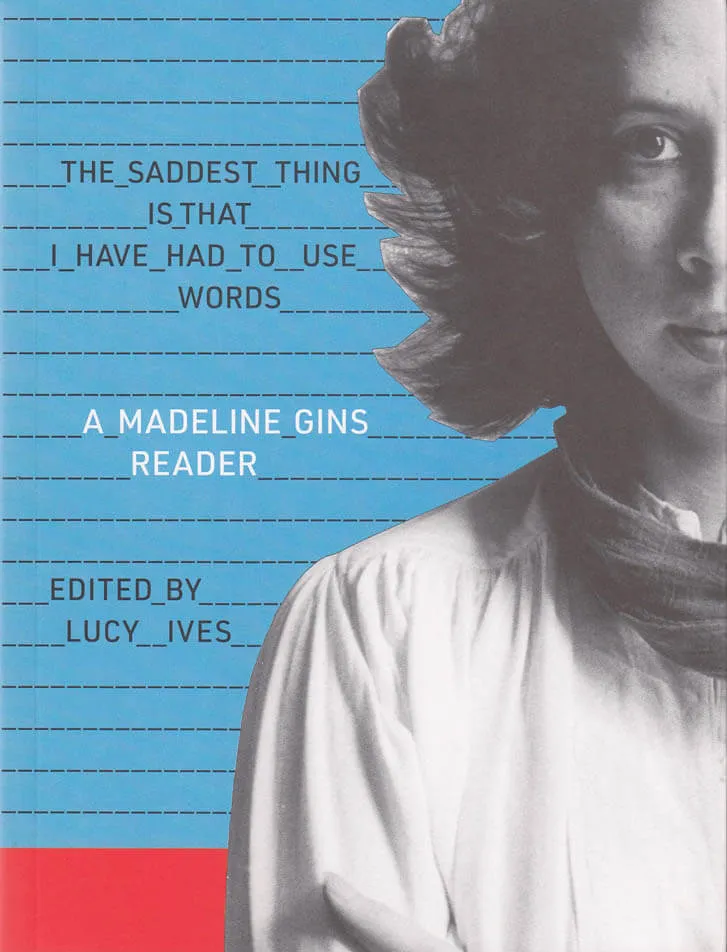
The Saddest Thing Is That I Have Had to Use Words: A Madeline Gins Reader
Poet, philosopher, speculative architect and transdisciplinary artist, Madeline Gins is well known for her collaborations with her husband, the artist Arakawa, on the experimental architectural project Reversible Destiny, in which they sought to arrest mortality by transforming the built environment. Yet, her own writings — in the form of poetry, essays, experimental prose and philosophical inquiries — represent her most visionary and transformative work. Like Gertrude Stein before her, Gins transfigures grammar and liberates words. Like her contemporaries in conceptual art, her writing is attuned to the energized, collaborative space between reader and page.
The Saddest Thing Is That I Have Had to Use Words: A Madeline Gins Reader is a revelatory anthology, edited and with an introduction by the writer and critic Lucy Ives. It brings never-before-published poems and essays together with a complete facsimile reproduction of Gins' 1969 masterpiece, WORD RAIN (or A Discursive Introduction to the Intimate Philosophical Investigations of G, R, E, T, A, G, A, R, B, O, It Says), along with substantial excerpts from her two later books What the President Will Say and Do!! (1984) and Helen Keller or Arakawa (1994). Long out of print or unpublished, Gins' poems and prose form a powerful corpus of experimental literature, one which is sure to upend existing narratives of American poetics at the close of the 20th century.
Edited by Lucy Ives.
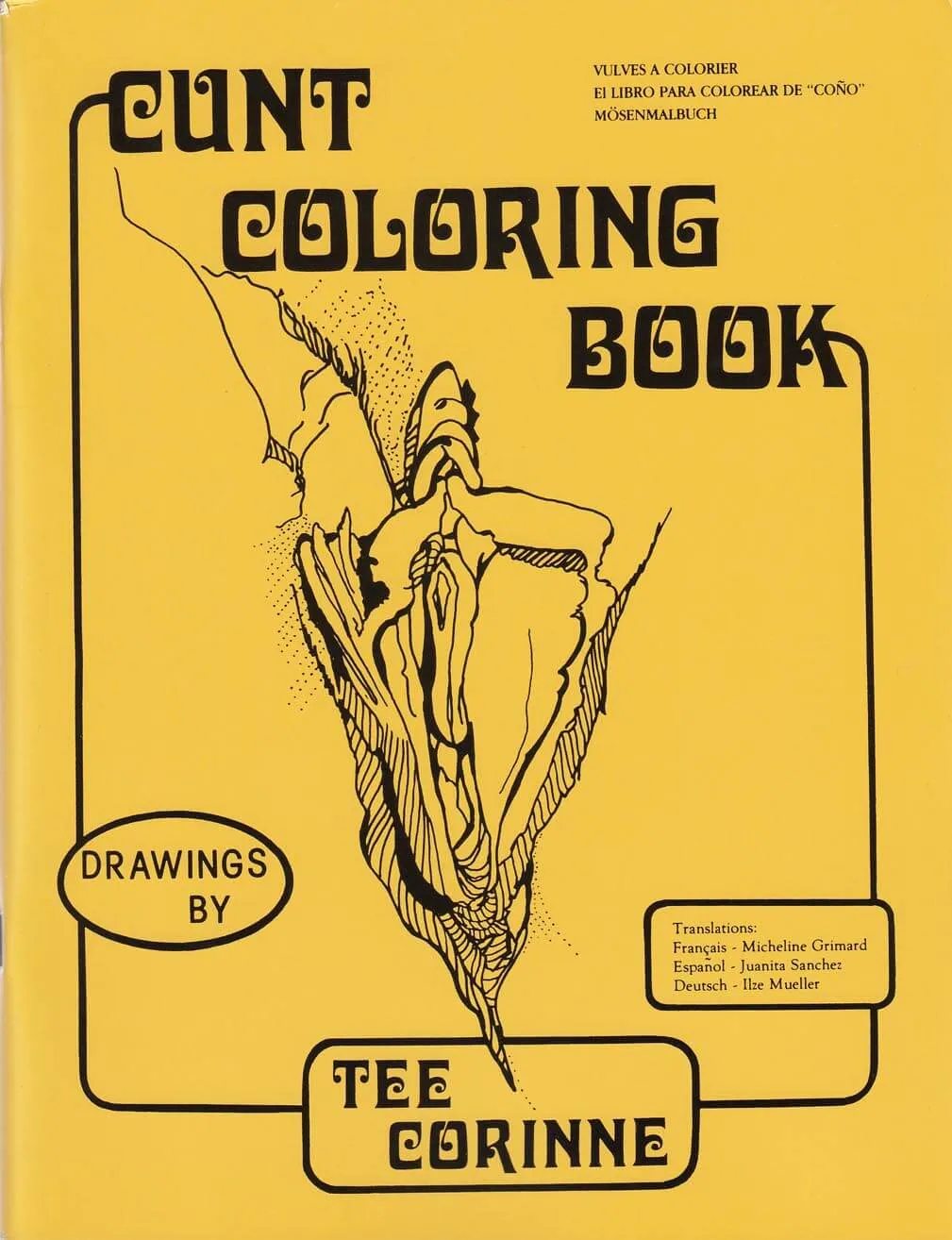
Cunt Coloring Book
Over three dozen c**ts of every size and description for you to color. Originally used for a sex-education class. Crayons not included. First published in 1975 by lesbian activist and artist Tee Corinne.
"In 1973 I set out to do drawings of women’s genitals for use in sex education groups. I wanted the drawings to be lovely and informative, to give pleasure and affirmation. I organized the drawings into a coloring book because a major way we learn to understand the world, as children, is by coloring. As adults many of us still need to learn about our external sexual anatomy." —Tee Corinne
Tee Corinne was born November 3rd, 1943 and grew up in St. Petersburg, Florida. Her mother, also an artist, introduced her to the creative principles and techniques that would serve her all her life. She received a B.A. in printmaking and painting from the University of South Florida, then went on to get an M.F.A. in drawing and sculpture at Pratt Institute, graduating in 1968. Afterwards she taught for many years, traveled through Europe, and finally became enmeshed in the back-to-the-land movement and communal living. After nearly ten years of marriage to a man she referred to as her "best friend," Corinne came out of the closet amidst severe depression in 1975. The strength to accomplish this difficult effort would later propel her to heights and achievements that would distinguish her as "one of the most visible and accessible lesbian artists in the world." From the mid-1960’s to the day she died Corinne created, published, and exhibited her art and writing around the world. She was a co-facilitator of the Feminist Photography Ovulars and a co-founder of The Blatant Image, A Magazine of Feminist Photography. She was the author of one novel, three collections of short stories, four books of poetry and numerous arts publications. In 1980, she was one of ten selected artists invited to have their work exhibited in the Great American Lesbian Art Show. The world lost Tee Corinne to cancer in 2006.
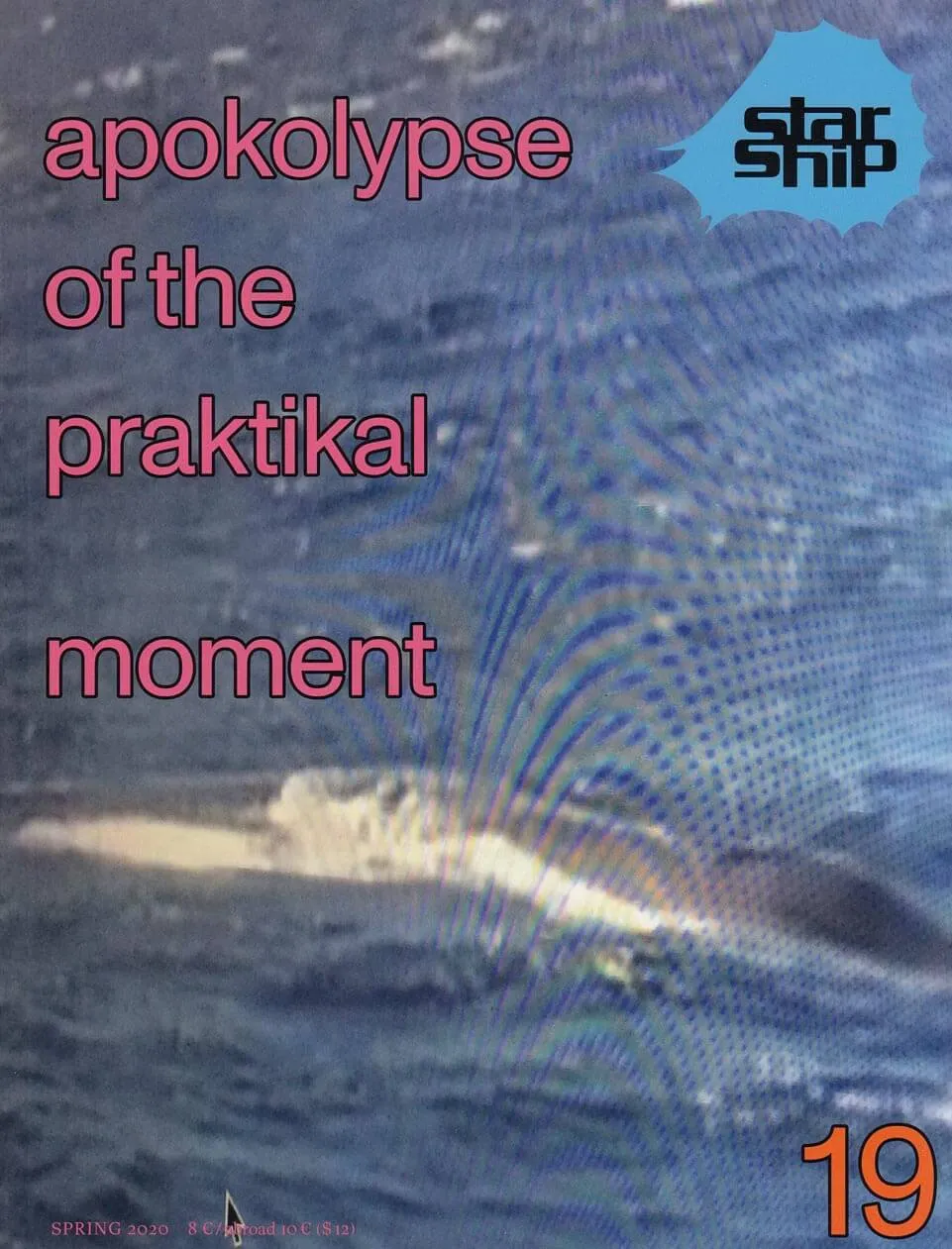
Apokolypse of the praktikal moment
Starship Magazine #19 presents contributions by John Boskovich, Elijah Burger, Simon Denny, Cornelia Herfurtner, Yuki Kimura, Vera Palme, Nora Schultz, Jack Smith; and by Rosa Aiello, Carter Frasier, María Galindo, Samuel Jeffery & Daniel Herleth, Elisa R. Linn, Paul B. Preciado, and Haytham El-Wardany
introducing new columnists: Mihaela Chiriac, Michèle Graf & Selina Grüter, Julia Jung, The Parliament of Bodies, and Ulla Rossek
and our columnists: Tenzing Barshee, Gerry Bibby, Mercedes Bunz, David Bussel, Eric D. Clark, Jay Chung, Hans-Christian Dany with Valérie Knoll, Francesca Drechsler, Stefanie Fezer & Vera Tollmann, Julian Göthe, Karl Holmqvist, Stephan Janitzky, Jakob Kolding, Lars Bang Larsen, Ariane Müller with Huang Rui, Robert M. Ochshorn, Mark von Schlegell, Max Schmidtlein, Amelie von Wulffen, and Florian Zeyfang
and artworks by Melvin Edwards, Elizabeth Ravn, Nong Shoahua, and Mark van Yetter.
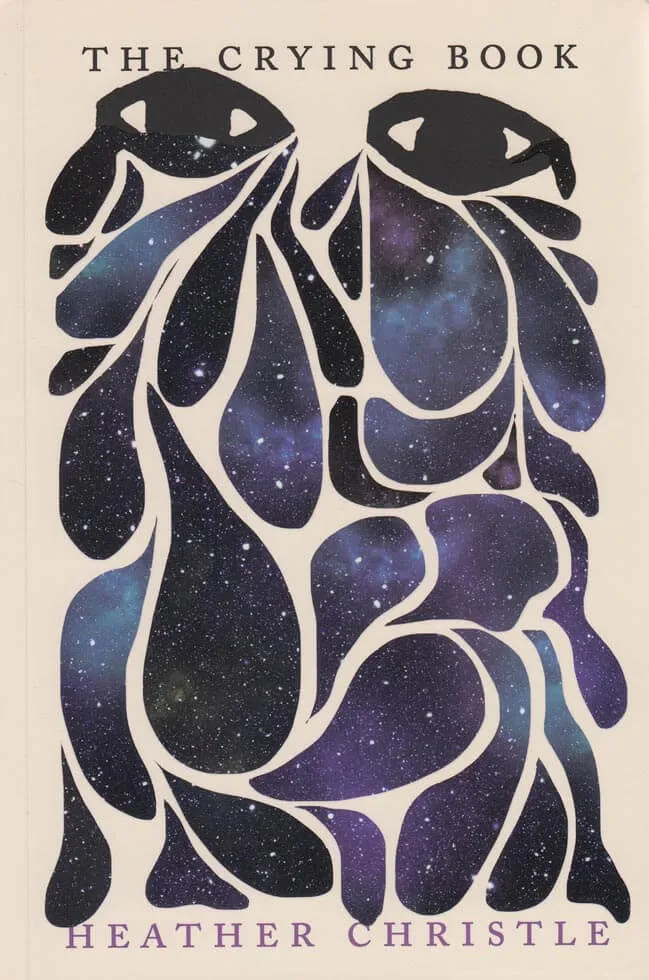
The Crying Book
A young poet on the cusp of motherhood shares a scientific, cultural, and artistic examination of why and how people cry and what crying means. Heather Christle has just lost a dear friend to suicide and must reckon with her own struggles with depression and the birth of her first child. How she faces her joy, grief, anxiety, impending motherhood, and conflicted truce with the world results in a moving meditation on the nature, rapture, and perils of crying—from the history of tear-catching gadgets (including the woman who designed a gun that shoots tears) to the science behind animal tears (including moths who drink them) to the fraught role of white women's tears in racist violence.
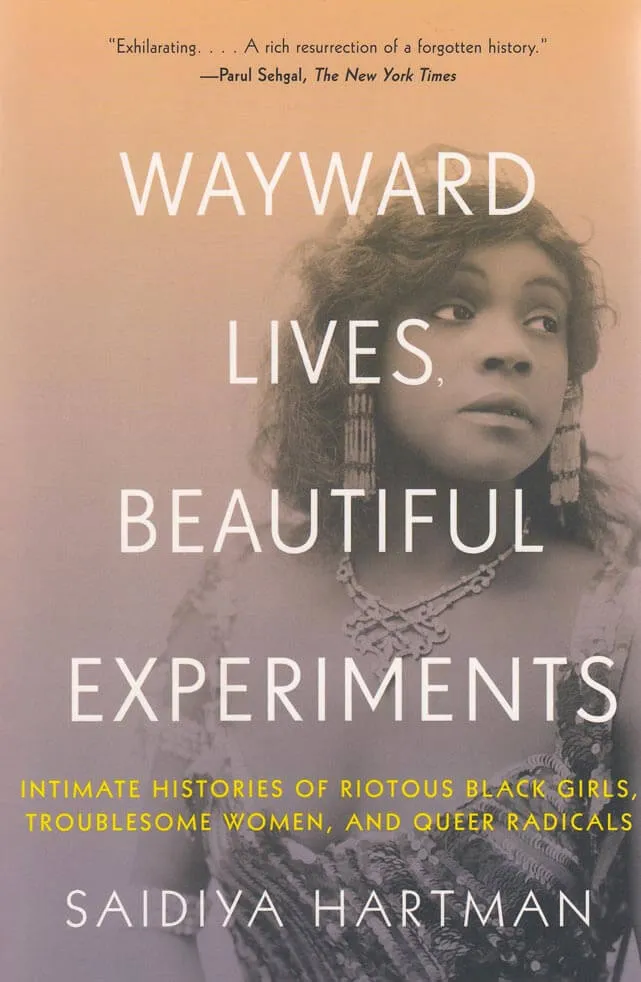
Wayward Lives, Beautiful Experiments
Wayward Lives, Beautiful Experiments examines the revolution of black intimate life that unfolded in Philadelphia and New York at the beginning of the twentieth century. In wrestling with the question of what a free life is, many young black women created forms of intimacy and kinship indifferent to the dictates of respectability and outside the bounds of law. They cleaved to and cast off lovers, exchanged sex to subsist, and revised the meaning of marriage. Longing and desire fueled their experiments in how to live. They refused to labor like slaves or to accept degrading conditions of work. Here, for the first time, these women are credited with shaping a cultural movement that transformed the urban landscape. Through a melding of history and literary imagination, Wayward Lives, Beautiful Experiments recovers these women's radical aspirations and insurgent desires.