Books
Books
Paperback

The Undying (paperback)
Blending memoir with critique, an award-winning poet and essayist's devastating exploration of sickness and health, cancer and the cancer industry, in the modern world
A week after her 41st birthday, Anne Boyer was diagnosed with highly aggressive triple-negative breast cancer. For a single mother living payslip to payslip, the condition was both a crisis and an initiation into new ideas about mortality and the gendered politics of illness.
In The Undying - at once her harrowing memoir of survival, and a 21st-century Illness as Metaphor - Boyer draws on sources from ancient Roman dream diarists to cancer vloggers to explore the experience of illness. She investigates the quackeries, casualties and ecological costs of cancer under capitalism, and dives into the long line of women writing about their own illnesses and deaths, among them Audre Lorde, Kathy Acker and Susan Sontag.
Genre-bending, devastating and profoundly humane, The Undying is an unmissably insightful meditation on cancer, the cancer industry and the sicknesses and glories of contemporary life.
Winner of The Pulitzer Prize for Nonfiction 2020; Windham Campbell Prize for Nonfiction 2020

Manifestly Haraway
Electrifying, provocative, and controversial when first published thirty years ago, Donna Haraway's "Cyborg Manifesto" is even more relevant today, when the divisions that she so eloquently challenges—of human and machine but also of gender, class, race, ethnicity, sexuality, and location—are increasingly complex. The subsequent "Companion Species Manifesto," which further questions the human-nonhuman disjunction, is no less urgently needed in our time of environmental crisis and profound polarization.
Manifestly Haraway brings together these momentous manifestos to expose the continuity and ramifying force of Haraway's thought, whose significance emerges with engaging immediacy in a sustained conversation between the author and her long-term friend and colleague Cary Wolfe. Reading cyborgs and companion species through and with each other, Haraway and Wolfe join in a wide-ranging exchange on the history and meaning of the manifestos in the context of biopolitics, feminism, Marxism, human-nonhuman relationships, making kin, literary tropes, material semiotics, the negative way of knowing, secular Catholicism, and more.
The conversation ends by revealing the early stages of Haraway's "Chthulucene Manifesto," in tension with the teleologies of the doleful Anthropocene and the exterminationist Capitalocene. Deeply dedicated to a diverse and robust earthly flourishing, Manifestly Haraway promises to reignite needed discussion in and out of the academy about biologies, technologies, histories, and still possible futures.
Donna J. Haraway is distinguished professor emerita in the History of Consciousness Department at the University of California, Santa Cruz, where she is also affiliated with the departments of anthropology, feminist studies, environmental studies, and film and digital media. She is an active participant in UCSC's Science and Justice Research Center and the Center for Cultural Studies.
Published 2016

Desire/Love
In this small theoretical novella-cum-dictionary entry, Lauren Berlant engages love and desire in separate entries. In the first entry, Desire mainly describes the feeling one person has for something else: it is organized by psychoanalytic accounts of attachment, and tells briefly the history of their importance in critical theory and practice. The second entry, on Love, begins with an excursion into fantasy, moving away from the parent-child structure so central to psychoanalysis and looking instead at the centrality of context, environment, and history. The entry on Love describes some workings of romance across personal life and commodity culture, the place where subjects start to think about fantasy on behalf of their actual lives.
Whether viewed psychoanalytically, institutionally, or ideologically, love is deemed always an outcome of fantasy. Without fantasy, there would be no love. Desire/Love takes us on a tour of all of the things that sentence might mean.

Antilogy
Drawing from notions of "bad poetry" as the critical undoing of normative taste, Antilogy brings together works by the Brazilian artist and poet Alex Hamburger.
Central to Hamburger's practice and engagement with poetry is a focus on writing as the expression of a performative disruption and playful reworking of semiotic systems. With references to Fluxus intermediality, Brazilian concretism, experimental music, and sound poetry, Hamburger's work dynamically collapses the distinctions between fact and fiction, theory and performance, system and noise. From visual poems to abstract narrative to personal fantasy, Antilogy reminds us about the potent sense of refusal and experimentation that all art should carry.
Alex Hamburger was born in Belgrade, Serbia, in 1948. From the 80s onward his researches and proposals turned to the possibilities of fusion and intertwining of languages, developing works in Verbal, Visual and Sound Poetry, Object-Poem, Artist's books, Installation, Performance art, etc. He has published seven books in various poetical genres, three CDs of Sound Poetry and has performed several performance pieces, some in partnership with the visual artist Marcia X, with whom he established a fruitful relationship throughout the 80s, contributing decisively for a better understanding and acceptance of the above practices in the local art circuit of Rio de Janeiro. His work is held in the collections of contemporary art institutions, in Brazil and abroad, including The Museum of Modern Art, RJ, The Museum of Modern Art, SP, Printed Matter Bookstore, New York, Compendium of Contemporary Fine Prints, Hamburg, ICA, London among others. Alex Hamburger continues to live and work in Rio de Janeiro, Brazil.

Ductus
DUCTUS is the latest solo project by Paul Abbott, featuring 51 minutes of audio, across 12 tracks, and a 42 page booklet featuring new writing. DUCTUS was written and recorded in Edinburgh and Porto in 2019.
DUCTUS presents a playful weave of collapsing time through a number of speculative elements and fictional characters. Abbott feels his way through learning drums, rhythm and writing as fleshy research technologies. DUCTUS is the latest stage in a process considering sound, the body, imagination, and language through music. This features as part of ongoing investigations using real and imaginary drums, synthetic sounds, performance and writing.

Glass, Irony & God
Known as a remarkable classicist, Anne Carson weaves contemporary and ancient poetic strands with stunning style in Glass, Irony and God. This collection includes: "The Glass Essay," a powerful poem about the end of a love affair, told in the context of Carson's reading of the Bronte sisters; "Book of Isaiah," a poem evoking the deeply primitive feel of ancient Judaism; and "The Fall of Rome," about her trip to "find" Rome and her struggle to overcome feelings of a terrible alienation there.
Anne Carson was born in Canada and teaches ancient Greek for a living.

A Textbook for the Ecocene
A Textbook for the Ecocene is a how-to guide for connecting to self, community and planet. The Ecocene is an emergent and imagined geologic era where all humyns are living in reciprocity with their ecosystems again. Each textbook chapter shares practical exercises to try at home, Earth-centered theory and spirituality, and interviews with Black and Indigenous Earth warriors—cultural workers generating planetary liberation in their everyday lives. These testimonios from Johanna Iraheta, Bruje Fuego, Raquel Lemus, Patty Denisse, Jasmine Nyende, Queen Hollins and Olivia Chumacero shine with wisdom and advice for new and seasoned Earth stewards alike. Created originally as Sarita Dougherty's DIY PhD Dissertation, A Textbook for the Ecocene is a curricula for eco-feminista educations, DIY degrees and planetary destinies. We are activating the Ecocene right now, one step at a time. What we pay attention to grows.
Self-published by Co—Conspirator Press with the support of Women's Center for Creative Work. Edited by Simone Krug, copy edited by Gowri Chandra and Demi Corso. Designed by MJ Balvanera, Riso-printed by Neko Natalia.
SARITA DOUGHERTY (she/her, they/them) is a painter, parent, collaborator and educator of Cajun, Irish and Andean descent. Sarita is a cocreator of The School for the Ecocene Cooperative, offering a DIY PhD and more programs for planetary liberation. She currently lives and cultivates habitat on Ohlone Land. Sarita’s book, A Textbook for the Ecocene, is a continuation of her Artist Residency at The Feminist Center for Creative Work in Fall 2018.

Leash
Leash extends the logic of S&M to its inexorable and startling conclusion, darkly and hilariously revealing the masochistic impulse as the urge to disappear from the chores, obligations, and emotional vacuity of daily life.
No more jobs, no more taxes, no more checkbook, no more bills, no more credit cards, no more credit, no more money, no more mortgages, no more rent, no more savings, no more junk mail, no more junk, no more mail, no more phones, no more faxes, no more busy signals, no more computers, no more cars, no more drivers' licenses, no more traffic lights, no more airports, no more flying, no more tickets, no more packing, no more luggage, no more supermarkets, no more health clubs... While her current spends the summer researching public housing in Stockholm, a moderately wealthy, object-oppressed, and terminally hip New York female of a certain age seeks adventure in the sedate dyke bars of lower Manhattan. Finding none, she answers a personal ad. She is ordered to put on a blindfold before the first meeting with the woman she knows only as Sir. Not knowing what someone looks like turns out to be freeing, as do the escalating constraints that alienate her not just from her former life, but from her very conception of who she is. Part Georges Bataille, part Fran Leibowitz, this is the Story of O told with a self-referentially perverse sense of humor.

The Complete Text Would Be Insufferable / Language as Prosthesis
We begin with the image of an idea in ruin. A small field of assumptions disassembled. A question no longer in need of its mark. A thought not sure where it began. It starts from the body and language. The debris of these three words, crumbling already at and, did not break apart but congealed the separations once made. We start from a research (project) undone and just beginning.
Typesetting and design: Will Holder
Produced by: A.pass
Chloe Chignell works across choreography and publication taking the body as the central problem, question and location of the research. She invests in writing as a body building practice, examining the ways in which language makes us up.

Rejected. Designs for the European Flag
The flag bearing twelve yellow stars on a blue background has become Europe’s most recognisable symbol. Since its introduction by the Council of Europe in 1955, it has stood for the unification of Europe’s nation states. It was precisely this yellow circle of stars that prevailed over more than 150 flag ideas sent to the Council of Europe by a host of diverse private individuals. These colourful designs are being now published in Rejected for the first time. They document the continent’s zeitgeist at a decisive period in the development of European unity. Alongside the flag proposals, the trilingual book (English, German, French) features a written contribution by the German-French poet and writer Marie Rotkopf, who tackles the EU’s neoliberal political cynicism and Germany’s expansion of power with biting irony.

Undrowned: Black Feminist Lessons from Marine Mammals
Undrowned is a book-length meditation for social movements and our whole species based on the subversive and transformative guidance of marine mammals. Our aquatic cousins are queer, fierce, protective of each other, complex, shaped by conflict, and struggling to survive the extractive and militarized conditions our species has imposed on the ocean. Gumbs employs a brilliant mix of poetic sensibility and naturalist observation to show what they might teach us, producing not a specific agenda but an unfolding space for wondering and questioning. From the relationship between the endangered North Atlantic Right Whale and Gumbs's Shinnecock and enslaved ancestors to the ways echolocation changes our understandings of "vision" and visionary action, this is a masterful use of metaphor and natural models in the service of social justice.
With Foreword by adrienne maree brown
Alexis Pauline Gumbs is a poet, independent scholar, and activist. She is the author of Spill: Scenes of Black Feminist Fugitivity, M Archive: After the End of the World, and Dub: Finding Ceremony; coeditor of Revolutionary Mothering: Love on the Front Lines; and the founder of Brilliance Remastered, an online network and series of retreats and online intensives serving community accountable intellectuals and artists.


The Flight of the Sparrow: Lingua 1 Poems and Other Theaters
A composition for one actor and tape, or two actors. Score. 1970
![Cover of Dante's Joynte: Lingua 1. [Poems and Other Theaters]](https://rile.space/storage/744/conversions/dante-webp.webp)
Dante's Joynte: Lingua 1. [Poems and Other Theaters]
Kenneth Gaburo (1926-1993) is renowned as a teacher, pioneer of electronics in music, jazz pianist, writer, ecologist, publisher, and proponent of compositional linguistics. Over the course of a dedicated career, his uncompromising work carved out its own patch in the territory of American experimentalism.
Lingua Press, 1976

Privacy One : Words Without Song (1950-1974)
Kenneth Gaburo (1926-1993) is renowned as a teacher, pioneer of electronics in music, jazz pianist, writer, ecologist, publisher, and proponent of compositional linguistics. Over the course of a dedicated career, his uncompromising work carved out its own patch in the territory of American experimentalism.
Lingua Press, 1976

Something Medieval
James Kirtland Randall (1929 - ) was born in Cleveland, Ohio. He studied at the Cleveland Institute of Music from 1934 to 1947, and subsequently attended Columbia University (B.A., 1955), Harvard (M.A., 1956) and Princeton (M.F.A., 1958). He studied piano with Leonard Shure and composition with Herbert Elwell, Thad Jones, Roger Sessions and Milton Babbitt. From 1958 to 1991 he taught at Princeton, where he was professor of music. He was a founding member of the American Society of University Composers and has written articles on composing and music theory for several journals, notably Perspectives of New Music (some of these were collected in the monograph Compose Yourself: A Manual for the Young (Open Space, 1995)). He also collaborated with Benjamin Boretz on the book Being About Music: Textworks 1960-2003 (Open Space, 2003).
From the early 1960s into the 1970s, Randall engaged principally in computer synthesis of sound and, with Godfrey Winham, developed facilities for this at Princeton University. His tape compositions were generated by the MUSIC IV B program, a version of MUSIC IV introduced at Princeton. He designed his own software "instruments," which enabled him to specify every aspect of every sound and structure developments within single notes in ways that reflect principles of development used in whole compositions as, for example in Lyric Variations for Violin and Computer (1966-1968).
In 1980 he turned his attention to improvised musical performance and began a series of explorations of spontaneous group performance, or "real-time co-creation," involving many kinds of musicians and other artists (painters, dancers) as well. The ongoing efforts, preserved on hundreds of sound recordings and videotapes (under the project name Inter/Play), document the emergence of idiosyncratic group styles and performing conventions. Randall is himself a regular participant in these performances. In 1990, Randall, along with Elaine Barkin and Benjamin Boretz, started the publications series Open Space.

For Chris Mann (Open Space Magazine #22)
Dorota Czerner, Elaine Radoff Barkin
Special issue of this US magazine dedicated in its entirety to the late Australian artist/compositional linguist/raconteur Chris Mann, who died in 2018. The magazine contains tributes from Mann associates and admirers, including Warren Burt, Amanda Stewart, Pi-0, Ronald Robboy, Linda Kouvaras, Alvin Lucier, Ruark Lewis, Annea Lockwood, as well as Mann’s own writing and an interview with him by Philip Blackburn.
88 pages bound in soft-cover glossy colour cover by Brigid Burke.

The Sense of Brown
The Sense of Brown is José Esteban Muñoz's treatise on brownness and being as well as his most direct address to queer Latinx studies. In this book, which he was completing at the time of his death, Muñoz examines the work of playwrights Ricardo Bracho and Nilo Cruz, artists Nao Bustamante, Isaac Julien, and Tania Bruguera, and singer José Feliciano, among others, arguing for a sense of brownness that is not fixed within the racial and national contours of Latinidad.
This sense of brown is not about the individualized brown subject; rather, it demonstrates that for brown peoples, being exists within what Muñoz calls the brown commons—a lifeworld, queer ecology, and form of collectivity. In analyzing minoritarian affect, ethnicity as a structure of feeling, and brown feelings as they emerge in, through, and beside art and performance, Muñoz illustrates how the sense of brown serves as the basis for other ways of knowing and being in the world.

Jangal
Ana Pi, Léna Araguas and 2 more
Jangal est un ouvrage collectif avec la participation d’Ana Pi, Julien Creuzet, Léna Araguas et Éva Barois De Caevel. Il a été conçu lors de l’exposition « Cet ailleurs, qui rejaillit en moi, lorsque je suis là (…) » de Julien Creuzet à la galerie NaMiMa de l’École nationale supérieure d’art et de design de Nancy.
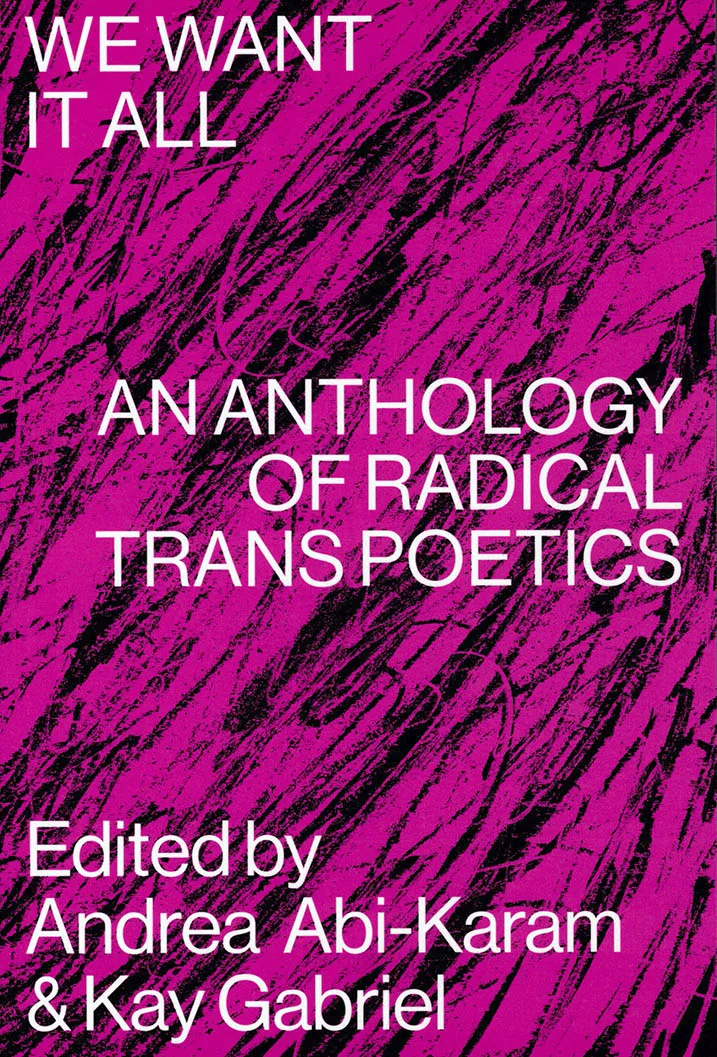
We Want It All: An Anthology of Radical Transpoetics
An anthology of formally inventive writing by trans poets against capital and empire.
With texts by: Andrea Abi-Karam, New York City Sam Ace, South Hadley, MA Bahaar Ahsan, Berkeley, CA jasper avery, Philadelphia, PA Ari Banias, Berkeley, CA Jo Barchi, Chicago, IL Joss Barton, St. Louis, MO Levi Bentley, Philadelphia, PA Jessica Bet, Baltimore, MA Rocket Caleshu, Los Angeles, CA Ching-in Chen, Seattle, WA listen chen, Vancouver, BC Faye Chevalier, Philadelphia, PA Cody-Rose Clevidence, Arkansas Miles Collins-Sibley, Easthampton, MA Valentine Conaty, New York City CA Conrad, Philadelphia, PA Jimmy Cooper, Rochester, MI Maxe Crandall, Oakland, CA José Díaz, Boston, MA Aaron El Sabrout, New Mexico Ian Khara Ellasante, Lewiston, ME Caelan Ernest, New York City, NY NM Esc, San Diego, CA joshua jennifer espinoza, Los Angeles, CA Logan February, Ibadan, Nigeria Ray Filar, Brighton, UK Nora Collen Fulton, Montreal, Canada Kay Gabriel, New York City Callie Gardner, Cardiff, Wales Jesi Gaston, Chicago, IL Harry Josephine Giles, Edinburgh, Scotland Aeon Ginsberg, Baltimore, MD Caspar Heinemann, Berlin, Germany Kamden Hilliard, Greenville, SC Stephen Ira, New York City Cyrée Jarelle Johnson, New York City Peach Kander, New York City Jayson Keery, Western, MA Evan Kleekamp, Los Angeles, CA Noah LeBien, New York City Ty Little, Richmond, VA Zavé Martohardjono, New York City Amy Marvin, Philadelphia, PA Natalie Mesnard, New York City Bianca Rae Messinger, Iowa City, IA Liam O'Brien, New York City Xandria Phillips, Madison, WI Rowan Powell, Santa Cruz, CA Nat Raha, Edinburgh, Scotland Holly Raymond, Philadelphia, PA Jackie S, New York City Trish Salah, Toronto, Canada Raquel Salas Rivera, Philadelphia, PA Mai Schwartz, New York City Kashif Sharma-Patel, London, UK Julian Talamantez Brolaski, Oakland, CA Charles Theonia, New York City Jamie Townsend, Oakland, CA Nora Treatbaby Laurel Uziell, London, UK Rachel Franklin Wood, Boulder, CO Clara Zornado Akasha-Mitra xtian w. and Anaïs Duplan, NYC.
Kay Gabriel is a poet and essayist. She's the author of Elegy Department Spring / Candy Sonnets 1 (BOAAT Press, 2017), the recipient of fellowships from Lambda Literary and the Poetry Project, and recently completed her PhD at Princeton University.
Andrea Abi-Karam is an arab-american genderqueer punk poet-performer cyborg, writing on the art of killing bros, the intricacies of cyborg bodies, trauma & delayed healing. Their chapbook, THE AFTERMATH (Commune Editions), attempts to queer Fanon's vision of how poetry fails to inspire revolution. Andrea's first book, EXTRATRANSMISSION (Kelsey Street Press, 2019), is a poetic critique of the U.S. military's role in the War on Terror.

DRINK DEEPLY AND DREAM
Drink Deeply and Dream by Elspeth Walker is an ethereal, offbeat short story about wannabe vampires with a Marxist bent and their search for salvation from capitalism via eternal bloodlust.
Paperback, Staple Bound and Offset Printed

Spill: scenes of black feminist fugitivity
In Spill, self-described queer Black troublemaker and Black feminist love evangelist Alexis Pauline Gumbs presents a commanding collection of scenes depicting fugitive Black women and girls seeking freedom from gendered violence and racism. In this poetic work inspired by Hortense Spillers, Gumbs offers an alternative approach to Black feminist literary criticism, historiography, and the interactive practice of relating to the words of Black feminist thinkers. Gumbs not only speaks to the spiritual, bodily, and otherworldly experience of Black women but also allows readers to imagine new possibilities for poetry as a portal for understanding and deepening feminist theory.
Alexis Pauline Gumbs is a poet, independent scholar, and activist. She is coeditor of Revolutionary Mothering: Love on the Front Lines and the Founder and Director of Eternal Summer of the Black Feminist Mind, an educational program based in Durham, North Carolina.

After Delores
A new edition of Sarah Schulman's acclaimed 1988 novel, a noirish tale about a no-nonsense coffee-shop waitress in New York who is nursing a broken heart after her girlfriend Dolores leaves her; her attempts to find love again are funny, sexy, and ultimately even violent. After Delores is a fast-paced, electrifying chronicle of the Lower East Side's lesbian subculture in the 1980s.
Sarah Schulman is the author of sixteen books, including the novels The Mere Future, The Child, Rat Bohemia, and Empathy (all from Arsenal Pulp Press) and the recent nonfiction works The Gentrification of the Mind: Witness to a Lost Imagination and Israel/Palestine and the Queer International. She was also co-producer with Jim Hubbard of the feature documentary United in Anger: A History of ACT UP and is co-director of the ACT UP Oral History Project. She lives in New York, where she is Distinguished Professor of English at City University of New York (College of Staten Island) and a Fellow at the New York Institute for the Humanities at NYU.