rile*books

Search books

Search books by title, author, publisher, keywords...

Cover of On the Origin of Species and Other Stories

Kaya Press

On the Origin of Species and Other Stories

Bo-Young Kim

€20.00

Straddling science fiction, fantasy and myth, the writings of award-winning author Bo-Young Kim have garnered a cult following in South Korea, where she is widely acknowledged as a pioneer and inspiration. On the Origin of Species makes available for the first time in English some of Kim's most acclaimed stories, as well as an essay on science fiction. Her strikingly original, thought-provoking work teems with human and non-human beings, all of whom are striving to survive through evolution, whether biologically, technologically or socially. Kim's literature of ideas offers some of the most rigorous and surprisingly poignant reflections on posthuman existence being written today.

Bo-Young Kim (born 1975) won the inaugural Korean Science & Technology Creative Writing Award with her first published novella in 2004 and has gone on to win the annual South Korean SF Novel Award three times. In addition to writing, she regularly serves as a lecturer, juror and editor of sci-fi anthologies, and served as a consultant to Parasite director Bong Joon Ho's earlier sci-fi film Snowpiercer. She has novellas forthcoming from HarperCollins in 2021. She lives in Gangwon Province, South Korea, with her family.

Language: English

recommendations

Cover of I Was Going to Work

Bored Wolves

I Was Going to Work

Nourhan Maayouf

Sci-Fi €20.00

“Invest in a floating city or gentrify a submerged one.”

Nourhan Maayouf’s I Was Going to Work is a hybrid sci-fi picture book by the Cairo-based artist, in which the proto-cyborg citizens of Happy Land Nation establish new-fashioned diurnal rhythms against the ever-present backdrop of a monorail to nowhere and its pillars, idle and idolatrous.

Across forty-four spreads of what might be thought of as a picture book for adults, Maayouf delves into every aspect of a deeply familiar society in which retrograde devolution is billboarded as reinvention by Orwellian technocrats and speculators.

And yet pockets of the cyborg population continue striving, dreaming, craving, protesting, gleaning, and inventing. For a situation to be bleak, some notion of beauty must remain tenaciously rooted where it matters most.

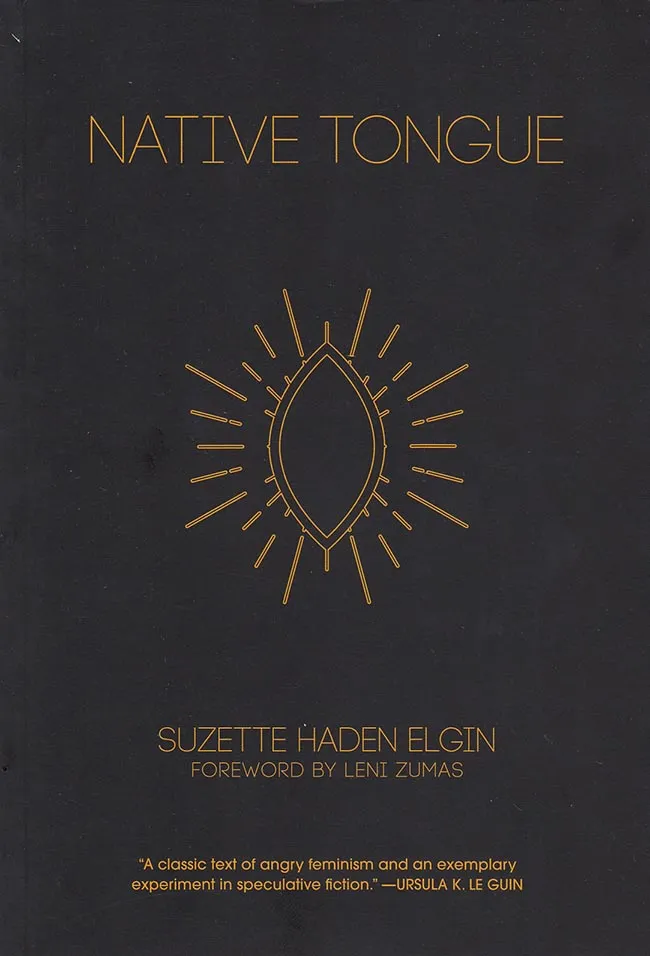
Cover of Native Tongue

Feminist Press

Native Tongue

Suzette Haden Elgin

Originally published in 1984, this classic dystopian trilogy is a testament to the power of language and women's collective action. 

In 2205, the Nineteenth Amendment has long been repealed and women are only valued for their utility. The Earth's economy depends on an insular group of linguists who "breed" women to be perfect interstellar translators until they are sent to the Barren House to await death. But instead, these women are slowly creating a language of their own to make resistance possible. Ignorant to this brewing revolution, Nazareth, a brilliant linguist, and Michaela, a servant, both seek emancipation in their own ways. But their personal rebellions risk exposing the secret language, and threaten the possibility of freedom for all.

Cover of The Letters of Mina Harker

Semiotext(e)

The Letters of Mina Harker

Dodie Bellamy

Fiction €18.00

In Dodie Bellamy's imagined "sequel" to Bram Stoker's fin de siècle masterpiece Dracula, Van Helsing's plain Jane secretarial adjunct, Mina Harker, is recast as a sexual, independent woman living in San Francisco in the 1980s. The vampire Mina Harker, who possesses the body of author Dodie Bellamy, confesses the most intimate details of her relationships with four vastly different men through past letters. Simultaneously, a plague is let loose in San Francisco-the plague of AIDS.

Bigger-than-life, half goddess, half Bette Davis, Mina sends letter after letter to friends and co-conspirators, holding her reader captive through a display of illusion and longing. Juggling quivering vulnerability on one hand and gossip on the other, Mina spoofs and consumes and spews back up demented reembodiments of trash media and high theory alike. It's all fodder for her ravenous libido and "a messy ambiguous place where pathology meets pleasure." Sensuous and captivating, The Letters of Mina Harker describes one woman's struggles finding the right words to explain her desires and fears without confining herself to one identity.

Cover of The Hearing Trumpet

New York Review of Books

The Hearing Trumpet

Leonora Carrington

Fiction €17.00

An old woman enters into a fantastical world of dreams and nightmares in this surrealist classic admired by Björk and Luis Buñuel.

Leonora Carrington, painter, playwright, and novelist, was a surrealist trickster par excellence, and The Hearing Trumpet is the witty, celebratory key to her anarchic and allusive body of work. The novel begins in the bourgeois comfort of a residential corner of a Mexican city and ends with a man-made apocalypse that promises to usher in the earth's rebirth. In between we are swept off to a most curious old-age home run by a self-improvement cult and drawn several centuries back in time with a cross-dressing Abbess who is on a quest to restore the Holy Grail to its rightful owner, the Goddess Venus. Guiding us is one of the most unexpected heroines in twentieth-century literature, a nonagenarian vegetarian named Marian Leatherby, who, as Olga Tokarczuk writes in her afterword, is "hard of hearing" but "full of life."

Cover of Stars in My Pocket Like Grains of Sand

Wesleyan

Stars in My Pocket Like Grains of Sand

Samuel R. Delany

Sci-Fi €27.00

The story of a truly galactic civilization with over 6,000 inhabited worlds. 

Stars in My Pocket Like Grains of Sand is a science fiction masterpiece, an essay on the inexplicability of sexual attractiveness, and an examination of interstellar politics among far-flung worlds. First published in 1984, the novel's central issues—technology, globalization, gender, sexuality, and multiculturalism—have only become more pressing with the passage of time. 

The novel's topic is information itself: What are the repercussions, once it has been made public, that two individuals have been found to be each other's perfect erotic object out to "point nine-nine-nine and several nines percent more"? What will it do to the individuals involved, to the city they inhabit, to their geosector, to their entire world society, especially when one is an illiterate worker, the sole survivor of a world destroyed by "cultural fugue," and the other is—you!