Books
Books
Hardcover

inner GLOw' replica
An immersion in the flow of language, words, and images within David Douard's work.
A jumble of workshop views, recent productions, and reassembled fanzines, inner GLOw' replica delves into the roots of David Douard's practice. The "zines," which he has been compulsively producing for years, interact with his works, contaminating them. Pages of collages, drawings, photocopies, scraps of tape, torn magazines, slogans picked up on social media, and photos taken with smartphones reveal the density and formation process of the artist's language. This flow insinuates itself and transmutes within his sculptures and installations, whose teeming and polymorphous materiality is revealed in an exhaustive set of objective photographs.
Three texts are added to this iconographic corpus: a phantasmagorical fiction by Charlie Fox, an essay by Ingrid Luquet-Gad, and a poetic enumeration by Nina Kennel.
inner GLOw' replica—the first book published by Zzz—is the result of a long collaboration between David Douard and designers Thomas Bizzarri and Alain Rodriguez.
Born 1983 in Perpignan, David Douard lives and works in Aubervilliers (France). Language is the very basis of his work. The texts and poems he collects on the Internet are manipulated, transformed in order to become a vital flow, feeding into his sculptures. Through language as an ingredient, David Douard redefines space as hybrid and collective by injecting anonymous, chaotic, deviant, ill and frustrating poems in it. As he recreates an infected environment where the real world used to be, the fantasy brought by new digital technologies expands.
Texts by Charlie Fox, Ingrid Luquet-Gad, Nina Kennel.

Black Ark
The point of departure for the book «Black Ark» with Lee “Scratch” Perry (1936–2021), a Jamaican musical and visual artist who was based in Switzerland, is a detailed inventory of photographs and writings (Spring 2021) from the Black Ark Studios in Kingston, Jamaica, where Lee produced his music from 1973 on. He was a seminal pioneer of dub, an electronic subgenre of reggae that uses sampling, looping, remixing, reverb and echoes to create new songs as well as rework and appropriate pre-recorded songs and tracks.
Black Ark Studios was one of the cradles of dub. It’s also where Lee “Scratch” Perry’s musical approach found an enduring visual counterpart in the form of continuously evolving mural paintings and drawings as well as shape-shifting assemblages of records, instruments, found objects, posters, newspaper and magazine clippings, and appropriated books. The artworks form actual layers upon layers that are rhizomatically intertwined with the studio building itself as well as with the furniture inside—and with Perry’s biography and persona.
Perry created his very own, dense and eclectic world—a world that is documented in «Black Ark», before it disappears for good: the premises have recently been sold. The photographic documentation of the studio was supplemented by efforts to secure and preserve Perry’s cultural objects as part of a joint project with various cultural institutions.
«Black Ark» which reflects the rhythm and layering effects of collage both in its content and the materials used to craft the book. Perry was involved in the conception of the book in its early stages. It also interweaves various media and chronologies. The new photographs of the Black Ark Studios will be juxtaposed with stills from old documentaries and archival photos.
The idea of a “house” serves as both a working hypothesis and a metaphor. It will be the starting point and endpoint of various thematic strands, both visual and textual: for example, the book will explore the Black Ark as a “spiritual yard” in the context of African diaspora, as well as looking into archeomusicological aspects. Furthermore, extended captions by Perry’s biographer will provide the backdrop for a kaleidoscopic panorama of Perry’s eclectic and ingenious work.

For the Sun After Long Nights: The Story of Iran's Women-Led Uprising
Fatemeh Jamalpour, Nilo Tabrizy
In September 2022, a young Kurdish woman, Mahsa Jîna Amini, died after being beaten by police officers who arrested her for not adhering to the Islamic Republic’s dress code. Her death galvanized thousands of Iranians—mostly women—who took to the streets in one of the country’s largest uprisings in decades: the Woman, Life, Freedom movement.
Despite the threat of imprisonment or death for her work as a journalist covering political unrest, state repression, and grassroots activism in Iran—which has led to multiple interrogation sessions and arrests—Fatemeh Jamalpour joined the throngs of people fighting to topple Iran’s religious extremist regime. And across the globe, Nilo Tabrizy, who emigrated from Iran with her family as a child, covered the protests and state violence, knowing that spotlighting the women on the front lines and the systemic injustice of the Iranian government meant she would not be able to safely return to Iran in the future.
Though they had met only once in person, Nilo and Fatemeh corresponded constantly, often through encrypted platforms to protect Fatemeh. As the protests continued to unfold, the sense of sisterhood they shared led them to embark on an effort to document the spirit and legacy of the movement, and the history, geopolitics, and influences that led to this point. At once deeply personal and assiduously reported, For the Sun After Long Nights offers two perspectives on what it means to cover the stories that are closest to one’s heart—both in the forefront and from afar.

Flesh Idol
Part historical and folkloric research, part auto-fiction, FLESH IDOL draws from a solitary journey through the Holy Mountains last winter to find meaning in suffering. A parallel search for internal solace, consideration of the voluntary abandonment of the body on this plane, and respect of the holy men who achieved it.
Delving into the fog-covered terrain of Yamagata Prefecture, the book documents the author’s passage taken in order to pay homage to the monks of Sokushinbutsu - the now outlawed ritual practice of self-mummification in the Japanese mountain religion of Shugendō.
As the second title to come from Doyenne founder and artist Flora Yin Wong, the new book - first conceived at the start of the year and released to coincide with the end of 2025 - is an abstract retelling of a personal journey, mytho-historical facts, their geographical locations and local lore under the domain of the ascetic religious sect.

The Complete C Comics
In the mid-1960s, legendary artist and writer Joe Brainard (I Remember) teamed with poets such as John Ashbery, Frank O’Hara, Barbara Guest, Ron Padgett, Kenneth Koch, Ted Berrigan, and many more for these pioneering collaborative comic strips—unavailable for decades and collected here for the first time.
“PEOPLE OF THE WORLD… RELAX!”
In the creative hotbed of 1960s New York, Joe Brainard was a whirlwind. He was a maker of paintings, assemblages, collages, book covers, poetry-reading flyers, and more. But some of his most exciting work was done with his friends. In 1964, the twenty-two-year-old Brainard turned his talents to rewiring the lowly comic book form into something new and surprising. He invited his friends Frank O’Hara, Ted Berrigan, John Ashbery, Kenneth Koch, Peter Schjeldahl, Barbara Guest, Ron Padgett, and others—all of them New York School poets—to collaborate with him on comics that they would write and he would draw.
The results were unlike any comics seen before. Previously available only on the rare-book market (at very high prices) but available here under one cover for the first time, the two issues of C Comics still feel as fresh as when the first page rolled off the mimeograph machine more than sixty years ago. Brainard’s energetic line and joyful humor charge across every page, illustrating O’Hara’s recasting of a cowboy as a mash-note-writing lover, Padgett’s experiments with traditional cartoon sound effects (ROAR! GRRR! SKREE!), cameos by Ernie Bushmiller’s Nancy, and heaps of Dadaesque delights.
This edition includes a foreword from Padgett and an essay by comics historian Bill Kartalopolous, who details the creation (and creators) of C Comics. A masterpiece of collaboration and spontaneity, C Comics is a testament to the vastness of Brainard’s creativity and his ability to push any artistic form in a new and powerful direction.
Foreword by Ron Padgett
Contributions by Bill Kartalopoulos

Herculine
A “witty, often-chilling, compulsively readable” (Vogue) horror debut following a woman who seeks refuge at an all-trans girl commune only to discover that demons haunt her fellow comrades—and she’s their next prey!
Herculine’s narrator has demons. Sure, her life includes several hallmarks of the typical trans girl sob story—conversion therapy, a string of shitty low-paying jobs, and even shittier exes—but she also regularly debates sleep paralysis demons that turn to mist soon after she wakes and carries vials of holy oil in her purse. Nothing, though, prepares her for the new malevolent force stalking her through the streets of New York City, more powerful than any she’s ever encountered. Desperate to escape this ancient evil, she flees to rural Indiana, where her ex-girlfriend started an all-trans girl commune in the middle of the woods.
The secluded camp, named after 19th-century intersex memoirist Herculine Barbin, is a scrappy operation, but the shared sense of community among the girls is a welcome balm to the narrator’s growing isolation and paranoia. Still, something isn’t quite right at Herculine. Girls stop talking as soon as she enters the room, everyone seems to share a common secret, and the books lining the walls of the library harbor strange cryptograms. Soon what once looked like an escape becomes a trap all its own.
While trying to untangle the commune’s many mysteries, the narrator contends with disemboweled pigs, cultlike psychosexual rituals, and the horrors of communal breakfast. And before long, she discovers that her demons have followed her. And this time, they won’t be letting her go.

Twelve Body Doubles
An overview of the French artist's film remakes over a decade.
"There's something deeply unsettling about the fact that Brice Dellsperger has spirited Laura Palmer away and replaced her with a doppelganger."—Evan Moffitt
Since 1995, the French artist Brice Dellsperger has been working on remakes of cult film sequences, which he has collected under the generic title "Body Double." The doubling of the actor or actress playing all the characters, both female and male, involves cross-dressing and raises questions about gender, originality and artifice. This book covers a decade and brings together video stills from his twelve most recent films, Body Double 29 (2013) to Body Double 40 (2024), with texts by Evan Moffitt and Rebekka Seubert and views of his latest exhibitions.
Brice Dellsperger (born 1972 in Cannes, France, lives and works in Paris) pushes the boundaries of genre and gender. In his multifaceted reprises of iconic film sequences—all assembled under the generic title Body Double—the cineast and artist reenacts the selected scenes frame for frame and lets his “body doubles” perform all of the roles, be they male or female.
Brice Dellsperger has exhibited extensively in Europe and abroad, and began his well-known Body Double series in 1995. His work is in collections that include the Museum of Modern Art, Musée d'Art Moderne – Centre Pompidou, and the Nouveau Musée National de Monaco.
Texts by Evan Moffitt and Rebekka Seubert.

Ding Dong Bell
Ding Dong Bell is an invitation to cross the threshold into a world that belongs not only to the imagination, but also to the concrete possibility of a different way of inhabiting reality. In this space, details weave together landscapes and reveal characters, hinting at unexpected encounters in a continuous search for shapes and textures, in a chromatic immersion and a sequence of perspectives on a syncretic and archaic world, on an alchemical pictorial practice, where the complex figurative iconography of living beings and cosmic constellations is progressively enriched with tonal stratifications and semantic density.
The collection of paintings outlines universes in which plants, animals, human beings, and subtle presences coexist outside any pre-established hierarchy. The forms cross each other lymphatically and transform without ever being fully accomplished, metamorphically generating a visual ecosystem based on the continuous exchange of substances and the visceral mixture of matter. In this fluid chorus, everything is constantly redefined in the process of becoming, yet without losing its identity. What emerges is a symbolic horizon that becomes a universal hope: an invitation to living beings, witnesses of contemporaneity, to cultivate mutual respect and nurture a providential alliance, where the different planes of existence vibrate in resonance.
The titles of the works, inspired by traditional English nursery rhymes, and the accompanying texts take the form of ancient and surreal chants, capable of evoking both the childhood of the world and its possible future. Their language, closer to illuminated manuscripts than to linear narration, constructs a vivid imaginary world in which whirlwinds and impulses evoke the idea of original totality: at the end of this long succession of worlds, everything seems to tend towards a single, shared substance of being.
Barbara Cammarata (born in 1977) lives and works in Catania (Sicily).

Derek Jarman's Garden: 30th Anniversary Edition
From artist and activist Derek Jaman, a visual and narrative exploration of his singular, paradisiacal garden, set in a most inhospitable place. Derek Jarman, a passionate gardener from childhood, combined his painter's eye, horticultural expertise, and ecological convictions to produce a landscape that combined flints, shells, and driftwood to create a unique paradise.
This book is Derek Jarman's own record of how this garden evolved, from its earliest beginnings in 1986 to 1994, the last year of his life. More than 150 photographs taken by his friend and photographer Howard Sooley capture the garden at all its different stages at every season. For both gardeners and admirers of this extraordinary man, this 30th anniversary edition, with a foreword by Jamaica Kincaid, marks three decades of the book as a gardening classic, and the ongoing impact of Jarman's transformative garden—proof of the garden space as one of ideas, philosophy, and myth—more than just a place of retreat.

Knigi
The new, adapted and expanded edition of Benjamin Sommerhalder's children's book (the story of the little ghost Knigi, learning how to read).
On little Ghost Knigi's birthnight he receives a book from his Aunt Abel. When she hands it to him all she says is, ‘I hope you enjoy reading this!' Knigi is quite young, but still at an age when human children normally learn to read. And it's the same for ghost children. ‘But something is wrong', Knigi worries. The book is absolutely white – every page, from cover to cover. Knigi is forced to embark on a journey to find out how to read.
Ghost Knigi is the first book drawn and written by Benjamin Sommerhalder and published in a first edition by Nieves in Zurich.
Graphic designer and publisher based in Zurich, Benjamin Sommerhalder is the founder and editor-in-chief of Nieves.

MONEY HORSE BOOK
Sands Murray-Wassink (b. 1974, Topeka, Kansas) is a painter, writer, and performance artist based in Amsterdam. A long-overlooked cult figure in the city’s art scene, his work spans decades, touching on themes of gender, desire, intimacy, mental health, and self-exploration. Deeply influenced by intersectional feminism and queer theory, his practice revolves around, and is shaped by figures such as Carolee Schneemann, Hannah Wilke, Adrian Piper, and Eva Hesse.
Since 2014, Sands has predominantly focused on what he calls “Horse Drawings,” utilizing mostly watercolors and often incorporating quickly drawn texts, on A4 and A3 formats, both on white, colored paper and found material such as newspapers. These drawings, while sometimes devoid of actual horse imagery, all bear the title and embody the spirit of equine grace, symbolizing a personal journey towards healing. The horse, a figure the artist was once restricted from engaging with by his grandfather due to its perceived femininity, has evolved in his work as an emblem of transformation and healing. The book includes a broad selection of over 700 drawings printed in full color, and the short text Investment by Sands.

Michigan State University Press
Citizens of Beauty: Poems of Jean Sénac
This stunning collection of poems by the Algerian poet Jean Sénac (1926–1973) was originally published when he was forty-one. Sénac represented the hope of the new generation of Algerians who were celebrating their independence from France after 130 years of colonialism, and in the tradition of René Char and the early Albert Camus, he portrayed an Algeria whose land and people would finally sing with their own voice.
Sénac celebrates revolution, love, and the body, beginning with the resonant verses: “And now we’ll sing love / for there’s no Revolution without love.” He sang, as well, of beauty: “No morning without smiling. / Beauty on our lips is one continuous fruit.”
Translated by Jack Hirschman

Disobedience
Published to accompany the artist's retrospective at the Kunstmuseum St. Gallen (September 2025–March 2026), this comprehensive monograph offers a detailed overview of the work of Dutch artist Jacqueline de Jong. Designed by Sabo Day and edited by Melanie Bühler, curator of the exhibition, this publication spans De Jong's entire artistic journey of from her editorial activities and bold figurative paintings of the 1960s to her "Billiards" series in the 1970s, and her latest series of the 2020s that reflect the current state of the world.
It features new essays by Karen Kurczynski (Professor of History of Art and Architecture at the University of Massachusetts Amherst), Emily LaBarge (writer and critic), Tiana Reid (Assistant Professor of English at York University), Paul Bernard (Director of Kunsthaus Biel), as well as an as-yet-unpublished conversation with the artist and McKenzie Wark (writer and theoretician).
Organized through six sections entitled "Disobedience," "Publishing," "Chaos," "Pop," "Play," and "Politics," all lavishly illustrated, it underlines the challenging approach to art and life developed by De Jong formally, visually, and conceptually from the early 1960s until 2024.
Edited by Melanie Bühler
Texts by Emily LaBarge, Gianni Jetzer, Jacqueline de Jong, Karen Kurczynski, McKenzie Wark, Melanie Bühler, Paul Bernard, Tiana Reid.

Cruising Diaries
Cruising Diaries is both a celebration and a provocation: a portrait of queer pleasure at its most raw, secret, and uncontainable. This photobook/diary explores the elusive visual language of cruising—a queer practice of anonymous desire played out in public spaces, where bodies negotiate consent through gaze, gesture, and instinct.
Franco Dupuy captures what is almost impossible to show: fleeting encounters, unspoken codes, and moments that vanish as quickly as they appear. Set in places that shift after dark—parks, train stations, beaches—the book documents a world that resists the camera, yet insists on being seen. Cruising Diaries becomes both archive and fiction: a love letter to the thrill of the hidden, and the politics of queer pleasure.
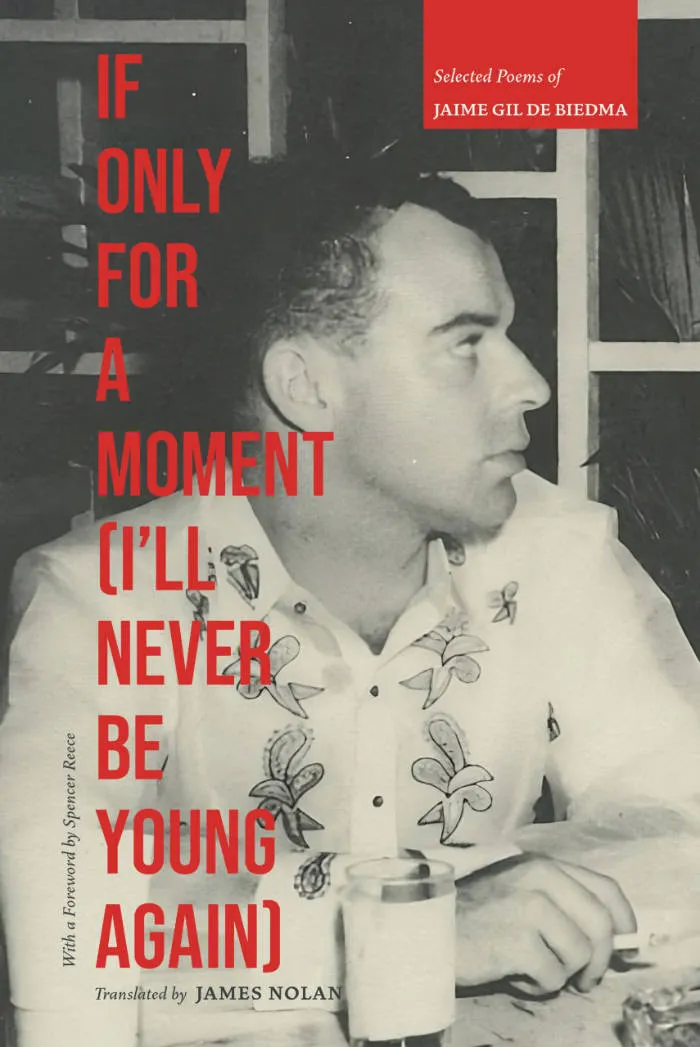
If Only For a Moment (I’ll Never Be Young Again)
Jaime Gil de Biedma, James Nolan
Jaime Gil de Biedma is the most original and influential among the poets known as the ‘50’s Generation in Spain, and is considered the greatest Spanish poet to emerge in the second half of the 20th century. His life and literary career were bracketed almost entirely by the rise and fall of Generalissimo Francisco Franco, notorious for the suppression of literature. Born in 1929, Gil de Biedma was six years old when García Lorca was murdered in Granada at the outbreak of the Civil War, and his collected poems, Las personas del verbo, first appeared in 1975, the year Franco died. What is surprising is that Gil de Biedma was a leftist, homosexual poet from the Catalan capitol, Barcelona – all of Franco’s favorite things – who not only published books of autobiographical poetry in Spain but was known as a poet of social conscience as well as erotic lyricism. Like other Spanish poets of his time, he chose his words carefully. Gil de Biedma died of AIDS in 1990.
If Only For a Moment (I’ll Never Be Young Again) consists of an extensive bilingual selection of Gil de Biedma’s poetry, including all of his most well-known work. The book additionally consists of a Foreword by Spencer Reece, Jaime Gil de Biedma’s short essay “I wanted to be the poem,” and two different essays on Gil de Biedma and the art of translation by James Nolan, the volume’s translator.

Nevertheless: A Choreographic Workbook
Yvonne Rainer, Emmanuèle Phuon
A legendary choreographer’s personal and practical guide to the art of dance-making.
Yvonne Rainer was a founding member of Judson Dance Theater, a 1960s New York artists’ collective that championed ordinary, spare movements and spontaneity. Rainer’s decades of creativity—in dance and in filmmaking—have inspired generations of avant-garde, political, and feminist choreographers. Her many works include the iconic dance Trio A and the film Hand Movie.
In this book, Rainer dancer and choreographer Emmanuèle Phuon helps Rainer gather teaching notes from her dance classes and workshops, passages from her creative journals, and her newer thoughts on movement and art, opening a window on to the life’s work of a transformative artist. With fifty prompts for improvisational movement (“39. Travel a long distance as fast as you can while making regular changes in your means of locomotion”), sly illustrations by Pascal Lemaître, and an illuminating interview with Phuon, this workbook makes Rainer’s friendly, humorous, and down&-to-earth creative practice available to everyone. Because, as Rainer says, if you can move, you are a dancer.

The Four Spent the Day Together
An unforgettable new novel from the “powerfully original” (Dwight Garner, The New York Times) author of the cult classic I Love Dick—a stark, witty journey into a fractured, violent America, culminating in the investigation of a teenage murder on Minnesota’s Iron Range.
On the Iron Range of northern Minnesota, at the end of the last decade, three teenagers shot and killed an older acquaintance after spending the day with him. In a cold, depressed town, on the fringes of the so-called “meth community,” the three young people were quickly arrested and imprisoned.
At the time of the murder, Catt Greene and her husband, Paul Garcia, are living nearby in a house they’d bought years earlier as a summer escape from Los Angeles. Locked into a period of personal turmoil, moving between LA and Minnesota—between the art world and the urban poverty of Paul’s addiction therapist jobs, the rural poverty of the icy, depressed Iron Range—Catt turns away from her own life and towards the murder case, which soon becomes an obsession. In her attempt to pierce through the brutality and despair surrounding the murder and to understand the teenagers’ lives, Catt is led back to the idiosyncratic, aspirational lives of her parents in the working-class Bronx and small-town, blue-collar Milford, Connecticut.
Written in three linked parts, The Four Spent the Day Together explores the tensions of unclaimed futures and unchosen circumstances in the age of social media, paralyzing interconnectedness, and the ever-widening gulf between the rich and poor.

Blackout
Spring 2020. During lockdown in a mountain village with his partner and young child, Yann Chateigné Tytelman becomes haunted by the presence of his dead father. Provoked by memories of him, of their laconic relationship and of the class antagonisms that emerged between them – the father was a manual labourer while his son ‘turned his back’ and entered the art world – Chateigné Tytelman starts writing letters, piles of them, which have as their subject that most mystical, most incomprehensible of phenomena: silence.
Condensed into a series of short fragments, Blackout interweaves the letter to the father with the observations of an art theorist who surveys with precision the occurrences and experiences of silence in painting, music, literature and philosophy.

Work Portraits Portrait Work
60 painted portraits of friends at work from the art world and culture.
In the expanded field of contemporary art, it is common to consider "work" and "pleasure" as one and the same thing. In this sense, it is easy to see how "labor" rapidly doubles as "labor of love," the subtext being that doing what one enjoys is invaluable no matter what. Inhabiting this dichotomy, Ben Wolf Noam's book Work Portraits Portrait Work is both a visual exploration of work in the cultural field and a statement of personal artistic intentions. Presenting 60 painted portraits of friends from the art world and culture in general, the book is a compendium of artists, musicians, chefs, filmmakers, actors, writers, and academics depicted while laboring in their chosen workplaces. At the same time, it is also a conceptual reflection on the complex nature of work in the cultural field, the relationship between subjectivity and collectivity, self-representation and belonging. The outcome is a surprisingly heartwarming object, somehow suggesting that work in the arts is never solely an individual affair. As Dean Kissick writes in one of the four texts specifically commissioned for the book— with Laura Adler, Gabriel Winant, and Ashley Mears —"art is a communal project." Furthermore, Work Portraits Portrait Work serves as a record of a specific time and place—most portraits depict people close to Noam himself, often in studios, apartments, cafés—but it does so embodying a fantasy of such time and place. The subjects of the paintings become a community, and this community becomes a character in Ben's narrative about what making art today might signify: a representation of what artistic representation could look like.
Contributions by Dean Kissick, Laura Adler, Gabriel Winant, Ashley Mears.

The Wax Child
In seventeenth-century Denmark, Christenze Kruckow, an unmarried noblewoman, is accused of witchcraft. She and several other women are rumored to be possessed by the Devil, who has come to them in the form of a tall headless man and gives them dark powers: they can steal people’s happiness, they have performed unchristian acts, and they can cause pestilence or even death. They are all in danger of the stake.
The Wax Child, narrated by a wax doll created by Christenze Kruckow, is an unsettling horror story about brutality and power, nature and witchcraft, set in the fragile communities of premodern Europe.
Deeply researched and steeped in visceral, atmospheric detail, The Wax Child is based on a series of real witchcraft trials that took place in Northern Jutland in the seventeenth century. Full of lush storytelling and alarmingly rich imagination, Olga Ravn weaves in quotes from original sources such as letters, magical spells and manuals, court documents, and Scandinavian grimoires.

Fournez
Brice Guilbert grew up on the French Indian Ocean island of La Réunion, at the foot of the Piton de la Fournaise volcano. The Fournez series is the result of years of repeated work on the very same motif: the eruption of this volcano.
Using only one proportion and five different canvas sizes, Guilbert's gaze focuses on repetition and composition bordering on abstraction, with an ineffable subconscious undertone and a strong rhythmic interest. All the works are painted on paper or wood using oil sticks made with the artist's own artisanal mixture of oil paint and natural beeswax. This book brings together a selection of one hundred works produced between 2016 and 2023, as well as ten songs written and composed by the artist in Kréyol Rényoné (Reunionese Creole).
Brice Guilbert (born 1979 in Montpellier), artist and musician, lives and works in Brussels, after growing up on Reunion Island in the town of Saint-Joseph. Since 2012, he has been exhibiting paintings and drawings often set to music. He has been painting erupting volcanoes since 2016.

Jacuzzi of Despair
There are countless ways to interpret death, and The Jacuzzi of Despair does not aim to add to them. Instead, it fizzes, swirls, weeps, and sweeps—an unsettled current of images and arrangements, placing Sharon Van Overmeiren's sculptures within a strange narrative of mortality and rebirth. Born from a collaboration with graphic designer Nana Esi, the publication refracts Sharon's work through a series of familiar yet elusive aesthetic mechanisms: from the speculative and ritualistic to the archival and surreal, from the encyclopaedic urge to categorise, to the spectacle of commercial catchphrases. As such, The Jacuzzi of Despair navigates and distorts the symbolic structures by which we typically frame life and death, suggesting a new order wherein their ineffable dimensions do not stand apart but fold seamlessly into one another. What emerges is a disorienting artifact, a publication both buoyant and weighty, performing a slippery, playful, and evocative attempt to grasp the mechanisms by which we make sense of life—only to dissolve them into incoherence, creating the conditions for new meanings to take root.
Published on the occasion occasion at Cultuurhuis De Warande, Turnhout, in 2025.
Sharon Van Overmeiren (born 1985, lives and works in Belgium) makes, in her own words, "fictional sculptures". She finds it difficult to qualify them as fully autonomous pieces, given that at any moment they may cease to exist in their current form of presentation. On a second level, this choice of wording refers to how she lends a voice to her sculptures; by providing them with a scenario based on found stories, taken from life or literature, combined with her own sense of how we are out of touch with the multiple objects that surround us. The sculptures make their appearance as "props" in a composition, installation or drawing, or as protagonists of a video or audio piece. In no small part, these works deal with the growing inability of the human mind to describe and experience "things" beyond its own desires.

One Big Bang
One Big Bang brings together 78 charcoal and pastel drawings from Adel Abdessemed's recent series Nature Morte and Politics of Drawing, where everyday objects, animals, and flowers are subtly charged with tension. Through these works, Abdessemed explores the intersections of beauty, fragility, and unrest. With texts by Hélène Cixous and David Elliott, One Big Bang offers a thoughtful entry into an artist's visual language shaped by memory, myth, and political urgency.
Published following the eponymous exhibition at Projeckt Brussels in 2024.
Adel Abdessemed (born 1971 in Constantine, Algeria, lives and works in Paris and Berlin) deconstructs identity codes, tackling head-on the tensions that permeate our society. His works, with their typical simplicity—sculptural installations, drawings, photographs, videos and performances—echo precise facts and familiar situations, but go beyond narrative commentary and militant criticism. Adel Abdessemed questions, among other things, the social and economic status of the artist in a system where his foothold is slight, by shrewdly keeping a distance in a gesture of subversive and committed resignation.
Abdessemed refuses to be limited to a single ideology. In his early works he passionately tackled religious, sexual, and taboos subjects and his later exhibitions have often focused on the theme of global violence. In an interview with Elisabeth Lebovici he stated, "I do not live between two cultures. I am not a postcolonial artist. I am not working on the scar and am not mending anything. I am just a detector … In the public sphere, I use passion and rage. Nothing else. I don't do illusions."
Sometimes reduced to a simple word, as in "Mohammedkarlpolpot" (1999), a condensation of names evoking totalitarism and religion, and sometimes complex and monumental installations such as "Habibi" (2004), a suspended skeleton of 17 meters propelled by a jet engine, Abdessemed's practice belongs to a new generation of artists who appeared recently on the French art scene, looking to offer another perspective on culture and identity.

The Fantasy and Necessity of Solidarity
From award-winning writer Sarah Schulman, a longtime social activist and outspoken critic of the Israeli war on Gaza, comes a brilliant examination of the inherent psychological and social challenges to solidarity movements, and what that means for the future.
For those who seek to combat injustice, solidarity with the oppressed is one of the highest ideals, yet it does not come without complication. In this searing yet uplifting book, award-winning writer and cultural critic Sarah Schulman delves into the intricate and often misunderstood concept of solidarity to provide a new vision for what it means to engage in this work—and why it matters.
To grapple with solidarity, Schulman writes, we must recognize its inherent fantasies. Those being oppressed dream of relief, that a bystander will intervene though it may not seem to be in their immediate interest to do so, and that the oppressor will be called out and punished. Those standing in solidarity with the oppressed are occluded by a different fantasy: that their intervention is effective, that it will not cost them, and that they will be rewarded with friendship and thanks. Neither is always the case, and yet in order to realize our full potential as human beings in relation with others, we must continue to pursue action towards these shared goals.
Within this framework, Schulman examines a range of case studies, from the fight for abortion rights in post-Franco Spain, to NYC’s AIDS activism in the 1990s, to the current wave of campus protest movements against Israel’s war on Gaza, and her own experience growing up as a queer female artist in male dominated culture industries. Drawing parallels between queer, Palestinian, feminist, and artistic struggles for justice, Schulman challenges the traditional notion of solidarity as a simple union of equals, arguing that in today’s world of globalized power structures, true solidarity requires the collaboration of bystanders and conflicted perpetrators with the excluded and oppressed. That action comes at a cost, and is not always effective. And yet without it we sentence ourselves to a world without progressive change towards visions of liberation.
By turns challenging, inspiring, pragmatic, and poetic, The Fantasy and Necessity of Solidarity provides a much-needed path for how we can work together to create a more just, more equitable present and future.