ReadPalestine
ReadPalestine

Ungrounding: The Architecture of Genocide
Eyal Weizman is one of the world’s leading experts on the relationship between violence, conflict and the environment, both built and natural. As director of the organisation Forensic Architecture, he and his team of interdisciplinary researchers document acts of state crimes and human rights violations around the world. Since 2023, the group has worked to produce evidence for the International Court of Justice’s genocide case against Israel.
In this revelatory new project, Weizman draws on that research to bring us on an eye-opening journey across time and into the 'deep cartography' of the area extending from Gaza’s subterranean tunnels through to its militarised topography, its unique soil, settlements and barriers. He catalogues, in unflinching and forensic detail, the Israeli campaigns of violence and displacement that have reshaped the region in an effort to make Gaza and its surrounding areas unliveable. Taking us through the broader geographic and historical context, from the Nakba in 1948 to the present day, Ungrounding establishes that architectural and territorial analysis is key to understanding the relationship between coloniser and colonised – and how Israel’s actions after 7 October escalated into violence so extreme and so far-reaching as to, Weizman argues, meet the definition of genocide.
Deeply informative and profoundly affecting in its scope and precision, and illustrated with dozens of original images, maps and diagrams, Ungrounding is an essential document of atrocity in our time.

Dreams of Ayn Ara
Sara Abou Ghazal, Katherine Halls
A dizzying, immersive portrait of a never-ending Nakba, as lived and relived by one displaced Palestinian family.
In Stockholm, Zein al-Abidin shivers, far from the warmth of revolt that simmered all those years ago in Shatila. In Paris, his son Nidal toils in solitude, ignoring his parents’ phone calls. Grandmother Nijmeh struggles to distinguish reality from dreams, and it’s left to fearless, level-headed matriarch Zahra to try to keep the family together. But daughter Salwa, with guidance from beyond the grave, digs backward in time and discovers an unlikely channel to the one place in the world she can’t go: Ayn Ara, the Abu Sukkar family’s ancestral home in Palestine.
Sara Abou Ghazal’s debut novel traces the worldwide, timewide scatter of the Abu Sukkar family in the wake of the 1948 Nakba and its displacement of 750,000 Palestinians from their homes. At every turn, their hopes of an ordinary existence are brutally thwarted by false friends, renewed violence, and memories so vivid they refuse to be consigned to the past. Building to a surreal crescendo, Dreams of Ayn Ara maps the cosmic upheaval in which Zionist settler colonialism denies Palestinians not only a homeland, but a future.

Palestinian Resistance Literature Under Occupation, 1948-1968
Ghassan Kanafani’s remarkable extended essay Palestinian Resistance Literature Under Occupation, 1948–1968 is an unyielding act of cultural and political endurance. Writing in the wake of Israel’s devastating territorial expansion in 1967, Kanafani elaborates his theory of resistance literature and offers a visceral account of life under occupation. Translated for the first time into English by one of the greatest living translators from Arabic to English, Tarif Khalidi, Kanafani’s essay offers one of the sharpest social and political analyses of life in Palestine in this early period of occupation.
In the two decades following the Nakba, Palestinian writers undertook the gruelling task of advancing a cultural struggle to protect their language, culture, and heritage. In addition to Kanafani’s groundbreaking essay, the book includes a selection of poetry, prose, and dramatic writing curated by Ghassan Kanafani himself. Alongside writing from Mahmoud Darwish, Hanna Abu Hanna, and Samih al-Qasim, among many others, Kanafani’s essay and the accompanying pieces stand as a defiant declaration of cultural survival in the wake of Israeli expansion.
This first English edition of Palestinian Resistance Literature Under Occupation is a joint publication with the Institute for Palestine Studies.

Men in the Sun: And Other Palestinian Stories
A classic of Arabic fiction and of what Kanafani termed ‘resistance literature’
Three Palestinian men embark on a brutal and treacherous odyssey across the Iraqi desert to Kuwait, not for liberation but material betterment. Under the indifferent brutality of border bureaucracy and the blank aggression of the sun, things grow increasingly oppressive. Breezily conversational and disarmingly lyrical, this short novel delivers a shuddering dose of horror.
Collected here alongside the titular novella are six short stories, including the timeless, resonant ‘Letter from Gaza’, Kanafani’s first published work.

The Sleep Thief
‘Sleep thief is what the interrogator called me. I’ll never forget that. I would steal a few seconds of sleep so I could remain steadfast before them. The name stuck; I even dreamt about it, the same dream, night after night. I woke up not knowing what to do and drenched in sweat.’
The experimental first novel from International Booker-Prize longlisted Palestinian author Ibtisam Azem, The Sleep Thief follows the life of Gharib (“the Stranger”) Haifawi as he comes of age, is drawn into resistance, makes friends, meets lovers, pushes back against traditional values, longs to be free of the labels and expectations that burden him, rails against the commodification of suffering, and dreams of a Palestinian identity that will transcend sorrow.

A Journal of Militant Sound Inquiry – Vol. 2 – Learning Circles for Palestine
The second volume of the journal investigating movement-based listening practices that take the forms of militant inquiry and political education, edited by the international sound art and popular education collective Ultra-red, is dedicated to the "Learning Circles for Palestine."
Contributors reflect on the current Palestine conjuncture several years after solidarity actions spread across university campuses around the world. It is now clear that the crackdown on student activism was a pretext for the dismantling or capturing of public institutions. The move against dissent also provided common ground for neofascists and liberals to enforce a consensus with imperialism.
The second volume ofUltra-red begins by pairing poems from Palestine with poems detailing the attacks on pro-Palestine students on university campuses. The journal then moves into its main feature: a dozen conversations with student and community groups. Each conversation is framed as a learning circle in which reflections shape critical questions and mark contradictions that speakers (and journal readers) continue to consider in the present moment. These learning circles come to the journal largely from contexts where Ultra-red members are involved in anti-capitalist and anti-racist base-building in Los Angeles, New York, London and in Novi Pazar. Additionally, we hear reflections on the Palestine conjuncture from the Bethlemen-based scientist and public-educator, Mazin Qumsiyeh as well as Palestinian Liberation Theologian and popular-educator, Omar Haramy. Through a list of listening protocols, the journal also offers a guide for readers to pursue their own learning circle for Palestine.
The journal continues with a special section titled, "The Case of Apartheid South Africa and Israel." This section combines historical and personal reflections on the anti-apartheid struggle in South Africa with a photo essay on anti-apartheid solidarity in the U.K. from the 1950s to the 1980s. Both articles underscore the historical links between South Africa's apartheid government and the state of Israel and the alliances established between anti-apartheid and Palestinian liberation movements.
The journal concludes with new dispatches from ongoing militant investigations. We read about Southern Italy where activists attempt to build a movement across multiple struggles from anti-extractivism to farm workers. A dispatch from the direct democracy movement in Serbia. And, an oppositional research detailing the role of neofascist operatives in pursuing hegemony in the U.S. by targeting poor people's movements and capturing university infrastructure and curriculum.
This volume of Ultra-red is edited by Dont Rhine and Robert Sember in collaboration with Zissel Aronow, Janna Graham, Chris Jones, Zoe Kisselbach, Elliot Perkins, and Araceli Veloz, and it includes numerous contributors.
Edited by Dont Rhine and Robert Sember in collaboration with Zissel Aronow, Janna Graham, Chris Jones, Zoe Kisselbach, Elliot Perkins, Araceli Veloz.

Falastiniyyat: A Century of Palestinian Feminisms
From early pioneers to modern-day revolutionaries: the resilience and centrality of feminists in the Palestinian Liberation Movement.
Women have been central to every phase of Palestinian resistance. Here Nada Elia recovers the long-suppressed story of Palestinian women’s organizing from 1929 to the present. Far from being a Western import, local feminism consistently linked personal empowerment with collective liberation, anticolonial struggle with social transformation. In the time of the Mandate, Matiel Mogannam confronted British imperialism through the Arab Women’s Congress. In the following decades, Camille Odeh built Arab American solidarity networks. Their legacy continues today in the work of contemporary activists fighting femicide and pinkwashing throughout the world.
Falastiniyyat rescues Palestinian feminism from obscurity. Furthermore, Elia argues that these activists were pioneers of a uniquely intersectional, anti-imperial feminist politics.

Almond Blossoms and Beyond
Mahmoud Darwish, Mohammad Shaheen
The first English translation of recent poetry by the late Mahmoud Darwish, the most important Palestinian contemporary poet.
Almond Blossoms and Beyond is one of the last collections of poetry that Mahmoud Darwish left to the world. Composed of brief lyric poems and the magnificent sustained Exile cycle, Almond Blossoms holds an important place in Darwish’s unparalleled oeuvre. It distills his late style, in which, though the specter of death looms and weddings turn to funerals, he threads the pulses and fragilities and beauties of life into the lines of his poems. Their liveliness is his own response to the collection’s final call to bid “Farewell / Farewell, to the poetry of pain.”
Mahmoud Darwish, born in 1941 in the village of al-Birweh, Palestine, was the author of over two dozen volumes of poetry and prose. When he died in the summer of 2008, he was mourned throughout the world as a voice of the Palestinian people—author of their official declaration of independence and, most importantly, a poet of the highest invention and beauty. Mohammad Shaheen is a professor of English at the University of Jordan. Amro Naddy has worked as an editor at the Virginia Quarterly Review. He teaches at the King’s Academy in Amman, Jordan.

Solidarité, entre fantasme et nécessité
Sarah Schulman, fervente militante pour les droits humains, livre dans cet essai une brillante analyse des défis sociaux et psychologiques inhérents à tout mouvement de solidarité. En prenant appui sur plusieurs exemples historiques (lutte pour le droit à l’avortement dans l’Espagne postfranquiste, lutte contre le VIH/sida dans le New York des années 1990, mobilisation contre le génocide à Gaza…) ainsi que sur sa propre expérience de femme queer et juive, l’autrice décortique les rouages de la solidarité et entreprend de questionner les fantasmes qui y sont traditionnellement associés.
En filigrane, cet ouvrage pose une question fondamentale : quelle place pouvons-nous prendre dans un monde de plus en plus polarisé, et comment agir en solidarité avec les populations opprimées à l’échelle mondiale, locale ou individuelle ? L’autrice analyse les conditions nécessaires à tout mouvement de solidarité et montre l’importance de l’écoute active, la nécessité d’intervenir lorsque l’on est confronté à une injustice, la capacité à tolérer l’imperfection, ou encore la reconnaissance du coût moral et social inhérent à toute mobilisation.
En dressant des parallèles entre différents mouvements sociaux, Sarah Schulman met en lumière certaines dynamiques transversales à tout acte de solidarité et montre l’importance de la convergence des luttes dans un contexte mondialisé. Ode à la libération des populations opprimées, cet ouvrage apparaît aujourd’hui indispensable pour quiconque souhaite oeuvrer à la construction d’un monde plus juste.

On ne bombardera jamais ma voix
Yahya AL Hamarna, Elissa Kayal and 1 more
« On ne bombardera jamais ma voix » est un recueil de poèmes écrits depuis le génocide en cours à Gaza. Yahya AL Hamarna y documente les brutalités de la guerre ainsi que les rituels fragiles de la vie quotidienne : étudier, se promener dans le parc, lire de la poésie, préparer du thé, pleurer, survivre. De l’intimité exiguë des tentes de déplacés à la sérénité imaginaire des cours universitaires et des matchs du Réal Madrid, AL Hamarna élabore une poétique de la survie : une poétique qui refuse le désespoir et insiste sur la dignité invincible du peuple palestinien.
Préface : Elissa Kayal
Postface : Alycia Dufour

The Fantasy and Necessity of Solidarity
From award-winning writer Sarah Schulman, a longtime activist and critic of the Israeli war on Gaza, comes a brilliant examination of the misunderstood concept of solidarity which seeks to provide a new vision of what it means, and why it matters.
In this nuanced analysis, Schulman challenges the traditional notion of solidarity as a simple union of equals, arguing that in today’s world of globalized power structures, true solidarity requires the collaboration of bystanders and conflicted perpetrators with the excluded and oppressed. Schulman examines a range of case studies, from the fight for abortion rights in post-Franco Spain, to NYC’s AIDS activism in the 1990s, to the current wave of protest movements against Israel’s genocide of the Palestinian people, and her own experience growing up as a queer female artist in male dominated culture industries. Reckoning with the successes and failures of these movements, she argues that action always comes at a cost, despite not always being effective. But without solidarity we are stuck with the status quo, and we lose any hope of progressive change.
By turns challenging, inspiring, pragmatic, and poetic, The Fantasy and Necessity of Solidarity provides a much-needed path for how we can work together towards justice now and for the future.

Strangers in Light Coats
Strangers in Light Coats is the third collection of Zaqtan's poetry to appear in English. It brings together poems written between 2014 and 2020 drawn from six volumes of poetry. Catching and holding the smallest particles of observation and experience in their gravity, the poems sprout and grow as though compelled, a trance of process in which fable, myth, and elegy take form only to fall apart and reconfigure, each line picked apart by the next and brought into the new body.
Ghassan Zaqtan is not only one of the most significant Palestinian poets at work today, but one of the most important poets writing in Arabic. Since the publication of his first collection in 1980, Zaqtan's presence as a poet has evolved with the same branching and cumulative complexity as his poems—an invisible system of roots insistently pushing through the impacted soil of political and national narratives.

Discontent Issue 6
Reportage, photography, and art from Palestine and Lebanon. Contributors include Alaa Mansour, Fady Joudah, Farah Silvana-Kanaan, Fatima Joumaa, Fouad Elkoury, Hadi Afif, Islam Al-Khatib, Philippa Dahrouj, Rawad Wehbe, Sakir Khader, and Wassila Abboud.

Land Keepers
EcoRove’s Land Keepers Reader brings together writers, activists, journalists, farmers, and ecologists from across Bilad al-Sham — Lebanon, Syria, and Palestine — to tell stories of green resistance in the Jabal al-Sheikh ecological zone. Spanning South Lebanon, the occupied Jawlan, and the occupied Galilee, this landscape faces ongoing ecocide, defined as the deliberate destruction of land and ecologies used by the settler-colonial regime to erode livelihoods, cultures, and environments. The Reader highlights these struggles through essays, research and testimonies that show how native communities remain rooted in place, resisting colonial environmental orientalism, greenwashing, and scorched-earth tactics. As part of a wider body of work that includes a documentary film, tapestries, and sculptural pieces, the Reader amplifies indigenous ecological knowledge and envisions regenerative futures for threatened landscapes.
with contributions by Mahdi Sabbagh, Hamza Hamouchene, Public Works, Hussein Chaabane, Hisham Younes, Nadine El-Khoury, Michelle Eid, and Munira Khayyat
From the intro by Ecorove:
"Return, Al’Awda in Arabic, signals the right of return to homeland, a central tenet of the Palestinian struggle. Al’Awda affirms the fundamental historical, legal, collective, and individual right of Palestinians to return to their homeland. But how do we return to the earth after it has been damaged and scorched? In landscapes marked by war, ruins, rubbles, and ecological destruction, can Al’Awda take another form? Can generations of Palestinian diaspora exercise Al’Awda differently? At a time when international legal systems and institutions have failed to secure justice, can return to land be understood beyond legal definitions alone? In times of mass displacement and ecological devastation, Al’Awda may therefore exceed juridical meaning, and live through those who remain on the land and their acts of love, labour, and agriculture."
Each book comes with a 2-color, double-sided risograph-printed bookmark.
Ecorove is Iyad Abou Gaida and Jumanah Abbas.
CUNY Center for the Humanities
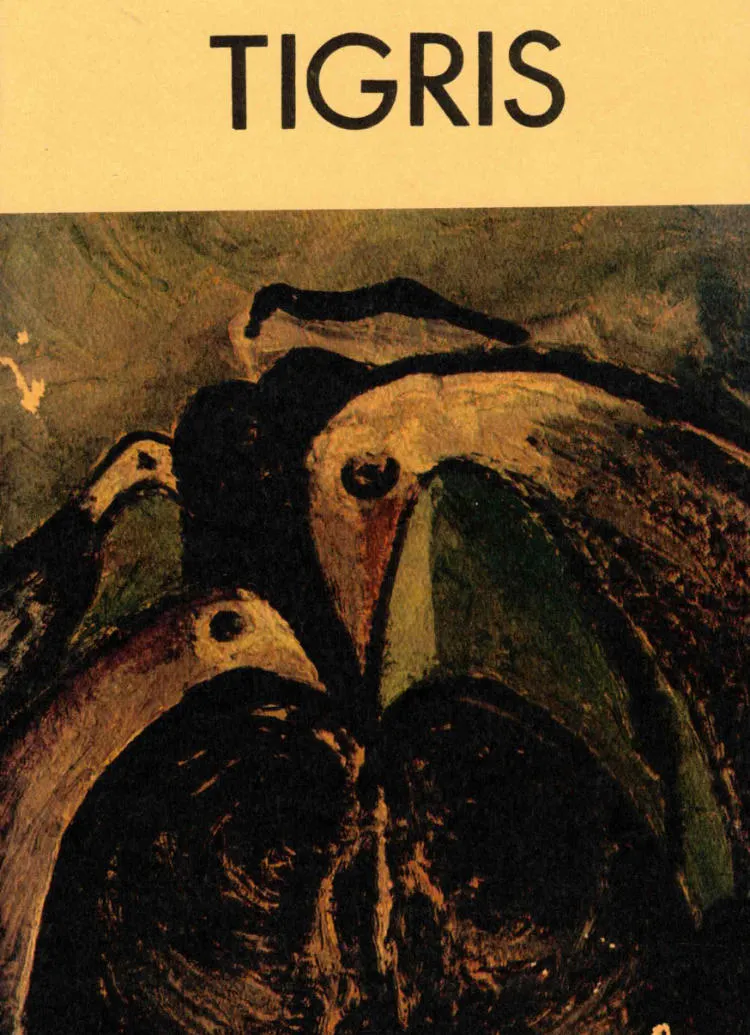
Tigris Vol. 1
In 1971, the great Iraqi poet Sargon Boulus (1944-2007) published a single issue of an English-language literary anthology that he called Tigris. The magazine—a whisper on the literary landscape that appeared three years after Boulus’s arrival in the US—brings together work by Boulus and several of his literary friends, in translation by Boulus and Etel Adnan.
Tigris was not an end in itself, but rather a temporary solution to the lifelong problem of how to devote oneself to poetry across different countries, eras, and styles: how to live poetry. Yet, in so doing, the small anthology includes significant work: Etel Adnan’s “Jebu,” translated by Adnan, and poetry by Boulus, Fouad Rifkah, Yusuf al-Khal, Mouayad al-Rawi, and Riadh Fakhouri, all in Boulus’s translations, as well as a work by Ankido, a “street-activist poet-café worker of importance to the Palestinian Liberation Movement.”
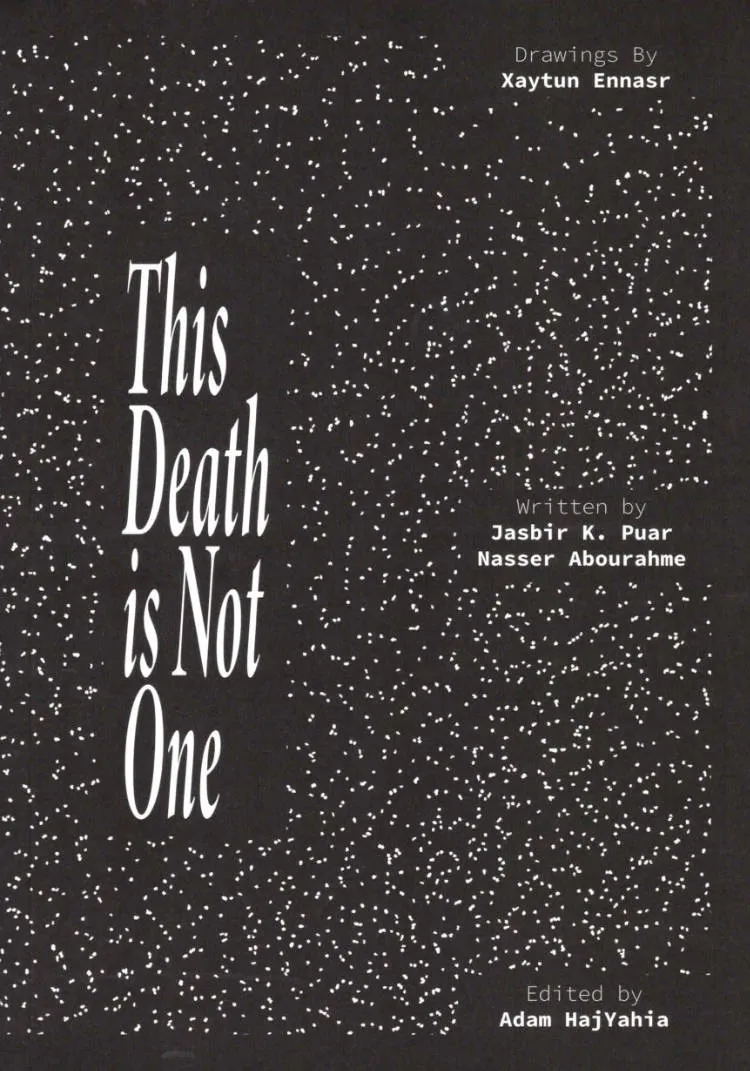
This Death is Not One
Jasbir K. Puar, Nasser Abourahme and 1 more
The publication of The Right to Maim by Jasbir K. Puar in 2017 was critical to advancing studies on disability and to further articulating how the body figures in the nexus of capacity and debility across racializing and extractive neoliberal lines. It offered a complex and rigorous anti-capitalist account of disability that is useful to both scholarly work and political and social organizing. However, despite its paramount contribution to scholarship on Palestine, delivered by its scathing analysis of the Israeli biopolitical policy—its right to maim—in how the injured Palestinian body is produced and reproduced, its reception was difficult, and hard to stomach. It cohered a political logic in writing before it was visibly evident on the ground. In the moment and aftermath of the Great March of Return (2018-19), Puar’s offerings became much harder to ignore, as the event crystallized a mass maiming campaign of Palestinian protesters inside the edges of the militarized borders of Gaza.
The occasion of this publication by Bilna’es marks the first translation into Arabic of the chapter “Will Not Let Die”: Debilitation and Inhuman Biopolitics in Palestine, alongside the postscript of The Right to Maim. Not simply a reissue of previously published work or a translation, This Death is Not One includes a new preface from Jasbir K. Puar revisiting the right to maim from within this moment of genocide in Gaza that interrogates the new vectors of living and dying under settler-colonialism, and how maiming, in fact, speaks of extermination; an introduction by Nasser Abourahme reflecting on the book’s stakes in the present and its reception in the past, alongside searing analysis of genocide in excess of the law, and what this reveals and forecloses in how we understand the juridical body and militancy in the wake of Zionism; and original drawings by Xaytun Ennasr that inscribe a relation between land and body mapped through cosmological patterns tracing the relation between martyrs, who are referred to as moons, and the moon, a symbol for martyrdom in Palestine.
Jasbir K. Puar is Distinguished Faculty of Arts Professor in the Social Justice Institute at the University of British Columbia, Extraordinary Professor in the Women’s and Gender Studies Department at the University of the Western Cape in Cape Town, South Africa, and Professor Emerita at Rutgers University where she was faculty in the Women’s, Gender, and Sexuality Studies Department for 23 years. Puar is the author of the award-winning books: The Right to Maim: Debility, Capacity, Disability (2017), and Terrorist Assemblages: Homonationalism in Queer Times (2007).
Nasser Abourahme is a writer and teacher, and is currently assistant professor at Bowdoin College. He’s the author of The Time beneath the Concrete: Palestine between Camp and Colony (Duke University Press, 2025), which was awarded the 2025 Palestine Book Award.
Xaytun Ennasr is an artist and designer. She works across experimental video games, paintings, prints, ceramics, installations, and text. She often uses science fiction, folklore, and radical softness as affective tools for revolutionary cultural production, specifically Palestinian liberation and sovereignty. Her work often deals with questions of land, cartography, transness, gender, and the living environment.
Drawings by Xaytun Ennasr
Translation to Arabic:
“Living in Genocide” by Jasbir K. Puar, translated by The Archilogue
“Our names, our remains” by Nasser Abourahme, translated by The Archilogue
The Right to Maim, Chapter 4: “Will not let die: Debilitation and Inhuman Biopolitics in Palestine ” and the The Right to Maim Postscript by Jasbir K. Puar, translated by Bekriah Mawasi

Foraging Fireflies
Various
Foraging Fireflies is a publication rooted in archiving, memory, and refusal amid ongoing violence and erasure in Palestine. Through personal stories, recipes, and reflections on foraging, farming and land-based knowledge, it insists on the presence of Palestinian lives, histories, and enduring connections to the land.
Gathering voices across generations, the publication documents practices of care, sustenance, and resistance—countering dispossession, greenwashing and colonial narratives. In a moment of attempted annihilation, preserving memory and knowledge becomes an act of defiance, continuity, and hope.
The publication naturally gives priority to Arabic in the design, allowing it to fully spread on the page, while English appears on narrower pages at the end of each contribution, unfolding like a booklet. The magazine is organized into four color-coded sections, each comprising multiple contributions that open with a full-page illustration by Aude Aboul-Nasr, portraying the land and its keepers. Printed in risograph, the colors gain a rich, vibrant texture. The publication also includes a poster and two postcards.
Creative Direction: SuperMelon | Besma Ben Said
Graphic Design: Chiara Vincenti Zakhia
Illustration: Aude Aboul-Nasr

Campism Divides Struggles: How Iranians and Palestinians Forced into Opposition
Various
In this interview, Palestine solidarity activists form the Chinese diaspora speak with Iranian activists in exile about the uprising that took place in Iran in January 2026, comparing notes about resistance to various forms of authoritarianism.

From Palestine to "Xinjiang": Forced Labour and Capitalist rule
Various
For a long time, Israel and the West, led by Europe and the United States, have used hasbara and neoliberal discourses to hide their colonial plunder of Palestine, while today China and Russia are also whitewashing their own imperialist practices by aligning themselves with authoritarin government and projecting an image of leading resistence to western hegemony.
This publication analyzes the structural similarities and differences between forced labor and capital exploitation of Palestinians and Uyghurs from left-wing perspective. The author hopes to dispel the myth of campism and call for inter-racial/-ethnic/-national proletarian solidarity against oppression of colonization, capital and totalitarianism.

Testimony From A West Bank Village: ‘Illegal Life’ Under Occupation
Various
Resistance dispatch 002
In 2024, the documentary No Other Land, co-produced by Palestinian and Jewish activists from Masafer Yatta drew internattional attention at film festivals, bringing the long-standing occupation, demolitions, and violence in the region into broader public view.
The starting point of this publication emerged from an impromptu decision to draw a family tree covering roughly five hundred villagers of Umm al-Kheir. The author follows two threads simultaneously: one traces verifiable institutional and geographic transformations, tracking how a community is systematically rendered illegal through planning regimes and court rulings; the other comes from lived encounters, oral testimony, and the moments when people entrusted me with their names, their kinship ties, and their past.

University of California Press
Novel Palestine
Palestinian writing imagines the nation, not as a nation-in-waiting but as a living, changing structure that joins people, place, and time into a distinct set of formations. Novel Palestine examines these imaginative structures so that we might move beyond the idea of an incomplete or fragmented reality and speak frankly about the nation that exists and the freedom it seeks. Engaging the writings of Ibrahim Nasrallah, Nora E. H. Parr traces a vocabulary through which Palestine can be discussed as a changing and flexible national network linking people across and within space, time, and community. Through an exploration of the Palestinian literary scene subsequent to its canonical writers, Parr makes the life and work of Nasrallah available to an English-language audience for the first time, offering an intervention in geography while bringing literary theory into conversation with politics and history.
NORA E. H. PARR is a Research Fellow at the University of Birmingham and at the Center for Lebanese Studies. She coedits Middle Eastern Literatures.

Freud and the Non-European
In this influential lecture, Edward Said explores Freud’s foundational work Moses and Monotheism to rethink the relationship between identity, politics and psychoanalysis. The result is a study illuminating both Freud’s thinking and that of Said, on whom the great psychoanalyst was a formative influence.
Was Moses Jewish or an Egyptian? The question undermines any simple ascription of identity, highlighting the limits of these categories. Said suggests that such an unresolved, nuanced sense of identity might, if embodied in political reality, form the basis for a new understanding between Jews and Palestinians. In contrast, Israel's relentless march towards an exclusively Jewish state denies any sense of a more complex, inclusive past.
With an introduction by Christopher Bollas and a response by Jacqueline Rose.

SABR N°04 - Half a life
“Perhaps much of what we once believed was never truth but a gentle and necessary illusion.It was something we chose quietly and almost unconsciously so we could continue without falling apart.”
Bayan Abu Nahla is a visual artist born in 2001 in Gaza, Palestine. Her artistic practice functions as a visual diary, documenting and reflecting rapidly evolving events, both before and after the genocide. Through her work, she explores realities and daily living conditions often unknown to those who have not lived in Gaza.
SABR/Collection is a series of publications that bring together short literary works in a variety of genres. Curated by Nesrine Salem, SABR/Collection wishes to highlight the macro-realities of the authors chosen, to make visible the intersectional nature of struggles.

And most of all I would miss
Picture a pencil curved, implausibly, parabolically. An implement bending back on itself (core straining) so as to be drawing the surest line, even as its eraser-end is simultaneously rubbing that graphite out. What remains almost never was: mark as memorial to foreclosure. Examined from a certain angle, the un-line flickers in and out of thereness. On registration, it lives, it goes forth. Sub rosa, it knows never to clear its throat. It has learnt to calibrate its signature; it can evade infra-red. Propelling itself through the narrowest channels, it proceeds with resolve, flayingly. Mattar’s And most of all I would miss the shadows of the tree’s own leaves cast upon its trunk by the orange streetlight in the sweet blue darks of spring is taut as writing can be. The tone she makes sound is singular and desperately (gloriously) intent.
- Sarah Hayden
Piercing and lucid in its exposition of atmospheric violence and total erasure, Mira Mattar gets to the grain of how the languages of selfhood, mediated but also inhibited by the force of the ‘un-universal’, become complicit in forming the sovereign imperative to self-determination, ‘oh arrogant ambition / to transform / you & keep myself / plumed’, through the reproduction of a ‘contested field / of meaning’, one both marked by the lure and ruse of psychic stability as the real fantasy of occupation, and immanent to concrete, unknown modes of personal resistance and collective recovery thread like a ‘rope / in a knot in a line / of knots’, an inherited ‘excess of memory / mostly portal.’ Mattar carefully gleans in its undecidability, given over to moments of precarious decision without ties or duplicity.
- James Goodwin