rile*books

Search books

Search books by title, author, publisher, keywords...

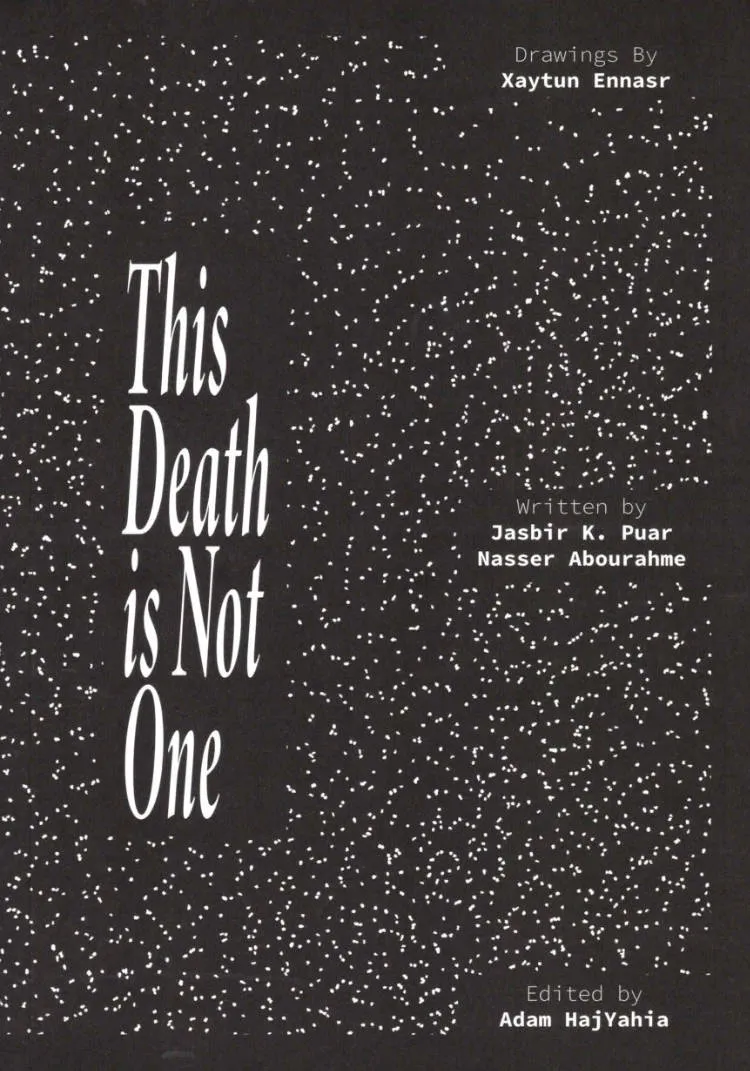
Cover of This Death is Not One

Bilna'es

This Death is Not One

Jasbir K. Puar, Nasser Abourahme, Adam HajYahia ed.

€20.00

The publication of The Right to Maim by Jasbir K. Puar in 2017 was critical to advancing studies on disability and to further articulating how the body figures in the nexus of capacity and debility across racializing and extractive neoliberal lines. It offered a complex and rigorous anti-capitalist account of disability that is useful to both scholarly work and political and social organizing. However, despite its paramount contribution to scholarship on Palestine, delivered by its scathing analysis of the Israeli biopolitical policy—its right to maim—in how the injured Palestinian body is produced and reproduced, its reception was difficult, and hard to stomach. It cohered a political logic in writing before it was visibly evident on the ground. In the moment and aftermath of the Great March of Return (2018-19), Puar’s offerings became much harder to ignore, as the event crystallized a mass maiming campaign of Palestinian protesters inside the edges of the militarized borders of Gaza.

The occasion of this publication by Bilna’es marks the first translation into Arabic of the chapter “Will Not Let Die”: Debilitation and Inhuman Biopolitics in Palestine, alongside the postscript of The Right to Maim. Not simply a reissue of previously published work or a translation, This Death is Not One includes a new preface from Jasbir K. Puar revisiting the right to maim from within this moment of genocide in Gaza that interrogates the new vectors of living and dying under settler-colonialism, and how maiming, in fact, speaks of extermination; an introduction by Nasser Abourahme reflecting on the book’s stakes in the present and its reception in the past, alongside searing analysis of genocide in excess of the law, and what this reveals and forecloses in how we understand the juridical body and militancy in the wake of Zionism; and original drawings by Xaytun Ennasr that inscribe a relation between land and body mapped through cosmological patterns tracing the relation between martyrs, who are referred to as moons, and the moon, a symbol for martyrdom in Palestine.

Jasbir K. Puar is Distinguished Faculty of Arts Professor in the Social Justice Institute at the University of British Columbia, Extraordinary Professor in the Women’s and Gender Studies Department at the University of the Western Cape in Cape Town, South Africa, and Professor Emerita at Rutgers University where she was faculty in the Women’s, Gender, and Sexuality Studies Department for 23 years. Puar is the author of the award-winning books: The Right to Maim: Debility, Capacity, Disability (2017), and Terrorist Assemblages: Homonationalism in Queer Times (2007).

Nasser Abourahme is a writer and teacher, and is currently assistant professor at Bowdoin College. He’s the author of The Time beneath the Concrete: Palestine between Camp and Colony (Duke University Press, 2025), which was awarded the 2025 Palestine Book Award.

Xaytun Ennasr is an artist and designer. She works across experimental video games, paintings, prints, ceramics, installations, and text. She often uses science fiction, folklore, and radical softness as affective tools for revolutionary cultural production, specifically Palestinian liberation and sovereignty. Her work often deals with questions of land, cartography, transness, gender, and the living environment.

Drawings by Xaytun Ennasr

Translation to Arabic:

“Living in Genocide” by Jasbir K. Puar, translated by The Archilogue

“Our names, our remains” by Nasser Abourahme, translated by The Archilogue

The Right to Maim, Chapter 4: “Will not let die: Debilitation and Inhuman Biopolitics in Palestine ” and the The Right to Maim Postscript by Jasbir K. Puar, translated by Bekriah Mawasi
Published in 2026 ┊ Language: English, Arabic

recommendations

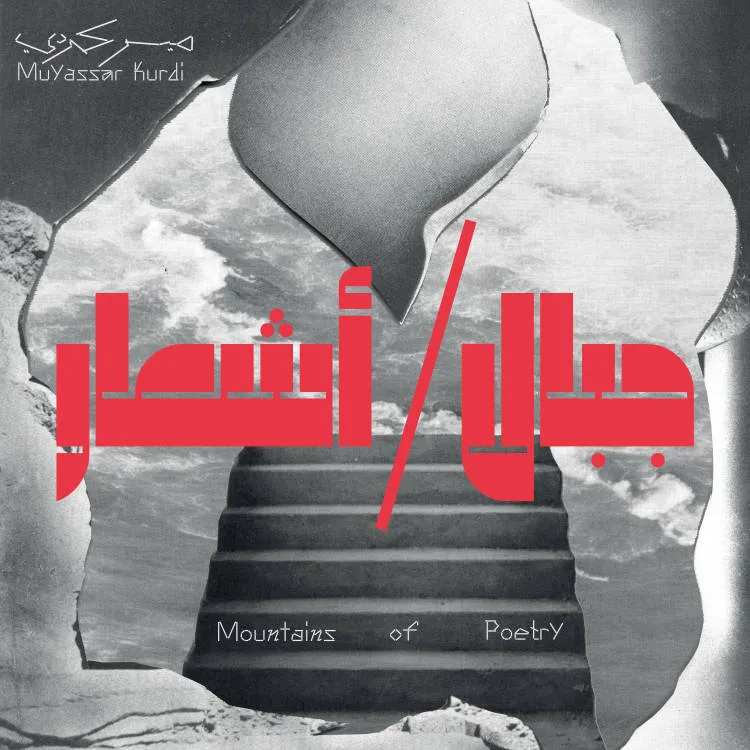
Cover of Mountains of Poetry (Limited Edition 12" Coloured)

Bilna'es

Mountains of Poetry (Limited Edition 12" Coloured)

Muyassar Kurdi

Mountains of Poetry is a new 8-track studio album produced and developed by interdisciplinary artist Muyassar Kurdi. The album traces the entwined relations between one’s body and land, driven by a sense of urgency. Embedded in the earth, Kurdi imagines her body as a site for sonic excavation of memory and longing. The artist’s voice paired with electronic sound honors the ancient and the futuristic that together form a ritualistic reflection to navigate the tender space of remembering, forgetting and mourning. Departing from her usual emphasis on vocal abstraction, Kurdi turns to concrete words that punctuate the sonic landscape, gathering them into mountains of poetry.

Cover of Palestine is everywhere

Silver Press

Palestine is everywhere

Skye Arundhati Thomas

Poetry €18.00

‘Palestine is everywhere because it names a political subject of radical universal emancipation,’ writes teacher and writer Nasser Abourahme. In Palestine is everywhere, writers, thinkers, poets and artists map the Palestinian struggle for freedom and its global resonances.

Vital dispatches from Gaza, essays, poems, protest chronicles, images and letters from prison reflect upon resistance, solidarity and the right to self-determination. Amid a world-historical moment marked by unknowability and loss, this collection offers essential reading for those interested in Palestinian liberation.

This collection is edited by Skye Arundhati Thomas, with contributions from Alaa Abd El-Fattah, Nasser Abourahme, Amal Al-Nakhala, Muhammad Al-Zaqzouq, Maisara Baroud, Ahmed Bassiouny, Houria Bouteldja, Anees Ghanima, Sahar Khalifeh, Laleh Khalili, Lujayn, Mira Mattar, Lina Meruane, Mohammed Mhawish, Nahil Mohana, Rahul Rao, Nasser Rabah, Adam Rouhana, Ahmad Zaghmouri.

Co-published by TBA21.

All royalties from this project will be donated to Medical Aid for Palestinians (MAP) and The Arab Group for the Protection of Nature (APN).

Cover of The Queer Arab Glossary

Saqi Books

The Queer Arab Glossary

Marwan Kaabour

LGBTQI+ €23.00

When conventional language does not equip us with the tools to speak about ourselves, we create our own. Slang expresses words and feelings that break down boundaries. It is a form of protest and fills in the gaps.

The Queer Arab Glossary is the first published collection of Arabic LGBTQ+ slang. This bold guide captures the lexicon of the queer Arab community in all its differences, quirks and felicities. Featuring fascinating facts and anecdotes, it contains more than 300 terms in both English and Arabic, ranging from the humorous to the harrowing, serious to tongue-in-cheek, pejorative to endearing. Here, leading queer Arab artists, academics, activists and writers offer insightful essays situating this groundbreaking glossary in a modern social and political context.

With beautiful, witty illustrations, The Queer Arab Glossary is a powerful response to pervasive myths and stereotypes around sexuality and an invitation to take a journey into queerness throughout the Arab world.

Contributors include Saqer Almarri, Nisrine Chaer, Sophie Chamas, Rana Issa, Adam HajYahia, Suneela Mubayi, Mejdulene Bernard Shomali, Hamed Sinno and Abdellah Taïa.

The Queer Arab Glossary was made possible with the generous support of the Arab Fund for Arts and Culture – AFAC, Mophradat, Bashar Assaf and Mohammed Fakhro.

Foreword by Rabih Alameddine

Cover of A Nazi Word for a Nazi Thing

Peninsula Press

A Nazi Word for a Nazi Thing

So Mayer

Essays €12.00

An essay on art, bodies and fascism.

In an era where identity politics is being weaponised against the very people it has sought to make visible, how can we reclaim complexity?

In 1937 the Nazis staged an exhibition of seized modernist artworks. Named Entartete ‘Kunst’ – Degenerate ‘Art’ – it sought to define degeneracy, display it and destroy it.This act of violent appropriation is one episode in a long and ongoing history of the erasure of queer and non-normative cultures.

A Nazi Word for a Nazi Thing works against this erasure; it is a manifesto – a catalogue for an exhibition that could never take place. Drawing on work from dissident sexologist Magnus Hirschfeld to South African artist Zanele Muholi, as well as a century of queer cinema from Sergei Eisenstein to Pedro Almodóvar, So Mayer creates an archive of resistance.

‘This book is a small revolution that becomes a party that you won’t be leaving soon. I believe we’re living in a time of fresh erasures, systemic violences working that global pandemic to take some other bodies out. Looking so freshly at the history of queerness, sexual deviance and the long long coordinated erasures of colonialism, bigotry and transphobia the essential non binary nature of art opens up right here like the wildly singing flower it is and So Mayer’s compelling version makes sense, makes me listen.’
Eileen Myles

‘A Nazi Word for a Nazi Thing is a reflective, creative walk through some of the worst – and best – people of the last hundred years, looking at the power of images and their relationship(s) with text. In a time of rising fascism, So Mayer highlights ways that artists have found strategies of resistance, and offers hope in historical analysis.’
Juliet Jacques

Cover of The Difficulties

Tripwire Journal

The Difficulties

Haytham El-Wardany

Essays €10.00

If there is a centre around which the language of this pamphlet circulates, then it is Palestine. As this centre, Palestine enables a transformative power that persistently and steadfastly turns repression and silencing into solidarity. Essay-fiction, prose poetry, radical philosophy, speculative nonfiction — this uncategorizable collection of texts brings militant inquiry to each utterance, each narrative turn, in acts of transnational and transhistorical becoming.

Cover of Devenir minéral | L’éditeur du dimanche

Avarie Publishing

Devenir minéral | L’éditeur du dimanche

Giuliana Prucca

Essays €38.00

Echoing Jean Dubuffet's idea that thought must arise from material in artistic practice, Giuliana Prucca, through this essay, reinterprets a moment in the history of 20th-century art using materials such as stone, sand, earth, and dust. She employs the mineral to illustrate that the creative act would be a trace of the body's disappearance. The loss of humanity and the deconstruction of the subject objectify themselves in the image. In other words, art resides in the tension between representation and its loss, ultimately leaving nothing but an image.

Drawing from the influential figure of Antonin Artaud, she weaves critical and poetic connections between the texts and works of various artists, writers, and thinkers, ranging from Jean Dubuffet to Jan Fabre and Anselm Kiefer, Yves Klein and Gutaï, Joë Bousquet to Camille Bryen and Francis Ponge, Gaston Bachelard to Gilles Deleuze, and Georges Bataille to Aby Warburg.

The material is not merely a thematic pretext; it is an active and explosive catapult that questions the arbitrary linearity of a conventionally assimilated art history. Following Ponge's example, Prucca applies the principles of poetry to criticism, starting from Artaud's material, the most undisciplined of poet-artist-thinkers of the modern era. This results in a critically inventive approach dangerously suited to its object, celebrating an anti-critique. The chosen writing materials, stonepaper for the cover and recycled paper for the pages, is consistent, intending to give the impression of being covered in dust.

The essay disrupts traditional reading habits and shatters the conservatism of art criticism by inhabiting writing space differently, presenting a physically engaging interaction. This is an essay in the literal sense, an experience where form never contradicts content, urging readers to take the risk of thinking deeply and embracing a new rhythm. A complex and challenging design invites them to choose different reading options, ultimately treating criticism as one would poetry.

Giuliana Prucca [Paris | Berlin] is an independent curator, researcher, and writer. She is the founder and art director of the publishing house AVARIE, specialising in contemporary art books that explore the relationships between text and image, body and space.

Graphic design, art direction by Vito Raimondi

Cover of Your Silence Will Not Protect You

Silver Press

Your Silence Will Not Protect You

Audre Lorde

Poetry €18.00

With a preface by Reni Eddo-Lodge and an introduction by Sara Ahmed.
Audre Lorde (1934-92) described herself as ‘Black, lesbian, mother, warrior, poet’. Born in New York, she had her first poem published while still at school and her last the year she died of cancer. Her extraordinary belief in the power of language – of speaking – to articulate selfhood, confront injustice and bring about change in the world remains as transformative today as it was then, and no less urgent. This edition brings Lorde’s essential poetry, speeches and essays, including ‘The Master’s Tools Will Never Dismantle the Master’s House’, together in one volume for the first time.

Cover of Voyage, War, Exile: Three Essays

Litmus Press

Voyage, War, Exile: Three Essays

Etel Adnan

Essays €17.00

Written between 1984 and 1995, this new edition collects three essays by Etel Adnan meditating on a life lived in motion: intellectual, geographic, linguistic and artistic perpetual motion. Published in honor of Adnan’s centennial (2025), these essays are a beacon and remain a piercing and profound model for reckoning with and surviving our times of war and exile.

Voyage, War, and Exile collects three essays by Etel Adnan that present a multilayered meditation on the author’s life within and without Beirut. Adnan reflects upon the intricacies of family, place, and language, asking what it means to be an Arab woman and writer in exile at the end of a century in which “Exile became the existential and metaphysical condition for every Arab.” At once deeply personal to the life of the author and yet ubiquitous in inquiry, Voyage, War, Exile pulls us into the shifting landscape of Lebanon and the United States in the 20th Century through a weaving of philosophical reflection and memory. This volume includes artwork by Simone Fattal.

Praise for Etel Adnan

The work of Etel Adnan—poet, painter, philosopher—is an interrogation of the human experience and a study in worldly engagement…Sorting through decades of memory, loss, and linguistic turns, we drift with her in a sea of thought and expansive meditation. —K.B. Thors, The Lambda Literary Review

Her poetry has the capacity to assemble and discern the ‘sides’ of the self as well as the literature and literary personalities which frame the self of her writing. —Matt Turner, Hyperallergic

Adnan’s receptivity is evident in her fine-tuned attention to detail, at the microscopic and cosmic level alike. Her lens shifts in scale and orientation, defamiliarizing the surroundings we thought we knew and re-introducing us to nature.—Noa Micaela Fields, Medium