Periodicals
Periodicals

OEI #92-93 Lettrist Corpus: The Complete Magazines (1946–2016)
Frédéric Acquaviva, Jonas J. Magnusson and 1 more
“Un livre qui fera date. Deux ans de recherches, 512 pages, 1.361 illustrations en quadrichromie, 119 revues lettristes parues de 1946 à 2016 pour un total de 1.200 ouvrages décrits (avec la couverture et le sommaire de chaque numéro). Qui d’autre que les éditeurs suédois de OEI (Jonas J. Magnusson et Cecilia Gronberg) aurait pu sortir ce travail anthologique? Personne!” — www.mauricelemaitre.org
“The ‘unreasonable’ idea for this ‘catalogue raisonné’ came to me as an attemps to draw up a complete inventory of all the journals and periodicals of the Lettrist group, from its birth until today. Because the lifespan of the Lettrist movement has exceeded that of all the other avant-garde movements, we are undoubtedly in front of the most immense corpus ever produced in terms of magazines, coverin a period from 1946 to 2016. It presents more than a hundred different titles with more than one thousand items and hundreds of authors. . . . I hope that this comprehensive work will give the reader an opportunity to understand the different paths of the Lettrist groups and the many areas addressed, if not shaken, beyond the books of Isidore Isou and Maurice Lemaître. Since other Lettrists have published relatively few monographic books, and very little outside their own magazines, OEI #92-93 is a unique database for most of the Lettrist texts that we can access, also making it possible for new readers to come across Lettrism.”
— from Frédéric Acquaviva’s introduction
Design by Fält

OEI #90/91 Sickle of Syntax & Hammer of Tautology
Tobi Maier, Cecilia Grönberg and 1 more
OEI # 90-91: Sickle of Syntax & Hammer of Tautology offers the first English language overview of the history of concrete and visual poetry production in socialist Yugoslavia between 1968 and 1983.
By focusing on mass-produced examples of concrete poetry, this publication presents these poetic experiments as organically linked to social movements, critical theories, and youth cultural revolutions. In his extensive introduction, Sezgin Boynik, the guest editor of this special issue of OEI, discusses concrete and visual poetry in socialist Yugo-slavia as an uneven and combined development, and emphasizes its confrontational and organizational aspects.
By means of interviews, translations, reproductions, and theoretical and historical statements, OEI # 90-91 offers a picture of a very lively scene of concrete and visual poetry in Yugoslavia, which unfortunately is not as recognized interna-tionally as it would deserve.
Hoping that OEI # 90-91 could contribute to this task in a substantial way, we present episodes from the early years of OHO formation and its complex theories of words and things; an interview with Rastko Močnik on programmed art and political formalism; militant polemics of Goran Babić; Signalist contradictions; subjective structural devices of Judita Šalgo; zaum experiments of Vojislav Despotov; detective meta-texts of Slavoj Žižek; poetic self-management studies of Vujica Rešin Tucić; a feminist historicisation of Ažin school for experimental poetry; democratisation of visual poetry by Westeast; selections from special issues of the journals Pitanja, Problemi, Ulaznica, Dometi, Delo, Koraci, Vidik, Pegaz, and many other materials translated here for the first time and presented in one publication.

OEI #86/87 Publishing Practices, Publishing Poetics
Tobi Maier, Cecilia Grönberg and 1 more
Once more, an astonishing issue of OEI – a thrilling, compelling, stimulating feast of ideas regarding publishing and the book: the perfect big companion to read and hug in bed while the virus spreads outside.
Bringing together contributions from circa 130 publishing structures, publishing communities, magazines, small press endeavors, artists, poets, writers, editors, theoreticians, curators, scholars, and art bookstores, OEI # 86–87 reflects upon the challenges, pressures and possibilities of publishing and creating publics in different contexts and places in a time of far-reaching – economical, medial, political, social, technological – transformations.
The potential and the versatility of publishing open it to a diversity of practices and approaches in the arts, but as an eminently social form of art, a collective or micro-collective work with shared responsibilities, it is also a never-ending process of “crafting a variegated approach to how you create, publish, distribute, and build a social ecosystem around your efforts”, of trying to “build up and strengthen the community around these printed forms” (Temporary Services).
It is the conviction of OEI #86–87 that print has the power to play an important part in the construction of social spaces, of a social world. As Benjamin Thorel puts it in one of the essays in the issue, “conceiving of the dynamics of publishing as making publics as well as making things public is not a pun – insofar as the artists/publishers encompass, beyond the book itself, its possible ‘lives’, imagining the different spaces, and the different people, amongst whom a publication will circulate.” This is what Michael Warner has called “a public [as] poetic worldmaking”, implying “that all discourse or performance addressed to a public must characterize the world in which it attempts to circulate, projecting for that world a concrete and livable shape, and attempting to realize that world through address.”
This is also, as stressed by Annette Gilbert and others, what can make publishing such an active force, a force co-constituting texts and publications and publics. Indeed, with Michalis Pichler, it is tempting to say that in publishing as practice – perhaps more than in any other art field – “artists have been able to assert the aesthetic value of their own socio-politically informed concerns and to engage, often under precarious conditions, in cultural activities fully aligned with their political values.”
OEI #86–87 also includes sections on and with contemporary poetry from Canada; Fluxus publishing; Krister Brandt/Astrid Gogglesworth; Kalas på BORD (Öyvind Fahlström); Lars Fredrikson; Claude Royet-Journoud’s poetry magazines; Carl Einstein; Gail Scott; Ållebergshändelser; OEI #79: edit/publish/distribute!; “det offentligas försvinnande” and many many other things. [publisher’s note]
Design by Konst & Teknik

OEI #82-83 Art in the Age of Kleptomania
Tobi Maier, Cecilia Grönberg and 1 more
Aeron Bergman and Alejandra Salinas, co-editors at INCA Press (along with Irena Borić), are the guest-editors of this issue of OEI: it contains essays, artworks, and archival materials by 21 artists, theorists, writers, and artist-run spaces (mostly from the Americas).
The subject of the issue is art and neoliberalism, and it encompasses essays, images and other works by Dorothée Dupuis, Max Jorge Hindered Cruz, Luciano Concheiro, Yvonne Osei, Diego Bruno, John Riepenhoff, Suhail Malik, Good Weather, The Luminary, Bikini Wax, Beta-Local and more.

OEI #80/81 The Zero Alternative
Tobi Maier, Cecilia Grönberg and 1 more
OEI #80-81 is not an anthological publication, and has no representative ambition. It is a montage-based publication trying, in as material a way as possible, to register, prolong, transform and reflect upon energies from the work of Portuguese artist Ernesto de Sousa and his fellows (Alberto Carneiro, Túlia Saldanha, Álvaro Lapa, Fernando Calhau, Lourdes Castro, Ana Vieira, Ana Hatherly, E.M. de Melo e Castro, António Barros...).
Ernesto de Sousa and his fellows defined themselves as aesthetic operators and worked as filmmakers, photographers, curators, critics, writers, folk art researchers, multimedia artists... OEI #80-81 also gathers texts on magazines such as Poesia Experimental, Operação, Nova, A Urtiga, and Alternativa; and works by artists from younger generations such as Isabel Carvalho, Paulo Mendes and Mariana Silva, in dialogue with that of de Sousa.

Le Chauffage — Issue #2
Francesca Percival, Felix Rapp and 1 more
Le Chauffage (french for “The Heater”) is an artist-run publication based in Brussels and Vancouver. It is conceived as a cross-continental, community oriented platform. Le Chauffage brings together the work and writing of artists / friends from different cities with the intent to spark discussion and fuel casual forms of critical discourse.
The second issue of Le Chauffage contains photographs and texts, photographs of text, photographs as text and vice versa. Loosely thinking through the format of The Photo Essay celebrated by John Szarkowski in an eponymously titled exhibition at MoMA in 1965, this issue considers some of the artistic possibilities that can be found in such an archaic and historically male-dominated form.
Many of the contributions that make up this second issue are not photo essays per se. But each one of them considers the printed page as a space in its own right. The magazine becomes an interior where words and images entertain a malleable and distinctly porous relationship. At times, it is also a space where artists and writers from different cities were invited to meet and collaborate. And since interest in other people is also an interest in yourself, it is always unclear who is really transforming who?
Contributions by: Bob Cain & Linda Miller, Moyra Davey, Laurie Kang, Niklas Taleb, Madeleine Paré & Diane Severin Nguyen, Josephine Pryde, Slow Reading Club, Ken Lum, Isaac Thomas, Vijai Maia Patchineelam, Artun Alaska Arasli & Graeme Wahn, Stephen Waddell, Maya Beaudry & Chloe Chignell, Lisa Robertson, groana melendez, Victoria Antoinette Megens and Will Holder.
Editors: Emile Rubino and Felix Rapp
Co-Editor: Francesca Percival
Design: Francesca Percival and Felix Rapp
Cover Design: Francesca Percival
Printed by: Cassochrome, Belgium
Edition of 350

HOOT nr. 3 — Kamilé Krasauskaité
Gufo, Clément Faydit and 1 more
Last year, on a summer night in Marseille, someone, within all the hungry people I am meeting during my dinners, specifically set her attention on my projects. Later during the fall I received a call from Austė ZDANČIŪTĖ, the cultural attache at the Lithuanian embassy in France, who introduced me to Kamilè Krasauskaitè. Since that fall, we kept on exchanging and making future plans in France where she would have a residency. The more we chatted, the closest we began. Kamilè is a almost-thirty-years-old Lithuanian artist that has been including sourdough bread in her work and builds a poetic and mesmerising world around that dimension of food, fermentation, senses, environment, rituals...Through our communication I decided to share that encounter that we managed to welcome in Marseille. We kneaded some bread together, shared it in a forest of Marseillais sunflowers, walked the streets, met people, questioned and compared artists' lives in Europe. This issue might be an excerpt of all the long conversations we had, it was hot and sunny in Marseille, it was in June.

Le Chauffage — Issue #1
Le Chauffage (french for “The Heater”) is an artist-run publication based in Brussels. It is conceived as a cross-continental, community oriented platform. Bringing together the work and writing of artists / friends from different cities, Le Chauffage intends to spark discussions and fuel casual forms of critical discourse.

Salvage 8: Comrades, this is madness
The Salvage Editorial Collective on the Covid-19 crisis.
Including: ‘Mothering Against the World' by Sophie Lewis on ‘Momrades’, ‘The Bushes’ a new fiction by China Miéville, ‘Hookers and Other Angels’ photography from Juno Mac, ‘Prepared for the Worst’ by Richard Seymour on Disaster Nationalism, ‘Welfare State Populism and the “Left-Behind Left”’ by Kevin Ochieng Okoth, ‘A Glimmer of a Shell of a Husk’ by Maya Osborne; ‘The Phallic Road to Socialism’ by Sebastian Budgen; A newly translated interview with Daniel Guérin, ‘Nationalism After Coronavirus’ by Sivamohan Valluvan, ‘Striking in Striking Times: Capitalism’s Coronavirus Crisis’ by Gregor Gall, ‘Getting Dressed for a Pandemic’ by Camila Valle, ‘Out of the Iron Lung: A Miasma Theory of Coronavirus’ by Matthew Broomfield.
Poetry by Nisha Ramayya, this issue’s featured poet, and an interview with her conducted by Salvage poetry editor, Caitlín Doherty. Plus the return of the Salvage Editorial Collective perspectives pamphlet, and a postcard.
Salvage is a bi-annual journal of revolutionary arts and letters. Salvage is written by and for the desolated Left, by and for those sick of capitalism and its planetary death-drive, implacably opposed to the fascist reflux and all ‘national’ solutions to our crisis, committed to radical change, guarded against the encroachments of ‘woke’ capitalism and its sadistic dramaphagy, and impatient with the Left’s bad faith and bullshit.

a queer anthology of wilderness
Featuring Zoe Leonard, Eileen Myles, Jimmy DeSana, Princess Julia, Olivia Laing, Simon Costin, Timothy Thornton, Mary Manning and many more. Published 2020.

The Interjection Calendar 005
Emily Pope, Christiane Blattmann
For the Interjection Calendar each month Montez Press invites an artist, a writer, a poet or a doer of some sorts to say things. All 12 pieces have introspection and reflection in common. They are a subjective overview of writing in the expanded field of contemporary art and writing in the year 2019. This is the Interjection Calendar 2019, the fifth collection in this series.
With contributions by sabrina soyer, Lisa Robertson, Hatty Nestor, Adrianna Whittingham, Sondria, Claudia Pagès, Laetitia Paviani, Bella Milroy, Georgina Tyson, Son Kit, Alix Jean Vollum, Rene Matic and bleubaglife.
Find the last 12 PDF's on montezpress.com.

F.R. David - Flurry
F.R.DAVID is a typographical journal, dealing with the organisation of reading and writing in contemporary art practises. “Flurry” is the 15th issue (a best-of, of sorts) edited by Will Holder. “I realized very slowly over a period of time that the activity of framing a performance and the intentions that accumulate around that activity produce a certain anxious kind of mode, and I became bothered by the flurry of activity and how it tends to mask so many things.”

F.R. David - Inverted Commas
F.R.DAVID is a typographical journal, edited by Will Holder, dealing with the organisation of reading and writing in contemporary art practises. This 13th issue of F.R.DAVID is edited with Riet Wijnen, and has its origins in her Registry of Pseudonyms, an online database which accounts for who is who and why who is who. ‘Inverted Commas’ follows ‘pseudonym’ through names, naming, bodies, brains, self, author, other, reader, labour.

F.R. David - Spin Cycle
F.R.DAVID is a typographical journal, dealing with the organisation of reading and writing in contemporary art practises.
This issue, "Spin Cycle", is concerned with captioning, commentary and description. Edited with Mike Sperlinger.

F.R. David - With Love
F.R.DAVID is a typographical journal, dealing with the organisation of reading and writing in contemporary art practises.
“With Love,” takes correspondence and calligraphy—or letter-writing—as model for information theory, and adaptive, cybernetic relations.
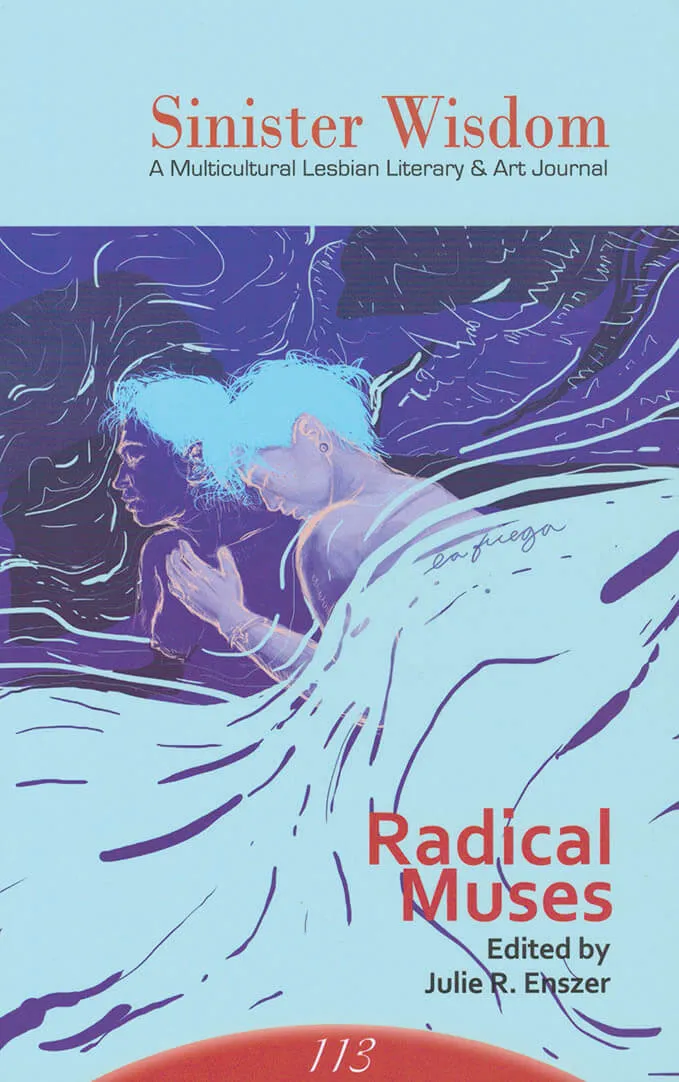
Radical Muses (Sinister Wisdom nr. 113)
Sinister Wisdom 113: Radical Muses features an eclectic array of contemporary poetry, prose, and art by lesbians from around the world, including new work by: Andrea Assaf, Tara Shea Burke, Cheryl Clarke, Marina Chirkova, Estela González, Barbara Haas, Nancy E. Lake, Vi Khi Nao, H. Ní Aódagaín and much more!

Still Life 4
STILL LIFE is an online and printed zine about relationships and configurations in which one person is still while others are not. Or where one person is passive and others are active. It’s about how we put ourselves in other people’s hands. Or how we are put in other people’s hands. It’s about care and power and vulnerability and agency. And other things not so clearly named. It’s about the different kinds of knowledge that people have about their own and other people’s bodies. And the kind of philosophical and political understandings woven into that knowledge.

How to Sleep Faster 1
How to Sleep Faster is published as part of the collaborative discussion that form the critical direction of the gallery. and sits alongside the first two exhibitions – Sleep Faster (February), and How to Carve Totem Poles (March). It has been put together as an open ended continuation of this dialogue through which we seek to understand the contradictions / complexities that define and form our experience, existence and participation in a contemporary digital-analogue creative environment.
Arcadia Missa Publications; Rozsa Farkas, Tom Clark, Jammie Nicholas, Laura Farley (eds).

How to Sleep Faster 2
How to Sleep Faster 2 is the second of our biannually published journals that form the backbone of Arcadia Missa’ critical collaborative discourse on participation, post-digital visual-production and institutional subjectivity.This issue explores moments of collapse, shift and potential in a cultural moment framed by economic, political and societal disturbance.
Arcadia Missa Publication; eds Rozsa Farkas, Tom Clark et al.

Celebrating the Michigan Womyn's Music Festival
Sinister Wisdom 103: Celebrating the Michigan Womyn's Music Festival honors the forty-year legacy of the Michigan Womyn’s Music Festival (1976–2015). Sinister Wisdom 103: Celebrating the Michigan Womyn's Music Festival celebrates this embodiment of radical feminist separatist collaboration, transformational self-defined autonomous spaces, a commitment to sisterhood and matriarchal culture, and a musical city sprung from the earth for one week in the woods.
A collective of five womyn each with a deep connection to Fest operated by consensus to create this issue. Striving to represent a range of womyn’s voices, values, traditions, and experiences of Fest, the collective highlighted what Fest has meant to generations of womyn, documented its chronology, and bore witness to the power of this community. Sinister Wisdom 103: Celebrating the Michigan Womyn's Music Festival includes womyn from multiple races, geographies, sexualities, generations, and gender and other social identities. Just as Fest brought together womyn from various backgrounds, our collection includes a range of artistic experience, from seasoned authors and photographers to those womyn new to publishing.
Sinister Wisdom 103: Celebrating the Michigan Womyn's Music Festival remembers the transformations, possibilities, and hopes for spaces cultivating the ongoing empowerment of womyn.