Feminist Studies
Feminist Studies

Kiila Feminist Archive Bibliography
The Kiila Feminist Archive Bibliography provides an annotation and contextualisation of works by founding members of the Finnish leftist anti-fascist writers’ group Kiila (wedge).
Still active today, Kiila was founded in 1936 with the explicit goal of being a counterforce to Finnish and European fascism, and increasing militarisation. The book focuses on the works of four women writers involved in Kiila, who were marginalised both by mainstream literary critics and their own male comrades within the group. By annotating writings of Katri Vala, Elvi Sinervo, Iris Uurto, and Tyyne Maija Salminen from the 1930s — and a selection of critiques they received — the Kiila Feminist Archive Bibliography recovers these powerful writers from unjust oblivion, and situates them within broader leftist internationalist struggles.
The Kiila Feminist Archive Bibliography is compiled and written by artist, Minna Henrikson, who casts these works as twice marginalised literature since they were written by politically active left-wing authors who were also struggling for emancipation from patriarchal norms. In her introduction to the Bibliography, Henriksson situates Kiila women writers in the international context of leftist anti-fascism and radical feminism.
This feminist history — overlooked within the left — is further brought to life by a series of linocut prints by Henriksson, inspired by the poetics of Kiila writers. Written by curator Lily Hall, the afterword situates the Kiila Feminist Archive within the wider context of contemporary practice of collective feminist reading circles.

Femmephilia
From the author of Enemy Feminisms and Abolish the Family, an original diagnosis of femmephobia in our culture, and a vision of a life-giving femme feminism for all.
To be femme is to embody a dispossessed femininity, to be freighted with freedom, to refuse to be made proper or institutionalized. To love it is to embrace love for women (be they butch or not) in the broadest sense. In Femmephilia, Sophie Lewis makes the case for the vital importance of politicized femme-ness: a feminism that is self-consciously artificial, extravagant in its erotic and political appetites, and staunchly anti-work, abolitionist, and utopian. Femme labors deserve our care, respect, and support, but instead face dismissal from masculinist antagonists and feminist allies alike.
Where neoliberal women’s empowerment has failed to combat the eruption of right-wing, anti-trans, and anti-feminist attacks, Lewis argues that femmephilia can help us imagine a radical future. In essays on the high femme genius of Marilyn Monroe and trans yearning in the myth of Apollo and Daphne; on octopuses and girlbosses, reluctant heterosexuals, lesbian separatists, and anti-work cats; and on a mother on strike from maternity, Femmephilia offers a new logic of liberation for all feminized people.

Art Monsters: Unruly Bodies in Feminist Art
In this dazzlingly original reassessment of women’s stories, bodies, and art, Lauren Elkin—the celebrated author of Flâneuse—explores the ways in which feminist artists have taken up the challenge of their work and how they not only react against the patriarchy but redefine their own aesthetic aims. How do we tell the truth about our experiences as bodies? What is the language, what are the materials, that we need to transcribe them? And what are the unique questions facing those engaged with female bodies, queer bodies, sick bodies, racialized bodies?
Encompassing a rich genealogy of work across the literary and artistic landscape, Elkin makes daring links between disparate points of reference—among them Julia Margaret Cameron’s photography, Kara Walker’s silhouettes, Vanessa Bell’s portraits, Eva Hesse’s rope sculptures, Carolee Schneemann’s body art, Theresa Hak Kyung Cha’s trilingual masterpiece DICTEE—and steps into the tradition of cultural criticism established by Susan Sontag, Hélène Cixous, and Maggie Nelson.
An erudite, potent examination of beauty and excess, sentiment and touch, the personal and the political, the ambiguous and the opaque, Art Monsters is a radical intervention that forces us to consider how the idea of the art monster might transform the way we imagine—and enact—our lives.
Destined to become a new classic . . . Elkin shatters the truisms that have evolved around feminist thought.
—Chris Kraus

Feminist Theory. From Margin to Center
Feminist Theory established bell hooks as one of international feminism’s most challenging and influential voices. This edition includes a preface by the author, reflecting on the book’s impact and the development of her ideas since it was first published.
In this beautifully written and carefully argued work, hooks maintains that mainstream feminism’s reliance on white, middle-class, and professional spokeswomen obscures the involvement, leadership, and centrality of women of colour and poor women in the movement for women’s liberation. Hooks argues that feminism’s goal of seeking credibility and acceptance on already existing ground – rather than demanding the lasting and more fundamental transformation of society – has short-changed the movement.
A sweeping examination of the core issues of sexual politics, Feminist Theory argues that contemporary feminists must acknowledge the full complexity and diversity of women’s experience to create a mass movement to end women’s oppression.

The Witch Studies Reader
Stories about witches are by their nature stories about the most basic and profound of human experiences—healing, sex, violence, tragedies, aging, death, and encountering the mystery and magic of the unknown. It is no surprise, then, that witches loom large in our cultural imaginations. In academia, studies of witches rarely emerge from scholars who are themselves witches and/or embedded in communities of witchcraft practitioners. The Witch Studies Reader brings together a diverse group of scholars, practitioners, and scholar-practitioners who examine witchcraft from a critical decolonial feminist perspective that decenters Europe and departs from exoticizing and pathologizing writing on witchcraft in the global South. The authors show how witches are keepers of suppressed knowledges, builders of new futures, exemplars of praxis, and theorists in their own right. Throughout, they account for the vastly different national, political-economic, and cultural contexts in which “the witch” is currently being claimed and repudiated. Offering a pathbreaking transnational feminist examination of witches and witchcraft that upends white supremacist, colonial, patriarchal knowledge regimes, this volume brings into being the interdisciplinary field of feminist witch studies.
Contributors: Maria Amir, Ruth Asiimwe, Bernadette Barton, Ethel Brooks, Shelina Brown, Ruth Charnock, Soma Chaudhuri, Carolyn Chernoff, Saira Chhibber, Simon Clay, Krystal Cleary, Adrianna L. Ernstberger, Tina Escaja, Laurie Essig, Marcelitte Failla, D Ferrett, Marion Goldman, Jaime Hartless, Margaretha Haughwout, Patricia Humura, Apoorvaa Joshi, Govind Kelkar, Oliver Kellhammer, Ayça Kurtoğlu, Helen Macdonald, Isabel Machado, Brandy Renee McCann, Dev Nathan, Mary Jo Neitz, Amy Nichols-Belo, Allison (or AP) Pierce, Emma Quilty, Anna Rogel, Karen Schaller, Jacquelyn Marie Shannon, Shashank Shekhar Sinha, Gabriella V. Smith, Nathan Snaza, Shannon Hughes Spence, Eric Steinhart, Morena Tartari, Nicole Trigg, Katie Von Wald, Tushabe wa Tushabe, Jane Ward

Pleasure Erased: The Clitoris Unthought
The clitoris was absent in anatomy books, in paintings and sculptures, absent in spirit and even body; it has long been the organ of erased pleasure. We assume that this oversight has been repaired in our times: today, the clitoris is not forgotten but honoured. Conferences, books, manifestos, works of art are all devoted to it. The autonomy of clitoral jouissance is recognized. The boundaries of feminism have also moved: queer, intersex and trans approaches claim that the clitoris is perhaps no longer the exclusive preserve of the woman. And yet, there remains a wounded space. Because genital mutilation is still common practice. Because millions of women are still denied pleasure.
The clitoris continues to mark the enigmatic space of the feminine. Constrained by the extreme difficulty and the extreme urgency of returning to this scorched earth, it is time to give voice to an organ of pleasure which has still not become an organ of thought.
“A project whose glaring absence has been hiding in plain sight, clitoral pleasure has finally found its philosopher. Malabou tells us what we can do with our clitoral brain, uncloaking its agency and anarchic politics. Essential reading for anyone interested in interpreting sex otherwise than phallic and in relation to philosophy’s power to shape the soma.” - Emily Apter, New York University

Reclaiming Mythological Rituals
The first monograph dedicated to the Neapolitan feminist and pacifist artists' collective: unpublished documents, images, photographs, and manifestos are accompanied by new creative, political, and historical contributions, evoking the collective joy of Le Nemesiache's history so as to bring a sense of myth back into the world, rewriting and embodying it anew.
Nemesiache is an informal feminist group co-founded in Naples in 1970 by the multidisciplinary and visionary artist and writer Lina Mangiacapre (1946-2002). The collective, which included up to twelve women (centered around Claudia Aglione, Fausta Base, Silvana Campese, Consuelo Campone, Conni Capobianco, Bruna Felletti, Anna Grieco, and Teresa Mangiacapre), fostered an experimental artistic practice and a way of being in the world rooted in feminism, mythology, folktales, sci-fi, and radical imagination, while also introducing "transfeminism" in the early '80s.
Throughout their long-lasting practice spanning several decades, the group retrieved an androgynous mythosophy to transcend art as mere representation and challenge the feminine as a modern identity category. Their distinct transformative approach within both Italian and Western feminist art history led not only to the emergence of an interdisciplinary practice—encompassing film, performance, writing, rituals, poetry, music, collage, costumes, protests, and conferences—but also the creation of a new political language, grounded in cosmological creativity and justice through mythological rituals.
Edited by Sonia D'Alto.
Texts by Chiara Bottici, Federica Bueti, Cairo Clarke, Sonia D'Alto, Giulia Damiani, Giusi Palomba, Imma Tralli & Roberto Pontecorvo, Elvira Vannini, Giovanna Zapperi, Arnisa Zeqo.

A Grammar Built with Rocks
Shoghig Halajian, Suzy Halajian
Featuring writing and artistic practices that trace the racialized and gendered relationship between bodies and land, A Grammar Built with Rocks explores artists’ engagement with sites of physical dispossession and socio-ecological crisis, highlighting how creative research methodologies can serve as radically new place-making practices. The publication brings together a range of feminist-decolonial texts and visual contributions that explore how movement, transience, and improvisation offer alternative ways of being-together while being-in-place.
Contributions by: Basel Abbas and Ruanne Abou-Rahme with Fawz Kabra, Jheanelle Brown and Julien Creuzet, Carolina Caycedo, Ryan C. Clarke and Cauleen Smith, DAAR—Decolonizing Architecture Art Research with Nicola Perugini, Sandra de la Loza, Demian DinéYazhi’, rafa esparza, Mashinka Firunts Hakopian, Tia-Simone Gardner, Raquel Gutiérrez, Suzanne Kite with Mahpíy̌a Nážinn, Candice Lin, Jumana Manna, K-Sue Park, Christine Rebet, Susan Silton, and Asiya Wadud.
The book also includes a reader, with grounding texts, sources of inspiration, and research references, by Jason Allen-Paisant, Dionne Brand, Suzanne Césaire, Lisa Lowe, Camila Marambio and Cecilia Vicuña, Robyn Maynard and Leanne Betasamosake Simpson, M. NourbeSe Philip, and K. Wayne Yang.
About the editors
Shoghig Halajian is a curator, writer, and artist whose work explores queer and diasporic imaginaries, place-based practices, and experiments in collectivity and collaboration. She is co-editor of the online journal, Georgia, which is supported by a Creative Capital | Andy Warhol Foundation Arts Writers Grant. Select curatorial projects include: A grammar built with rocks (Human Resources LA, One Archives at the USC Libraries, and REDCAT, 2018); At night the states (Hammer Museum, 2017); DISSENT: what they fear is the light (LACE, 2016); and rafa esparza: I have never been here before (LACE, 2015). She was a TBA21 Ocean Space Fellow in Venice (2021) and a curatorial fellow at École du Magasin in Grenoble (2011), where she co-curated the exhibition, The Whole World is Watching, on the the collective Vidéogazette (1973–76), which organized a public access television program in the city. She received her PhD in Art History, Theory, and Criticism with a specialization in Critical Gender Studies from the University of California, San Diego in 2024.
Suzy Halajian is a curator and writer based in Los Angeles, where she serves as the Executive Director and Curator at JOAN. Her practice is invested in long-term collaborations with artists, critically engaging with the intersections of art, politics, and social histories. She explores strategies of image-making through the lens of colonial histories and contemporary surveillance states. Halajian has curated exhibitions and public programs at institutions such as Los Angeles Contemporary Exhibitions (LACE), ONE Archives at the USC Libraries, the Hammer Museum, and Human Resources Los Angeles, as well as Tanya Bonakdar Gallery (New York), Oregon Contemporary (Portland), Kunstverein (Amsterdam), UKS (Oslo), Galerie Hubert Winter (Vienna), and the Sursock Museum (Beirut). She also serves on the Programming Committee at Human Resources and has worked with nonprofit organizations including the MAK Center for Art and Architecture (Los Angeles) and Ashkal Alwan (Beirut). Her curatorial work and writing have been supported by the Graham Foundation, the Andy Warhol Foundation Arts Writers Grant—for Georgia, a journal she co-founded and co-edits with Anthony Carfello and Shoghig Halajian—and a Curatorial Research Fellowship from the Andy Warhol Foundation for the Visual Arts. Halajian’s writing has appeared in ArteEast, BOMB, X-TRA, Ibraaz, and other publications. She holds an MA from the Center for Curatorial Studies at Bard College and is currently a PhD candidate in the Film and Digital Media program at the University of California, Santa Cruz.

Monument Zero
Niloufar Nematollahi, Jose Rosales
Monument Zero emerges from International Women’s Day on 8 March 1979 in Iran. The archival materials that form the starting point depict six days of protests, sit-ins, and conferences that began on this day in Tehran. These historical objects have been preserved by the mercy of their creators, who were present during the 1979 protests, and are scattered across personal and public holdings worldwide. By bringing together the materials that depict this forgotten history, Monument Zero counters historical erasure and explores the preservation of political struggles through collective artistic practice.

Feminist Fatwas
Feminist Fatwas traces how Muslim feminists are resisting misogynistic interpretations of the Quran (like the verse male clerics have used to condone wife-beating).
For centuries, the translators and interpreters of the Holy Quran have been men. This is changing now as more and more Muslim feminists cast their eye on the patriarchal contexts of these interpretations. Feminist Fatwas tells the story of Verse 34 in Chapter 4 which has been interpreted by male clerics as condoning a husband beating his wife. This essay traces the groundbreaking work of knocking down this misogynist Quranic interpretations. The story of how Muslim feminists are doing this work is a chronicle of the slow and quiet feminist revolution taking place within Islam as women take on significant and powerful roles.
Rafia Zakaria is a Pakistani-American attorney, feminist, journalist, and author. She has written for The Nation, Guardian Books, The New Republic, The Baffler, Boston Review, and Al Jazeera. In 2021, she published Against White Feminism, in which she critiques the emphasis that conventional feminist thought places on the experiences of white women while excluding women of color

Theory, A Sunday
Louky Bersianik, Nicole Brossard and 8 more
Collectively authored by Louky Bersianik, Nicole Brossard, France Théoret, Gail Scott, Louise Cotnoir, Louise Dupré, Lisa Robertson, and Rachel Levitsky. Twenty-five years after its first French language publication, Theory, A Sunday (2013), a collaborative feminist poetics text, marks the first in Belladonna’s new Germinal Texts series. Written through Sunday meetings in Montreal, this volume gathers six women’s theoretical feminist texts, with a new introduction by Lisa Robertson and afterword by Gail Scott and Rachel Levitsky. Translators of this text include Erica Weitzman, Luise von Flotow, Popahna Brandes, and Nicole Peyrafitte.
Germinal Texts trace feminist avant-garde histories and the poetic lineages they produce. Focused on authors and texts that provide generative grounds for other writers and their work, Germinal Texts gesture to networks of affiliation, whether explicit or subterranean; to kinships and inheritances; to the unfolding of a text through its readership; and to always provisional origins without endings. Germinal Texts are works that gather dense histories and, for this reason, the series is designed to hold a space for critical discussion, with contextualizing front and back matter that launches new conversations.
Louky Bersianik (1930-2011) is the author of twelve books of poetry and prose. Essayist, novelist and poet, her much admired novel L’Eugélionne is considered Québec’s first feminist novel (translated by Howard Scott as The Eugélionne (1996). Her novel Permafrost, 1937-38, won the Governor General’s award in 1997. Louky was born in Montréal and studied at Université de Montréal, the Sorbonne, and Centre d’études de radio et de television.
Nicole Brossard was born in Montréal. Poet, novelist and essayist, she has published more than forty books. Her work has been influential on a generation of poets and feminists. Her work has been widely acknowledged and translated in many languages. Her most recent book, translated into English by Erin Mouré and Robert Majzels, is WHITE PIANO (Coach House Books, 2013). Nicole Brossard lives in Montréal.
Louise Cotnoir has published seventeen books of poetry, fiction and drama. She was twice nominated for the Governor General’s Award for Poetry, most recently for Les îles (2005). Dis-moi que j’imagine was a finalist for the prestigious Académie des lettres du Québec poetry prize (1996). She has participated in numerous conferences on women and writing, notably “Women and Words” (Vancouver, 1983), “L’écriture des femmes au Québec” (Sweden, 1992), “L’originalité de l’écriture au féminin au Québec” (New Jersey, 1995). She has contributed to or served on the editorial boards of Sorcières (Paris), Estuaire, Arcade, Tessera, Matrix, Moebius, Room of One’s Own, Ellipse, Trivia (USA), Silencíada Festada Palabra (Barcelona), El Ciervo (Barcelona) and Cahiers internationaux du symbolisme (Brussels). Her work has been translated into English, Spanish, Catalan, Finnish and Chinese. Her last collection of poetry, Les soeurs de, appeared with Éditions du Noroît (2011), with a stage adaptation in Ottawa (2012) and Montréal (2013). Les îles, translated by Oana Avasilichioaei, appeared as The Islands in 2011. She lives in Montréal.
Poet, novelist and essayist, Louise Dupré has published twenty books. Her work has received numerous awards and has been translated in various languages. She has collaborated with artists of visual arts, cinema, video and dance. Her play Tout comme elle was produced on stage and directed by Brigitte Haentjens in Montréal in 2006 and in Toronto in 2011, during the Luminato Festival. Plus haut que les flammes won the Governor General’s Award for poetry as well as the Grand Prix du Festival international de la poésie de Trois- Rivières in 2011. She is a member of the Académie des lettres du Québec and the Royal Society of Canada. She was professor of creative writing and women’s writing in Université du Québec à Montréal for twenty years.
Gail Scott’s fourth novel, THE OBITUARY (Nightboat Books, 2012), was a finalist for the 2011 Montréal Book of the Year (Grand prix du livre de Montréal). Scott’s other experimental novels include My Paris (Dalkey Archive), HEROINE (Talonbooks, 1999), and Main Brides. She has published collections of essays, stories, manifestos, and collaborations with Robert Glück et al BITING THE ERROR (Coach House Books, 2004), shortlisted for a Lambda award (2005). Scott’s translation of Michael Delisle’s Le Déasarroi du matelot was a finalist for the Canadian Governor General’s award in translation. The Canadian journal Open Letter devoted its autumn 2012 edition to Scott’s work. She lives, mostly, in Montréal and teaches Creative Writing at Université de Montréal.
France Théoret is a Montreal poet, novelist and essayist. She holds a doctorate in French studies from the University of Sherbrooke, and taught literary studies from 1968 to 1987. She was a member of the editorial board of the journal La Barre du jour from 1967 to 1969, and is the author of one of the monologues in the 1976 theatre piece La Nef des sorcières. In that same year she co-founded the feminist journal Les Têtes de pioche and in 1979, the cultural magazine Spirale, which she directed from 1981 to 1984. She has published over twenty books and been nominated for many prizes. Most of her work has been translated into English. Her poetry is available in Italian, Spanish, and Portuguese and has appeared in anthologies in Quebec and abroad. In 2012, she was awarded the Athanase-David Prix du Québec for her entire oeuvre. She lives in Montreal.

Rage Assassine: Mettre Fin au Racisme
Avant que Black Lives Matter et #MeToo ne viennent secouer l’Amérique et le monde occidental, bell hooks montrait, dans cet essai incisif, que l’abolition du racisme et l’éradication du sexisme vont de pair. Sans le féminisme, la lutte antiraciste reste une affaire d’hommes. Sans l’antiracisme, le féminisme s’expose à servir de courroie aux logiques de domination raciale. L'autrice insiste sur le bien-fondé de la rage qui anime les masses populaires et la jeunesse noire et sur la nécessité d’en faire un moteur de changement social radical. Elle propose une théorie et une pratique révolutionnaires, dont la fin est une communauté solidaire fondée sur l’égalité réelle et la volonté de tou.te.s de travailler au changement.
Traduit de l'anglais par Ségolène Guinard.
GLORIA JEAN WATKINS, connue sous son nom de plume BELL HOOKS, née en 1952, est une intellectuelle, féministe, et militante étasunienne. Elle a publié plus de trente livres et de nombreux articles, et est apparue dans plusieurs films documentaires. Traduits dans de nombreuses langues, ses ouvrages sont considérés parmi les plus importants sur la question aux Etats-Unis et suscitent un réel engouement en France depuis quelques années. Les éditions divergences ont déjà traduit et publié trois de ses ouvrages dont La volonté de changer et A propos d'amour.

L'Écriture de Monique Wittig À La Couleur De Sappho
Invitation au voyage à travers l’œuvre littéraire de Monique Wittig, ce livre nous embarque dans une passionnante exploration de ses textes de fiction, de L’opponax à Virgile, non. Il rend compte de la lutte amoureuse qu’elle livre au langage – matériau brut qu’elle travaille au corps pour faire advenir dans la réalité ce qui n’y a pas (encore) droit de cité. La convocation malicieuse et grave des grands récits du passé, les nombreux emprunts aux auteurs anciens, la pratique de la citation font des Guérillères une formidable épopée féministe, du Corps lesbien un Évangile selon Sappho, du Voyage sans fin le combat drôle et tragique d’une Quichotte féministe et lesbienne.
En soulignant la cohérence des textes et leur fragmentation, Catherine Écarnot met en évidence la passion poétique qui habite ces livres que Wittig concevait comme des « chevaux de Troie » : des machines de guerre destinées à fissurer la réalité pour y inscrire une subjectivité mouvante, échappée du continent noir de la féminité, rétive aux assignations de genre. Uniques et radicalement disruptives, les fictions ainsi créées ouvrent grands les chemins qui relient littérature et lesbianisme.
Publié pour la première fois en 2002, cet ouvrage, le premier consacré en Europe à l’œuvre witigienne, reparaît dans une nouvelle édition remaniée, actualisée et enrichie de nombreuses références aux études publiées depuis sa parution.

The Third Body
In The Third Body, the poet, novelist, feminist critic, and theorist Hélène Cixous interweaves a loose narrative line with anecdotes, autobiography, lyricism, myth, dream, fantasy, philosophical insights, and intertextual citations of and conversations with other authors and thinkers. Cixous evokes the relationship of the female narrator and her lover, a relationship of alternating presences and absences, separations and rejoinings. This relationship assumes protean forms within a complex web of writing, creating a third body out of the entwined bodies of the narrator and her lover.
Hélène Cixous is a professor emerita of literature and founder of the Centre d'études feminines, Paris VIII. Her numerous books include Stigmata, Three Steps on the Ladder of Writing, The Newly Born Woman, The Laugh of the Medusa, and Manhattan: Letters from Prehistory. In 2000, a collection in Cixous' name was created at the Bibliothèque nationale de France.

Manifestly Haraway
Electrifying, provocative, and controversial when first published thirty years ago, Donna Haraway's "Cyborg Manifesto" is even more relevant today, when the divisions that she so eloquently challenges—of human and machine but also of gender, class, race, ethnicity, sexuality, and location—are increasingly complex. The subsequent "Companion Species Manifesto," which further questions the human-nonhuman disjunction, is no less urgently needed in our time of environmental crisis and profound polarization.
Manifestly Haraway brings together these momentous manifestos to expose the continuity and ramifying force of Haraway's thought, whose significance emerges with engaging immediacy in a sustained conversation between the author and her long-term friend and colleague Cary Wolfe. Reading cyborgs and companion species through and with each other, Haraway and Wolfe join in a wide-ranging exchange on the history and meaning of the manifestos in the context of biopolitics, feminism, Marxism, human-nonhuman relationships, making kin, literary tropes, material semiotics, the negative way of knowing, secular Catholicism, and more.
The conversation ends by revealing the early stages of Haraway's "Chthulucene Manifesto," in tension with the teleologies of the doleful Anthropocene and the exterminationist Capitalocene. Deeply dedicated to a diverse and robust earthly flourishing, Manifestly Haraway promises to reignite needed discussion in and out of the academy about biologies, technologies, histories, and still possible futures.
Donna J. Haraway is distinguished professor emerita in the History of Consciousness Department at the University of California, Santa Cruz, where she is also affiliated with the departments of anthropology, feminist studies, environmental studies, and film and digital media. She is an active participant in UCSC's Science and Justice Research Center and the Center for Cultural Studies.
Published 2016

Malibongwe: Poems from the Struggle by ANC Women
In the late 1970s, Lindiwe Mabuza, a.k.a. Sono Molefe, sent out a call for poems written by women in anc camps and offices throughout Africa and the world. The book that resulted, published and distributed in Europe in the early 1980s, was banned by the apartheid regime.
Authorised by the editor, this re-issue of Malibongwe re-establishes a place for women artists in the history of South Africa's liberation. These are the struggles within the Struggle: a book that records the hopes and fears, the drives and disappointments, and the motivation and resilience of women at the front lines of the battle against apartheid. Here we see the evidence, too often airbrushed out of the narratives of national liberation, of a deep and unrelenting radicalism within women; of a dream of a South Africa in which not only freedom reigned, but justice too.

Beauty Kit
BEAUTY KIT – AN ECO-EROGENOUS ART PROJECT by Isabel Burr Raty with contributions by Kristin Rogghe, Elke Van Campenhout, Gosie Vervloessem, Pablo Diartinez and Tim Vets, is an experimental catalog summarizing Isabel Burr Raty’s research on conceptualizing and manufacturing eco-erogenous para-pharmaceutical products. It tells the story of the BKFF, a mobile farm where she and other females harvest their orgasmic juices to produce beauty bio-products, used for treatments in the BK Spa, critically discussed in the BK Focus Group and moving forward into becoming a village, where every-body harvests each other. The catalog comes with contributing text, “Harvesting bodies – The Farm as Paradox” by Elle/Elke Van Campenhout, and other reflections on the project.
Isabel Burr Raty is a Belgian-Chilean artist, filmmaker, and Media Art History teacher in ERG (École de Recherche Graphique), living between Brussels and Amsterdam. She is currently developing her second feature film, about the colonial impact on Easter Island, and creating live art and new media installations that queer production understandings, such as the Beauty Kit Project. Her works have been shown internationally.
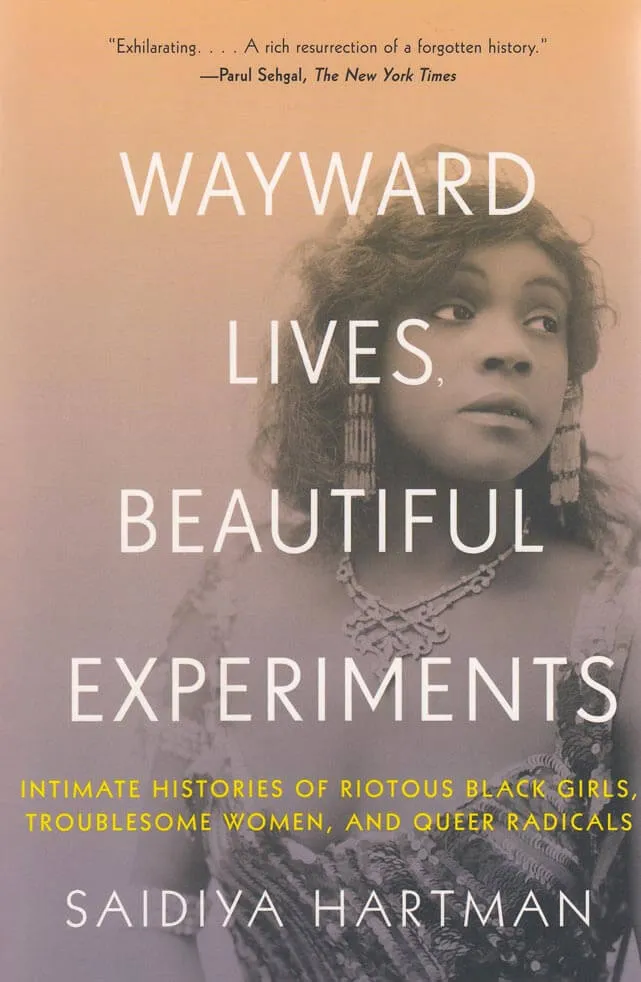
Wayward Lives, Beautiful Experiments
Wayward Lives, Beautiful Experiments examines the revolution of black intimate life that unfolded in Philadelphia and New York at the beginning of the twentieth century. In wrestling with the question of what a free life is, many young black women created forms of intimacy and kinship indifferent to the dictates of respectability and outside the bounds of law. They cleaved to and cast off lovers, exchanged sex to subsist, and revised the meaning of marriage. Longing and desire fueled their experiments in how to live. They refused to labor like slaves or to accept degrading conditions of work. Here, for the first time, these women are credited with shaping a cultural movement that transformed the urban landscape. Through a melding of history and literary imagination, Wayward Lives, Beautiful Experiments recovers these women's radical aspirations and insurgent desires.

The Feminist Bookstore Movement
From the 1970s through the 1990s more than one hundred feminist bookstores built a transnational network that helped shape some of feminism's most complex conversations. Kristen Hogan traces the feminist bookstore movement's rise and eventual fall, restoring its radical work to public feminist memory. The bookwomen at the heart of this story—mostly lesbians and including women of color—measured their success not by profit, but by developing theories and practices of lesbian antiracism and feminist accountability.
At bookstores like BookWoman in Austin, the Toronto Women's Bookstore, and Old Wives' Tales in San Francisco, and in the essential Feminist Bookstore News, bookwomen changed people's lives and the world. In retelling their stories, Hogan not only shares the movement's tools with contemporary queer antiracist feminist activists and theorists, she gives us a vocabulary, strategy, and legacy for thinking through today's feminisms.

Re-Enchanting the World
In this edited collection of work spanning more than 20 years, Silvia Federici provides a detailed history and critique of the politics of the commons from a feminist perspective. In her clear and combative voice, Federici provides readers with an analysis of some of the key issues in contemporary thinking on this subject. Drawing on rich historical research, she maps the connections between the previous forms of enclosure that occurred with the birth of capitalism and the destruction of the commons and the "new enclosures" at the heart of the present phase of global capitalist accumulation.
Considering the commons from a feminist perspective, this collection argues that women and reproductive work are crucial to both our economic survival and the construction of a world free from the capitalist hierarchies. Federici is clear that the commons should not be understood as happy islands in a sea of exploitative relations—but rather autonomous spaces from which to challenge the existing organization of life and labor.