Artists' Books
Artists' Books

Give Piss A Chance
A collection of notes, pictures, social media posts, about the legendary “Piss Goblin” who is / was (?) active in the Berghain bathrooms. This edition – handmade by Cutt Press – beautifully + playfully embodies its subject, as orange plasticky sheets are interspersed in between the text pages, and marble paper half-covers shimmer, in an evocation of golden torrents . . .
Give Piss a Chance. A Williing Suspension of Consequences was first published in the context of the For Real exhibition at DAADGalerie, Berlin, in 2025.

toi, moi, la pluie
toi, moi, la pluie is a sequence of cards that can be assembled into three-dimensional configurations. The cards present two sides of the same moment: rain falling outdoors, and an art exhibition taking place indoors.
With humour and a sense of casual abandon, Sara Graça reduces the exhibition space to a dry place offering shelter from the rain. Despite a moment of intense intimacy—a passionate kiss—the space is largely inhabited by figures who do not seem to know one another, or to get along. The same kiss takes place outdoors; lovers, after all, do not care about the weather. Drawn in a caricatural style, recalling Ad Reinhardt’s How to Look series, these characters speak English, French, and Portuguese. We cannot tell whether they are visiting or staying; we do not know where they are.
The cards are accompanied by a small cut-out horse that can also be assembled and added. A memory of a past life, a lingering presence, a sense of “other”, the horse becomes the final piece of the puzzle. It acts as an exclamation point to these otherwise trivial human exchanges—cutting across inside and outside, shelter and rain, intimacy, cohabitation, and distance.
The publication is disguised as a book, revealing its playful nature only once opened, and inviting the reader to assemble, rearrange, and make choices of their own.
Sara Graça (Lisbon, 1993) lives in London and works in interdisciplinary ways, mainly using sculpture, drawing, photography and video. Her practice often questions ideas of value, authenticity and impermanence.
All copies are numbered & signed.

a slight cast down at the edges of the lips
“a slight cast down at the edges of the lips brings together work from the last decade of Katherine Hubbard’s prolific practice, which intertwines analogue photography, writing, and live performance. Reproductions of exhibited prints, a selection of new photographs, and images created from within her performances are gathered here, along with four of the artist’s original written works. This publication marks the first occasion for Hubbard’s photographs and writings-for-performance to exist on the same scale, that of the book.”
— co-editor, Corrine Fitzpatrick
The book is accompanied by a poster with a full-scale detail reproduction of Katherine Hubbard's rip stop weave artwork, printed on glossy tissue paper.
Additional contributions by Zoe Leonard, Mónica de la Torre, Elisabeth Sherman, and Lynne Tillman. Edited by Corrine Fitzpatrick and Lara Mimosa Montes.

Abstract Coloring Book
A coloring book conceived as an artist book. Coumba Samba’s publication prompts you to explore geometric forms and structures with a small set of colored pencils. Using those simple materials one realises how interaction and experimentation challenge again and again the relationship between color, abstraction and internalised form systems.
Published in connection with the exhibitions deutschland at Kunstverein in Hamburg and Coumba Samba at MauMaus in Lisbon.
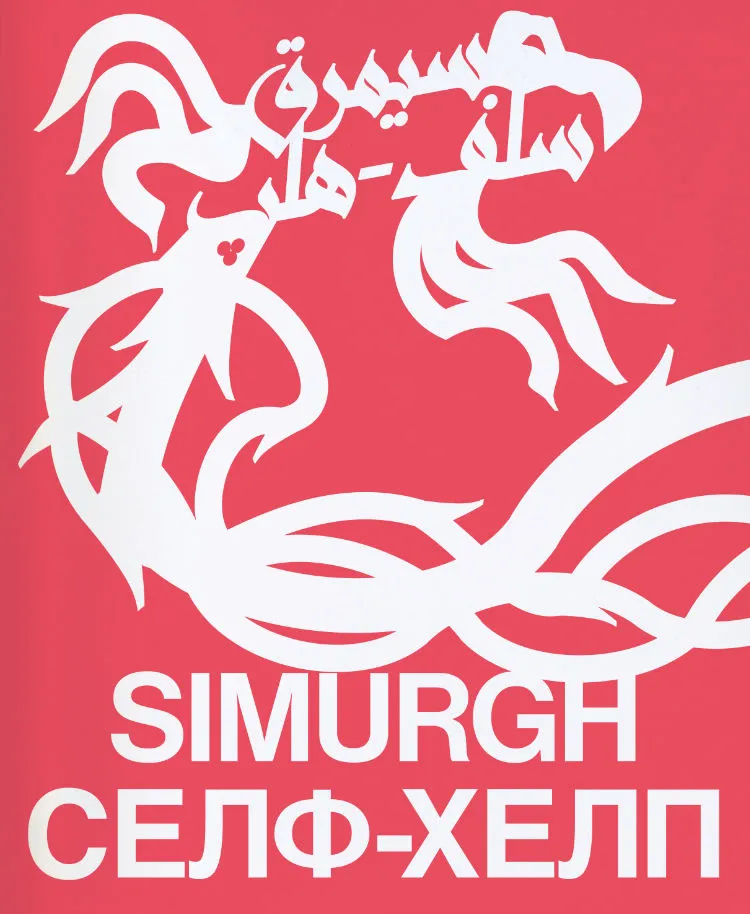
Simurgh Self-Help
The 2025 Ringier annual report (artist's book).
Since 1998, Ringier, the Swiss-based global media company, has traditionally commissioned an artist to design its annual report. Publisher Michael Ringier and curator Beatrix Ruf initiated this series as a means of reinforcing the links between art and the activities of the company.
For the 2025 edition, Slavs and Tatars' Simurgh Self-Help revisits Marcel Broodthaers' seminal work Musée d'Art Moderne: Département des Aigles (1968–1972), replacing or "translating" the eagle—a symbol of power and empire that is used to challenge our understanding of authority and value—with the Simurgh, a mythical bird found across the Turkic-Persianate world. Whilst the eagle is often associated with nation-states and masculinity, the Simurgh is decidedly transnational, metaphysical, and flamboyant, if not gender-fluid.
Much like the collective's geographic remit—between the former Berlin Wall and the Great Wall of China—this publication attempts to shift our focus elsewhere, eastwards, to regions which too often fall through the cracks of historiography and art history. If modern and contemporary art institutions in Broodthaers' time were largely situated between the Rhineland and Northeast United States, the multipolarity of today's art world is a fait accompli: with biennials in Uzbekistan and museums in Kazakhstan, amongst others, rivalling the traditional centers of power.
Once too a sacred bird—accompanying Zeus, for example—the eagle has, over the past two millennia, undergone a thorough profanation: a brawny, secular flex of nationalism. It would be remiss not to see the parallels in the world of media: print itself and the act of reading, once an activity for the few and anointed, has undergone a similar dynamic of democratization over the past several centuries and, especially in recent years with the internet, a vulgarization which would make medieval Church elders wag their shriveled fingers at us in an I-told-you-so meme meant for the ages. This profanation has challenged the very institution of media and the narratives it disseminates, much as important works of institutional critique challenged contemporary art in the 1970s and beyond—akin to Slavs and Tatars' genre-bending mix of high and low, East and West, sacred and profane does today.
Slavs and Tatars' (founded 2006) extensive publishing activity—some 15 books in 20 years—has treated subjects as diverse as alphabet politics, Uighur literary culture, political satire in the Muslim world, and German anti-Enlightenment thinkers. Alongside sculptures, textile works, installations, sound pieces, and even a brick-and-mortar Pickle Bar in Berlin, the collective's books have cleared new paths for contemporary discourse via a wholly idiosyncratic form of knowledge production that draws on popular culture, spiritual and esoteric traditions, oral histories, modern myths, as well as scholarly research.
Slavs and Tatars is a faction of polemics and intimacies devoted to an area east of the former Berlin Wall and west of the Great Wall of China known as Eurasia. The collective's work spans several media, disciplines, and a broad spectrum of cultural registers (high and low) focusing on an oft-forgotten sphere of influence between Slavs, Caucasians and Central Asians.
Slavs and Tatars has published Kidnapping Mountains (Book Works, 2009), a celebration of complexity in the Caucasus, Love Me, Love Me Not: Changed Names (onestar press, 2010) and are currently preparing solo engagements at Vienna's Secession, Museum of Modern Art, New York and Künstlerhaus Stuttgart.

Katalog 2
Assembled and copied by Jan Matthé at Permeke Library Antwerp, September—October 2022. Edited at Kransen, printed in Borgerhout in an edition of 200, bound by De Wrikker in Berchem. Released on the occasion of Permeke draait door met Risiko Press, Sunday 27 November 2022 at Permeke Library, with readings and performances by Tina Schott, Jóhanna Kristbjörg Sigurðardóttir, Stefanie Alexandra, Sis Matthé, Ria Pacquée, Jan Matthé, Clodagh Kinsella and Roman Hiele. Thanks to Christel Kumpen for the invitation, Allon McKaye for the Saturday and Toni Matthé for the unicorn with a heartshaped tail.

Marlie Mul
Marlie Mul (b. 1980 in Utrecht, the Netherlands; lives and works in Brussels) is characterized by a strong material awareness, spatial thinking, and an ongoing engagement with conditions of labor, systems of value, and forms of collectivity. Her practice foregrounds a sustained interest in sculptural concerns, direct engagement with materials, and processes of layering, transformation, meaning and re-meaning across multiple levels of articulation. Central to this is a continuous process of familiarizing herself and working with new materials and practices, which are repeatedly extracted from their conventional contexts and expanded into new bodies of work. These are, in turn, accompanied and reframed by other materials as well as by more social formats of production and presentation.
The first comprehensive monograph on Marlie Mul’s work is published on the occasion of her solo exhibition Das Budget (2025) at Kunsthaus Glarus. It offers a comprehensive chronological overview of key bodies of work from the early 2000s to the present and, through a richly illustrated index, unfolds a complex structure of contexts, collaborations, and modes of production. The publication includes new contributions by Annie Goodner, Lili Reynaud-Dewar and Frank Wasser, a dialogue between the artist and the editor, as well as numerous reprints of texts that have accompanied Mul’s work over the years, including writings by the artist herself.

Terminal Boundaries and A natural water course diverted reduced or displaced
Made in 1969 but never published, Terminal Boundaries is an artist book by Lawrence Weiner, a sculptor whose medium was language. The manuscript for the publication, which was recently brought to light, contains two related bodies of work represented as typewritten statements on paper that Weiner pasted to the pages of a small composition notebook. The book’s absence from Weiner’s oeuvre plagued him as it marked a terminus of his relationship to the physical construction of his artworks, and illustrated the principle of “specific” and “general” which he applied to his art.
Created from a standard notebook purchased in a stationery store, the manuscript is two books in one: Terminal Boundaries and A natural watercourse diverted reduced or displaced. A tête-bêche with two front covers, the book can begin from either cover by turning it upside down.
Weiner was a traveler by nature and the materials he refers to in these works are those that one can encounter on a road trip. The artist was traveling across Europe when this manuscript was composed. Struck by the tumultuous times and the critical illuminations about the climate from the Club of Rome discussions, the works in this book are in Weiner’s words, “concerned with the relationship of natural resources in relation to human beings.” Distinct from his contemporaries associated with the Land Art movement, in Terminal Boundaries and A natural water course diverted reduced or displaced, Weiner constructs his landscape interventions in language—the specific and/or general act and the location are stated—offering the reader/viewer the opportunity to consider each work’s existence, to build it in their mind’s eye. One can only wonder what Weiner did to divert, reduce, or displace a natural water course in Saltsrumen, Norway, the location of the world’s strongest maelstrom, or in nearby Bodø at the site of Svartisen glacier. A work in Terminal Boundaries titled The joining of France Germany and Switzerland by rope demonstrates the geopolitical perspective of Weiner’s land art. Requiring physical and mental borders to be transgressed in performing this work; how and where could this happen?
Terminal Boundaries finds Weiner just off the cusp of his decision to make art that lived centered in language, emphasizing the viewer’s responsibility to engage with it to make it whole. The book marks a crucial inflection point in the artist’s practice, defining his direction to make work that “attempts to present something to people that is not just about me,” but about materials and the world we find ourselves in here and now.

fierce pussy
This eponymously titled publication by fierce pussy brings together thirty-nine of the legendary art collective’s posters, from works made in the urgent early days of the AIDS crisis to present-day advocacy for Queer and Trans rights. In keeping with fierce pussy’s activism in public spaces, the publication is designed to allow readers to tear out any of the posters to share, wheatpaste, scan, photocopy, and distribute or to easily open the book to any page to hang it on a wall. Combining calls for political and social action, proud reclamations of derogatory language, and pointed questions, the posters in fierce pussy address pressing sociopolitical issues in the group’s distinctive voice.
Emerging during a decade steeped in the AIDS crisis and LGBTQ+ activism, fierce pussy brought Queer identity directly into the streets in a manner characterized by the urgency of those years. In recent years they have expanded to also present their work in galleries and museums, while continuing to intervene in the public space, always working with an economy of means and a collective ethos of inclusion and solidarity.
This publication was originally published by Printed Matter in 2008 to coincide with a retrospective exhibition of the collective’s work. This new expanded edition includes twenty-five additional posters.
fierce pussy is an art collective formed in New York City in 1991. Originally composed of a fluid and often-shifting cadre of dykes, the collective was active through 1994. In 2008, the four core founding members Nancy Brooks Brody (1962–2023), Joy Episalla, Zoe Leonard, and Carrie Yamaoka began working together again. Adamantly low-tech and low-budget, fierce pussy has always relied on modest resources: old typewriters, found photographs, and their own baby pictures. In the early days, much of the work was produced using materials and resources they had on hand and the equipment at their day jobs. This publication exemplifies the ethos of the group—to share their work and messaging with the masses.
Managing Editor: Jules Spector
Designers: Garrick Gott and Bryce Wilner

Hosted by Red Dust
Partie sur les sites de la dernière briqueterie artisanale de Riemst et de la recyclerie de briques d'Alexander van Mosselaer, Juliet Mérie en ramène un récit poétique qui explore notre rapport à la matière vivante et questonne le cours de la vie.
Loin d'être un documentaire, ses photographies créent un rapport ambigu entre la perception des espaces visités et l'allégorie qui s'installe. La possière se soulève pour dévoiler les lieux de vie et de mort des briques qui dessinent le paysage belge.

Alphabet Soup
"Alphabet Soup" collects the sayings of two multilingual girls as written down by their poet father. As their Turkish-German-Russian-American family moves from New York to Berlin, the girls communicate in a witty and colorful language of their own, effortlessly mixing words of different origin. Does who we are determine the way we speak — or is it the other way around? Alphabet Soup shows us the girls’ language as it changes, letting us witness their metamorphoses from toddlers to teenagers.
With an essay and poems by the author.
A co-publication with Rab-Rab Press (Helsinki).

Verlag der Buchhandlung Walther König
in the coherence, we weep
“in the coherence, we weep is both an artist book and an exhibition. The project is about the critical potential of incoherencies. It is an attempt to map methodology across media, while welcoming glitches that allow for moments of critical self-reflection and knowledge production. Developed in parallel, the book and exhibition critically reflect on each other’s approaches. It looks at strategies for how text can be alive and vibrant across various architectural contexts as well as those used in the artist’s family archive, particularly annotation, redaction, indexing, blurring, and learning through reading and writing.” - KW Institute for Contemporary Art
“Multilayering was in that sense an important aspect, which got translated with the material and the design by choosing papers with differents gradients of transparency, as well as interfering and overlapping text layouts. We also designed the cover with a blue scratch off drawing on top of another artwork, so every book might change a bit over time depending on the use. This reflects the artist‘s idea of including the audience and an ever changing oeuvre, where the relation between pieces become important too.” - Studio Pandan
Texts by Dr. Christina Landbrecht, Krist Gruijthuijsen, Sofie Krogh Christensen, Chang Yuchen, Ladi'Sasha Jones
This artist book is published on the occasion of Kameelah Janan Rasheed’s Schering Stiftung Award for Artistic Research 2022 solo exhibition at KW Institute for Contemporary Art (2023).

A Psalm for the Third Wind
Book: 11.7 × 18 cm
Book and Glove: 13.5 × 31.5 cm
Presented in a monster glove
Three broken halves of one god walk a city that wants them dead
Their bodies speak in static hunger and rust
Something follows breathing through their mouths
Read it Bleed from it
In A Psalm for the Third Wind, a film script written from 3 perspectives, Damien Troadec is aiming to address in parallel narrative the struggle of having multiples inner voices and the danger of following their distinct desires. One question is raised without any light at the end of the tunnel, confronting the reader to a conflict : THE COMFORT OF MISERY OR THE PAIN OF CHANGE ?
![Cover of Visit [country]](https://rile.space/storage/4263/conversions/01KNPFVPPA9VBM18HD24YCC4XJ-webp.webp)
Visit [country]
Visit [country] is an artist’s book that brings together texts taken word for word from official government tourism websites and state-produced promotional videos from every UN-recognized country in the world. Stripped of the usual accompanying imagery and inspirational music, what becomes clear is how tourism feeds on — and is fuelled by — nationalism, chauvinism, and the invention of identity.
Much like a “choose your own adventure” book, the reader is guided by a series of questions that connect one country to another through recurring ideas and clichés, and must decide whether to visit the destination with “the best food”, “the most beautiful women”, “the friendliest people”, or “the most authentic history”. The book also includes an extensive concept index that maps the thematic and linguistic patterns linking the nations’ self-descriptions. It is a journey where every country is the best.
The project grows out of The Complete National Anthems of the World, a durational performance first presented in 2023, and stands as a parallel, autonomous, yet complementary work.

Local Warming
For Sebastian Black, 2020 was a year like no other: a pandemic; three exhibitions; a move to Los Angeles; a presidential election; a baby, too. Local Warming is Black's tale of it all, as recorded in his diary.
One million years ago, when I started making the paintings compiled here, I was listening to lots of audiobooks and recorded philosophy lectures. It was the winter of 2019, my paintings were about this and about that, and every brushstroke drifted safely over a net of ideas. I was gathering a list of things that I knew to be true because I was sick of having nothing to say when people asked me to explain myself. Then a professor, who to me is now a holy exegete, said that difference precedes identity as the substance of reality. I'd been eavesdropping on YouTube as he taught a continuing-ed class on Deleuze for a claque of narrative therapists. Difference before identity. I couldn't grasp the idea— only touch it. That's okay, said the professor, as though speaking directly to me, the point of thinking isn't to grasp things that are true but rather to prod things that are interesting. — Sebastian Black
Sebastian Black is an artist/writer. He was born in New York City in 1985. He lives and works in Los Angeles.

Tehran North
Published on the occasion of her exhibition at the Palais de l'Athénée, Geneva (September 18–October 18, 2025) following her Prix de la Société des Arts de Genève award in 2025, this new artist's book by Shirana Shahbazi is fully dedicated to her "Displacement" series (2023–2025). To describe it, she states: "I use multiple exposure and overlapping to create an independent experience of time and space. The simultaneity of different realities is relevant to many of us. I think a lot about how to depict these complex realities."
Designed by Norm, Zurich, this publication is itself an inquiry into space and time, and our relationship to them. Each alternate page is trimmed short, creating new perceptions. The artist adds: "I enjoy deconstructing rooms, creating new ways of experiencing them. Sharpening the awareness while you see the works." The latest book in a series of acclaimed photography publications, this volume is characteristic of Shahbazi's distinctive and conceptually rigorous approach to photography in which light, vibrant color field, and layering play key roles. Flipping through the pages of An Exciting Opportunity Lies Ahead of You is a dream-like journey through architecture and senses.
Born in Tehran in 1974, Shirana Shahbazi moved to Germany at the age of 11. She studied photography in Dortmund and Zurich, where she lives and works today. Her practice has been dedicated to generating a hybrid visual language that defies simple categorization and can be experienced on multiple levels. It challenges the translation and the transcultural construction of meaning. The physical presence of her work is just as important as its semantic underpinnings.

Black Ark
The point of departure for the book «Black Ark» with Lee “Scratch” Perry (1936–2021), a Jamaican musical and visual artist who was based in Switzerland, is a detailed inventory of photographs and writings (Spring 2021) from the Black Ark Studios in Kingston, Jamaica, where Lee produced his music from 1973 on. He was a seminal pioneer of dub, an electronic subgenre of reggae that uses sampling, looping, remixing, reverb and echoes to create new songs as well as rework and appropriate pre-recorded songs and tracks.
Black Ark Studios was one of the cradles of dub. It’s also where Lee “Scratch” Perry’s musical approach found an enduring visual counterpart in the form of continuously evolving mural paintings and drawings as well as shape-shifting assemblages of records, instruments, found objects, posters, newspaper and magazine clippings, and appropriated books. The artworks form actual layers upon layers that are rhizomatically intertwined with the studio building itself as well as with the furniture inside—and with Perry’s biography and persona.
Perry created his very own, dense and eclectic world—a world that is documented in «Black Ark», before it disappears for good: the premises have recently been sold. The photographic documentation of the studio was supplemented by efforts to secure and preserve Perry’s cultural objects as part of a joint project with various cultural institutions.
«Black Ark» which reflects the rhythm and layering effects of collage both in its content and the materials used to craft the book. Perry was involved in the conception of the book in its early stages. It also interweaves various media and chronologies. The new photographs of the Black Ark Studios will be juxtaposed with stills from old documentaries and archival photos.
The idea of a “house” serves as both a working hypothesis and a metaphor. It will be the starting point and endpoint of various thematic strands, both visual and textual: for example, the book will explore the Black Ark as a “spiritual yard” in the context of African diaspora, as well as looking into archeomusicological aspects. Furthermore, extended captions by Perry’s biographer will provide the backdrop for a kaleidoscopic panorama of Perry’s eclectic and ingenious work.

Yellow Songs 1: Voiced-Voiceless
Fifty years after the fall of Saigon, Dao Strom’s Yellow Songs vibrates with the ramifications and ripples of Empire. Each of the four Yellow Songs books reckons with the intimate consequences of the colonial project, reconfiguring them into complex and lucid, literal and figurative songs of selfhood. Embodied, critical, wholehearted, collective, personal, genre-defying—Yellow Songs renders the brute force of history with tender precision. Art book quality printing in full color with felt paper inserts.
Yellow Songs 1: Voiced-Voiceless unearths, unwinds, un-bodies the violence of stigma, reclaiming the ventriloquized voice of David Bowie's "China Girl” through a lyric-critical essaying (assaying) of cultural tropes, racialized and gendered power plays, and memory.

Tips of the sung
Tips of the Sung is a collection of interdisciplinary texts from Samuel Brzeski composed over the five years whilst he was Associate Artist at Lydgalleriet. The collection brings together performance scripts for voice and video with newly composed texts for the page. Centring on the vibrations of the voice, the texts exist somewhere between signification and delirium, at times making more sound than sense.
The texts are full of bumbling mumbles, meandering hums, homophones, inner voices, affirmations, motivations, subvocalisations, resolutions, errors in speech production, peach seduction, car maintenance manuals, self-help fallacies, roomy echo chambers, overheard language lessons, morning meditations, and other forms of verbal rehearsal at the limits of language.

Metropolitan Voids Agency
Margherita Moscardini, Zasha Colah and 1 more
Metropolitan Voids Agency is the first monographic publication dedicated to the collected works of artist Margherita Moscardini. The book recounts the work carried out by Moscardini spanning seventeen years, between 2008 and 2024, inviting a reading of her practice in its entirety as an investigation into ‘urban voids’: those which Moscardini has recognized and designated as voids, or those she has herself invented in the urban fabric.

Slow Mania
Nazareth Hassan’s devastatingly brilliant Slow mania is a powerful document of senses and sense-making where estrangement and ugliness meets longing and beauty. The artist begins with a photographic sequence: two white-blue sky panels; a shattered glass storefront window; a street gutter clutching leaves, smashed straw sleeves and plastic lids; then snow holding a disassembled red stained chest of drawers. These are the writer’s plinths where form as waste is configured: “smoggy breath thru burnt-edged holes tracking acid mucous inside your home.” Slow mania provokes through enumerative structures, for instance, “screening bodies” who keep a sex club’s gates open only to some: “…197 mmm maybe lemme think / 151 yes / 162 yes / 197 ok yes, but keep your shirt on.” The poet deftly folds human intimacy into interspecies metaphor: “The rat torso twitches in agreement. Across / the street, the flies continue to starve,” where “…you’re lost in your own hole: what did you find?” Hassan attends to this painful search, bearing witness to the disturbingly exultant, offering a radical state of being, in and out of which the stunning and timely Slow mania lives and thrives. — Ronaldo V. Wilson
Slow mania is resistance to resolution, it’s pointillistic magic, it’s Seurat in Bed-Stuy: the tighter you zoom, the more undifferentiated beauty you encounter. It’s kinky (the kinked-up curls of somebody’s greased-up chops). It’s tender (bruised and brown, like the overripe fruit that haunts your summer kitchen waiting to be crumbled into a crumble). The colors are blurry, the edges are soft, the stakes are high, and everything—everything!—shimmers in the space between life and afterlife. Hassan’s gaze is a hot summer steam that sneaks into the skinniest, stinkiest crevices; the grimiest seams, the most miraculous cracks. Breathe into the abyss, that’s the invitation. Take it in, let it in. Be a wit(h)ness to every single being. — Steffani Jemison
This amazing book reads like a synesthetic performance, the only thing missing is the smell of sweat, of streets, of loss. A book of choreographed pages, scores, movements, image blur, hand-scribbles. The bleak, unsparing texts hidden among the materials turn out to be the record of sudden eruptions, violent street scenes, pick-up scenes, unclear dialogues, insults, self-debasing verbal injuries on repeat. The performers are racialized, sexualized, anonymized “persons,” “meats,” numbers, lovers, passers-by, all caught up in these dangerous yet desperately emotional and triggering dances at the limit. It will leave you raw, spaced-out, both roused and alarmed as though coming out of an intoxicating show, and wanting more. — Caroline Bergvall

The (Incomplete) Cosmic Catalogue
Mapping constellations between five specific pre-colonial cosmological examples extending from the Sahel to the Horn of Africa, this work reframes cosmology as a multi-dimensional and scalable practice of situated technologies and embodied cartographies. The resulting publication which was produced during the Jan van Eyck residency is a culmination of several years of research and exploration into precolonial cosmologies and spatial orders rooted in the African Sahel extending to the Horn of Africa.
The (Incomplete) Cosmic Catalogue is an output of a research project that was initially commissioned by the Canadian Centre for Architecture as part of the multi-disciplinary research fellowship, The Digita Now: Architecture and Intersectionality in 2022.


The Prime Times Vol.2
Sophie T. Lvoff revient avec « The Prime Times, Volume 2 » à l'occasion de la fin de sa résidence aux ateliers de la ville de Marseille, bye, bye! Au travers de poèmes en haïku, de gros titres et de photographies de son atelier traversé par la lumière du jour au milieu de l’après-midi, le journal chronique la torpeur des longues journées de travail mêlées d’attente, de glimpses et de glances. En attendant the prime time, Sophie lit les nouvelles sur son téléphone, parcourt paresseusement sa bibliothèque, écrit des emails à des amix éloigné·es et parfois à elle-même. Elle note des blagues et des poèmes dans son cahier, mange des snacks, doute d’elle-même, fume, jette des regards autour d’elle, jusqu’au moment précis où la photo doit être prise.
Sophie T. Lvoff is back with « The Prime Times, Volume 2 »! Through haiku poems, headlines, doodles and photographs of her studio pierced by mid-afternoon daylight, the journal chronicles the torpor of long workdays mixed with waiting, glimpses, and glances. While waiting for the prime time, Sophie reads the news on her phone and lazily reads her collection of books, writes emails to far-away friends and sometimes to herself. She notes things in notebooks and writes jokes and poems, stretches, eats snacks, doubts herself, smokes, glances around, until the precise moment when the picture has to be taken.