Books
Books
in random order

Borderlands / La Frontera: The New Mestiza 5th Edition
A new edition of Anzaldúa's classic text.
Borderlands/La Frontera: The New Mestiza is a 1987 semi-autobiographical work by Gloria E. Anzaldúa that examines the Chicano and Latino experience through the lens of issues such as gender, identity, race, and colonialism. Borderlands is considered to be Anzaldúa’s most well-known work and a pioneering piece of Chicana literature.
Rooted in Gloria Anzaldúa's experience as a Chicana, a lesbian, an activist, and a writer, the essays and poems in Borderlands/La Frontera: The New Mestiza profoundly challenged, and continue to challenge, how we think about identity. Borderlands/La Frontera remaps our understanding of what a border' is, presenting it not as a simple divide between here and there, us and them, but as a psychic, social, and cultural terrain that we inhabit, and that inhabits all of us.
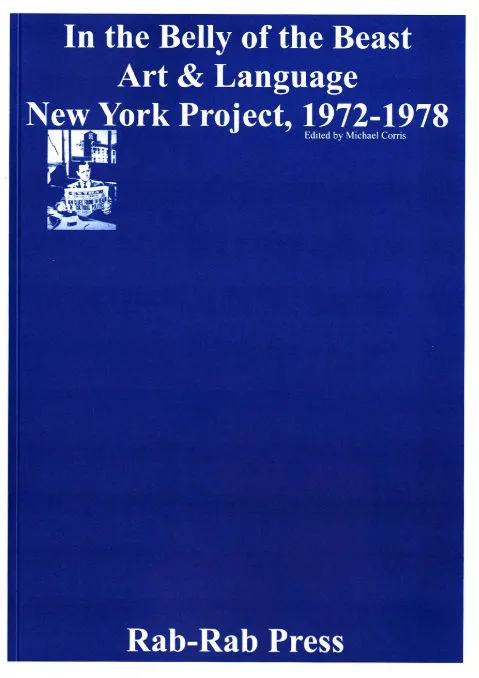
In the Belly of the Beast – Art & Language New York Project 1972-1978
Edited by Michael Corris, the expanded edition of In the Belly of the Beast: Art & Language New York Project 1972-1978 is a survey of the tumultuous years of the political Conceptualism in the mid-seventies New York.
Artists have always experimented with politics, either by organizing themselves or uniting in support of a broader political movement. Today, "activist art" is taught in universities, supported by foundations, and featured in museums and international exhibitions. Is this the only possible way?
In the Belly of the Beast tells a different story, of the work of politically engaged artists and the conflicts they experienced. It is the history of artists wishing to continue working within the boundaries of the artworld and those who were intent on establishing new ideological and class relationships with activists to build a political party.
During the 1970s in New York, the Art & Language collective pioneered institutional critique; published a Marxist-influenced journal; agitated against racism and sexism in museums; challenged the cultural imperialism of international exhibitions; and forged a framework for a socialist organization of artists. This new edition includes previously unpublished documents illuminating the contradictions and disputes that lay at the center of the organization and practices of Art & Language and left-wing groups, such as the Anti-Imperialist Cultural Union and the Artists' Meeting for Cultural Change, mobilizing artists in New York at the time.
The new and expanded edition of In the Belly of the Beast features an extensive interview with Michael Corris, who annotated a collection of previously unavailable documents from the period, including manuscripts, pamphlets, transcripts, and letters.
Art & Language is the name of a group of English artists who choose to work collectively, and the title of a magazine that they founded in 1968. Proposing a critical analysis of the relations between art, society, and politics, Art & Language marks, even in its name, the importance of the “textual turning point” in the 1960s.
Since 1976, Art & Language's project has continued, through Mel Ramsden and Michael Baldwin, with the literary and theoretical collaboration of Charles Harrison. Working with very varied mediums, from painting to rock, these co-founders of Conceptual art remain, even today, attached to observing the consequences of what they themselves call the “depressing collapse of modernism.”

Fanzine Grrrls
Making a fanzine is an act of rebellion, even more so if it is published and produced by a woman. The grrrls of today use them to inspire countless young people around the world, to take control of their lives and to create their own culture. These homemade publications are a quick and cheap way to spread their ideas and dismantle the usual stereotypes. Traditionally hand-drawn, photocopied, and stapled together, the format of fanzines are now as diverse as their subject matter, with online platforms and social networks fast becoming the norm. The fanzine is more alive than ever!
Gemma Villegas runs her graphic design studio based from Barcelona. She works in close dialog with commissioners and collaborators on a broad range of projects, including visual identities, exhibitions, publications, and digital platforms, overseeing the creative process during all the phases of a project. Her work is characterized by a fresh and powerful visual language focused on detail with special attention to typography.

Dreaming in the Fault Zone: A Poetics of Healing
A virtuosic inquiry into the forms and uses of healing, from ancient and modern medicine to contemporary literature, ecology, and protest.
In the era of the “chronic acute” long predating COVID-19, Eleni Stecopoulos set out to investigate the imagination, aesthetics, and ideology of healing—its mysteries and mystifications, its many channels and codes. Fusing lyric inquiry with cultural criticism, Dreaming in the Fault Zone explores art’s treatment of our conditions at a time of both increased cynicism about healing and longing for it. Stecopoulos talks to physicians, poets, psychotherapists, disability activists, ethnographers, spiritual seekers; curates performances and takes part in community rituals; documents pilgrimages and visits therapeutic landscapes. Whether writing about the poet H.D.’s psychoanalysis with Freud or madness and apartheid in Bessie Head’s novel A Question of Power, the salve of demagogues or a global alliance of people with contested illnesses, Stecopoulos confronts the poetics and politics of affliction, empathy, memory, and survival. Weaving together esoteric scenes and everyday practice, with flashes of humor, these essays travel in a space of impasse and unending experiment.

Livre d'images sans images (LP)
Mette Edvardsen, Iben Edvardsen
Livre d’images sans images by Mette Edvardsen & Iben Edvardsen borrows its title from a book by H.C. Andersen, also referred to as The Moon Chronicler. The book follows a conversation between a painter and the Moon, where the Moon describes to the painter what she sees on her journey around the world every evening, telling the painter to paint what she describes. “This conversation, as in the now obsolete meaning of the word (‘a place where one lives or dwells’), was the starting point for our work. Using the weather report as dramaturgy, (‘the moon did not show up every evening, sometimes a cloud came in between’), we have created and collected materials from our conversations in the form of recordings, text, voice, drawings, references, found images, loose connections, inspirations and imaginations, in the order they came to us. They are at the same time sources and traces, material and support for new imaginations or events to come.” The work consists of three different media: vinyl, paper and live performance.
Mette Edvardsen is a choreographer and performer eager to explore the performing arts as a practice and situation, also in relation to other media such as books and writing. This work is in collaboration with her daughter, Iben Edvardsen.
Published by Xing & Varamo Press
XONG collection – artist records XX10 (2023)
First edition, September 2023
Recorded and edited by Mette Edvardsen & Iben Edvardsen
Format white 12’ vinyl LP in cardboard sleeve
Released in a numbered edition of 300 copies, including collector’s edition of 25 copies, each accompanied by a unique poster hand drawn with black marker by Mette Edvardsen & Iben Edvardsen, 59,4 x 84 cm, folded, signed by the artists

The Sunflower
Jackie Wang's magnetic and spellbinding debut collection of poetry that attempts to speak in the language of dreams.
The poems in The Sunflower Cast A Spell To Save Us From The Void read like dispatches from the dream world, with Jackie Wang acting as our trusted comrade reporting across time and space. By sharing her personal index of dreams with its scenes of solidarity and resilience, interpersonal conflict and outlaw jouissance, Wang embodies historical trauma and communal memory. Here, the all-too-familiar interplay between crisis and resistance becomes first distorted, then clarified and refreshed. With a light touch and invigorating sense of humor, Wang illustrates the social dimension of dreams and their ability to inform and reshape the dreamer's waking world with renewed energy and insight.
Jackie Wang is a student of the dream state, black studies scholar, prison abolitionist, poet, performer, library rat, trauma monster and PhD candidate in the Department of African and African American Studies at Harvard University, specializing in race and the political economy of prisons and police in the United States. She is the author of a number of punk zines including On Being Hard Femme, as well as a collection of dream poems titled Tiny Spelunker of the Oneiro-Womb. In 2018 she published a book, titled Carceral Capitalism on the racial, economic, political, legal, and technological dimensions of the US carceral state. She is currently an Arleen Carlson and Edna Nelson Graduate Fellow at the Radcliffe Institute for Advanced Study.

Curious Affinities
How much distance and difference can intimacy hold? How much proximity and likeness does it require? What can we learn from its capacities? And what could we salvage from its limits?
Curious Affinities unravels the risks and possibilities brought forth by unconventional styles of intimacy. Across kinship, friendship, romance and community, the threads of social relation are entangled by race, class and queerness in unexpected and generative ways, as we find ourselves rent to shreds and stitched back together in the name of common feelings.
In rousing poetry and incisive prose, Sophie Chauhan reflects on the bonds and boundaries that govern our collective ways of life and wonders how they might be reimagined.
Sophie Chauhan is a London-based writer and researcher, born in the UK and raised in Naarm (Melbourne). She is completing a PhD in Race, Ethnicity and Postcolonial Studies at University College London. Her academic, creative and organising work converge around her interest in anti-capitalist, queer and decolonial approaches to radical coalition-building.

Movement Research Performance Journal
Issue #52/53 - Sovereign Movements
Movement Research announces Issue 52/53 of its print publication, the Movement Research Performance Journal. For this issue, Sovereign Movements: Native Dance and Performance, guest editor, choreographer Rosy Simas invited writer, Ahimsa Timoteo Bodhrán, to work with her. Together they assembled contributors from Native and Indigenous communities to reflect upon their practices, the historical conditions out of which they operate as well as movement, performance, and choreography as a socio-political project. Just as it is important for physical institutions to acknowledge that they sit upon occupied land of Native and Indigenous people, so too must institutions of history, practice, and epistemology acknowledge their occupation of knowledge and memory.
Throughout this issue, dance and movement is posited as a powerful strategy against settler-colonial mindsets and as an effective tool against erasure of Native and Indigenous cultural traditions. These pages discuss the importance of Native sovereignty and analyze various histories of resistance to settler-colonialism. Artists in the issue propose alternative artistic models to probe the roles of art and artists in society towards a more expansive constellation that fundamentally critiques the Western reward system in culture as well as the often celebrated cult of authorship.

Entropia Vol. 1 & 2
Entropia (vol. I & II) – written by William Kherbek and edited in collaboration with Jack Clarke – is a publication which seeks to recount and re-examine a decade of artistic curation, production, and critique between London, Berlin, and other urban art centres from 2010 to 2020.
Comprised of two volumes, this publication contains a compendium of over one hundred reviews and interviews with luminaries of contemporary art (Vol I), as well as a speculative attempt to create a newly generated algorithmic art(ificial) critic (Vol II). Together they serve to document, excoriate, and theorise an art world which is simultaneously hegemonic and precarious, complicit and constructive, driven by values, yet fed by extraction, all filtered through Kherbek’s precise, aphoristic, acerbic, lens.
The publications include contextual contributions from both Josie Thaddeus-Johns, writer for the New York Times, The Financial Times, Frieze; and Rozsa Farkas, director of London-based gallery Arcadia Missa.

Touching Feeling
A pioneer in queer theory and literary studies, Eve Kosofsky Sedgwick brings together for the first time in Touching Feeling her most powerful explorations of emotion and expression. In essays that show how her groundbreaking work in queer theory has developed into a deep interest in affect, Sedgwick offers what she calls "tools and techniques for nondualistic thought," in the process touching and transforming such theoretical discourses as psychoanalysis, speech-act theory, Western Buddhism, and the Foucauldian "hermeneutics of suspicion."

Works from the Collection of Holly Van Houten
Werkplaats Typografie presents a catalog of Works from the Collection of Holly van Houten. Spanning multiple decades and personally selected from around the world, the collection includes over a thousand items that memorialize the life of this candidly private, bohemian connoisseur. Carefully examined by our specialists, a curated selection of rarities, antiquities, oddities, and works of art is available in this catalog, which accompanied an exclusive auction held during Printed Matter’s LA Art Book Fair in May 2025 in Los Angeles, Van Houten’s beloved city.
Project by: WT Year 25 & Year 26 for LA PMABF led by Hannes Drißner, Lisa Lagova, Nuno Beijinho
Designer: Hannes Drißner, Lisa Lagova, Nuno Beijinho. Objects photographed by Augustinas Milkus and Jordi de Vetten

Massive Massive Oil Slick
Expect anger. Expect joy, joy interspersed with anger, anger with joy, anger and joy in equal proportions, till joy is eclipsed by anger, or anger by joy. Expect decline. Expect steady and sudden decline, in fortune and wellbeing, a decline in wellbeing in places as far afield as Corby and Inverness, London, Manchester, and Yorkshire.
Massive Massive Oil Slick is a monologue written in sentences that begin with the verbs expect, suppose, and avoid, delivered in a seminar room of an unnamed institution. The audience is invited to participate in imagined scenarios: predicaments, thought-experiments, moral quandaries. Themes range from profound to mundane, serious to absurd: homelessness, drug trials, social exclusion, traffic, Brazil nuts, carveries, contact with extra-terrestrial life. The result is a prophecy, and the reader the central character through whom multiple futures are posited, dismissed, and revived.

This is NOT what i want to tell you
In This is NOT what I want to tell you: she looks at the many attacks carried out by teenagers in Palestine in 2015 and 2016. The teens, all children aged between 10 and 15, were shot dead or sentenced to years in prison. The series of almost daily knife attacks by these lone wolves reflected the hopelessness and despair among the young people of Palestine. They wanted to send a message to the world, but were unable to convey this in ordinary language.
In Two Ladybugs the fates of three characters, a Belgian woman, a Palestinian girl and an Israeli soldier, are closely intertwined. The players don't feel comfortable in this new, strange world and they don't hide that from the public.
Broken Shapes: A young woman in a city that has been occupied for decades, on the day of her father’s funeral, discovers his architectural drawings. Overcome with grief, she slips into the dream worlds and imagined places that he created.
Rimah Jabr Rimah Jabr (Nablus, Palestine, 1980) is a theatre director, playwright, screenwriter and Ph.D. candidate in Theatre and Performance Studies at York University. She completed a master’s degree in theatre-making from the RITCS in Brussels. She wrote and directed several plays produced in Belgium, Canada, and Palestine. She actively collaborates with visual artists to craft unique performances. Her doctoral research is a performance ethnography research-creation with Palestinian Designers from Hebron, examining the impact of confinement on the creative process involved in set design. Broken Shapes is a collaborative project co-created by Toronto-based theatremaker Rimah Jabr and Brussels-based visual artist Dareen Abbas.

Issue 7: Daffodils
Many bulbous plants have been dubbed ‘heralds of spring’, but none is more deserving of the title than those carrying actual megaphones to spread the word – daffodils. To know a daffodil is to love a daffodil. Come join our cult.
Including:
I Like the Daffodils – An introduction by Lou-Lou van Staaveren to the genus Narcissus, with amazing photographs by Elspeth Diederix from her garden.
Dafs in Art History – Painters, poets and writers all over the world, have been inspired by the daffodils’ dual aura of macabre and threatening elegance.
The Daffodil Society – The members of The Daffodil Society in the UK promote the genus Narcissus for everyone’s greater pleasure. Photographer Luke Stephenson followed them to various shows where their flowers are reviewed.
How to follow your nose – Philosopher Christopher F. Julien invites us into his fragrant garden where scent mixes with memories with drawings by Pom Koolen.
Artist Tina Farifteh digs into her personal archive and writes a beautiful account of her memories growing up in Iran, and how daffodils have become a staple for New Year’s celebrations and a symbol of hope.
Cover and inside cover by Lou Buche
Centrefold miniatures by Jesse Fischer

Reclaiming Mythological Rituals
The first monograph dedicated to the Neapolitan feminist and pacifist artists' collective: unpublished documents, images, photographs, and manifestos are accompanied by new creative, political, and historical contributions, evoking the collective joy of Le Nemesiache's history so as to bring a sense of myth back into the world, rewriting and embodying it anew.
Nemesiache is an informal feminist group co-founded in Naples in 1970 by the multidisciplinary and visionary artist and writer Lina Mangiacapre (1946-2002). The collective, which included up to twelve women (centered around Claudia Aglione, Fausta Base, Silvana Campese, Consuelo Campone, Conni Capobianco, Bruna Felletti, Anna Grieco, and Teresa Mangiacapre), fostered an experimental artistic practice and a way of being in the world rooted in feminism, mythology, folktales, sci-fi, and radical imagination, while also introducing "transfeminism" in the early '80s.
Throughout their long-lasting practice spanning several decades, the group retrieved an androgynous mythosophy to transcend art as mere representation and challenge the feminine as a modern identity category. Their distinct transformative approach within both Italian and Western feminist art history led not only to the emergence of an interdisciplinary practice—encompassing film, performance, writing, rituals, poetry, music, collage, costumes, protests, and conferences—but also the creation of a new political language, grounded in cosmological creativity and justice through mythological rituals.
Edited by Sonia D'Alto.
Texts by Chiara Bottici, Federica Bueti, Cairo Clarke, Sonia D'Alto, Giulia Damiani, Giusi Palomba, Imma Tralli & Roberto Pontecorvo, Elvira Vannini, Giovanna Zapperi, Arnisa Zeqo.