Books
Books
in random order

Bodies Found in Various Places
Elvira Hernández, Daniel Borzutzky and 1 more
The first anthology of Elvira Hernández’s poetry translated into English brings the award-winning contemporary Chilean poet's work of love, survival, persistence, disturbance, amazement, and delight to a new audience.
Elvira Hernández has occupied a marginal position in the Chilean poetic scene for decades, her quiet but mordant voice looking inward and outward, ironizing the circumstances of life that have brought us to this critical point in society. As recently as 2018, her work has become more visible after receiving the Jorge Teillier National Poetry Award (2018), the Pablo Neruda Ibero-American Poetry Award (2018), and the National Literature Prize (Chile 2024). With this belated recognition of her work has come an interest in studying her unique poetic language, with new critical books forthcoming from Spanish and Latin American publishers. Bodies Found in Various Places collects poems written from 1981-2016, providing readers with a curation of texts that show why Hernández is one of the most vital Latin American poets writing today.
"Elvira Hernández wrote her poem “The Chilean Flag” after she herself had been detained and tortured by the dictatorship for not complying with its lies. While Chileans were trained to look the other way, to go quiet by this terror, Elvira Hernández wrote a poem that could not be printed. Yet, the poem escaped like a prisoner and began circulating in Xeroxes, from hand to hand, until ten years later it was finally printed in Buenos Aires. In Elvira Hernández’s poetry, each line restores the right of words to speak. Each word becomes a healer, a prayer for a wounded, enslaved humanity forced to obey the rule of profit over life."— Cecilia Vicuña, author of Spit Temple

The Swarm
A shape-shifting, metaphysical thriller where sensorial, sexual, and revolutionary impulses are aligned for the purpose for anarcho-transcendent-communal escape, The Swarm circles around a sundry of anomalous and dead beings who plot their way out of Hungarian fascist rule in the thermal baths of Budapest.
Based in Berlin, Dalia Neis is a writer, filmmaker, and lyricist and vocalist for Dali Muru & The Polyphonic Swarm. Previous publications include Zephyrian Spools: An Essay, a Wind (Knives, Forks & Spoons), and Hercules Road (Ma Bibliothèque).

Up Your Ass
Valerie Solanas's rarely published, legendary play, Up Your Ass, explodes social and sexual mores and the hypocritical, patriarchal culture that produces them through her signature irreverence and wit, incisiveness and camp.
The play, whose full title is Up Your Ass Or From the Cradle to the Boat Or The Big Suck Or Up from the Slime, marches out a cast of screwy stereotypes: the unknowing john, the frothy career girl, the boring male narcissist, two catty drag queens, the sex-depraved housewife, and a pair of racialized pickup artists, among others. At the center is protagonist Bongi Perez—a thinly veiled Solanas—a sardonic, gender-bending hustler who escorts us through the back alleys of her street life. The fictionalized predecessor to SCUM Manifesto, the play shares the same grand, subversive, implicative language, equally spitting and winking, embracing the margins, the scum, and selling a trick along the way.
Valerie Solanas (1936-1988) is an American radical feminist intellectual, known for her SCUM Manifesto—a pamphlet with which she declares the power of women and imagines a political future through the margin—, and for having tried to assassinate Andy Warhol.
Edited by Leah Whitman-Salkin.
With a contribution by Paul B. Preciado.
Graphic design: Roxanne Maillet.

The Lip Anthology: An Australian Feminist Arts Journal 1976–1984
Lip Magazine was self-published by women in Melbourne from 1976 to 1984 and stood as a lightning rod for Australian feminist artistic practice throughout the Women’s Liberation era. The art and ideas expressed over Lip’s lifetime track groundbreaking moves in performance, ecology, social-engagement and labour politics—all at an intersection with local realities. Collecting and presenting the materials of Lip for the first time since their original appearance, The Lip Anthology, edited by Vivian Ziherl, privileges the range and dynamism of contesting feminisms that comprised the Lip project.
Designed by: Marc Hollenstein

Document
Amelia Rosselli, Roberta Antognini and 1 more
The pivotal 1976 work of one of Italy's most significant post-war voices asks how poetry can document lived experience while dialoguing with the Petrarchan sonnet tradition. Long fascinated by the classical sonnet as an ideal model, Rosselli took on the Petrarchan structure of a canzoniere—a text in which meaning is generated by sequence—to contain the flood of 175 poems for her third collection. Speaking of Document, Rosselli said: “It was hard work; those who do not write poetry cannot imagine to what lengths poets go in order to compose, even if they barely scrape by, and even if it’s still the case that poetry is either inspired or worthless.” This “hard work” conveyed the pain, intensity, and turmoil of her existence and of our own violent chaotic times. Originally published in 1976, Document is the last of her major collections to be translated into English.
I think the great anti-fascist poet Amelia Rosselli has always been in a "lockdown" mode of existence. Document documents Rosselli's internal well, an echo chamber-she orchestrates the signals of global turmoil of war, violence, class struggle, religion, consumerism, financial capitalism. Nothing goes amiss inside her chamber. Rosselli’s oblique, taut, and mocking entries pile up relentlessly—they make up an anti-fascist soliloquy that also echoes the "lockdown" of our current troubled era. — DON MEE CHOI
Amelia Rosselli is one of the towering poets of the twentieth century, so we owe immense gratitude to Roberta Antognini & Deborah Woodard for bringing Documento, Rosselli’s third book, to an anglophone public in full for the first time, in a sharp translation with helpful notes. Less overtly biting and difficult than Rosselli’s previous work-at least at first-these barbed lyrics will initiate new readers into her mind-bending oeuvre. As she writes at the start, "in the end I wrote beautiful things, all of them / for you." Yes: that means you. — BARRY SCHWABSKY

Unbidden Tongues #7: Continuity Girl
Unbidden Tongues #7: Continuity Girl unpacks the ‘forensic feminist methodology’ developed by writer, curator and administrator Naomi Pearce. Informed by research conducted in various personal archives of women administrators of artist studio spaces in London from the 1970s until now, the components of Pearce’s writing span mortuary field notes, interview transcripts, intimate first-person accounts and an auto-fictive mystery novella. These various evidentiary approaches blend to form an unconventional casebook that puts forward the complicating factors underpinning the process of writing history in the first place.
In this particular title, the biographical lens focuses on Shirley Read—a photographer, writer, teacher, administrator and oral historian, whose work has been largely overlooked, until now.

Oostende
Oostende is a book about displacement and the sometimes-overwhelming internal monologue we live with. In between poetry, diary and novel, the book reflects on Zicari’s life in Buenos Aires and Belgium, as he navigates work fragility, friendship, sex and love, migration and the fiction laying behind everyday actions and life changing decisions.
Zícari's portrayal of his private life is far from the domain of the concrete, instead he ventures into the uncontrollable production of fantasies that sustain his inner discourse. It is around this dichotomy between the real and the imaginary, the tension between the experienced and the illusion, that Martín Zícari builds a book sustained in orality and proximity.
Martín Zícari, PhD, is a writer and producer based in Brussels. He has published poetry collections such as "Oostende" (Paripé Books, Madrid, 2023), "Del Príncipe Azul al Hombre Invisible en una Semana" (Editorial Municipal de Rosario, Argentina, 2018), and "Pequellpu" (LUMA Foundation, Switzerland, 2015), as well as the short novel "Scalabritney" (Entropia, Argentina, 2014), among others. His research has been featured in scientific journals such as Performance Research, Memory Studies, and the Journal of Latin American Cultural Studies.

The Pepsi Cola Addict
The legendary lost novel in which fourteen-year-old Preston Wildey-King must choose between his all-consuming passion for Pepsi Cola and his love for schoolmate Peggy.
"He walked into the turbulent super market. There were people everywhere. His eyes swept over the shelves and stabilised on a large stack of Pepsi-colas. He could almost experience the cool fizzy liquid descending his parched throat."
Written by June-Alison Gibbons when she was only 16, The Pepsi Cola Addict is considered one of the great works of twentieth-century outsider literature. More than just a literary curiosity, however, this tale of a teenager whose passion for a well-known cola drink threatens to ruin his life is the uniquely vivid expression of a young woman trying to make sense of the confusing, often brutal world she in which found herself.
Published in 1982 by a vanity press who took £800 from its young author and gave her only a single book in return, it's thought that fewer than ten original copies still exist in the world.
Shortly after its publication, June-Alison and her sister Jennifer would become infamous as "The Silent Twins" and find themselves cruelly incarcerated for over a decade in Broadmoor Hospital. This author-approved edition makes June-Alison Gibbon's remarkable vision widely available for the first time.

How to see rivers in cracks
How to See Rivers in Cracks, an invitation to read through softness rather than certainty. It begins where attention loosens, where listening lingers, and where small cracks let the world in.
Written as a shifting sequence of notes, exercises, and reflections, the publication moves through Moerwijk, The Hague, Antwerp, and in-between spaces, tracing how soil, sound, and urban surfaces remain porous and in constant transformation. Cracks are not treated as damage but as openings where relation becomes visible~ where matter, bodies, and environments co-compose one another.
The text resists a fixed interpretation. Instead, it unfolds as an instruction that can be followed, misread, or left open. In this sense, it does not hold itself steady. Without the reader, it does not fully take place, remaining dependent on attention, proximity, and the act of reading itself.

And Then Comes the Chorus
In the high-octane essay And Then Comes the Chorus, Jon Refsdal Moe pursues the imagination of theatre opened up by Alfred Jarry when he slipped an ‘r’ into a profanity as he exclaimed ‘Merdre!’ on stage. ‘What matters is that the words became flesh and that this flesh exploded right in the world’s face. What matters is that literature stood up at the Théâtre de l’Œuvre on December 10, 1896 and cried FUCK! and all hell broke loose and the world has never been the same since.’
Jon Refsdal Moe is a writer and dramaturg from Oslo. He has written two novels, one doctoral dissertation, several essays and a lot of criticism. He was artistic director of Black Box teater in Oslo from 2009 to 2016 and is now professor of dramaturgy at Stockholm University of the Arts.
Published by Varamo Press in the essay series Gestures
First edition November 2022
48 pages, 11.0 x 16.5 cm, sewn perfect binding
ISBN: 978-82-691492-8-9
Graphic design by Michaël Bussaer
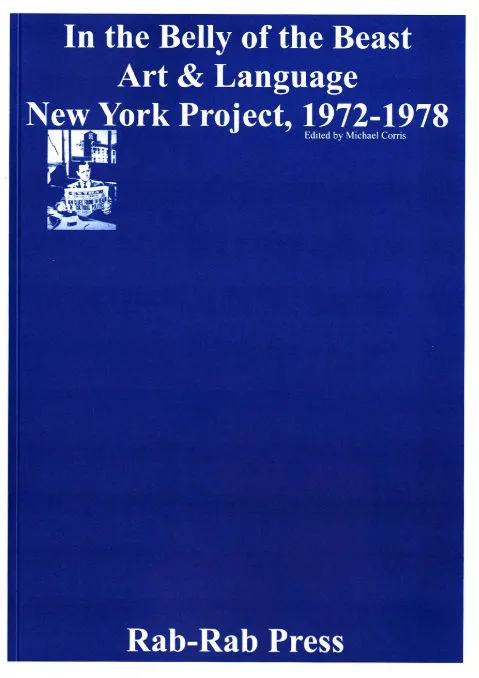
In the Belly of the Beast – Art & Language New York Project 1972-1978
Edited by Michael Corris, the expanded edition of In the Belly of the Beast: Art & Language New York Project 1972-1978 is a survey of the tumultuous years of the political Conceptualism in the mid-seventies New York.
Artists have always experimented with politics, either by organizing themselves or uniting in support of a broader political movement. Today, "activist art" is taught in universities, supported by foundations, and featured in museums and international exhibitions. Is this the only possible way?
In the Belly of the Beast tells a different story, of the work of politically engaged artists and the conflicts they experienced. It is the history of artists wishing to continue working within the boundaries of the artworld and those who were intent on establishing new ideological and class relationships with activists to build a political party.
During the 1970s in New York, the Art & Language collective pioneered institutional critique; published a Marxist-influenced journal; agitated against racism and sexism in museums; challenged the cultural imperialism of international exhibitions; and forged a framework for a socialist organization of artists. This new edition includes previously unpublished documents illuminating the contradictions and disputes that lay at the center of the organization and practices of Art & Language and left-wing groups, such as the Anti-Imperialist Cultural Union and the Artists' Meeting for Cultural Change, mobilizing artists in New York at the time.
The new and expanded edition of In the Belly of the Beast features an extensive interview with Michael Corris, who annotated a collection of previously unavailable documents from the period, including manuscripts, pamphlets, transcripts, and letters.
Art & Language is the name of a group of English artists who choose to work collectively, and the title of a magazine that they founded in 1968. Proposing a critical analysis of the relations between art, society, and politics, Art & Language marks, even in its name, the importance of the “textual turning point” in the 1960s.
Since 1976, Art & Language's project has continued, through Mel Ramsden and Michael Baldwin, with the literary and theoretical collaboration of Charles Harrison. Working with very varied mediums, from painting to rock, these co-founders of Conceptual art remain, even today, attached to observing the consequences of what they themselves call the “depressing collapse of modernism.”

A Queen in Bucks County
An epistolary sequence about sex, exchange and social space set along the Northeast Corridor.
In A Queen in Bucks County, our protagonist Turner, who both is and is not the writer, makes his pleasurable way through miserable space. Men "buy him things," lovers drive across state lines, users down volatile cocktails to see what happens, landlords turn tenants out, and Turner writes poetic tracts to friends about it. Part pornography, part novel, all love letter, A Queen in Bucks County is an experiment in turning language upside down to see what falls out.
2023 LAMBDA LITERARY AWARD FINALIST

The Obscene Madame D
Nathanaël, Hilda Hilst and 1 more
A wickedly funny work of depraved genius by one of Brazil’s most radical twentieth-century writers; imagine the Marquis de Sade as written by Clarice Lispecter.
An electrifying masterpiece by one of modern Brazilian literature’s most significant and controversial writers, Hilda Hilst takes us into the disorder and beauty of a mind restlessly testing its own limits.
Every month I ingested the body of God, not in the way one swallows green peas or agrostis, or swallows swords, I ingested the body of God the way people do when they know they are swallowing the More, the All, the Incommensurable, for not believing in finitude I would lose myself in absolute infinity…
The Obscene Madame D tells the story of Hillé, a sixty-year-old woman who has decided to abandon conventional life and spend the rest of her days in contemplation in a recess under the stairs. There, she is haunted by the perplexity of her recently deceased lover, Ehud, who cannot understand her rejection of common sense, sex and a simple life in favour of metaphysical speculations that he considers delusional and vain.
In a stream-of-consciousness monologue that’s part James Joyce, part Clarice Lispector, and part de Sade, Hillé speaks of her search for spiritual fulfilment from a space of dereliction, as she searches for answers to great questions of life, death and the relationship between body and soul.
Translated by Nathanaël and Rachel Gontijo Araujo

Rumors
When Socrates was standing before the Athenian tribunal in 399 BC, he said in his defence that the opponents he feared most were the invisible ones, those who had been spreading rumors against him for years but none of whom were being brought to court – it was like fighting shadows. The moment was Socrates, the harbinger of logos and true knowledge, was eventually defeated by rumors and mendacious slander.
Where does the strange power of rumors come from? Everyone knows that rumors are unfounded and based on thin air, but still they pass them rumors spread, and what appeared as a small breeze can grow into a mighty whirlwind and produce serious effects, ruin people’s lives and change the course of events. This book scrutinizes the mysterious power of rumors and seeks to analyse it philosophically, examining along the way some key moments of our cultural history concerning rumors, from Shakespeare and Cervantes to Gogol and Kafka. It also underlines the fact that, although rumors are as old as humankind, the advent of the internet and social media has raised the spreading of rumors to an entirely new level, to the point where we could speak of the rumorization of the social. The more communication there is, the more the social fabric threatens to fall apart – and the more urgent it becomes to find strategies to counteract this.

Not A Cookbook
TBW Books is proud to announce the release of Not a Cookbook, the debut book by Canadian filmmaker and artist Robby Reis.
At first glance, Not a Cookbook appears to be just what its title implies—but beneath the surface lies a layered, collage-style portrait of a restaurant and the family that holds it together. Centered on Resto Palme, a Caribbean restaurant in Montreal run by married duo Lee-Anne Millaire Lafleur and Ralph Alerte, the book offers a deeply personal and provocative exploration of kitchen culture, where food becomes a lens through which to examine family, friendship, labor, and resistance.
A longtime friend of the family, Reis takes an embedded, nonlinear approach to storytelling. Through photographs, texts, and contributions from customers and staff, Not a Cookbook captures not just the daily challenges of running a family business, but also the peripheral stories—of racism, activism, and the emotional labor required to build and protect something shared and sacred.
Despite its name, Not a Cookbook does offer some treasured family recipes—however, when it comes to a few key ingredients that make a certain sauce so special, Alerte leaves us simply with, “sorry blood, I can’t give it away.” The result is a new model for the cookbook: a radical kitchen guide rooted in community, resilience, and love. Less about what’s on the plate, and more about everything that makes the plate possible.

The Rebound
In The Rebound, a short story by author Natasha Stagg (Surveys, Artless), a young woman takes a work trip in the wake of a humiliating break-up, and agrees to be set up on a blind date...
The erotic works of Anaïs Nin started out as a freelance job. To support their bohemian lifestyles, Nin and her writer friends earned a dollar a page writing pornography for an anonymous client. The writers hated The Collector, as they called him, for his repeated instructions to “Concentrate on sex. Leave out the poetry”.
The Collector, a new series of short stories published by jouissance, seeks to pay homage to writers, like Nin, who explored the erotic, the taboo and the connection between jouissance and the creative process. It also honours their chosen, but much maligned, genre. By commissioning some of our favourite female writers to compose erotic short stories, we begin what we hope will be an ever-growing collection of compelling and provocative fiction that will inspire conversation, debate and further creative expression.
Munken Pure 80gsm paper publication with red Singer Sewn binding. Featuring an illustration by Emma Rose Schwartz.

Vrai travail
Le Collectif Occasionnel a organisé en Suisse deux expositions qui présentaient les oeuvres de personnes à la fois artistes et travailleureuses du sexe. Cet ouvrage prolonge leur travail en proposant des textes et des entretiens avec des Tds ou des alliéxes. Permettant l’auto-représentation des personnes interrogées, les entretiens mettent en lumière la pluralité des pratique du travail du sexe, mais aussi l’importance de construire des solidarités travailleuses, des outils pour défaire les stigmates et des perspectives de luttes intersectionnelles.

Gender and Postsecularity in Visual Culture and Knowledge Production
Boka En, Sabine Grenz and 2 more
A collection exploring the intersections of gender and religion in post-secular knowledge production and visual culture.
Over the last three decades, religious practices and belongings have gained increased visibility across the globe, turning secularity and its relationship with religion into subjects of intense interdisciplinary and international debate. Previously marginalized in gender studies, the secular and the religious now attract growing interest in academic and activist feminism, prompting a critical reflection on secularity's emancipatory potential. This publication aims to foster this interest by providing a platform for interdisciplinary and transregional discussions on the complex dynamics of secularity, religiosity, and gender, as well as new approaches to explore these relationships.
The contributions examine the entanglements and boundaries of religions and secularities in everyday life, art, culture, and knowledge production. By presenting relevant case studies, this book underscores an understanding of religion as both a category of knowledge and a marker of identity.

The Seers
The Seers follows the first weeks of a homeless Eritrean refugee in London. Set around a foster home in Kilburn and in the squares of Bloomsbury, where its protagonist Hannah sleeps, the novel grapples with how agency is given to the sexual lives of refugees, insisting that the erotic and intimate side of life is as much a part of someone’s story as ‘land and nations’ are.
Hannah arrives in London with her mother’s diary, containing a disturbing sexual story taking place in Keren, Eritrea, where the Allies defeated the Italians in the Second World War. In a gripping, continuous paragraph, The Seers moves between the present day and the past to explore intergenerational histories and colonial trauma alongside the psychological and erotic lives of its characters as their identities are shaped, but refused to be suppressed, by the bureaucratic processes of the UK asylum system.
Sulaiman Addonia is an Eritrean-Ethiopian-British novelist. He spent his early life in a refugee camp in Sudan, and his early teens in Jeddah, Saudi Arabia. He arrived in London as an underage unaccompanied refugee without a word of English and went on to earn an MA in Development Studies from SOAS and a BSc in Economics from UCL. His first novel, The Consequences of Love (Chatto & Windus, 2008), was shortlisted for the Commonwealth Writers’ Prize and was translated into more than 20 languages. His second novel, Silence is My Mother Tongue (Indigo Press, 2019; Graywolf, 2020), was a Finalist for the Lambda Literary Awards 2021, the Firecracker (CLMP) Awards, the inaugural African Literary Award from The Museum of the African Diaspora (MoAD) in San Francisco, and longlisted for the 2019 Orwell Prize for Fiction. Addonia’s essays appear in LitHub, Granta, Freeman’s, The New York Times, De Standaard and Passa Porta. He is a contributor to Tales of Two Planets (Penguin, 2020) and Addis Ababa Noir (Akashic Books, 2020).

Charismatic Spirals
Charismatic Spirals is for an America circa 2024, where poetry—the art of developing new means of speaking—has never been of such artistic, technological and political consequences.
An archetypal outsider, Will Alexander released his first poetry collection aged forty-four while working at the Los Angeles Lakers' ticket office. Three decades on, he has ascended to the legendary status of the city's great living surrealist, existing, as Eliot Weinberger wrote, in a state of "imaginal hyperdrive," with forty such collections to his name.
Operating at the edge of language, Alexander deploys words in a way that feels prophetic—human psyches synthesize with technological artifacts; atoms and archetypes collide; bodies are vacated, voices are newly incarnated. His America—like Glissant's—is multinational and—like Coover and Spiegelman's—multivalent and symbolically unstable. That is to say, he belongs to an America circa 2024, where poetry—the art of developing new means of speaking—has never been of such artistic, technological, and political consequence.
In doing so, Alexander draws from a vast array of influences, from luminaries like Aimé Césaire, Bob Kaufman, Andre Breton, Antonin Artaud, and Philip Lamantia, to holistic visions such as Sri Aurobindo's Integral Yoga, the Mayan numerical system, and Cheikh Anta Diop's perspectives on ancient Egypt. In a preview of Charismatic Spirals in the New York Times, Anne Boyer captured the essence of his work: "visionary poetry [that] achieves its effect through sound, not image...Cadence [that] can shatter us, set the world ablaze."
Read it syllabically, surf it quickly—there is no single way to approach this work.
Will Alexander (born 1948 in Los Angeles) is an African-American artist, philosopher, poet, novelist, essayist and pianist.

We, the Heartbroken
What do we do when the world breaks our hearts? Racial capitalism in the age of pandemic continues to crush ever more lives and spirits. Yet, we are told repeatedly to master, to overcome, to be resilient. Beneath this fragile pretence of coping, many of us have grown used to living with profound and fathomless sorrow.
In graceful prose, Gargi Bhattacharyya navigates collective grief and how it mingles with personal tragedy. Alongside love and joy, perhaps grief is what makes us human―and while its pain scrapes our wounds, its presence can help us renounce that which exists and build anew.
Heartbreak is the class consciousness of our times. So, it is up to us, the heartbroken, to learn again to heal—and remake the world.
"We, the Heartbroken reckons with loss and grief’s fullness and its surprising abilities to make us alive to one another … entranced by one another again. We are called upon to do this work, to allow for heartbreak to engender capaciousness and collectivity."
— Full Stop
Gargi Bhattacharyya lives and works in London. Their work includes writing on racism, racial capitalism, austerity and war.

Vostok
The theme was built around the idiom “VOSTOK”, the title given by Stéphanie Pécourt to her cycle dedicated to performative semantics, in which carte-blanches signed by guest curators at the Centre Wallonie-Bruxelles are deployed. Buried beneath several kilometers of ice, Lake Vostok acts as an invitation that both fascinates and refuses us. This sub-glacial lake on the edge of Antarctica, the largest identified, becomes the mirror-object of our desires and fears for the abyssal depths. The title of the program, Now I am a Lake, is taken from Sylvia Plath's poem Mirror (1961).
This booklet includes the scripts and texts of the performances, translated exclusively into French for the occasion, as well as images from the videos presented at the eponymous event. The compilation focuses on Sylvia Plath's poem Mirror, and includes an introductory text by curator Pauline Hatzigeorgiou.
edited by SB34
graphic design by Raphaëlle Serres / Solid Éditons
Contributions by Signe Frederiksen, Pauline Hatzigeorgiou, Margaux Schwarz, Hagar Tenenbaum, Sylvia Plath & Eleanor Ivory Weber

the mind is the body
Printed on thick cardboard, this book throws you right back into the child-like explorer mode we know from when we were young. It illustrates the mindful written words of Lisa Gutscher journey through the inner body based on a large archive from found images, screenshots and other image sources to unfold a whole new world in front of your eyes.
