Books
Books
in random order

From The Prop To The Inside
FROM THE PROP TO THE INSIDE gathers texts on the concept of the prop—as object, requisite and support—on stage and in the exhibition space. The starting points of this book are objects and installations of the artist Michaela Schweighofer, which deal with the stage as a platform and the sculpture as a prop.
The authors are friends: artists, critics and curators whom she has invited to write a text at the interface of their and her practice. The contributions within take on multiple forms; letters, essays and interviews—they are intended to create a theoretical-subjective anthology that makes visible the phenomena of the private as symptoms of the structural, as well as to provide a direct insight into contemporary artistic creation.
Text: Juliane Bischoff, Veronika Eberhart, Cornelia Lein, Cathrin Mayer, Gianna Virgina Prein, Agnieszka Roguski, Juliane Saupe, Michaela Schweighofer & Chloe Stead

Standpoint Autotheory – Writing Embodied Experiences and Relational Artistic Practices
Ana de Almeida, Mariel Rodríguez
In this anthology of essays, twelve artists explore radically self-reflexive research attitudes integrating embodied experiences within the production of theory.
Standpoint Autotheory encompasses a multitude of manifestations of radically self-reflexive research attitudes. It traces research based artistic practices through twelve contributions that propose a performative integration of the personal within the production of theory and explore the entanglements of subjectivity with criticality aimed at social transformation by questioning dominant epistemologies.
The positions assembled in the book are permeated by different modes of thinking and practice such as autoethnography, practices of the self, auto-historia teoría, standpoint theories, strong objectivity and situated knowledge, self-authority, narrativity and storytelling, radical positioning, performative philosophy, autofiction, thinking-feeling, and other methods that, through the interrogation of embodied experiences, illuminate the connections between the personal and the political, as well as the individual and the communal.
Edited by Ana de Almeida and Mariel Rodríguez.
Contributions by Ana de Almeida, andrea ancira, Cana Bilir-Meier, Nina Hoechtl, Olena Khoroshylova, Sanja Lasić, Mai Ling, Stephanie Misa, Lena Ditte Nissen, Mariel Rodríguez, Ruth Sonderegger, Elif Süsler-Rohringer, Verena Melgarejo Weinandt.

Selected Poems
Pat Parker, SaraEllen Strongman
'Her Black Woman’s voice rings true and deep and gentle, with an iron echo. It is merciless and vulnerable and far ranging.' —Audre Lorde
Alongside her invaluable contributions to social justice, Pat Parker (1944-1989) wrote five collections of poetry during her lifetime and is widely recognised as one of the leading African-American, lesbian-feminist voices of the 20th Century.
Selected Poems collects her most loved works into an accessible volume, introducing new readers to Parker's fire for justice, tenderness, and vision for the world.
This is the first time Pat Parker's poetry has been published in the United Kingdom.
Readers interested in Pat Parker’s life may also enjoy The Letters of Audre Lorde and Pat Parker 1974–1989, an archival work documenting their intimate friendship and important work as activist-poets.

Screensaver Error
Nº 49 / October 2022
In her work, Lisa Vlaemminck explores the boundaries of painting, creating an exciting, vibrating and disorienting universe. In her images, she questions very classical phenomena in painting, such as the landscape and the still life, by freezing them behind semi-transparent layers of paint. We catch a glimpse that feels familiar, but soon find that nothing is what it seems. Vlaemminck’s work oscillates between the microscopic and the interstellar, as well as the amorphous spaces in between. Image, material, shape, texture and form mutate into compositional playgrounds floating in a newly created universe where different laws and rules apply.
The book “Screensaver Error” is conceived as a symmetrical, folded stack of sheets with images of Lisa’s paintings and collages.
At the heart of the book is the sixty-metre long, worm-shaped textile sculpture, which runs like a stream through the book for many pages.
Dominique De Groen wrote an electrically charged shimmering poem tailored to the work. The introductory text was written by Simon Delobel.
In KIOSK, Lisa Vlaemminck presents a series of new paintings and a sixty-metre long textile sculpture that will occupy the various exhibition spaces. For the design of the fabric, Lisa worked patterns that form a long colour gradient.
At the end of the exhibition, the sculpture, Meat A Morph Hose, will be cut into 35 separate, new sculptures that will be offered as artworks at € 350 each. Each work is a part of the colour gradient and has a unique print. The proceeds will finance the book. Details: Printed cotton, latex spaghetti filling, the ends are closed with climbing rope
40 cm diameter x 130cmA signed copy of the book will also be delivered together with the work.
The sculptures can be collected from KIOSK at the book-launch: Sat. 26 November
The artist is reprented by gallery rodolphe janssen

UNIVERSAL PRODUCT CODE
"Like the Elizabeth Bishop painting “Interior with Extension Cord,” Kelly Clare’s helical, light-filled Universal Product Code delicately traces a bewildering infrastructure. This incantatory song, “busy in green,” points its reader to the disturbing beauty in stripey checksum barcodes, to arrays of imported figs at the grocer, to words like cloud or lime that now mean too much. Humorous, musical, perspicacious, this chapbook rocks."
- Katherine Gibbel, April 2026
Includes 3 poems by Dre Roelandt.
Published as part of Paraphernalia and Addenda 2.2 of Tabloid Publications.

The Prime Times Vol.1
Dans « The Prime Times, Volume 1 », Sophie T. Lvoff met en scène sa pratique quotidienne d’atelier. Au travers de poèmes en haïku, de gros titres et de photographies de son atelier traversé par la lumière du jour au milieu de l’après-midi, le journal chronique la torpeur des longues journées de travail mêlées d’attente, de glimpses et de glances.
En attendant the prime time, Sophie lit les nouvelles sur son téléphone, parcourt paresseusement sa bibliothèque, écrit des emails à des amix éloigné·es et parfois à elle-même. Elle note des blagues et des poèmes dans son cahier, mange des snacks, doute d’elle-même, fume, jette des regards autour d’elle, jusqu’au moment précis où la photo doit être prise.
In « The Prime Times, Volume 1 », Sophie T. Lvoff dramatizes her daily studio practice. Through haiku poems, headlines, doodles and photographs of her studio pierced by mid-afternoon daylight, the journal chronicles the torpor of long workdays mixed with waiting, glimpses, and glances.
While waiting for the prime time, Sophie reads the news on her phone and lazily reads her collection of books, writes emails to far-away friends and sometimes to herself. She notes things in notebooks and writes jokes and poems, stretches, eats snacks, doubts herself, smokes, glances around, until the precise moment when the picture has to be taken.

An Archive of Feelings
In this bold new work of cultural criticism, Ann Cvetkovich develops a queer approach to trauma. She argues for the importance of recognizing—and archiving—accounts of trauma that belong as much to the ordinary and everyday as to the domain of catastrophe. An Archive of Feelings contends that the field of trauma studies, limited by too strict a division between the public and the private, has overlooked the experiences of women and queers. Rejecting the pathologizing understandings of trauma that permeate medical and clinical discourses on the subject, Cvetkovich develops instead a sex-positive approach missing even from most feminist work on trauma. She challenges the field to engage more fully with sexual trauma and the wide range of feelings in its vicinity, including those associated with butch-femme sex and aids activism and caretaking.
An Archive of Feelings brings together oral histories from lesbian activists involved in act up/New York; readings of literature by Dorothy Allison, Leslie Feinberg, Cherríe Moraga, and Shani Mootoo; videos by Jean Carlomusto and Pratibha Parmar; and performances by Lisa Kron, Carmelita Tropicana, and the bands Le Tigre and Tribe 8. Cvetkovich reveals how activism, performance, and literature give rise to public cultures that work through trauma and transform the conditions producing it. By looking closely at connections between sexuality, trauma, and the creation of lesbian public cultures, Cvetkovich makes those experiences that have been pushed to the peripheries of trauma culture the defining principles of a new construction of sexual trauma—one in which trauma catalyzes the creation of cultural archives and political communities.

Biography of a Fiction
Biography of a Fiction collects poems written between 2020 to 2025. These poems were written in a diaristic way, mostly in short form, while working on larger pieces, some of which also collected here or elsewhere. What started, seemingly, as notes on reproductive desire, gender, and sexuality soon matured into a meditation on the role of fiction in the exercise of writing (and idealizing) a biography, including the thorny aspect of artistic license and the uses of one’s own life and of others.

Positions of the Sun
The second work in Belladonna* Collaborative’s Germinal Texts series, Lyn Hejinian’s Positions of the Sun is a book of twenty-six interlocking “essays with characters” that explores the mid-2000s financial “crisis” through the movements and daily lives of a wide-ranging cast of characters located in the Bay Area.
In Positions, Hejinian plays the bricoleur, bringing together whatever’s needed in her to approach to the subject—whether the paratactic tactics of poetry, scholarship’s critical patchwork, or dramatis personae set in time that evokes but frustrates narrative.
Earlier iterations of essays 4, 14, and 17 appeared in Belladonna*’s Elders Series #5, edited by Jennifer Scappettone with work by Etel Adnan, Lyn Hejinian, and Jennifer Scappettone.


KAMERA CAHIER N° 9
Peter Downsbrough (New Jersey, US, 1940) lives and works in Brussels (Belgium). Associated with major international art movements such as minimal art, conceptual art, and visual poetry, his work spans across various mediums including sculpture, wall pieces and room pieces, books, work on paper, photography, film, and video. The work, which has affinities with architecture and typography, explores the traditional use of space and language, while criticizing power structures, e.g. urbanism, that influence social interactions and shape the landscape.
A special edition issue curated, designed and published by AVARIE, Paris and Labor Neunzehn, Berlin. It accompanies KAMERA SERIES, while it is an independent and valuable object to collect.
The central idea that informs and directs the booklets’ montage is the interplay between the concepts of addition and subtraction. This is achieved by unveiling a missing image in the screening or an unreleased second from an artist's film, expanded to 24 pages. Additionally, each booklet contains a piece directly removed from the show.
The editing establishes a dialogue between film frames and performed writings derived from texts, scripts, storyboards, and notes. The KAMERA exhibition is consequently extended into a physical space—the book—allowing for its widespread dissemination, complementing and contrasting with its potential online occurrence.
KAMERA SERIES is a screening program of experimental films, video art works and printed matter taking place in a former GDR building in Berlin. Each event showcases a retrospective of selected films by an artist and a small exhibition of his/her publications or works on paper over a span of 4 days.

Devenir minéral | L’éditeur du dimanche
Echoing Jean Dubuffet's idea that thought must arise from material in artistic practice, Giuliana Prucca, through this essay, reinterprets a moment in the history of 20th-century art using materials such as stone, sand, earth, and dust. She employs the mineral to illustrate that the creative act would be a trace of the body's disappearance. The loss of humanity and the deconstruction of the subject objectify themselves in the image. In other words, art resides in the tension between representation and its loss, ultimately leaving nothing but an image.
Drawing from the influential figure of Antonin Artaud, she weaves critical and poetic connections between the texts and works of various artists, writers, and thinkers, ranging from Jean Dubuffet to Jan Fabre and Anselm Kiefer, Yves Klein and Gutaï, Joë Bousquet to Camille Bryen and Francis Ponge, Gaston Bachelard to Gilles Deleuze, and Georges Bataille to Aby Warburg.
The material is not merely a thematic pretext; it is an active and explosive catapult that questions the arbitrary linearity of a conventionally assimilated art history. Following Ponge's example, Prucca applies the principles of poetry to criticism, starting from Artaud's material, the most undisciplined of poet-artist-thinkers of the modern era. This results in a critically inventive approach dangerously suited to its object, celebrating an anti-critique. The chosen writing materials, stonepaper for the cover and recycled paper for the pages, is consistent, intending to give the impression of being covered in dust.
The essay disrupts traditional reading habits and shatters the conservatism of art criticism by inhabiting writing space differently, presenting a physically engaging interaction. This is an essay in the literal sense, an experience where form never contradicts content, urging readers to take the risk of thinking deeply and embracing a new rhythm. A complex and challenging design invites them to choose different reading options, ultimately treating criticism as one would poetry.
Giuliana Prucca [Paris | Berlin] is an independent curator, researcher, and writer. She is the founder and art director of the publishing house AVARIE, specialising in contemporary art books that explore the relationships between text and image, body and space.
Graphic design, art direction by Vito Raimondi

one long continuous line or a thought that dissolves into the distance
A short text or a long line written by Mette Edvardsen for Etcetera magazine (June 2018) on an invitation to elaborate on her approach to text, writing and speech from a choreographic point of view. Held by a cardboard cover, the text is here published on its own as a very slim book.

Fair Arts Almanac 2019
In 2019 SOTA finished the first Fair Arts Almanac. The content of the book was generated during a week long summer camp in 2018 with about 70 contributors. The result was a bundling of tips & tricks, statements & demands, visions & ideas, dates & data, testimonies & voices, addresses & announcements on fairness within the complex relationships between the artistic, political and economic sphere. The compilation of various contributions in this first edition was deliberately associative and open for debate, full of contradictions, loose ends and inconsistencies.

F.R. David - Spin Cycle
F.R.DAVID is a typographical journal, dealing with the organisation of reading and writing in contemporary art practises.
This issue, "Spin Cycle", is concerned with captioning, commentary and description. Edited with Mike Sperlinger.

TRANSMISSIONS: Radio Essays on Edges, Crossings and Narrowcasting Borderlands
Transmissions: Radio Essays on Edges, Crossings and Narrowcasting Borderlands gathers radio essays—created as part of Robida Collective’s project Radio drugega/The Other Radio—which reveal that to speak of “the border” is never to speak of a single line. There are political borders, conceptual borders, bodily borders; carnivalesque borders, where order collapses into play; linguistic and cultural borders, where words slip between languages and where accents become geographies; archival borders, separating memory from forgetting; borders of abandonment, where life and death enter into a dialectical ballet; economic borders, drawn by property, ownership, enclosure; borders of matter, space and time; acoustic borders, where the voice meets noise and incomprehensibility; cosmic borders, where meteors cross the thin edge of air; ecological borders, porous and breathing, where one species touches another. These are some of the borders this book speaks of – lines that do not divide but resonate, that hold together separation and proximity, distance and relation. Together, these essays form a cartography of friction but also affinity, reminding us that to erase all borders is to erase the very conditions of encounter – and that meaning often emerges not at the centre, but at the edges where worlds meet.
With texts by:
Agnes Cameron, Ajda Bračič, Aljaž Škrlep, Antônio Frederico Lasalvia, Giorgia Maurovich, Jack Bardwell, Kate Donovan, Kat Macdonald, Lijuan Klassen, Luca Vettori, Michael Marder, Moritz Gansen, Olya Korsun, Petra Filagrana, Urška Savič.

The Slicks: On Sylvia Plath and Taylor Swift
In The Slicks, Maggie Nelson positions culture-dominating pop superstar Taylor Swift and feminist cult icon Sylvia Plath as twin hosts of the female urge toward wanting hard, working hard, and pouring forth—and as twinned targets of patriarchy’s ancient urge to disparage, trivialize, and discipline creative work by women rooted in autobiography and abundance.
A buoyant melding of popular culture and literary criticism, The Slicks is a captivating and unexpected assessment of two iconic female artists by one of the most revered and influential critics of her generation.

Pfeil Magazine #18 – Body
From its anatomy and autonomy to its death and diet, this issue focuses on the motif Body and all its meanings, direct and indirect, for instance as in relation to human and non-human bearers of bodies, its inhabitants like bacteria and organs, its social, medical and juridical conditions, its intoxications, chemical processes, traumas, transitions, well-being, replacements, weaknesses, and its opposites.
Contributors: Adam Dickinson, Andrea Éva Győri, A.L. Steiner, Alexandra Ivanciu, Barak Zemer, Bernhard Willhelm, Clara Lena Langenbach, Clémentine Bedos, Constance DeJong, Daisy Hildyard, Fanny Howe, Hanne Loreck, Hasti, Holly Hunter, Ingrid Jäger, Jannis Marwitz, Jess Arndt, Johannes Kuczera, Jolanta Nowaczyk, Henriette Maier, Mag Gabbert, Maja Smrekar, Manuel Vason, R.I.P. Germain, Rebekka Endler, Sonja Yakovleva
Within the format of a magazine, each page of Pfeil represents the floor, walls, or ceiling which together create an imagined room displaying a printed exhibition. Each issue is dedicated to a specific word, and artists are invited and given space to work on and with this term, and to construct or deconstruct the architecture around it. Combined, the contributions transform into an organic display surrounding the leitmotif.

The Moon is Reading us a Book
THE MOON IS READING US A BOOK is the debut collection of poetry from a writer who displays a wide-ranging palette for storytelling and folklore in a suite of narrative poems. The collection is built around an ensemble of characters that range from known to unknown, through which Serubiri crafts visually-inspired poems that combine the photographic, the intensely personal, and the scholarly. In his book, he manages to domesticate larger-than-life figures, including Zanzibari-born singer-songwriter Freddie Mercury and Nigerian-born photographer Rotimi Fani Kayode. Simultaneously pondered and elastic, Serubiri’s poetry lures these figures – and the reader – into an atmosphere that is only as expansive as the interior landscapes he delineates with each succeeding poem. With this he expresses his own doubts and path, from memories of his native Uganda to New York City, through a psychology of decisions and life choices.
Serubiri Moses is a Ugandan curator and author based in New York City. He currently serves as faculty in Art History at Hunter College and visiting faculty at the Center for Curatorial Studies, Bard College. He previously held positions at New York University and the New Centre for Research and Practice, and delivered lectures at Williams College, Yale University, University of Pittsburgh, The New School, basis voor aktuelle kunst, and University of the Arts Helsinki. As a curator, he has organized exhibitions at museums including MoMA PS1, New York; Kunst-Werke Institute for Contemporary Art, Berlin; and the Hessel Museum, Bard College, NY. He previously held a research fellowship at the University of Bayreuth; received his MA in Curatorial Studies at Bard College; and is an alumni of the Àsìkò International Art Programme. He serves on the editorial team of e-flux journal. He has published poetry in the online journals Jalada and Badilisha Poetry Exchange, as well as in print in journals Kwani? 7, Kwani? 8, and READ: A Journal of Inter-Translation (2022). His poetry has been reviewed online in The New Inquiry. THE MOON IS READING US A BOOK is his first book of poetry.

In The Pines
Alice Notley is considered by many to be among the most outstanding of living American poets. Notley's work has always been highly narrative, and her new book mixes short lyrics with long, expansive lines of poetry that often take the form of prose sentences, in an effort "to change writing completely." The title piece, a folksong-like lament, makes a unified tale out of many stories of many people; the middle section, "The Black Trailor," is a compilation of noir fictions and reflections; while the shorter poems of "Hemostatic" range from tough lyrics to sung dramas. Full of curative power, music, and the possibility of transformation, In the Pines is a genre- bending book from one of our most innovative writers.
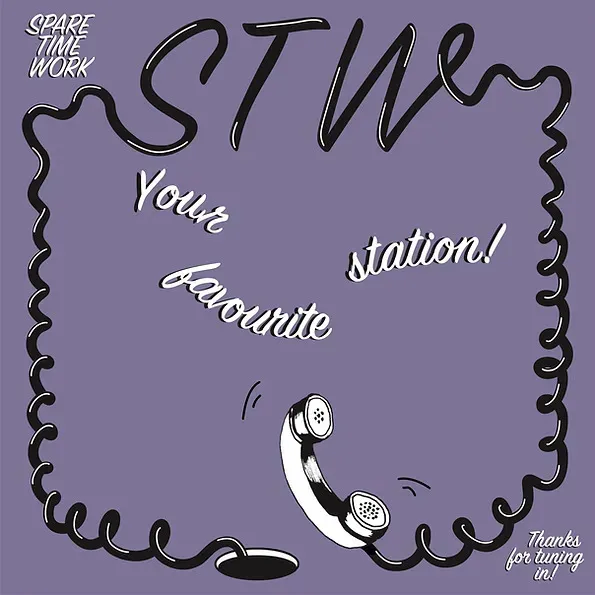
STW, your favourite station!
STW, your favourite station! functioneert als een radioprogramma. Een boek dat lyrisch proza uitzendt van We make stuff up for a living (een CV medley) tot COMPUTER_SONG, een ceremoniële quiz met Adult Hood & Young als protagonisten, een grillige anekdote van iemand die zich ergert aan een Call Service, en meer! Thanks for tuning in!

Movement Research Performance Journal
Issue #62 - We Exist in the Ambivalence of Those Motherfuckers
Anh Vo, maura nguyen-donohue and 1 more
What began as a project responding to the fiftieth anniversary of the ‘end’ of the Vietnam War became a project of inhabiting the Movement Research Performance Journal (MRPJ) from within the landscape of contemporary Vietnamese performance art. The result, Issue #62, is a window onto a community of insiders who reflect a set of concerns, questions, historical trajectories, and aesthetic legacies that differ from what has more often been foregrounded in our U.S./New York City-centric publication. Like other documents of this kind, which endeavor to portray a performance scene that will be foreign to many readers, the texts from this group of intergenerational, contemporary artists demonstrate a careful navigation of the dialectics of inside and outside, self and other, performer and audience, seeing and being seen, that informs every exchange across cultural difference.
The texts are also not monolithic, suggesting a range of relations to the Vietnam of the past and present, from within Vietnam’s national borders and among the diaspora. Especially for contributors living and working in Vietnam, writing has also been a practice of choreographing words within a political landscape where to speak publicly, in itself, is a performance of negotiated risk. Embracing the complexities of these differing positions has been the focus of our editorial process—one that has asked the editorial team to embrace the limits of our own knowledge, to recognize we will not be able to recognize all valences others may discover in these texts, and not to edit these layers out of the works that follows.

CUNY Center for the Humanities
Lost & Found: The CUNY Poetics Document Initiative, Series VI
Lost & Found: The CUNY Poetics Document Initiative publishes unexpected, genre-bending works by important 20th century writers. Unearthed from personal and institutional archives in the United States and abroad, these materials are edited by doctoral students at the Graduate Center, CUNY.
LOST & FOUND SERIES VI presents work by Gregory Corso, Judy Grahn, Bobbie Louise Hawkins, and Ted Joans. While the styles and experiences of these writers are radically different, each project presented here enacts a commitment to the exploration of knowledge unbound by disciplinary constraints.
Gregory Corso: Naropa Lectures 1981, introduced by Anne Waldman, includes two transcribed and annotated lectures that illustrate Corso's vast storehouse of cultural knowledge, animating his poetics both on the page and in the classroom.
Bobbie Louise Hawkins: The Sounding Word presents two very different lectures from the Jack Kerouac School of Disembodied Poetics, and a new interview with the author. Whether looking at iconic French novelist Colette or examining the poetics of prose, The Sounding Word describes an unflinching empirical approach to knowledge and its transmission through direct experience.
Judy Grahn: Selections from Blood, Bread, and Roses explores mythic, societal, and personal relationships to menstruation throughout time, and is accompanied by a recent interview with the legendary poet, teacher, scholar, and activist.
Ted Joans: Poet Painter / Former Villager Now / World Traveller, introduced by Diane di Prima, presents an array of previously unpublished texts on jazz, surrealism, travel guides to Africa and Paris, his inimitable Negative Cowboy, and photographs from his life and times. As writers, each considers and refigures the malleable conditions of historical truth and the pursuit of knowledge as part of their creative process. And as readers, we are encouraged to do the same.
SERIES VI includes:
Gregory Corso: Naropa Lectures 1981 (Part I & II) (ed. William Camponovo, Mary Catherine Kinniburgh, Öykü Tekten)
Bobbie Louise Hawkins: The Sounding Word (ed. Iris Cushing)
Judy Grahn: Selections from Blood, Bread, and Roses (ed. Iemanjá Brown & Iris Cushing)
Ted Joans: Poet Painter / Former Villager Now / World Traveller (Part I & II) (ed. Wendy Tronrud & Ammiel Alcalay)

Comeback Death
Comeback Death, Jennifer Soong's third book, weaves its registers of what Soong names as "dread, gender, sarcasm, sublimation of pain, fruit, ambition, and fecundity" through an English which is not only polyvocal but uncannily porous. Its languages (English, Russian, German, ancient Greek) underscore a perverse pastoral range that somehow bridges Oxford, New Jersey, and Lesbos. With a ferocity both musical and analytic, Soong's third book offers an unprecedented set of tonalities for immense architectures of feeling.
"In Comeback Death, Jennifer Soong dramatizes one of the key problems of our time, and indeed any time, which is how to reorganize the (negative) affects structuring intersubjectivity and thus conditioning our capacity to act in a common interest among others."—Thom Donovan