Books
Books
in random order

Numbered Map
Goswell Road publishes ‘Numbered Map’ by Archie Chekatouski, to accompany his exhibition 'You can do so much more with a chair than you can with a painting?'. The publication is edited in 30 copies and focuses on Chekatouski’s Paint-by-numbers Series.
Bio: Archie Chekatouski (born 1996 in Minsk, Belarus) lives and works in Paris. His works are touchingly silly and beautifully simple.

Spectres IV: A Thousand Voices
Bartolomé Sanson, François J. Bonnet
The fourth issue of the annual publication dedicated to sound and music experimentation, co-published by Shelter Press and Ina GRM – Groupe de Recherches Musicales, around the topic of voice.
The voice is everywhere, infiltrating everything, making civilisation, marking out territories with infinite borders, spreading from the farthest reaches to the most intimate spaces. It can be neither reduced nor summarised. And accordingly, when taken as a theme, the voice is inexhaustible, even when seen in the light of its very particular relation with the sonic or the musical, as is the case in most of the texts collected in this volume. There is no point therefore in trying to circumscribe or amalgamate the multiple avatars of the voice. We must rather try to apprehend what the voice can do, to envisage its landscape, its potential effects.
Spectres is an annual publication dedicated to sound and music experimentation, co-published by Shelter Press and Ina GRM – Groupe de Recherches Musicales.
Edited by François J. Bonnet and Bartolomé Sanson.
Contributions by Joan La Barbara, Sarah Hennies, Peter Szendy, Youmna Saba, Lee Gamble, Ghédalia Tazartès, David Grubbs, Stine Janvin, Pierre Schaeffer, Akira Sakata, Haela Ravenna Hunt-Hendrix, Yannick Guédon, François J. Bonnet, John Giorno.

Lentil Space – Recipes from Artists' Homes
A compilation of recipes from the Arab world that were presented by artists for Mophradat's online cooking show Lentil Space.
Adapted from its namesake online program produced by Mophradat, co-curated by Mai Abu ElDahab and Reem Shilleh, from 2021 to 2023, this book is a celebration of the varied cuisine of the Arab world and its relationship with inherited food practices and the cultures of cooking and talking about food.
With contributions by Adam HajYahia and Haitham Haddad, Deena Abdelwahed, Laila Hida with Amine Lahrach, Mohamed Abdelkarim with Abla elBahrawy, Nadah El Shazly, amongst many others, this cookbook includes recipes chosen and prepared by the artists in an intimate setting coupled with stories both personal and about their art practice.

KW Institute for Contemporary Art
Pia Arke
Pia Arke, Ros Carter and 1 more
Pia Arke (1958–2007) was a Greenlandic Inuk and Danish artist, writer and photographer. She is known for her self-portraits and landscape photographs of Kalaallit Nunaat (Greenland), as well as for her paintings, collages, performative film works and writing. Arke strove to make visible the silence that surrounded the colonial history and complex political and cultural relationship between Greenland and Denmark.
This publication accompanies the first international exhibitions of Arke’s work outside of Greenland and the Nordic countries, happening over the course of 2024 at John Hansard Gallery in Southampton (UK) and at KW Institute for Contemporary Art in Berlin (DE). It reflects on Arke’s ideas and legacy in a wider international context and aims to demonstrate how the work she made and the ideas she expressed connect with current discourse and contemporary thinking.
Texts by Krist Gruijthuijsen, Woodrow Kernohan, Ros Carter, Alice Maude-Roxby, Mette Sandbye, Tiara Roxanne, Sofie Krogh Christensen, Nivi Christensen, Siri Paulsen, Trinh T. Minh-ha

Poetry, or else...
The poet, the unknown being… a loony, a dreamer, a hermit. The poet writes poetry… but really, what is poetry? Arts, politics, mere amusement?
This little book is an insight into the mindset of someone who just can’t help but to be a poet. It is a manifesto for the freedom of thought and expression, an essential source of motivation and inspiration for readers and writers alike.
Anisur Rahman (b.1978) made his poetic debut in 2003. As a journalist, translator and playwright he has further contemplated the poetic mind. Born in Bangladesh, he writes in both Bengali and English, but nowadays lives exiled in Sweden.

Active Reception
A vibrant work of lyric, conceptual, and confessional poetic modes pitched to enact a queer politics of liberation.
Active Reception is a book of bottoming lovers, the world around us, and a history of letters, that thinks through a queer mode of writing from the bottom, a kind of coalition based politics of receptivity and expansion that is open to the world around us, its myriad life forms, its systemic oppressions, its hidden ghosts.
Noah Ross is a bookseller, editor, and poet based in Berkeley, CA. Noah is the author of Swell, and an editor of Baest: a journal of queer forms & affects, and Mo0on/IO with Lindsay Choi.

Telling is Listening: Selected Essays 1973-2014
Ursula K. Le Guin, Conner Bouchard-Roberts
An essential collection of essays on language, the imagination, and the art of words by one of the great literary masters of the last century.
This book traces a long sweep (1973-2014) through Ursula K. Le Guin's career; offering both a portrait of the author as a philosopher and a reference text for new generations of wordworkers and bookmakers.

Information Activism: A Queer History of Lesbian Media Technologies
Cait McKinney traces how lesbian feminist activists in the United States and Canada between the 1970s and the present developed communication networks, databases, and digital archives to use as a foundation for their feminist, antiracist, and trans-inclusive work.
For decades, lesbian feminists across the United States and Canada have created information to build movements and survive in a world that doesn't want them.
In Information Activism Cait McKinney traces how these women developed communication networks, databases, and digital archives that formed the foundation for their work. Often learning on the fly and using everything from index cards to computers, these activists brought people and their visions of justice together to organize, store, and provide access to information.
Focusing on the transition from paper to digital-based archival techniques from the 1970s to the present, McKinney shows how media technologies animate the collective and unspectacular labor that sustains social movements, including their antiracist and trans-inclusive endeavors. By bringing sexuality studies to bear on media history, McKinney demonstrates how groups with precarious access to control over information create their own innovative and resourceful techniques for generating and sharing knowledge.

Steering The Craft
A Twenty-First-Century Guide to Sailing the Sea of Story.
With an introduction by Theo Downes-Le Guin, Karen Joy Fowler, Molly Gloss and Kelly Link.
Steering the Craft is Ursula K. Le Guin’s carrier bag of the tools of a writer’s craft: how – and why – to write. From the sound of language to tenses to point of view, Le Guin offers a comprehensive and generous guide to the fundamental components of narrative, illustrating her incisive analysis with examples from some of her favourite writers. Revised and updated for the twenty-first century, this handbook includes exercises that the writer can do alone or in a group.
CUNY Center for the Humanities
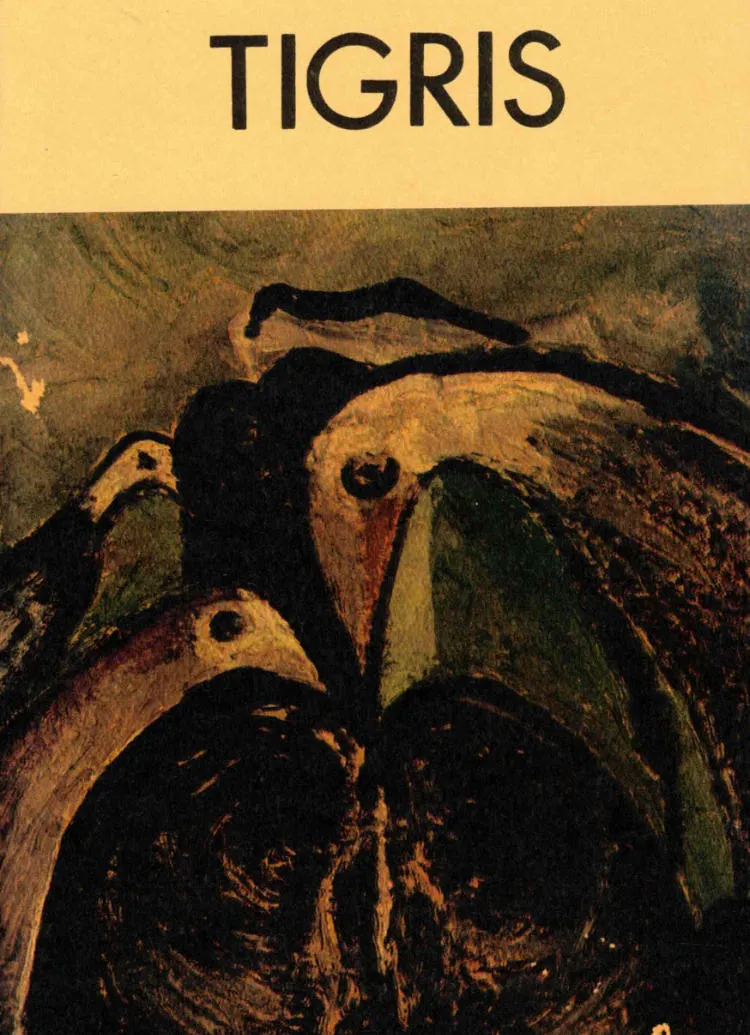
Tigris Vol. 1
In 1971, the great Iraqi poet Sargon Boulus (1944-2007) published a single issue of an English-language literary anthology that he called Tigris. The magazine—a whisper on the literary landscape that appeared three years after Boulus’s arrival in the US—brings together work by Boulus and several of his literary friends, in translation by Boulus and Etel Adnan.
Tigris was not an end in itself, but rather a temporary solution to the lifelong problem of how to devote oneself to poetry across different countries, eras, and styles: how to live poetry. Yet, in so doing, the small anthology includes significant work: Etel Adnan’s “Jebu,” translated by Adnan, and poetry by Boulus, Fouad Rifkah, Yusuf al-Khal, Mouayad al-Rawi, and Riadh Fakhouri, all in Boulus’s translations, as well as a work by Ankido, a “street-activist poet-café worker of importance to the Palestinian Liberation Movement.”

Bird Watching and Their First Three Books of Poetry
Any future film director planning to make a movie of Myles's iconic novel Chelsea Girls (it's always just about to happen) would be wise to read Bird Watching first. Written in 1978 and unpublished until now, the central character of the book is a twenty-something that is already filled with memories. Living in New York City, resplendent, full of both grandeur and awkwardness, they are about to embark on a life fully invested in art. Bliss happens, as does uncertainty. Everything is here and now.
The Irony of the Leash, A Fresh Young Voice from the Plains, and Sappho's Boat, the other collections contained in the volume, comprise the first three books that Myles published, when their promise as one of the most important writers of their generation was just coming into view. Immensely readable, raw, and slightly unhinged, the poetry that comprises these three texts is post young. Slight creaky but fully functional, all of these poems are beautiful and funky.Bird Watching and Their First Three Books of Poetry contains a critical foreword by poet and scholar Rosa Campbell, along with a preface by Eileen Myles contextualizing the book within our contemporary moment.
Eileen Myles (them/them, b. 1949) is a poet, novelist and art journalist whose practice of vernacular first-person writing has made them one of the most recognized writers around town (globally). They live in New York & in Marfa, TX.

Walking from Scores
An anthology of text and graphic scores to be used while walking, from Fluxus to the critical works of current artists, through the tradition of experimental musicand performance, gathered and presented by Elena Biserna.
Walking from Scores is a hundred or so collection of non site-specific protocols, instructions and textual and graphic scores centred on walking, listening and playing sound in urban environment. It explores the relationship between art and the everyday, the dynamics of sound and listening in various environments and the (porous) frontiers between artists and audiences. It starts with two premises: an interest in walking envisaged as a relational practice and tactic enabling us to read and rewrite space; an interpretation of scores understood as open invitations and catalysers of action in the tradition of Fluxus event scores.
With scores and texts by Peter Ablinger, Milan Adamčiak, G. Douglas Barrett, Elena Biserna, Blank Noise, George Brecht, Cornelius Cardew, Stephen Chase, Giuseppe Chiari, Seth Cluett, Philip Corner, Viv Corringham, Bill Dietz, Amy Dignam, David Dunn, Haytham El-Wardany, Esther Ferrer, Simone Forti, Francesco Gagliardi, Jérôme Giller, Oliver Ginger, Anna & Lawrence Halprin, David Helbich, Dick Higgins, Christopher Hobbs, Jérôme Joy, katrinem, Debbie Kent, Bengt af Klintberg, James Klopfleisch, Milan Knížák, Alison Knowles, Takehisa Kosugi, Jirí Kovanda, Anne Leilehua Lanzilotti, Bob Lens, Ligia Lewis, Alvin Lucier, Walter Marchetti, Larry Miller, iLAND/Jennifer Monson, Max Neuhaus, Alisa Oleva, Pauline Oliveros, Yoko Ono, Open City & Emma Cocker, Nam June Paik, Michael Parsons, Ben Patterson, Cesare Pietroiusti, Mathias Poisson, Anna Raimondo, Pheobe riley Law, Jez riley French, Paul Sharits, Mieko Shiomi, Mark So, Standards, Nicolas Tardy, Davide Tidoni, Ultra-red, Isolde Venrooy, Carole Weber, Manfred Werder, Franziska Windisch, Ben Vautier, La Monte Young.
Elena Biserna is a scholar and independent curator based in Marseille, France. She is associate researcher at PRI SM (AMU / CNRS) and TEAMeD (Université Paris 8). Her interests are focused on listening and on contextual, "situated" art practices in relationship with urban dynamics, sociocultural processes, the public and political sphere. Her writings have appeared in several publications. As a curator, she has collaborated with different organisations and presented her projects internationally.

Amalgamemnon
History and literature seem to be losing ground to the brave new world of electronic media and technology, and battle lines are being drawn between the humanities and technology, the first world and the third world, women and men. Narrator Mira Enketei erases those boundaries in her punning monologue, blurring the texts of Herodotus with the callers to a talk-radio program, and blending contemporary history with ancient: fairy-tale and literal/invented people (the kidnappers of capitalism, a girl-warrior from Somalia, a pop singer, a political writer), connected by an elaborate mock-genealogy stretching back to the Greek gods, move in and out of each other's stories. The narrator sometimes sees herself as Cassandra, condemned by Apollo to prophesy but never to be believed, enslaved by Agamemnon after the fall of Troy. Brooke-Rose amalgamates ancient literature with modern crises to produce a powerful novel about the future of culture.
Christine Frances Evelyn Brooke-Rose was a British writer and literary critic, known principally for her later, experimental novels.

Heatwave #2
In an era when many “radical” theorists were seeking out the peaceable expression of politics in “everyday utopias,” Joshua Clover stressed that politics was always, at root, a fiery confrontation with the powers that be. To these ends, he not only helped bring together a new generation of young communists but also pushed them to engage directly with the rising tide of class conflict, understanding full well that the street and the shopfloor are the true classrooms of the partisan.
Heatwave is, in a sense, an attempt to embody this spirit at a larger scale. Like Joshua, we hope to serve as an engine of engagement, linking our readers to their own history and to one another. Like Joshua, we adopt a principle of ecumenicism, refusing the false dividing lines inherited from the long dissolution of the last global communist movement. At the same time, like Joshua, we also insist on a theoretically rigorous approach that invokes the real complexity of revolutionary theory and history, actively seeks evidence for its claims, and engages in good faith with opposing positions. And, like Joshua, we maintain that the partisan project is inherently incendiary, requiring confrontation with the rulers of the world, rather than gradualist compromise or secessionist retreat. Finally, communism requires an unambiguous commitment to internationalism. Although our project is currently anglophone, we recognize that elaborating a partisan politics requires learning from the self-activity of the dispossessed at the global scale.
The name "Heatwave" echoes that of an old Situationist magazine ("Britain's most incandescent journal" of 1966), but with added urgency in an era where every summer is the hottest on record. While the statistical certainty of catastrophe is inescapable, "revolt" names many species of conflagration, including that peculiar variety we call communism. We must sift through the ashes to find it.

T (poem)
T is a long poem in multiple parts and its author's second book. “The two genders are YES and NO, so you stutter or else shut up forever”.
From the Afterword: "Between 2017-2018 I was involved in a trial with a group of TERFs after a scuffle emerged during a counter protest against a ‘debate’ about sex-based rights in light of proposed reforms to the Gender Recognition Act which would have made trans people’s lives marginally easier. Luckily I wasn’t actually in the dock, but I appeared to give evidence, and for everyone involved it was a humiliating ordeal as we were doxxed, harrassed online and in real life, while the relentless media campaign which ensued took a toll on the entire trans community. The caricaturesque reduction of a complex interrelation of political positions, epistemologies, traumas and personal grievances into two ‘sides’ ultimately worked to further the persecution of trans people, but nevertheless highlighted a social logic on whose terms the so called debate was forced to appear: sex was pitted against gender (or more revealingly ‘gender identity’), objective biology against subjective ‘self-identification’, nature against culture, or perhaps, first nature against second nature."
What does a poet say (what does anyone say), when placed on the stand, how answer the binary logics forced like a cage in the legally-grounded violence which splittingly interrogates solidarity, the splitting invocation of law? In answer, T spreads across the page as if desperately finding a form for speech acts forced into a garrotted tick-box, a witness stand, video evidence, Nature’s originary disguise as history or vice versa, wrapped inside ‘common sense’ as a pronominal shroud, in the policing of body, speech, and every fungible fibre of being. The author writes: “I want the whole text to be a kind of horrific inorganic body with awkward parts, both to replay at the level of form some of the critiques of organicist thinking with reference to nature that the poem tries to articulate, and also, more glibly, to be somewhat like a trans body, awkwardly fitting together with some parts undercutting others”. An extended enquiry into Materialism and its material (fleshed) stakes, driven through the heart and to the heart of things, T sees lyric poem shudder to line-broken essay to fragment of play to citational drop; in tight compression sprawling, a poem whose argument is necessary and necessarily incomplete, poetry can do thinking, this thinking we do outside and within it, sprung trap, open and closing door.

LllOovVee - Forbid me my love
It is right and necessary to be speaking with strangers. There are islands, backroads and cliffs of wet inked worded sea ridgelines where aodán McCardle’s work emerges concrete and lyric as a chant of delicately provoking permutations. forbid me my love, the first part of this beautiful book, is poetry as poiesis or making. By means of a series of concrete meditations, McCardle takes us where he, or perhaps the words themselves, unknit, erase, appear and disappear. Wor(l)ds of the size of terrorist and bomb are subject to a system of alterations that end up shooting lovebombs from the page as if love could become an error in the system. The second part of the book, LllOovVee, starts closer to verse. Reading it, one can almost hear aodán’s delicate Irish voice, but any easy reading gets explosively interrupted by the scanned handwritten, scribbled and scratched lines that open another set of permutations, one about what is behind us, how to be there here and what is it to be there then now, in the making, in the ear and in the eye with this revealing poetry.
- Martín Gubbins
Aodán McCardle is a performance poet, artist, & tattooist. In this book he combines all three artistic expressions into a performance. These poems are audacious. A poetic trajectory worthy of reading aloud.

Abattre les arbres, boucher les fontaines, renverser les pierres
Abattre les arbres, boucher les fontaines, renverser les pierres réunit les 4 tomes d’un conte épisodique initialement paru en auto-édition tout au long de l’année 2021.
”Abattre les arbres, boucher les fontaines, renverser les pierres” sont les mots d’une archéologue s’exprimant à la radio au sujet des intentions des premiers chrétiens arrivant en Grande Bretagne. Cette formule a attendu de longues années dans mes notes avant de devenir un récit d’images.

Fraitaxtsēs sores tsîn ge ra≠gâ – Ondjembo yo Null Vier
A complete documentation on a multimedia exhibition by Berlin-based artist Ixmucané Aguila, giving voice to voiceless descendants of victims of genocide in Namibia.
Genocide in Namibia is an especially sensitive matter—its history has at times been ignored, underestimated, or even denied outright. In the artistic documentary Fraitaxtsēs sores tsîn ge ra≠gâ – Ondjembo yo Null Vier, Ixmucané Aguilar has worked in close collaboration with Nama and OvaHerero people who vividly evoke memories and rituals of mourning caused by human loss and land dispossession under Imperial Germany's violent occupation.
From these personal encounters emerge portraits, visuals and narratives as documental fragments, consisting of living voices which insist on defending memory as an invocation to witness and never to remain passive in the face of social injustice. Rather than a linear collection of data referring to distant places and its distant past, this work engages with stories as chronicles calling to be recognised as pieces of humanity and time.
Alongside Aguilar's portraits, this publication also contains contributions by human rights attorney Wolfgang Kaleck and the curator of the work Tristan Pranyko, along with poetry by Namibian artists Nesindano Namises, Fritz Isak Dirkse and Prince Kamaazegi, and narratives, testimonies, chants and mourning rituals shared by OvaHerero and Nama people in present-day Namiba.
Published on the occasion of the eponymous exhibition at National Art Gallery of Namibia, Windhoek, in 2023
Ixmucané Aguilar (born 1983) is a Guatemalan Berlin-based visual artist/designer who, through multi-layered documentary photography, engages in extensive field research to put out installations and art publications to relay her work in an artistic language.

Nothing at All
An atmospheric rumination on gendered violence, cosmic collapse, and colonialism.
From deep inside a black hole, comes Nothing at All—the space where everything collapses: form, genre, gender, and being. Olivia Tapiero’s poetic and essayistic fragments overflow with lyric beauty as they explore how colonialism, illness, and desire intertwine amidst personal and collective suffering. Generations, geographies, and desires mingle, contaminating one another in these anarchic, insubordinate texts. Here, the written word disrupts foundations and nations, claiming its own survival.
Olivia Tapiero is a writer, translator and musician. She is the author Les murs (Robert-Cliche Award, Prix Senghor finalist), Espaces (2012), Chairs (2019), Phototaxie / Phototaxis (Nightboat Books, 2017 / 2021, Lambda Literary Awards finalist), and Rien du tout (2021, Grand Prix du livre de Montréal Finalist, Governor General’s Literary Awards finalist). She is editor-in-chief for the literary magazine Moebius, and has contributed poems and essays to various publications in Canada, France, and Korea. She has also translated works of contemporary authors such as Roxane Gay, Anne Boyer and Billy-Ray Belcourt. She lives between Marseille and Montréal.
Foreword by Anne Boyer.

The Faggots and Their Friends Between Revolutions
The Faggots and Their Friends Between Revolutions is a beloved queer utopian text written by Larry Mitchell with lush illustrations by Ned Asta, published by Calamus Press in 1977. Part-fable, part-manifesto, the book takes place in Ramrod, an empire in decline, and introduces us to the communities of the faggots, the women, the queens, the queer men, and the women who love women who are surviving the ways and world of men.
This new edition will feature essays from performance artist Morgan Bassichis, who adapted the book to music with TM Davy in 2017 for a performance at the New Museum, and activist filmmaker Tourmaline.

A Toast to St Martirià
A Toast to St Martirià is an improvised speech given by the cult Catalan filmmaker Albert Serra at the St Martirià fiesta in Banyoles, the town of his birth. Transmitting his subversive attitude and impulsive lust for life, it is a journey through his formative years and early relationships – established in the nightlife of his hometown – that have shaped his particular conception of cinema, art and life. ‘Cinema should be this, making perception of time and space more intense.’
Translated by Matthew Tree
Afterword by Alexander García Düttmann
The Catalan artist and filmmaker Albert Serra was born in 1975. His films usually depict European myths and literature. In 2001, he co-founded the production company Andergraun Films. His Honor of the Knights was selected by Cahiers du Cinéma as one of the ten best films of 2007. For Story of My Death, Serra was awarded the Golden Leopard at the Locarno Film Festival in 2013. For The Death of Louis XIV, Serra received the Prix Jean Vigo in 2016. Pacifiction was nominated for the Palme d’Or at the Cannes Film Festival in 2022.
Matthew Tree was born in London in 1958. He taught himself Catalan in 1979 and moved to Catalonia in 1984. Since then he has published nine works of fiction and non-fiction written in Catalan, and five written in English. He writes regular columns for Catalonia Today magazine in English and El Punt Avui newspaper in Catalan. He has translated works by Jordi Puntí, Maria Barbal, Monika Zgustová, Joel Joan, Marta Marín-Dòmine and Albert Serra, among others. Two of his English novels, Just Looking and Almost Everything, will appear in Catalan translation at the start of 2025.

Sick issue 7
Writing on navigating the workplace as an ambulatory wheelchair user, how sex work can be a means of survival, re-imagining 'Christina's World', the boundaries of our bodies, an interview with Caren Beilin, poetry, artwork, book recommendations, and much more.
Essays, features, poetry, art, interviews & more from Laura Baliman, Caren Beilin, Amy Berkowitz, Leah M. Bowie, Kaitlin D'Avella, Lindsy Davis, Katherine DeCoste, Yining Fang, Emily Freeman, Maria Gray, Bec Mackenzie, Ariana Martinez, Chloe McGreal, Ryann McKinney, Iyla Owens, Emily Pinkerton, Marin Scarlett, Maya-Gawonii Shabazz-Saleh, Anna Stiles, Maeve Sweeney, & J Min Wang.
SICK is an independent, thoughtful magazine exploring illness and disability, founded & edited by Olivia Spring and designed by Kaiya Waerea. Founded in Norwich, UK in 2019, we are currently based in Maine, USA and London, UK. We typically publish one issue per year.

Mr. Outside
During a time of restricted movement, the narrator of Mr Outside visits his reclusive father Thomas who is packing up to move into a care home. As father and son grapple with the task, long-buried conflicts resurface. Thomas, a poet and former radical priest, slips between affection and fear, while the narrator struggles to find the words he’s been holding back. Yet amidst confusion and grief, moments of humour and connection emerge, as both men discover new ways to listen.
Told through a striking combination of text and image, Klaces’ distilled novel explores the stories we tell about our lives, intimacy in crisis, and the fragile line between reality and delusion. Based on the life of his own father, Mr Outside is poignant, profound, and unexpectedly funny; a tender meditation on endings, the limits of understanding, and the act of letting go.

The Close Chaplet
Long out of print, The Close Chaplet is Laura Riding's first book, originally published in 1926. Riding deliberately ceased writing poems after 1940, when she came to see poetry as irrevocably flawed as a means of expression. These poems demonstrate Riding's early desire to depart from the close and well-tilled ground of traditional lyric poetry. According to her biographer, Elizabeth Friedman, many of the poems for THE CLOSE CHAPLET were brought in typescript from New York, a few were added in Egypt, and the entire text was carefully edited by Robert Graves.
In his introduction, Mark Jacobs writes that Riding was identifying herself with the pre-moment, the 'what-was-there' before Creation. How did the world, the universe, come to exist, why does it exist, why does it die, why do we? From these questions, Riding begins to develop a theory about the role of women as the origin of all human beings, the only animals with written language. This edition also includes Riding's essay A Prophecy or a Plea, a statement of her poetics initially published in 1926.
Laura Riding was a poet, novelist, short-story writer, essayist, and publisher. While primarily known for the critical works that she co-authored with Robert Graves — A Pamphlet Against Anthologies and A Survey of Modernist Poetry — Riding also left behind an incredibly powerful body of poetry and prose works that, regrettably, remain little read today. These include THE CLOSE CHAPLET (Ugly Duckling Press, 2020), EXPERTS ARE PUZZLED (Ugly Duckling Presse, 2018), CONVALESCENT CONVERSATIONS (Ugly Duckling Presse, 2018), The Lives of Wives, and The Progress of Stories. Famously rejecting poetry early in her career, she spent the last decades of her life co-writing a theoretical work on linguistics, Rational Meaning, with her husband Schuyler Jackson. She was awarded the Bollingen Prize in 1991, the very same year she died.