rile*books

Search books

Search books by title, author, publisher, keywords...

Explore

Categories
Visit
Collections
Publishers
Back in stock
Any books
Cover of Bird Watching and Their First Three Books of Poetry

Fonograf Editions

Bird Watching and Their First Three Books of Poetry

Eileen Myles

€24.00

Any future film director planning to make a movie of Myles's iconic novel Chelsea Girls (it's always just about to happen) would be wise to read Bird Watching first. Written in 1978 and unpublished until now, the central character of the book is a twenty-something that is already filled with memories. Living in New York City, resplendent, full of both grandeur and awkwardness, they are about to embark on a life fully invested in art. Bliss happens, as does uncertainty. Everything is here and now.

The Irony of the Leash, A Fresh Young Voice from the Plains, and Sappho's Boat, the other collections contained in the volume, comprise the first three books that Myles published, when their promise as one of the most important writers of their generation was just coming into view. Immensely readable, raw, and slightly unhinged, the poetry that comprises these three texts is post young. Slight creaky but fully functional, all of these poems are beautiful and funky.Bird Watching and Their First Three Books of Poetry contains a critical foreword by poet and scholar Rosa Campbell, along with a preface by Eileen Myles contextualizing the book within our contemporary moment.

Eileen Myles (them/them, b. 1949) is a poet, novelist and art journalist whose practice of vernacular first-person writing has made them one of the most recognized writers around town (globally). They live in New York & in Marfa, TX.

Published in 2026 ┊ 232 pages ┊ Paperback ┊ Language: English
recommendations

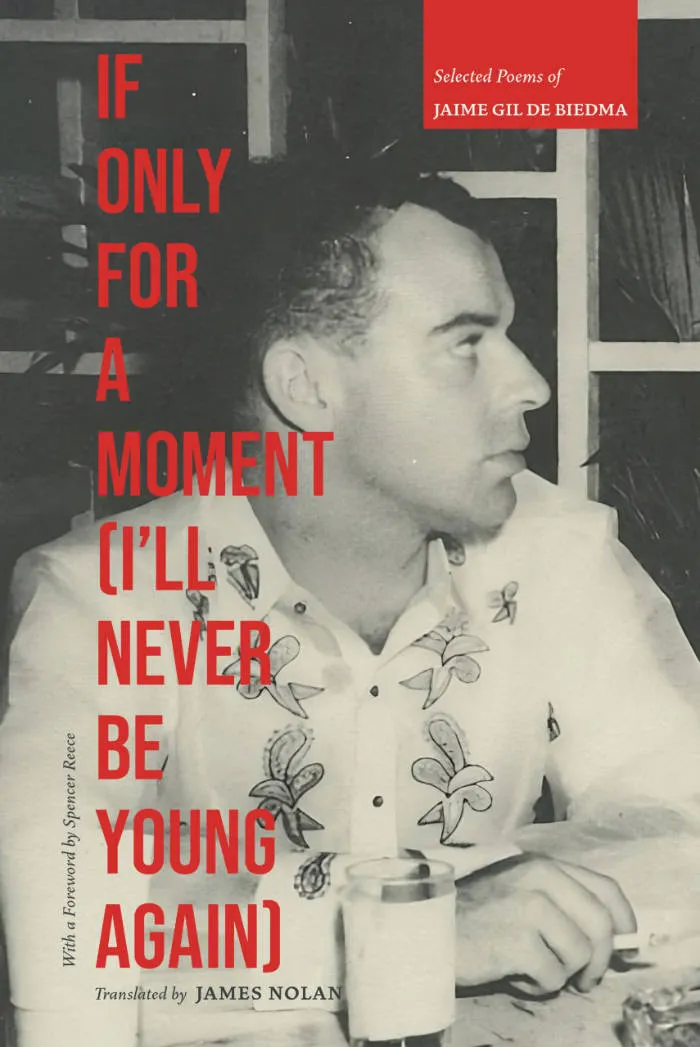
Cover of If Only For a Moment (I’ll Never Be Young Again)

Fonograf Editions

If Only For a Moment (I’ll Never Be Young Again)

Jaime Gil de Biedma, James Nolan

Poetry €19.00

Jaime Gil de Biedma is the most original and influential among the poets known as the ‘50’s Generation in Spain, and is considered the greatest Spanish poet to emerge in the second half of the 20th century. His life and literary career were bracketed almost entirely by the rise and fall of Generalissimo Francisco Franco, notorious for the suppression of literature. Born in 1929, Gil de Biedma was six years old when García Lorca was murdered in Granada at the outbreak of the Civil War, and his collected poems, Las personas del verbo, first appeared in 1975, the year Franco died. What is surprising is that Gil de Biedma was a leftist, homosexual poet from the Catalan capitol, Barcelona – all of Franco’s favorite things – who not only published books of autobiographical poetry in Spain but was known as a poet of social conscience as well as erotic lyricism. Like other Spanish poets of his time, he chose his words carefully. Gil de Biedma died of AIDS in 1990.

If Only For a Moment (I’ll Never Be Young Again) consists of an extensive bilingual selection of Gil de Biedma’s poetry, including all of his most well-known work. The book additionally consists of a Foreword by Spencer Reece, Jaime Gil de Biedma’s short essay “I wanted to be the poem,” and two different essays on Gil de Biedma and the art of translation by James Nolan, the volume’s translator.

Cover of A Mouth Holds Many Things: A De-Canon Hybrid Literary Anthology

Fonograf Editions

A Mouth Holds Many Things: A De-Canon Hybrid Literary Anthology

Dao Strom, Jyothi Natarajan

Poetry €36.00

A Mouth Holds Many Things collects hybrid-literary works from 36 women and nonbinary BIPOC writer-artists. Spanning experimental poetry and prose, image-text, collage, performance text, AI-generated writing, and more, this ground-breaking full-color print volume illuminates and expands the interstitial spaces where text blends, blurs, and morphs with visual and other media.

At the restless heart of this collection is a challenge to some fundamental questions: What is reading? What is writing? Lifting language beyond the domain of the letter, the works collected here present language in other forms: visual, embodied, sonic, asemic, tactile. Language, after all, is multi-textu(r)al, interwoven, punctured, fragmented, grafted, possessing power to construct and deconstruct, fed into by many rivers of experience: marginalizations and migrations, diasporas and displacements, invisibilities and hyper-visibilities.

A project of the Portland-based literary-social art project, De-Canon, which creates unique spaces and experiments to center works by writers of color, this collection is edited by Dao Strom and Jyothi Natarajan.

A Mouth Holds Many Things was, in the short stories/poetry/anthologies category, the winner of a 2024 PubWest Book Design Award.

Full list of contributors

Stephanie Adams-Santos, Kimberly Alidio, Samiya Bashir, Aya Bram, Victoria Chang, Jennifer S. Cheng, Gabrielle Civil, desveladas (Macarena Hernández, Sheila Maldonado, Nelly Rosario), Carolina Ebeid, Nadia Haji Omar, Christine Shan Shan Hou, Imani Elizabeth Jackson, Vi Khi Nao, Diana Khoi Nguyen, Quyên Nguyễn-Hoàng, Cindy Juyoung Ok, Monica Ong, Shin Yu Pai, Jenne Hsien Patrick, Jennifer Perrine, Alley Pezanoski-Browne, Kelly Puig, Ayesha Raees, Jhani Randhawa, Paisley Rekdal, Daisuke Shen, Sasha Stiles, Sandy Tanaka, Arianne True, Addie Tsai, Vauhini Vara, Divya Victor, Anna Martine Whitehead, Kathy Wu

Cover of Alice Notley, Live in Seattle

Fonograf Editions

Alice Notley, Live in Seattle

Alice Notley

Poetry €23.00

Entirely comprised of poems contained in her latest collection, 2016’s Certain Magical Acts, Live in Seattle elucidates why Alice Notley is one of the world’s most revered poets, the recipient of the Los Angeles TimesBook Award, the Griffin Prize, the Shelley Memorial Award, the Lenore Marshall Prize, and the Poetry Foundation’s Ruth Lilly Prize. “I am alive outside written memory” is how one of the speakers of Notley’s poem “Voices” puts it and listening to the poet read her work live, in front of an entranced audience, serves to detail the intangibility of sound vis-à-vis language.

Live in Seattle also includes excerpts of the onstage conversation Notley had with Seattle poets John Marshall, Christine Deavel and Rebecca Hoogs. Among other topics, the talk revolves around concepts of success, what it means to write a female poetry circa 2017, and the importance of always creating from a position of disobedience.

As part of Seattle Arts & Lectures’ Poetry Series, Live in Seattle was recorded at McCaw Hall in Seattle, Washington on Wednesday, April 5th, 2017 and mastered and engineered by Gus Elg at Sky Onion in Portland, Oregon in the Summer of 2017. 

Purchase of Live in Seattle includes a 11×11 insert of Notley’s poem “FOUND WORK (lost lace),” as well as a download card for the entire album. Live in Seattle can also be found digitally on Spotify and Bandcamp. The record itself is not black but clear.

Cover of The Speak Angel Series

Fonograf Editions

The Speak Angel Series

Alice Notley

Poetry €28.00

The Speak Angel Series is composed of six full-length books in various forms but towards the achievement of a unifying epic narrative in which the poet, as character, leads all the souls of all the living and dead to a point zero where the remaking of the cosmos can be performed. As this is being done, the official public world takes place in Paris, France and the United States, and new “characters” are incorporated from the news and from the poet’s life.

The forms include a long-line narrative broken by lyric stand-alones, an operatic form designed to make the reader chant if reading aloud, two spiritual sequels to the author’s book The Descent of Alette, written in the same stanzaic form, a book that is simply a collection of different kinds of poems, a book formed by literary collaging, and a final, long book that is the volume’s ultimate culmination.

The Speak Angel Series took years to accomplish but is finally ready; it is meant to be read for plot, pleasure, musical experience, wisdom and truth. Why not? The books present something like a cosmology in the philosophical sense, a reading of existence and of death. The dead are very close-by and available in the series, which is a work of stunning ambition.

Cover of Early Works

Fonograf Editions

Early Works

Alice Notley

Poetry €26.00

Early Works collects Alice Notley’s first four out of print poetry collections, along with 80 pages of previously uncollected material. A must have for any Notley fan. Includes original collection cover artwork by Philip Guston, Philip Whalen and George Schneeman, among others.

From editor Nick Sturm’s “Introduction” to Early Works:

In the author’s note that begins Grave of Light: New and Selected Poems 1970-2005, Alice Notley writes, “My publishing history is awkward and untidy, though colorful and even beautiful.” I have always been enamored of this sentence, which reminds us that an array of dispersed and varying publishing contexts are the original sites that give shape to such a book’s form. It is also something of an invitation into that color and untidiness, a prompt to become more curious about the awkwardness and beauty of Notley’s publishing history. This book, Early Works, accounts for a significant portion of that history by bringing back into print the complete versions of her first four books, a little-known 22-poem sonnet sequence, and a large selection of early uncollected poems gathered from little magazines. In doing so, Early Works joins an important set of recent volumes that put Notley’s earlier poetry back into circulation, including Manhattan Luck (Hearts Desire, 2014), which collects four long poems written between 1978 and 1984, and Songs for the Unborn Second Baby, originally published by United Artists in 1979 and reissued in a facsimile edition by London-based Distance No Object in 2021. Each in their own way, and especially taken together, these books continue to confirm that, as Ted Berrigan writes in The Poetry Project Newsletter in 1981, “Alice Notley is even better than anyone has yet said she is.”

Cover of a queer anthology of wilderness

Pilot Press

a queer anthology of wilderness

Richard Porter

Periodicals €15.00

Featuring Zoe Leonard, Eileen Myles, Jimmy DeSana, Princess Julia, Olivia Laing, Simon Costin, Timothy Thornton, Mary Manning and many more. Published 2020.

Cover of My Dead Book: A Novel

Pilot Press

My Dead Book: A Novel

Nate Lippens

Fiction €18.00

My Dead Book is a novel composed of nonlinear vignettes and fragments about a queer man approaching his fiftieth birthday who is haunted by insomnia and his past. In the dead of night, he remembers his friends who died in the late 1980s and 1990s, his years as a teenage throwaway and sex worker, and ruminates on working class survival, queer aging, AIDS, and whether he has outlived his place in the world.

“What a blistering book—with My Dead Book, Nate Lippens has created something truly fucking great. It's as if the storied stars of Lou Reed's 'Walk on the Wild Side' overshot Manhattan and wound up in Wisconsin, broke and blue with cold and depressed beyond belief by the thought that this nowhere is now home. It's a bitter pill, but I love bitterness, and who doesn't love pills?”— Derek McCormack, author of Castle Faggot

“There’s no doubt to this book. You’d think that was a flaw but it’s been burned away. My Dead Book is not short though it is brief. It’s loving, bittersweet, and actually courageous because it tells a story that is slightly unbearable because it’s all secret, awful hard bad secrets and funny as hell. Nate’s balancing act works because the heart of it (this novel) is true even though it’s often heartless. It’s simple. He knows what things are worth. When you need the sea or a bird they’re there like they never were before.”
Eileen Myles, author of Afterglow

Cover of Tripwire 16 - Performance/Writing

Tripwire Journal

Tripwire 16 - Performance/Writing

David Buuck, Kevin Killian

Performance €18.00

A special issue focused on performance writing, with work by Tanya Lukin Linklater (with Michael Nardone), Jibade-Khalil Huffman & Simone White, Jean-Thomas Tremblay, Claudina Domingo (trans. Ryan Greene), Kim Rosenfield, Nathan Walker, Liz Knox, Rona Lorimer, Léo Richard, & Hector Uniacke, Mohamed A. Gawad & Dalia Neis, Mei-mei Berssenbrugge & Teddy Yoshikami, interviewed by Michelle N. Huang, Kyoo Lee and Jocelyn Saidenberg, Adriana Garriga-López, Gabrielle Civil, plus a Kevin Killian Tribute, with Eileen Myles * Scott Hewicker * Cliff Hengst * Karla Milosevich * Craig Goodman * Michelle Rollman * Anne McGuire * Wayne Smith * Tanya Hollis * Steve Orth * Lindsey Boldt * Maxe Crandall * Arnold J. Kemp * Carla Harryman, Lee Ann Brown & Tony Torn * Susan Gevirtz * Laynie Browne * Patrick Durgin * Norma Cole * Jo Giardini. & reviews: Jessica Lopez Lyman & Jocelyn E. Marshall on Gabrielle Civil, alex cruse on Merce Cunningham, Rob Stanton on Anne Boyer, Jack Chelgren on Miyó Vestrini, David Grundy on Stephen Jonas, Virginia Konchan on Sarah Vap.

Cover of A Nazi Word for a Nazi Thing

Peninsula Press

A Nazi Word for a Nazi Thing

So Mayer

Essays €12.00

An essay on art, bodies and fascism.

In an era where identity politics is being weaponised against the very people it has sought to make visible, how can we reclaim complexity?

In 1937 the Nazis staged an exhibition of seized modernist artworks. Named Entartete ‘Kunst’ – Degenerate ‘Art’ – it sought to define degeneracy, display it and destroy it.This act of violent appropriation is one episode in a long and ongoing history of the erasure of queer and non-normative cultures.

A Nazi Word for a Nazi Thing works against this erasure; it is a manifesto – a catalogue for an exhibition that could never take place. Drawing on work from dissident sexologist Magnus Hirschfeld to South African artist Zanele Muholi, as well as a century of queer cinema from Sergei Eisenstein to Pedro Almodóvar, So Mayer creates an archive of resistance.

‘This book is a small revolution that becomes a party that you won’t be leaving soon. I believe we’re living in a time of fresh erasures, systemic violences working that global pandemic to take some other bodies out. Looking so freshly at the history of queerness, sexual deviance and the long long coordinated erasures of colonialism, bigotry and transphobia the essential non binary nature of art opens up right here like the wildly singing flower it is and So Mayer’s compelling version makes sense, makes me listen.’
Eileen Myles

‘A Nazi Word for a Nazi Thing is a reflective, creative walk through some of the worst – and best – people of the last hundred years, looking at the power of images and their relationship(s) with text. In a time of rising fascism, So Mayer highlights ways that artists have found strategies of resistance, and offers hope in historical analysis.’
Juliet Jacques

Cover of Pfeil Magazine #19 – Rest

Montez Press

Pfeil Magazine #19 – Rest

Anja Dietmann, Nina Kuttler

Periodicals €15.00

There is no pause without prior exertion, and this issue of the magazine explores rest and all its associated contexts and contradictions. Amidst increasing environmental pollution, a tenuous global political climate, and a performance-oriented society demanding ever greater productivity, the balance between rest and labour becomes skewed. Pausing carries the risk of falling behind, but this risk can be mitigated by knowing when to rest. This issue examines rest as activity and as resistance. It questions how the individual body, in cohesion with a community, can generate weight through relaxation and distribute it. 

Contributors: Asma Ben Slama, Camila Cañeque, Christiane Blattmann, Eileen Myles, Federico Tosi, Gelare Khoshgozaran, Hanne Loreck, Hans-Christian Dany, Hyemin Yang, Ingrid Jäger, Jenni Bohn, Jochen Lempert, Julia Schulze Darup, Mariona Berenguer, Matthias Schubert, Mikołaj Sobczak, Mirene Arsanios, Nat Raha, Nicholas Grafia, Niclas Riepshoff, Omar Hahad, Sarah Drath, Stacy Skolnik, Thomas Laprade, Vir Andres Hera

Within the format of a magazine, each page of Pfeil represents the floor, walls, or ceiling which together create an imagined room displaying a printed exhibition. Each issue is dedicated to a specific word, and artists are invited and given space to work on and with this term, and to construct or deconstruct the architecture around it. Combined, the contributions transform into an organic display surrounding the leitmotif.

Cover of Tripwire 23 - Work/Anti-work

Tripwire Journal

Tripwire 23 - Work/Anti-work

David Buuck

Work/Anti-work issue with writing by Nat Raha /. lisa minerva luxx /Ghayath Almadhoun, trans. Catherine Cobham / Jacqui Germain / Jazra Khaleed, trans. Peter Constantine / Finn Finneran / Cait O’Kane / Rebecca Kosick / Lara Durback Skye /Lotta Thießen / William Rowe / Danny Hayward / Rona Lorimer / Zoe Beloff / Jike Ayou, trans. Yě Yě / Miguel de Vallester, trans. Erasmo Pantoja / Lucas Martínez / ko ko thett / Hung Q. Tu / Raymond de Borja / etaïnn zwer, trans. Ilan A.L.S. Erikson Weisbrod / Annie Raab on Taylor Portela / Rachael Guynn Wilson on Lyn Hejinian / Will Rowe on Danny Hayward / Chloe Watlington on Joshua Clover

Cover of Secret Poetics

Soberscove Press

Secret Poetics

Hélio Oiticica

Poetry €24.00

Hélio Oiticica (1937-80) is widely considered one of Brazil's most significant artists, and his influence is felt across a range of disciplines including painting, film, installation and participatory art. He is well known as a key founder of the interdisciplinary movement known as Neoconcretismo, launched in Rio de Janeiro in 1959 with the collaboration of artists and writers including Lygia Clark, Lygia Pape and Ferreira Gullar.

Between 1964 and 1966, moving out of his Neoconcretist period, Oiticica wrote a series of lyrical poems entitled Poâetica Secreta (Secret Poetics), and he reflected in a private notebook on their significance for his wider practice as an artist. Despite Oiticica's global fame, his "secret" poems are almost unknown and have never been published as a collection.

This bilingual edition, with accompanying essays by translator Rebecca Kosick and critic Pedro Erber, uncovers the significance of poetry for Oititica's art and shows its importance to his thinking on participation, sensation and memory