Books
Books
in random order

La locataire
The Tenant is a monographic critical essay by Marie Canet. It is the first text to directly address the connections between McKenzie’s work, pornography, and special effects. The title refers to the way the artist moves through different periods and aesthetic spaces, appropriating their codes in order to construct new visual fictions. The book is infused with post-#MeToo feminist thinking, alternative uses of biography, reflections on the art world, and contemporary debates surrounding appropriation, embodiment, and the status of the artwork.
McKenzie and Canet worked with each other for over eight years, on projects like Atelier E.B: Passer-by catalogue, published on the occasion of the Fondation Galeries Lafayette exhibition, or the book Pervert or Detective, a conversation between Lucy McKenzie and artist Reba Maybury. This collaboration now culminated in an exhibition and a book: Plastic Newspaper (presented at CRAC Sète in March 2026) and Lucy McKenzie, The Tenant.
Texts by Marie Canet and Lucy McKenzie
Translations: Catherine Petit & Paul Buck (Marie Canet), Juliette Desorgues (Lucy McKenzie)
Published in connection with the exhibition Lucy McKenzie, Plastic Newspaper, at Crac Occitanie, Centre régional d‘art contemporain Occitanie/Pyrénées-Méditerranée à Sète, 21.03.-06.09.26

BRICKS FROM THE KILN #7
Matthew Stuart, Harriet Moore and 1 more
Guest edited by artist Helen Marten and literary agent Harriet Moore with Matthew Stuart, this volume of the journal considers what it means for a publication to be an allegorical container. A simple box in which to gather multiple things, an economical set of permutations — rational in one sense, yet defiantly flexible to move. Contributors were approached with an open invitation; some explored the multiplicities of containing or containers, while others filled the printed vessel with their own ongoing preoccupations. The following pages perform as envelope, bag, shell, net, fold, alarm, letter and instruction. There are holes to disappear within; smoke to knot and wind; shadows to unfold — a context that takes in and binds, finding new kinships from unforeseen proximities.
THE FIRE FLOWERS AND THE FLOWER LIGHTS UP –
Lucy Mercer
(spine)
WE SHALL GREET THE MOON AGAIN
Walter Price
(front cover)
BACK PAGES OF ALGIERS DIARIES 2018
Lydia Ourahmane
(inside front & inside back cover)
AN INTRODUCTION TO / NOTES ON / INSTRUCTION FOR THE FRONT NOVEL
Eliza Barry Callahan
(pp.1–16)
SATURDAY MORNING
Kathryn Scanlan
(pp.25–29)
KILLDEER
Jason Schwartz
(pp.33–38)
ALARMS AND EXCURSIONS
Rosmarie Waldrop
(pp.45–61)
"THE BATHROOM"
Najwa Barakat
(pp.67–76)
ARMY ROLLS, A CIRCUMSCRIPTION
Roy Claire Potter
(pp.81–91)
CONCHOMANIA
Felix Bernstein
(pp.95–109)
O-POEM
Line-Gry Hørup
(pp.113–129)
THIS MUSCLE
Cally Spooner
(pp.133–153)
STERLING PARK IN THE DARK
Susan Howe
(pp.159–179)
COCONUTTERY
Mathelinda Nabugodi
(pp.183–193)
YOUR SELF CONFIDENT BABY
Aurelia Guo
(pp.197–206)
BIOGRAPHY OF A NET: HOLDING A VOLUME
Daisy Hildyard
(pp.211–225)
A GUIDE TO THE POETRY OF LI HO
Eliot Weinberger
(pp.229–235)
WOMEN SMOKING
Charline von Heyl
(throughout & p.239)
INFRATHIN
Marcel Duchamp
(throughout & p.239)
THE MAZED WORLD
Rachael Allen
(bookmark insert)
UNTITLED
Helen Marten
(back cover)

Campism Divides Struggles: How Iranians and Palestinians Forced into Opposition
In this interview, Palestine solidarity activists form the Chinese diaspora speak with Iranian activists in exile about the uprising that took place in Iran in January 2026, comparing notes about resistance to various forms of authoritarianism.

Inch Aeons
Inch Aeons is a meditation on the form of meaning, the nature of nature, and the locality of tradition in an over-wired-world.
Here, award-winning poet Nuala Archer adopts, breaks and recreates the limits of haiku, evoking moments of collision and convergence, from "Beyond Conception- / Without Regeneration- / Big Bang's Leave let Be" to "Am-Is-Are-Was-Were- / Has-Have-Had-Do-Does-Did-Shall- / Should-Can-Could-Will-Would-."
Poet Juliet Patterson calls Inch Aeons "a complex and wondrous book," while poet Pam Ore says the poems are "like starlight, resonat[ing] with the brightness of an original violence, cooling-healing and coalescing into the word."
Published as part of the TrenchArt Casements series, Inch Aeons includes inside illustrations by Japanese artist Tamzo and visual art (back cover) by American artist Molly Corey.
Nuala Archer is the author of Whale on the Line, Two Women, Two Shores (with Medbh McGuckian), PAN/AMA, and From a Mobile Home. She served as the primary English-language editor for University Over the Abyss: The Story Behind 520 Lecturers & 2,430 Lectures in Kz Theresienstadt 1942-1944. In 1995 she survived a catastrophic car accident; recovering in Jerusalem, she enrolled in a theatre degree program at the School of Visual Theatre. Archer continues to perform with the Jerusalem Theatre Company at festivals around the world, including in Auschwitz, London, Dublin, New Delhi, Bangalore, Seoul and Kagoshima. She is an Associate Professor at Cleveland State University.

The Carrier Bag Theory of Fiction
In The Carrier Bag Theory of Fiction, visionary author Ursula K. Le Guin tells the story of human origin by redefining technology as a cultural carrier bag rather than a weapon of domination.
Hacking the linear, progressive mode of the Techno-Heroic, the Carrier Bag Theory of human evolution proposes: ‘before the tool that forces energy outward, we made the tool that brings energy home.’ Prior to the preeminence of sticks, swords and the Hero’s killing tools, our ancestors’ greatest invention was the container: the basket of wild oats, the medicine bundle, the net made of your own hair, the home, the shrine, the place that contains whatever is sacred. The recipient, the holder, the story. The bag of stars.
This influential essay opens a portal to terra ignota, where the possibilities of human experience and knowledge can be discovered anew.

Grammar of the Cage
What words made this world of captivity and extinction? If written language is a biological adaptation, how can a text reshape the environment? These are the questions at the heart of Grammar of the Cage, a startling first collection of poetry by Pam Ore. The Compulsive Reader calls Ore "a poet of great promise," and poet Eloise Klein Healy says she has found Ore's book "haunting but necessary...a stunning debut collection."
Grammar of the Cage is clean and heartbreaking as a bone, and yet, as poet Ingrid Wendt writes in her Introduction, "[like] Emily Dickinson, Ore's 'business' is 'to sing.' And sing she does."

Zami: A New Spelling of My Name: A Biomythography
Zami: A New Spelling of My Name is a 1982 autobiography by African-American poet Audre Lorde. It started a new genre that the author calls biomythography, which combines history, biography, and myth. In the text, Lorde writes that "Zami" is "a Carriacou name for women who work together as friends and lovers," Carriacou being the Caribbean island from which her mother immigrated.

The New Television: Video After Television
Rachel Churner, Rebecca Cleman and 1 more
On the rich history of video art and its enduring relevance to today's artistic and critical practices.
The New Television delves into the rich history of video art, reexamining the pivotal Open Circuits conference held at MoMA in 1974 and exploring its enduring relevance to today's artistic and critical practices. Open Circuits was an important event in establishing video art in American museums and articulated a range of conflicting teloses for the medium, some which materialized (like local cable television) and others that remain unrealized. The conference proceedings were published in 1977 as The New Television: A Public/Private Art, and the radical design of the book reflected the conference's utopian aims.
This two-part publication includes a facsimile of the long-out-of-print conference proceedings and new essays and discussions by over a dozen scholars and artists. The new scholarly texts and previously unpublished archival documents in The New Television illuminate the network of institutional histories of video art, consider global televisual contexts and alternative critical approaches, and examine contemporary video art and its continued relevance from new perspectives.
Rachel Churner is the director of the Carolee Schneemann Foundation. She is also an art critic and editor, whose writings have appeared in Artforum and October magazine, among other publications. She was a recipient of the 2018 Creative Capital/Andy Warhol Foundation Arts Writers Grant and is the editor of multiple books, including Jacqueline Humphries: jHΩ1:) (2022); Yvonne Rainer: Revisions (no place press, 2020), Hans Haacke (MIT Press, 2015), and two volumes of writings by film historian Annette Michelson (MIT Press, 2017 and 2020). Churner is a faculty member at Eugene Lang College at The New School, New York.
Rebecca Cleman is Executive Director of Electronic Arts Intermix (EAI) and a writer. She has programmed screenings and special projects for such venues as the International House Philadelphia; the Museum of Art and Design, Anthology Film Archives, and Andrea Rosen Gallery, New York City; and the Julia Stoschek Collection, Germany; and organized or co-organized many events for EAI, including a panel discussion on the films of David Wojnarowicz and a conversation between Hilton Als and The Wooster Group's director and co-founder Elizabeth LeCompte.
Tyler Maxin is curator at Blank Forms. He was previously the Communications and Special Projects Associate at Electronic Arts Intermix (EAI). His writing has appeared in publications including Artforum, BOMB, and Film Comment.

Blackout
Spring 2020. During lockdown in a mountain village with his partner and young child, Yann Chateigné Tytelman becomes haunted by the presence of his dead father. Provoked by memories of him, of their laconic relationship and of the class antagonisms that emerged between them – the father was a manual labourer while his son ‘turned his back’ and entered the art world – Chateigné Tytelman starts writing letters, piles of them, which have as their subject that most mystical, most incomprehensible of phenomena: silence.
Condensed into a series of short fragments, Blackout interweaves the letter to the father with the observations of an art theorist who surveys with precision the occurrences and experiences of silence in painting, music, literature and philosophy.

History Of A Tree
In a reality in which the boundaries between cinema, art, installation and multimedia experimentation seem to be increasingly blurred, History of a Tree by Flatform is a project that sets out to radically alter the idea of the portrait in western art.
A non-human living organism – the Oak of the Hundred Knights of Tricase, the oldest Vallonea oak in Europe at the age of 900 years – and the territory in which it has stood for centuries become the subject: through a film and a robotized video installation, statements become a portrait, and are transformed into a work of art.
The book retraces the genesis, development and implementation of this original idea, providing a visual score, the film in 80 images, dialogues in ten languages, the contributions of a tree searcher, an art historian and two philosophers, as well as a series of in-depth essays drawing on the fields of science, history, anthropology, music and linguistics.

Biarritz
Written and edited in Biarritz, Borgerhout and Midsommarkransen, 2016—2021. Dedicated to Räffi, with much love. Another version of this text was published in Pfeil Magazin 10 (Montez Press, 2018); editor: Anja Dietmann, copy-editor: Stacy Skulnik. Epigraph from Numéro Deux (1975) by Anne-Marie Miéville and Jean-Luc Godard. Presented on Saturday February 5th 2022 at Kransen, Borgerhout.
128x201mm, 40p, staple bound. Riso-printed on Arcoprint Edizioni Avorio 90g and Clairefontaine Blue 210g. Design by Kaye–Matthé, typefaces: Tribute, Gillies Gothic Light. Printed by Risiko Press at Kransen, covers silkscreened at Afreux, bound by Drukkerijcollectief De Wrikker. Edition of around 200.

Clarifications
Hourja Bouteldja, Alain Brossat
Alain Brossat est ex-militant de la LCR ancré dans une lecture anti-impérialiste de la politique. Houria Bouteldja est la cofondatrice du QG Décolonial et une figure de l'antiracisme politique. Dans cet entretien exigeant, les deux penseur·ses et militant·es clarifient leurs divergences et leurs convergences autour de la religion, du racisme, de l'État, du fascisme et de l'impérialisme. Alors que ces questions clivent celles et ceux qui luttent pour l'émancipation, rendant parfois les discussions impossibles, les deux auteur·ices reviennent sur leurs parcours politiques et philosophiques, sans pour autant feindre le consensus de leurs héritages politiques. Entretien coordonné par Marianne VL Koplewicz.

Vestiges_07: Catachresis
To wilt tears for an infatuation who has no name of their own. To weep rain like a sentence that passes through the unrequited glimpse. Language is the instrument of our shivers; literature the wink that slips into a wince.
Out of profane necessity we dress the missing words for each circumstance in ecstatic deprivation. Anticipation and alienation. Shock and sorrow. Craving and cruelty. Elation and tension. Emotion is the borrowed absence of transferred meaning: the sensuous "legs" of a table and the sunrise that falls-in-shadow upon the "foot" of a bed. Quintilian's "thirsty" crops that have neither tongue nor throat. Barthes' compassed "wings" of a house. Augustine's "piscina" in which no fish are to be found (and only humans drown). With delirium we endure, and delight in, the abuse of our sensibilities by the sadistic literalization of metaphor.
Featuring Will Alexander, Kimberly Alidio, César Dávila Andrade, Martine Bellen, Stanislav Belsky, Anselm Berrigan, David Buuck, Garrett Caples, Sam Cha, Logan Fry, Lawrence Giffin, Tilghman Alexander Goldsborough, E. Tracy Grinnell, Karen Holman, Elise Houcek, Andrew Joron, Inna Krasnoper, Carlos Lara, Jonathan Larson, Sueyeun Juliette Lee, Michael Leong, Douglas A. Martin, olga mikolaivna, Sheila E. Murphy, Ann Pedone, Sal Randolph, Martha Ronk, Jonathan Simkins, Christophe Tarkos, Edwin Torres, Christina Vega-Westhoff, Wendy Xu & John Yau

The Gloria Anzaldúa Reader
Gloria Anzaldua, AnaLouise Keating
A collection of published and unpublished writings of the groundbreaking Chicana writer and self-described "chicana dyke-feminist, tejana patlache poet, writer and cultural theorist" Gloria Anzaldua.
Gloria Anzaldúa (1942-2004) was a visionary writer whose work was recognized with many honors, including the Before Columbus Foundation American Book Award, a Lambda literary award, the National Endowment for the Arts Fiction Award, and the Bode-Pearson Prize for Outstanding Contributions to American Studies. Her book Borderlands/La frontera was selected as one of the 100 Best Books of the Century by Hungry Mind Review and the Utne Reader. AnaLouise Keating, Professor of Women's Studies at Texas Woman's University, is the author of Women Reading, Women Writing: Self-Invention in Paula Gunn Allen, Gloria Anzaldúa, and Audre Lorde; editor of Anzaldúa's Interviews/Entrevistas and EntreMundos/AmongWorlds: New Perspectives on Gloria Anzaldúa; and co-editor, with Anzaldúa, of this bridge we call home: radical visions for transformation.
AnaLouise Keating, Professor of Women's Studies at Texas Woman's University, is the author of Women Reading, Women Writing: Self-Invention in Paula Gunn Allen, Gloria Anzaldúa, and Audre Lorde; editor of Anzaldúa's Interviews/Entrevistas and EntreMundos/AmongWorlds: New Perspectives on Gloria Anzaldúa; and co-editor, with Anzaldúa, of this bridge we call home: radical visions for transformation.

Letterpress Revolution
While the stock image of the anarchist as a masked bomber or brick thrower prevails in the public eye, a more representative figure should be a printer at a printing press. In Letterpress Revolution, Kathy E. Ferguson explores the importance of printers, whose materials galvanized anarchist movements across the United States and Great Britain from the late nineteenth century to the 1940s. Ferguson shows how printers—whether working at presses in homes, offices, or community centers—arranged text, ink, images, graphic markers, and blank space within the architecture of the page. Printers' extensive correspondence with fellow anarchists and the radical ideas they published created dynamic and entangled networks that brought the decentralized anarchist movements together. Printers and presses did more than report on the movement; they were constitutive of it, and their vitality in anarchist communities helps explain anarchism’s remarkable persistence in the face of continuous harassment, arrest, assault, deportation, and exile. By inquiring into the political, material, and aesthetic practices of anarchist print culture, Ferguson points to possible methods for cultivating contemporary political resistance.

Malibongwe: Poems from the Struggle by ANC Women
In the late 1970s, Lindiwe Mabuza, a.k.a. Sono Molefe, sent out a call for poems written by women in anc camps and offices throughout Africa and the world. The book that resulted, published and distributed in Europe in the early 1980s, was banned by the apartheid regime.
Authorised by the editor, this re-issue of Malibongwe re-establishes a place for women artists in the history of South Africa's liberation. These are the struggles within the Struggle: a book that records the hopes and fears, the drives and disappointments, and the motivation and resilience of women at the front lines of the battle against apartheid. Here we see the evidence, too often airbrushed out of the narratives of national liberation, of a deep and unrelenting radicalism within women; of a dream of a South Africa in which not only freedom reigned, but justice too.

The Stone Door
The Stone Door is a surrealist allegory intertwining myth, mysticism, and romance. Written by Leonora Carrington after World War II, the novel follows a woman's symbolic journey through esoteric teachings, ancient lands, and dreamlike visions in pursuit of spiritual awakening and the unification of male and female forces. Both a metaphysical adventure and a tribute to Carrington's personal love story, it offers a visionary exploration of transformation and liberation.

TRANSMISSIONS: Radio Essays on Edges, Crossings and Narrowcasting Borderlands
Transmissions: Radio Essays on Edges, Crossings and Narrowcasting Borderlands gathers radio essays—created as part of Robida Collective’s project Radio drugega/The Other Radio—which reveal that to speak of “the border” is never to speak of a single line. There are political borders, conceptual borders, bodily borders; carnivalesque borders, where order collapses into play; linguistic and cultural borders, where words slip between languages and where accents become geographies; archival borders, separating memory from forgetting; borders of abandonment, where life and death enter into a dialectical ballet; economic borders, drawn by property, ownership, enclosure; borders of matter, space and time; acoustic borders, where the voice meets noise and incomprehensibility; cosmic borders, where meteors cross the thin edge of air; ecological borders, porous and breathing, where one species touches another. These are some of the borders this book speaks of – lines that do not divide but resonate, that hold together separation and proximity, distance and relation. Together, these essays form a cartography of friction but also affinity, reminding us that to erase all borders is to erase the very conditions of encounter – and that meaning often emerges not at the centre, but at the edges where worlds meet.
With texts by:
Agnes Cameron, Ajda Bračič, Aljaž Škrlep, Antônio Frederico Lasalvia, Giorgia Maurovich, Jack Bardwell, Kate Donovan, Kat Macdonald, Lijuan Klassen, Luca Vettori, Michael Marder, Moritz Gansen, Olya Korsun, Petra Filagrana, Urška Savič.

Wages For Wages Against – Volume 1 – We are not where we need to be, but we ain't where we were
Ramaya Tegegne, Lili Reynaud-Dewar and 1 more
We are not where we need to be but, we ain't where we were is the first volume of a new series of publications by the collective Wages For Wages Against that reports on active research engaged within the artistic professions and institutions since 2017. Its aim is to question the underlying neoliberal logics in the contemporary art world, by orienting our object of study towards the struggles that impact it. With this publication, our hope is to put into practice various values specific to the campaign: the existence of a systematic and fair remuneration, a desire for transparency, the sharing of knowledge, and the visibilization of demands proper to the field of the visual arts and concomitant struggles. It is the result of militant experiences, at the convergence of our individual experiences and collective questionings.
With texts by Tiphanie Blanc, Antonella Corsani, Fanny Lallart, Lili Reynaud-Dewar, Ramaya Tegegne and an interview with Outrage Collectif.

The Trial
The Trial is an extensive publication chronicling the decade-plus-long evolution of one of Rossella Biscotti's seminal works, focusing on the trials of members of the revolutionary left-wing movement Autonomia Operaia in the early 1980s, an emblematic judicial drama of Italy's Years of Lead.
The core of the book is the English transcription of a six-hour audio piece, originally composed from hundreds of hours of the trial's archival recordings broadcast by Radio Radicale. Edited like a theatrical script, The Trial becomes a polyphonic narrative that foregrounds the political voices of defendants in opposition to the structure and language of the legal machine: prosecutors, judges, lawyers. The transcript is accompanied by critical texts by Michael Hardt, Daniel Blanga Gubbay, and Giovanna Zapperi, as well as a conversation between the artist and philosopher Antonio Negri, one of the trial's key defendants. It investigates how political memory is carried, translated, and embodied across time.
Featuring visual documentation and multilingual excerpts from performances staged across various institutions and countries, this publication traces the work's ongoing reactivation through translation, collaboration, and context-specific interventions.

Painting Photographs
TBW Books is pleased to announce the publication of Painting Photographs, a new book by Creative Growth Art Center artist Alice Wong. Wong's bold interpretation of vintage vernacular photographs breathes new life into family album kitsch and cliché shots of plants and landscapes, transforming them into a hyper-color plane of vivid abstraction. Using paint markers to enhance and obscure the formal qualities of appropriated imagery, Wong's hand brings energy to each underlying image, recalibrating the viewer's eye and sparking appreciation for otherwise still compositions. With fluid mark-making and a striking approach to color-blocking, Wong's craft merges with the photographic process to create work that feels at once of times past and completely contemporary.
Creative Growth Art Center is the oldest and largest nonprofit art studio for artists with developmental disabilities in the United States. Since 1974, Creative Growth has played a significant role in increasing public interest in the artistic capabilities and achievements of people with disabilities, providing a professional studio environment for artistic development, gallery exhibition and representation.
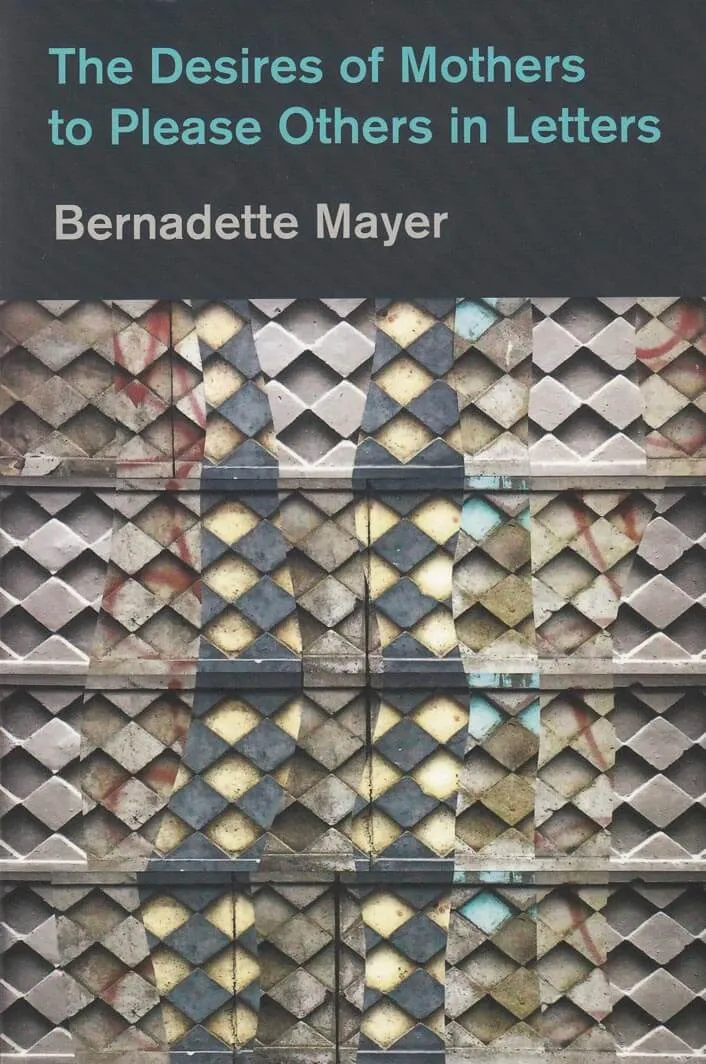
The Desires of Mothers to Please Other in Letters
A reissue of Bernadette Mayer's classic fugitive intergenre text. Endlessly inclusive, The Desires of Mothers to Please Others in Letters, first published in 1994 and long out of print, evokes the complexity of real persons as it simultaneously reinvents multiple genres: epistle, prose poem, and memoir.
Written between 1979 and 1980 while pregnant with her third child, Mayer extends her imaginative letters into meditations for us all on life as it is lived in real time, with its responsibilities and manifold desires. Fierce, lyrical, intimate, and wise, both new and familiar readers, both mothers and non–mothers, will find this book beckoning again and again to offer delicious writing, timely information, consolation, and advice.
With Introduction by Laynie Browne.

Dance First Think Later
An encounter between dance and visual arts.
Dance First Think Later - The Thinking Body between Dance and Visual Arts follows on from the exhibition-festival Dance First Think Later - An Encounter between Dance and Visual Arts, presented in Geneva in summer 2020, documenting it with a wealth of iconography and enriching it with a critical, theoretical and historical perspective on the works and the project. Commissioned texts are devoted to the 22 artists, written by authors active in museums, festivals, art schools, independent critics and artists.
The biennial event Dance First Think Later explores the converging fields between dance, performance, visual arts and moving images. Arta Sperto, which is organising and producing the exhibition-festival and publishing the book, is developing a cross-disciplinary approach that combines the operating mechanisms of the visual and performing arts, and the respective characteristics of museums/art centres and theatres/festivals. This approach is motivated by the need to support artists whose cross-disciplinary practices come up against the way in which culture is still largely organised by field, whether in terms of cultural policies, institutions, funding or the media. Starting with the works themselves, the book offers food for thought on cross-disciplinary approaches to the contemporary arts.
With / around Halil Altindere, Alexandra Bachzetsis & Julia Born, Pauline Boudry & Renate Lorenz, Alex Cecchetti, Clément Cogitore, Dara Friedman, Gerard & Kelly, Marie-Caroline Hominal, Lenio Kaklea, La Ribot, Pierre Leguillon, Xavier Le Roy, Klara Lidén, Melanie Manchot, Olivier Mosset & Jacob Kassay, Samuel Pajand, Christodoulos Panayiotou, Alexandra Pirici, Julien Prévieux, Marinella Senatore, Gregory Stauffer, Barbara Wagner & Benjamin de Burca.

The Vivisectors
A reclusive graduate student is forced into a friendship that destabilizes her life in this surreal, allegorical romance.
In a famed but crumbling university city overrun by nature, where power is held in a fragile balance between academics and a contingent of rogue gardeners, the reclusive narrator of The Vivisectors spends her days propping up the career of her needy and fraudulent professor boss. Then a controversy ruptures her careful routine: Adam, a contrarian student and an obsession of the boss, comes into heated conflict with a young professor, with both men claiming discrimination. The crisis subsumes the university, though the narrator is unmoved—not even the attempted suicide of her estranged mother has been enough to dispel her lack of engagement with the world. But when her boss commands her to befriend Adam, the narrator finds herself both caught up in the events threatening to tear the city apart and increasingly drawn to the alluring student at the heart of it all.
Coursing with icy suspense and told with violent precision, The Vivisectors is a new kind of love story for an age of deteriorated communication. With the unsparing style and intellectual ambition that made her award-winning debut The Doloriad a celebrated provocation, Missouri Williams holds a mirror up to humanity’s most intimate contradictions and reflects them back through a novel of profound, spiky spiritual reckoning.