Books
Books
in random order

Par-delà étrange et familier
Dans cet ouvrage, malheureusement son dernier, Mark Fisher revisite des artefacts culturels familiers afin de cartographier les variétés de l’étrange dont ils sont porteurs. Longtemps sensible aux dimensions bizarre et omineuse qu’il devinait, sans les nommer, entre autres dans les œuvres de Lovecraft, les films de David Lynch ou les albums de The Fall, M. Fisher tente ici la synthèse essentielle d’un questionnement qui l’avait hanté, jusqu’à ce livre.
Avec son regard si particulier, celui du critique culturel tout à la fois pop et moderniste, puisant aux sources de la psychanalyse et du marxisme, Fisher se penche sur des objets sensibles pour y saisir les rapports entre présence et absence, entre ce qui devrait être mais n’est pas, ce qui ne devrait pas se présenter mais survient. C’est en compagnie de ces spectres — du titre d’un autre ouvrage — que nous sommes invités à voyager, pour questionner les formes mêmes de nos existences sociales, jusqu’aux frontières de l’étrange.

Gravity And Grace
Simone Weil, the French philosopher, political activist, and religious mystic, was little known when she died young in 1943. Four years later the philosopher-farmer Gustave Thibon compiled La pesanteur et la grbce from the notebooks she left in his keeping.
In 1952 this English translation accelerated the fame and influence of Simone Weil. The striking aphorisms in Gravity and Grace reflect the religious philosophy of Weil's last years. Written at the onset of World War II, when her health was deteriorating and her left-wing social activism was giving way to spiritual introspection, this masterwork makes clear why critics have called Simone Weil "a great soul who might have become a saint" and "the Outsider as saint, in an age of alienation." Introducer Thomas R. Nevin is a professor of classical studies at John Carroll University and the author of Simone Weil: Portrait of a Self-Exiled Jew.

Privacy One : Words Without Song (1950-1974)
Kenneth Gaburo (1926-1993) is renowned as a teacher, pioneer of electronics in music, jazz pianist, writer, ecologist, publisher, and proponent of compositional linguistics. Over the course of a dedicated career, his uncompromising work carved out its own patch in the territory of American experimentalism.
Lingua Press, 1976

Better Do It Now before You Die Later: Sonny Simmons with Marc Chaloin
Though his years in the New York free-jazz scene of the sixties cemented his reputation as "one of the most forceful and convincing composers and soloists in his field," saxophonist Sonny Simmons (1933–2021) was nearly forgotten by the '80s, which found him broke, heavily dependent on drugs and alcohol, and separated from his wife and kids. "I played on the streets from 1980 to 1994, 365 days a year," Simmons tells jazz historian and biographer Marc Chaloin. "I would go to North Beach, and I'd sleep in the park. The word got around town that Sonny is a junkie, really strung out."
The resurrection of Simmons' career―upon the release of his critically acclaimed Ancient Ritual (Qwest Records) in 1994―has become a modern legend of the genre. In the last two decades of his musical career, Simmons broke through to a new echelon of recognition, joining the pantheon of great innovators and masters of the music. But to this day he remains an undersung figure. Here, in the first ever book dedicated to his life, Simmons recounts his childhood in the backwoods of Louisiana, his adolescence in the burgeoning Bay Area jazz scene and his star-studded life in New York playing alongside the greats.

A Textbook for the Ecocene
A Textbook for the Ecocene is a how-to guide for connecting to self, community and planet. The Ecocene is an emergent and imagined geologic era where all humyns are living in reciprocity with their ecosystems again. Each textbook chapter shares practical exercises to try at home, Earth-centered theory and spirituality, and interviews with Black and Indigenous Earth warriors—cultural workers generating planetary liberation in their everyday lives. These testimonios from Johanna Iraheta, Bruje Fuego, Raquel Lemus, Patty Denisse, Jasmine Nyende, Queen Hollins and Olivia Chumacero shine with wisdom and advice for new and seasoned Earth stewards alike. Created originally as Sarita Dougherty's DIY PhD Dissertation, A Textbook for the Ecocene is a curricula for eco-feminista educations, DIY degrees and planetary destinies. We are activating the Ecocene right now, one step at a time. What we pay attention to grows.
Self-published by Co—Conspirator Press with the support of Women's Center for Creative Work. Edited by Simone Krug, copy edited by Gowri Chandra and Demi Corso. Designed by MJ Balvanera, Riso-printed by Neko Natalia.
SARITA DOUGHERTY (she/her, they/them) is a painter, parent, collaborator and educator of Cajun, Irish and Andean descent. Sarita is a cocreator of The School for the Ecocene Cooperative, offering a DIY PhD and more programs for planetary liberation. She currently lives and cultivates habitat on Ohlone Land. Sarita’s book, A Textbook for the Ecocene, is a continuation of her Artist Residency at The Feminist Center for Creative Work in Fall 2018.

Touching Feeling
A pioneer in queer theory and literary studies, Eve Kosofsky Sedgwick brings together for the first time in Touching Feeling her most powerful explorations of emotion and expression. In essays that show how her groundbreaking work in queer theory has developed into a deep interest in affect, Sedgwick offers what she calls "tools and techniques for nondualistic thought," in the process touching and transforming such theoretical discourses as psychoanalysis, speech-act theory, Western Buddhism, and the Foucauldian "hermeneutics of suspicion."

Égal infini
Égal infini cherche le contact : une crêpe oubliée dans un tram, un tatouage de baiser, une présence derrière un écran. Ici, les algorithmes affectifs côtoient des recettes de consolation, les robots parlants croisent les animaux marins, et la vitesse d’une voiture dans la nuit rejoint le mouvement fragile des relations. Journal éparpillé, galerie de gestes et de paroles collectées, le livre avance comme le refrain « marabout, bout de ficelle… », laissant à chacun·e la liberté de tracer son propre chemin.

This Part Is Silent: A Life Between Cultures
Born in Korea, raised in the American South, and trying her best to survive British academia, SJ Kim probes her experiences as a writer, scholar, and daughter to confront the silences she finds in the world. With curiosity and sensitivity, she writes letters to the institutions that simultaneously support and fail her, intimate accounts of immigration, and interrogations of rising anti-Black and anti-Asian racism. She considers the silences between generations―especially within the Asian diaspora in the West―as she finds her way back to her own family during the pandemic lockdown. Embracing the possibilities and impossibilities of language, Kim rejoices in the similes of Korean, her mother tongue, and draws inspiration from K-dramas and writers who sustain her, including Yusef Komunyakaa, Don Mee Choi, Toni Morrison, and Theresa Hak Kyung Cha.
Longlisted for the 2025 Andrew Carnegie Medal for Excellence in Nonfiction.

Spike #88 – Spirituality
For our Summer 2026 issue, amid the latest revival of SPIRITUALITY in culture, Spike asked: what are people reaching for beyond what can be measured? The answers are eclectic, emphatic, and most of all personal: Johanna Hedva’s essay about the human voice’s part in the divine; portraits of mystic artists Lee “Scratch” Perry, Natasha Tontey, and Santiago Yahuarcani by Isis Semaj-Hall, Riar Rizaldi, and Miguel A. López; Jamieson Webster’s psychoanalytic look at Renaissance painting’s body of Christ; a spiritual history of perfumes by Élisabeth de Feydeau; Patrick McGraw’s soulful reading of America’s (perhaps) greatest living author, Joy Williams; queries of Gen Z’s search for God by Lamorna Ash, the disappearance of atheism by Steven Phillips-Horst, and a new form of contemplation by Aodhan Madden; and LIFEMAXXING recommendations to purge the soul, sometimes devilishly. Plus, some backpage words of wisdom from Tea Hačić-Vlahović: “Devotion and humiliation are holy.”

Mystic Transport
Mystic Transport is an exhibition project initiated through a chance encounter between two artists, Koen Theys and Gülsün Karamustafa. Both are very much intertwined with the city they live in; Brussels and Istanbul and integrate visible and invisible materials and remnants from their immediate surroundings within their practice.
Intrigued by religious parades, the hamam, war propaganda, gender issues and the entertainment industry, Theys and Karamustafa use these phenomena as starting points for their video work, installations and performances. In doing so, both artists sketch a critical portrait of the society and culture in which we live and reside, reflecting on cultural canons and differing socio-economic realities. Mystic Transport thus results in unique crossovers.

Pyre
Michael Cavuto, Astrid Terrazas
"From this moment / and hence backwards / a visitation / echoes thru the apparent opening / to the tomb / the narrow passage is the mind's reasoning / in clarity / as she moves like a shadow / having lived her life before " — Joanne Kyger, from Places to Go (Black Sparrow, 1970)
"All processes measured as form are traceable in curved decay. Seemingly unmeasurable, unquenchable, the heart stone harbors its own native entropy. The evolution of organs is not ours to decipher. We’re drawn slanting toward the stone in helices of approaching circles. Our movements throw shadows, our bodies ring haloes." — Michael Cavuto, "Isis Theses"
"In the dual work of Isis Theses & Pyre I-V, living, death, language’s work of remembrance, place & poetic lineage all take part in shifting throughlines of recombinant forms, as a spiral spirals back on itself, changed over time. Early on, here, Cavuto writes “There is not enough wood for coffins. There is wood enough for a boat.” a Pyre then is a boat, a burning that is going somewhere, not death-as-end but as an upward & outward movement into collectively shared air, an archeology of connection. “Kyger wrote that memory is a weird dimension carried around invisibly in the ‘mind’’ Cavuto writes, in one of those moments that feels like a key, “Writing, she said, gives history back to you.” But it is not only history that Cavuto is carrying forward in these poems, it is something more spatially complex, enlivened & embodied in the dance of the words, & in the vital breakdown of the words themselves. The poems in Pyre I-V enact their answer to the question ‘what essence is left us when no words are left,’ & leave us, after the ritual process, dazzled with the true sense that something is left, something important of resonance & remembrance, in the atomized language-space; the air around the dis-integrating morphemes shimmering on the page as dissipative, potentiate sparks. —Cody-Rose Clevidence
Michael Cavuto is a poet based in Brooklyn, New York. His books include Country Poems (Knife Fork Book, 2020) and Pyre (Spiral Editions, 2025). With the poets Dale Smith and Hoa Nguyen, he publishes the Slow Poetry in America Newsletter. Along with Tessa Bolsover, he publishes hand-bound poetry books through auric press.
Pyre, Michael Cavuto. Illustrations by Astrid Terrazas. 52p, 8.5" x 6.75", hand sewn with red linen thread. Covers letterpressed on a 1963 Vandercook proof press with Strathmore Premium Grandee paper. Copy text and illustrations printed both offset and digitally on Mohawk felt paper in a first edition of 275. Printed, assembled, and bound in “Kingston, New York,” the unceded and currently occupied lands of the Haudenosaunee, Mohican, Munsee Lenape, and Schaghticoke. With thanks to Vladimir Nahitchevansky and the various friends who helped assemble.

Entangled – Texts On Textiles
What does it mean to be a curator who writes, and, more specifically, how can curators write about textiles? This publication steps outside the framework of the typical exhibition catalogue to occupy "the space between literature and criticism".
The Community of writers was set up to create time and space to retreat from these outside opinions and demands and to let curiosity and the joy of writing be the driving forces of the writing process. This book has been realised under the auspice of Interweaving Structures: Fabric as Material, Method, and Message, and specifically through collaboration between the Faculty of Fine Art, Music and Design at the University of Bergen and the Central Museum of Textiles in Łódź. The two partners have strong positions of specialisation—the museum acts as a caretaker of material textile traditions and art in Poland, and the faculty has a strong textile art tradition and offers the only education programme for curators in Norway.
Edited by Anne Szefer Karlsen.
Contributions by Andreas Hoffmann, Heather Jones, Martina Petrelli, Anne Szefer Karlsen, Lea Vene, Johanna Zanon.

Assembling a Black Counter Culture
DeForrest Brown, Jr.’s Assembling a Black Counter Culture presents a comprehensive account of techno with a focus on the history of Black experiences in industrialized labor systems—repositioning the genre as a unique form of Black musical and cultural production.
Brown traces the genealogy and current developments in techno, locating its origins in the 1980s in the historically emblematic city of Detroit and the broader landscape of Black musical forms. Reaching back from the transatlantic slave trade to Emancipation, the Industrial Revolution, and the Great Migration from the rural South to the industrialized North, Brown details an extended history of techno rooted in the transformation of urban centers and the new forms of industrial capitalism that gave rise to the African American working class. Following the groundbreaking work of key early players like The Belleville Three, the multimedia output of Underground Resistance and the mythscience of Drexciya, Brown illuminates the networks of collaboration, production, and circulation of techno from Detroit to other cities around the world.
Assembling a Black Counter Culture reframes techno from a Black theoretical perspective distinct from its cultural assimilation within predominantly white, European electronic music contexts and discourse. With references to Theodore Roszak’s Making of a Counter Culture, writings by African American autoworker and political activist James Boggs, and the “techno rebels” of Alvin Toffler’s Third Wave, among others, Brown draws parallels between movements in Black electronic music and Afrofuturist, speculative, and Afrodiasporic practices to imagine a world-building sonic fiction and futurity embodied in techno.
DeForrest Brown, Jr. is an Alabama-raised rhythmanalyst, writer, and representative of the Make Techno Black Again campaign. As Speaker Music, he channels the African American modernist tradition of rhythm and soul music as an intellectual site and sound of generational trauma. On Juneteenth of 2020, he released the album Black Nationalist Sonic Weaponry on Planet Mu. His written work explores the links between the Black experience in industrialized labor systems and Black innovation in electronic music, and has appeared in Artforum, Triple Canopy, NPR, CTM Festival, Mixmag, among many others. He has performed or presented work at Haus der Kulturen der Welt, Berlin; Camden Arts Centre, UK; Unsound Festival, Krakow; Sónar, Barcelona; Issue Project Room, New York; and elsewhere. Assembling a Black Counter Culture is Brown’s debut book.
—
Editor: Rachel Valinsky
Editorial Consultant: Ting Ding and Camille Crain Drummond
Designer: Scott Ponik
Copy Editor: Madeleine Compagnon

And Then Comes the Chorus
In the high-octane essay And Then Comes the Chorus, Jon Refsdal Moe pursues the imagination of theatre opened up by Alfred Jarry when he slipped an ‘r’ into a profanity as he exclaimed ‘Merdre!’ on stage. ‘What matters is that the words became flesh and that this flesh exploded right in the world’s face. What matters is that literature stood up at the Théâtre de l’Œuvre on December 10, 1896 and cried FUCK! and all hell broke loose and the world has never been the same since.’
Jon Refsdal Moe is a writer and dramaturg from Oslo. He has written two novels, one doctoral dissertation, several essays and a lot of criticism. He was artistic director of Black Box teater in Oslo from 2009 to 2016 and is now professor of dramaturgy at Stockholm University of the Arts.
Published by Varamo Press in the essay series Gestures
First edition November 2022
48 pages, 11.0 x 16.5 cm, sewn perfect binding
ISBN: 978-82-691492-8-9
Graphic design by Michaël Bussaer

And so on, a single universe
A collection of Pauline Julier’s art that expands from the terrestrial to the cosmos to comment on our place in the universe.
At the interface of documentary and fiction, the multimedia works collected in Pauline Julier take us on a dizzying journey through space and time. Julier’s art travels through the geological ages of planet Earth, through different histories, natural disasters, and the Anthropocene’s paradigm shifts and into outer space. Her background in political science and photography is reflected in her work: looking into the past and the future, she investigates topical questions about our unlimited use of natural resources, escapism, and the colonization of space.
Conceived and designed as a work of art in its own right, this volume offers a comprehensive insight into Julier’s art and thought through a conversation with eminent scholar of science and technology studies Donna Haraway alongside contributions by curator Céline Eidenbenz, anthropologist, and writer Nastassja Martin, and art historian, curator, and author Chus Martínez.
Edited by Céline Eidenbenz and Sarah Mühlebach.
With Contributions by Donna Haraway, Pauline Julier, Nastassja Martin, and Chus Martínez.

Jungle
Jungle, (the latest 2025 self-published zine offering from studio saudari), delves into The Socio-Political, The Pitfalls of Neoliberalism, Circus State, Environmental Collapse, Heterotopias & Growth ~ Decay.
Referencing Upton Sinclair’s novel The Jungle (1905), this print issue aims to combine various interpretations of The Jungle as a site of critique, of contention, of potential growth.
Contributors:
y3000w, Video Club, Fred Horton, Jordan Ossermann, Tristac Gac, Tom Hegen, Santiago Barragán, Anu Jakobson, Camille Theodet, George Nebieridze, Mu Pan, Robert Zhao Renhui, Thérèse Rafter, Cecilia Vicuña, Dani Santander Villarroel, Adam Call Roberts, Dr. Sönke Johnsen, Elena Zaghis, Miguel Garchitorena, Amanda Nell Eu, Mishka Mahomed, Dani Kyengo O'Neill / BŪJIN, Erin Jane Nelson, Mariana E. Rivas Salazar, Kim Rosario, Rachel Lamot, Marion Post Wolcott, Madina Mahomedova.
Designed by Felicia Usinto & Sera van de Water

Risking the Self. Philosophy, Tai Chi and Psychedelics
A philosopher’s path towards embodiment through Tai Chi and psychedelics.
This book proposes different forms of embodiment that are not necessarily leading to production of subjectivity or territorialized identities but rather putting the “self” at risk allowing us to be emancipated from the mandatory illusion of self-realization. This can be facilitated by a daily commitment with a set of body altering practices that disjoint us from the ordinary accustomed experience of reality and provide us access to “other” layers of the real. These practices grant access to the primary control centers of the body that regulate frequencies of energy and consciousness in a deeper way and enable the body to unfold in different dimensional spaces of experience: rendering sensible the multi-layered energetic body.

Godlike
New York poet Paul Vaughn has a trick for enjoying poetry readings: He simply imagines the reader died a long time ago. Paul is twenty-seven, married, and an admired poet himself. R. T. Wode’s mission is to give offense. He’s also a poet, freshly landed in the city, and, at age sixteen, unknown.
Paul worships T. They embark on a tempestuous affair, dropping acid and crashing parties and perambulating the grit and grime of New York City circa 1972. Paul is in love with T., but T. is in love with experience. Their relationship disintegrates.
A novel of compelling originality and transcendent beauty by legendary musician and poet Richard Hell, Godlike transposes the notorious romance of Paul Verlaine and Arthur Rimbaud to the East Village in its squalid, glorious ’70s heyday. The book comprises a version of Paul’s 1997 hospital notebooks: diaries amidst poems and essays, along with, most pertinently, the poet’s third-person memoir-novelette of his youthful time with the now-famous T. Godlike is infused as well with evocations—and sometimes actual poems—of many New York poets of the era, from Ted Berrigan and Ron Padgett to Edwin Denby and James Schuyler. It achieves a lyricism both profane and profound as it conjures the frenetic vitality as well as the existential malaise of an era. It’s a searching meditation on art, life, love, and the impossibility of everything.
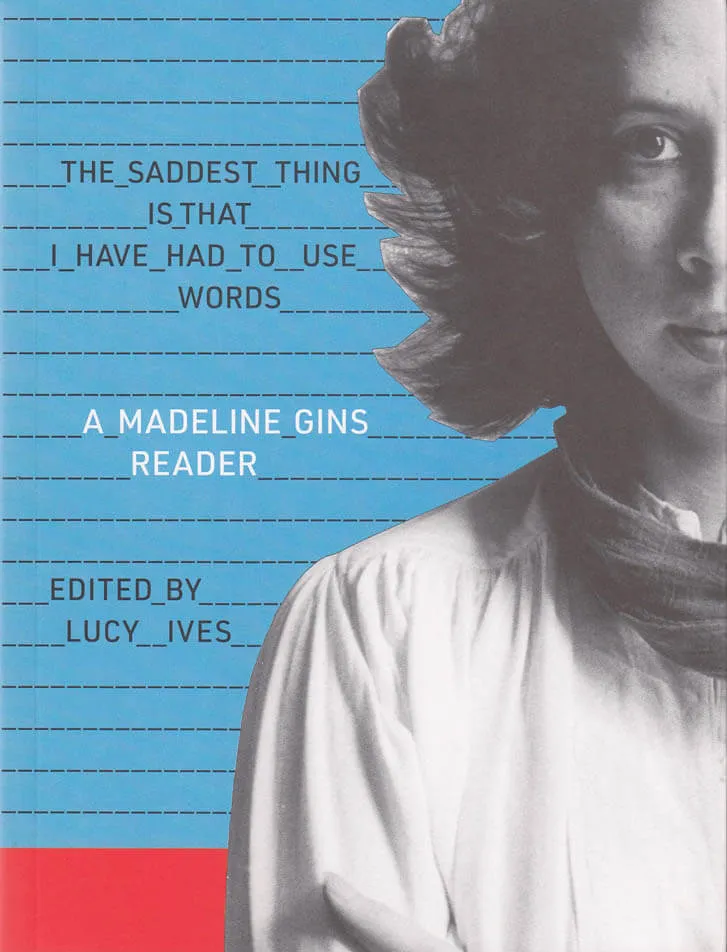
The Saddest Thing Is That I Have Had to Use Words: A Madeline Gins Reader
Poet, philosopher, speculative architect and transdisciplinary artist, Madeline Gins is well known for her collaborations with her husband, the artist Arakawa, on the experimental architectural project Reversible Destiny, in which they sought to arrest mortality by transforming the built environment. Yet, her own writings — in the form of poetry, essays, experimental prose and philosophical inquiries — represent her most visionary and transformative work. Like Gertrude Stein before her, Gins transfigures grammar and liberates words. Like her contemporaries in conceptual art, her writing is attuned to the energized, collaborative space between reader and page.
The Saddest Thing Is That I Have Had to Use Words: A Madeline Gins Reader is a revelatory anthology, edited and with an introduction by the writer and critic Lucy Ives. It brings never-before-published poems and essays together with a complete facsimile reproduction of Gins' 1969 masterpiece, WORD RAIN (or A Discursive Introduction to the Intimate Philosophical Investigations of G, R, E, T, A, G, A, R, B, O, It Says), along with substantial excerpts from her two later books What the President Will Say and Do!! (1984) and Helen Keller or Arakawa (1994). Long out of print or unpublished, Gins' poems and prose form a powerful corpus of experimental literature, one which is sure to upend existing narratives of American poetics at the close of the 20th century.
Edited by Lucy Ives.

Alia Syed: Imprints, Documents, Fictions
Published by Courtisane festival in collaboration with Open City Documentary Festival, Alia Syed: Imprints, Documents, Fictions (ed. María Palacios Cruz) is the first monograph to be devoted to Syed’s work and features new essays by Jemma Desai, Inga Fraser, Peter Gidal, Rahila Haque, Salima Hashmi, Anjana Janardhan, Ruth Noack and Henrietta Williams, as well as writing by Syed herself.

Flower Engine
the second poetry collection from Natalie Briggs titled ‘FLOWER ENGINE’. This collection of cinched, bright free-verse explores the passing locations of love and the slow, private operations of pain’s knocking counterweight. The book extends Briggs’ relay of concise universal suggestions, translating them through brief, intimate utility.

This Reasonable Habit
Rainer Diana Hamilton, Violet Spurlock
Violet and Rainer, over the course of a long phone call, become hosts of an imaginary literary summit where attendees spar over casualwear, animal metaphors, fascist art, bodily autonomy, and other problems of the everyday. A collaborative work of friendship as much as the occasion for philosophical scholarship, where one can find the answers to burning questions like: What makes sex good? What constitutes a good reason to dislike someone? What does my nipple piercing mean for your nipples? And how have you been, lately?

Fugues
FUGUES is a study of objects. Elements repeat and imitate one another like a polyphonic canon of voices narrating stories of domestic confinement in looped time.
With images by photographer Nicole Maria Winkler & texts by artist Issy Wood, writer Ella Plevin, model Freja Beha Erichsen and curator Elaine Tam.
